View Article

Abstract

Binders are agents working to impart cohesiveness to the granules. This ensures the tablet remains complete after compression. The Researchers are still looking for novel excipients that could be used as binding agents in tablet formulations. For diverse pharmaceutical uses, different binding agents can be helpful in achieving varying tablet mechanical strengths and drug release qualities. Natural binders like different starch, gums, mucilage, dried fruits possess binding capacity as well as some other properties like filler, disintegrant & natural polymers are safer and inexpensive than polymers like PVP.

Keywords

Natural Binders , Gums, Mucilage ,Polysaccharides, Cost effective , eco-friendly

Introduction

The oral route has been commonly adopted and  the most convenient route for drug delivery .A tablet is the popular dosage form and 70% of the total medicines are dispensed.

Several excipients are utilized in the manufacture of solid dosage forms. In addition to many other categories, they comprise dyes, flavors, lubricants, fillers, emollients, binders, and preservatives. Excipients were traditionally used in medicine formulations as inert vehicles to supply the weight, volume, and consistency required for the proper delivery of the active ingredient, but in modern pharmaceutical dosage forms, they often fulfill multifunctional roles such as modifying release, improving the stability and Bioavailability of the active ingredient, enhancement of the patient acceptability and ensure ease of manufacture. To satisfy the demands of sophisticated drug delivery systems, new and enhanced excipients are constantly being created.

Polymers, both natural and manmade, have been studied in great detail. Certain properties of synthetic polymers disadvantages such as high cost, toxicity, environmental pollution during synthesis, non -renewable sources, side effects, and poor patient compliance. However, because natural polymers are affordable, easily accessible, nontoxic, chemically modifiable, and possibly biodegradable, their usage in pharmaceutical applications is appealing, with few exceptions, and biocompatible.

In the creation of pharmaceutical dosage forms, plant gums—which are often polysaccharides with a polymeric nature—are a common natural ingredient derived from both woody and nonwoody plant parts, including bark, seed, sap, roots, rhizomes, fruit, and leaves They are translucent and amorphous substances and are soluble or partly soluble in water. They are insoluble in alcohol and most of the  organic solvents. They form viscous and adhesive solutions with water either by swelling or due to absorption. Gum acacia, tragacanth, gum karaya, gum Ghati, and guar gum are significant gums in the pharmaceutical industry. Gums are characteristics of certain natural order like Leguminosae, rosaceae, combretaceace and sterculiaceae. In general, gums are employed mostly as thickening agents or adhesives in the printing, textile, paper, confectionery, culinary, and pharmaceutical industries. They serve as thickening agents, stabilizers, emulsifiers, suspending agents, and tablet binding agents. Gum is mostly used as a binding agent in tablets.     

Binding agents:

Binding agents or binders are employed to convey cohesiveness to the granules. Binders are added to the tablet formulation to impart plasticity as well as increase inter-particulate bonding strength in the tablet that ensures the tablet remains intact after compression. Binder is used to hold different powders together to create tablets. It can be added dry or mixed with granulating liquid to create a matrix that contains fillers and the medicine. On drying solid binder forms glue which holds the particles together, the wet binder is the most important ingredient in the wet granulation process; most binders are hydrophilic and most times soluble in water. As well as gums like ferule gummosis bios, gum olibanum, beilschmiedia seed gum, and okra gum, various starches such rice, potatoes, maize corn, wheat, and tapioca starch marmalade gum, gum cordial, okra gum and cassia Roxburghe seeds gums and plant fruit like date palm fruit orange peel pectin shows good potency as a natural binding agent. They also hold some other properties like filler, Disintegrant, thickening agent and are safe and economical synthetic polymers like PVP.A binding agent that are holds other materials together mechanically or adhesive to form a cohesive whole.

Advantages of natural binder:

  1. They can be used to alteration of the drug release and thereby influences the absorption and bioavailability of the integrated drugs.
  2. Because they are inexpensive, accessible, biodegradable, and low in toxicity, natural binders are frequently utilized as excipients and additives in the food and pharmaceutical industries.
  3. They serve as vehicles that deliver the combined medication to the site of absorption, ensure that the dosage is precise and accurate, and enhance the medications' organoleptic qualities. Where required to enhance patient faithfulness.
  4. They should test dose forms both when they are being manufactured and when patients take them.

Disadvantages of natural binders:

  1. When polymer binders are selected, addition of wrong disintegrates typically required but these are considerable expensive and have a negative effect on product stability .
  2. It sometimes may lead to processing difficulties such as rapid  over granulation , tablet hardness increases etc.
  3. Synthetic manufacturing is controlled procedure with fixed quantities but in case of natural polymers in dependent on environment and various physical factors .
  4. As the production rate depends on environment and other factors, natural polymers have a slow rate of production .

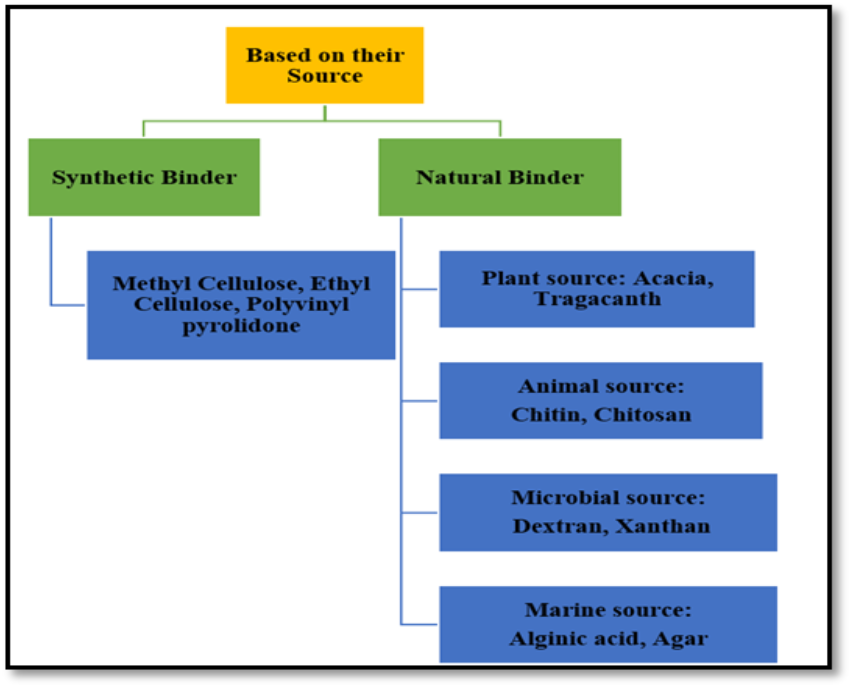
TYPES OF BINDERS:

  1. Classification based on their source:

CHARACTERISTICS OF AN IDEAL NATURAL EXCIPIENTS:      

  1. Nontoxic and non-irritant
  2. Easy handling .
  3. no interactions with medications or other ingredients found in the formulation or container.
  4. Pharmaceutically active.

SOURCES OF NATURAL BINDERS:

Natural binders obtain from origin like plants, animals & minerals and sometimes from microbes.

  1. Plant Sources: starch ,sugar, cellulose & alginate .
  2. Animal source : lactose , gelatine ,and stearic acid
  3. Mineral Sources: calcium ,phosphate ,silica.

Natural binders often lack trade names after examining those binders obtained from the plant, animal, and minerals origin its therapeutic value can be identified. Natural binders used in pharmaceutical formulation over synthetic ones because of its non -toxicity property with any other ingredients used in the preparation. It does not show any adverse effect in the target site, that’s why today world is running after natural excipients in pharmaceutical preparation.

METHODS OF USING NATURAL BINDERS:

The method depends on the specific binder and the desired tablet properties:

1. Wet granulation:

Starch paste: A freshly prepared starch paste is a common binder .Starch is cooked with water to form a paste , then mixed with the other powder ingredients to form granules.

Gums and Mucilage: Gums and mucilage are dispersed in a solvent (like  water or alcohol) to form solutions or dispersions. This liquid is then added to the powder blend to create granules through the wet granulation process ,similar to using synthetic binders.

2. Direct Compression:

Pregelatinized starch(PGS): Specially processed starch (PGS) can be used in the dry powder blend for direct compression. It swells in cold water ,reducing processing time and costs compared to traditional starch paste preparation.

Dry Binders: Some  natural substances, like certain forms of cellulose or gums, can be added as dry binders to the powder mixture, which is then compressed directly into tablets.

3. Granulation  in situ:

For some binders like polyvinylpyrrolidone (a synthetic binder ), they can be added to the powder and granulated in place by adding water or an alcohol solution to the mixture .

Materials

Common name

Botanical name

Family

Pharmaceutical application

Guar gum

Cyamopsis tetragonoloba

Leguminosae

It is used as emulsifier ,binder and disintegrant

Gum Ghatti

Anogeissus latifolia

Combretaceae

It is used as binders , emulsifiers and suspending agents

Albizia gum

Albizia zygia

 Mimosoideae

It is used as tablet binders

Fenugreek mucilage

Trigonella foenum-graecum

Leguminosae

It is used as gelling agent ,Disintegrant, tablet binder, sustaining agent ,emollient and demulcent

Cassia tora mucilage

Cassia obtusifolia linn

Caesalpiniaceae

It is used as granulating agent ,binding agent &suspending agent

Phoenix mucilage

Phoenix dactylifera

Arecaceae

It is used as binder

Dendrophthoe mucilage

Dendrophthoe falcata

Loranthaceae

It is used as a binder

Cordia mucilage

Cordia obliqua

Boraginaceae

It is used as a tablet binder and emulsifier

RESULT AND DISCUSSION

EXTRACTION OF DIFFERENT BINDING AGENT

1. EXTRACTION OF PECTIN FROM CITRUS FRUIT PEEL

 Dried citrus fruit peel powder (in required quantity)was dissolved in distilled water . The water used in extraction should be acidic in nature so using any acidic medium like citrus acid made it acidified and the ph of that acidified water should be l.2.Then prepared acidified mixture was pour in the peel mixture and heat the mixture by maintaining  temperature up to 60 and time period up to 120 min .after heating period in two ways either with ethyl alcohol or ethanol with continuous stirring up to 15 min . After letting the mixture sit for two hours and filtering away any precipitation, it is stored in a desiccator until it is needed again.

2. STARCH 1500 AS A BINDING AGENT:

Starch 1500 act as an excellent binding agent for different pharmaceutical formulation .It is used as super disintegrant for mouth dissolving tablets or dispersible tablets which release their active ingredients rapidly . In comparison with the povidone, which is also a super disintegrant, the starch 1500 improves tablet’s hardness and friability. The formulation of lamivudine tablets with starch 1500 exceeded the povidone formulation's dissolving and disintegration capabilities using a super disintegrant.

3. EXTRACTION  OF TAPIOCA STARCH AS A BINDING AGENT

These natural binders are mostly utilized in the production of diclofenac tablets. The starch content of fresh tapioca roots ranges from 25% to 32%, which is a commonly utilized extraction. The clean raw cassava tubers were initially uprooted during the extraction procedure. With tapioca starch processing machine. The fresh cassava was then brought to the raspier, which mostly grinds it into pulp. Pulp is then sent to a screening machine to separate the fibers and starch. A device that is connected to the screening machine in order to gather the pulp's extracted starch. The dewatering machine is used to dry the slurry. Starch that satisfies commercial need is produced when the moisture content is reduced.

4. EXTRACTION OF GUM OKRA FRUIT AS A NATURAL BINDER

It acts  as a natural binder which contains gum that makes a thick ,s19imy mucilage . It is mostly derived from okra plant pods. The potential of okra gum made through conventional extraction as a tablet for film coating. Okra powder pods dispersed in demineralized water heating up to 80 to 30 minutes in the presence of sodium chloride. then the mixture was filtered in centrifuge in 4000rpm for 30,60,120 min &freeze dried. the gum was then filter under vacuum and dried in desiccator.

5. A POTENTIAL NATURAL TABLET BINDERS FROM GREWIA OPTIVA

Grewia Optiva bark was used to extract the mucilage. The gum and mucilage obtained from the Grewia Optiva have superior rheological properties. The dissolution, disintegration and hardness of the tablet increase with increase in the concentration of gum mucilage. Grewia Optiva is affordable, practical, and readily available. It can also be used as a medicinal tablet binder.

CONCLUSION

There are large number of natural polymers that have been used in pharmaceutical preparation. Naturally occurring materials that can be employed as binding agents include gums, dried fruits, mucilage, and starches. In addition to having several other qualities like disintegration agents, fillers, and sustained releasing agents, they have demonstrated good promise as binding agents.  When compared to alternative binders, natural polymers exhibit good binding properties in wet granulation; the granules are stable and less friable. Additionally, they can be employed to alter the drug's release, which will affect the drug's absorption and subsequent bioavailability.  Additionally, they serve as vehicles that deliver the incorporated drug to the site of absorption. They are supposed to ensure the stability of the incorporated drug, the precision and accuracy of the dosage, and, if required, improve the drugs' organoleptic qualities to improve patient adherence. The effectiveness of dose forms should be maximized both during production and during patient ingestion.

REFERENCES

  1. Patel, D.M., Prajapat,  D.G., Patel, N.M., 2007, seed  mucilage from Ocimum americanmum linn. As disintegrant in tablets: separation and evaluation Indian journal of pharmaceutical sciences ,69,431-435.
  2. Enauyatifard R, Azadbakht M, Fadakar Y. Assisment of ferula gummosa gum as a binding agent in tablet formulations. Acta Poloniac pharma. Drug Research. 2012; 69: 291-8. 
  3. Oyi AR, Olayemi OJ, Allagah TS. Comparative binding effects of wheat, rice and maize starches in chloroquine phosphate tablet formulations, Res. J. App. Sci. Eng. Tech. 2009; 1: 77-80.
  4. Odeku O A, Itiola OA. Evaluation of khaya gum as a binder in a  paracetamol tablet Formulation. Pharm PharmacolCommun 1998; 33(3):263-68.
  5. Prajapati VD, Jani GK, Moradiya NG, et al. pharmaceutical applications of various natural Gums, mucilage's and their modifiedforms.CarbohydrPolym.2013;92(2):1685–1699.
  6. Caprita R, Adrian C, Calin J. Biochemical aspects of non–starch polysaccharides. Animal Sciences and Biotechnologies. 2010;43(1):368– 375.
  7. Miguel AC, Pinheiro AC, Bartolomeu WSS, et al. Extraction, purification and characterization of galactomannans from non–traditional sources. Carbohydrates Polymers. 2009;75(3):408–414.
  8. Muazu J, Alpha A, Mohammed GT. Isolation and release retardant properties of a plant gum Obtained from a yoyo. Carib J Sci Tech. 2014;2:301–313.
  9. Ahmed SI, Smagoni JM. Modulating the release behavior and kinetic evaluation of Diclofenac sodium from natural polymers. International Journal of Chem Tech Research.2010;2(2):834–841.
  10. Femi OMN, Aremu OL, Kehinde OJ. Evaluation of Beilschmiedia seed gum as tablet binder.East and Central African Journal of Pharmaceutical Sciences. 2009;12(1):15–18.
  11. Braja P. Evaluation of binder’s efficiency of different natural gums in tableting process.Scholar Research Library. 2010;2(4):429–431.
  12. Tadesse W, Desalegn G, Alia R. Natural gum and resin bearing species of Ethiopia. InvestAgrar:Sist Recur For. 2007;16(3):211–221.
  13. Valluru R, Shivakumar HG. Investigation of kondagogu gum and ghatti gum as binders in Formulating metaprolol tartrate tablets. Research Journal of Pharmaceutical, Biological and Chemical Sciences. 2013;4(2):1110–1121.
  14. Aditya KJ, Mousumi D, Arnab DE, et al. Determination of efficacy of a natural tabletBinder:Characterization and invitro release study. Asian Journal of Pharmaceutical and Clinical Research. 2014;7(3):164–168.
  15. Bahlul. Exploitation of gum olibanum as novel natural binding agent in the designing of oral Furosemide formulations. Journal of Chemical and Pharmaceutical Sciences. 2010;3(1):71–74.
  16. Amelia MA, Rakesh RD, Shilpa NS. Recent investigations of plant based natural gums, Mucilage and resins in novel drug delivery systems. Indian Journal of Pharmaceutical Education and Research. 2011;45(1):86–99.
  17. Muhammad K, Ramakrishnan Y. Functional and preliminary characterization of hydrocolloid from tamarillo puree. Molecules. 2012;17(6):6869–6885.
  18. Sivakumar T, Selvam RP, Singh AK. Isolation, characterization and formulation properties of A new plant gum obtained from Mangifera indica. International Journal of Pharmaceutical and Biomedical Research. 2010;1(2):35–41.
  19. Sharma HK, Laskar S, Nath LK. Extraction, characterization and compatibility study of Polysaccharides from dillenia indica and abelmoschus esculentus with metformin hydrochloride for development of drug delivery system. International Journal of Pharm Tech Research.2013;5(1):275–283.
  20. Hossain MM, Kishor M, Tasmuna TT, et al. Investigations of film coating potential of okra Gum by using diclofenac tablets as model drug. International Journal of Inventions in Pharmaceutical Sciences. 2013;1(3):250–255.
  21. Divekar VB. Isolation and characterization of mucilage from Lepidium sativum seeds. International Journal of Pharma Research & Development. 2010;2(1):01–05.
  22. Ademoh NA. Natural honey and Nigerian  gum Arabic as composite binder for expendableFoundery cores. AU Journal of Technology. 2011;15(2):70–76.
  23. Maheshwar G, Hogade. Evaluation of binding properties of aegle marmelos fruit mucilage. Journal of Pharmaceutical Sciences and Technology. 2011;3(11):739–743.
  24. Shanmugam S, Manavalan R. Natural polymers and their applications. Article.2005;4(6):478–481.
  25. Singh. Pharmaceutical characterization of cassia tora seed mucilage in tablet formulations. Scholar Research Library. 2010;2(5):54–61.
  26. Narkhede Sachin B, Atul R. Bedale, Anil G. Jadhav. Isolation and Evaluation of Starch of Arto carpushetero phyllus as a Tablet Binder. Pharm tech 2011;3;836-840.
  27. Vijay J Kumar, O. P. Sati and Ranjit Singh. A potential natural tablet binder from Grewia Optiva 2011, 3(3): 120-127
  28. Tavakoli N, Ghassemi DN, Teimouri R, Harishankar H. Characterization and evaluation of
  29. Okra gum as a tablet binder. Jun. J. Natural Pharm. Prod. 2008; 3: 33-8.
  30. Anoop Kumar Singh, Vipul Kumar Shingala, R. Panner Selvam, T. Sivakumar. Evaluation of Mangifera indica gum as tablet binder. 2010.2(3)2098-2100.

Reference

  1. Patel, D.M., Prajapat,  D.G., Patel, N.M., 2007, seed  mucilage from Ocimum americanmum linn. As disintegrant in tablets: separation and evaluation Indian journal of pharmaceutical sciences ,69,431-435.
  2. Enauyatifard R, Azadbakht M, Fadakar Y. Assisment of ferula gummosa gum as a binding agent in tablet formulations. Acta Poloniac pharma. Drug Research. 2012; 69: 291-8. 
  3. Oyi AR, Olayemi OJ, Allagah TS. Comparative binding effects of wheat, rice and maize starches in chloroquine phosphate tablet formulations, Res. J. App. Sci. Eng. Tech. 2009; 1: 77-80.
  4. Odeku O A, Itiola OA. Evaluation of khaya gum as a binder in a  paracetamol tablet Formulation. Pharm PharmacolCommun 1998; 33(3):263-68.
  5. Prajapati VD, Jani GK, Moradiya NG, et al. pharmaceutical applications of various natural Gums, mucilage's and their modifiedforms.CarbohydrPolym.2013;92(2):1685–1699.
  6. Caprita R, Adrian C, Calin J. Biochemical aspects of non–starch polysaccharides. Animal Sciences and Biotechnologies. 2010;43(1):368– 375.
  7. Miguel AC, Pinheiro AC, Bartolomeu WSS, et al. Extraction, purification and characterization of galactomannans from non–traditional sources. Carbohydrates Polymers. 2009;75(3):408–414.
  8. Muazu J, Alpha A, Mohammed GT. Isolation and release retardant properties of a plant gum Obtained from a yoyo. Carib J Sci Tech. 2014;2:301–313.
  9. Ahmed SI, Smagoni JM. Modulating the release behavior and kinetic evaluation of Diclofenac sodium from natural polymers. International Journal of Chem Tech Research.2010;2(2):834–841.
  10. Femi OMN, Aremu OL, Kehinde OJ. Evaluation of Beilschmiedia seed gum as tablet binder.East and Central African Journal of Pharmaceutical Sciences. 2009;12(1):15–18.
  11. Braja P. Evaluation of binder’s efficiency of different natural gums in tableting process.Scholar Research Library. 2010;2(4):429–431.
  12. Tadesse W, Desalegn G, Alia R. Natural gum and resin bearing species of Ethiopia. InvestAgrar:Sist Recur For. 2007;16(3):211–221.
  13. Valluru R, Shivakumar HG. Investigation of kondagogu gum and ghatti gum as binders in Formulating metaprolol tartrate tablets. Research Journal of Pharmaceutical, Biological and Chemical Sciences. 2013;4(2):1110–1121.
  14. Aditya KJ, Mousumi D, Arnab DE, et al. Determination of efficacy of a natural tabletBinder:Characterization and invitro release study. Asian Journal of Pharmaceutical and Clinical Research. 2014;7(3):164–168.
  15. Bahlul. Exploitation of gum olibanum as novel natural binding agent in the designing of oral Furosemide formulations. Journal of Chemical and Pharmaceutical Sciences. 2010;3(1):71–74.
  16. Amelia MA, Rakesh RD, Shilpa NS. Recent investigations of plant based natural gums, Mucilage and resins in novel drug delivery systems. Indian Journal of Pharmaceutical Education and Research. 2011;45(1):86–99.
  17. Muhammad K, Ramakrishnan Y. Functional and preliminary characterization of hydrocolloid from tamarillo puree. Molecules. 2012;17(6):6869–6885.
  18. Sivakumar T, Selvam RP, Singh AK. Isolation, characterization and formulation properties of A new plant gum obtained from Mangifera indica. International Journal of Pharmaceutical and Biomedical Research. 2010;1(2):35–41.
  19. Sharma HK, Laskar S, Nath LK. Extraction, characterization and compatibility study of Polysaccharides from dillenia indica and abelmoschus esculentus with metformin hydrochloride for development of drug delivery system. International Journal of Pharm Tech Research.2013;5(1):275–283.
  20. Hossain MM, Kishor M, Tasmuna TT, et al. Investigations of film coating potential of okra Gum by using diclofenac tablets as model drug. International Journal of Inventions in Pharmaceutical Sciences. 2013;1(3):250–255.
  21. Divekar VB. Isolation and characterization of mucilage from Lepidium sativum seeds. International Journal of Pharma Research & Development. 2010;2(1):01–05.
  22. Ademoh NA. Natural honey and Nigerian  gum Arabic as composite binder for expendableFoundery cores. AU Journal of Technology. 2011;15(2):70–76.
  23. Maheshwar G, Hogade. Evaluation of binding properties of aegle marmelos fruit mucilage. Journal of Pharmaceutical Sciences and Technology. 2011;3(11):739–743.
  24. Shanmugam S, Manavalan R. Natural polymers and their applications. Article.2005;4(6):478–481.
  25. Singh. Pharmaceutical characterization of cassia tora seed mucilage in tablet formulations. Scholar Research Library. 2010;2(5):54–61.
  26. Narkhede Sachin B, Atul R. Bedale, Anil G. Jadhav. Isolation and Evaluation of Starch of Arto carpushetero phyllus as a Tablet Binder. Pharm tech 2011;3;836-840.
  27. Vijay J Kumar, O. P. Sati and Ranjit Singh. A potential natural tablet binder from Grewia Optiva 2011, 3(3): 120-127
  28. Tavakoli N, Ghassemi DN, Teimouri R, Harishankar H. Characterization and evaluation of
  29. Okra gum as a tablet binder. Jun. J. Natural Pharm. Prod. 2008; 3: 33-8.
  30. Anoop Kumar Singh, Vipul Kumar Shingala, R. Panner Selvam, T. Sivakumar. Evaluation of Mangifera indica gum as tablet binder. 2010.2(3)2098-2100.

Photo
Dr. Y. Venkat Veerendranadh
Corresponding author

NRI College of Pharmacy, Pothavarappadu, Vijayawada, 521212

Photo
B. Ranjitha
Co-author

NRI College of Pharmacy, Pothavarappadu, Vijayawada, 521212

Photo
K. Srivalli
Co-author

NRI College of Pharmacy, Pothavarappadu, Vijayawada, 521212

Photo
K. Kalyani
Co-author

NRI College of Pharmacy, Pothavarappadu, Vijayawada, 521212

Photo
K. Thriveni
Co-author

NRI College of Pharmacy, Pothavarappadu, Vijayawada, 521212

Photo
B. Poojitha
Co-author

NRI College of Pharmacy, Pothavarappadu, Vijayawada, 521212

Dr. Y. Venkat Veerendranadh, B. Ranjitha, K. Srivalli, K. Kalyani, K. Thriveni, B. Poojitha, A Review on Exploring Natural Binders for Tablet Formulation in Pharmaceutical, Int. J. of Pharm. Sci., 2025, Vol 3, Issue 9, 1910-1916. https://doi.org/10.5281/zenodo.17143657

More related articles
Review on Pharmacognostic and Phytochemical Evalua...
Uday Shinde, Vaibhav Shinde, Siddhu Taranjeet Kaur Karnalsingh, P...
Research advance in clinical evaluation of antihyp...
Vishavjeet Pisal, Tejaswini Kamble, Pritam Salokhe, Sachin Navale...
A Comprehensive Review on Fabrication Techniques, Transdermal Applications and F...
Afeefa K. A, Dr. Geetha V. S, Sajin K. C, Greeshma V. P, Kadeeja P. S, ...
A Brief Review On Emulgel: Recent Advances...
Navneet Kumar Verma, Pragya Mishra, Shweta Yadav, Ravindra Singh, Sushil Kumar Tiwari, ...
Related Articles
Emulgel For Keratoconjunctivitis Sicca...
Aditi Singh, Dr. Nakul Gupta, Dr. Md. Sarfaraz Alam, Kamal Singh Bani, Aanchal Dahiya, Preeti Bhunia...
More related articles
Review on Pharmacognostic and Phytochemical Evaluation of Tridax Procumben...
Uday Shinde, Vaibhav Shinde, Siddhu Taranjeet Kaur Karnalsingh, Prachi Sirge, Vishwajit Sonkamble, S...
Research advance in clinical evaluation of antihypertensive Drug...
Vishavjeet Pisal, Tejaswini Kamble, Pritam Salokhe, Sachin Navale, Nilesh Chougule, ...
Review on Pharmacognostic and Phytochemical Evaluation of Tridax Procumben...
Uday Shinde, Vaibhav Shinde, Siddhu Taranjeet Kaur Karnalsingh, Prachi Sirge, Vishwajit Sonkamble, S...
Research advance in clinical evaluation of antihypertensive Drug...
Vishavjeet Pisal, Tejaswini Kamble, Pritam Salokhe, Sachin Navale, Nilesh Chougule, ...