
Department of Pharmacology, Swami Vivekanand college of Pharmacy, Indore M.P
Anxiety is often fleeting in nature, but if it interferes with daily activities and exhibits long-lasting, severe, or occurs in the absence of stressors and interferes with daily activities, it is referred to as an anxiety disorder. It is an adaptive reaction to stress that aids in coping with challenging circumstances. It entailed the unwelcome sensation of uncertainty, coupled with unease and fear. One of the most prevalent mental illnesses affecting children and adolescents is anxiety disorder. flower of Taraxacum officinale coarsely powdered weighed and filled in Soxhlet apparatus for extraction. First the powdered drug was defatted with petroleum ether (Pet. Ether) (60°C-80°C); Defatted drug was then dried and again filled in soxhlet apparatus for successively extraction. In animal research, the LD50 (lethal dose for fifty percent of test subjects) of Taraxacum officinale (dandelion) is commonly reported to be very high (more than 2,000 mg/kg to more than 5,000 mg/kg). Both the 150 mg/kg and 300 mg/kg dosing levels of Dandelion flower extract demonstrated statistically significant anxiolytic activity across all parameters when compared to the control group. Furthermore, additional investigation is required to determine the mechanism of action of this medication as well as the chemical component responsible for its anxiolytic effects. These insights may lead to the development of novel anxiolytic drugs with fewer adverse effects and greater efficacy.
Anxiety is a sensation of tension, concerned thoughts, and bodily changes like elevated blood pressure. Anxiety is often fleeting in nature, but if it interferes with daily activities and exhibits long-lasting, severe, or occurs in the absence of stressors and interferes with daily activities, it is referred to as an anxiety disorder. It is an adaptive reaction to stress that aids in coping with challenging circumstances. It entailed the unwelcome sensation of uncertainty, coupled with unease and fear. One of the most prevalent mental illnesses affecting children and adolescents is anxiety disorder. These exhibit symptoms such as trembling, sweating, elevated blood pressure, and dread. But daily living is hampered when these symptoms become overwhelming. In the entire planet, 1/8th of the people suffered from anxiety problems (Adamec & Shallow 1993). anxiety have investigated the role of various neurotransmitter systems including the adrenergic, dopaminergic, adenosinergic and cholecystokinin systems, although most studies have focused on γ-aminobutyric acid (GABA) and serotonin (5-HT) as they are the targets of known anxiolytics. GABA is the primary inhibitory neurotransmitter in the brain. GABA counteracts the activity of the excitatory neurotransmitter glutamate to maintain homeostasis. It is hypothesized that in anxiety the GABA system is down- regulated, possibly resulting in a state of excessive neuronal hyper-excitability. The inhibitory function of GABA is mediated mainly through the GABA-A receptor. The GABA-A receptor is composed of five receptor subunits arranged around a central chloride channel and is highly expressed in many anxiety- related brain regions including the amygdala and hippocampus. When GABA binds and activates the GABA-A receptor the chloride channel opens and chloride ions move into the neuron. This influx inhibits neuronal activity by hyperpolarizing the cell, blocking neuronal depolarization. Many anxiolytics impact GABA transmission by activating the GABA-A receptor. The benzodiazepines exert their effects by making the GABA-A receptor more sensitive to the effects of GABA, enhancing the inhibitory action of GABA itself. Other known, but obviously less popular, anxiolytics such as ethanol and barbiturates, affect the GABA-A receptor by directly opening its chloride channel [2]. Anxiety disorders are among the most prevalent neuropsychiatric conditions worldwide, characterized by excessive worry, fear, and physiological hyperarousal. They affect an estimated 284 million people globally and are strongly associated with reduced quality of life, increased risk of depression, and impaired social and occupational functioning. Conventional anxiolytic drugs—such as benzodiazepines, selective serotonin reuptake inhibitors (SSRIs), and buspirone—are effective but often limited by side effects including sedation, dependency, tolerance, cognitive impairment, and withdrawal symptoms. These issues have intensified scientific interest in herbal compounds with safer pharmacological profiles and potential anxiolytic effects. Medicinal plants have historically served as important sources of psychoactive and CNS- modulating agents. Among them, Taraxacum officinale (commonly known as dandelion) is a widespread perennial herb belonging to the family Asteraceae. Although traditionally considered a weed, dandelion has been used extensively in European, Asian, and Native American medicine systems for conditions involving liver dysfunction, digestive problems, inflammation, and metabolic disorders. In recent decades, scientific studies have highlighted its antioxidant, anti- inflammatory, neuroprotective, hepatoprotective, and adaptogenic properties, suggesting potential roles in modulating neuronal function and stress responses.The flowers of Taraxacum officinale are particularly rich in bioactive compounds. Phytochemical analyses have identified significant levels of flavonoids (e.g., luteolin, apigenin derivatives), phenolic acids (chlorogenic acid, caffeic acid, chicoric acid), triterpenoids, carotenoids, and sesquiterpene lactones. Many of these compounds are known to influence pathways implicated in anxiety disorders: Oxidative stress contributes to neuronal dysfunction, amygdala hyperactivity, and altered neurotransmitter metabolism in anxiety disorders. Dandelion flowers possess strong antioxidant activity, attributed to their high flavonoid and phenolic content. These molecules can scavenge free radicals, enhance endogenous antioxidant enzymes (SOD, CAT, GSH), and reduce lipid peroxidation—actions that support neuroprotection and the modulation of stress-induced neural changes.Chronic neuroinflammation has been linked to anxiety through activation of microglia and release of pro-inflammatory cytokines (IL-1β, TNF-α). Dandelion extracts have demonstrated inhibitory effects on inflammatory mediators, possibly preventing cytokine-induced alterations in mood and behavior. Some flavonoids found in dandelion, such as luteolin and apigenin derivatives, have shown potential affinity for GABA-A receptors, which are central to anxiolytic mechanisms. GABAergic modulation is a key target of benzodiazepines. The presence of such flavonoids raises the possibility that dandelion flower extract may exert calming or sedative effects via enhancement of inhibitory neurotransmission. Plants with adaptogenic properties are known to regulate the hypothalamic–pituitary–adrenal (HPA) axis. Preliminary evidence suggests that dandelion extracts may influence cortisol levels and stress- related biochemical pathways, supporting their potential role in anxiety reduction. Despite its widespread traditional use and promising phytochemical profile, systematic scientific evaluation of the anxiolytic effects of dandelion flower extract remains limited. Most studies have focused on its antioxidant, hepatoprotective, and anti-inflammatory actions, with only a few preliminary investigations suggesting CNS benefits. Therefore, it is important to conduct rigorous preclinical studies using validated behavioral models—such as the elevated plus maze (EPM), light–dark box test, and open-field test—to evaluate the anxiolytic potential of dandelion flower extracts. Such research will not only validate traditional knowledge but may also lead to the development of safer, plant-based anxiolytic agents with fewer side effects compared to conventional medications. The proposed study aims to bridge this knowledge gap by investigating the phytochemistry, behavioral effects, and possible mechanisms of action of Taraxacum officinale flower extract in experimental models of anxiety.
2.MATERIAL AND METHODS
The material
Analytical-grade chemicals were used throughout and Merck provided the ethanol (Germany). All research were conducted using deionized and milli-Q water
Plants material collection and authenticated
The leaves of Dandelion (Taraxacum officinale) were taken from the garden near Indore, M.P. The plants were authenticated, Botanist. Fresh Taraxacum officinale flowers were collected from [local nursery], identified and authenticated by a botanist- Dr. Sandeep K. Verma (Professor and Head of Dept. in Botany) SAGE University Indore (M.P.) [Voucher No. J/Bot/SLF-037]
Characteristics of the Organoleptic properties
The use of sensory organs allowed for the recording of colour, smell, and texture.
Extract Preparation [(Omanakuttan et al., 2023)]
The flowers were shade-dried, powdered, and extracted with ethanol solvent using Soxhlet apparatus. The extract was evaporated, dried, and stored at 4°C. Extraction method by Soxhlet apparatus Around 500 gms dried flower of Taraxacum officinale coarsely powdered weighed and filled in Soxhlet apparatus for extraction. First the powdered drug was defatted with petroleum ether (Pet. Ether) (60°C-80°C); Defatted drug was then dried and again filled in soxhlet apparatus for successively extraction. The extraction was carried out for a period of 72 extract obtained was dried in vacuum to remove excess solvent and were weighed for the determination of % yield Percentage yield estimation Dried extracts were calculated for percentage yield estimation using formula-
Preliminary phytochemical tests
Qualitative chemical tests of all extracts were subjected to various chemical tests to detect various s phytoconstituents (Kokate, 2003; Khandelwal, 2006).
Selection of animals
Swiss albino mice of either sex between 1 to 2 months of age weighing 25-30 g 30 mice were used which were procured from the central animal house of College of Pharmacy, Swami Vivekanand College of Pharmacy, Indore (M.P.), India. All animals were housed in an animal room under normal condition of 25±10C, 12-h light and dark cycle. The animals were allowed free to access commercial rat pallet diet and water. The bedding materials of the cages were changed every day. All the experimental procedures were carried out in accordance with the Committee for the Purpose of Control and Supervision of Experiments on Animals (IAEC) guidelines. CCSEA Registration No. 1839/PO/Re/S/2015/CCSEA. The study designs were approved by the Institutional Animal Ethical Committee of College of Pharmacy,
Acute toxicity study and dose selection
In animal research, the LD50 (lethal dose for fifty percent of test subjects) of Taraxacum officinale (dandelion) is commonly reported to be very high (more than 2,000 mg/kg to more than 5,000 mg/kg). This suggests that large volumes are required to be lethal, yet even at high dosages, death is not always guaranteed. As a result, it is generally considered safe for medicinal use in standard doses, while allergic responses in sensitive individuals are possible. (Li et al., 2022)
Experimental Design
Three experimental protocols were designed with 4 groups of mice and each group comprised 5 mice. Experimental protocol I, consisting of 4 groups, was designed to assess antianxiety activity of ethanolic extracts of T. officinale flower (ETOF) parts. The test doses of crude extracts and fractions of the plant were prepared using vehicle 10 ml/kg vehicle 0.5%w/v of carboxymethyl cellulose. Diazepam was used as standard antianxiety drug at the dose of 1 mg/kg, p.o
Evaluation of anti-anxiety activity [Manu et al., 2017]
This consists of a central platform of 10 cm × 10 cm connected to two open arms of 50x10cms and two closed arms of 50 cm × 40 cm × 10 cm in dimension and elevated 50 cm above the floor. Swiss albino mice weighing 20-40 g was treated with ethanolic extracts of T. officinale flower (ETOF), diazepam, 30 min before being placed individually in the center of the elevated plus maze, facing a closed arm. The time spent in both open and closed arms was recorded for 5 min. The time spent was measured in seconds. The numbers of entries into the open and closed arms were counted during the test. An entry was defined as having all four paws within the arm.
B. Light and dark Model:
The apparatus consisted of two square boxes separated by wooden wall each measuring 50 cm × 50 cm × 50 cm. One box was dark and another box illuminated with 7W/12V bulb. In the center of the wooden wall, there was an opening (6 cm × 6 cm) which can be opened or closed using a transparent plex glass sliding door from which the animals can move on either side. The mice were placed individually in the center of the light box and observed for the next 5 min. The time spent in both boxes was measured in seconds. The numbers of crossings between the boxes are also noted. The mice were treated with OS extract, diazepam 30 min before being placed in the light box.
Organoleptic and physiochemical characters
In this study, the organoleptic and physiochemical properties of dried flower of Taraxacum officinale that had been collected, mashed, and then dried were analysed. The outcomes of these tests are reported in Table
|
Table Organoleptic and physiochemical characters of Flower of Taraxacum officinale |
||
|
S.No. |
Characterization parameters |
Plant Material |
|
Organoleptic Characters |
||
|
|
Colour |
Yellowish Brown |
|
|
Odour |
Aromatic |
|
|
Texture |
Smooth |
Characterization of Flower of Taraxacum officinale (ETOF)
After preparing an ethanolic extract of Taraxacum officinale flower (ETOF) in the manner outlined in the "Materials and Methods" section, the substance's physical and chemical characteristics were analysed to characterize it. These observations are included in table that is
|
Table Characterization of ETOF |
|||||
|
S.No. |
Extract |
% Yield |
Colour |
Odour |
Texture |
|
|
Ethanolic extracts of Taraxacum officinale flower (ETOF) |
21 |
Light brown |
Aromatic |
Smooth |
Phytochemicals testing of the extract
|
Phytochemicals testing of the extract |
|
|
Carbohydrates |
+ |
|
Alkaloids |
- |
|
- |
|
|
Flavonoids |
+ |
|
Tannins and phenolic compounds |
+ |
|
Saponins |
- |
|
Glycosides |
- |
|
Fats and lipids |
+ |
Dose selection and Acute toxicity studies
In animal research, the LD50 (lethal dose for fifty percent of test subjects) of Taraxacum officinale (dandelion) is commonly reported to be very high (more than 2,000 mg/kg to more than 5,000 mg/kg). This suggests that large volumes are required to be lethal, yet even at high dosages, death is not always guaranteed. As a result, it is generally considered safe for medicinal use in standard doses, while allergic responses in sensitive individuals are possible. Previous studies that there were no deaths involved till the highest dose of 5000 mg/kg. Minor toxicity symptoms at 5000 mg/kg included urine, stomach cramps, right leg elongation, abdominal distension, and muscular twitching. The extract dosages were set at 150 mg/kg and 300 mg/kg to allow for future pharmacological development (Li et al., 2022).
Evaluation of anti-anxiety activity
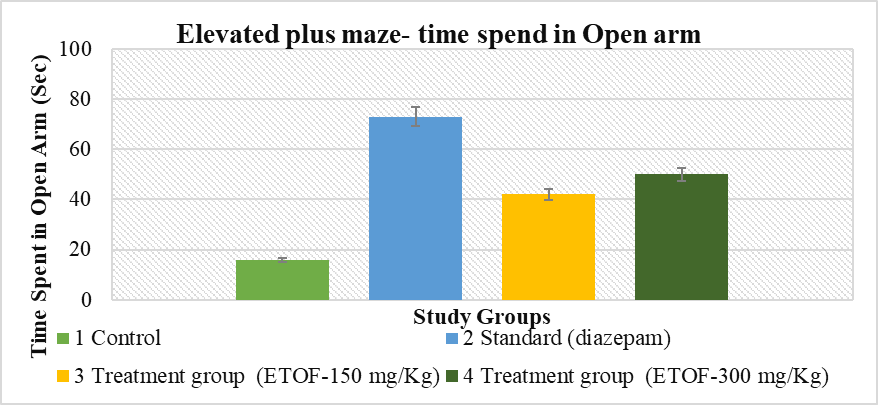
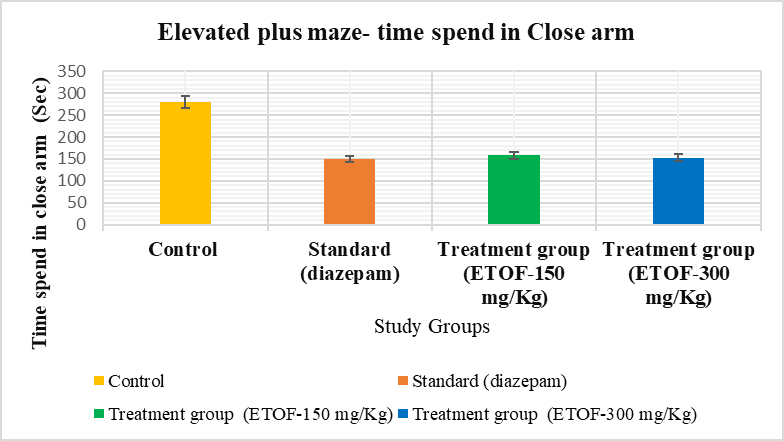
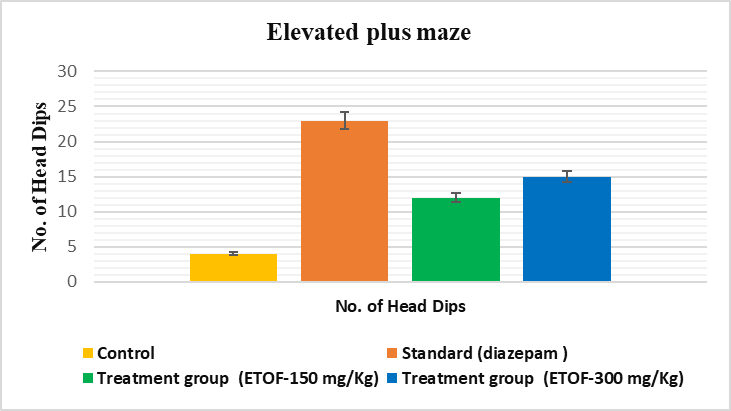
The effects of different doses of Ethanolic extracts of Taraxacum officinale flower (ETOF) on the into the open arms are shown in Fig. 1. A one-way analysis of variance revealed that, as compared to the control group, the Taraxacum officinale extract increased the proportion of entry into the open arms. Biostatic analysis revealed that Taraxacum officinale significantly increased the proportion of entry into open arms at 300 mg/kg (p < 0.01), but not at 150 mg/kg, compared to the control group. The effects of different doses of Ethanolic extracts of Taraxacum officinale flower (ETOF) on the entries into the close arms are shown in Fig. 2. A one-way analysis of variance revealed that, as compared to the control group, the Taraxacum officinale extract not increase the proportion of entry into the close arms. Biostatic analysis revealed that Ethanolic extracts of Taraxacum officinale flower (ETOF) not significantly show difference compared to the control group. In an Elevated Plus Maze (EPM), a head dip is a behaviour where a rodent partially lowers its head or the top half of its body below the edge of an open arm, often to peer down, and is a key indicator of anxiety-like behaviour, risk assessment, and exploration. An increase in head dips is generally interpreted as decreased anxiety, while fewer head dips can signify higher anxiety in a rodent. The effects of different doses of Ethanolic extracts of Taraxacum officinale flower (ETOF) on the into the open arms are shown in Fig. 1. A one-way analysis of variance revealed that, as compared to the control group, the Taraxacum officinale extract increased the Head dip into the open arms. Biostatic analysis revealed that Taraxacum officinale significantly increased the proportion of Head dip into the open arms at 300 mg/kg (p < 0.01), but not at 150 mg/kg, (P < 0.05) compared to the control group.
A. Elevated plus maze test:
|
Elevated plus maze test |
||||
|
S.no |
Group |
Time(S) spend in open arm Mean± SD |
Time(S) spend in closed rm Mean± SD |
No. of Head Dips Mean± SD |
|
1 |
Control |
16±2.01 |
280±1.96 |
4±2.5 |
|
2 |
Standard (diazepam) |
73±1.51** |
150±1.87** |
23±1.98** |
|
3 |
Treatment group (ETOF -150 mg/Kg) |
42±4.26* |
158±4.03* |
12±4.94* |
|
4 |
Treatment group (ETOF -300 mg/Kg) |
50±3.11* |
153±2.97* |
15±3.36* |
|
Statistical significance was evaluated by one-way analysis of variance (ANOVA) and Bonferroni multiple pairwise comparisons between group means by Bio-stat 4.0 version Each Value represent in Mean±SD and n=5. asterisk (*) is represent significant (P<0.05) and double asterisk, (**) High Significance (p < 0.001). |
||||
B. Light and dark Model
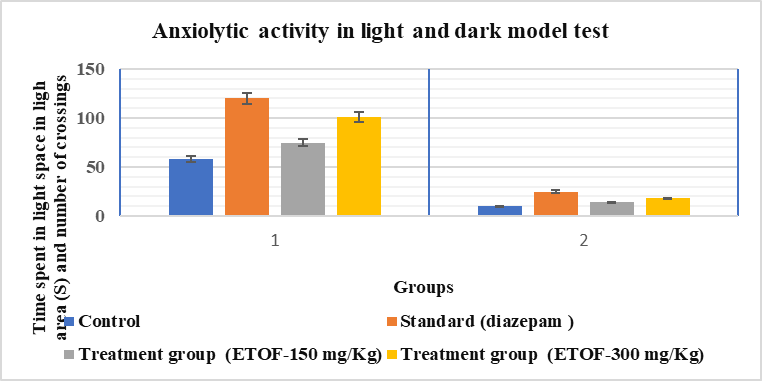
The Light-Dark Model (or Test) is a mouse behavioural test used to determine if a plant extract has anxiolytic (anti-anxiety) or anxiogenic (anxiety-causing) properties. Mice tend to avoid highly lighted locations, therefore anxiolytic-like substances will boost their exploration of the illuminated compartment, as assessed by time spent and transitions between compartments. Researchers give the plant extract and examine how the mouse's behavior in the light-dark box changes compared to the control groups to see if the extract has anti-anxiety qualities. The effects of different doses of Ethanolic extracts of Taraxacum officinale flower (ETOF) on the into the time spent in light area and Number of crossings shown in Fig. 1. A one-way analysis of variance revealed that, as compared to the control group, the ETOF increased the Time spent in light area and Number of crossings at 300 mg/kg (p < 0.01), whereas 150 mg/kg, (P < 0.05) compared to the control group. Treatment with diazepam significantly increased the time spent (P < 0.001) in light box as well as the number of crossings (P < 0.05) between the light and dark boxes
|
Table - Light and Dark Box Model (LDB) |
|||
|
S.no |
Groups |
Time spent in light space |
|
|
1 |
Control |
58 ±3.1 |
10 ±2.1 |
|
2 |
Standard (diazepam) |
120±2.4** |
25 ±2.9** |
|
3 |
Treatment group (CFLE-100 mg/Kg) |
75±2.9* |
14±3.2* |
|
4 |
Treatment group (CFLE-200 mg/Kg) |
101±3.6** |
18± 2.5** |
DISCUSSION
Anxiety is a sensation of tension, concerned thoughts, and bodily changes like elevated blood pressure. Anxiety is often fleeting in nature, but if it interferes with daily activities and exhibits long-lasting, severe, or occurs in the absence of stressors and interferes with daily activities, it is referred to as an anxiety disorder. It is an adaptive reaction to stress that aids in coping with challenging circumstances. It entailed the unwelcome sensation of uncertainty, coupled with unease and fear. One of the most prevalent mental illnesses affecting children and adolescents is anxiety disorder. There are several beneficial effects of ROS in biological systems. They are useful in intracellular signaling and redox regulation. Nitric oxide (NO) is found to be a signaling molecule and it regulates transcription factor activities and other determinants of gene expression Hydrogen peroxide and superoxide show similar intracellular functions (Several cytokines, growth factors, hormones, and neurotransmitters use ROS as secondary messengers in the intracellular signal transduction Another important function of radicals is as a defence against infection. ROS oxidize important components of cell permanently. They oxidize lipids, proteins, DNA and other unsaturated fatty acids of cell permanently damaging them. Hydroxyl radical is the most reactive among all the radicals generated in the body. It is capable of reacting with any molecule in the living. ROS are found to be mutagenic First the powdered drug was defatted with petroleum ether (Pet. Ether) (60°C-80°C); Defatted drug was then dried and again filled in soxhlet apparatus for successively extraction. In animal research, the LD50 (lethal dose for fifty percent of test subjects) of Taraxacum officinale (dandelion) is commonly reported to be very high (more than 2,000 mg/kg to more than 5,000 mg/kg). This suggests that large volumes are required to be lethal, yet even at high dosages, death is not always guaranteed. As a result, it is generally considered safe for medicinal use in standard doses, while allergic responses in sensitive individuals are possible. Three experimental protocols were designed with 4 groups of mice and each group comprised 5 mice. Experimental protocol I, consisting of 4 groups, was designed to assess antianxiety activity of ethanolic extracts of T. officinale flower (ETOF) parts. The test doses of crude extracts and fractions of the plant were prepared using vehicle 10 ml/kg vehicle 0.5%w/v of carboxymethyl cellulose. Diazepam was used as standard antianxiety drug at the dose of 1 mg/kg, p.o. This consists of a central platform of 10 cm × 10 cm connected to two open arms of 50x10cms and two closed arms of 50 cm × 40 cm × 10 cm in dimension and elevated 50 cm above the floor. Swiss albino mice weighing 20-40 g was treated with ethanolic extracts of T. officinale flower (ETOF), diazepam, 30 min before being placed individually in the center of the elevated plus maze, facing a closed arm. The time spent in both open and closed arms was recorded for 5 min. The time spent was measured in seconds. The numbers of entries into the open and closed arms were counted during the test. An entry was defined as having all four paws within the arm. The apparatus consisted of two square boxes separated by wooden wall each measuring 50 cm × 50 cm × 50 cm. One box was dark and another box illuminated with 7W/12V bulb. In the center of the wooden wall, there was an opening (6 cm × 6 cm) which can be opened or closed using a transparent plex glass sliding door from which the animals can move on either side. The mice were placed individually in the center of the light box and observed for the next 5 min. The time spent in both boxes was measured in seconds. The numbers of crossings between the boxes are also noted. The mice were treated with OS extract and diazepam, 30 min before being placed in the light box. According to the findings, the flower of Taraxacum officinale, popularly known as ETOF, has strong anxiolytic effects.
CONCLUSION
Both the 150 mg/kg and 300 mg/kg dosing levels of Dandelion flower extract demonstrated statistically significant anxiolytic activity across all parameters when compared to the control group. Although the precise mechanism underlying its anxiolytic characteristics is unknown, the observed activity can be connected to plant components having structural similarities to SSRIs. Additional research is needed to identify, isolate, and purify the active chemical constituent discovered in neem leaves that has the potential to be anxiolytic, as well as to uncover the mechanism of action for this constituent. Furthermore, additional investigation is required to determine the mechanism of action of this medication as well as the chemical component responsible for its anxiolytic effects. These insights may lead to the development of novel and anxiolytic drugs with fewer adverse effects and greater efficacy.
REFERENCES



: Poonam Chouhan, Yashraj Yadav* Sohan Singh, Chauhan, Dishant Gupta, Neelam Patel Aahire, A preclinical anti-anxiety effect of Dandelion (Taraxacum officinale) flower extract in Swiss albino mice., Int. J. of Pharm. Sci., 2026, Vol 4, Issue 1, 2885-2895. https://doi.org/10.5281/zenodo.18365644
 10.5281/zenodo.18365644
