View Article

Abstract

Cough is a common respiratory symptom often associated with infections, allergies, and chronic pulmonary conditions. While conventional antitussive medications offer symptomatic relief, they are frequently associated with side effects such as drowsiness, gastrointestinal disturbances, and dependency risks. In contrast, herbal cough syrups—formulated with medicinal plants such as Liquiorice, Tulsi, Turmeric, Ginger and Honey have been traditionally used for their bronchodilator, anti-inflammatory, mucolytic, and immunomodulatory properties. This research systematically examines the pharmacological efficacy, safety profiles, and active phytoconstituents of commonly used herbal ingredients in cough syrups. It also highlights the synergistic mechanisms by which these botanical components exert antitussive effects. The research emphasizes the growing scientific validation of traditional formulations and underscores the need for rigorous clinical trials to establish standardization, dosage efficacy, and regulatory frameworks for herbal cough preparations. Herbal cough syrups present a promising, safer alternative for managing both acute and chronic cough, particularly in populations seeking natural therapeutic options. The aim of study to develop a herbal cough syrup and evaluate the parameters such as turbidity, color, odor, taste, pH, viscosity and optimized batch further selected for stability study3,6.

Keywords

Herbal Cough Syrup, Honey base, Tulsi, Turmeric, Ginger, Expectorant, Cough management, Bronchodilator drugs, Traditional medicine, Evaluation Test, Stability test.

Introduction

Herbal formulations are used for many types of diseases. Herbal formulations mean a dosage form consisting of one or more herbs or processed herbs in specified quantities to provide specific nutritional, and cosmetic benefits meant for use to diagnose, treat, and mitigate diseases of the human being. An herbal syrup is prepared by combining a decoction with either honey or sugar and sometimes alcohol. A potent herbal decoction serves as the syrup's foundation. In cough syrup, many types of herbal plants are used, for example, ginger, Tulsi, honey, and clove. Cough is one of the most common problems faced by all people. A cough is your body's way of responding when something irritates your throat or airway. An irritation activates nerves that cause your brain to receive a message. The brain then tells muscles in your chest and abdomen to push air out of the ilium lungs to force out the irritant. An occasional cough is normal and healthy.[1]The oral administration of liquid pharmaceuticals has typically been justified on the grounds of simplicity of administration to patients who have difficulty swallowing solid dosage forms. Cough Syrup is a liquid dosage form. Sugar and clean water are condensed together to create syrup. Syrups are distinguished from other types of solutions by their high sugar content. The presence of medication or other flavorings in syrups is debatable. Non-medicated or flavored syrups are ones that contain a flavoring component but no medication. Flavored syrups are frequently employed as delivery systems for unpleasant-tasting pharmaceuticals; the end product is medicated syrup. Syrups frequently have a preservative since the high sugar content makes them vulnerable to contamination. This research article describes the formulation and evaluation of a multi-herbal anti-tussive syrup that includes some natural remedies like Tulsi Turmeric and Honey (as a base). These natural medication mixtures in the form of powder that are cough suppressant are converted into syrup. These are far preferable to over-the-counter medicines because they are nontoxic, not dangerous, and don't have any negative effects on the body.[2]

Types of coughs :

A. Types of coughs:[3]

Mainly there are two types of coughs, which are classified as follows

  1. Wet cough
  2. Dry cough

1. Wet cough:

  • Productive and effective cough.
  • It expels secretion from mucous or forges in material from the respiratory tract.
  • The main purpose of a wet cough is to remove the foreign matter of mucous from the respiratory tract by which inspection is caused.
  1.  Dry cough:
  • Non-effective and infective cough.
  • It expels secretion or mucous from the lungs.
  • Dry cough is chronic, and it is caused by dry irritation, smoke, and dust

Herbal cough syrup :-

Herbal cough syrup it is defined as a prepared and combination and concentration decoction with honey. Sugar or either some time use alcohol. Another name for “Cough” is “tussis” the voluntary or involuntary act which clears the throat and breathing passage of foreign particles, microbes, irritants, fluids, and mucus is nothing but cough[4]. It is the rapid expulsion of air from lungs. when we have blockage or irritation in the throat or upper air passage, the brain thinks a foreign element is there in body and it inform body immediately to cough to expel out foreign element out of our body. the cough reflex consists of the 3 phases which are an inhalation, a forced exhalation against a closed glottis, and a violet release of air from the lungs following opening of the glottis, and followed by a distinctive sound.[5]

Types of Herbal cough syrup:

  1. Herbal syrup
  2. Flavoured syrup
  3. Artificial syrup
  4. Medicated syrup
  1. Acute cough. – Not more than 3 week duration
  2. Chronic cough- More than 3 weeks.
  3. Dry cough – No mucus or secretion.
  4. Wet cough – With mucus or secretion.
  5. Coughs from chest and throat – Productive and non- productive.
  6. Paroxysmal cough –Spasodic and recurrent.
  7. Bovine cough –Soundless cough.

Stability testing of Herbal Formulation:

Stability Testing Of Herbal Formulation Stability testing studies give substantiation on how the quality of herbal products varies with time under the influence of environmental factors similar as temperature, light, oxygen, humidity, presence of other constituents or excipients in lozenge form, microbial impurity, flyspeck size of medicine, trace essence impurity, filtering from vessel, and other factors. These studies help to establish recommended storehouse conditions, shelf life, and check period for herbal products.[6] [7]

ADVANTAGES OF HERBAL COUGH SYRUP:-[1]

  1. Low cost
  2. Harmless
  3. Easily Available
  4. Not required prescription
  5. Herbs grow in common places
  6. No side effects
  7. Herbal medicines are more effective.
  8. They are eco-friendly.

DISADVANTAGES OF HERBAL COUGH SYRUP[1]:-

  1. Herbal medicine can produce adverse effects.
  2. Herbal medicine has another disadvantage is the rare risk of self-dosing herbs.
  3. Sometimes microbial contamination occurs
  4. Not suitable for emergency & for unconsious patient

MATERIALS AND METHODS :

The following herbal medications are used to create herbal syrup with expectorant and antipyretic properties.[1]

Table 1: Herbal Ingredient

SR.NO

Ingredient

1

Tulsi

2

Ginger

3

Liquiorice

4

Fennel

5

Cardamom

6

Honey

7

Turmeric

8

Cinnamon

Table  2 :Equipment’s And Glassware Used:

Sr. No.

Glassware

1

Beaker

2

Measuring cylinder

3

Reflux Condenser

4

Spatula

5

Funnel

6

Round Bottom Flask

7

Specific gravity bottle

8

Density bottle

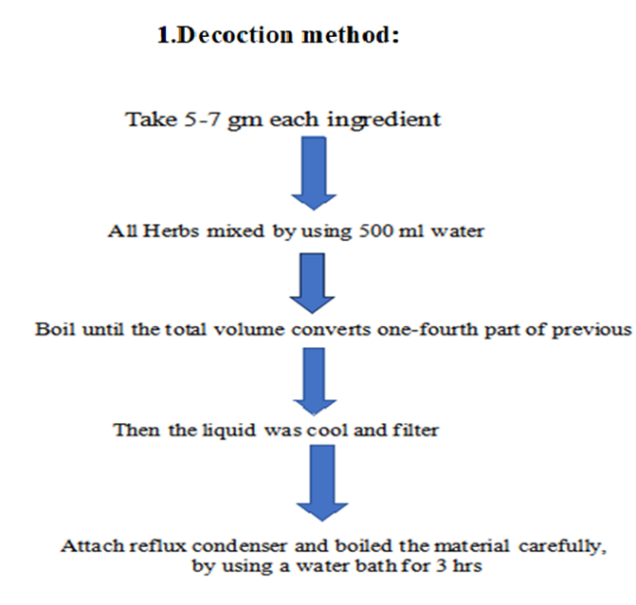
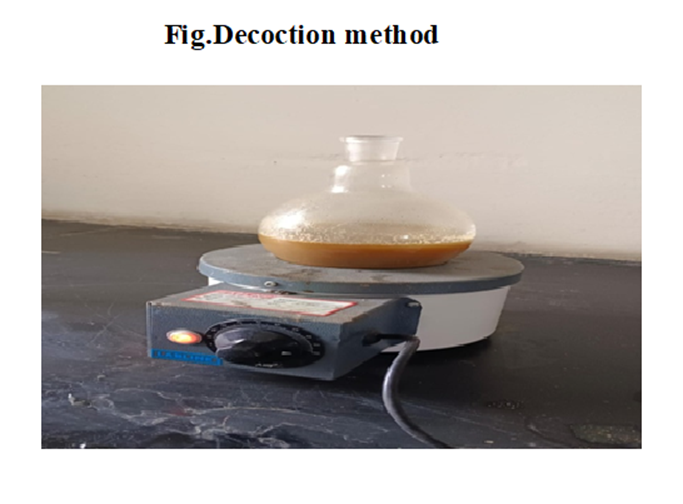
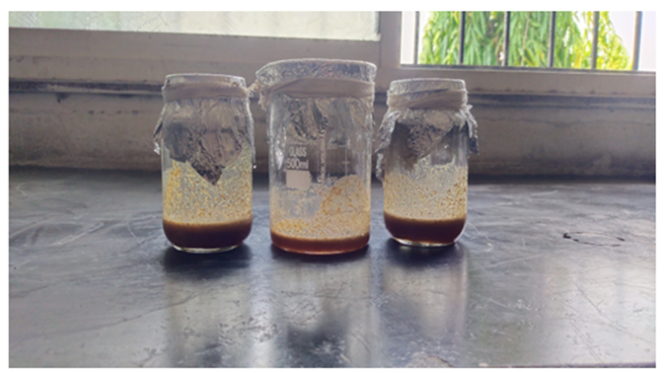
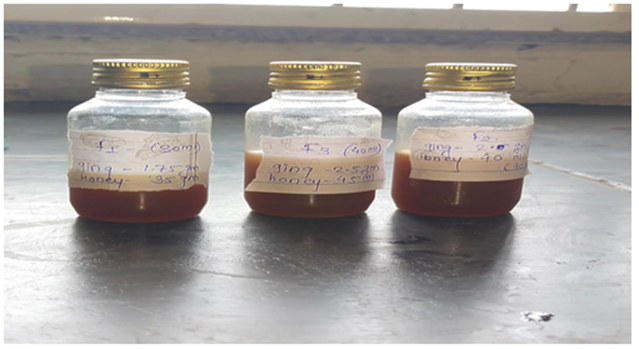
Method of preparation:

Fig: Decoction method
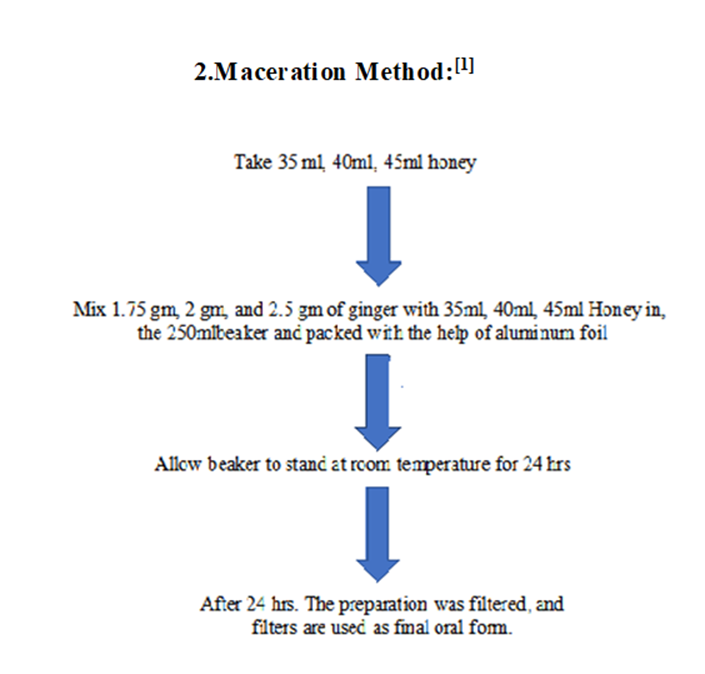
Fig: Maceration Method
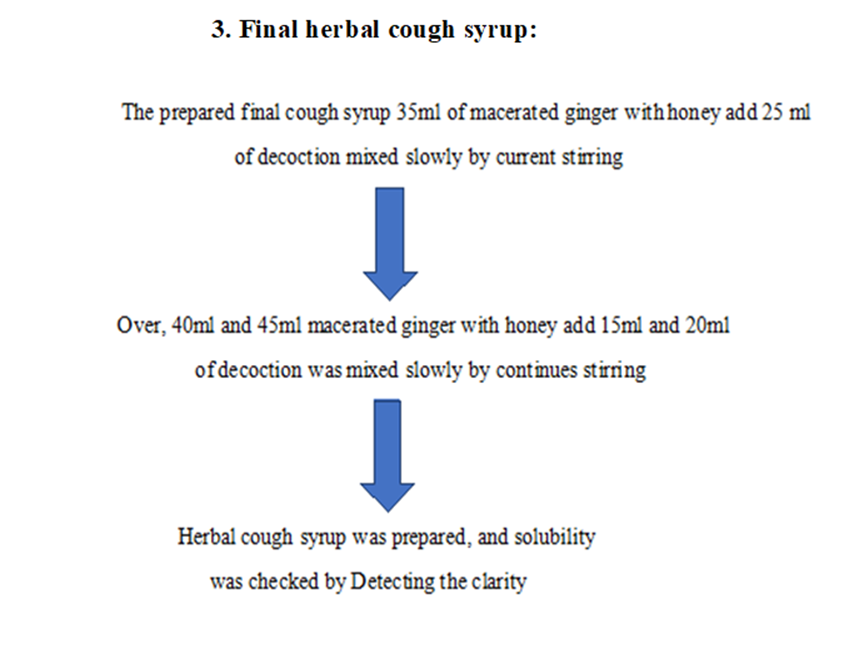
Fig: Final Herbal Cough Syrup

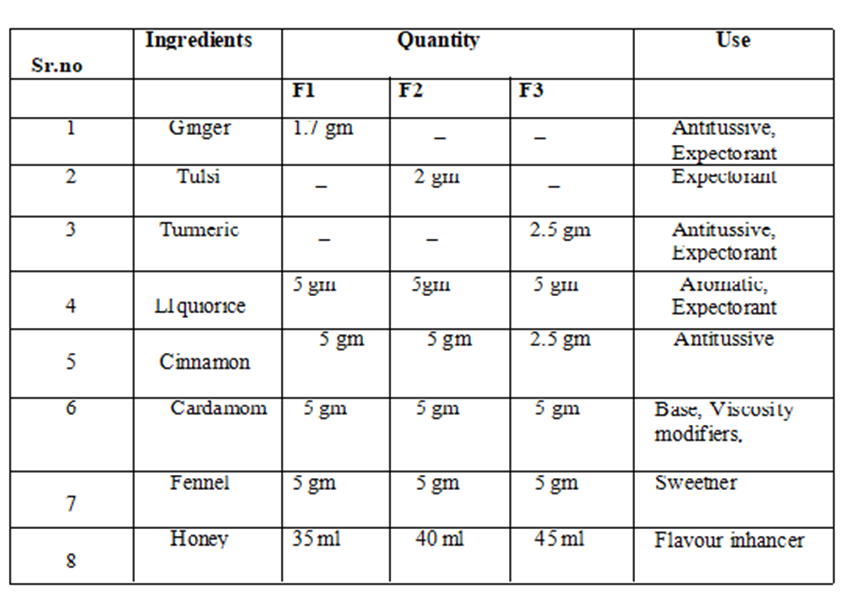
Formulation Table

These are the natural herbal drug which is used for the preparation of Herbal Cough Syrup.8
Evaluation parameter of of herbal cough syrup:

1. Organoleptic characters12:

Sr.no

TEST

PROCEDURE

1

Colour examination

5ml of prepared syrup was taken on a watch glass

Watch glass placed against white background in white tube light Color was observed by necked eyes

2

Odour examination

2ml of prepared syrup was taken and smelled by   individually

3

Taste examination

A pinch of final syrup was taken and examined on taste buds of tongue

2. pH12:

  1. Disturbed water was used to clean and wash the glass electrode.
  2. The electrode was inserted into pH 7 buffer solution, and the pH meter's calibrate knob was turned to 7 to set the value.
  3. The electrode was taken out, cleaned, and washed with distilled water.
  4. The electrode's placement was in a solution of pH 4 buffer. Change the value.
  5. After that, the electrode was inserted into the syrup, and the pH was measured.

3. Viscosity12:

  1. Used acetone or other suitable organic solvent to thoroughly clean the Ostwald viscometer.
  2. Set the viscometer on a suitable stand in a vertical position.
  3. I filled the dry viscometer with water to the G mark.
  4. The time it took for water to flow from point A to mark B was measured in seconds.
  5. To get an accurate reading, this step was repeated at least three times.

4. Density14:

  1. Clean the bottle with specific gravity.
  2. Distilled water was used to clean the bottle.
  3. Calculate the empty dry syrup bottles weight using the stopper (w1).
  4. After placing the topper on the bottle and adding the total amount of syrup, wipe any extra syrup exterior of the tube.
  5. Calculate the syrups weight in gm (w2).
  6. Calculate the weight in syrup (w3).

5. Stability Test14:

  1. Stability testing of the prepared herbal syrup was performed on keeping the sample at accelerated temperature condition.
  2. The final optimized syrup was taken in culture tubes.
  3. Then kept at accelerated temperature at 4 degree Celsius, Room temperature and 47 degree Celsius respectively.
  4. The sample were tested for all the physiochemical parameter (color, odour, taste) turbidity and at the interval of 24 hr., 48 hr., and 72 hr. to observe any change.

RESULT :

1.Organoleptic characterization

Appearance of all formulations were observed visually which was found to be brownish.

Sr no.

Formulation

Colour

Odour

Taste

01

Ginger

Brownish

Sweet aromatic

Sweet

02

Tulsi

Brownish

Sweet aromatic

Sweet

03

Turmeric

Brownish

Sweet aromatic

Sweet

2. pH Determination:

The pH of all prepared batches of herbal cough syrup were determined by using digital pH meter and observed pH value are.

Sr no

Formulation

pH

1

F1

7

2

F2

6.65

3

F3

6.85

3. Viscosity Determination:

The viscosity of all prepared batches of herbal cough syrup were determined by using Ostwalds viscometer and observed  viscosity values are,

Sr no

Formulation code

Viscosity

1

F1

3.14cp

2

F2

3.46cp

3

F3

3.78cp

4. Density determination study:

The density result of all prepared batches of herbal cough syrup were determined by using density bottle  and observed  density values is given in table 8.4 which sowed 0.85 g/ml,1.2 g/m and 1.50 g/ml respectively. From All of these formulation the F2 shows best density  range ideally.

Sr no

Formulation Code

Density

1

F1

0.85 g/ml

2

F2

1.2 g/ml

3

F3

1.50 g/ml

5. Stability determination:

The stability study F2 batches selected for the stability testing  of all prepared batches of herbal cough syrup was determined and appearance are noted and  showed in table no- 8.5, F2 formulation does not show any changes after the 1 month stability study. So we conclude that F2 formulation showed the best result.


Initial

Appearance

Brownish

Organoleptic properties

Sweet

pH

6.85

Antimicrobial contamination

Stable


After 1 month

Appearance

Brownish

Organoleptic properties

Sweet

pH

6.76

Antimicrobial contamination

Stable

CONCLUSION

Our overall research study is determination of general physiochemical parameters that are essential for the identification of crude drug on the basis of availability of standard data. As the study shows that the herbal treatment is more beneficial for cough. as herbal drugs have less or no side effects. Herbal treatments are preferred widely. Herbal drugs are easy to available than that of prescribed drugs our respective formulations F1 F2 and F3 was Showed a good preliminary formulation. The evaluation of these three formulation was conducted manually or experimentally as like organoleptic characterization, pH viscosity and density all the formulation showed the good result but from all the formulation F2 formulation showed the pH 6.65, Viscosity 3.46 cp and density 1.2 g/mol which are best reading nearby ideal range that’s why F2 formulation selected for further antimicrobial study and stability study were the F2 formulation 1 month showed good antimicrobial property an formulation become considered  stable after the stability study, which is effective and safe.

ACKNOWLEDGMENT

The authors are thankful to the operation and Students, staff  of DJP’s College Of Pharmacy, Pathri  for furnishing the necessary installations and for their precious support in the project.

REFERENCES

  1. Chaudhary N,  Kaur M: Formulation and evaluation of herbal cough syrup. International Journal 2023: 2456-4184.
  2. Sharma V, Singh S, Dixit A: Formulation and evaluation of herbal cough syrup. Int J Res Pharm Chem. 2020 Jan 10: 2231-2781.
  3. Kumar S P, Prasan N: Formulation and evaluation of herbal cough syrup. Int J Ayurvedic Med 2013: 0976-5921.
  4. Diwan U. Dhawale T: Formulation and evaluation of herbal cough syrup. Int J Res Publ Rev: 2024 Jun: 2582-7421.
  5. Matovu J, Gonahasa M: Formulation and evaluation of herbal cough syrup Microbial and physical contamination: Afr J Pharm Pharmacol. 2023 Aug: 1996-0816.
  6. Tarle  B. Wagh M: Formulation and evaluation of herbal cough syrup. Int J Novel Delivery : 2023 May: 2456-4184.
  7. Mohammad Ali: Pharmacognocy and phytochemistry, CBS Publisher and Distribution, New Delhi, First edition 2007, reprint-2018, 432-434 And 454-457.
  8. Vikash Sharma, saurabh singh, Arushi Dixit and Alka Saxena, “Formulation and evaluation of herbal cough syrup from seeds extract of hedge Mustard” International Journal of research pharmacy and chemistry : 2231-278.
  9. More, Shraddha M. Jain. “Formulation and evaluation of herbal syrup”. World journal of pharmaceutical research volume 8, 1061-1067.
  10. Tanuja Nesari, B. K. Bhagwat, Jasmin Johnson, Narenda S. Bhatt, and Deepa Chitre, “Clinical Validation of Efficacy and Safety of Herbal Cough Formula: Study of Herbal Cough Syrup”, Journal of Herbal Pharmacotherapy, 1-12
  11. Sagar Bhanu PS, Zafar R, Panwar R. Herbal drug Standardization. The Indian Pharmacist 2005; 4(35):19- 22.
  12. Quality Control Methods for Medicinal Plant Materials, WHO, Geneva, 1996.
  13. Devesh Tewari and Manoj Kumar. Formulation and Comparative evaluation of different Sitopaladi Herbal syrups. Der Pharmacia Lettre, 2014, 6 (2):178-183.
  14. Sarah Spiteri Staines. Herbal medicines, adverse Effects, and drug-herb interactions. Journal of the Malta College of Pharmacy Practice. 2011: 17; 38-42.
  15. J.B. Calixto. Efficacy, safety, quality control, Marketing, and regulatory guidelines for herbal Medicines (physiotherapeutic agents). Braz J Med Biol Res (2000) 33: 179-189.
  16. Karlsson, J.A. (1996) The role of capsaicin-sensitive fiber afferent nerves in the cough reflex. Pulm.Pharmacol. 9, 315–321.
  17. Mazzone, S.B. (2003) Sensory pathways for the cough Reflex. In Cough: Causes, Mechanisms, and Therapy (Chung, K.F. ed.), pp. 161–171
  18. Farhat Pirjade Mujawar, Manojkumar Patil, JyotiramSawale.” Formulation and Evaluation of Herbal Cough Syrup of Echinops Echinatus Roxb Roots”, International Journal of Pharmacy & Technology, 09-06- 2016, ISSN: 0975-766X
  19. Anu Kaushik, Formulation and Evaluation of Herbal Cough Syrup. European Journal of Pharmaceutical & medical Research, 2016; 3(5): 517-522.
  20. Luise Wagnera, “herbal medicine for cough: a systematic review and meta-analysis” Published online: December 14, 2015

Reference

  1. Chaudhary N,  Kaur M: Formulation and evaluation of herbal cough syrup. International Journal 2023: 2456-4184.
  2. Sharma V, Singh S, Dixit A: Formulation and evaluation of herbal cough syrup. Int J Res Pharm Chem. 2020 Jan 10: 2231-2781.
  3. Kumar S P, Prasan N: Formulation and evaluation of herbal cough syrup. Int J Ayurvedic Med 2013: 0976-5921.
  4. Diwan U. Dhawale T: Formulation and evaluation of herbal cough syrup. Int J Res Publ Rev: 2024 Jun: 2582-7421.
  5. Matovu J, Gonahasa M: Formulation and evaluation of herbal cough syrup Microbial and physical contamination: Afr J Pharm Pharmacol. 2023 Aug: 1996-0816.
  6. Tarle  B. Wagh M: Formulation and evaluation of herbal cough syrup. Int J Novel Delivery : 2023 May: 2456-4184.
  7. Mohammad Ali: Pharmacognocy and phytochemistry, CBS Publisher and Distribution, New Delhi, First edition 2007, reprint-2018, 432-434 And 454-457.
  8. Vikash Sharma, saurabh singh, Arushi Dixit and Alka Saxena, “Formulation and evaluation of herbal cough syrup from seeds extract of hedge Mustard” International Journal of research pharmacy and chemistry : 2231-278.
  9. More, Shraddha M. Jain. “Formulation and evaluation of herbal syrup”. World journal of pharmaceutical research volume 8, 1061-1067.
  10. Tanuja Nesari, B. K. Bhagwat, Jasmin Johnson, Narenda S. Bhatt, and Deepa Chitre, “Clinical Validation of Efficacy and Safety of Herbal Cough Formula: Study of Herbal Cough Syrup”, Journal of Herbal Pharmacotherapy, 1-12
  11. Sagar Bhanu PS, Zafar R, Panwar R. Herbal drug Standardization. The Indian Pharmacist 2005; 4(35):19- 22.
  12. Quality Control Methods for Medicinal Plant Materials, WHO, Geneva, 1996.
  13. Devesh Tewari and Manoj Kumar. Formulation and Comparative evaluation of different Sitopaladi Herbal syrups. Der Pharmacia Lettre, 2014, 6 (2):178-183.
  14. Sarah Spiteri Staines. Herbal medicines, adverse Effects, and drug-herb interactions. Journal of the Malta College of Pharmacy Practice. 2011: 17; 38-42.
  15. J.B. Calixto. Efficacy, safety, quality control, Marketing, and regulatory guidelines for herbal Medicines (physiotherapeutic agents). Braz J Med Biol Res (2000) 33: 179-189.
  16. Karlsson, J.A. (1996) The role of capsaicin-sensitive fiber afferent nerves in the cough reflex. Pulm.Pharmacol. 9, 315–321.
  17. Mazzone, S.B. (2003) Sensory pathways for the cough Reflex. In Cough: Causes, Mechanisms, and Therapy (Chung, K.F. ed.), pp. 161–171
  18. Farhat Pirjade Mujawar, Manojkumar Patil, JyotiramSawale.” Formulation and Evaluation of Herbal Cough Syrup of Echinops Echinatus Roxb Roots”, International Journal of Pharmacy & Technology, 09-06- 2016, ISSN: 0975-766X
  19. Anu Kaushik, Formulation and Evaluation of Herbal Cough Syrup. European Journal of Pharmaceutical & medical Research, 2016; 3(5): 517-522.
  20. Luise Wagnera, “herbal medicine for cough: a systematic review and meta-analysis” Published online: December 14, 2015

Photo
K. S. Jamkar
Corresponding author

DJPs college of Pharmacy Pathri Dist Parbhani

Photo
S. D. Ashfaq
Co-author

DJP'S college of Pharmacy Pathri Dist Parbhani

Photo
K. M. Dahe
Co-author

DJP'S college of Pharmacy Pathri Dist Parbhani

Photo
K. O. Naikwadi
Co-author

DJP'S college of Pharmacy Pathri Dist Parbhani

Photo
V. V. Shinde
Co-author

DJP'S college of Pharmacy Pathri Dist Parbhani

Photo
Dr. R. D. Ingole
Co-author

DJP'S college of Pharmacy Pathri Dist Parbhani

K. S. Jamkar, S. D. Ashfaq, K. M. Dahe, K. O. Naikwadi, V. V. shinde, Dr. R. D. Ingole, Formulation and Evaluation of Herbal Cough Syrup of Tulsi by Using Honey Base, Int. J. of Pharm. Sci., 2025, Vol 3, Issue 6, 3604-3611. https://doi.org/10.5281/zenodo.15720171

More related articles
RP-HPLC Method Development and Validation for Simu...
Battu Rama Madhuri, Manda Swapna, Rongali indu, ...
A Comprehensive Review on Phytochemistry and Pharm...
Supriya Jadhav, Wadulkar R. D., Satpute K. L., Undare A. S., ...
Formulation, Development and Evaluation of Clarithromycin Floating Tablets by Us...
G. Hariharaputhraayyanar, T. Tamilveeran, D. Jothika, P. Lokeshwari, S. Rithick Raja, M. Sriram, E. ...
Related Articles
Phytochemical and Pharmacological Insights into Caesalpinia Bonducella: A Compre...
Rohini Jadhav, Sujata Karande, Rajnandini Kamble, Dr. D. R. Jadage, ...
A Systematic Review Preparation of Nanoparticle ...
ABHIJEET SURESH JADHAV, Nakul kathar , Dr. Gajanan sanap, ...
Protein Binding In Drug Development: A Systematic Review Of Mechanisms, Pharmaco...
K.T. AKSHARA, PRASANTH S.S, JISHA.U, SANOOJA P.K, SIBINA M.K, RIYA RAJAN, AJAY. A, MOHAMED FAROOQ. P...