

We use cookies to ensure our website works properly and to personalise your experience. Cookies policy
Dr Rajendra Gode College of Pharmacy.
Corrective and Preventive Actions (CAPA) is essential for the improvement and increasing the quality of the final product or service. It is a key component for the continuous development of any industry. It is a regulatory requirement in a pharmaceutical company as well as a comprehensive part of Quality Management System. The corrective actions are taken after the occurrence of non- conformity whereas a preventive action is taken to control or avert non-conformity and its recurrence. This review gives an insight to the corrective and preventive actions as well as the series of action involved in the CAPA plan.
Corrective and Preventive Action (CAPA) is a subsystem that integrates all quality subsystems, so completing a "quality loop." CAPA is one of several processes that guarantees continuous improvement within a business, alongside customer satisfaction assessments, internal audits, trend analysis, and non-conforming product management. Upon attaining the desired performance, a new performance criterion is established to facilitate ongoing enhancement with an augmented emphasis on quality. Thus, CAPA embodies the principle of the spiral helix illustrated by the International Organization for Standardization (ISO) 9001: 2000. A CAPA program is a comprehensive and continuous component for the enhancement of products, processes, and quality systems. CAPA is regarded as a quality enhancement instrument that operates on a dual-loop system: a reactive loop and a proactive loop. Implementing a CAPA program must be proactive in accordance with the Food and Drug Administration's (FDA) revised systemic audit inspection methodology and its focus on risk-based management.[1]
CAPA is an essential management instrument applicable to all quality systems. It offers a straightforward, sequential procedure for executing and recording remedial or preventive measures. The outcome will be a comprehensive, thoroughly documented inquiry and solution that meets the majority of regulatory standards and establishes a foundation for an effective continuous improvement plan for any organization.[2]
A CAPA program must adhere to the SMARTER criteria is Specific, Measurable, Attainable, Results-oriented, Time-based, Evaluated, and Reviewed. All seven features of a SMARTER program hold equal significance. Without performance goals and specified metrics for analysis and monitoring, the evaluation of program efficacy is unfeasible.[3]
The primary aim of corrective action and preventative action (CAPA) in any pharmaceutical or industrial context is to identify weaknesses, discrepancies, or failures and to conduct investigations followed by appropriate measures to avert recurrence of the issue. CAPA is a proactive approach that implements preventive steps at the outset to avert the occurrence of any discrepancies. It constitutes a component of the comprehensive Quality Management System (QMS) and serves as a regulatory obligation inside a pharmaceutical enterprise.[4]
Corrective action is to be identified by Statistical Process Control (SPC) in response to customer complaints, unacceptable levels of product non-conformance, faults identified during an internal audit, as well as adverse or unstable patterns in product and process monitoring. Preventive measures are being implemented in response to the identification of probable sources of non-conformity. To validate the efficacy of corrective and preventive measures, a systematic examination of the root causes of failure is essential. CAPA constitutes a component of the overarching Quality Management System (QMS).[5]

Figure 1: CAPA Management System
Correction: An action undertaken to rectify non-conformities or undesirable conditions. Nevertheless, rectification fails to address the underlying issues.
Corrective Action:
A corrective action refers to the process of addressing product issues, customer grievances, or other non-conformities and rectifying them. CA refers to the prevention of the reoccurrence of non-conformities or adverse conditions. To eradicate the previously existing issues and diminish the likelihood of their recurrence.
Preventive Actions:
A preventive action is a procedure for identifying possible issues or non-conformities and rectifying them. PA signifies the prevention of non-conformities or adverse events. It is responsible for recognizing and mitigating potential future problems.[6]
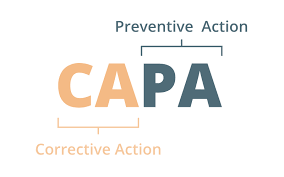
Fig No 1. CAPA
Table No. 1: 1: Difference Between Corrective Action and Preventive Action
|
Corrective Action |
Preventive Action |
|
Corrects an existing problem |
Prevents a potential problem |
|
Reactive (after issue occurs) |
Proactive (before issue occurs) |
|
Based on actual deviation |
Based on risk or trends |
|
Prevents recurrence |
Prevents occurrence |
Objective: The purpose of the corrective and preventive action subsystem is to gather and analyse information, identify and investigate product and quality problems, and take appropriate and effective corrective and/or preventive action to avoid their recurrence. Verifying or validating corrective and preventive actions, communicating corrective and preventive action activities to responsible people, providing relevant information for management review and documenting these activities are important in dealing effectively with product and preventing their recurrence, quality problems and minimizing device failures. One amongst the foremost important quality system elements is that the corrective and preventive action subsystem.[7]
What is CAPA per ICH Q10?

Fig. no. 2.ICH Q10 QMS in Practice
A structured approach to the examination process should be used with the target of determining the root cause. The level of effort, formality and documentation of the examination should be equivalent with the extent of risk, in line with ICH Q9. As per ISO 9000:2005 corrective actions is taken to prevent recurrence whereas preventive action is taken to prevent occurrence. Corrective and preventive actions even have introduced within the quality management process as defined in the Project Management Book of Knowledge (PMBOK). For understanding regular business of corrective and preventive action is additionally considered a tool within Six Sigma operations. CAPA has strong parallels with Design for Six Sigma (DFSS), won’t to design new products or redesign existing products.[8]
What is the rationale for CAPA?
Corrective Action and Preventive Action, also referred to as corrective action, are measures implemented within an organizational process to eradicate undesired conditions and non-conformities. Corrective and preventive actions are advantageous for eliminating issues arising during the production process. This prevents the recurrence of the issue throughout manufacturing and analysis.
• Assess the efficacy of a specified action plan.The CAPA also certifies that information related to nonconforming items and quality issues originates from individuals responsible for preventing such problems or ensuring the quality of these products.
• The corrective action and preventive action are responsible for the collection, analysis, identification, and examination of quality and product issues, as well as implementing effective and appropriate preventive and/or corrective measures to avert their occurrence or recurrence. • Providing essential information for management review and documenting activities crucial for addressing quality and product issues, preventing recurrence, and minimizing or averting device failures.
• CAPA is an indispensable tool for enhancing organizational processes.
CAPA is responsible for assessing and certifying preventative and corrective actions, as well as conveying these activities to the appropriate individuals.[9]
Fundamentals of the CAPA Quality Process:
CAPA management software aims to elucidate FDA mandates on corrective and preventative action procedures.
To mitigate regulatory risk effectively, CAPA primarily functions as a component of an extensive quality management system. If not, it typically possesses the ability to integrate with management systems for audits, nonconformities, document management, change control, and additional functionalities.
Regrettably, the FDA provides few guidance on the selection of a CAPA system. The CAPA system must encompass procedures that address the needs of the quality system.
• Facilitate data analysis to identify the origins of product quality issues
• Empower enterprises to monitor trends for proactive measures.
• Integrate with adjacent systems and quality assurance procedures to ensure information integrity.
• Facilitate statistical analysis and formal investigations of failures.
• Enable organizations to verify the efficacy of preventative or corrective actions.
Enhanced methodology for CAPA
Insufficient CAPA management is regarded as a significant compliance deficiency. CAPA investigations are typically launched by a consumer complaint, a regulatory or internal audit, a manufacturing discrepancy, or a laboratory inquiry. Most organizations commence their CAPA processes following the identification of a complaint or product failure.
This typically indicates a negative outlook for any pharmaceutical enterprise, as it reflects an ignorance regarding the underlying reasons of recognized issues. Although CAPA encompasses more than merely resolving production-related concerns, it occasionally appears that problem-solving is the primary focus. CAPA specialists characterize investigations as a multi-step process: identifying the problem, assessing its magnitude, investigating to determine accountability, and analyzing the root cause.
CAPA management entails conducting root cause analysis and enhancing systems through appropriate training for stakeholders to avert recurrence of the issue. The CAPA technique is designed to implement enhancements in products and processes. Effective CAPA management necessitates uniform process requirements and documented processes.
Pharma Manufacturing reports that inconsistencies among laboratories or facilities result in organizations experiencing simultaneous recurring issues at several operational areas. Smaller pharmaceutical companies often excel in implementing effective CAPA systems and adopting a systematic methodology for addressing issues or complaints, as single-site operations typically foster greater team collaboration and minimize complications arising from long-distance information management. CAPA mandates the establishment of standardized specifications and documented procedures, which enhances the operational efficiency of a pharmaceutical company, particularly when supported by advanced technological solutions.[10]
These requirements do not directly correspond to software functionality. A comprehensive understanding of the CAPA quality procedure is essential.

Fig no 3 CAPA Process
1.Detection:
The phase of problem identification and CAPA detection necessitates appropriate recording of the issue at hand. The overview must be comprehensive, encompassing who, what, when, where, why, and how many.Furthermore, a risk assessment should be conducted to ensure compliance risk management. The outcomes of the risk assessment should inform the CAPA timetable. It is evident that low-risk situations do not possess the same level of urgency as high-risk concerns.
2. Investigation and Root Cause Analysis:
The quality management teams must engage in prompt investigation and root cause analysis. Numerous methodologies exist for performing analysis, including:
• Brainstorming
• Flowcharting
• Fishbone Diagrams
• Affinity Diagrams
• The Physics of Failure
Typically, root cause determination is facilitated by quality management systems. End-to-end traceability enables the comprehensive tracking of every modification and activity from inception to completion through fully integrated, closed-loop quality processes.
3. Proposed Corrections:
In this subsequent step, rectification and condition should be executed promptly to prevent more interruption. Furthermore, companies must to systematically evaluate processes and procedures to identify overarching issues. In the event of a product-related issue, field repair and/or recall are necessary.
4. Implementation:
Currently, long-term corrective and preventive measures aim to identify or eradicate the causes of nonconformity. A corrective action is an intervention that eliminates the root cause of nonconformity. Conversely, a preventative step entails the elimination of the rationale for possible nonconformity.
5. Validation of Effectiveness:
Ultimately, assess the efficacy of corrective and preventive actions. Upon completion of a CAPA inquiry, ascertain whether nonconformities have been identified. Furthermore, to ascertain whether corrective and preventative measures have engendered new discrepancies. Modifications to the assembly process implemented to address a challenge should also be regarded as a possible source of new issues. [11]
Stages of CAPA [12]

Figure 4: Flow Chart of Stages
Identification delineates a current issue or a potential concern.
It encompasses:
• Elucidation of issues
• Documentation of verifiable evidence
• Internal audits, process oversight, data analysis, customer grievances, and quality assurance inspections
The aim is to assess the requirement for intervention and the extent of action required.
• Potential impact - pertains to the effects on the organization and clients about expenses, product quality, safety, and customer happiness.
• Risk - degree of risk associated with the issue
• Remedial action - evaluation of potential impact and risk assessment to inform the selection of appropriate remedial measures
3. Investigation:
• Examine diverse parameters related to a controversy, such as equipment, supplies, methods, analyst training, software functionalities, and environmental conditions.
• Establish specific tasks and resource requirements, including cash, personnel, and equipment. These needs are formulated and recorded.
Analysis identifies the root cause of the issue. • Gather data and enumerate potential sources to determine the root cause. Data may originate from sources like as records, procedures, service information, and operations. The root cause analysis will not merely address symptoms but will identify the primary contributing elements.
5. Action Plan:
The action plan is designed to rectify and avert future instances of failure. The plan entails modifications to current procedures and the allocation of duties.All revisions and alterations must be communicated to the relevant persons, departments, and suppliers.Employee training is a crucial component of any transformation and is invariably included in an action plan.
6. Implementation:
The implementation phase encompasses:
• Execution of designated tasks
• Amendments to documentation
• Alterations in processes
• Adjustments in environmental conditions
• Provision of training regarding adjustments
All phases of the implementation process must be accurately recorded.
7. Subsequent Action:
The follow-up verifies the execution of the specified tasks and evaluates their suitability. Effectiveness of the measures implemented. The validation report must document:
• The resolution of the primary issue
• The rectification of any resultant secondary situations
• The implementation of appropriate controls to avert repeat occurrences
• The measures undertaken that do not produce additional detrimental impacts
• Sufficient monitoring arrangements are established, assigning specific responsibilities.
A CAPA report must be signed by authorized or experienced persons within the organization's operating divisions. [12]
What is a CAPA Report?
A CAPA (Corrective and Preventive Action) Report may be a tool utilized in identifying, addressing, and preventing regulatory and organizational non- conformance. Compliance officers record the main points of a problem or incident on a CAPA Report form, which primarily includes a summary of the event, date of occurrence, items and other people involved, corrective actions taken, and preventive action established to avoid future recurrence.
Here is an example scenario of a CAPA report’s
response to an incident:
Sample Incident:
A working man is injured because of the improper use of commercial machinery.
Corrective Action – this is the action taken to instantly address the prevailing problem.
The worker is given trending and brought to the closes hospital for further treatment.
Preventive Action:
This is often the action taken to stop recurrence of the identical problem.
Workers are trained on the right use of commercial machinery to avoid recurring accidents and injuries.
When to put in writing CAPA Report:
A CAPA report is flexible and may be used for various sorts of issues and incidents. However, not every event warrants a CAPA report. Quality teams must utilize risk management techniques to see the severity of an event and choose if a CAPA report is required.
Here are some situations where a CAPA report is beneficial:
• If the problem is severe/urgent
• If the difficulty is recurring
• If the difficulty is systemic [13]
Benefits of automated CAPA management:
· Optimum use of resources
· Enhance organization’s compliance quotient
· Facilitate better and more informed decisions by organizations
· Reduction in issues, complaints and recall
· Improved customer satisfaction [14]
Future Outcomes of CAPA [15,16]
CONCLUSION:
Corrective action and Preventive action (CAPA) is very important path towards improvement and effectiveness of Quality Management System in pharmaceutical industry. It plays a vital role in Quality Risk Management System. The root cause analysis of any problem or deviation is often easily done by implementing CAPA. Pharmaceuticals, healthcare and medical devices industries should strictly follow the CAPA system to maintain the consistent quality in their products. CAPAs, is performed to help an organization to improve its competitive position by improving processes. Corrective and Preventive Actions are integral parts of a continuous improvement program. An effective CAPA system can help to prevent a warning letter during an audit. CAPA is used as tool for forward and backward traceability. CAPA compliance with the requirements, and get correct nonconformity and which are reasonable to measure the limit of risk. Fortunately, when pharmaceuticals products are failed then we demand for investigation to identify why it’s occurred. CAPA is a process which investigates and solves problems, identifies causes, take corrective action and preventive recurrences of the root causes. The ultimate purpose of CAPA is to assure the problem that can never be experienced again. Hence, it is compulsory to implement the CAPA system in pharmaceutical industry to maintain the consistent quality in their products.
REFERENCES



Dhanashri Chaudhari, Om Kale*, V. R. Ambulkar, Dr. H. Sawarkar, A Comprehensive Review on CAPA System in Quality Management, Int. J. of Pharm. Sci., 2025, Vol 3, Issue 12, 679-689 https://doi.org/10.5281/zenodo.17810006
 10.5281/zenodo.17810006