

We use cookies to ensure our website works properly and to personalise your experience. Cookies policy
Dr Naikwadi College of Pharmacy Jamgaon, Sinnar, Nashik, Maharashtra
Bryophyllum pinnatum (Lam.) Oken, commonly known as the “miracle leaf” or “life plant,” is a widely used medicinal herb belonging to the family Crassulaceae. Originally native to Madagascar, it is now distributed across tropical and subtropical regions worldwide. Traditionally, various parts of the plant—especially the leaves and juice—have been employed in the treatment of numerous ailments, including infections, inflammation, ulcers, diabetes, pain, wounds, and respiratory disorders. Phytochemical investigations that the plant contains diverse bioactive compounds such as alkaloids, flavonoids, triterpenoids, steroids, saponins, bufadienolides, and phenolic acids. Pharmacological studies have demonstrated significant antibacterial, antiviral, anti-inflammatory, antioxidant, antidiabetic, antihistamine, anti-ulcer, analgesic, CNS depressant, wound-healing, and anticancer activities. These findings support its long-standing use in traditional medicine and highlight its potential for development into novel therapeutic agents. This review provides a comprehensive overview of the botanical characteristics, phytochemical constituents, and pharmacological activities of Bryophyllum pinnatum, emphasizing its value as a multipurpose medicinal plant with promising future applications in modern medicine.
Bryophyllum pinnatum (Linn.), is one of the most significant medicinal plants known for its wide range of therapeutic applications. Commonly referred to as the "miracle leaf," "life plant," or "love plant,"(1). The name Bryophyllum pinnatum comes from Greek roots:Bryo-meaning "to sprout",phyllum- meaning "leaf"(2).Synonyms :These are historical or alternative botanical names that have been used for the same species Bryophyllum pinnatum , Cotyledon pinnata Lam, Bryophyllum calycinum, Bryophyllum calyculata, Cotyledon calyculata, Crassula pinnata, Crassuvia floripendia, Verea pinnata, C. germinans, Sedum madagascariense, Sedum Clus(10). Bryophyllum pinnatum (syn. Kalanchoe pinnata), a member of the family Crassulaceae, is an upright, perennial succulent shrub that can grow up to 1.5 meters tall. It reproduces both sexually through seeds and vegetatively from leaf buds(15).”In the beginning, it originates from Madagascar but can now be found in warm regions worldwide”(16). Bryophyllum pinnatum, native to Madagascar, has spread and now grows naturally in many tropical and subtropical regions around the world. It is found in Asia’s temperate regions, the Galápagos Islands, the West Indies, New Melanesia, Polynesia, Hawaii, Australia, Macaronesia, the Mascarene Islands, the Caribbean, and various parts of the Pacific(7), Nepal, Thailand, Pakistan, Melanesia(21), Tropical Africa tropical America, China, & India(19).

Fig(A) Bryophyllum Pinnatum Plant
The juice and leaves of the plant were traditionally used as a cough suppressant, antipyretic, antimicrobial, anti-inflammatory, antitumor, hypocholesterolemic, antioxidant, diuretic, antiulcer, styptic, hypocholesterolemic antiseptic, antilithic, and astringent (3),Used for skin, swelling, high blood pressure, bone pain, headache, wound ulcer, analgesic, snack bite, Sexually Transmitted Disease(13), Potent anti-histamine & anti-allergic activity(5). Plants used as herbs demonstrate antibacterial and antifungal activity over time against infections in humans(14).Additionally, studies have reported a wide variety of active phytochemicals, including alkaloids, triterpenes, glycosides(23),flavonoids, steroids, lipids, and organic acids,(22), saponins, tannins, cyanates, terpenes(11,19), “The active bufadienolide compounds found in Bryophyllum pinnatum exhibit anti-tumor, anti-bacterial, anti-cancer, and insecticidal properties”(4).Numerous pharmacological effects, including anticancer, antioxidant, immunomodulating, antibacterial, antihelmentic, antiprotozoal, neurologica, anti-inflammatory, analgesic, diuresis, antiurolithitic, nephroprotective, hepatoprotective, anti-peptic ulcer, hypotensive, antiidiabetic, wound healing, CNS depressant, anti-tumor, anti-convulsant, insecticidal, and other pharmacological effects, were demonstrated by the pharmacological studies (10,17,18).
Common Name:(8,10,24)
Cathedralbells, curtain plants, floppers, the good luck leaf, the green mother of millions, the leaf of life, the Mexican love plant, the miracle leaf, the resurrection plant, the sprouting leaf, Parvu, the air or maternity plant, the canterberrybells, the cathedral bells, the Parnabija, and the Goethe plant
Vernaculars Names:(1,2,7,8)
Taxonomical Classification:(2,6,8,13)
Ayurvedic Properties: (2,20,10,24)
Morphology: (1,2,9,10,16)
PLANT :
Bryophyllum pinnatum, also known as the “miracle leaf” or “life plant,” is a smooth, succulent herb that typically grows between 0.3 and 1.2 meters tall. What makes this plant truly distinctive is its remarkable ability to propagate through its leaves.
LEAVES :
The leaves of Bryophyllum pinnatum are thick, fleshy, and oval-shaped with a shiny surface. Younger leaves may appear reddish, while older ones often take on a yellowish or purplish. Along the edges of the leaves are notches, each capable of producing small plantlets. These plantlets can grow into new plants if they detach and fall to the ground. This ability makes Bryophyllum pinnatum easy to propagate. The Leaves are rich in water content, which help in survive in dry conditions.
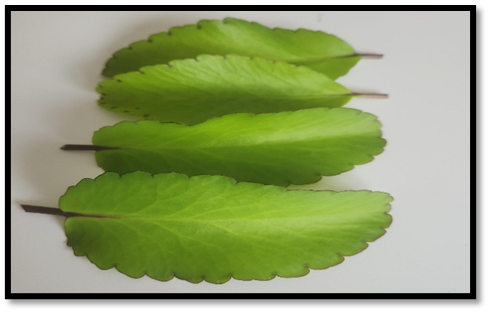
Fig:(B) Bryophyllum Pinnatum Leaves
FLOWERS :
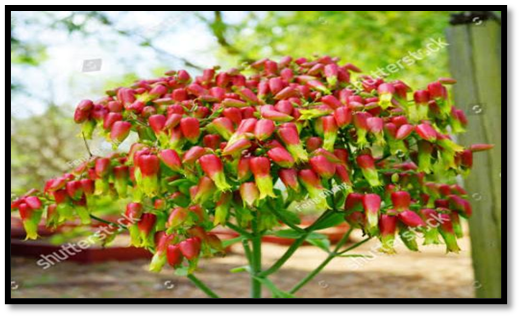
Fig:(C) Bryophyllum Pinnatum Flowers
SEED & FRUIT :
Seed ; Small, smooth, and shaped like an oblong ellipsoid.
Fruit; A persistent, papery calyx and corolla protect the fruit. The fruitpod has four septa and is oblong, ellipsoid, and smooth. The seeds are small and smooth. Striate seeds within. A follicle containing numerous seed

Fig: (D) Bryophyllum Pinnatum Fruit
STEAM :
The young stems of Bryophyllum pinnatum are reddish with white spots, while the older stems become pale in colour. The stems are upright, thick, smooth, and distinctly four-sided in shape.
Phytochemical Constituents:
Bryophyllum pinnatum (also known as Kalanchoe pinnata) contains a wide range of phytochemicals that contribute to its pharmacological activities. The major chemical constituents reported from different parts of the plant include:
Alkaloids:
Bryophylline: An alkaloid reported from Bryophyllum species, noted for its potential analgesic and anti-inflammatory activities (16).
Flavonoids:
kaemferol, rutin & quarcetin are show anti-inflammatory activity & it is powerful antioxidant (2).
Phenol, Phenylpropanoids & Flavonoids:
Syringic Acid, caffeic acid, 4-hydroxy-3 methoxy-cinnamic acid, 4-hydroxybenzoic acid, p-hydroxycinnamic acid,Paracoumaric acid, ferulic acid, protocatechuic acid, (21).
Bufadinolides:
A class of cardiotonic steroids, including compounds such as: Bersaldegenin-1-acetate, Bersaldegenin-1,3,5-orthoacetate, Bryotoxin C, Bryophyllins A and related glycosides(20).
Triterpenoids and Steroids:
Α-amyrin, α-amyrin acetate, β-amyrin, β-amyrin acetate,Bryophollenone, bryophollone, Taraxerol, pseudo-taraxasterol,18-α-oleanane, Friedelin, Glutinol (1).
Saponins:
Saponins are effective against both fungi and bacteria (2).
Pharmacological Activity :
Anti-Bacterial Activity:
Several studies have reported the antibacterial activity of the bryophyllum Pinnatum extract. It demonstrated bactericidal effects against clinical isolates of Streptococcus pyogenes, Bacillus subtilis, Staphylococcus aureus, Streptococcus faecalis, Escherichia coli, Klebsiella spp., Salmonella spp., and Pseudomonas aeruginosa. Schmitt et al. observed antibacterial activity in dilution tube assays, particularly against Gram-positive bacteria. Similarly, Akinpelu reported that a 60% methanolic leaf extract at 25 mg/mL inhibited the growth of five of the eight tested bacterial strains. However, the extract showed no inhibitory effect on Klebsiella pneumoniae, Pseudomonas aeruginosa, or Candida albicans(1,13). The presence of phenolic compounds indicates that the plant possesses antimicrobial activity. Ofokansi et al. (2005) reported that the plant is effective in treating typhoid fever and other bacterial infections, particularly those caused by Staphylococcus aureus, Escherichia coli, Bacillus subtilis, Pseudomonas aeruginosa, Klebsiella aerogenes, Klebsiella pneumoniae, and Salmonella typhi. In their study, the antibacterial activities of the plant’s infusion and methanolic extracts were evaluated against S. aureus ATCC 13709, E. Coli ATCC 9637, Bacillus spp., P. aeruginosa, K. pneumoniae, and S. typhi using the agar diffusion method, as well as against S. aureus, E. coli, S. typhi, Klebsiella spp., and P. aeruginosa using a modified checkerboard method. These findings support the traditional use of the plant in treating the placenta and navel of newborns, promoting rapid healing and preventing infection(5).
Anti-depressant activity:
Animal models have been used to evaluate the effects of Kalanchoe pinnata on the brain and spinal cord. The observed sedative and central nervous system (CNS) depressant activities suggest that the plant influences the neurological and behavioral functions of the animals. In particular, the branch extract of Kalanchoe pinnata has been shown to increase the levels of the neurotransmitter GABA in the brain(12,20).
Anti-histamine activity:
The plant exhibits notable antihistamine and antiallergic properties. The methanol extract of its leaves specifically inhibits histamine (H1) receptors in the lungs and has demonstrated antagonistic activity in the ileum, peripheral blood vessels, and bronchial muscles. Through this mechanism, it provides protection against chemically induced anaphylactic reactions and mortality(25A).
Anti-diabetic activity:
“The aqueous extract of Bryophyllum pinnatum significantly reduced blood glucose levels in both fasted normal rats and fasted streptozotocin-induced diabetic rats(7).” .”The study demonstrated that the aqueous leaf extract of B. pinnatum exhibits anti-diabetic activity at four different doses (200, 400, 800 mg/kg, and 800 mg/kg combined with glibenclamide 2 mg/kg) in diabetic rats induced with glucose (D-glucose, 3 g/kg)(2). The anti-inflammatory and antidiabetic effects of the plant extract were investigated in rats using fresh egg albumin–induced pedal oedema and streptozotocin-induced diabetes mellitus models. The aqueous leaf extract produced significant (P < 0.05–0.001) antinociceptive effects against both thermally and chemically induced nociceptive pain stimuli in mice. The extract also significantly (P < 0.05–0.001) inhibited acute inflammation induced by fresh egg albumin and produced notable hypoglycaemic effects in rats(6).
Anti-viral activity:
The antiviral properties of the juices from eight Kalanchoe species—K. daigremontiana, K. petrii, K. prolifera, K. marnieriana, K. blossfeldiana, K. beharensis, K. waldheimii, and K. pinnata—were tested. The juice from four of these species showed particularly strong virus-neutralizing activity when tested alone(21).
Anti-ulcer activity:
Bryophyllum has anti-ulcer activity (17).“Adesanwo et al. demonstrated a significant, dose-dependent reduction in ulcer incidence as well as in mean basal and histamine-stimulated gastric acid secretion, thereby supporting the traditional use of the plant as an anti-ulcer agent in folklore medicine”(6).
Wound healing activity;
Patil et al. investigated the wound healing potential of Panphuti extracts using petroleum ether, alcohol, and water as solvents. The study evaluated four extracts, including the alcoholic and petroleum ether extracts. All extracts showed significant enhancement in wound healing compared to the control group(1,8).
Anti-inflammatory and analgesic activity:
The leaves and blossoms of Bryophyllum pinnatum are traditionally used for their analgesic and anti-inflammatory effects. Phytochemical studies reveal that the plant contains flavonoids, which can reduce cyclooxygenase (COX) enzyme activity as well as Tumor Necrosis Factor-alpha (TNF-α) activity, thereby modulating inflammatory responses.
Recent studies have identified a novel steroidal derivative in the aqueous extract of the leaves. This compound demonstrated significant anti-inflammatory activity in a diclofenac-induced rat paw edema model. Additionally, it exhibited analgesic properties in rodent models, providing approximately 75.57% protection in the acetic acid-induced writhing test in mice.
Overall, these findings indicate that the aqueous extract of B. pinnatum leaves possesses potent analgesic activity. Furthermore, the ethanolic extract has shown efficacy against both acute and chronic topical inflammation, likely by modulating the arachidonic acid pathway, which is a major contributor to inflammatory processes(2,3,13).
Anti-oxidant activity:
The water-soluble (aqueous) extract of Kalanchoe pinnata was evaluated for protective effects against gentamicin-induced nephrotoxicity in rats (21).
RESULTS AND DISCUSSION:
Bryophyllum pinnatum is a highly valuable medicinal plant with strong ethnobotanical significance and broad pharmacological potential. Rich in phytochemicals such as flavonoids, alkaloids, phenolic compounds, bufadienolides, triterpenoids, and saponins, the plant exhibits diverse therapeutic effects. Scientific studies support its traditional uses, demonstrating significant antibacterial, antiviral, anti-inflammatory, antioxidant, anti-ulcer, anti-diabetic, analgesic, antihistamine, CNS-depressant, nephroprotective, hepatoprotective, and wound-healing activities.
Overall, Bryophyllum pinnatum stands out as a “miracle leaf” not only in folklore but also in modern research. Its rich phytochemical profile and proven therapeutic actions highlight its potential for future drug development and integrative medical applications. Further research and clinical studies will help to fully explore and utilize its medicinal benefits.
REFERENCES


Sneha Gavali, Rashmi Bagul, Bryophyllum Pinnatum: A Comprehensive Review of its Phytochemistry and Pharmacological Activities, Int. J. of Pharm. Sci., 2025, Vol 3, Issue 12, 2987-2994. https://doi.org/10.5281/zenodo.17989124
 10.5281/zenodo.17989124