
Department of Pharmaceutical Chemistry, Tagore College of Pharmacy, Rathinamangalam, Chennai, Tamilnadu, India
Anticoagulant agents play a vital role in preventing and treating thromboembolic disorders through inhibition of key coagulation factors or interference with vitamin K-dependent clotting pathways. Natural coumarins and their derivatives have historically served as structural templates for several synthetic anticoagulants such as warfarin and dicoumarol. Dipteryx odorata (Tonka bean) and Melilotus officinalis (sweet clover) are two Fabaceae species rich in coumarin in the seeds at high concentrations and contributes mainly to fragrance and mild bioactivities, without demonstrating intrinsic anticoagulant properties. Its toxicological concern is hepatotoxicity resulting from metabolic activation of coumarin. Conversely, Melilotus officinalis contains coumarin glycosides that, upon microbial spoilage, convert to dicoumarol-a potent vitamin k antagonist responsible for the classical “sweet clover disease” and the biochemical basis for warfarin discovery. Comparative analysis highlights that while D. odorata represents a non-anticoagulant coumarin source, M. officinalis serves as a natural precursor for anticoagulant agents. Understanding these mechanistic and metabolic distinctions is essential for evaluating their pharmacological significance, toxicity risk, and potential therapeutic applications
Anticoagulant drugs are prescribed to prevent and manage venous thromboembolism, decrease the likelihood of stroke linked to atrial fibrillation, and address a range of other disorders caused by blood clot formation?. [1]. The initial anticoagulant agents, such as unfractionated heparin and warfarin, were originally identified by chance during research efforts?. [2,3]. Over time, advances have led to the development of new medications targeting enzymes like thrombin (factor IIa) and factor Xa, thereby enhancing the prevention and treatment of thromboembolic conditions?. [4,5]. Unfractionated heparin consists of a mixture of varying polysaccharide chains?. In the human body, the function of the primary physiological anticoagulant is significantly boosted by the presence of these polysaccharides?. [6]. Antithrombin acts specifically to block the activity of thrombin and factor Xa, which are both integral to the coagulation process?. [7].
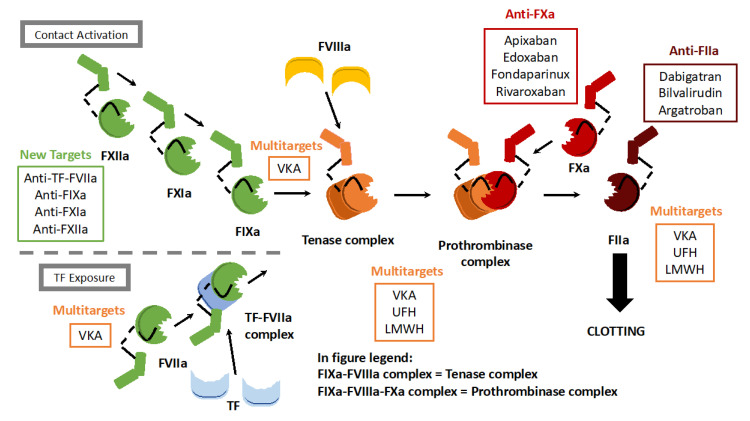
Figure 1: Coagulation Pathway [7]
The coagulation process is divided into three primary pathways: the tissue factor pathway, contact activation pathway, and the common pathway?.Most modern anticoagulant drugs are designed to inhibit key factors within the common pathway, particularly thrombin (factor IIa—targeted by agents like dabigatran, bivalirudin, and argatroban) and factor Xa (blocked by drugs such as apixaban, edoxaban, fondaparinux, and rivaroxaban)?.Agents such as unfractionated heparin, vitamin K antagonists, and low molecular weight heparins exert their effects at multiple points in the coagulation cascade?.Ongoing research and clinical testing are evaluating anticoagulants that specifically inhibit elements within the contact pathway (e.g., FIXa, FXIa, FXIIa) as well as those interfering with the tissue factor route (TF-FVIIa complex); enzymatic complexes like FVIIIa-FIXa (tenase) and FVIIIa-FIXa-FXa (prothrombinase) are crucial nodes in this regulatory network?. [7]. When dicumarol was isolated in 1939, it was discovered to be a potent vitamin K antagonist (VKA). Vitamin K epoxide reductase, an enzyme that recycles vitamin K, is in competition with dicumarol in the bloodstream. [8,9].
MAJOR CLASSES:
Warfarin, an oral vitamin K antagonist, prevents γ-carboxylation of clotting factors II, VII, IX, and X. [10,11]. The direct thrombin inhibitor dabigatran and the direct factor Xa inhibitors rivaroxaban, apixaban, and edoxaban are examples of direct oral anticoagulants (DOACs/NOACs). (oral) — directly block thrombin or Xa's active sites. [12].
HIGH LEVEL CLINICAL USES:
Peri-procedural bridging in some patients, treatment of specific acute coronary syndromes in specific circumstances, prevention/treatment of DVT/PE, and stroke prevention in non-valvular AF. For several non-valvular AF and VTE indications, guidelines increasingly favour DOACs over warfarin due to their equivalent or superior efficacy and decreased major bleeding rates in numerous trials. [13].
1.2 CHEMICAL AND HISTORICAL BACKGROUND OF COUMARIN:
1,2-benzopyrone, also known as coumarin, is a benzopyranone compound that was first isolated from plants belonging to the Dipteryx odorata and Melilotus officinalis families. It is known for its aromatic qualities. [14,15,16]. Warfarin, a coumarin derivative, has anticoagulant properties and is used to kill rodents. [17,18,19]. Vitamin K and coumarin medications share structural similarities. Drugs that resemble coumarins bind to the liver's vitamin K epoxide reductase complex 1 and prevent inactive oxidative vitamin K from becoming active reducing vitamin K. The actions of coagulation factors VII, IX, X, and II (which lower prothrombin synthesis) are mediated by active vitamin K. Bleeding is one of warfarin's side effects, which can be brought on by interactions with other medications or foods that intensify the anticoagulant effect. [16]. The anticoagulant effects of 4-hydroxycoumarin derivatives, such as Warfarin, Dicoumarol, and Acenocoumarol, have a greater impact than those of coumarin itself. [20].
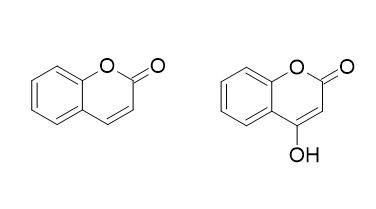
Figure 2: Structure of coumarin & 4-hydroxycoumarin [21]
2. PHYTOCHEMICAL COMPOSITION:
2.1 Dipteryx odorata (Tonka Beans):
Coumarouna odorata Aubl., a synonym for Dipteryx odorata, belongs to the Fabaceae family. Common names include muirapajé, cumbari, cumbaru, cumaruzeiro, cumaru-do-amazonas, fava-de-cumaru, paru, cumaru, cumaru-roxo, cumaruverdadeiro, and fava-tonga. It has a 1-3% coumarin content, which gives it a pleasant smell. [22,23,24,25]. Germacrene D (34.2%), bicyclogermacrene (14.3%), spathulenol (12.4%), a-cadinol (4.3%), and nonanal (2.9%) were the main constituents found. The levels of other constituents were established at a maximum of 1.8%. The primary substance found in seeds but absent from flowers is coumarin. [22].
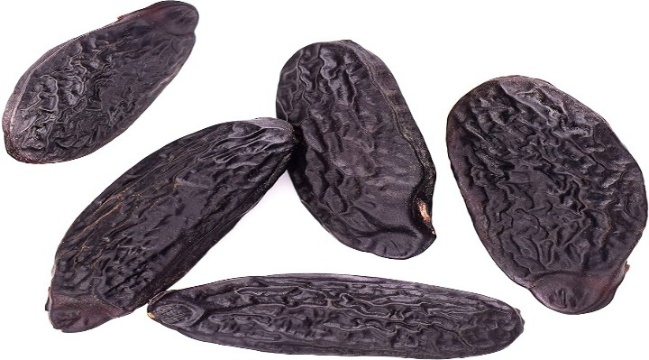
Figure 3: Tonka beans (Dipteryx odorata)
2.2 Melilotus officinalis (Yellow sweet clover):
The forage plant known as sweet clover (Melilotus spp.) is a member of the Faboideae subfamily and the Fabaceae family of legumes. [26,27]. Sweet clover comes in about 25 varieties, but the two most common ones are yellow sweet clover (Melilotus officinalis (L.) Lam.) and white sweet clover (Melilotus albus Medic.). [26,28,29]. Dicoumarol was later identified as the leading agent. [30,31,32,33]. coumarin, a naturally occurring plant metabolite that is abundant in sweet clover, is used to make an anticoagulant. [33]. The entire or chopped dried aerial portions of Melilotus officinalis (L.) Lam., with a minimum coumarin content of 0.3%, make up the herbal raw material known as Meliloti herba, according to the European Pharmacopoeia. [26,34]. When steam distillation was applied, the process yielded the greatest amounts of several compounds, including ethyl 2-(5-methyl-5-vinyltetrahydrofuran-2-yl) propan-2-ylcarbonate, β-phellandrene, benzeneacetaldehyde, phenylethyl alcohol, β-menthane, and thymol, each present in varying percentages?. Soxhlet extraction was most effective for isolating caryophyllene, 13-epimanool, phenylacetic acid, and p-eugenol, with high concentrations detected for these chemicals?. When ultrasound-assisted extraction (USE) was performed, phenylacetic acid, α-(phenylmethyl)benzenethanol, and p-acetoxyanisole emerged as the predominant components. [35,36]. Column chromatographic (CC) fractionation was used to separate the 70% ethanol extract of yellow sweet clover, yielding the following recognized compounds: fumalic acid, betaine, coumarin, salicylic acid, caffeic acid, luteolin, and quercetin. [26,37,38,39,40,41,42,]
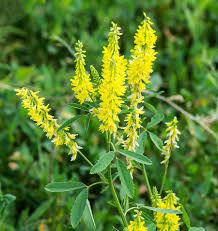
Figure 4: Yellow sweet clover (Melilotus officinalis)
3. INHIBITION MECHANISM OF COAGULATION
3.1 COUMARIN:
Although coumarin does not inhibit vitamin K, its derivative, 4-hydroxycoumarin, can inhibit [8]
MECHANISM OF ACTION OF 4-HYDROXY COUMARIN:
γ-carboxylation of coagulation factors reliant on vitamin K: γ-carboxylation of glutamate residues is necessary for the functional activation of several clotting factors (II, VII, IX, X) and anticoagulant proteins (C, S); this post-translational alteration enables calcium binding and connection with phospholipid surfaces that are crucial for coagulation. [43]. Reduced vitamin K (vitamin K hydroquinone, KH?) is used as a cofactor in the carboxylation reaction; during the reaction, KH? is oxidized to produce vitamin K 2,3-epoxide (VKO). The liver's Vitamin K epoxide reductase (VKORC1) enzyme complex is then required to recycle VKO back to KH?. [44].
Inhibition of vitamin K epoxide reductase (VKORC1):4-hydroxycoumarin anticoagulants work by targeting VKORC1, preventing the regeneration of the active (reduced) form of vitamin K from its oxidized counterpart, thereby impairing the γ-carboxylation necessary for proper clotting if KH? is deficient?. [44].
3.2 Dipteryx odorata (Tonka beans):
Although the chemical coumarin (1,2-benzopyrone) is present in the seeds of Dipteryx odorata at a weight percentage of approximately 1-3 percent, there is no peer-reviewed evidence from any sources that this substance has a legitimate anticoagulant mechanism in either humans or animals, such as vitamin K-cycle inhibition. To assert anticoagulant action or mechanism, coumarin alone is insufficient. [8,21,45]
3.3 Melilotus officinalis (Yellow sweet clover):
Source of anticoagulant: Formation of dicoumarol: A naturally occurring component of sweet clover, Melilotus officinalis, is coumarin (1,2-benzopyrone). Microbial oxidation (fungal metabolism) transforms coumarin into dicoumarol (bis-4-hydroxycoumarin), a dimeric 4-hydroxycoumarin derivative, when the plant or hay becomes moldy or rotten. Cattle and other animals have historically developed "sweet-clover disease" (hemorrhagic sickness) as a result of this conversion. [46].
Chemical Class responsible for anticoagulation: Dicoumarol, a derivative of 4-hydroxycoumarin, is the active anticoagulant. The 4-hydroxycoumarin scaffold (dicoumarol, warfarin, and acenocoumarol) produces anticoagulation; plain coumarin has little to no anticoagulant effect on its own. [47].
Molecular Mechanism of inhibition of the vitamin K cycle: The enzyme responsible for converting vitamin K epoxide back to its active, reduced form (hydroquinone, KH?), known as vitamin K epoxide reductase (VKOR or VKORC1), is inhibited by dicoumarol and other 4-hydroxycoumarin derivatives such as warfarin?. As a result, the critical γ-carboxylation process needed for the activation of vitamin K-dependent clotting factors—specifically factors II, VII, IX, and X—as well as proteins C and S, is compromised when vitamin K availability is limited?. Ca2+ and phospholipid membranes cannot be efficiently bound by under-carboxylated factors, which results in reduced thrombin production and anticoagulation. This is the proven metabolic underpinning of the anticoagulant effects of warfarin and dicoumarol. [21]. The coumarin found in Melilotus officinalis is transformed by microbial spoiling into dicoumarol, a 4-hydroxycoumarin dimer, which inhibits vitamin K epoxide reductase (VKORC1) competitively and prevents the γ-carboxylation of vitamin-K-dependent clotting factors (II, VII, IX, X). [48].
4. MEDICINAL AND BIOLOGICAL EFFECTS:
In addition to its traditional therapeutic applications for respiratory, lymphatic, and spasm disorders, D. odorata exhibits antifungal and other bioactivities. [24,45]. The biological activities of M. officinalis (anti-inflammatory, antioxidant, hepatoprotective, and immunomodulatory) are better documented than those of D. odorata. [26,37].
5. COUMARIN TOXICITY:
5.1 Dipteryx odorata (Tonka beans):
Liver damage, or hepatotoxicity, is the primary worry. The metabolism of coumarin in both humans and animals results in 3,4-coumarin epoxide and o-hydroxyphenylacetic acid, which can elevate enzymes and necrotize liver cells. [36].
5.2 Melilotus officinalis (Yellow sweet clover):
The natural coumarin found in fresh yellow sweet clover (Melilotus officinalis) is non-toxic. However, fungal metabolism transforms coumarin into dicoumarol, a strong anticoagulant that prevents vitamin K recycling and results in hemorrhagic toxicity, also referred to as "Sweet Clover Disease," when stored in damp or moldy circumstances. [48,49,50].
6. NATURAL MODULATORS OF COUMARIN TOXICITY:
Several natural modulators influence coumarin toxicity, including intracellular glutathione-mediated conjugation [51], species-specific metabolic detoxification pathways (e.g., conversion of coumarin to O-hydroxyphenylacetic acid instead of epoxide) [52], induction of detoxification enzymes (GST/P450) by coumarins themselves [53], microbial degradation in gut or environmental microbiota [54]. These mechanisms reduce the formation or presence of toxic metabolites and thereby modulate toxicity risk.
7. REGULATION OF COUMARIN:
A Tolerable Daily Intake (TDI) of 0.1 mg of coumarin per kilogram of body weight was set by the European Food Safety Authority (EFSA). Accordingly, an adult weighing 60 kg should not consume more than 6 mg per day; yet, consuming 0.2 g of tonka beans may surpass that limit. [55]. In 1954, coumarin was banned from use in the United States when it was discovered to induce liver toxicity in humans and carcinogenicity and mutagenicity in animals. Based on experimental evidence showing that coumarin can produce both benign and malignant tumours in the liver, kidneys, and lungs of animals, the UK outlawed coumarin in 1964. [56].
CONCLUSION:
Although coumarin is a crucial phytochemical in both Melilotus officinalis (sweet clover) and Dipteryx odorata (tonka bean), their anticoagulant properties are essentially different. Although coumarin is found in considerable quantities in Dipteryx odorata, it does not interfere with vitamin K-dependent coagulation pathways, so it does not have an intrinsic anticoagulant effect. Its toxicity is mostly hepatocellular because to the metabolic production of reactive coumarin metabolites, whereas its medicinal role is mostly aromatic with modest antioxidant and antifungalactivities.
On the other hand, coumarin glycosides found in Melilotus officinalis are converted into dicoumarol, a strong antagonist of vitamin K, when they are exposed to microbial spoiling. Historically referred to as Sweet Clover Disease, dicoumarol inhibits the vitamin K epoxide reductase enzyme, impairing the formation of clotting components and producing hemorrhagic and anticoagulant effects.Overall, Dipteryx odorata serves as a natural coumarin source with limited pharmacological anticoagulant potential but possible hepatotoxicity, whereas Melilotus officinalis demonstrates a clear biochemical pathway for anticoagulant activity through microbial conversion of coumarin. These distinctions highlight how structural and metabolic differences in coumarin derivatives determine whether a plant exhibits therapeutic or toxic anticoagulant effects.
REFERENCES:



Bhuvana Ezhil Rohini*, Abishake S., Subhalakshmi R., Devadharshini M., Kirankumar R. , Comparative Analysis of Anticoagulant Activity in Dipteryx Odorata (Tonka Bean) And Melilotus Officinalis (Yellow Sweet Clover)), Int. J. of Pharm. Sci., 2026, Vol 4, Issue 2, 754-762. https://doi.org/10.5281/zenodo.18493412
 10.5281/zenodo.18493412
