
Chaudhary Charan Singh University, Meerut, Bharat 250004
The blue-green algae (Cyanoprokaryotes) are considered as one of the most ancient microorganisms. The members of this group are capable to perform oxygenic photosynthesis and evolve oxygen as a by-product and few of them are also capable to perform nitrogen fixation and contribute significantly in ecosystem. Present investigation deals with potential of scytonemin of nine species of sub-aerial blue-green algae i.e. Calothrix braunii, C. kuntzei, Fischerella major, Scytonema chengii, S. insulare, S. tolypothrichoides, Stigonema expansum, Westiellopsis interrupta and W. iyengari. All the species of were collected and isolated from the sub-aerial habitats of Meerut, Western Uttar Pradesh, Bharat, identified and evaluated for harnessing of their potential for scytonemin, UV screening compounds for pharmaceutical applications.
The blue-green algae (Cyanoprokaryotes/ Cyanobacteria) are considered as one of the most ancient microorganisms and they are found growing in all most all types of known habitats (Singh et al, 2021, 2022; Sarma et al., 2022, 2023; Kant, 2011; Kant et al., 2024). They are the first autotrophic organisms on Earth (Singh et al., 2016). The members of this group are capable to perform photosynthesis and evolve oxygen as a by-product. In addition, some those particularly heterocystous forms of blue-green algae are also capable to perform nitrogen fixation (Tiwari et al., 2007). The endowment of these two unique characteristics by the nature, make them different from all other living forms and they depend on solar radiation for their existence and thrive on exposed surfaces of building walls, roofs, rocks and tree barks and there they face very harsh and extreme environmental conditions and solar radiations during summer (Kant et al., 2005).
The blue-green algae have been taxonomically categorized according to their morphological characteristics and growth patterns by several algologists (Gomont 1892; Geitler 1932; Desikachary 1959). The blue-green algae exhibit advanced filamentous morphological characteristics, including heterocystous trichomes, as well as both false (Nostocales) and real (Stigonematales) branching. Primarily, blue-green algal species are enveloped in a dense gelatinous coating (Banerjee and Pal, 2017). They possess numerous beneficial bioactive compounds utilized in the cosmetics, nutraceutical, and pharmaceutical industries, as well as in human food, animal feed, biofuel production, biofertilizers, and phycobiliproteins for the control of plant pathogens (Pandey and Tripathi, 1988; Kant et al., 2004, 2006; Kant, 2012; Righini et al., 2022; Gauri et al., 2024, 2025; Gupta et al., 2025). Additionally, blue-green algae exhibit antibiotic, antifungal, anticancer, antibacterial, antimicrobial, antiviral, antitumor, anti-inflammatory, immunosuppressant, anti-HIV and antimalarial (Zahra et al., 2020), anti-parasitic, hepatoprotective, anti-diabetic, anti-obesity, antioxidant, anti-aging, photoprotective, neuroprotective bioactivities and many other bioactive compounds (Perera et al., 2023). Approximately 2000 secondary metabolites have been found in blue-green algae. The brown coloration of blue-green algal colonies results from extracellular pigments, including Mycosporine-like Amino Acids (MAAs) and Scytonemin (Castenholz & Garcia-Pichel 2012).
The Scytonemin is a UV-absorbing pigment generated solely by certain subaerial blue-green algae as a defense against detrimental ultraviolet light of solar radiations. The Scytonemin is lipid-soluble, yellow-brown molecule and is classified as an indole-alkaloid and demonstrates significant absorption in the UV-A (315–400 nm) and UV-B (280–315 nm) areas, rendering it a potential natural photoprotective agent for pharmaceutical uses (Pathak et al., 2022). Blue-green Algae, especially those inhabiting severe habitats including deserts, intertidal zones, and rocky substrates, synthesize scytonemin inside their extracellular sheath to alleviate oxidative stress and DNA damage caused by extended UV exposure (Rastogi et al., 2023). Recent research has emphasized its powerful antioxidant, anti-inflammatory, and photostable characteristics, establishing it as a feasible substitute for synthetic sunscreens, which frequently provide ecological and dermatological hazards (Singh et al., 2023). Additionally, the biosynthesis route of scytonemin, which includes essential enzymes like ScyA, ScyB, and ScyC, has been genetically elucidated, facilitating potential biotechnological mass production (D’Agostino et al., 2024). In light of the escalating global prevalence of skin cancer and photoaging, alongside heightened regulatory constraints on chemical UV filters such as oxybenzone, scytonemin's environmentally friendly and biocompatible characteristics render it an attractive option for advanced photoprotective formulations (Gomes et al., 2023). This study examines the molecular characteristics, biosynthetic pathways, and therapeutic potential of scytonemin, highlighting its incorporation into pharmaceutical and cosmeceutical formulations, bolstered by recent progress in cyanobacterial biotechnology. The present research work is focused on the analysis of UV sun screening compound Scytonemin from the isolated sub aerial blue-green algal species were collected from Meerut, Western Uttar Pradesh, Bharat.
MATERIALS AND METHODS
The blue-green algae containing sample were collected from the study area and were inoculated into liquid BG-11 (Stainer et al., 1971) nutrient medium for enrichment culturing. A total nine species of five genera of sub-aerial blue-green algae viz. Calothrix braunii, C. kuntzei, Fischerella major, Scytonema chengii, S. insulare, S. tolypothrichoides, Stigonema expansum, Westiellopsis interrupta and W. iyengari were isolated and purified from the enrichment cultures, with the help of methods described by Kant et al. (2005). The morphological characteristics of isolated blue-green algal species were observed with the help of trinocular research Microscope (Olympus, CH20i) and digital Magnus Magcam camera (DC 10). All the isolated species were identified with the help of available monographs (Komárek and Anagnostidis, 1998; 2005, Komárek , 2013). Morphological details are mentioned in Table-1 and Figure-1. The estimation of scytonemin was done following the method described by the Garcia-Pichel and Castenholz (1991).
All the experiments were designed in conical flask (Borosil) containing 100 ml of BG11 nutrient medium and all the selected species were maintained under the controlled culture conditions (4 K Lux light, 14:10 LD, temp. 30±2 ºC). All blue-green species were grown in batch culture and were harvested at 10,20,30,40 days of inoculation to examine the potential of sub-aerial blue-green algae for scytonemin production for pharmaceutical application. During the harvesting (after 10 days) three flask for each species were used to analysis of UV screening compound. All the experiments were performed in the triplicate.
RESULTS AND DISCUSSION
All the nine isolated species belong to the filamentous and heterocystous group of Blue-green algae and out them seven species are branched forming. Studied species include Calothrix braunii, C. kuntzei, Fischerella major, Scytonema chengii, S. insulare, S. tolypothrichoides, Stigonema expansum, Westiellopsis interrupta and W. iyengari. Morphological details of studied species of sub-aerial blue-green algae are given in Table-1 and Figure 1.
The scytonemin content obtained from different subaerial blue-green algae across time intervals of 10, 20, 30, and 40 days demonstrate considerable fluctuations in production levels, which are essential for medicinal applications. The highest scytonemin concentration was recorded in Scytonema tolypothrichoides at 30 days with 0.2590 µg/ml, demonstrating its significant potential for large-scale extraction. W. iyengari demonstrated significant output, especially at 20 days with 0.1826 µg/ml and 30 days with 0.2211 µg/ml, indicating optimal harvesting within this timeframe. The minimal scytonemin content was observed in F. major at 10 days with 0.0247 µg/ml and S. expansum at 10 days with 0.0209 µg/ml, indicating their reduced efficacy during early development stages. S. chengii consistently demonstrated poor yields at all intervals, with the minimum yield recorded at 10 days with 0.0267 µg/ml, rendering it less appropriate for pharmaceutical applications. The results indicate that S. tolypothrichoides and W. iyengari are the most viable candidates for scytonemin extraction, especially within a 20–30 day period, while species such as F. major and S. expansum may necessitate extended cultivation or genetic enhancement for satisfactory yields. Details of the result are given in the figure B. The research highlights the significance of choosing high-yield strains and ideal harvest periods to optimize scytonemin production for UV-protective medicines.
The synthesis of scytonemin have been reported in the several cyanoprokaryotes viz. Aphanothece, Asterocapsa, Gloeocapsa, Porphyrosiphon, Chlorogloeopsis etc. either found growing on the surfaces exposed to direct sunlight viz. rooftops of monuments, building walls, wet rocks and tree barks or cyanoprokaryotes floating on the surface of water bodies and enjoy direct sunlight exposure of the sun during daytime viz. Gloeotrichia, Aphanothece (Mishra et al, 2015).
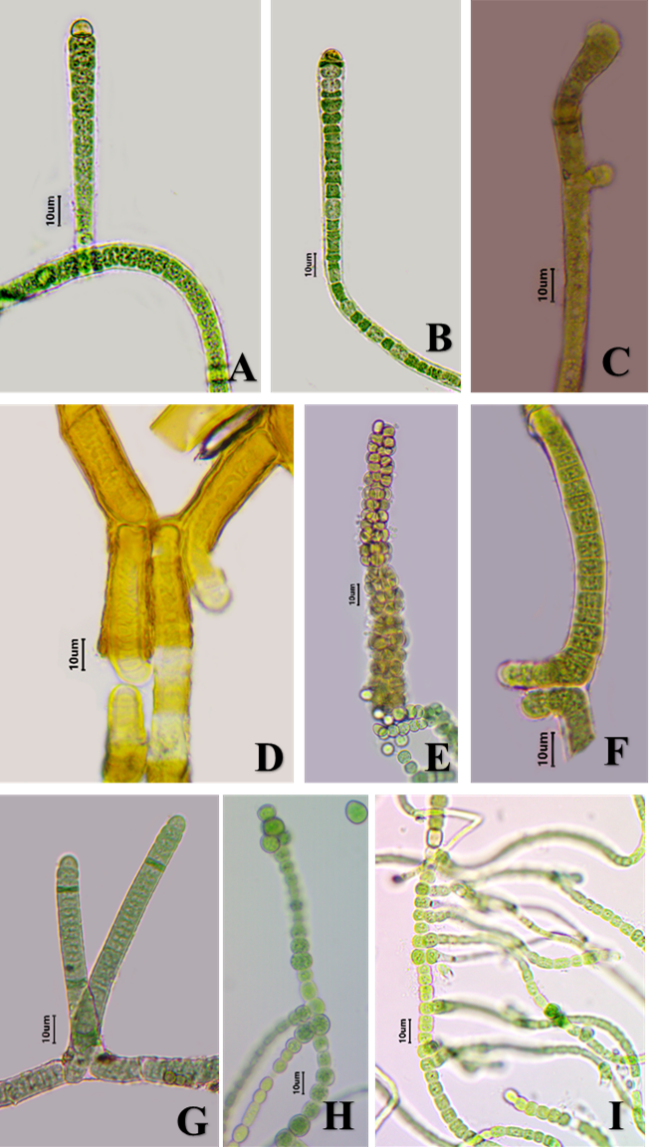
Figure: 1. Morphology details of nine blue-green algae species A. Calothrix braunii; B. C. kuntzei; C. Fischerella major; D. Scytonema chengii; G. S. insulare F. S. tolypothrichoides; E. Stigonema expansum; H. Westiellopsis interrupta, I. W. iyengar; H. Westiellopsis interrupta, I. W. iyengar
Table 1. Showing the morphological details of the isolated sub-aerial blue-green algae.
|
Sr. No. |
Blue-green Algal species |
Morphological characteristics |
|
|
Calothrix braunii |
Filaments 500 µm long, 9–12 µm broad, single. Sheaths thin, colorless. Trichomes blue-green, 6–8 µm wide at the base. Cells cylindrical and isodiametric. Heterocysts 6-11 × 8.2-12.4 µm, basal, solitary (Fig. 1A). |
|
|
C. kuntzei |
Thallus blue-green, up to 5 mm thick. Sheaths lamellated, thick, solid, and colorless up to golden yellow. Trichomes typically constricted at the cross-walls, ±10 µm at the bases. The blue-green, cylindrical to slightly barrel-shaped vegetative cells. Heterocysts up to 7 µm long and spherical (Fig. 1B). |
|
|
Fischerella major |
Thallus brownish-green, thick, long, and prostrate. The filaments 8–16 µm broad. The branches upright, cylindrical, 6–12 µm broad. The cells subspherical and 6–8 µm in diameter. Intercalary, cylindrical, the three types of heterocysts. Large, ovoid measuring length 10-14 and width 7-10 µm referred to as akinetes (Fig. 1C). |
|
|
Scytonema chengii |
Filaments, 7-11 µm wide, and highly false-branched, up to 1 mm long. Sheaths hard, hyaline at first, yellowish. Trichomes cylindrical and 4-6.5 µm broad. The cells pale blue-green, 5.5–11.5% long, isodiametric. Heterocysts length 8-11.5 and width 5-7.5 µm, intercalary, and uncommon (Fig. 1D). |
|
|
S. insulare |
Thallus 9–15 µm broad, blackish, and filaments. The brownish sheaths piled parallel to one another. Trichomes 5–13 µm broad and restricted at cross-walls. Cells 2.5–10 µm long, violet or blue-green material. Heterocysts length 3.5-14 and width 5.5-12 µm, intercalary (Fig. G). |
|
|
S. tolypothrichoides |
Thallus round, brownish or green, and up to 3 cm in diameter. Filaments had abundant fake branches and 10–17 µm wide and 5–6 mm long. Cells measured length 3.5-14 and width 8-14 µm, olive-green, yellowish, or pale blue-green, cylindrical, isodiametric. Heterocysts 6–16 µm long, barrel-shaped, spherical to elongate cylindrical (Fig. 1F). |
|
|
Stigonema expansum |
Thallus had upright and creeping filaments. Filaments olive-green, 40-90 µm broad, and found in branches. The diameter of the ellipsoidal or spherical cells ranged from 10.4 to 22.8 µm. Globose or subglobose, irregularly shaped, or intercalary heterocysts all possible, length 52-132.6 width 10.4-33.8 µm (Fig. 1E). |
|
|
Westiellopsis interrupta |
The main filaments coiled unevenly. Heterocysts intercalary, 6.2-8 × 4.5-5.3 µm, quadrate to oblong cylindrical. Monocytes develop individually from rounded cells 4-6.4 µm in diameter, measuring length 4.8-11 and width 24.8-7.4 µm (Fig. 1H). |
|
|
W. iyengari |
The main filaments length 4.9-13.2 and width 4.2-13.2 μm, irregular, barrel-shaped cells. Trichomes had oval to long, cylindrical cells that length 2.5-19.8 and width 2.8-4.9 µm. Sheaths stiff and thin, tight to trichomes, thickened up to 2.5 µm. The intercalary heterocysts measured length 4.2-23.1 and width .2-15.6 µm and cylindrical (Fig. 1 I). |
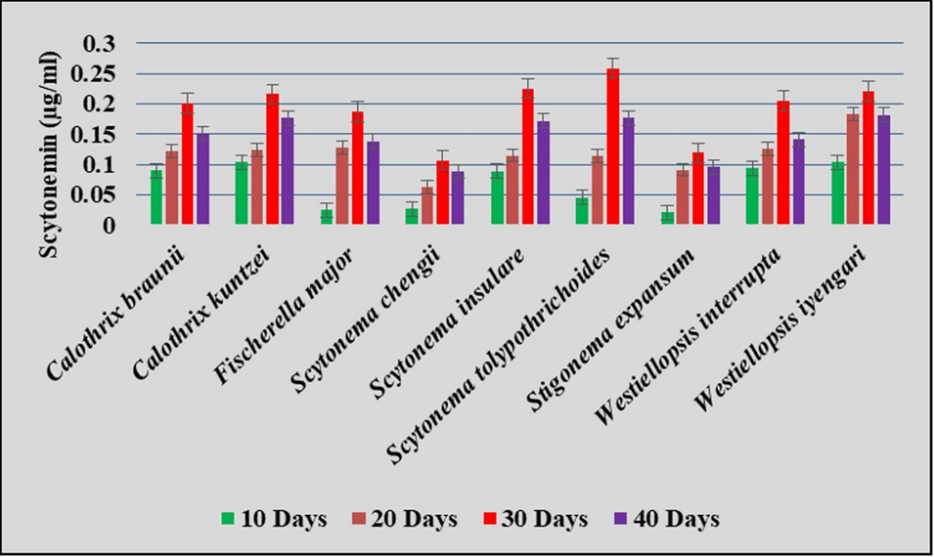
Figure: 2. Showing Scytonemin content (µg/ml) in the nine species of the blue-green algae on 1-4 harvesting on 10th, 20th, 30th and 40th day of inoculation.
Scytonemin, an UV-absorbing pigment synthesized by sub-aerial blue-green algae, has emerged as a potential natural chemical for therapeutic uses owing to its potent ultraviolet (UV) absorption and antioxidant effects. This lipid-soluble, yellow-brown pigment is predominantly produced in reaction to UV radiation, providing photoprotection to blue-green algae in harsh habitats (Garcia-Pichel & Castenholz, 1991). Its distinctive structure, comprising indolic and phenolic subunits, enables the absorption of both UVA (315–400 nm) and UVB (280–315 nm) radiation, positioning it as a viable option for inclusion in sunscreens and anti-aging skincare products (Rastogi et al., 2014). The extraction yields of scytonemin fluctuate based on the cyanobacterial species and environmental factors. Research indicates that scytonemin concentrations vary between 0.1% and 5% of dry biomass in strains such Nostoc commune and Scytonema sp. (Prasanna et al., 2009). Optimized advanced extraction procedures, such as solvent-based approaches utilizing acetone or methanol, enhance yield and purity, essential for pharmaceutical standards (Bultel-Poncé et al., 2004). Moreover, scytonemin has UV-blocking actions alongside anti-inflammatory and antioxidant capabilities, indicating its promise in mitigating UV-induced skin damage and illnesses associated with oxidative stress (Stevenson et al., 2002).
The integration of scytonemin into pharmaceutical and cosmeceutical formulations may offer a natural substitute for synthetic UV filters such as oxybenzone, which have elicited concerns regarding environmental toxicity and dermal irritation (Downs et al., 2016). Nonetheless, scaling is a hurdle, as the extensive culture of blue-green algae for scytonemin production necessitates optimization. Subsequent study ought to concentrate on biotechnological methodologies, including genetic modification and bioreactor culture, to improve yield and commercial feasibility (Pathak et al., 2018). Scytonemin is a sustainable, multifunctional biomolecule with considerable promise for photoprotective and medicinal uses. Pathak et al. (2019) indicated that Scytonemin is a lipid-soluble, very stable yellow-brown secondary metabolite that accumulates in the extracellular polysaccharide sheath of some, but not all, cyanobacteria. Scytonemin is a crucial metabolite for ecology and medicine. Recent advancements in the genetics and biochemistry of this chemical have facilitated its utilization and commercialization for the benefit of humanity. Pandey et al. (2020) demonstrated the effects of scytonemin's UV-screening on the growth, pigmentation, survival, and nitrogen metabolism enzymes of cyanobacterial strains. The data indicate that scytonemin enhances the survival and adaptability of cyanobacteria in challenging environmental conditions.
CONCLUSION
The study highlights the significance of choosing high-yield species such as S. tolypothrichoides and optimizing the culture period for about 30 days to increase scytonemin production for pharmaceutical applications. Due to its robust UV-absorbing characteristics, scytonemin has the potential to function as a sustainable, biocompatible component in sunscreens and photoprotective products, contingent upon more study confirming its stability, safety, and scalability for industrial manufacturing.
ACKNOWLEDGEMENT
Authors are thankful to Head, Department of Botany, Chaudhary Charan Singh University, Meerut for providing necessary facilities. The Authors are also thankful to U.P. Govt. for financial support under the Centre of Excellence (F.No.70/2022/1543/ Sattar-4-2022/ 001-70-4099-7-2022). Authors are also grateful to the Vice-Chancellor, CCS University, Meerut for financial support under the UGRS (Ref. No. Dev/1043; Sl.No.25). We are also thankful to Prof. G.L. Tiwari, Retd. Professor and Head, Department of Botany, University of Allahabad, Prayagraj for identification of Sub Aerial Blue-green Algae.
REFERENCES

Sunil Kumar, Rama Kant, Exploring The Sub-Aerial Blue-Green Algae for Scytonemin, An UV Screening Pigment for Pharmaceutical Application, Int. J. of Pharm. Sci., 2025, Vol 3, Issue 8, 866-874. https://doi.org/10.5281/zenodo.16778619
 10.5281/zenodo.16778619
