
ROFEL Shri G. M. Bilakhia College of Pharmacy, Vapi, Gujarat, India 396191
The aim of this project to formulate and evaluate an exfoliating polyherbal body wash using natural extracts of dragon fruit (Hylocereus undatus) and papaya (Carica papaya). These fruits are known for their antioxidant properties, gentle exfoliating enzymes and skin-nourishing capabilities. The goal was to develop a natural, skin-friendly alternative to conventional body washes. Dragon fruit and papaya were selected and authenticated. Pectin and papain were extracted from the respective fruits using acid extraction and maceration techniques. The presence of these bioactive compounds was confirmed through FTIR spectroscopy. Several formulations were prepared and evaluated based on physicochemical parameters including pH, viscosity, foaming ability, stability and cleansing efficiency. The final formulation was optimized by adjusting the composition for ideal skin compatibility. The optimized formulation showed satisfactory results on performing evaluation parameters tests. Organoleptic evaluation revealed a pleasant odour, red coloration and appropriate consistency. The body wash remained stable at elevated temperatures for 28 days without significant changes. Volunteer feedback supported the product’s effectiveness, acceptability and overall satisfaction.
Shower gel is a specialized liquid product used for cleaning body during showers. Not to be confused with liquid soap, in fact do not contain saponified oil. Instead, it uses herbal plant as an ingredient. Shower gel has lower pH value than the traditional soap, which is also known to feel less drying to the skin. Shower gel have a high liquid consistency. Designed to foam when applied to the skin, many also contain foaming agents such as SLS. These ingredients produce lather when they are applied to the skin and come in contact with water, but have very different molecular structure so can affect the skin in different ways. Unlike slippery soap bars, shower gels have a liquid format that may find more convenient to wash with.
The main benefit of using shower gel include:
Types of bodywash
Advantages
The advantages of using body wash over traditional bar soap include:
Materials
Synonyms of dragon fruit is pitahaya, yellow pitahaya or pitaya.
Its botanical name is Selenicereus undatus and it belongs to Cactaceae family.
Chemical constituents are Betacyanins, pectin and dietary fiber, along with polyphenols and flavonoids. Pectin is extracted from its peel.
Taxonomy
Kingdom: Plantae
Division: Spermatophyta
Ordo: Cactaceae
Genus: Hylocereus
Species: Hylocereus polyrhizu, Hylocereus undatus, Hylocereus megalanthus
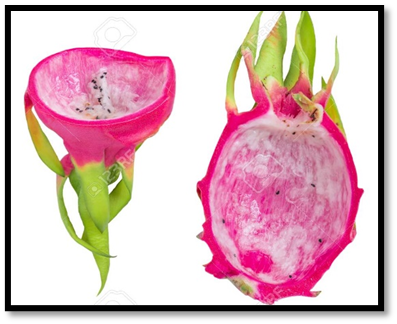
Fig 1: Dragonfruit peel
Synonyms of papaya is Papaia, pawpaw.
Its botanical name is Carica Papaya and it belongs to Caricaceae family.
Papaya contains a variety of chemical constituents including vitamins (A, B, C, E, K), minerals, enzymes (papain, chymopapain), carotenoids (lycopene, beta-carotene), flavonoids, phenolic acids, alkaloids, and other compounds. Papain is extracted from outer surface of raw papaya.
Taxonomy
Kingdom: Plantae
Division: Magnoliophyte
Order: Violales
Genus: Carica L.
Species: Carica papaya L.
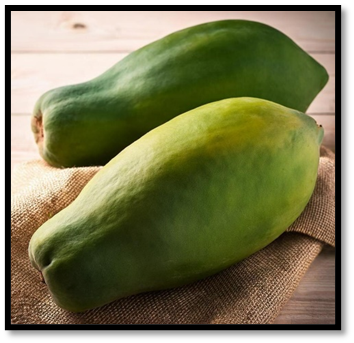
Fig 2: Papaya
Excipients used in bodywash
It is low molecular weight polymer of ethylene oxide with an average molecular weight of about 400. It is clear, viscous, hygroscopic liquid, widely used as a solvent, humectant, plasticizer, and vehicle in pharmaceutical, cosmetic, and industrial formulations.
It lowers the surface tension of water, allowing better spreading and wetting, and produces foaming cleansing. It is a surfactant commonly used in pharmaceutical, cosmetic, and cleaning formulations.
It is a sweet, colourless, odourless, viscous liquid that is widely used as humectant, solvent, and sweetening agent pharmaceutical, cosmetic, and food preparation.
It is a semisynthetic, inert, viscoelastic polymer derived from cellulose, widely used as thickener, stabilizer, film-former, and controlled-release agent.
It is a water-soluble, anionic derivative of cellulose used as a thickener, stabilizer, suspending agent, and binder in pharmaceutical, cosmetic, and food formulations.
Method of preparation:
Extraction of pectin from dragon fruit peel: [2]
Take dried dragon fruit peel and weighed it, add water in a beaker containing dried peel in 1:2 ratio and heat it at 60-90°C.
Add HCl to balance the pH in the range 1-3, stir it occasionally, add methanol and stir, later the formation of gelatinous mass (pectin) on the top obtain.
Extraction of papain from papaya: [3]
Take raw papaya and make longitudinal cuts on outer surface of papaya, wait for few minutes and papain will appear on the outer surface of papaya and with the help of spatula scrap the papain and collect it
Method of preparation of bodywash: [4]
Take 66.2ml of water and add 6.67gm of SLS
Now slowly add 1.67gm of Na CMC and 2.67gm of HPMC K 100, mix until a homogenous mixture is obtained.
In another beaker add 8.9gm glycerine, 8.9gm PEG 400, 8.9gm Papain and 16ml dragon fruit extract
Mix both the above solution and stir it properly.
Resulting solution obtained is final mixture.
Preparation of Batches:
Table 1: Different Batches which were formulated for preparation of ideal batch
|
Formulations |
Water (ml) |
SLS (gm) |
HPMC K100 (gm) |
Na CMC (gm) |
Dragon fruit extract (ml) |
Papaya extract (ml) |
PEG 400 (ml) |
Glycerin (ml) |
Rosemary (ml) |
|
F1 |
20 |
2 |
0.4 |
0.4 |
5 |
2.5 |
2.5 |
2.5 |
q. s |
|
F2 |
20 |
2 |
0.6 |
0.4 |
5 |
2.5 |
2.5 |
2.5 |
q. s |
|
F3 |
20 |
2 |
0.8 |
0.4 |
5 |
2.5 |
2.5 |
2.5 |
q. s |
|
F4 |
20 |
2 |
1.0 |
0.4 |
5 |
2.5 |
2.5 |
2.5 |
q. s |
|
F5 |
20 |
2 |
0.4 |
0.5 |
5 |
2.5 |
2.5 |
2.5 |
q. s |
|
F6 |
20 |
2 |
0.6 |
0.5 |
5 |
2.5 |
2.5 |
2.5 |
q. s |
|
F7 |
20 |
2 |
0.8 |
0.5 |
5 |
2.5 |
2.5 |
2.5 |
q. s |
|
F8 |
20 |
2 |
1.0 |
0.5 |
5 |
2.5 |
2.5 |
2.5 |
q. s |
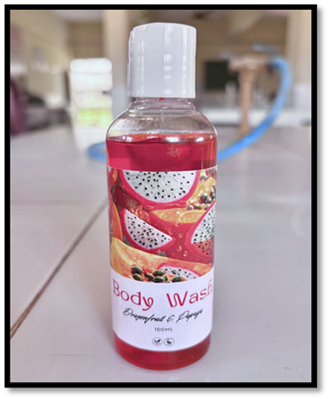
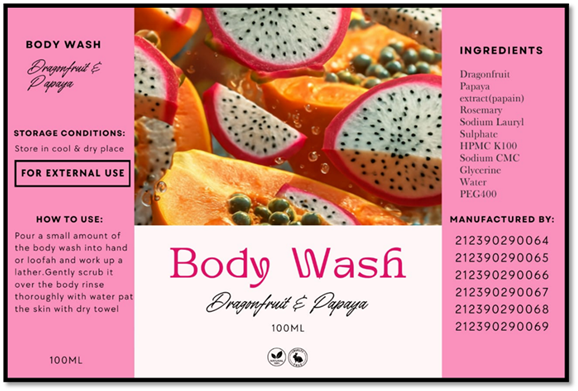
Fig 3: Final Product Fig 4: Final Product
The bodywash was analyzed for morphological characteristics. The color of the product is red. The smell of prepared formulation is pleasant and acceptable and appearance is viscous.
The pH was resolved using a computerized pH meter. The cathode was submerged in the body wash solution for ten minutes prior to getting the perusing at surrounding temperature. Start pH measurements by thoroughly rinsing the pH electrode with distilled water. Be careful not to rub the bulb as it can cause a static charge build up. The rinse step should be performed between each sample to prevent contamination. Dip the pH electrode into a sample with stirring. The stirring speed should be the same as during calibration. Wait for the reading to become stable, which should take less than 60 s for most samples, then record the pH value.
The foam height and stability of a body wash is tested by dispersing a sample in water, agitating it, and measuring the foam volume over time. Good foaming ability and stability are desirable properties. Take 1ml of bodywash in 10 ml of water in measuring cylinder. Measure the initial height of the foam at 0 mins. Again, measure the foam height after 5 mins. Now calculate the foam height by given formula.
Foam height = Final height – Initial height
Dirt dispersion:
Cleaning test:
Viscosity test:
Stability:
Acid value:
Acid value = 56.1 x V x N
W
Flow rate:
Drug and Excipient compatibility test:
Bodywash was made by combining the enzymes with polymers. There is a possibility of chemical interaction, which might lead to degradation and skin irritation. Hence the FTIR method was used to test enzyme compatibility with each other. FTIR was performed in the centre of excellence laboratory.
https://docs.google.com/forms/d/e/1FAIpQLScHzSHopZntLoyNvaSB0pnIIfpw5J5OLze6RXRP_yLqYEVOg/viewform?usp=sharing
Table 2: Organoleptic properties evaluation
|
1. Appearance: 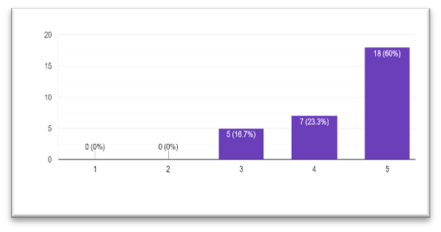
|
2. Odour: |
|
3. Irritation: 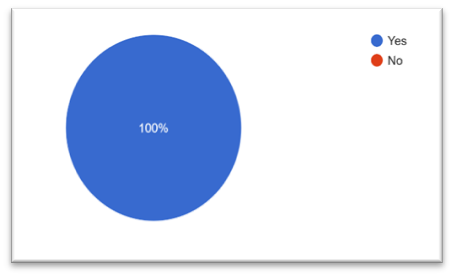
|
4. Dryness: 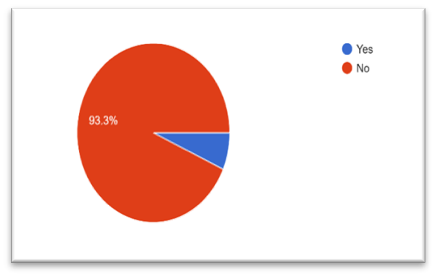
|
|
5. Foam : 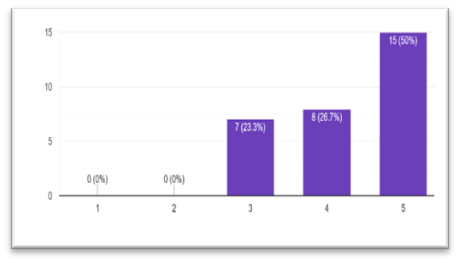
|
|
Foam height:
Table 4: Foam height
|
Sr. No. |
Initial(cm) |
Final(cm) |
|
1. |
9.7 |
7.4 |
|
2. |
9.5 |
7.6 |
|
3. |
8.5 |
6.2 |
Viscosity and pH:
Table 5: Viscosity and pH
|
Formulation |
Viscosity |
pH |
|
F1 |
3114 |
5.62 |
|
F2 |
3816 |
5.42 |
|
F3 |
4246 |
5.70 |
|
F4 |
4337 |
5.91 |
|
F5 |
3512 |
5.67 |
|
F6 |
3912 |
5.71 |
|
F7 |
4664 |
5.82 |
|
F8 |
4984 |
6.10 |
Stability:
Table 6: Stability
|
Days |
Viscosity(cp) |
pH |
|
7 |
4662 |
5.82 |
|
14 |
4634 |
5.80 |
|
21 |
4701 |
5.80 |
Acid Value:
|
W |
where, V = Volume of KOH solution used (ml)
N = Normality of KOH solution (mole/L)
W = Weight of the sample (gm)
56.1 = Molecular weight of KOH
Flow Rate:
Drug and Excipient compatibility test:

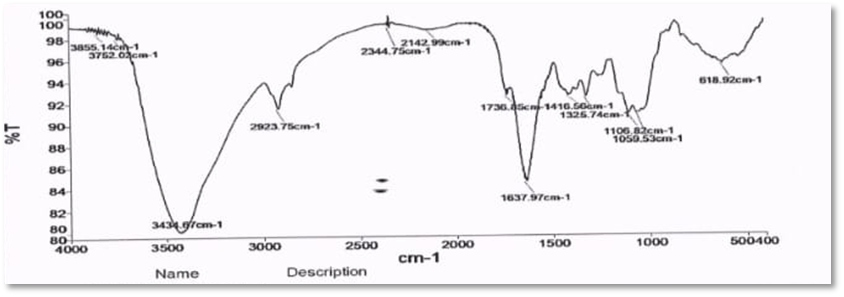
Fig 1: FTIR result of Pectin

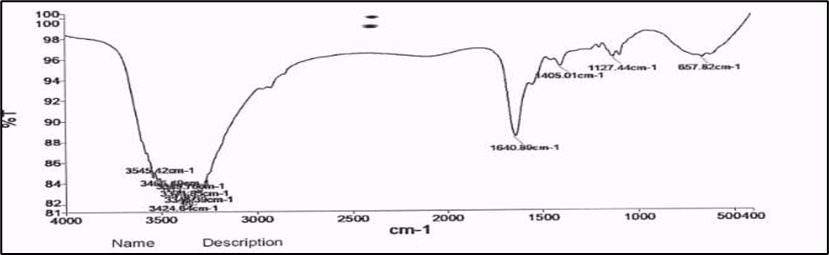
Fig 2: FTIR result of Papain

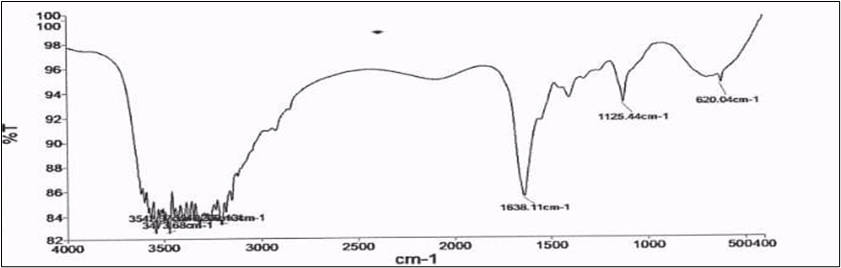
Fig 3: FTIR result of Pectin and Papain
Table 7: FTIR value of pectin
|
Sr. No |
Functional Group |
Observed Value |
Standard Value |
|
1 |
N-H Stretch |
3434.67 |
3300-3500 |
|
2 |
-COOH, hydrogen bonded alcohol |
2923.75 |
2500-3000 |
|
3 |
Acids, >C=O |
1736.85 |
1600-760 |
|
4 |
R-O-R, Ethers |
1059.53 |
1000-1300 |
|
5 |
-C-C- |
618.92 |
600-1500 |
Table 8: FTIR value of papain
|
Sr. No |
Functional Group |
Observed Value |
Standard Value |
|
1 |
-OH |
3545.42 |
3000-3700 |
|
2 |
-NH2 |
3446.49 |
3300-3500 |
|
3 |
Acids, >C=O |
1640.89 |
1600-1760 |
|
4 |
Aromatic ring |
1405.01 |
1500-1600 |
|
5 |
-C-C- |
657.82 |
600-1500 |
Table 9: FTIR value of Pectin and Papain
|
Sr. No |
Functional Group |
Observed Value |
Standard Value |
|
1 |
-C=O |
3542.97 |
3300-3600 |
|
2 |
-NH2 |
3473.68 |
3300-3500 |
|
3 |
-COOH, hydrogen bonded alcohol |
3206.13 |
1620-1680 |
|
4 |
Ethers, Alcohol |
1125.44 |
1000-1300 |
|
5 |
-C-C- |
620.04 |
600-1500 |
Through this FTIR study, presence of functional groups within the range specified indicated that Pectin and Papain are compatible and are present.
CONCLUSION
The study demonstrated that both HPMC K100 and Sodium CMC significantly influenced the viscosity and pH of the polyherbal bodywash formulations. Increasing concentrations of HPMC resulted in a progressive increase in viscosity, suggesting its strong thickening and gel-forming capacity. Similarly, a slight increase in viscosity was observed with higher concentrations of Sodium CMC, likely due to its water-binding and stabilizing properties.
The pH of all formulations remained within the acceptable skin-compatible range (5.4–5.9), ensuring product safety and mildness. Importantly, the incorporation of pectin and papain, derived from natural sources, added potential antioxidant, exfoliating, and moisturizing benefits to the formulation, aligning with the rising demand for natural and herbal cosmetics.
After testing, we conclude that the best prepared batch is F7. The result of evaluation test of body wash preparation was stable at room temperature, with its viscosity 4664cPwds, flow rate 4.61ml/sec and pH 5.82 which falls within the ideal range.
REFERENCES






Kashish Patel, Priyanshi Patel, Mitika Rohit, Ronak Prajapati, Aarsh Patel, Aayush Singh, Khushboo Kapadia, Formulation and Evaluation of Dragon Fruit and Papaya Based Exfoliating Polyherbal Body Wash, Int. J. of Pharm. Sci., 2026, Vol 4, Issue 4, 1097-1107. https://doi.org/10.5281/zenodo.19460653
 10.5281/zenodo.19460653
