

We use cookies to ensure our website works properly and to personalise your experience. Cookies policy
Aadhibhagawan College Of Pharmacy, Rantham, Thiruvannamalai, Tamil Nadu, India
The present study was aimed at the formulation and in vitro evaluation of mucoadhesive buccal tablets of Zolpidem tartrate to enhance bioavailability and prolong drug release by avoiding hepatic first-pass metabolism. Zolpidem tartrate, a non-benzodiazepine hypnotic agent used in the short-term management of insomnia, exhibits a short biological half-life, necessitating frequent dosing. Mucoadhesive buccal drug delivery offers prolonged residence time, improved patient compliance, and controlled drug release. Six formulations (F1–F6) of Zolpidem tartrate mucoadhesive buccal tablets were prepared by direct compression using Carbopol 940 LR and Hydroxypropyl Methylcellulose (HPMC) as primary mucoadhesive polymers in varying ratios along with sodium alginate and sodium carboxymethyl cellulose. Preformulation studies indicated satisfactory flow properties of the powder blends. Post-formulation evaluation parameters such as hardness, friability, weight variation, surface pH, swelling index, mucoadhesive strength, ex vivo residence time, drug content uniformity, and in vitro drug release were carried out. Among all formulations, F3 demonstrated optimal performance with satisfactory mucoadhesive strength, prolonged ex vivo residence time, controlled swelling behavior, and sustained drug release up to 6 hours (91.3%). FTIR studies confirmed the absence of drug–excipient interactions. The study concludes that mucoadhesive buccal tablets of Zolpidem tartrate prepared using HPMC in combination with other polymers are a promising approach for controlled drug delivery with improved therapeutic efficacy.
Oral drug delivery remains the most preferred route of administration due to ease of use and patient compliance. However, conventional oral dosage forms often suffer from drawbacks such as first-pass hepatic metabolism, enzymatic degradation, and variable absorption. Buccal drug delivery systems have emerged as an effective alternative by allowing direct absorption of drugs into systemic circulation through the buccal mucosa, thereby bypassing hepatic first-pass metabolism.
Mucoadhesive buccal tablets adhere to the mucosal surface for an extended period, enhancing residence time and providing controlled drug release. Polymers such as Carbopol 940 LR, Hydroxypropyl Methylcellulose (HPMC), sodium alginate, and sodium carboxymethyl cellulose (SCMC) are commonly used due to their excellent mucoadhesive and swelling properties.
Zolpidem tartrate is a non-benzodiazepine hypnotic agent used in the short-term treatment of insomnia. Despite its rapid onset of action, Zolpidem exhibits a short half-life of 2–3 hours and undergoes extensive hepatic metabolism, resulting in reduced bioavailability. Therefore, the development of a mucoadhesive buccal delivery system for Zolpidem tartrate can potentially improve bioavailability, prolong therapeutic action, and reduce dosing frequency.
The present study focuses on the formulation and in vitro evaluation of mucoadhesive buccal tablets of Zolpidem tartrate using different polymer combinations to achieve prolonged drug release and enhanced mucoadhesive properties.
2. DRUG PROFILE:

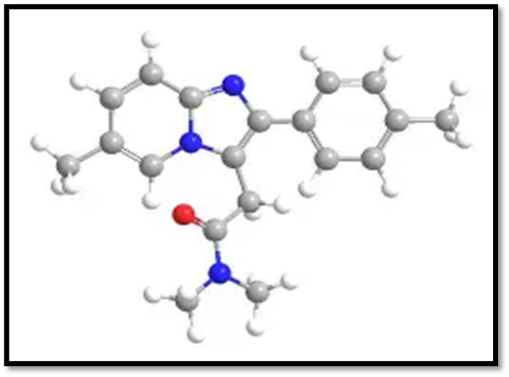
Fig: 1 Chemical Structure Zolpidem
3. MATERIALS AND METHODS:
3.1 Method of Formulation of Zolpidem Tartrate Mucoadhesive Buccal Tablets:
Six batches F1, F2, F3, F4, FS5, F6 of zolpidem tartrate mucoadhesive buccal tablets were formulated at different drug, polymer ratio (1:1, 1:4 - Carbopol 940LR as base along with other values, 1:1, 1:2, 1:3, 1:4 · HPMC as base along with other polymers)
3.2 Composition of Ingredient for Each Tablet:
Table: 1 Formulation Table
|
INGREDIENTS FOR EACH TABLET |
F1 (mg) |
F2 (mg) |
F3 (mg) |
F4 (mg) |
F5 (mg) |
F6 (mg) |
|
Zolpidem tartrate |
10 |
10 |
10 |
10 |
10 |
10 |
|
Hydroxyl propyl methyl cellulose |
10 |
40 |
98 |
68 |
38 |
8 |
|
Carbopol 940 LR |
98 |
8 |
10 |
20 |
30 |
40 |
|
Sodium alginate |
10 |
40 |
10 |
20 |
30 |
40 |
|
SCMC |
10 |
40 |
10 |
20 |
30 |
40 |
|
Mannitol |
3 |
3 |
3 |
3 |
3 |
3 |
|
Magnesium stearate |
1.5 |
1.5 |
1.5 |
1.5 |
1.5 |
1.5 |
|
Talc |
7.5 |
7.5 |
7.5 |
7.5 |
7.5 |
7.5 |
|
Total weight of each one tablet |
150 |
150 |
150 |
150 |
150 |
150 |
3.3 Pre-Formulation Study:
3.3.1 Drug Content Uniformity:
A) Standard Graph for the Drug Zolpidem Tartrate: The drug zolpidem tartrate (100mg) was weighed and transferred into 100ml volumetric ask, initially15ml of 0.0IN Hcl was added and shaken for 15minutes and volume was made to 100 ml with 0.0IN Hcl to get the first stock solution. From this 1ml was pipette out and rinsed into 100ml volumetric flask and volume was made with 0.01N Hcl to get second sock solution. From the second stock solution a series of 1ml, 2ml, 3ml, 4ml, 5ml, 6ml, 7ml, 8ml, ml were pipetted in to I0mlseparate volumetric flask and volume was made with 0.01N
HCl to get concentration of 1mg/ml – Drug ml respectively
From the first stock solution a series of 1ml, 1.1ml, 1.2ml, 1.3ml, 1.4ml, 1.5ml, 1.6ml, 1.7ml, 2ml, 2.5ml, 3ml were pipetted out into separate 100ml volumetric flask and volume was made with 0.0IN HCl to get 10ug/ml-30ug/ml respectively
The absorbance was measured at 294nm
B) Determination Of Drug Content:
Twenty tablets were selected randomly and powdered in a mortar. Amount equivalent to 10mg (average weight of the tablets) of drug was weighed and transferred into 100ml volumetric flask, initially 15ml of 0.0IN HCl was added and shaken for 10 minutes. Then the volume was made upto 100ml with 0.0IN HCl. The solution was filtered and 1ml of the filtrate was diluted to I0ml with 0.01N HCl and the absorbance was measured at 294nm using Microprocessor UV-Visible spectrophotometer.
3.3.2 Bulk Density:
Bulk density of the powder blend utilized in FI, F2, F3, F4, F5, F6 range from 120gm/cm³, 0.7140gm/cm³, 0.555gm/cm³, 0.4545gm/cm³, 0.5882gm/cm³, 0.7692gm/cm³ respectively. Each value represents mean value of three determinations.
3.3.3 Carr's Index:
Car's index for the powder blend utilized in F1, F2, F3, F4, F5, F6 range from 34%, 26%, 10%, 12%, 15%,13% respectively. Each value represents mean value of three determination.
3.3.4 Angle of Repose:
The Ø valve which represents the angle of repose for the powder blend utilized in F1, F2, E3, F4, F5, F6 were found be 38.79θ, 30.02θ, 26.01θ, 27.38θ, 27.15θ, 27.01θ respectively. Each value represents mean value of three determination.
3.3.5 Hausner Ratio:
Hausner ratio for the powder blend utilized in F1, F2, F3, F4, F5, F6 were found to be 1.5, 1.3, 1.1, 1.13, 1.17, 1.1 respectively. Each value represents mean value of three determinations.
3.3.6 Drug -Excipients Compatibility Studies:
The pure drug zolpidem tartrate and the powder blend of drug and the excipients were characterized by FTIR studies. The peak in 3320.82 cm¯¹and 2919.7cm¯¹ indicate C-H stretching, the peak in 1635.34cm¯¹ indicate C=O stretching and C=N stretching. The peak observed in 1384.64cm¯¹indicate C-H bending in aromatic ring, The peak in 1214.93cm¯¹, 1349cm¯¹ indicate tertiary amine group. The peak in 793.564cm¯¹ indicate C-H bending.
The FTIR spectrum of pure drug shows the peak at following valves Which are characteristics of the drug.
3320.82cm¯¹ C-H stretching, 1635.34cm¯¹ C=o stretching, C=N stretching1214.93cm¯¹ tertiary amine group, 793.56cm¯¹C-H bending, 1384.64cm¯¹ C-H bending in aromatic ring, there was no significant difference in the FTIR spectra of pure drug zolpidem tartrate and the formulations.
3.4 Post-Formulation Study:
3.4.1 Evaluation of Zolpidem Tartrate Mucoadhesive Buccal Tablets:
Drug content uniformity, Hardnes, Friability, Weight variation, In vitro drug release, surface pH, swelling index, Mucoadhesion strength, Ex vivo residence time were studied.
3.4.2 Drug Content Uniformity:
A. Standard Graph for The Drug Zolpidem Tartrate: Standard graph for the drug zolpidem tartrate was plotted using 0.0IN Hel. The linearity was best observed in the concentration range of 10- 30μg/ml. Y=0.02x;R-=0.998
B. Drug Content Uniformity: Dag content of the formulated zolpidem tartrate mucoadhesive buccal tablets F1, F2, F3, F4, F5, F6 were found to be 3.3 ± 0.005mg, 9.8 ±0.010mg, 10 ±0.012mg, 9.7±0016ong, 9.6±0.090mg, 9.9±0.016mg respectively. Each value represents mean value ±S. Dof three determinations.
3.4.3 Hardness:
Hardness of the formulated (F1, F2, F3, F4, F5, F6) zolpidem tartrate mucoadhesive buccal tablets were found to be 11 ±0.235 kg/cm², 12.5 ± 0.230 kg/cm², 12.5 ± 0.470 kg/cm², 12.5 ± 0.280 kg/cm², 12 ± 0.400 kg/cm², 12.5 ± 0.238 kg/cm² respectively. Each value represents mean value ±S.D of three determination.
3.4.4 Friability:
Friability of the formulated zolpidem tartrate mucoadhesive buccal tablets were found to by Roche friabilator. The percentage weight loss ranges from 0.1± 0.008 %, 0.3±0.014 %, 0.1±0.010 %, 0.2±0.008 %, 0.1±0.020 %, 0.4±0.014 % for the batches F1, F2, F3, F4, F5, F6 respectively. Each value represents mean value ± S.D of three determination.
3.4.5 Weight Variation Analysis:
The percentage weight variation for the formulated zolpidem tartrate mucoadhesive buccal tablets were found to be within the range of ± 7.5%.
3.4.6 In-vitro Drug Release Study:
The percentage drug release at the end of the 6 hours for the formulated zolpidem tartrate mucoadhesive buccal tablets F1, F2, F3, F4, F5, F6 were found to be 96.5%, 97.5% 91.3%, 97.2%, 97.3%, 96.9 respectively. Each value represents mean value of six determinations.
3.4.7 Surface pH:
Surface pH of the formulated zolpidem tartrate mucoadhesive buccal tablets F1, F2, F3, F4, F5, F6were found to be 5.3 ± 0.040, 5.8 ± 0.140, 60 ± 0.100, 62 ± 0.029, 56±0.020, 6.3±0.016 respectively. Each value represents mean value ±S.D three determination.
3.4.8 Swelling Index:
swelling index for the formulated tablets were found using phosphate buffer pH 6.8. At the end of 6 hours the value for the batches FI, F2, F3, F4, F5, F6 were found to be 82.8%, 79.6%,42.5%, 49.0%, 51.6%, 57.2% respectively. Each value represents mean value of three determination.
3.4.9 Mucoadhesion Strength:
Mucoadhesion strength was found by using modified physical balance. The values for the different batches FI, F2, F3, F4, F5, F6 were found to be 25.10 ± 0.115 gms, 22.5 ± 0.205 gms, 20.3 ± 0.124 gms, 19.5 ± 0.216 gms, 18.63 ± 0.271 gms, 20.10 ± 0.170 gms respectively. Each value represents mean value ± S.D of three determination.
3.4.10 Ex Vivo Residence Time:
Ex vivo residence time was found by using modified disintegration apparatus. The ex vivo residence time for the formulated zolpidem tartrate buccal tablets FI, F2, F3, F4, F5, F6 were found to be 5 hours ± 0.030, 3hrs 48min ± 0.040, 4hrs 58min ± 0.020, 3hrs 5Omin ± 0.033, 3hrs 40min ± 0.037, 3hrs 48min ± 0.042 respectively. Each value represents mean value ±S.D determination.
4. RESULTS AND DISCUSSION:
4.1 Pre-formulation Parameters:
Table: 2 Pre-formulation
|
FORMULATION |
BULK DENSITY (gm/cm³) |
CARR`S INDEX (%) |
ANGLE OF REPOSE |
HAUSNER RATIO |
|
F1 |
0.4120 |
34 |
38.79` |
1.50 |
|
F2 |
0.7140 |
26 |
30.02` |
1.30 |
|
F3 |
0.5555 |
10 |
26.00` |
1.10 |
|
F4 |
0.4545 |
12 |
27.38` |
1.13 |
|
F5 |
0.5882 |
15 |
27.15` |
1.17 |
|
F6 |
0.7692 |
13 |
27.00` |
1.10 |
4.2 Concentration & The Absorbance for The Drug Zolpidem Tartrate (Standard Graph)
Table: 3 Standard Graph
|
SR. NO |
CONCENTRATION |
ABSORBANCE |
|
1. |
1 |
0.06 |
|
2. |
2 |
0.061 |
|
3. |
3 |
0.069 |
|
4. |
4 |
0.090 |
|
5. |
5 |
0.102 |
|
6. |
6 |
0.135 |
|
7. |
7 |
0.151 |
|
8. |
8 |
0.160 |
|
9. |
9 |
0.191 |
|
10. |
10 |
0.203 |
|
11. |
11 |
0.200 |
|
12. |
12 |
0.211 |
|
13. |
13 |
0.212 |
|
14. |
14 |
0.218 |
|
15. |
15 |
0.234 |
|
16. |
16 |
0.298 |
|
17. |
17 |
0.324 |
|
18. |
20 |
0.376 |
|
19. |
25 |
0.412 |
|
20. |
30 |
0.498 |
4.3 Procedure for Determination of Drug Content Uniformity:
Table: 4 Drug Content Uniformity
|
FORMULATION |
PROCEDURE |
|
F1 |
Dissolve 0.064mg(average weight) of powdered tablet in 100ml of 0.01N Hcl, filtered and suitably diluted. |
|
F2 |
Dissolve 0.140mg(average weight) of powdered tablet in 100ml of 0.01N Hcl, filtered and suitably diluted. |
|
F3 |
Dissolve 0.120mg(average weight) of powdered tablet in 100ml of 0.01N Hcl, filtered and suitably diluted. |
|
F4 |
Dissolve 0.110mg(average weight) of powdered tablet in 100ml of 0.01N Hcl, filtered and suitably diluted. |
|
F5 |
Dissolve 0.120mg(average weight) of powdered tablet in 100ml of 0.01N Hcl, filtered and suitably diluted. |
|
F6 |
Dissolve 0.110mg(average weight) of powdered tablet in 100ml of 0.01N Hcl, filtered and suitably diluted. |
4.4 Drug Content Uniformity of Formulated Zolpidem Tartrate Mucoadhesive Buccal Tablet:
Table: 5 Drug Content
|
FORMULATION |
DRUG CONTENT (mg) |
PERCENTAGE DRUG CONTENT |
|
F1 |
3.3±0.005 |
33±0.057 |
|
F2 |
9.8±0.010 |
98±0.031 |
|
F3 |
10±0.012 |
100±0.129 |
|
F4 |
9.7±0.016 |
97±0.516 |
|
F5 |
9.6±0.090 |
96±0.100 |
|
F6 |
9.9±0.015 |
99±0.160 |
4.5 Weight Variation Analysis for Zolpidem Tartrate Mucoadhesive Buccal Tablet: (Weight of Individual Tablets)
Table: 6 Weight of Individual Tablets
|
F1 (gm) |
F2 (gm) |
F3 (gm) |
F4 (gm) |
F5 (gm) |
F6 (gm) |
|
0.0640 |
0.1480 |
0.1230 |
0.1120 |
0.1230 |
0.1100 |
|
0.0632 |
0.1490 |
0.1220 |
0.1120 |
0.1230 |
0.1120 |
|
0.0630 |
0.1488 |
0.1220 |
0.1130 |
0.1230 |
0.1142 |
|
0.0642 |
0.1488 |
0.1220 |
0.1120 |
0.1222 |
0.1122 |
|
0.0624 |
0.1486 |
0.1232 |
0.1130 |
0.1212 |
0.1172 |
|
0.0632 |
0.1484 |
0.1242 |
0.1142 |
0.1220 |
0.1162 |
|
0.0620 |
0.1488 |
0.1272 |
0.1122 |
0.1240 |
0.1152 |
|
0.0620 |
0.1490 |
0.1262 |
0.1122 |
0.1202 |
0.1132 |
|
0.0630 |
0.1490 |
0.1232 |
0.1134 |
0.1224 |
0.1124 |
|
0.0632 |
0.1492 |
0.1210 |
0.1122 |
0.1236 |
0.1112 |
|
0.0630 |
0.1488 |
0.1232 |
0.1122 |
0.1238 |
0.1106 |
|
0.0634 |
0.1478 |
0.1222 |
0.1122 |
0.1222 |
0.1162 |
|
0.0636 |
0.1486 |
0.1220 |
0.1130 |
0.1230 |
0.1132 |
|
0.0632 |
0.1490 |
0.1230 |
0.1120 |
0.1220 |
0.1124 |
|
0.0632 |
0.1490 |
0.1242 |
0.1122 |
0.1202 |
0.1122 |
|
0.0628 |
0.1488 |
0.1240 |
0.1130 |
0.1214 |
0.1146 |
|
0.0626 |
0.1478 |
0.1230 |
0.1122 |
0.1222 |
0.1132 |
|
0.0628 |
0.1488 |
0.1222 |
0.1122 |
0.1230 |
0.1172 |
|
0.0632 |
0.1488 |
0.1220 |
0.1134 |
0.1220 |
0.1164 |
|
AVERAGE WEIGHT FOR F1-F6(gm) |
|||||
|
0.0631± 0.001 |
0.1487± 0.039 |
0.1232± 0.004 |
0.1125± 0.0003 |
0.222± 0.0013 |
0.1138± 0.0021 |
4.6 Weight Variation Tolerance for The Formulated Zolpidem Tartrate Mucoadhesive Buccal Tablets:
Table: 7 Weight Variation
|
SR. NO |
F1 |
F2 |
F3 |
F4 |
F5 |
F6 |
|
1. |
0 |
-5.71 |
-2.50 |
-1.82 |
-2.50 |
0.00 |
|
2. |
1.25 |
-6.43 |
-1.67 |
-1.82 |
-2.50 |
-1.82 |
|
3. |
1.56 |
-6.29 |
-1.67 |
-2.73 |
-2.50 |
-3.82 |
|
4. |
-0.13 |
-6.29 |
-1.67 |
-1.82 |
-1.83 |
-2.00 |
|
5. |
2.50 |
-6.14 |
-2.67 |
-2.73 |
-1.00 |
-6.55 |
|
6. |
1.25 |
-6.00 |
-3.50 |
-3.82 |
-1.67 |
-5.04 |
|
7. |
3.13 |
-6.29 |
-6.00 |
-2.00 |
-3.33 |
-4.73 |
|
8. |
3.13 |
-6.43 |
-5.17 |
-2.00 |
-0.17 |
-2.91 |
|
9. |
1.56 |
-6.43 |
-0.83 |
-3.09 |
-2.20 |
-2.98 |
|
10. |
1.25 |
-6.57 |
-2.67 |
-2.00 |
-3.00 |
-1.09 |
|
11. |
1.56 |
-6.29 |
-1.83 |
-2.00 |
-3.17 |
-2.55 |
|
12. |
0.94 |
-5.57 |
-1.67 |
-2.00 |
-1.83 |
-5.64 |
|
13. |
0.62 |
-6.14 |
-2.50 |
-2.73 |
-2.50 |
-2.91 |
|
14. |
1.25 |
-6.43 |
-3.50 |
-1.82 |
-1.67 |
-2.18 |
|
15. |
1.25 |
-6.43 |
-3.33 |
-2.00 |
-0.17 |
-2.00 |
|
16. |
1.88 |
-6.29 |
-2.50 |
-2.73 |
-1.17 |
-4.18 |
|
17. |
2.19 |
-5.57 |
-1.83 |
-2.00 |
-1.83 |
-2.91 |
|
18. |
1.88 |
-6.29 |
-1.67 |
-2.00 |
-2.50 |
-6.55 |
|
19. |
1.25 |
-6.29 |
-2.67 |
-3.09 |
-1.67 |
-5.85 |
|
20. |
-0.31 |
-6.43 |
-4.20 |
-2.00 |
-0.17 |
-4.73 |
4.7 Evaluation of Zolpidem Tartrate Mucoadhesive Buccal Tablets:
Table: 8 Evaluation of Hardness, Friability & Surface pH
|
FORMULATION |
HARDNESS Kg/cm² |
FRIABILITY TEST |
SURFACE pH |
|
F1 |
11.0±0.235 |
0.1±0.008 |
5.3±0.040 |
|
F2 |
12.5±0.230 |
0.3±0.014 |
5.8±0.140 |
|
F3 |
12.5±0.280 |
0.1±0.010 |
6.0±0.100 |
|
F4 |
12.5±0.470 |
0.2±0.008 |
6.2±0.029 |
|
F5 |
12.0±0.400 |
0.1±0.020 |
5.6±0.020 |
|
F6 |
12.5±0.238 |
0.4±0.014 |
6.3±0.016 |
4.8 Mucoadhesive Strength, Ex Vivo Residence Time of The Formulated Zolpidem Tartrate Mucoadhesive Buccal Tablet:
Table: 9 Evaluation of Mucoadhesive Strength & Ex Vivo Residence Time
|
FORMULATION |
MUCOADHESION STRENGTH (gm) |
EX VIVO RESIDENCE TIME |
|
F1 |
25.10±0.155 |
5hrs±0.030 |
|
F2 |
22.50±0.205 |
3hrs 48 mins ± 0.040 |
|
F3 |
20.30±0.124 |
4hrs 58min ± 0.020 |
|
F4 |
19.50±0.216 |
3hrs 50min ± 0.033 |
|
F5 |
18.63±0.271 |
3hrs 40min ± 0.037 |
|
F6 |
20.10±0.170 |
3hrs 48min ± 0.042 |
4.9 In Vitro Drug Release Studies:
4.9.1 In-Vitro Drug Release Studies for The Formulation-F1:
Table: 10 In-Vitro Drug Release Studies for The Formulation-F1
|
FORMULATION 1 |
||
|
TIME IN HOURS |
AMOUNT OF DRUGS (mg) |
PERCENTAGE DRUG RELEASE |
|
0.5 |
1.36 |
41.2 |
|
1 |
1.91 |
57.9 |
|
2 |
2.42 |
73.3 |
|
3 |
2.63 |
79.8 |
|
4 |
2.84 |
86.2 |
|
5 |
2.97 |
90.1 |
|
6 |
3.18 |
96.5 |
4.9.2 In-vitro Drug Release Studies for The Formulation-F2:
Table: 11 In-Vitro Drug Release Studies for The Formulation-F2
|
FORMULATION 2 |
||
|
TIME IN HOURS |
AMOUNT OF DRUGS (mg) |
PERCENTAGE DRUG RELEASE |
|
0.5 |
2.97 |
30.3 |
|
1 |
4.20 |
2.9 |
|
2 |
5.60 |
57.2 |
|
3 |
6.67 |
68.0 |
|
4 |
7.90 |
80.6 |
|
5 |
9.30 |
94.9 |
|
6 |
9.55 |
97.5 |
4.9.3 In-vitro Drug Release Studies for The Formulation-F3:
Table: 12 In-Vitro Drug Release Studies For The Formulation-F3
|
FORMULATION 3 |
||
|
TIME IN HOURS |
AMOUNT OF DRUGS (mg) |
PERCENTAGE DRUG RELEASE |
|
0.5 |
2.97 |
29.7 |
|
1 |
3.35 |
33.5 |
|
2 |
4.54 |
45.4 |
|
3 |
5.86 |
58.6 |
|
4 |
7.60 |
76.0 |
|
5 |
8.58 |
85.8 |
|
6 |
9.13 |
91.3 |
4.9.4 In-vitro Drug Release Studies for The Formulation-F4:
Table: 13 In-Vitro Drug Release Studies for The Formulation-F4
|
FORMULATION 4 |
||
|
TIME IN HOURS |
AMOUNT OF DRUGS (mg) |
PERCENTAGE DRUG RELEASE |
|
0.5 |
4.16 |
42.9 |
|
1 |
6.16 |
63.5 |
|
2 |
6.88 |
70.9 |
|
3 |
7.94 |
81.8 |
|
4 |
8.53 |
88.0 |
|
5 |
9.25 |
95.4 |
|
6 |
9.42 |
97.2 |
4.9.5 In-vitro Drug Release Studies For The Formulation-F5:
Table: 14 In-Vitro Drug Release Studies for The Formulation-F5
|
FORMULATION 5 |
||
|
TIME IN HOURS |
AMOUNT OF DRUGS (mg) |
PERCENTAGE DRUG RELEASE |
|
0.5 |
1.91 |
19.9 |
|
1 |
2.89 |
30.1 |
|
2 |
4.46 |
46.4 |
|
3 |
6.62 |
69.0 |
|
4 |
7.98 |
83.1 |
|
5 |
8.53 |
88.9 |
|
6 |
9.34 |
97.3 |
4.9.6 In-vitro Drug Release Studies For The Formulation-F6:
Table: 15 In-Vitro Drug Release Studies For The Formulation-F6
|
FORMULATION 6 |
||
|
TIME IN HOURS |
AMOUNT OF DRUGS (mg) |
PERCENTAGE DRUG RELEASE |
|
0.5 |
2.55 |
25.7 |
|
1 |
3.44 |
34.7 |
|
2 |
5.60 |
56.6 |
|
3 |
7.90 |
79.8 |
|
4 |
8.87 |
89.6 |
|
5 |
9.25 |
93.5 |
|
6 |
9.59 |
96.9 |
4.10 Swelling Index For Zolpidem Tartrate Mucoadhesive Buccal Tablets
Table: 16 Swelling Index
|
TIME IN HOUR |
F1 |
F2 |
F3 |
F4 |
F5 |
F6 |
|
0.5 |
21.8 |
27.1 |
2.5 |
2.7 |
1.6 |
2.7 |
|
1 |
40.6 |
39.2 |
13.3 |
5.4 |
6.6 |
4.5 |
|
2 |
50.0 |
51.4 |
17.5 |
9.0 |
10.8 |
12.7 |
|
3 |
59.3 |
57.1 |
23.3 |
18.2 |
22.5 |
20.9 |
|
4 |
62.5 |
67.8 |
34.1 |
26.3 |
38.3 |
37.7 |
|
5 |
76.5 |
74.2 |
36.5 |
38.1 |
46.6 |
44.5 |
|
6 |
82.8 |
99.6 |
42.5 |
49.0 |
51.6 |
57.2 |
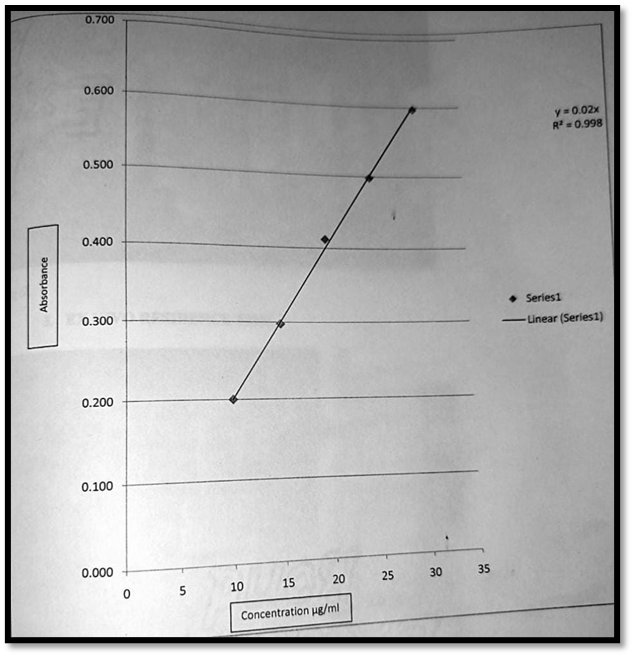
Fig: 2 Standard Graph For The Drug Zolpidem Tartrate
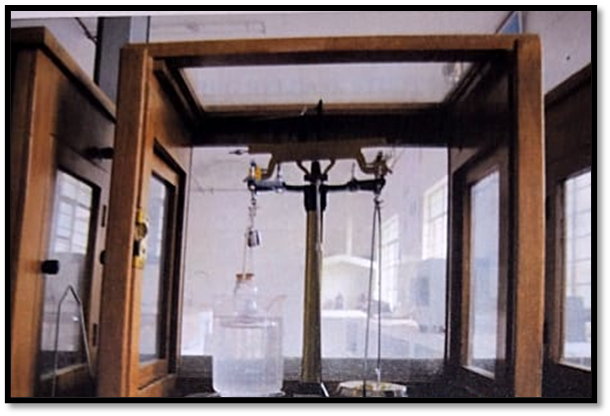
Fig: 3 Mucoadhesion Strength
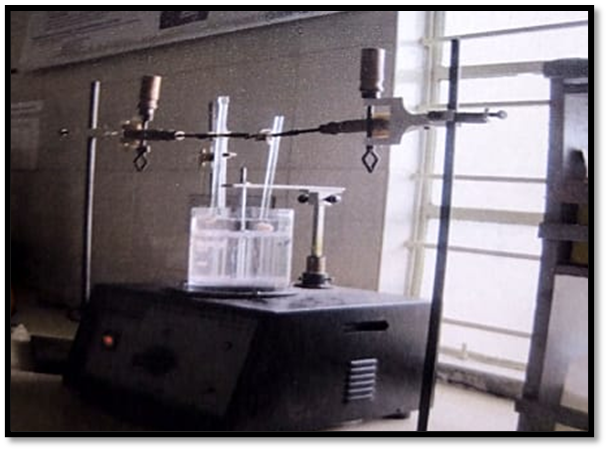
Fig: 4 Ex-Vivo Residence Time
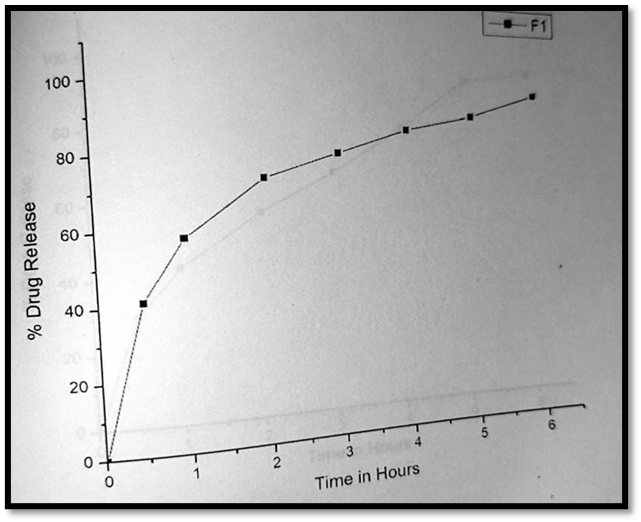
Fig: 5 In-Vitro Drug Release Studies For The Formulation-F1
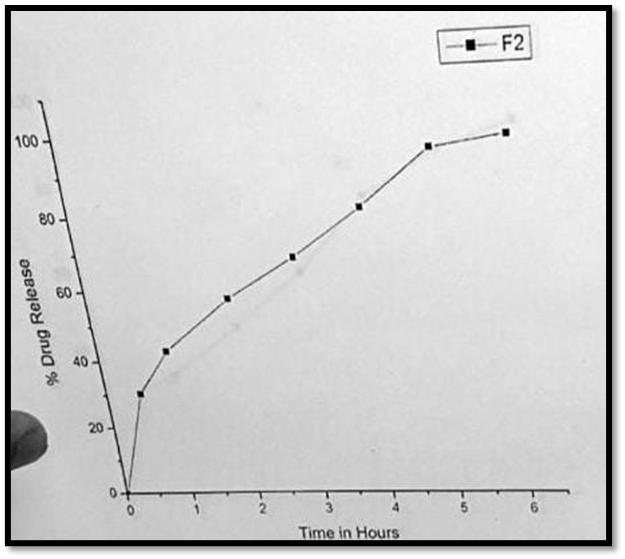
Fig: 6 In-Vitro Drug Release Studies For The Formulation-F2

Fig: 7 In-Vitro Drug Release Studies For The Formulation-F3
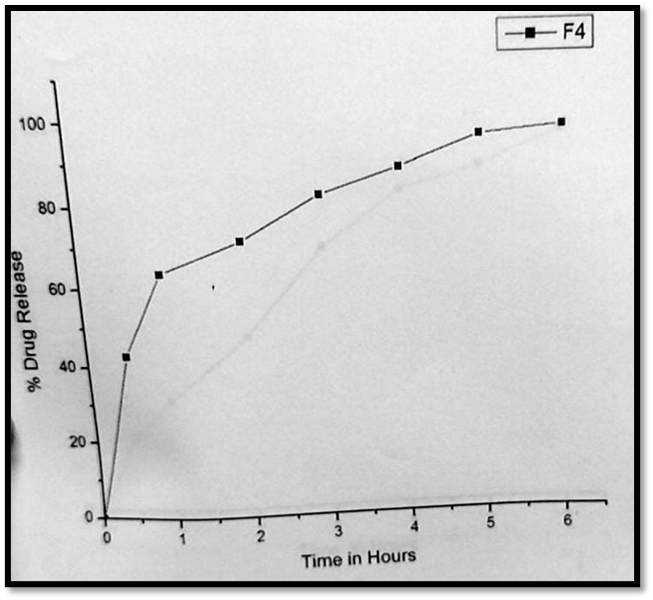
Fig: 8 In-Vitro Drug Release Studies For The Formulation-F4
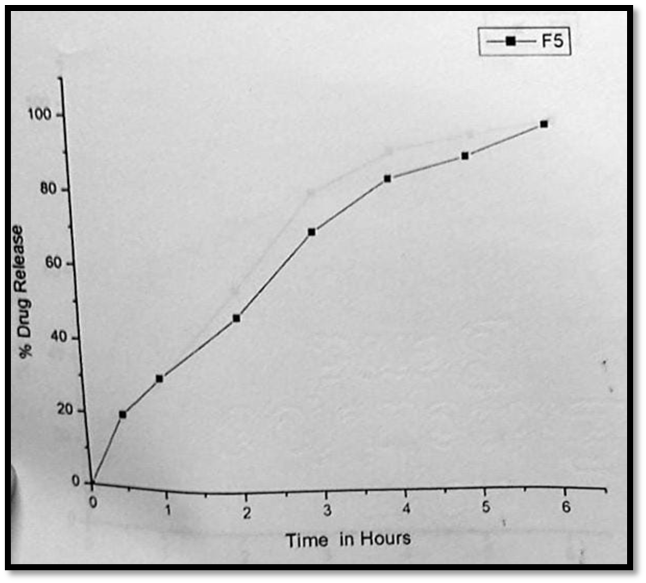
Fig: 9 In-Vitro Drug Release Studies For The Formulation-F5
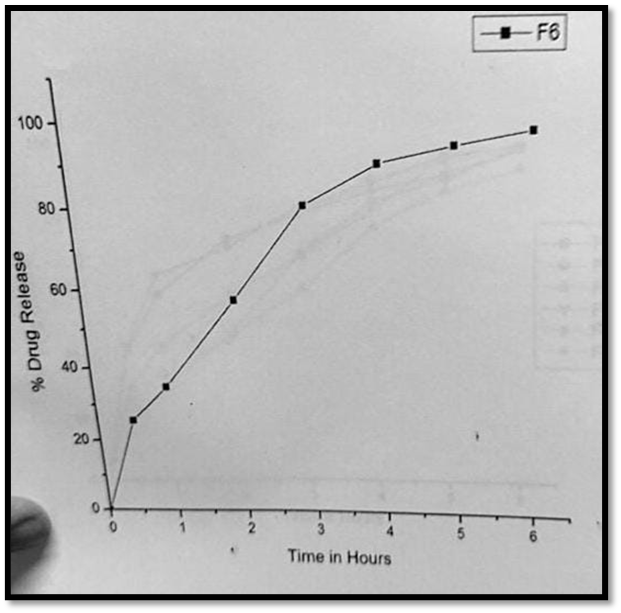
Fig: 10 In-Vitro Drug Release Studies For The Formulation-F6
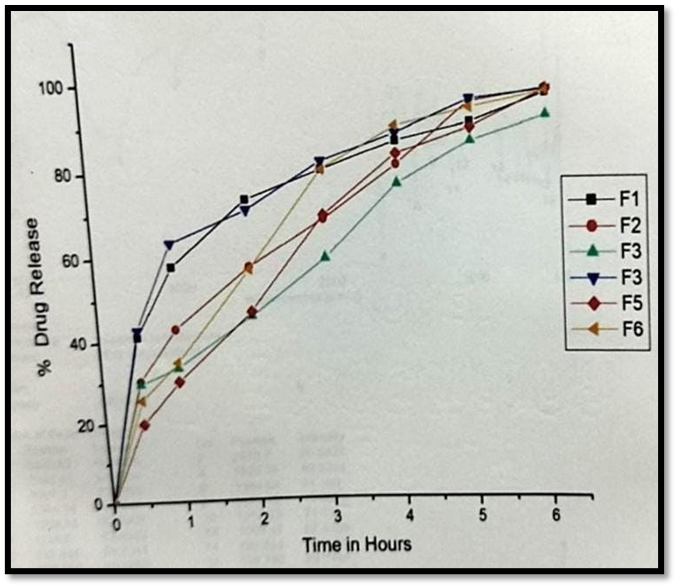
Fig: 11 In-Vitro Drug Release Studies For The Formulation F1-F6
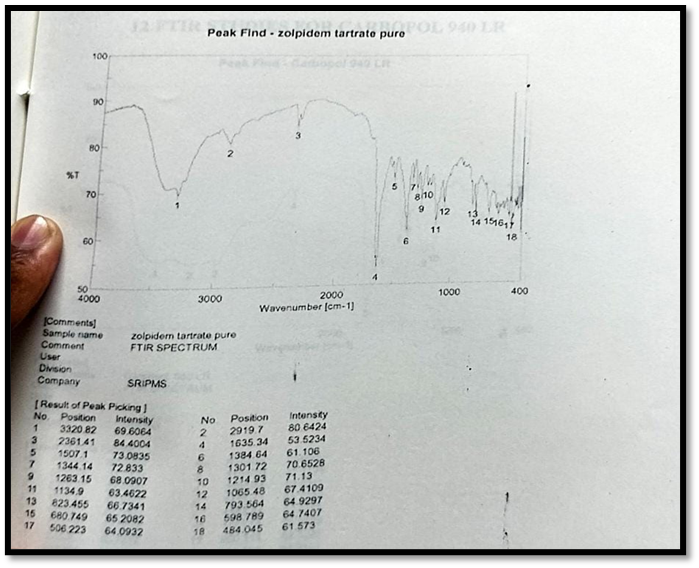
Fig: 12 FTIR Studies For Pure Drug Zolpidem Tartrate
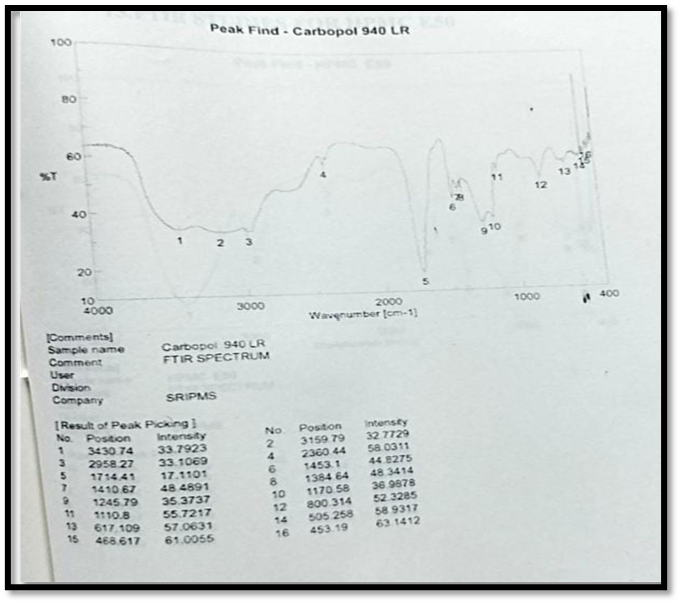
Fig: 13 FTIR Studies For Carbapol 940 LR
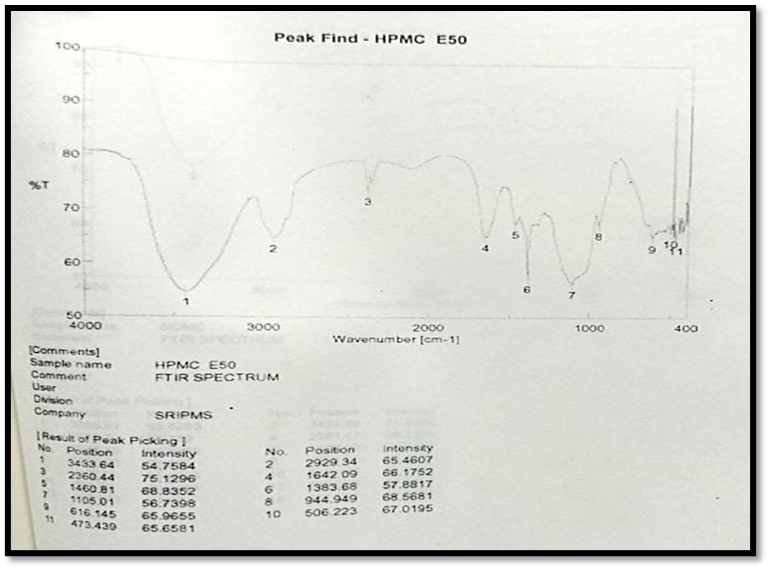
Fig: 14 FTIR Studies For HPMC E50
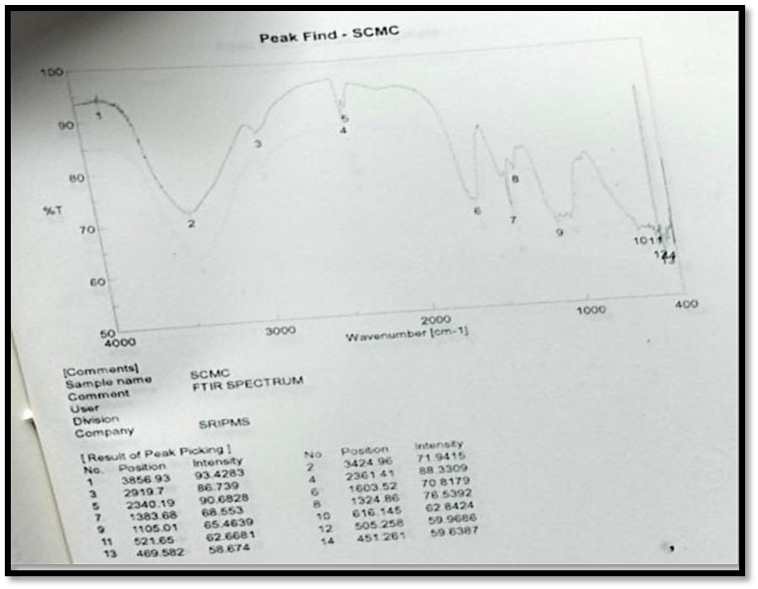
Fig: 15 FTIR Studies For SCMC
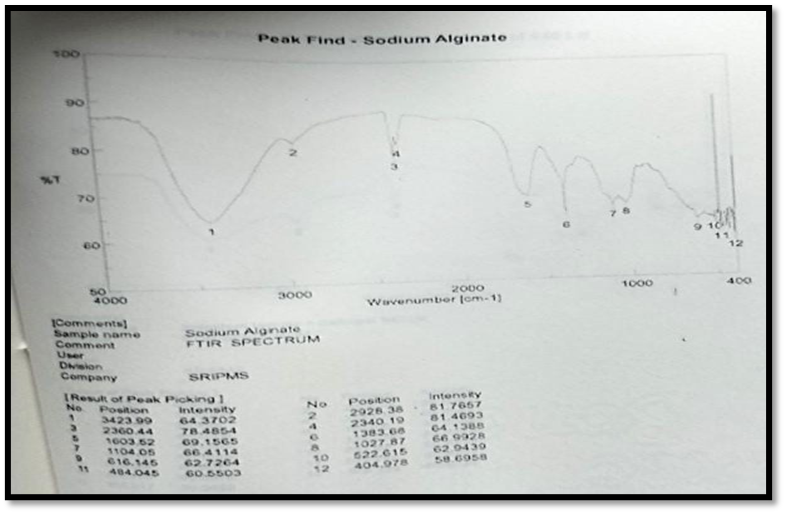
Fig: 16 FTIR Studies For Sodium Alginate
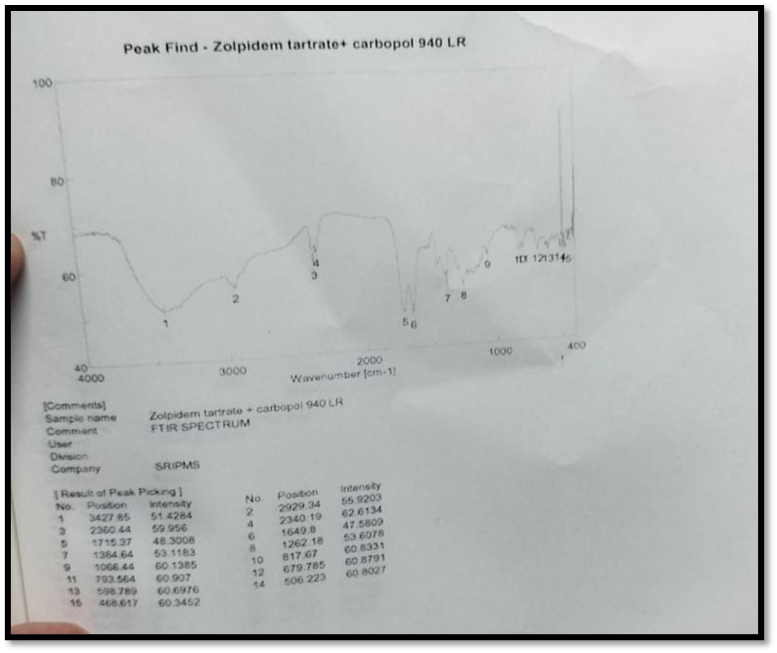
Fig: 17 FTIR Studies For Pure Drug & Carbapol 940 LR
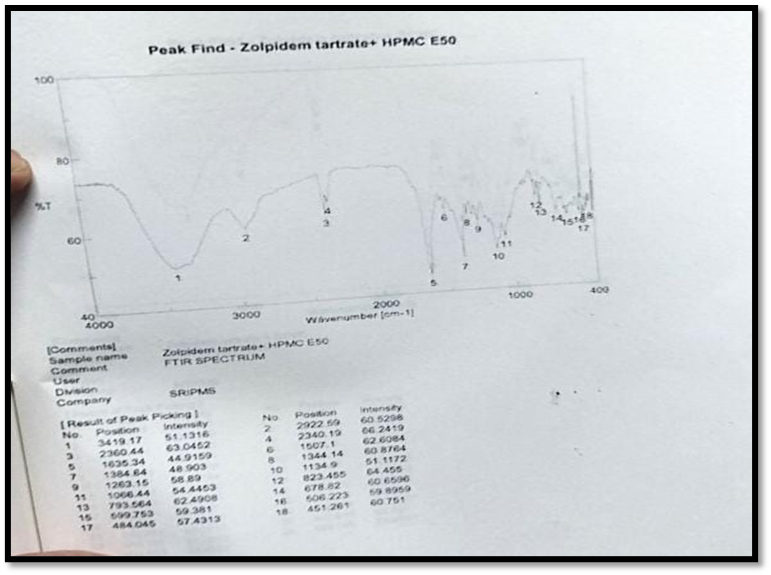
Fig: 18 FTIR Studies For Pure Drug & HPMC E50

Fig: 19 FTIR Studies For Pure Drug & SCMC
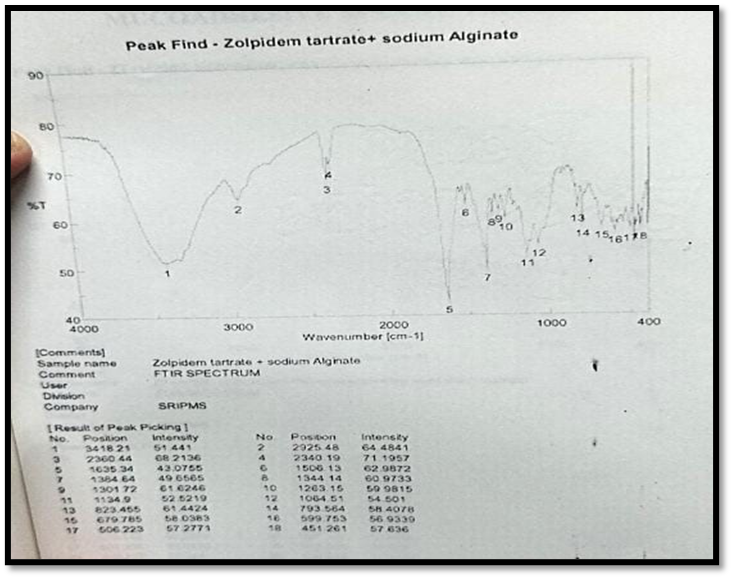
Fig: 20 FTIR Studies For Pure Drug & Sodium Alginate
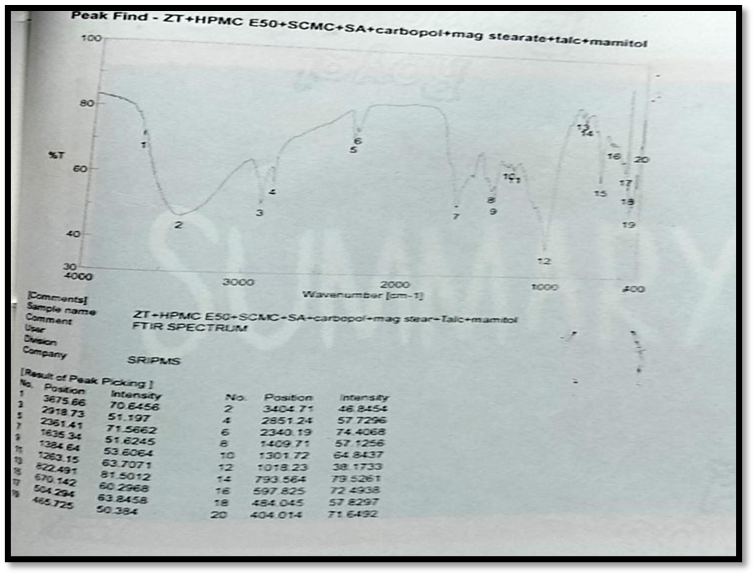
Fig: 21 FTIR Studies For Powder Blend Used In Formulation Of Zolpidem Tartrate Mucoadhesive Buccal Tablet
DISCUSSION:
Preformulation studies indicated acceptable flow properties of the powder blends, as evidenced by bulk density, Carr’s index, Hausner ratio, and angle of repose values. These results confirmed the suitability of the blends for direct compression.
FTIR studies revealed no significant changes in the characteristic peaks of Zolpidem tartrate in the presence of excipients, indicating the absence of drug–excipient interactions and ensuring formulation stability.
Post-formulation evaluation showed that all tablets complied with pharmacopoeial limits for hardness, friability, and weight variation, indicating adequate mechanical strength. Surface pH values ranged between 5.3 and 6.3, suggesting minimal risk of mucosal irritation.
Swelling index and mucoadhesive strength increased with higher concentrations of Carbopol 940 LR due to its high hydration and gel-forming capacity. However, excessive Carbopol content resulted in increased tablet hardness and processing difficulty. Formulation F1 showed the highest mucoadhesive strength and residence time but required improved compressibility.
Formulation F3, containing HPMC as the primary polymer, exhibited balanced swelling behavior, adequate mucoadhesive strength, and prolonged ex vivo residence time. In vitro drug release studies demonstrated sustained drug release up to 6 hours, making F3 the most optimized formulation.
Overall, the results confirm that polymer type and concentration significantly influence mucoadhesion, swelling behavior, and drug release characteristics. HPMC-based formulations provided controlled drug release with acceptable mucoadhesive properties, making them suitable for buccal delivery of Zolpidem tartrate.
CONCLUSION:
The formulation containing higher concentration of Carbopol 940 LR exhibit better mucoadhesion and ex-vivo residence time which are essential for prolonged drug release, but at higher concentration of Carbopol 940 LR the formulation may need a pre-compression or granulation.
Among all other formulation F3 exhibit prolonged drug release and also exhibit good Mucoadhesion, Swelling index, Ex vivo residence time, Surface pH and other parameters such as Hardness, Friability, Weight variation within the limit. Zolpidem tartrate mucoadhesive buccal tablets may be better formulated with HPMC as base along with other mucoadhesive polymers which exhibit prolonged drug release and quick onset of action.
REFERENCES

G. Dhivakar, Dr. V. Kalvimoorthi, L. Gopi, Formulation and In-Vitro Evaluation of Mucoadhesive Buccal Tablets of Zolpidem Tartrate, Int. J. of Pharm. Sci., 2026, Vol 4, Issue 1, 3586-3603. https://doi.org/10.5281/zenodo.18441859
 10.5281/zenodo.18441859