
Department of Pharmacy , Institute of Technology and Management , Gida, Gorakhpur , Uttar Pradesh, India,273209.
Ficus religosa, sometimes referred to as peepal, is a member of the Moraceae family. Studies have been conducted on phenolic components, hydrocarbons, aliphatic alcohols, volatile components, phytosterols, amino acids, furanocoumanins, and a few other secondary metabolite types in Ficus religiososa. The agar well diffusion technique was used to assess the antimicrobial activity of plant extracts. The researcher will be asked to isolate novel medicinal chemicals from various regions of Ficus religiosa in order to discover novel medications. Similar to Ayurveda, Siddha, Unani, and homeopathy, it is a prominent indigenous medical system. Traditional medicine uses a variety of parts, including stem bark, root bark, aerial roots, vegetative buds, leaves, fruits, and latex, to treat diabetes, vomiting, burns, gynecological disorders, diarrhea, nervous disorders, and as a tonic and astringent. In India, medicinal plants have been the main source of treatment because they contain a variety of complex chemical substances with varying compositions. Following the formulation's completion, it was assessed for physicochemical characteristics such as color, odor, pH, spreadability, extrudability, consistency, solubility, and washability. Additionally, the formulation was assessed for stability at different temperatures, demonstrating no change in irritancy or spreadability..
It has long been known that medicinal plants are an important source of bioactive substances for both conventional and contemporary medical uses. Ficus religiosa L. (Peepal), a member of the Moraceae family, is one of the most significant ethnomedical plants on the Indian subcontinent. The plant's leaves are especially notable because of their rich phytochemical composition and variety of biological activities, even though the plant's bark, fruits, latex, and roots have all been used in traditional therapeutic techniques.A Modern medicine aims to create medications that are more effective and have fewer negative effects Pharmaceutical plants continue to be an important source of novel pharmaceutical compounds [1]. These flora have complicated chemicals that contribute to their therapeutic qualities, referred to as secondary plant metabolites Medicinal plants have long been a reliable source of treatments for a wide range of illnesses background [2]. In thepast, more than 30% of plant species have been utilized therapeutically, and more than 75% of people use plant extracts for medical purposes globally [3].
2. Botanical Description of Ficus Religiosa
DIAGRAM
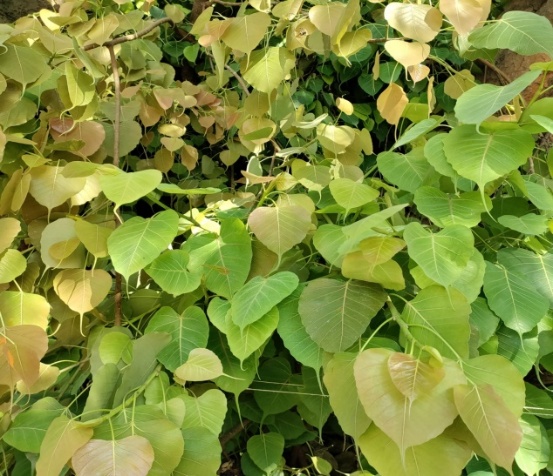

Fig. Ficus religiosa Leaves
F. religiosa is an irregularly shaped, perennial, or deciduous tree that grows to a height of 20 m and a height of 1.5-2 mdbh. Its branches extend widely and lack aerial roots. The leaves are thin, shiny ,and contain five to seven veins. The broken bark has a brown or white hue. The tiny fruits resemble an eye's pupil and have a diameter of around ½ inches. It has a rounded form and is compressed. The fruit transforms from green to black as it ripens. Fruits are grown in the summer and mature throughout the wet season. The leaves are dark green, glossy, alternating, coriaceous (leathery), roughly oval, spirally arranged by 7.5–10 cm, base-choroidal, pink when young, stipulate, and have peculiar ends that resemble tailsLesions are seen on the leaves. Flowers are unisexual and axillary sessile. Figs are spherical, flat-topped, and green, up to 1.5 cm in diameter, smooth, sessile, and axillary, with basal bracts that develop to purple with red spots. They are found in pairs. Petioles range in length from 7.5 to 10 cm [4] Ficus, a genus of plants in the Moraceae family, is home to more than 800 species of trees, shrubs, and epiphytes that are distributed across tropical and subtropical parts of the world. With deciduous and evergreen free-standing trees, climbers, stranglers, creepers, tiny shrubs, lithophytes, and rheophytes, it is one of the most diversified plant genera in terms of growth habit [5].Commonly referred to as figs or fig trees, the Ficus genus has more than 800 species. These plants may be found in many tropical and subtropical areas of Asia, America, Australia, and Africa [6–8]. Some species, including Ficus benghalensis, are revered in India and called the National Tree, signifying endless life and spiritual wisdom [9]. Some species, like the fiddle-leaf fig (Ficus lyrata), are utilized as attractive plants, while others are edible. Ficus trees are renowned for having a wide variety of growth patterns, from lithophytes and climbers to free-standing trees. They also have a high rate of photosynthesis, making them among the greatest oxygen producers [10]. Additionally, it is utilized to cure skin conditions brought on by the use of Kumkum (Bindi). Unlike other plants, which release oxygen during the day and absorb it at night, F. religiosa releases oxygen continually. This is because it can carry out Crassulacean Acid Metabolism (CAM) photosynthesis, which enables it to absorb carbon dioxide at night. F. religiosa is a hemiepiphyte, which means that once the host tree dies, its seeds sprout and develop as an epiphyte on additional trees before settling on the ground. It is hypothesized that F. religiosa shifts to C3-type photosynthesis when it resides on soil and uses the CAM pathway to create carbohydrates .[11- 14]
Taxonomy and Common Names [15-17]
|
Kingdom |
Plantae |
|
Division |
Magnoliophyta |
|
Class |
Magnoliopsida |
|
Order |
Rosales |
|
Family |
Moraceae |
|
Genus |
Ficus |
|
Species |
religiosa |
|
Vemacular name |
Peepal |
Common Names [18-21]
|
India |
Peepal |
|
China |
Pu ti Shu |
|
Sri Lanka |
Bodhi tree |
|
Arabic |
teen mukadas, teen Asnam, shajarat bebal, Ficus abu lesan |
|
English |
botree, peepultree, sacred fig |
|
French |
arbre de dieu, figuier de pagodes |
|
German |
bobaum, heiliger feigenbaum, indischer pepulbaum, pepulbaum |
|
Italian |
fico del diavolo |
DISTRIBUTION :
The species Ficus religiosa is native to the Asia-Tropical area, which includes Bangladesh, India, Nepal, Pakistan, China, Myanmar, Thailand, Vietnam, and Iraq [22]. In India, the tree is frequently found in woods and hilly regions, especially those close to streams. It is also cultivated.[23]
Phytochemical Constituents of Ficus Relignosa
A wide range of phytochemicals found in plants have the potential to be used as natural treatments for a number of human health problems. Phytosterols, amino acids, furanocoumarins, phenolic components, hydrocarbons, aliphatic alcohols, volatile components, and other secondary metabolites are among the phytochemical components of F. religiosa that have been investigated. Nearly every portion of the plant contains amino acids and phenolic components like flavonoids and tannins[24].
CONSTITUENTS OF THE LEAVES
Campestrol, stigmasterol, isofucosterol, α-amyrin, lupeol, tannic acid, arginine, serine, aspartic acid, glycine, threonine, alanine, proline, tryptophan, tyrosine, methionine, valine, isoleucine, leucine, nonacosane, n-hentricontanen, hexa-cosanol, and n-octacosan are all found in leaves. [25, 26,27,28]. Carbohydrates, protein, lipids, calcium, salt, potassium, and phosphorus are found in leaves and fruits[29].Almost every section of the plant contains amino acids and phenolic components like flavonoids and tannins [30].
|
Plant Parts |
Compounds class |
|
Seeds |
Alanine, threonine, tyrosine, glycoside, albuminoids,and carbohydrate |
|
Leaves |
L-cystine,lysine, 1-arginine, dl-aspartic acid, glycine, tryptophan, 1-tyrosine, campestrol, stigmasterol, |
|
Fruit |
Amino acids, asgargine, tyrosine, flavonols, tridecane, tetradecane, limonene |
|
Barks |
Bergapten, bergaptol, lanosterol, stigmasterol, lipeol acetate vitamin K1 |
Antimicrobial Activity
The use of any plant's seeds, berries, roots, leaves, bark, or flowers for therapeutic reasons is known as herbal medicine, botanical medicine, or phytomedicine. Extended practice Herbalism is gaining popularity outside of traditional medicine as current analysis and research demonstrate its benefits in illness prevention and treatment. Long before history was written, plants were employed for therapeutic purposes. While some created traditional medical systems (Ayurveda and Traditional Chinese Medicine) that employed herbal remedies in a methodical manner, other indigenous societies (African and Native American) used herbs in their healing rituals.The screening of plants used in popular medicine is the first step in achieving this objective. Therefore, the goal of antimicrobial research is to find and create new antibacterial and antifungal agents. Many people believe that plant-based medications are less harmful and have fewer adverse effects than manufactured ones. A viscous, semisolid substance used topically on various body surfaces is called an ointment. The skin and the mucous membranes of the nose, anus, vagina, and eyes are among them. An ointment may or may not include medication. A medication is dissolved, suspended, or emulsified in the basis of medicated ointments. Ointments are used topically for numerous purposes [32].
Antimicrobial Activity of Ficus religiosa
Fruit chloroform extract had antibacterial activity against Azobacter chroococcum, Bacillus cereus, B. megaterium, Streptococcus faecalis, Streptomycin lactis, and Klebsiella pneumoniae in another investigation. The leaves' ethanolic extract showed antifungal activity against Candida albicans. The antibacterial and antifungal properties of aqueous, methanol, and chloroform extracts from F. religiosa leaves were thoroughly examined. The F. religiosa chloroform extract exhibited a wide range of antibacterial activity with a 10–21 mm zone of inhibition. A few bacterial strains were susceptible to the methanolic extracts' mild antibiotic activity. There was little to no antibacterial activity in the aqueous extract. The majority of the microorganisms examined were significantly and inconsistently inhibited by the leaf extracts.[33]
Role of Ficus religiosa in Herbal Formulation
In the Ayurvedic medical system, F. religiosa is used as a herbal remedy to cure several illnesses. F. religiosa parts can be eaten raw or in the form of oils, ointments, capsules, or pills. Every composition serves a certain purpose and has the potential to be successful.
in a certain type of illness. Dermatitis, scabies, eczema, acne, urticaria, pimples, etc. can all be effectively treated with nalpamradi thailam oil. According to reports, this oil's medicinal qualities were F. religiosa is also eaten in powder form after being dried and ground in conventional grinders for its antifungal, oxidant, and other properties. Additionally, several illnesses, including diabetes mellitus and urinary problems, can be effectively treated using powder form. The powdered stem bark of F. religiosa has been shown to be more beneficial when consumed with honey, either before or after meals. Similarly, there are a number of medicines or formulations on the market that are recognized to cure particular illnesses.[34]
Advantages of Herbal Antimicrobial Formulation
The capacity of a material to either suppress or eradicate bacterial cells is known as antibacterial activity. Different kinds of chemotherapeutic agents and antibiotics are utilized to treat different diseases. While the chemotherapeutic drugs are produced from plants, the majority of these antibiotics were initially developed from microorganisms. However, a variety of synthetic methods are currently used to produce these antibiotics and chemotherapeutic drugs. Herbal medications are often made as ointments in addition to other dosage forms. A viscous semisolid substance used topically on a range of body surfaces is called an ointment. The skin and the mucous membranes of the nose, anus, vagina, and eyes are among them. An ointment may or may not include medication. A medication is dissolved, suspended, or emulsified in the base of medicated ointments. Ointments are used topically for a variety of reasons, including protective, antiseptic, emollient, antipruritic, keratolytic, and astringent effects. Ointment bases often include one or more medications in suspension or solution and are nearly always anhydrous.[35]
FUTURE PROSPECTS
Ficus religiosa based herbal antimicrobial formulations show promising therapeutic potential due to their natural origin, safety, and broad –spectrum antimicrobial activity.However, further research is required to fully explore and utilize its medicinal benefits.The exploration of synergistic effects with other or synthetic antimicrobial agents could provide-enhanced activity against resistant microbial strains. This approach may help in combating the growing problem of antimicrobial resistance.Overall, with advancements in pharmaceutical technology and increases interest in herbal medecine , Ficus religosa holds significant potential for the development of effective and safe antimicrobial formulations in the future.
CONCLUSION
The purpose of the study was to prepare antimicrobial herbal ointment using locally available plants. On the basis of antimicrobial efficacy, five different local plants were taken and their extracts were incorporated in the most effective ratio in appropriate base. The final product readily spread on skin surface, showed no irritant effect, diffused well and was stable at different temperatures. Antimicrobial resistance is encouraged by the wrong utilization of pharmaceuticals, for instance, when taking substandard measurements or not completing an endorsed course of treatment. Low-quality meds, wrong medicines and poor disease counteractive action and control likewise support the improvement and spread of medication resistance. Herbs are plants that content healing properties and can treat a number of health problems. The study on selected plants for the formulation proved the potential for therapeutic use of wound healing and antimicrobial purpose
REFERENCES


Soni Sharma, Dr. Prabhudatta Panda, Herbal Antimicrobial Formulations of Ficus religiosa : A comprehensive Review, Int. J. of Pharm. Sci., 2026, Vol 4, Issue 4, 2460-2467, https://doi.org/10.5281/zenodo.19602707
 10.5281/zenodo.19602707
