
View Article

Abstract

Poor aqueous solubility is a major limitation in the oral delivery of Biopharmaceutics Classification System (BCS) Class II and IV drugs. Self-Microemulsifying Drug Delivery Systems (SMEDDS) have emerged as an effective way to improve solubility, dissolution, and bioavailability of lipophilic drugs by forming fine oil-in-water microemulsions with mild gastrointestinal agitation. These systems include oils, surfactants, and co-surfactants that spontaneously disperse in water to create nano-sized droplets. This improves drug absorption by increasing surface area, enhancing lymphatic transport, and protecting against enzymatic degradation. Newer versions like supersaturable SMEDDS and solid SMEDDS further improve stability, patient compliance, and industrial use. This review covers the basics, components, mechanisms, preparation methods, marketed formulations, and pharmaceutical uses of SMEDDS, emphasizing their importance in tackling oral delivery issues related to poorly water-soluble drugs.

Keywords

SMEDDS, Self-Microemulsifying Drug Delivery Systems Lipid-based Drug Delivery, Bioavailability Enhancement, Poorly Soluble Drugs, Microemulsion, Lymphatic Transport, Oral Drug Delivery, Surfactants

Introduction

The challenge of making effective oral drug delivery systems remains one of the biggest problems in today’s pharmaceutical field. Even though taking medicine by mouth is the easiest and most popular way to give drugs, it has major issues because many new drugs are not very soluble in water and have low ability to pass through the body’s tissues. Over the years, techniques like high-throughput screening and combinatorial chemistry have led to more drugs that are oil-like and not very water-soluble. According to the Biopharmaceutics Classification System, about 40% to 60% of existing medicines and nearly 70% of new drug molecules are in classes II and IV, which means they have poor solubility and unpredictable absorption. These physical and chemical problems often lead to inconsistent drug absorption, dependence on food, high differences in how well they work from person to person, and varying treatment effects, all of which limit their usefulness in real-world use. Because of this, there is a big need for new ways to make drug formulations that can solve these solubility problems and improve how well oral drugs work. [1,2]
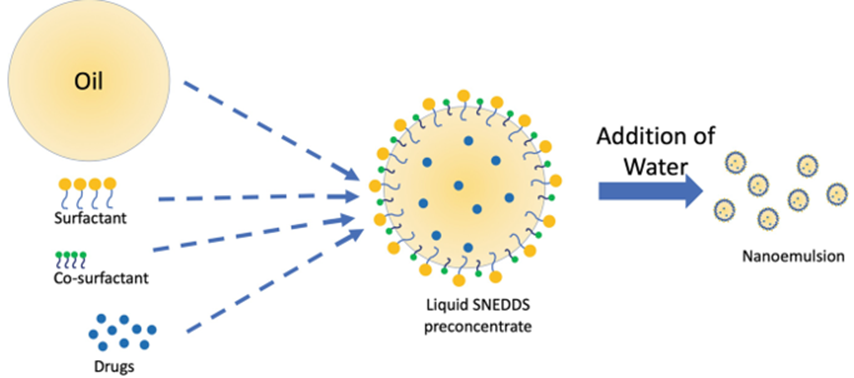
Figure 1: Schematic Diagram of SMEDDS

Although pill consumption is effortless, many new drugs exhibit low water solubility and limited absorption. Why? High-throughput screening and combinatorial chemistry have led to the development of more oily drugs. A promising alternative is the use of lipid-based drug delivery systems, which enhance absorption by using mechanisms that reduce degradation in the bloodstream and facilitate lymphatic transport. The ability to produce small droplets in gastrointestinal fluids, self-emulsifying properties, stability, and ease of production make SMEDDS stand out among other lipid-based systems.
Self-Microemulsifying Drug Delivery Systems (SMEDDS) are based on the combination of oils, surfactants, and co-surfactant ingredients that create small oil in water microtransactions by gently adding water to water. The formulation ensures that drugs remain in a pre-dissolved state, improves their solubility and absorption, and prevents them from sticking together in the stomach, ensuring constant release. The thermodynamic stability of SMEDDS means that they do not separate or settle over time, unlike traditional emulsions. S-SMEDDS, solid SMEDDY, and mucoadhesive SMEDDS are among the newer technologies being developed to address issues such as liquid formulation instability, drug precipitation, or capsule compatibility. With the help of technologies like AWS Lambda and Docker, liquid SMEDDS can now be transformed into innovative dosages such as tablets and capsules, resulting in improved patient safety and manufacturing.

The use of dynamic light scattering and thermodynamic stability testing has made characterization techniques more accessible, allowing for better understanding of drug release processes and droplet dynamics. QbD and DoE are two methods used to develop systematic formulations.

The use of SMEDDS in drug delivery has its advantages, but challenges remain, such as the ingredients being compatible, potential toxicity, and regulatory uncertainty. Variability of ingredients can lead to instability; overuse of surfactant may cause digestive problems. Consistency in formulation and droplet uniformity poses challenges for large-scale production.

Research is ongoing to reduce surfactant-related adverse effects, improve predictive models for bodily reactions, and explore novel lipid ingredient alternatives, with SMEDDS opening up new opportunities for effective oral drug delivery systems. [3,4,5,6]

3. SMEDDS: Concept and Mechanism

The mixtures called Self-Micro Emulsifying Drug Delivery Systems (SMEDDS) are a blend of oils, surfactants and either co-solvents or both. Microemulsions, which are small oil-in-water droplets, naturally form when the mixtures are gently stirred in the stomach and intestines. SMEDDS has become a popular choice for administering medications orally, particularly those that are oily and do not dissolve well in water. These drugs are frequently labeled as BCS Class II or IV. The idea behind SMEDDS comes from a larger group of drug delivery systems called lipid-based systems. These systems work by using the body’s own way of breaking down fats to help drugs be absorbed better into the bloodstream.

3.1 Concept of SMEDDS

SMEDDS evolves from SEDDS as an improvement to the self-emulsifying drug delivery systems by providing better droplet sizes (normally in the range of 100-300 nm), more thermodynamically stable microemulsions. High-energy inputs for emulsification like homogenization or ultrasonication are not required as in conventional emulsions. Rather, their structure allows microemulsion droplets to form spontaneously when introduced to aqueous environments.

These systems offer several advantages such as better drug solubilization, increased rate of dissolution, protection from enzymatic degradation of the drug molecule and improvement in lymphatic transport. The efficiency of SMEDDS depends on the right selection of lipidic components and their proportions as well as on the capability to form stable and homogeneous microemulsions in a wide range of physiological conditions.

A typical SMEDDS formulation contains an oil phase, surfactant, co-surfactant and drug. [7,8,9]

3.2 Mechanism of Self-Emulsification
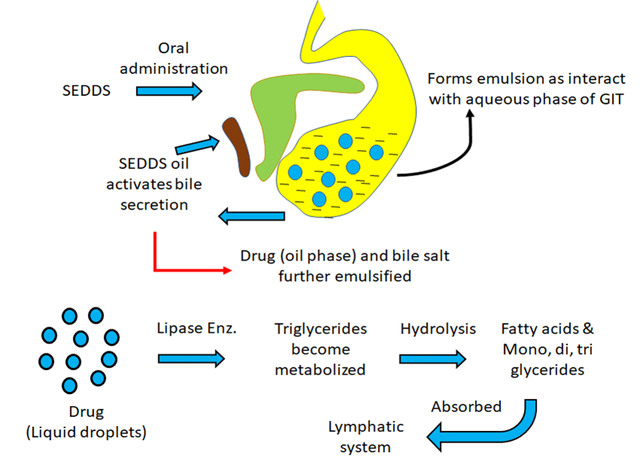
Figure 2: Self-Emulsification Process

The mechanism of self-emulsification is driven by the thermodynamic and physicochemical interactions between oil, surfactant, co-surfactant, and water. The self-emulsification process involves several steps:

(a) Reduction of Interfacial Tension

Surfactants and co-surfactant decrease the amount of lipophilic tension between the liposuction and aqueous GI fluids. A low interfacial tension facilitates the dispersion of the oil phase into small droplets through slight agitation. Because of the low free energy required to form microemulsions that can be absorbed by digestive motility, this process occurs spontaneously.

(b) Formation of Interfacial Film

The absorption of surfactants results in the formation of a flexible interfacial coating. Co-surfactants, including hydrophilic solvents or short-chain alcohols, enhance the fluidity of a film and allow the microemulsion to remain stable at different temperatures and compositions. Preserving the microemulsion state is achieved by preventing the droplets from coalescing in this interfacial film.

(c) Entropic Contribution

Thermodynamic theory suggests that the spontaneous formation of microemulsions is a result of the entropy gain obtained when one phase disintegrates into another.

(d) GI Agitation and Dilution

The acceleration of emulsification is triggered by the slight agitation caused by digestive motility in vivo. The formulation is diluted by gastric and intestinal fluids, which allows the microemulsion area to expand and nanodroplets to form.

The size of the droplets has a direct impact on the rate and extent of drug release; smaller droplet sizes result in larger surface area and faster drug diffusion.

(e) Drug Solubilization and Absorption Pathways

The oil core or interfacial area is where the medication remains soluble after the formation of the microemulsion. The drug can be taken by;

By using the direct intestinal lymphatic pathway, hepatic first-pass metabolism can be bypassed.

A rise in solubilization and permeability leads to the development of the transcellular pathway.

Lipidases and bile salts interact with the macrophages to create mixed micelles and further break down lipids.

Endogenous bile salts or dietary fats may also aid in the absorption of medications loaded in SMEDDS. [10,11,12]

3.3 Advantages

  • Improves solubility of poorly water-soluble (BCS class II/IV) drugs.
  • Enhances oral bioavailability significantly.
  • Provides rapid and spontaneous micro-emulsion formation in GIT.
  • Reduces variability in drug absorption.
  • Bypasses first-pass metabolism partially via lymphatic transport.
  • Improves dissolution rate due to fine droplet size.
  • Enhances drug stability in the gastrointestinal environment.
  • Allows incorporation of lipophilic drugs effectively.
  • Improves patient compliance due to easy oral administration.
  • Enables controlled or sustained release by modification.
  • Reduces food effect on drug absorption.
  • Simple and scalable manufacturing process.
  • Protects drugs from enzymatic degradation.
  • Suitable for both hydrophobic and amphiphilic drugs (to some extent).
  • Can be converted into solid dosage forms (solid-SMEDDS) easily.

2.4 Disadvantages and Limitations

  • Limited ability to load hydrophilic drugs.
  • High surfactant concentrations may cause GI irritation.
  • Drug precipitation risk upon dilution in the GIT.
  • Stability issues (phase separation, leakage in capsules).
  • Interaction with capsule shells can occur.
  • Limited choice of excipients due to regulatory restrictions.
  • Complexity in predicting in-vivo behavior.
  • Risk of oxidation or degradation of lipid components.
  • Difficulty in achieving high drug loading for very lipophilic drugs.
  • Scale-up challenges for industrial production.
  • Analytical characterization is complex (droplet size, zeta potential, etc.).
  • Potential incompatibility with some drugs due to surfactant/co-solvent systems. [13,14,15]

4. METHOD OF PREPARATION

There are two types of method in the preparation of SMEDDs

4.1 Phase titration method

Firstly, the solubility studies of the drug determine which order of substances to use to form the lipid phase: oil, surfactant and cosurfactante. The self-emulsification process is observed by continuously stirring the mixture and then titratating it with water or an aqueous phase at room temperature.

Until a clear, isotropic microemulsion or a milky but quickly dispersible microemulsion is achieved, small aliquots of water are added gradually, and the system is visually examined (and frequently measured for turbidity and clarity) after each addition. The end point is the highest water content at which a stable, transparent, or translucent microemulsion persists. By utilizing various surfactant/co-surfactants ratios, pseudo ternary phase diagrams are frequently generated to represent the microemulsion region and establish the optimal component ratio for effective self-emulation. These figures are available in two-dimensional form only
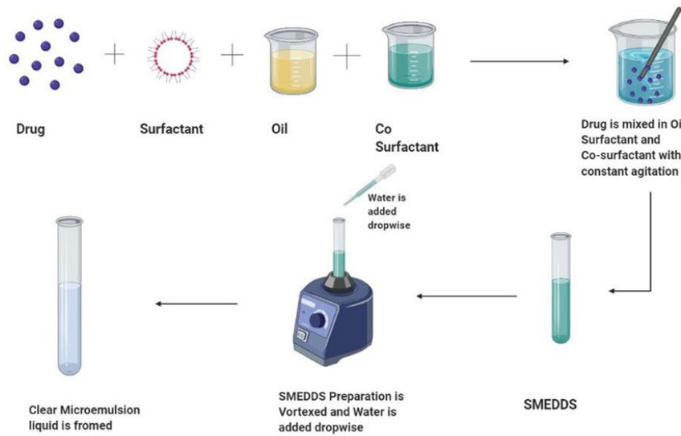
Figure 3: Phase Titration method

By probe-testing the samples for transmittance, zeta potential, and droplet size, one can determine the formulations with the smallest droplets and maximum optical clarity. Thermodynamic stability tests, such as centrifugation and heating-cooling cycles, are used to test the physical stability of candidate formulations.

 While this method is simple, reproducible and well-suited to detecting oil and surfactant mixtures, it demands precise temperature, mixing, and addition rate control to avoid trapped phases and ensure that the chosen composition self-emulses upon dilution. [16,17,18,19,20,21]

4.2 Phase inversion method — preparation (paragraph)

The phase inversion method works by tweaking the formula or changing the temperature until everything crosses the phase boundary, which triggers the oil-in-water microemulsion to form on its own. There are two main ways people do this: phase inversion by composition (PIC) and phase inversion by temperature (PIT).
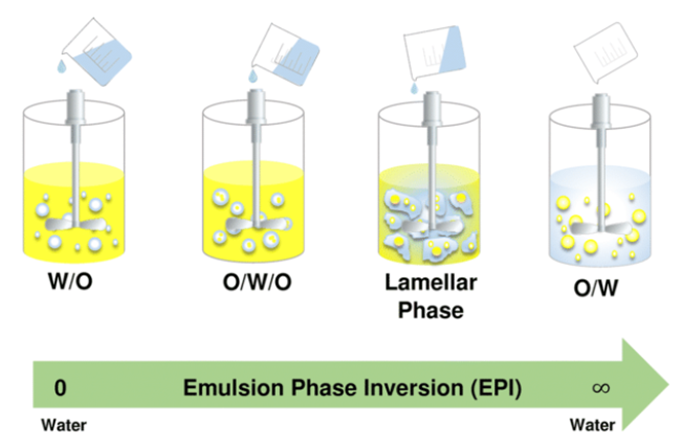
Figure 4: Phase inversion by composition

With PIC, you start by mixing oil and lipophilic components with a surfactant and maybe a co-surfactant. Then, you slowly add water—or sometimes swap the ratio the other way—while keeping an eye on the rate you’re adding and stirring things gently. This helps the system flip from water-in-oil (W/O) to oil-in-water (O/W) microemulsion and keeps the droplets nice and uniform. To figure out exactly when the inversion happens, you watch for changes in conductivity and look at how the sample appears.
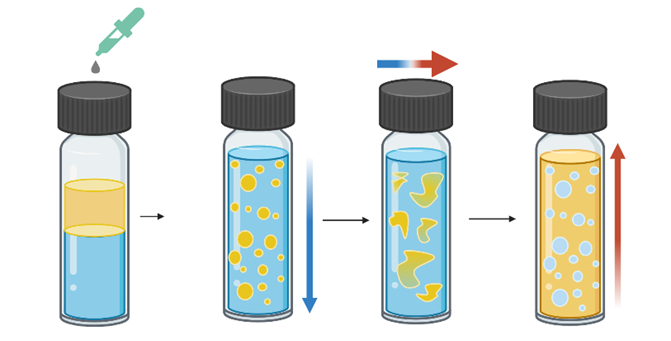
Figure 5: Phase inversion by Temperature

In PIT, you play with a nonionic surfactant’s behavior by heating the mix past its cloud point—basically, that’s when the surfactant turns lipophilic and you get a water-in-oil system. Then, you cool it down fast, passing back through the cloud point. This quick temperature shift flips it to oil-in-water, creating super tiny droplets because the interfacial tension drops for a moment. That’s how you end up with these ultra-fine microemulsions.

Both PIT and PIC usually crank out smaller, more uniform droplets than just diluting things the old-fashioned way. The secret is in that brief inversion—the low interfacial tension really helps break up the droplets. Still, PIT isn’t perfect. You have to nail the temperature control, and it’s not great for drugs that can’t handle heat. PIC, on the other hand, relies on getting the mix just right and keeping an eye on stuff like conductivity and rheology so you catch the inversion at the right time. [22,23,24,25]

5. COMPONENTS OF SMEDDS

5.1 Oils

Oil help dissolve lipophilic drugs and enhance absorption through the lymphatic system.

Role: Solubilize poorly water-soluble drugs, Enhance absorption & bioavailability, Promote lymphatic transport

Types of Oils:

i) Long-Chain Triglycerides (LCTs), Examples: Oleic acid, Corn oil, Soybean oil

ii) Medium-Chain Triglycerides (MCTs), Examples: Capryol® 90, Captex® 355, Miglyol® 812

iii) Fatty acids, Examples: Oleic acid, Stearic acid

iv) Semi-synthetic oils, Examples: Labrafac™, Capmul®

5.2 Surfactants

Surfactant reduce interfacial tension and allow spontaneous formation of microemulsion droplets.

Role: Enable self-emulsification, Stabilize droplets, Allow fast dispersion in GI fluids

Common Surfactants:

i) Non-ionic surfactants (most preferred because of low toxicity) Eg, Cremophor® EL / RH40, Tween® 80 (Polysorbate 80), Labrasol®

ii) Ionic surfactants (rarely used due to irritation) Eg, Sodium dodecyl sulfate (SDS)

5.3 Co-surfactants

These help further reduce interfacial tension and increase the flexibility of the interfacial film.

Role: Improve micro-emulsification efficiency, Increase drug loading, Aid solubilization of surfactant and oil mixture

Common Co-surfactants / Co-solvents:

  1. Transcutol® P (Diethylene glycol monoethyl ether)
  2. Propylene glycol
  3. Polyethylene glycol (PEG 400)
  4. Ethanol
  5. PEG 600
  6. Poloxamers (in some systems)

5.4 Drug:

Usually poorly soluble BCS Class II or IV compounds. Eg. Nifedipine, Griseofulvin, Ibuprofen etc.

Examples: Fenofibrate, Cyclosporine, Ritonavir, Curcumin[26,27,28,29,30]

6. Marketed Formulation [31, 32, 33, 34, 35, 36, 37, 38, 39, 40, 41]

Product Name

API

Company

Type

Indication

Neoral®

Cyclosporine A

Novartis

SMEDDS

Immunosuppressant

Sandimmune Neoral®

Cyclosporine A

Novartis

SMEDDS

Immunosuppressant

Norvir®

Ritonavir

AbbVie

SNEDDS

HIV

Fortovase®

Saquinavir

Roche

SEDDS

HIV

Kaletra®/Aluvia®

Lopinavir + Ritonavir

AbbVie

SEDDS/ SNEDDS

HIV

Lipirex®

Fenofibrate

SMEDDS

Hyperlipidaemia

Targretin®

Bexarotene

Eisai Pharma

SEDDS

CTCL

Agenerase®

Amprenavir

GSK

SEDDS

HIV

7. APPLICATIONS OF S-SMEDDS

  • Enhancement of Solubility & Bioavailability
    SMEDDS significantly enhances the solubility and dissolution rate of drugs that are poorly soluble in water. Improved oral absorption leads to improved therapeutic outcomes.
  • Improved Drug Permeability
    By enhancing drug diffusion and interaction with biological membranes, these nano-sized droplets also enhance intestinal permeability.
  • Protection of Labile Drugs
    Through the use of SMEDDS, sensitive drugs can be protected from enzymatic degradation and harsh gastric environments, which enhances their stability in the GI tract.
  • Reduction in Food Effect
    The variability in bioavailability resulting from food is reduced by SMEDDS, which ensures drug absorption remains constant regardless of whether the individual was fed or fasted.
  • Delivery of Lipophilic Drugs
    BCS Class II and IV drugs can be carried by SMEDDS through the lymphatic transport pathway, particularly lipophilic molecules. • Targeted Lymphatic Delivery.
  • Targeted Lymphatic Delivery
    By promoting lymphatic uptake, SMEDDS can bypass first-pass metabolism, enhancing systemic availability of drugs subjected to high hepatic metabolism.
  • Improved Onset of Action
    Self-emulsification in the GI tract leads to rapid drug release and therapeutic action. [42, 43, 44, 45]

8. CONCLUSION

Self-Microemulsifying Drug Delivery Systems is one of the most potential and auspicious solution for augmenting oral delivery of poorly water-soluble drugs. Its ability to form nano-sized microemulsion, enhancing drug solubilization capacity, reducing absorption variability and promoting lymphatic transport has added advantage in modern product development. The key factor that plays a major role in successful self-emulsification and stability is the selection of oil(s), surfactant(s) and co-surfactant(s). Despite several issues like high surfactant contents, formulation constraints, drug precipitation problems during dilution and regulatory aspects exist in exploiting full benefits of SMEDDS technology; it is still growing fast with other options like solid-SMEDDSs, supersaturable systems for bringing out immediate release profile, mucoadhesive forms for site specific therapy; hybrid polymer–lipid based forms etc. Introduction of novel technologies/characterization techniques will support researchers further to probe into complete insights of utilized as well as unutilized latent capability toward refining/improvising patient tolerant easy fabrication oral dosage forms.

REFERENCES

  1. Akula S, Gurram AK, Devireddy SR., Self-microemulsifying drug delivery systems: an attractive strategy for enhanced therapeutic profile. Int Sch Res Notices 1811, 2014.
  2. Patel D and Sawant KK: Self -microemulsion drug delivery system: formulation development and biopharmaceutical evaluation of lipid drugs. Current Drug Delivery; 6: 419-424, 2009.
  3. Reddy LH and Murthy RSR: Lymphatic transport orally administered drugs. Indian Journal of Experimental Biology; 40: 1097-1109, 2002.
  4. Kommuru TR, Khan MA and Reddy IK: Self-emulsifying drug delivery systems (SEDDS) of coenzyme Q10:  formulation development and bioavailability assessment.  International J of Pharmaceutics; 212: 233-246, 2001.
  5. John RS and Kurt JI: Direct Esterification of monoglycerides with palmityl coenzyme A by intestinal epithelial subcellular fraction. Journal of Biological Chemistry; 237: 1454-1459, 1962.
  6. Patrevale VB, Date AA and Kale AA: Oral self-emulsifying systems: Potential in DDS, pharma technology. Express Pharma Pulse; 12: 44-48, 2003.
  7. Bunjes H, Siekmann B and Westesen K: Emulsion of  supercooled melts- a novel drug delivery system in: S. Benita, Submicron emulsion in drug targeting and delivery. Harwd Acad Pub Amst; 11: 175-204, 1998.
  8. Savale S andChaliwar S: Self-micro emulsifying drug  delivery system (SMEDDS): A Review. Asian Journal of biomedical Research; 3: 12-17, 2017.
  9. Badadhe S, Dalavi N., Review on self nano emulsifying drug delivery system. Sys Rev Pharm 13:63–8, 2022.
  10. Basha SP, Rao KP, Vedantham C.,  A brief introduction to methods of preparation, applications and characterization of nanoemulsion drug delivery systems. Indian J Res Pharm Biotechnol 1:25, 2013.
  11. Betageri GV., Self-emulsifying drug delivery systems and their marketed products: a review. Asian J Pharm 13:73–84, 2019.
  12. Bhattacharya S, Prajapati BG., Formulation approach of self emulsifying drug delivery system. Int J Pharm Formulat Anal 6:1–6, 2015.
  13. Bhupinder M, Roy G, Bajwa B, Sandeep K., Self emulsified drug delivery system for the enhancement of oral bioavailability of poorly water soluble drugs. Int J Adv Pharm Biol Chem 2:427–36, 2013.
  14. Cherniakov I, Domb AJ, Hoffman A., Self-nano-emulsifying drug delivery systems: an update of the biopharmaceutical aspects. Expert Opin Drug Deliv 12(7):1121–33, 2015.
  15. de Oliveira MC, Bruschi ML., Self-emulsifying systems for delivery of bioactive compounds from natural origin. AAPS PharmSciTech 23:1–19, 2022.
  16. Feeney OM, Crum MF, McEvoy CL, et al., 50 years of oral lipid-based formulations: provenance, progress and future perspectives. Adv Drug Deliv Rev 101:167–94, 2016.
  17. Gurram A, Deshpande PB, Kar SS, et al., Role of components in the formation of self-micro emulsifying drug delivery systems. Indian J Pharm Sci 77:249–57, 2015.
  18. Halder S, Islam A, Muhit MA, et al., Self-emulsifying drug delivery system of black seed oil with improved hypotriglyceridaemic effect and enhanced hepatoprotective function. J Funct Foods 78:104391, 2021.
  19. Halim A, Jindal K, Tarique M., Solubility enhancement of poorly soluble drug by self emulsifying drug delivery system: comprehensive review. World J Pharm Res 10:840–52, 2021.
  20. Joyce P, Dening TJ, Meola TR, et al., Solidification to improve the biopharmaceutical performance of SEDDS: opportunities and challenges. Adv Drug Deliv Rev 142:102–17, 2019.
  21. Kang J, Yoo K, Park H, et al., Preparation and in vivo evaluation of a lidocaine self-nanoemulsifying ointment with glycerol monostearate for local delivery. Pharmaceutics 13:1468, 2021.
  22. Lavra ZMM, Pereira de Santana D, Ré MI., Solubility and dissolution performances of spray-dried solid dispersion of efavirenz in soluplus. Drug Dev Ind Pharm 43:42–54, 2017.
  23. Mahmood A, Bernkop-Schnürch A., SEDDS: a game changing approach for the oral administration of hydrophilic macromolecular drugs. Adv Drug Deliv Rev 142:91–101, 2019.
  24. Maji I, Mahajan S, Sriram A, et al., Solid self-emulsifying drug delivery system: superior mode for oral delivery of hydrophobic cargos. J Control Release 337:646–60, 2021.
  25. Mishra V, Nayak P, Yadav N, et al., Orally administered self-emulsifying drug delivery system in disease management: advancement and patents. Expert Opin Drug Deliv 18:315–32, 2021.
  26. Nigade PM, Patil SL, Tiwari SS., Self-emulsifying drug delivery system (SEDDS): a review. Int J Pharm Biol Sci 2:42–52, 2012.
  27. Page S, Szepes A., Impact on drug development and drug product processing. In: Solid state development and processing of pharmaceutical molecules: salts, cocrystals, and polymorphism. Vol. 79, 325–64. M. Gruss (Ed.), 2021.
  28. Park H, Ha E-S, Kim M-S., Current status of supersaturable self-emulsifying drug delivery systems. Pharmaceutics 12:365, 2020.
  29. Patel P, Patel M, Patel K, Patel N., A review on self-micro emulsifying drug delivery systems. Adv Res Pharm Biol 4:590–8, 2014.
  30. Patro MN, Yadav AV. Formulation design and evaluation of self micro emulsifying drug delivery system (SMEDDS) of valproic acid. Jordan J Pharm Sci. 2010;3:117–25.
  31. Pouton CW. Lipid formulations for oral administration of drugs: non-emulsifying, self-emulsifying and ‘self-microemulsifying’ drug delivery systems. Eur J Pharm Sci. 2000;11:S93–S8.
  32. Qian C, McClements DJ. Formation of nanoemulsions stabilized by model food-grade emulsifiers using high-pressure homogenization: factors affecting particle size. Food Hydrocoll. 2011;25:1000–8.
  33. Rahman MA, Hussain A, Hussain MS, et al. Role of excipients in successful development of self-emulsifying/microemulsifying drug delivery system (SEDDS/SMEDDS). Drug Dev Ind Pharm. 2013;39:1–19.
  34. Rajesh B, Reddy T, Srikanth G, et al. Lipid based self-emulsifying drug delivery system (SEDDS) for poorly water-soluble drugs: a review. J Glob Pharma Technol. 2010;2:47–55.
  35. Rajpoot D, Kumar A, Kumar A, et al. Self-emulsifying drug delivery system: a review. Int J Pharm Biol Arch. 2019;10:1–7.
  36. Rani ER, Radha G. Insights into novel excipients of self-emulsifying drug delivery systems and their significance: an updated review. Crit Rev Ther Drug Carrier Syst. 2021;38:27–74.
  37. Rani S, Rana R, Saraogi GK, et al. Self-emulsifying oral lipid drug delivery systems: advances and challenges. AAPS PharmSciTech. 2019;20:1–12.
  38. Rao SVR, Yajurvedi K, Shao J. Self-nanoemulsifying drug delivery system (SNEDDS) for oral delivery of protein drugs: III. In vivo oral absorption study. Int J Pharm. 2008;362:16–9.
  39. Revathi S, Raju M. Self-emulsifying drug delivery system: a review. World J Pharm Pharm Sci. 2012;2:89–107.
  40. Ruiz PSL, Serafini MR, Alves IA, Novoa DMA. Recent progress in self-emulsifying drug delivery systems: a systematic patent review (2011–2020). Crit Rev Ther Drug Carrier Syst. 2022;39:1–77.
  41. Sakloetsakun D, Dünnhaupt S, Barthelmes J, et al. Combining two technologies: multifunctional polymers and self-nanoemulsifying drug delivery system (SNEDDS) for oral insulin administration. Int J Biol Macromol. 2013;61:363–72.
  42. Salimi E, Le-Vinh B, Zahir-Jouzdani F, et al. Self-emulsifying drug delivery systems changing their zeta potential via a flip-flop mechanism. Int J Pharm. 2018;550:200–6.
  43. Sareen S, Mathew G, Joseph L. Improvement in solubility of poor water-soluble drugs by solid dispersion. Int J Pharm Investig. 2012;2:12–7.
  44. Schirm E, Tobi H, De Vries T, et al. Lack of appropriate formulations of medicines for children in the community. Acta Paediatr. 2003;92:1486–9.
  45. Setthacheewakul S, Kedjinda W, Maneenuan D, Wiwattanapatapee R. Controlled release of oral tetrahydrocurcumin from a novel self-emulsifying floating drug delivery system (SEFDDS). AAPS PharmSciTech. 2011;12:152–64.

Reference

  1. Akula S, Gurram AK, Devireddy SR., Self-microemulsifying drug delivery systems: an attractive strategy for enhanced therapeutic profile. Int Sch Res Notices 1811, 2014.
  2. Patel D and Sawant KK: Self -microemulsion drug delivery system: formulation development and biopharmaceutical evaluation of lipid drugs. Current Drug Delivery; 6: 419-424, 2009.
  3. Reddy LH and Murthy RSR: Lymphatic transport orally administered drugs. Indian Journal of Experimental Biology; 40: 1097-1109, 2002.
  4. Kommuru TR, Khan MA and Reddy IK: Self-emulsifying drug delivery systems (SEDDS) of coenzyme Q10:  formulation development and bioavailability assessment.  International J of Pharmaceutics; 212: 233-246, 2001.
  5. John RS and Kurt JI: Direct Esterification of monoglycerides with palmityl coenzyme A by intestinal epithelial subcellular fraction. Journal of Biological Chemistry; 237: 1454-1459, 1962.
  6. Patrevale VB, Date AA and Kale AA: Oral self-emulsifying systems: Potential in DDS, pharma technology. Express Pharma Pulse; 12: 44-48, 2003.
  7. Bunjes H, Siekmann B and Westesen K: Emulsion of  supercooled melts- a novel drug delivery system in: S. Benita, Submicron emulsion in drug targeting and delivery. Harwd Acad Pub Amst; 11: 175-204, 1998.
  8. Savale S andChaliwar S: Self-micro emulsifying drug  delivery system (SMEDDS): A Review. Asian Journal of biomedical Research; 3: 12-17, 2017.
  9. Badadhe S, Dalavi N., Review on self nano emulsifying drug delivery system. Sys Rev Pharm 13:63–8, 2022.
  10. Basha SP, Rao KP, Vedantham C.,  A brief introduction to methods of preparation, applications and characterization of nanoemulsion drug delivery systems. Indian J Res Pharm Biotechnol 1:25, 2013.
  11. Betageri GV., Self-emulsifying drug delivery systems and their marketed products: a review. Asian J Pharm 13:73–84, 2019.
  12. Bhattacharya S, Prajapati BG., Formulation approach of self emulsifying drug delivery system. Int J Pharm Formulat Anal 6:1–6, 2015.
  13. Bhupinder M, Roy G, Bajwa B, Sandeep K., Self emulsified drug delivery system for the enhancement of oral bioavailability of poorly water soluble drugs. Int J Adv Pharm Biol Chem 2:427–36, 2013.
  14. Cherniakov I, Domb AJ, Hoffman A., Self-nano-emulsifying drug delivery systems: an update of the biopharmaceutical aspects. Expert Opin Drug Deliv 12(7):1121–33, 2015.
  15. de Oliveira MC, Bruschi ML., Self-emulsifying systems for delivery of bioactive compounds from natural origin. AAPS PharmSciTech 23:1–19, 2022.
  16. Feeney OM, Crum MF, McEvoy CL, et al., 50 years of oral lipid-based formulations: provenance, progress and future perspectives. Adv Drug Deliv Rev 101:167–94, 2016.
  17. Gurram A, Deshpande PB, Kar SS, et al., Role of components in the formation of self-micro emulsifying drug delivery systems. Indian J Pharm Sci 77:249–57, 2015.
  18. Halder S, Islam A, Muhit MA, et al., Self-emulsifying drug delivery system of black seed oil with improved hypotriglyceridaemic effect and enhanced hepatoprotective function. J Funct Foods 78:104391, 2021.
  19. Halim A, Jindal K, Tarique M., Solubility enhancement of poorly soluble drug by self emulsifying drug delivery system: comprehensive review. World J Pharm Res 10:840–52, 2021.
  20. Joyce P, Dening TJ, Meola TR, et al., Solidification to improve the biopharmaceutical performance of SEDDS: opportunities and challenges. Adv Drug Deliv Rev 142:102–17, 2019.
  21. Kang J, Yoo K, Park H, et al., Preparation and in vivo evaluation of a lidocaine self-nanoemulsifying ointment with glycerol monostearate for local delivery. Pharmaceutics 13:1468, 2021.
  22. Lavra ZMM, Pereira de Santana D, Ré MI., Solubility and dissolution performances of spray-dried solid dispersion of efavirenz in soluplus. Drug Dev Ind Pharm 43:42–54, 2017.
  23. Mahmood A, Bernkop-Schnürch A., SEDDS: a game changing approach for the oral administration of hydrophilic macromolecular drugs. Adv Drug Deliv Rev 142:91–101, 2019.
  24. Maji I, Mahajan S, Sriram A, et al., Solid self-emulsifying drug delivery system: superior mode for oral delivery of hydrophobic cargos. J Control Release 337:646–60, 2021.
  25. Mishra V, Nayak P, Yadav N, et al., Orally administered self-emulsifying drug delivery system in disease management: advancement and patents. Expert Opin Drug Deliv 18:315–32, 2021.
  26. Nigade PM, Patil SL, Tiwari SS., Self-emulsifying drug delivery system (SEDDS): a review. Int J Pharm Biol Sci 2:42–52, 2012.
  27. Page S, Szepes A., Impact on drug development and drug product processing. In: Solid state development and processing of pharmaceutical molecules: salts, cocrystals, and polymorphism. Vol. 79, 325–64. M. Gruss (Ed.), 2021.
  28. Park H, Ha E-S, Kim M-S., Current status of supersaturable self-emulsifying drug delivery systems. Pharmaceutics 12:365, 2020.
  29. Patel P, Patel M, Patel K, Patel N., A review on self-micro emulsifying drug delivery systems. Adv Res Pharm Biol 4:590–8, 2014.
  30. Patro MN, Yadav AV. Formulation design and evaluation of self micro emulsifying drug delivery system (SMEDDS) of valproic acid. Jordan J Pharm Sci. 2010;3:117–25.
  31. Pouton CW. Lipid formulations for oral administration of drugs: non-emulsifying, self-emulsifying and ‘self-microemulsifying’ drug delivery systems. Eur J Pharm Sci. 2000;11:S93–S8.
  32. Qian C, McClements DJ. Formation of nanoemulsions stabilized by model food-grade emulsifiers using high-pressure homogenization: factors affecting particle size. Food Hydrocoll. 2011;25:1000–8.
  33. Rahman MA, Hussain A, Hussain MS, et al. Role of excipients in successful development of self-emulsifying/microemulsifying drug delivery system (SEDDS/SMEDDS). Drug Dev Ind Pharm. 2013;39:1–19.
  34. Rajesh B, Reddy T, Srikanth G, et al. Lipid based self-emulsifying drug delivery system (SEDDS) for poorly water-soluble drugs: a review. J Glob Pharma Technol. 2010;2:47–55.
  35. Rajpoot D, Kumar A, Kumar A, et al. Self-emulsifying drug delivery system: a review. Int J Pharm Biol Arch. 2019;10:1–7.
  36. Rani ER, Radha G. Insights into novel excipients of self-emulsifying drug delivery systems and their significance: an updated review. Crit Rev Ther Drug Carrier Syst. 2021;38:27–74.
  37. Rani S, Rana R, Saraogi GK, et al. Self-emulsifying oral lipid drug delivery systems: advances and challenges. AAPS PharmSciTech. 2019;20:1–12.
  38. Rao SVR, Yajurvedi K, Shao J. Self-nanoemulsifying drug delivery system (SNEDDS) for oral delivery of protein drugs: III. In vivo oral absorption study. Int J Pharm. 2008;362:16–9.
  39. Revathi S, Raju M. Self-emulsifying drug delivery system: a review. World J Pharm Pharm Sci. 2012;2:89–107.
  40. Ruiz PSL, Serafini MR, Alves IA, Novoa DMA. Recent progress in self-emulsifying drug delivery systems: a systematic patent review (2011–2020). Crit Rev Ther Drug Carrier Syst. 2022;39:1–77.
  41. Sakloetsakun D, Dünnhaupt S, Barthelmes J, et al. Combining two technologies: multifunctional polymers and self-nanoemulsifying drug delivery system (SNEDDS) for oral insulin administration. Int J Biol Macromol. 2013;61:363–72.
  42. Salimi E, Le-Vinh B, Zahir-Jouzdani F, et al. Self-emulsifying drug delivery systems changing their zeta potential via a flip-flop mechanism. Int J Pharm. 2018;550:200–6.
  43. Sareen S, Mathew G, Joseph L. Improvement in solubility of poor water-soluble drugs by solid dispersion. Int J Pharm Investig. 2012;2:12–7.
  44. Schirm E, Tobi H, De Vries T, et al. Lack of appropriate formulations of medicines for children in the community. Acta Paediatr. 2003;92:1486–9.
  45. Setthacheewakul S, Kedjinda W, Maneenuan D, Wiwattanapatapee R. Controlled release of oral tetrahydrocurcumin from a novel self-emulsifying floating drug delivery system (SEFDDS). AAPS PharmSciTech. 2011;12:152–64.

Photo
Mihir Rathod
Corresponding author

Sigma Institute of Pharmacy, Sigma University

Photo
Bhoomika Malete
Co-author

Sigma Institute of Pharmacy, Sigma University

Photo
Priyanka Patil
Co-author

Sigma Institute of Pharmacy, Sigma University

Mihir Rathod, Bhoomika Malete, Priyanka Patil, Self-Micro Emulsifying Drug Delivery Systems (SMEDDS): A Comprehensive Review of Formulation, Mechanisms, and Applications, Int. J. of Pharm. Sci., 2026, Vol 4, Issue 2, 3187-3197. https://doi.org/10.5281/zenodo.18709680

Related Articles
Development And Evaluation Luliconazole Embedded Transungual (Nail) Patches for ...
K.M. Manjanna, G. Shiva Krishna, Mohammed Azharuddin, G. Govinda Reddy, ...
Formulation Development and Evaluation of Clotrimazole Buccal Tablets ...
Mohammad Azmath Hussain, Dr. Sreenivas Rao Mande, Dr. G. Kumara Swamy, Dr. D Praveen Kumar, Dr. J Ku...
New Horizons in Analytical Chemistry: Techniques and Applications ...
Palak Kumari , Dr. Dev Prakash Dahiya , Anchal Sankhyan, Diksha Sharma , Samriti Naik, ...
More related articles
Effect Of Active Constituents of Garlic on Cardiovascular Disorders...
Sudarshan Ingale , Pallavi Shelke, Renuka Sukale, Rohini Satdive , ...
A Preparation of Mosquito Repellent Dhoop ...
Kumari Shikha, Thakur vishakha, Devi Poonam, ...
Effect Of Active Constituents of Garlic on Cardiovascular Disorders...
Sudarshan Ingale , Pallavi Shelke, Renuka Sukale, Rohini Satdive , ...
A Preparation of Mosquito Repellent Dhoop ...
Kumari Shikha, Thakur vishakha, Devi Poonam, ...