Neuropsychiatric symptoms, habitually labelled as Behavioural and Psychological Symptoms of Dementia (BPSD)1, are almost universally present in Alzheimer's disease (AD), affecting between 90% and 97% of individuals throughout the progression of the disease2–7. These symptoms encompass apathy, depression, anxiety, agitation, and psychosis2, markedly weakening the overall well-being of patients and their care providers, while anticipating a higher speed of operational decline, earlier entry into formal care facilities, and increased mortality2,4. Although their rate of occurrence, NPS remains underappreciated and difficult to deal with and manage due to their intricate biological, psychological, and social fundamental mechanisms2. This review brings together the most recent literature on the biological basis of NPS, highlighting network-level alterations in normal function, impairment in neurotransmitter indices, and amyloid and tau pathology2. We elaborate on certain pathophysiologies for the principal symptom areas and assess existing diagnostic approaches and treatment paradigms. These findings point out the need for a paradigm shift8 toward individual-focused, biomarker-assisted care that merges pharmacological and non-pharmacological techniques9,10. Future improvements rely on improving the quality of the diagnostic set of rules and the formation of targeted interventions that tackle the biological influences of these incapacitating symptoms10
Keywords
Neuropsychiatric Symptoms (NPS), Behavioural and Psychological Symptoms of Dementia (BPSD), Alzheimer's disease (AD), Apathy, Psychosis, Depression
Introduction
×
Fig I . Graphical Abstract
Alzheimer's disease11,12 ranks among the most widely observed nerve degeneration disorders globally, characterised mainly by a gradual decline in memory abilities. Increasingly, it is acknowledged that neuropsychiatric symptoms significantly contribute to the disease, rather than merely resulting from memory loss2,13,14. These symptoms often appear during Mild Cognitive Impairment (MCI) and mild behavioural impairment (MBI)15,16, which are the initial phases preceding Alzheimer's disease (AD)2,17–19. Neuropsychiatric symptoms (NPS) encompass a extensive variety of issues20, including emotional symptoms (such as depression and anxiety), psychotic problems (such as delusions and hallucinations), and behavioural changes such as agitation, aggression, and apathy2,10,21. The presence of these symptoms is a more accurate indicator of the necessity for residential care and increased caregiver stress than cognitive decline alone2,22.
BACKGROUND & RATIONALE
The clinical phase of AD is outlined by regression over multiple areas; however, non-cognitive expressions frequently present chief handling difficulties23. This review is necessitated by the fact that, despite the enormous public health effect of NPS, they remain inadequately studied and commonly poorly treated2,4. Prior diagnostic models commonly ruled out NPS as feedback to loss of memory, but recent neuroimaging and biomarker information validate that these symptoms appear from a precise neurobiological weakness1,9,24. By combining the latest breakthroughs in neurobiology and clinical trials, this review aims to furnish a roadmap for more powerful, mechanistically guided initiatives.
PATHOPHYSIOLOGY OF NEUROPSYCHIATRIC SYMPTOMS
The neuroscience of NPS encompasses scattered malfunction over multiple brain regions outside conventional amyloid and tau deposition1,2,24.
Apathy:
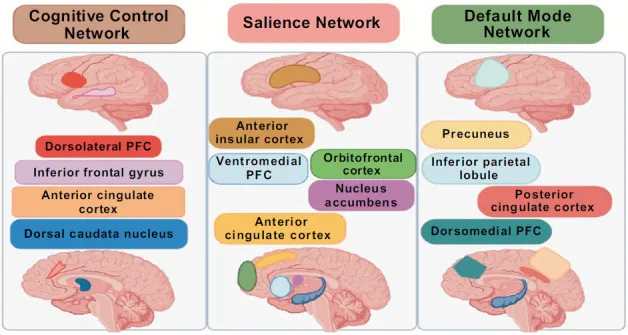
widespread disturbances in the neural networks, that is the Salience Network, Default Mode Network (DMN), and locus coeruleus network (LC-NA)1,32.
Role of the Salience Network33: Outside the ACC and OFC, apathy is related to altered function in the Salience Network (SN), which comprises the anterior insula and amygdala1,34,35. This network is vital for assessing external and internal information, and its dysfunction affects emotional numbing and reduces the capability to process emotionally important signals1,36.
Default Mode Network Involvement: Dysfunction within the Default Mode Network, particularly in the dorsomedial prefrontal cortex (DMPFC) and precuneus37, is linked to difficulties in self-motivation and self-awareness37,37,38. This may result in a lack of spontaneous emotional responses or a shortfall in self-initiated ideas25.
Locus Coeruleus-Norepinephrine (LC-NA) System: Apart from dopaminergic pathways, the beginning and significant destruction of the locus coeruleus is a key contributor to early cognitive decline39. This disturbance in the norepinephrine system specifically affects reward processing and cognitive control, further intensifying the motivational challenges40,41.
Figure 2. Key brain networks in goal-directed behaviour and planning31
Certain deficiencies in executive function, including problems with initiation, set-shifting, and abstract thought, are correlated with these physiologic changes. These neuropsychological deficits set the condition of apathy apart from other neuropsychiatric illnesses such as depression.
Depression:
Depression associated with AD is characterised by a complex interaction of structural brain alterations, dysfunction at the circuit level, and neurochemical imbalances, primarily influenced by the fundamental pathology of AD and neuroinflammation42. Structural neuroimaging reveals atrophy in grey matter volume43and cortical thinning, mainly in the frontal and temporal lobes1 b, including areas such as the left dorsolateral prefrontal cortex (DLPFC), orbitofrontal cortex, anterior cingulate cortex (ACC), hippocampus, and entorhinal cortex44. The alterations affect the frontal-subcortical limbic circuits, where the dorsal section (comprising the DLPFC and dorsal ACC) is responsible for the cognitive elements of mood, while the ventral section (encompassing paralimbic and subcortical areas) controls physical symptoms1,45,46. From a neurochemical perspective, depression is linked with notable impairments in serotonin and norepinephrine due to the lack of cell bodies47 in the dorsal raphe nucleus and locus coeruleus, respectively, which results in decreased levels of these neurotransmitters throughout the brain21,48. These neurotransmitter imbalances are frequently initiated by neuroinflammation, where the stimulation of microglia and the discharge of pro-inflammatory cytokines such as TNF-α and IL-616 further reduce serotonin levels1,9,15,49. This process aligns with the fundamental pathologies of Alzheimer's disease6, as the buildup of amyloid-beta in the frontal lobes and tau in the transentorhinal6 and hippocampal areas is associated with more pronounced symptoms50. Additionally, changes in the hypothalamic-pituitary-adrenal (HPA) axis, marked by elevated cortisol16 indices, facilitate to the persistence of these depressive symptoms over time9,15,51,52.
Psychosis:
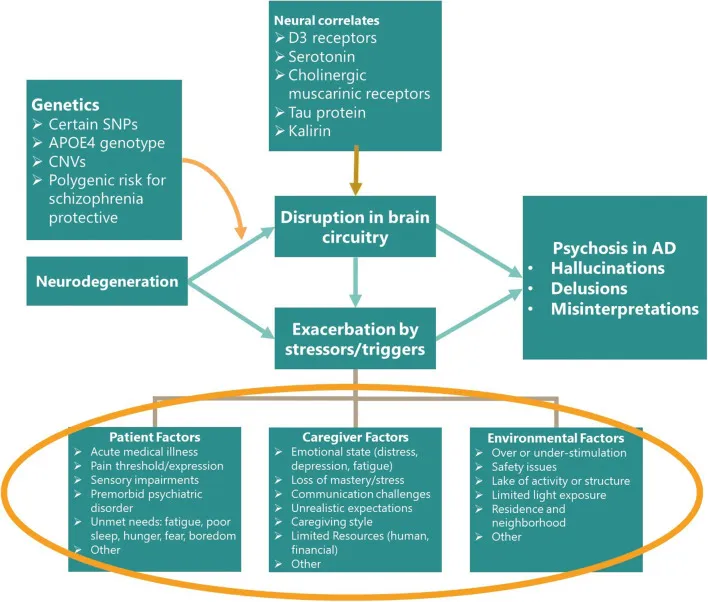
The underlying pathology of psychosis in Alzheimer's disease (AD) – typified by the occurrence of delusions and hallucinations - is multifaceted53–55, and includes both neurochemical and anatomical changes as well as genetic and neuropathological causes2,4,56. AD psychosis is biologically different from functional psychotic disorders like schizophrenia, and is generally seen in moderate-to-severe AD56.
Neurochemical Imbalances: AD psychosis is associated with an imbalance in the "monoamine-cholinergic balance".
Dopamine System: Delusions are highly associated with relative hyperdopaminergia in the striatum1. Studies suggest that AD patients having delusions have greater striatal dopamine D2/D3 receptor availability than patients who don’t have delusions46,57. This could be due to the lack of cholinergic neurons51, which normally inhibit the dopaminergic system, while it remains relatively intact1,58. Also, increased dopamine D3 receptor binding in the nucleus accumbens has been found post-mortem56.
Dysfunction of the Serotonin (5-HT) System: There are severe serotonergic abnormalities associated with psychosis58. There is a decrease in 5-HT in the ventral temporal cortex and decreased cell density in the dorsal raphe nucleus56,59. In particular, decreased serotonin levels in the temporal cortex are related to psychosis and hyperactivity1,15,16,60,61.
Cholinergic System: Muscarinic receptors are increased (higher M2 density) in the orbitofrontal gyrus and temporal association cortex in association with delusions56,58,62.
Neuroanatomical and Circuit-Level Dysfunction
AD psychosis has been linked to widespread dysfunction in multiple neural networks, which can manifest as asymmetrical changes1,2.
Delusions: These are mainly associated with frontotemporal lesions, such as left frontal lobe and right temporal lobe atrophy1. Structural imaging studies often reveal hypometabolism in the right lateral frontal cortex, anterior cingulate cortex (ACC) and orbitofrontal cortex (OFC)1,21,63. There is also some evidence of delusions being associated with reduced connectivity in the Default Mode Network (DMN) with the left inferior parietal lobule13.
Hallucinations: These are linked to a disruption of the anterior-posterior neural network, including the dorsolateral prefrontal cortex, occipital lobes and anterior insula1. Visual hallucinations, the most frequent type in AD, are linked with atrophy and white matter lesions of the occipital lobe58.
Salience Network (SN): Dysfunction of the salience network, which informs integrated behavioural and emotional responses, is also believed to be a critical factor in the progression of psychosis64.
Neuropathological Hallmarks
Global amyloid and tau pathology is associated with cognitive impairment, while psychosis is associated with specific pathology.
Amyloid and Tau: Cross-sectionally, increased neuritic plaque density (Aβ) is linked to psychosis65. But tau seems to be more reliable; elevated neurofibrillary tangle density and phosphorylated tau (p-tau) concentrations in the neocortex and frontal cortex of psychosis patients have been observed9,56,60,66psych67.
White Matter Hyperintensities (WMH): Higher WMH volume in the left occipital lobe is a significant predictor of delusions, and whole-brain WMH volume is associated with the severity of delusions68.
Genetics and Risk Factors
Heritability: The estimated heritability of psychosis in AD is 61%, indicating a significant genetic influence56,69,70.
Genetic Variants: The APOE ε4 allele has been connected with an increased risk of psychosis in females9,30,71. There have also been reported associations with common variants in the RP11-541P9.3 antisense transcript and structural copy number variants in the APC2 gene56.
Environmental and Sensory Stimuli: Sensory loss (visual, such as cataracts; auditory) can trigger visual hallucinations and paranoia, respectively56,72. Other acute illnesses (infection, dehydration) and caregiver distress also promote psychosis56.
Figure 3. Conceptual model of psychosis in AD56
Anxiety :
The underlying mechanism of anxiety in Alzheimer's disease is primarily directed attention towards the structural and neurodynamic changes in the amygdala-mediated circuit, which is important for fear interpretation and risk evaluation1,73. Structural magnetic resonance imaging (MRI) shows atrophy of the amygdala and entorhinal cortex74, and atrophy in the right precuneus, inferior parietal lobule, posterior cingulate gyrus and the insula1,75. Structural changes are linked to key functional connectivity changes, including decreased connectivity amid the medial amygdala and the retrosplenial cortex76 (part of the default mode network) and increased local infratemporal connectivity77.
Biologically, these symptoms are connected with preclinical amyloid-beta accumulation in the precuneus, frontal and parietal lobes, and focal tau deposition in the lateral and medial amygdala76,78. Neurochemically, anxiety is linked to abnormalities in the serotonergic, dopaminergic and noradrenergic systems, where the locus coeruleus serves as a key hub for dysfunctional responses to uncertainty79. Additionally, anxiety in AD is increasingly linked to neuroinflammation and is connected to raised interleukin-6 (IL-6) and C-reactive protein (CRP) indices, which may indicate early brain injury, even in the absence of overt cognitive impairment80.
METHODOLOGY
This review presents evidence from a summary of major reviews and original research papers cited in the sources.
Literature Sources and Methods: The literature was searched in major databases (PubMed (MEDLINE), EMBASE, Scopus, and Google Scholar).
Inclusion Criteria: We included studies that included patients with probable AD and MCI (based on NINCDS-ADRDA or DSM-IV/V criteria), reported the prevalence or biological factors associated with NPS, and involved validated instruments such as the Neuropsychiatric Inventory (NPI).
Exclusion Criteria: Manuscripts involving non-AD dementia (unless for comparison purposes), sample sizes less than 10, and patients under 50 years of age were excluded.
Quality Assessment and Data Extraction: Manuscripts were rated for bias and quality using established tools such as the Joanna Briggs Institute-Qualitative Assessment (JBI-QARI) and Newcastle-Ottawa Scale. Extraction of information was done with an emphasis on rates of prevalence, neuroanatomical correlates (MRI/PET), and pharmacotherapy outcomes.
SYNTHESIS OF EVIDENCE
This evidence confirms that NPS are core to AD. Biomarker studies show that decreased CSF Aβ42 and increased p-tau are predictive of longitudinal progression of apathy, depression and anxiety. Also, neuroinflammation (as measured by microglial activation in the ACC and temporal regions) is a predictor of irritability and agitation. A "symptom hypothesis" proposes that these symptoms stem from the same neurodegenerative processes that result in cognitive impairment, whereas a "risk factor hypothesis" suggests that NPS symptoms may be due to coexisting non-AD pathology, like vascular disease15,16.
CURRENT TREATMENTS AND DIAGNOSIS
Diagnosis:
The most commonly utilised instrument of NPS is the Neuropsychiatric Inventory (NPI) or the shorter version, NPI-Q, which both use informant ratings to assess frequency and severity81,82. Other scales include the Geriatric Depression Scale (GDS) and the Cornell Scale for Depression in Dementia (CSDD)83.
Current Treatments:
Pharmacological:
Cholinesterase inhibitors (ChEIs) (such as donepezil) have restricted effects on apathy and overall NPS. Selective serotonin reuptake inhibitors (SSRIs) are used first for depression/anxiety, but are often questioned in large trials for AD84–87.
Antipsychotics are reserved for severe psychosis and agitation because of stroke and death risks88. Newer drugs, such as brexpiprazole and pimavanserin, are promising for symptom subsets.
Non-Pharmacological: These are recommended as first-line interventions. These include caregiver communication training, environmental modifications to minimise distractions and sensory stimulation activities, such as music and art therapy89.
Table 1 ; Major Studies About Neuropsychiatric Diseases In Alzheimer’s Disease
Study Name, Author
Sample Size
Design
Key Findings
DELCODE Study (Sannemann et al., 2020)
687
Longitudinal
NPS in SCD worriers are associated with underlying AD pathology biomarkers (Aβ42).
Cache County Study (Lyketsos et al., 2001)
5,092
Longitudinal
Identified 3 clusters of NPS: 98% of AD patients developed NPS over 5 years.
Amsterdam Dementia Cohort (Eikelboom et al., 2021)
1,515
Observational
NPS were prevalent across th spectrum; apathy and agitation with worse cognitive empairment.
Mayo Clinic Study of Aging (Geda et al., 2014)
1,038
Population Based
NPS like agitation and apathy in cognitively normal persons predict incident MCI.
HABS Cohort (Donovan et al., 2014)
268
Longitudinal
Higher depression scores correlated with lower hippocampal volume in non-depressed, unimpaired subjects.
A4 Study (Li et al., 2024)
598
Preclinical
Focal amygdalar tau binding and connectivity changes relate to early mood symptoms in AD.
FUTURE PERSPECTIVES
Biomarker-driven precision medicine is key to improving NPS2,90. Potential future research directions include virtual reality to improve sensory stimulation and AI monitoring for early detection of changes in behaviour. Incorporating the MBI construct into clinical trials will enable interventions before onset of cognitive deterioration21,91. Further, the role of neuroinflammation and the gut-brain system in regulating behaviour presents an important avenue for drug development92.
CONCLUSION
Neuropsychiatric symptoms are a central, not incidental, feature of Alzheimer's disease4,20. Their multifaceted pathogenesis includes a combination of traditional AD pathology, network deintegration and psychogenic factors24. Although currently available medications have limited efficacy and safety, early recognition of these symptoms through MBI criteria and systematic use of non-pharmacological interventions holds promise for reducing patient and family suffering93. The key to future care is a shift in paradigm that prioritises NPS with the same mechanistic attention as cognitive decline.
REFERENCES
Chen Y, Dang M, Zhang Z. Brain mechanisms underlying neuropsychiatric symptoms in Alzheimer’s disease: a systematic review of symptom-general and –specific lesion patterns. Mol Neurodegeneration. 2021 Jun 7;16(1):38. doi:10.1186/s13024-021-00456-1
Rose DK, Lyketsos CG, Rosenberg PB, Nowrangi MA. Neuropsychiatric symptoms in Alzheimer’s disease: Bridging mechanisms, management, and emerging innovations. Neurotherapeutics. 2026 Jan;23(1):e00788. doi:10.1016/j.neurot.2025.e00788
Rabl M, Clark C, Dayon L, Popp J. Neuropsychiatric symptoms in cognitive decline and Alzheimer’s disease: biomarker discovery using plasma proteomics. J Neurol Neurosurg Psychiatry. 2025 Apr;96(4):370–82. doi:10.1136/jnnp-2024-333819
Pless A, Ware D, Saggu S, Rehman H, Morgan J, Wang Q. Understanding neuropsychiatric symptoms in Alzheimer’s disease: challenges and advances in diagnosis and treatment. Front Neurosci. 2023 Sep 5;17:1263771. doi:10.3389/fnins.2023.1263771
Panza F, Seripa D, D′Onofrio G, Frisardi V, Solfrizzi V, Mecocci P, et al. Neuropsychiatric Symptoms, Endophenotypes, and Syndromes in Late‐Onset Alzheimer′s Disease: Focus on APOE Gene. Reitz C, editor. International Journal of Alzheimer’s Disease. 2011 Jan;2011(1):721457. doi:10.4061/2011/721457
Iravani B, Abdollahi E, Eslamdoust-Siahestalkhi F, Soleimani R. Neuropsychiatric Symptoms of Alzheimer’s Disease and Caregiver Burden. Front Neurol. 2022 Jul 29;13:877143. doi:10.3389/fneur.2022.877143
Kidd EJ, Newhouse PA, editors. Neurobiology of Alzheimer’s Disease. Cham: Springer Nature Switzerland; 2025. 1 p. (Current Topics in Behavioral Neurosciences; no. 69). doi:10.1007/978-3-031-84920-6
Aktary N, Jeong Y, Oh S, Shin Y, Sung Y, Rahman M, et al. Unveiling the therapeutic potential of natural products in Alzheimer’s disease: insights from in vitro, in vivo, and clinical studies. Front Pharmacol. 2025 Jun 23;16:1601712. doi:10.3389/fphar.2025.1601712
Chatzikostopoulos A, Moraitou D, Papaliagkas V, Tsolaki M. Mapping the Neuropsychiatric Symptoms in Alzheimer’s Disease Using Biomarkers, Cognitive Abilities, and Personality Traits: A Systematic Review. Diagnostics. 2025 Apr 24;15(9):1082. doi:10.3390/diagnostics15091082
Raphael DDL, Alzheimer’s Foundation of America, Research Department, 322 8th Avenue, Floor 16, New York, NY 10001, USA. Neuropsychiatric symptoms in mild cognitive impairment and early Alzheimer’s disease: Clinical pattern and diagnostic implications. AIMSN. 2025;12(4):676–705. doi:10.3934/Neuroscience.2025032
Botto R, Callai N, Cermelli A, Causarano L, Rainero I. Anxiety and depression in Alzheimer’s disease: a systematic review of pathogenetic mechanisms and relation to cognitive decline. Neurol Sci. 2022 Jul;43(7):4107–24. doi:10.1007/s10072-022-06068-x
Broderick PA, editor. Biomedical Imaging in Neurodegeneration [Internet]. Cham: Springer Nature Switzerland; 2025 [cited 2026 May 1]. Available from: https://link.springer.com/10.1007/978-3-031-95878-6 doi:10.1007/978-3-031-95878-6
Lyketsos CG, Peters ME. Neuropsychiatric symptoms in Alzheimer’s disease: Past, present, and future. Alzheimer’s & Dementia. 2026 Jan;22(1):e71077. doi:10.1002/alz.71077
Argyriou S, Fullard JF, Krivinko JM, Lee D, Wingo TS, Wingo AP, et al. Beyond memory impairment: the complex phenotypic landscape of Alzheimer’s disease. Trends in Molecular Medicine. 2024 Aug;30(8):713–22. doi:10.1016/j.molmed.2024.04.016
Ormazabal P, Bastías-Pérez M, Inestrosa NC, Cisternas P. Adipokines at the Metabolic–Brain Interface: Therapeutic Modulation by Antidiabetic Agents and Natural Compounds in Alzheimer’s Disease. Pharmaceuticals. 2025 Oct 11;18(10):1527. doi:10.3390/ph18101527
Ramírez-Expósito MJ, Cueto-Ureña C, Martínez-Martos JM. Neurotransmitter Systems in Alzheimer’s Disease. CIMB. 2026 Mar 22;48(3):334. doi:10.3390/cimb48030334
Guazzarini AG, Galaris E, Boccardi V, Mancinetti F, Ruggiero C, Muehlboeck J, et al. Neuropsychiatric symptoms in preclinical and clinically manifest dementia: clusters and their health determinants. Alzheimer’s & Dementia. 2026 Mar;22(3):e71255. doi:10.1002/alz.71255
Blasutto B, Fattapposta F, Casagrande M. Mild Behavioral Impairment and cognitive functions: A systematic review and meta-analysis. Ageing Research Reviews. 2025 Mar;105:102668. doi:10.1016/j.arr.2025.102668
Scheuermann JS, Graessel E, Kratzer A, Scheerbaum P. Mild behavioral impairment in people with mild cognitive impairment: Are the two conditions related? Journal of Alzheimer’s Disease. 2024 Dec;102(3):792–800. doi:10.1177/13872877241291231
Eikelboom W. More than Memory: The prevalence, assessment, and management of neuropsychiatric symptoms in Alzheimer’s disease [Internet]. 2023. doi:10.13140/RG.2.2.35376.23043
Lyketsos CG, Carrillo MC, Ryan JM, Khachaturian AS, Trzepacz P, Amatniek J, et al. Neuropsychiatric symptoms in Alzheimer’s disease. Alzheimer’s & Dementia. 2011 Sep;7(5):532–9. doi:10.1016/j.jalz.2011.05.2410
Majer R, Adeyi O, Bagoly Z, Simon V, Csiba L, Kardos L, et al. Neuropsychiatric symptoms, quality of life and caregivers’ burden in dementia. Open Medicine. 2020 Sep 14;15(1):905–14. doi:10.1515/med-2020-0124
Thaliath A, Pillai JA. Non-Cognitive Symptoms in Alzheimer’s Disease and Their Likely Impact on Patient Outcomes. A Scoping Review. Curr Treat Options Neurol. 2025 Dec;27(1):41. doi:10.1007/s11940-025-00852-8
Zhang NK, Zhang SK, Zhang LI, Tao HW, Zhang GW. The neural basis of neuropsychiatric symptoms in Alzheimer’s disease. Front Aging Neurosci. 2024 Dec 5;16:1487875. doi:10.3389/fnagi.2024.1487875
Dolphin H, Dyer AH, McHale C, O’Dowd S, Kennelly SP. An Update on Apathy in Alzheimer’s Disease. Geriatrics. 2023 Jul 14;8(4):75. doi:10.3390/geriatrics8040075
Tunnard C, Whitehead D, Hurt C, Wahlund Lo, Mecocci P, Tsolaki M, et al. Apathy and cortical atrophy in Alzheimer’s disease. Int J Geriat Psychiatry. 2011 Jul;26(7):741–8. doi:10.1002/gps.2603
Tekin S, Mega MS, Masterman DM, Chow T, Garakian J, Vinters HV, et al. Orbitofrontal and anterior cingulate cortex neurofibrillary tangle burden is associated with agitation in Alzheimer disease. Annals of Neurology. 2001 Mar;49(3):355–61. doi:10.1002/ana.72
Santangelo G, Vitale C, Picillo M, Cuoco S, Moccia M, Pezzella D, et al. Apathy and striatal dopamine transporter levels in de-novo, untreated Parkinson’s disease patients. Parkinsonism & Related Disorders. 2015 May;21(5):489–93. doi:10.1016/j.parkreldis.2015.02.015
Chong TTJ, Husain M. The role of dopamine in the pathophysiology and treatment of apathy. In: Progress in Brain Research [Internet]. Elsevier; 2016 [cited 2026 Apr 26]. p. 389–426. Available from: https://linkinghub.elsevier.com/retrieve/pii/S0079612316300607 doi:10.1016/bs.pbr.2016.05.007
Ruthirakuhan M, Guan DX, Mortby M, Gatchel J, Babulal GM. Updates and future perspectives on neuropsychiatric symptoms in Alzheimer’s disease. Alzheimer’s & Dementia. 2025 Mar;21(3):e70079. doi:10.1002/alz.70079
Wu D, Zhang B, Chang Y, Huang S. Apathy Associated with Alzheimer’s Disease. CAR. 2025 Jan;21(8):527–37. doi:10.2174/0115672050350970241216072400
Seoane S, Van Den Heuvel M, Acebes Á, Janssen N. The subcortical default mode network and Alzheimer’s disease: a systematic review and meta-analysis. Brain Communications. 2024 Mar 1;6(2):fcae128. doi:10.1093/braincomms/fcae128
Angelopoulou E, Papatriantafyllou J, Papageorgiou S, Villa C. Elucidating the Neurobiological Underpinnings of Mild Behavioral Impairment in Tauopathies: Clinical and Molecular Insights. IJMS. 2026 Apr 7;27(7):3341. doi:10.3390/ijms27073341
Moretti R, Signori R. Neural Correlates for Apathy: Frontal-Prefrontal and Parietal Cortical- Subcortical Circuits. Front Aging Neurosci. 2016 Dec 9;8. doi:10.3389/fnagi.2016.00289
Pan C, Li R, Yuan X, Ma J, Zhang W, Zheng X, et al. Neural network disruptions between default mode network and salience network in mild cognitive impairment with neuropsychiatric symptoms. International Psychogeriatrics. 2025 May;100092. doi:10.1016/j.inpsyc.2025.100092
Altunkaya S, Huang SM, Hsu YH, Yang JJ, Lin CY, Kuo LW, et al. Dissociable Functional Brain Networks Associated With Apathy in Subcortical Ischemic Vascular Disease and Alzheimer’s Disease. Front Aging Neurosci. 2022 Feb 3;13:717037. doi:10.3389/fnagi.2021.717037
Iordan AD, Ploutz-Snyder R, Ghosh B, Rahman-Filipiak A, Koeppe R, Peltier S, et al. Salience Network Segregation Mediates the Effect of Tau Pathology on Mild Behavioral Impairment [Internet]. Psychiatry and Clinical Psychology; 2024 [cited 2026 Apr 30]. Available from: http://medrxiv.org/lookup/doi/10.1101/2024.05.26.24307943 doi:10.1101/2024.05.26.24307943
Corriveau-Lecavalier N, Gunter JL, Kamykowski M, Dicks E, Botha H, Kremers WK, et al. Default mode network failure and neurodegeneration across aging and amnestic and dysexecutive Alzheimer’s disease. Brain Communications. 2023 Mar 2;5(2):fcad058. doi:10.1093/braincomms/fcad058
Mercan D, Heneka MT. The Contribution of the Locus Coeruleus–Noradrenaline System Degeneration during the Progression of Alzheimer’s Disease. Biology. 2022 Dec 14;11(12):1822. doi:10.3390/biology11121822
Hofmeister J, Sterpenich V. A Role for the Locus Ceruleus in Reward Processing: Encoding Behavioral Energy Required for Goal-Directed Actions. Journal of Neuroscience. 2015 Jul 22;35(29):10387–9. doi:10.1523/JNEUROSCI.1734-15.2015
Nikolenko VN, Borminskaya ID, Nikitina AT, Golyshkina MS, Rizaeva NA, Oganesyan MV. Locus Coeruleus-Norepinephrine System: Spheres of Influence and Contribution to the Development of Neurodegenerative Diseases. Front Biosci (Landmark Ed). 2024 Mar 20;29(3):118. doi:10.31083/j.fbl2903118
Li J, Lian T, Li J, Wei N, Guo P, He M, et al. Alzheimer’s disease with depression: clinical characteristics and potential mechanisms involving orexin and brain atrophy. Transl Psychiatry. 2025 Feb 24;15(1):66. doi:10.1038/s41398-025-03251-4
Wu Y, Wu X, Wei Q, Wang K, Tian Y, and the Alzheimer’s Disease Neuroimaging Initiative. Differences in Cerebral Structure Associated With Depressive Symptoms in the Elderly With Alzheimer’s Disease. Front Aging Neurosci. 2020 May 12;12:107. doi:10.3389/fnagi.2020.00107
Wu Z, Peng Y, Hong M, Zhang Y. Gray Matter Deterioration Pattern During Alzheimer’s Disease Progression: A Regions-of-Interest Based Surface Morphometry Study. Front Aging Neurosci. 2021 Feb 3;13:593898. doi:10.3389/fnagi.2021.593898
Rashidi-Ranjbar N, Miranda D, Butters MA, Mulsant BH, Voineskos AN. Evidence for Structural and Functional Alterations of Frontal-Executive and Corticolimbic Circuits in Late-Life Depression and Relationship to Mild Cognitive Impairment and Dementia: A Systematic Review. Front Neurosci. 2020 Apr 17;14:253. doi:10.3389/fnins.2020.00253
Li K, Zeng Q, Luo X, Qi S, Xu X, Fu Z, et al. Neuropsychiatric symptoms associated multimodal brain networks in Alzheimer’s disease. Human Brain Mapping. 2023 Jan;44(1):119–30. doi:10.1002/hbm.26051
Fu C, Li X, Liu X, Zheng Y, Ma X, Zhang B, et al. Psychoactive substances: novel molecular insights and therapeutic potential for Alzheimer’s disease. Transl Neurodegener. 2025 Jul 25;14(1):38. doi:10.1186/s40035-025-00498-1
Kwon KJ, Kim HY, Han SH, Shin CY. Future Therapeutic Strategies for Alzheimer’s Disease: Focus on Behavioral and Psychological Symptoms. IJMS. 2024 Oct 22;25(21):11338. doi:10.3390/ijms252111338
Metaxas A, Anzalone M, Vaitheeswaran R, Petersen S, Landau AM, Finsen B. Neuroinflammation and amyloid-beta 40 are associated with reduced serotonin transporter (SERT) activity in a transgenic model of familial Alzheimer’s disease. Alz Res Therapy. 2019 Dec;11(1):38. doi:10.1186/s13195-019-0491-2
for the Alzheimer’s Disease Neuroimaging Initiative, Chung JK, Plitman E, Nakajima S, Chow TW, Chakravarty MM, et al. Lifetime History of Depression Predicts Increased Amyloid-β Accumulation in Patients with Mild Cognitive Impairment. JAD. 2015 Mar 24;45(3):907–19. doi:10.3233/JAD-142931
P S, Vellapandian C. Hypothalamic-Pituitary-Adrenal (HPA) Axis: Unveiling the Potential Mechanisms Involved in Stress-Induced Alzheimer’s Disease and Depression. Cureus. 2024 Aug 23. doi:10.7759/cureus.67595
Réus GZ, Titus SE, Abelaira HM, Freitas SM, Tuon T, Quevedo J, et al. Neurochemical correlation between major depressive disorder and neurodegenerative diseases. Life Sciences. 2016 Aug;158:121–9. doi:10.1016/j.lfs.2016.06.027
Park A, Finan G, Kim TW. Emerging Therapeutic Opportunities for Alzheimer’s Disease Psychosis [Internet]. PsyArXiv; 2024 [cited 2026 Apr 30]. Available from: https://osf.io/4n3f9_v1 doi:10.31234/osf.io/4n3f9
Singh AK, Malviya R, Prakash A, Verma S. Neuropsychiatric Manifestations in Alzheimer’s Disease Patients: Genetics and Treatment Options. CNSNDDT. 2024 Jan;23(1):39–54. doi:10.2174/1871527322666230301111216
Almeida FC, Jesus T, Coelho A, Quintas-Neves M, Gauthreaux K, Teylan MA, et al. Psychosis in Alzheimer’s disease is associated with specific changes in brain MRI volume, cognition and neuropathology. Neurobiology of Aging. 2024 Jun;138:10–8. doi:10.1016/j.neurobiolaging.2024.02.013
Sharma B, Das S, Mazumder A, Rautela DS, Tyagi PK, Khurana N. The role of neurotransmitter receptors in antipsychotic medication efficacy for Alzheimer’s-related psychosis. Egypt J Neurol Psychiatry Neurosurg. 2024 Jun 20;60(1):75. doi:10.1186/s41983-024-00848-2
Hirao K, Pontone GM, Smith GS. Molecular imaging of neuropsychiatric symptoms in Alzheimer’s and Parkinson’s disease. Neuroscience & Biobehavioral Reviews. 2015 Feb;49:157–70. doi:10.1016/j.neubiorev.2014.11.010
Imbimbo C, Cotta Ramusino M, Leone S, Mazzacane F, De Franco V, Gatti A, et al. Emerging Pharmacological Approaches for Psychosis and Agitation in Alzheimer’s Disease. CNS Drugs. 2025 Feb;39(2):143–60. doi:10.1007/s40263-024-01133-9
DeChellis-Marks MR, Wei Y, Ding Y, Wolfe CM, Krivinko JM, MacDonald ML, et al. Psychosis in Alzheimer’s Disease Is Associated With Increased Excitatory Neuron Vulnerability and Post-transcriptional Mechanisms Altering Synaptic Protein Levels. Front Neurol. 2022 Mar 2;13:778419. doi:10.3389/fneur.2022.778419
Abarca M, Pizarro H, Bustamante ML, Rohde G, Arancibia M. Genetic and neurobiological aspects of psychosis in major neurocognitive disorder. Medwave. 2025 Jan 8;25(01):e2994–e2994. doi:10.5867/medwave.2025.01.2994
Fahed M, Steffens DC. Apathy: Neurobiology, Assessment and Treatment. Clin Psychopharmacol Neurosci. 2021 May 31;19(2):181–9. doi:10.9758/cpn.2021.19.2.181
Dominantly Inherited Alzheimer Network, Ng KP, Pascoal TA, Mathotaarachchi S, Chan YH, Jiang L, et al. Neuropsychiatric symptoms are early indicators of an upcoming metabolic decline in Alzheimer’s disease. Transl Neurodegener. 2021 Dec;10(1):1. doi:10.1186/s40035-020-00225-y
Ng KP, Chiew H, Rosa-Neto P, Kandiah N, Ismail Z, Gauthier S. Associations of AT(N) biomarkers with neuropsychiatric symptoms in preclinical Alzheimer’s disease and cognitively unimpaired individuals. Transl Neurodegener. 2021 Dec;10(1):11. doi:10.1186/s40035-021-00236-3
Sharif SF. Neuropsychiatric symptoms and progression to pathologically confirmed Alzheimer’s disease.
Agüera-Ortiz L, Babulal GM, Bruneau MA, Creese B, D’Antonio F, Fischer CE, et al. Psychosis as a Treatment Target in Dementia: A Roadmap for Designing Interventions. Abbate C, editor. Journal of Alzheimer’s Disease. 2022 Aug 16;88(4):1203–28. doi:10.3233/JAD-215483
Fan W, Ma S, Wang Z, Han Y, Liu X, Gu R, et al. Correlation between white matter hyperintensity and delusional symptoms in Alzheimer’s disease. BMC Psychiatry. 2023 Dec 6;23(1):914. doi:10.1186/s12888-023-05420-5
DeMichele-Sweet MAA, Weamer EA, Klei L, Vrana DT, Hollingshead DJ, Seltman HJ, et al. Genetic risk for schizophrenia and psychosis in Alzheimer disease. Mol Psychiatry. 2018 Apr;23(4):963–72. doi:10.1038/mp.2017.81
DeMichele-Sweet MAA, Klei L, Creese B, Harwood JC, Weamer EA, McClain L, et al. Genome-wide association identifies the first risk loci for psychosis in Alzheimer disease. Mol Psychiatry. 2021 Oct;26(10):5797–811. doi:10.1038/s41380-021-01152-8
Lozupone M, Leccisotti I, Mollica A, Berardino G, Moretti MC, Altamura M, et al. Neuropsychiatric symptoms and apolipoprotein E genotypes in neurocognitive disorders. Neural Regeneration Research. 2026 Apr;21(4):1528–41. doi:10.4103/NRR.NRR-D-24-01274
Burns A. Neuropsychiatric phenomena in Alzheimer’s disease. Journal of Neurology, Neurosurgery & Psychiatry. 2001 Dec 1;71(6):715–715. doi:10.1136/jnnp.71.6.715
Wang DW, Ding SL, Bian XL, Zhou SY, Yang H, Wang P. Diagnostic value of amygdala volume on structural magnetic resonance imaging in Alzheimer’s disease. WJCC. 2021 Jun 26;9(18):4627–36. doi:10.12998/wjcc.v9.i18.4627
Wang Z, Yang X, Li H, Wang S, Liu Z, Wang Y, et al. Bidirectional two-sample Mendelian randomization analyses support causal relationships between structural and diffusion imaging-derived phenotypes and the risk of major neurodegenerative diseases. Transl Psychiatry. 2024 May 28;14(1):215. doi:10.1038/s41398-024-02939-3
Stouffer KM, Grande X, Düzel E, Johansson M, Creese B, Witter MP, et al. Amidst an amygdala renaissance in Alzheimer’s disease. Brain. 2024 Mar 1;147(3):816–29. doi:10.1093/brain/awad411
Li JS, Tun SM, Ficek-Tani B, Xu W, Wang S, Horien CL, et al. Medial Amygdalar Tau Is Associated With Mood Symptoms in Preclinical Alzheimer’s Disease. Biological Psychiatry: Cognitive Neuroscience and Neuroimaging. 2024 Dec;9(12):1301–11. doi:10.1016/j.bpsc.2024.07.012
Song J. Amygdala activity and amygdala-hippocampus connectivity: Metabolic diseases, dementia, and neuropsychiatric issues. Biomedicine & Pharmacotherapy. 2023 Jun;162:114647. doi:10.1016/j.biopha.2023.114647
Singh-Manoux A, Dugravot A, Brunner E, Kumari M, Shipley M, Elbaz A, et al. Interleukin-6 and C-reactive protein as predictors of cognitive decline in late midlife. Neurology. 2014 Aug 5;83(6):486–93. doi:10.1212/WNL.0000000000000665
Dahl MJ, Kulesza A, Werkle-Bergner M, Mather M. Declining locus coeruleus–dopaminergic and noradrenergic modulation of long-term memory in aging and Alzheimer’s disease. Neuroscience & Biobehavioral Reviews. 2023 Oct;153:105358. doi:10.1016/j.neubiorev.2023.105358
Satizabal CL, Zhu YC, Mazoyer B, Dufouil C, Tzourio C. Circulating IL-6 and CRP are associated with MRI findings in the elderly: The 3C-Dijon Study. Neurology. 2012 Mar 6;78(10):720–7. doi:10.1212/WNL.0b013e318248e50f
Kaufer DI, Cummings JL, Ketchel P, Smith V, MacMillan A, Shelley T, et al. Validation of the NPI-Q, a Brief Clinical Form of the Neuropsychiatric Inventory. JNP. 2000 May;12(2):233–9. doi:10.1176/jnp.12.2.233
Wong A, Cheng ST, Lo ESK, Kwan PWL, Law LSN, Chan AYY, et al. Validity and Reliability of the Neuropsychiatric Inventory Questionnaire Version in Patients With Stroke or Transient Ischemic Attack Having Cognitive Impairment. J Geriatr Psychiatry Neurol. 2014 Dec;27(4):247–52. doi:10.1177/0891988714532017
Kørner A, Lauritzen L, Abelskov K, Gulmann N, Marie Brodersen A, Wedervang-Jensen T, et al. The Geriatric Depression Scale and the Cornell Scale for Depression in Dementia. A validity study. Nordic Journal of Psychiatry. 2006 Jan;60(5):360–4. doi:10.1080/08039480600937066
Rea R, Carotenuto A, Fasanaro AM, Traini E, Amenta F. Apathy in Alzheimer’s Disease: Any Effective Treatment? The Scientific World Journal. 2014;2014:1–9. doi:10.1155/2014/421385
Zhang J, Zheng X, Zhao Z. A systematic review and meta-analysis on the efficacy outcomes of selective serotonin reuptake inhibitors in depression in Alzheimer’s disease. BMC Neurol. 2023 May 31;23(1):210. doi:10.1186/s12883-023-03191-w
Agronin ME. Alzheimer’s Disease and Other Dementias [Internet]. 0 ed. Routledge; 2014 [cited 2026 Apr 30]. Available from: https://www.taylorfrancis.com/books/9781135074739 doi:10.4324/9780203708361
Tay J, Morris RG, Markus HS. Apathy after stroke: Diagnosis, mechanisms, consequences, and treatment. International Journal of Stroke. 2021 Jul;16(5):510–8. doi:10.1177/1747493021990906
Ralph SJ, Espinet AJ. Increased All-Cause Mortality by Antipsychotic Drugs: Updated Review and Meta-Analysis in Dementia and General Mental Health Care. Journal of Alzheimer’s Disease Reports. 2018 Mar 6;2(1):1–26. doi:10.3233/ADR-170042
Rose KC, Gitlin LN. Background characteristics and treatment-related factors associated with treatment success or failure in a non-pharmacological intervention for dementia caregivers. International Psychogeriatrics. 2017 Jun;29(6):1005–14. doi:10.1017/S1041610217000205
Lawler M, Keeling P, Kholmanskikh O, Minnaard W, Moehlig-Zuttermeister H, Normanno N, et al. Empowering effective biomarker-driven precision oncology: A call to action. European Journal of Cancer. 2024 Sep;209:114225. doi:10.1016/j.ejca.2024.114225
Soto M, Rosenberg P, Ballard C, Vellas B, Miller D, Gauthier S, et al. Neuropsychiatric Symptoms in AD: Clinical Trials Targeting Mild Behavioral Impairment: A Report from the International CTAD Task Force. The Journal of Prevention of Alzheimer’s Disease. 2024 Jan;11(1):56–64. doi:10.14283/jpad.2023.125
Wu YY, Hsu JL, Wang HC, Wu SJ, Hong CJ, Cheng IHJ. Alterations of the Neuroinflammatory Markers IL-6 and TRAIL in Alzheimer’s Disease. Dement Geriatr Cogn Disord Extra. 2015 Nov 24;5(3):424–34. doi:10.1159/000439214
Ismail Z, Smith EE, Geda Y, Sultzer D, Brodaty H, Smith G, et al. Neuropsychiatric symptoms as early manifestations of emergent dementia: Provisional diagnostic criteria for mild behavioral impairment. Alzheimer’s & Dementia. 2016 Feb;12(2):195–202. doi:10.1016/j.jalz.2015.05.01
Reference
Chen Y, Dang M, Zhang Z. Brain mechanisms underlying neuropsychiatric symptoms in Alzheimer’s disease: a systematic review of symptom-general and –specific lesion patterns. Mol Neurodegeneration. 2021 Jun 7;16(1):38. doi:10.1186/s13024-021-00456-1
Rose DK, Lyketsos CG, Rosenberg PB, Nowrangi MA. Neuropsychiatric symptoms in Alzheimer’s disease: Bridging mechanisms, management, and emerging innovations. Neurotherapeutics. 2026 Jan;23(1):e00788. doi:10.1016/j.neurot.2025.e00788
Rabl M, Clark C, Dayon L, Popp J. Neuropsychiatric symptoms in cognitive decline and Alzheimer’s disease: biomarker discovery using plasma proteomics. J Neurol Neurosurg Psychiatry. 2025 Apr;96(4):370–82. doi:10.1136/jnnp-2024-333819
Pless A, Ware D, Saggu S, Rehman H, Morgan J, Wang Q. Understanding neuropsychiatric symptoms in Alzheimer’s disease: challenges and advances in diagnosis and treatment. Front Neurosci. 2023 Sep 5;17:1263771. doi:10.3389/fnins.2023.1263771
Panza F, Seripa D, D′Onofrio G, Frisardi V, Solfrizzi V, Mecocci P, et al. Neuropsychiatric Symptoms, Endophenotypes, and Syndromes in Late?Onset Alzheimer′s Disease: Focus on APOE Gene. Reitz C, editor. International Journal of Alzheimer’s Disease. 2011 Jan;2011(1):721457. doi:10.4061/2011/721457
Iravani B, Abdollahi E, Eslamdoust-Siahestalkhi F, Soleimani R. Neuropsychiatric Symptoms of Alzheimer’s Disease and Caregiver Burden. Front Neurol. 2022 Jul 29;13:877143. doi:10.3389/fneur.2022.877143
Kidd EJ, Newhouse PA, editors. Neurobiology of Alzheimer’s Disease. Cham: Springer Nature Switzerland; 2025. 1 p. (Current Topics in Behavioral Neurosciences; no. 69). doi:10.1007/978-3-031-84920-6
Aktary N, Jeong Y, Oh S, Shin Y, Sung Y, Rahman M, et al. Unveiling the therapeutic potential of natural products in Alzheimer’s disease: insights from in vitro, in vivo, and clinical studies. Front Pharmacol. 2025 Jun 23;16:1601712. doi:10.3389/fphar.2025.1601712
Chatzikostopoulos A, Moraitou D, Papaliagkas V, Tsolaki M. Mapping the Neuropsychiatric Symptoms in Alzheimer’s Disease Using Biomarkers, Cognitive Abilities, and Personality Traits: A Systematic Review. Diagnostics. 2025 Apr 24;15(9):1082. doi:10.3390/diagnostics15091082
Raphael DDL, Alzheimer’s Foundation of America, Research Department, 322 8th Avenue, Floor 16, New York, NY 10001, USA. Neuropsychiatric symptoms in mild cognitive impairment and early Alzheimer’s disease: Clinical pattern and diagnostic implications. AIMSN. 2025;12(4):676–705. doi:10.3934/Neuroscience.2025032
Botto R, Callai N, Cermelli A, Causarano L, Rainero I. Anxiety and depression in Alzheimer’s disease: a systematic review of pathogenetic mechanisms and relation to cognitive decline. Neurol Sci. 2022 Jul;43(7):4107–24. doi:10.1007/s10072-022-06068-x
Broderick PA, editor. Biomedical Imaging in Neurodegeneration [Internet]. Cham: Springer Nature Switzerland; 2025 [cited 2026 May 1]. Available from: https://link.springer.com/10.1007/978-3-031-95878-6 doi:10.1007/978-3-031-95878-6
Lyketsos CG, Peters ME. Neuropsychiatric symptoms in Alzheimer’s disease: Past, present, and future. Alzheimer’s & Dementia. 2026 Jan;22(1):e71077. doi:10.1002/alz.71077
Argyriou S, Fullard JF, Krivinko JM, Lee D, Wingo TS, Wingo AP, et al. Beyond memory impairment: the complex phenotypic landscape of Alzheimer’s disease. Trends in Molecular Medicine. 2024 Aug;30(8):713–22. doi:10.1016/j.molmed.2024.04.016
Ormazabal P, Bastías-Pérez M, Inestrosa NC, Cisternas P. Adipokines at the Metabolic–Brain Interface: Therapeutic Modulation by Antidiabetic Agents and Natural Compounds in Alzheimer’s Disease. Pharmaceuticals. 2025 Oct 11;18(10):1527. doi:10.3390/ph18101527
Ramírez-Expósito MJ, Cueto-Ureña C, Martínez-Martos JM. Neurotransmitter Systems in Alzheimer’s Disease. CIMB. 2026 Mar 22;48(3):334. doi:10.3390/cimb48030334
Guazzarini AG, Galaris E, Boccardi V, Mancinetti F, Ruggiero C, Muehlboeck J, et al. Neuropsychiatric symptoms in preclinical and clinically manifest dementia: clusters and their health determinants. Alzheimer’s & Dementia. 2026 Mar;22(3):e71255. doi:10.1002/alz.71255
Blasutto B, Fattapposta F, Casagrande M. Mild Behavioral Impairment and cognitive functions: A systematic review and meta-analysis. Ageing Research Reviews. 2025 Mar;105:102668. doi:10.1016/j.arr.2025.102668
Scheuermann JS, Graessel E, Kratzer A, Scheerbaum P. Mild behavioral impairment in people with mild cognitive impairment: Are the two conditions related? Journal of Alzheimer’s Disease. 2024 Dec;102(3):792–800. doi:10.1177/13872877241291231
Eikelboom W. More than Memory: The prevalence, assessment, and management of neuropsychiatric symptoms in Alzheimer’s disease [Internet]. 2023. doi:10.13140/RG.2.2.35376.23043
Lyketsos CG, Carrillo MC, Ryan JM, Khachaturian AS, Trzepacz P, Amatniek J, et al. Neuropsychiatric symptoms in Alzheimer’s disease. Alzheimer’s & Dementia. 2011 Sep;7(5):532–9. doi:10.1016/j.jalz.2011.05.2410
Majer R, Adeyi O, Bagoly Z, Simon V, Csiba L, Kardos L, et al. Neuropsychiatric symptoms, quality of life and caregivers’ burden in dementia. Open Medicine. 2020 Sep 14;15(1):905–14. doi:10.1515/med-2020-0124
Thaliath A, Pillai JA. Non-Cognitive Symptoms in Alzheimer’s Disease and Their Likely Impact on Patient Outcomes. A Scoping Review. Curr Treat Options Neurol. 2025 Dec;27(1):41. doi:10.1007/s11940-025-00852-8
Zhang NK, Zhang SK, Zhang LI, Tao HW, Zhang GW. The neural basis of neuropsychiatric symptoms in Alzheimer’s disease. Front Aging Neurosci. 2024 Dec 5;16:1487875. doi:10.3389/fnagi.2024.1487875
Dolphin H, Dyer AH, McHale C, O’Dowd S, Kennelly SP. An Update on Apathy in Alzheimer’s Disease. Geriatrics. 2023 Jul 14;8(4):75. doi:10.3390/geriatrics8040075
Tunnard C, Whitehead D, Hurt C, Wahlund Lo, Mecocci P, Tsolaki M, et al. Apathy and cortical atrophy in Alzheimer’s disease. Int J Geriat Psychiatry. 2011 Jul;26(7):741–8. doi:10.1002/gps.2603
Tekin S, Mega MS, Masterman DM, Chow T, Garakian J, Vinters HV, et al. Orbitofrontal and anterior cingulate cortex neurofibrillary tangle burden is associated with agitation in Alzheimer disease. Annals of Neurology. 2001 Mar;49(3):355–61. doi:10.1002/ana.72
Santangelo G, Vitale C, Picillo M, Cuoco S, Moccia M, Pezzella D, et al. Apathy and striatal dopamine transporter levels in de-novo, untreated Parkinson’s disease patients. Parkinsonism & Related Disorders. 2015 May;21(5):489–93. doi:10.1016/j.parkreldis.2015.02.015
Chong TTJ, Husain M. The role of dopamine in the pathophysiology and treatment of apathy. In: Progress in Brain Research [Internet]. Elsevier; 2016 [cited 2026 Apr 26]. p. 389–426. Available from: https://linkinghub.elsevier.com/retrieve/pii/S0079612316300607 doi:10.1016/bs.pbr.2016.05.007
Ruthirakuhan M, Guan DX, Mortby M, Gatchel J, Babulal GM. Updates and future perspectives on neuropsychiatric symptoms in Alzheimer’s disease. Alzheimer’s & Dementia. 2025 Mar;21(3):e70079. doi:10.1002/alz.70079
Wu D, Zhang B, Chang Y, Huang S. Apathy Associated with Alzheimer’s Disease. CAR. 2025 Jan;21(8):527–37. doi:10.2174/0115672050350970241216072400
Seoane S, Van Den Heuvel M, Acebes Á, Janssen N. The subcortical default mode network and Alzheimer’s disease: a systematic review and meta-analysis. Brain Communications. 2024 Mar 1;6(2):fcae128. doi:10.1093/braincomms/fcae128
Angelopoulou E, Papatriantafyllou J, Papageorgiou S, Villa C. Elucidating the Neurobiological Underpinnings of Mild Behavioral Impairment in Tauopathies: Clinical and Molecular Insights. IJMS. 2026 Apr 7;27(7):3341. doi:10.3390/ijms27073341
Moretti R, Signori R. Neural Correlates for Apathy: Frontal-Prefrontal and Parietal Cortical- Subcortical Circuits. Front Aging Neurosci. 2016 Dec 9;8. doi:10.3389/fnagi.2016.00289
Pan C, Li R, Yuan X, Ma J, Zhang W, Zheng X, et al. Neural network disruptions between default mode network and salience network in mild cognitive impairment with neuropsychiatric symptoms. International Psychogeriatrics. 2025 May;100092. doi:10.1016/j.inpsyc.2025.100092
Altunkaya S, Huang SM, Hsu YH, Yang JJ, Lin CY, Kuo LW, et al. Dissociable Functional Brain Networks Associated With Apathy in Subcortical Ischemic Vascular Disease and Alzheimer’s Disease. Front Aging Neurosci. 2022 Feb 3;13:717037. doi:10.3389/fnagi.2021.717037
Iordan AD, Ploutz-Snyder R, Ghosh B, Rahman-Filipiak A, Koeppe R, Peltier S, et al. Salience Network Segregation Mediates the Effect of Tau Pathology on Mild Behavioral Impairment [Internet]. Psychiatry and Clinical Psychology; 2024 [cited 2026 Apr 30]. Available from: http://medrxiv.org/lookup/doi/10.1101/2024.05.26.24307943 doi:10.1101/2024.05.26.24307943
Corriveau-Lecavalier N, Gunter JL, Kamykowski M, Dicks E, Botha H, Kremers WK, et al. Default mode network failure and neurodegeneration across aging and amnestic and dysexecutive Alzheimer’s disease. Brain Communications. 2023 Mar 2;5(2):fcad058. doi:10.1093/braincomms/fcad058
Mercan D, Heneka MT. The Contribution of the Locus Coeruleus–Noradrenaline System Degeneration during the Progression of Alzheimer’s Disease. Biology. 2022 Dec 14;11(12):1822. doi:10.3390/biology11121822
Hofmeister J, Sterpenich V. A Role for the Locus Ceruleus in Reward Processing: Encoding Behavioral Energy Required for Goal-Directed Actions. Journal of Neuroscience. 2015 Jul 22;35(29):10387–9. doi:10.1523/JNEUROSCI.1734-15.2015
Nikolenko VN, Borminskaya ID, Nikitina AT, Golyshkina MS, Rizaeva NA, Oganesyan MV. Locus Coeruleus-Norepinephrine System: Spheres of Influence and Contribution to the Development of Neurodegenerative Diseases. Front Biosci (Landmark Ed). 2024 Mar 20;29(3):118. doi:10.31083/j.fbl2903118
Li J, Lian T, Li J, Wei N, Guo P, He M, et al. Alzheimer’s disease with depression: clinical characteristics and potential mechanisms involving orexin and brain atrophy. Transl Psychiatry. 2025 Feb 24;15(1):66. doi:10.1038/s41398-025-03251-4
Wu Y, Wu X, Wei Q, Wang K, Tian Y, and the Alzheimer’s Disease Neuroimaging Initiative. Differences in Cerebral Structure Associated With Depressive Symptoms in the Elderly With Alzheimer’s Disease. Front Aging Neurosci. 2020 May 12;12:107. doi:10.3389/fnagi.2020.00107
Wu Z, Peng Y, Hong M, Zhang Y. Gray Matter Deterioration Pattern During Alzheimer’s Disease Progression: A Regions-of-Interest Based Surface Morphometry Study. Front Aging Neurosci. 2021 Feb 3;13:593898. doi:10.3389/fnagi.2021.593898
Rashidi-Ranjbar N, Miranda D, Butters MA, Mulsant BH, Voineskos AN. Evidence for Structural and Functional Alterations of Frontal-Executive and Corticolimbic Circuits in Late-Life Depression and Relationship to Mild Cognitive Impairment and Dementia: A Systematic Review. Front Neurosci. 2020 Apr 17;14:253. doi:10.3389/fnins.2020.00253
Li K, Zeng Q, Luo X, Qi S, Xu X, Fu Z, et al. Neuropsychiatric symptoms associated multimodal brain networks in Alzheimer’s disease. Human Brain Mapping. 2023 Jan;44(1):119–30. doi:10.1002/hbm.26051
Fu C, Li X, Liu X, Zheng Y, Ma X, Zhang B, et al. Psychoactive substances: novel molecular insights and therapeutic potential for Alzheimer’s disease. Transl Neurodegener. 2025 Jul 25;14(1):38. doi:10.1186/s40035-025-00498-1
Kwon KJ, Kim HY, Han SH, Shin CY. Future Therapeutic Strategies for Alzheimer’s Disease: Focus on Behavioral and Psychological Symptoms. IJMS. 2024 Oct 22;25(21):11338. doi:10.3390/ijms252111338
Metaxas A, Anzalone M, Vaitheeswaran R, Petersen S, Landau AM, Finsen B. Neuroinflammation and amyloid-beta 40 are associated with reduced serotonin transporter (SERT) activity in a transgenic model of familial Alzheimer’s disease. Alz Res Therapy. 2019 Dec;11(1):38. doi:10.1186/s13195-019-0491-2
for the Alzheimer’s Disease Neuroimaging Initiative, Chung JK, Plitman E, Nakajima S, Chow TW, Chakravarty MM, et al. Lifetime History of Depression Predicts Increased Amyloid-β Accumulation in Patients with Mild Cognitive Impairment. JAD. 2015 Mar 24;45(3):907–19. doi:10.3233/JAD-142931
P S, Vellapandian C. Hypothalamic-Pituitary-Adrenal (HPA) Axis: Unveiling the Potential Mechanisms Involved in Stress-Induced Alzheimer’s Disease and Depression. Cureus. 2024 Aug 23. doi:10.7759/cureus.67595
Réus GZ, Titus SE, Abelaira HM, Freitas SM, Tuon T, Quevedo J, et al. Neurochemical correlation between major depressive disorder and neurodegenerative diseases. Life Sciences. 2016 Aug;158:121–9. doi:10.1016/j.lfs.2016.06.027
Park A, Finan G, Kim TW. Emerging Therapeutic Opportunities for Alzheimer’s Disease Psychosis [Internet]. PsyArXiv; 2024 [cited 2026 Apr 30]. Available from: https://osf.io/4n3f9_v1 doi:10.31234/osf.io/4n3f9
Singh AK, Malviya R, Prakash A, Verma S. Neuropsychiatric Manifestations in Alzheimer’s Disease Patients: Genetics and Treatment Options. CNSNDDT. 2024 Jan;23(1):39–54. doi:10.2174/1871527322666230301111216
Almeida FC, Jesus T, Coelho A, Quintas-Neves M, Gauthreaux K, Teylan MA, et al. Psychosis in Alzheimer’s disease is associated with specific changes in brain MRI volume, cognition and neuropathology. Neurobiology of Aging. 2024 Jun;138:10–8. doi:10.1016/j.neurobiolaging.2024.02.013
Sharma B, Das S, Mazumder A, Rautela DS, Tyagi PK, Khurana N. The role of neurotransmitter receptors in antipsychotic medication efficacy for Alzheimer’s-related psychosis. Egypt J Neurol Psychiatry Neurosurg. 2024 Jun 20;60(1):75. doi:10.1186/s41983-024-00848-2
Hirao K, Pontone GM, Smith GS. Molecular imaging of neuropsychiatric symptoms in Alzheimer’s and Parkinson’s disease. Neuroscience & Biobehavioral Reviews. 2015 Feb;49:157–70. doi:10.1016/j.neubiorev.2014.11.010
Imbimbo C, Cotta Ramusino M, Leone S, Mazzacane F, De Franco V, Gatti A, et al. Emerging Pharmacological Approaches for Psychosis and Agitation in Alzheimer’s Disease. CNS Drugs. 2025 Feb;39(2):143–60. doi:10.1007/s40263-024-01133-9
DeChellis-Marks MR, Wei Y, Ding Y, Wolfe CM, Krivinko JM, MacDonald ML, et al. Psychosis in Alzheimer’s Disease Is Associated With Increased Excitatory Neuron Vulnerability and Post-transcriptional Mechanisms Altering Synaptic Protein Levels. Front Neurol. 2022 Mar 2;13:778419. doi:10.3389/fneur.2022.778419
Abarca M, Pizarro H, Bustamante ML, Rohde G, Arancibia M. Genetic and neurobiological aspects of psychosis in major neurocognitive disorder. Medwave. 2025 Jan 8;25(01):e2994–e2994. doi:10.5867/medwave.2025.01.2994
Fahed M, Steffens DC. Apathy: Neurobiology, Assessment and Treatment. Clin Psychopharmacol Neurosci. 2021 May 31;19(2):181–9. doi:10.9758/cpn.2021.19.2.181
Dominantly Inherited Alzheimer Network, Ng KP, Pascoal TA, Mathotaarachchi S, Chan YH, Jiang L, et al. Neuropsychiatric symptoms are early indicators of an upcoming metabolic decline in Alzheimer’s disease. Transl Neurodegener. 2021 Dec;10(1):1. doi:10.1186/s40035-020-00225-y
Ng KP, Chiew H, Rosa-Neto P, Kandiah N, Ismail Z, Gauthier S. Associations of AT(N) biomarkers with neuropsychiatric symptoms in preclinical Alzheimer’s disease and cognitively unimpaired individuals. Transl Neurodegener. 2021 Dec;10(1):11. doi:10.1186/s40035-021-00236-3
Sharif SF. Neuropsychiatric symptoms and progression to pathologically confirmed Alzheimer’s disease.
Agüera-Ortiz L, Babulal GM, Bruneau MA, Creese B, D’Antonio F, Fischer CE, et al. Psychosis as a Treatment Target in Dementia: A Roadmap for Designing Interventions. Abbate C, editor. Journal of Alzheimer’s Disease. 2022 Aug 16;88(4):1203–28. doi:10.3233/JAD-215483
Fan W, Ma S, Wang Z, Han Y, Liu X, Gu R, et al. Correlation between white matter hyperintensity and delusional symptoms in Alzheimer’s disease. BMC Psychiatry. 2023 Dec 6;23(1):914. doi:10.1186/s12888-023-05420-5
DeMichele-Sweet MAA, Weamer EA, Klei L, Vrana DT, Hollingshead DJ, Seltman HJ, et al. Genetic risk for schizophrenia and psychosis in Alzheimer disease. Mol Psychiatry. 2018 Apr;23(4):963–72. doi:10.1038/mp.2017.81
DeMichele-Sweet MAA, Klei L, Creese B, Harwood JC, Weamer EA, McClain L, et al. Genome-wide association identifies the first risk loci for psychosis in Alzheimer disease. Mol Psychiatry. 2021 Oct;26(10):5797–811. doi:10.1038/s41380-021-01152-8
Lozupone M, Leccisotti I, Mollica A, Berardino G, Moretti MC, Altamura M, et al. Neuropsychiatric symptoms and apolipoprotein E genotypes in neurocognitive disorders. Neural Regeneration Research. 2026 Apr;21(4):1528–41. doi:10.4103/NRR.NRR-D-24-01274
Burns A. Neuropsychiatric phenomena in Alzheimer’s disease. Journal of Neurology, Neurosurgery & Psychiatry. 2001 Dec 1;71(6):715–715. doi:10.1136/jnnp.71.6.715
Wang DW, Ding SL, Bian XL, Zhou SY, Yang H, Wang P. Diagnostic value of amygdala volume on structural magnetic resonance imaging in Alzheimer’s disease. WJCC. 2021 Jun 26;9(18):4627–36. doi:10.12998/wjcc.v9.i18.4627
Wang Z, Yang X, Li H, Wang S, Liu Z, Wang Y, et al. Bidirectional two-sample Mendelian randomization analyses support causal relationships between structural and diffusion imaging-derived phenotypes and the risk of major neurodegenerative diseases. Transl Psychiatry. 2024 May 28;14(1):215. doi:10.1038/s41398-024-02939-3
Stouffer KM, Grande X, Düzel E, Johansson M, Creese B, Witter MP, et al. Amidst an amygdala renaissance in Alzheimer’s disease. Brain. 2024 Mar 1;147(3):816–29. doi:10.1093/brain/awad411
Li JS, Tun SM, Ficek-Tani B, Xu W, Wang S, Horien CL, et al. Medial Amygdalar Tau Is Associated With Mood Symptoms in Preclinical Alzheimer’s Disease. Biological Psychiatry: Cognitive Neuroscience and Neuroimaging. 2024 Dec;9(12):1301–11. doi:10.1016/j.bpsc.2024.07.012
Song J. Amygdala activity and amygdala-hippocampus connectivity: Metabolic diseases, dementia, and neuropsychiatric issues. Biomedicine & Pharmacotherapy. 2023 Jun;162:114647. doi:10.1016/j.biopha.2023.114647
Singh-Manoux A, Dugravot A, Brunner E, Kumari M, Shipley M, Elbaz A, et al. Interleukin-6 and C-reactive protein as predictors of cognitive decline in late midlife. Neurology. 2014 Aug 5;83(6):486–93. doi:10.1212/WNL.0000000000000665
Dahl MJ, Kulesza A, Werkle-Bergner M, Mather M. Declining locus coeruleus–dopaminergic and noradrenergic modulation of long-term memory in aging and Alzheimer’s disease. Neuroscience & Biobehavioral Reviews. 2023 Oct;153:105358. doi:10.1016/j.neubiorev.2023.105358
Satizabal CL, Zhu YC, Mazoyer B, Dufouil C, Tzourio C. Circulating IL-6 and CRP are associated with MRI findings in the elderly: The 3C-Dijon Study. Neurology. 2012 Mar 6;78(10):720–7. doi:10.1212/WNL.0b013e318248e50f
Kaufer DI, Cummings JL, Ketchel P, Smith V, MacMillan A, Shelley T, et al. Validation of the NPI-Q, a Brief Clinical Form of the Neuropsychiatric Inventory. JNP. 2000 May;12(2):233–9. doi:10.1176/jnp.12.2.233
Wong A, Cheng ST, Lo ESK, Kwan PWL, Law LSN, Chan AYY, et al. Validity and Reliability of the Neuropsychiatric Inventory Questionnaire Version in Patients With Stroke or Transient Ischemic Attack Having Cognitive Impairment. J Geriatr Psychiatry Neurol. 2014 Dec;27(4):247–52. doi:10.1177/0891988714532017
Kørner A, Lauritzen L, Abelskov K, Gulmann N, Marie Brodersen A, Wedervang-Jensen T, et al. The Geriatric Depression Scale and the Cornell Scale for Depression in Dementia. A validity study. Nordic Journal of Psychiatry. 2006 Jan;60(5):360–4. doi:10.1080/08039480600937066
Rea R, Carotenuto A, Fasanaro AM, Traini E, Amenta F. Apathy in Alzheimer’s Disease: Any Effective Treatment? The Scientific World Journal. 2014;2014:1–9. doi:10.1155/2014/421385
Zhang J, Zheng X, Zhao Z. A systematic review and meta-analysis on the efficacy outcomes of selective serotonin reuptake inhibitors in depression in Alzheimer’s disease. BMC Neurol. 2023 May 31;23(1):210. doi:10.1186/s12883-023-03191-w
Agronin ME. Alzheimer’s Disease and Other Dementias [Internet]. 0 ed. Routledge; 2014 [cited 2026 Apr 30]. Available from: https://www.taylorfrancis.com/books/9781135074739 doi:10.4324/9780203708361
Tay J, Morris RG, Markus HS. Apathy after stroke: Diagnosis, mechanisms, consequences, and treatment. International Journal of Stroke. 2021 Jul;16(5):510–8. doi:10.1177/1747493021990906
Ralph SJ, Espinet AJ. Increased All-Cause Mortality by Antipsychotic Drugs: Updated Review and Meta-Analysis in Dementia and General Mental Health Care. Journal of Alzheimer’s Disease Reports. 2018 Mar 6;2(1):1–26. doi:10.3233/ADR-170042
Rose KC, Gitlin LN. Background characteristics and treatment-related factors associated with treatment success or failure in a non-pharmacological intervention for dementia caregivers. International Psychogeriatrics. 2017 Jun;29(6):1005–14. doi:10.1017/S1041610217000205
Lawler M, Keeling P, Kholmanskikh O, Minnaard W, Moehlig-Zuttermeister H, Normanno N, et al. Empowering effective biomarker-driven precision oncology: A call to action. European Journal of Cancer. 2024 Sep;209:114225. doi:10.1016/j.ejca.2024.114225
Soto M, Rosenberg P, Ballard C, Vellas B, Miller D, Gauthier S, et al. Neuropsychiatric Symptoms in AD: Clinical Trials Targeting Mild Behavioral Impairment: A Report from the International CTAD Task Force. The Journal of Prevention of Alzheimer’s Disease. 2024 Jan;11(1):56–64. doi:10.14283/jpad.2023.125
Wu YY, Hsu JL, Wang HC, Wu SJ, Hong CJ, Cheng IHJ. Alterations of the Neuroinflammatory Markers IL-6 and TRAIL in Alzheimer’s Disease. Dement Geriatr Cogn Disord Extra. 2015 Nov 24;5(3):424–34. doi:10.1159/000439214
Ismail Z, Smith EE, Geda Y, Sultzer D, Brodaty H, Smith G, et al. Neuropsychiatric symptoms as early manifestations of emergent dementia: Provisional diagnostic criteria for mild behavioral impairment. Alzheimer’s & Dementia. 2016 Feb;12(2):195–202. doi:10.1016/j.jalz.2015.05.01
Roselit Mariya
Corresponding author
Department of Pharmacology, St. Joseph’s College Of Pharmacy, Cherthala, Alappuzha, Kerala, India
Surya A.S.
Co-author
Department of Pharmacology, St. Joseph’s College Of Pharmacy, Cherthala, Alappuzha, Kerala, India
Suji P.S.
Co-author
Department of Pharmacology, St. Joseph’s College Of Pharmacy, Cherthala, Alappuzha, Kerala, India
Roselit Mariya *, Surya A.S. , Suji P.S., Perspectives On Neurobehavioural Manifestations Of Alzheimer’s Disease: An Overview, Int. J. of Pharm. Sci., 2026, Vol 4, Issue 10, 3388-3403. https://doi.org/10.5281/zenodo.23577198





 10.5281/zenodo.23577198