
View Article

  • Regulatory Challenges in Multilingual Pharmaceutical Labelling for Global Drug Distribution

  • B.D.M. College of Pharmacy, Chhuchhakwas, Jhajjar, Haryana, India.

Abstract

Background: Medicines are distributed across jurisdictions that impose different requirements on the language, content, format and presentation of labels and package leaflets. Multilingual labelling affects regulatory compliance, translation quality, patient safety, packaging design and lifecycle management, but the relevant evidence is dispersed across separate fields. Methods: Narrative review of official regulatory documents from ten jurisdictions or regions (USA, EU, India, Japan, China, GCC, ASEAN, Canada, Australia, Brazil), international standards, and scholarly literature, mainly 2000–2026, with emphasis on developments in 2023–2026. Findings: Language obligations depend on market, product category and pack component; templates and formats differ by regulator; regional arrangements do not remove national requirements. Evidence shows that literacy and language barriers impair understanding of medicine information, but direct studies of multilingual labels are few and exploratory. Translation quality can be governed through process standards and error metrics, while machine translation and AI performance varies by language and requires human oversight. Multilingual packs create space pressure that affects legibility, and readability measures are language-specific. Electronic labelling is advancing quickly but unevenly, with equity safeguards a central concern. Lifecycle control is needed to keep all language versions consistent with approved text. Conclusions: An integrated framework built on regulatory compliance, information equivalence and operational control is proposed, with five pillars and an unvalidated review checklist. Priorities for research include audits of authentic labels, user testing, evaluation of AI-assisted translation and validation of the framework.

Keywords

multilingual labelling, pharmaceutical regulation, package leaflet, translation quality, medication safety, electronic product information, harmonisation

Introduction

× Popup Image

Medicines are now developed, manufactured and sold across many regulatory territories, yet each patient meets a medicine through the same few square centimetres of text: the label and the package leaflet. These materials carry the information needed to identify the product, take it correctly, store it, and recognise warning signs. Inadequate or ambiguous information is a recognised contributor to medication errors, which are common, costly and largely preventable.[1-3] The World Health Organization's Medication Without Harm challenge set an ambition of halving severe avoidable medication-related harm, and clear medicine information is part of that agenda.[4,5]

When a product is distributed internationally, the information must be adapted to the legal and linguistic conditions of each market. Languages, templates, mandatory statements, type-size expectations, security features and change-control procedures differ between regulators.[6–8] Multilingual labelling therefore involves far more than translation: it combines regulatory mapping, terminology control, translation validation, artwork design, quality control and lifecycle management. It also sits at the meeting point of several research traditions, namely regulatory science, health literacy, translation studies and information design, which rarely cite one another.

The landscape is also moving. Electronic product information (ePI) is being piloted in the European Union, Japan has largely replaced paper inserts for prescription drugs, Brazil has introduced a digital access mechanism for leaflets, and Singapore extended e-labelling to additional medicine categories in 2026.[9-12] At the same time, machine translation and large language models are entering regulatory workflows, and regulators have begun to set expectations for their use.[13,14]

This article reviews the regulatory challenges of multilingual pharmaceutical labelling in global distribution. It (i) compares the regulatory approaches of ten jurisdictions or regions; (ii) synthesises evidence on language, literacy and medication safety; (iii) examines translation quality assurance, including machine translation and artificial intelligence (AI); (iv) discusses label design, readability and packaging space; (v) reviews electronic labelling; and (vi) considers lifecycle management and harmonisation, before proposing an integrated framework and priorities for research.

2. Review Methods

This is a narrative review with a structured approach to source selection. Official sources were identified from regulator, standards-body and international-organisation websites for the USA, European Union (EU), India, Japan, China, the Gulf Cooperation Council (GCC), the Association of Southeast Asian Nations (ASEAN), Canada, Australia and Brazil. Scholarly literature published mainly between 2000 and 2026 was identified through searches of biomedical and multidisciplinary databases and by checking reference lists, using terms such as pharmaceutical labelling, multilingual or bilingual labelling, package leaflet, medication error, health literacy, translation quality, machine translation, electronic labelling and regulatory harmonisation. Veterinary, food, supplement and device-only labelling were excluded.

Because the review is narrative, it does not claim exhaustive retrieval or provide pooled estimates, and its conclusions should be read as an evidence-informed synthesis. Regulatory statements reflect documents available at the time of writing; requirements change, and any reader applying them to a specific product must verify the current text. A formal systematic review of the same topic, following PRISMA 2020, is the logical next step.[15]

3. The Regulatory Landscape

3.1 Principal frameworks

Labelling regulation is cumulative and jurisdiction-specific (Figure 1). In the United States, the Federal Food, Drug, and Cosmetic Act and Title 21 of the Code of Federal Regulations, Part 201, establish labelling requirements and treat deficient labelling as misbranding.[7,16] Prescription labelling follows the Physician Labeling Rule format, and non-prescription products use the Drug Facts format.[17-19]
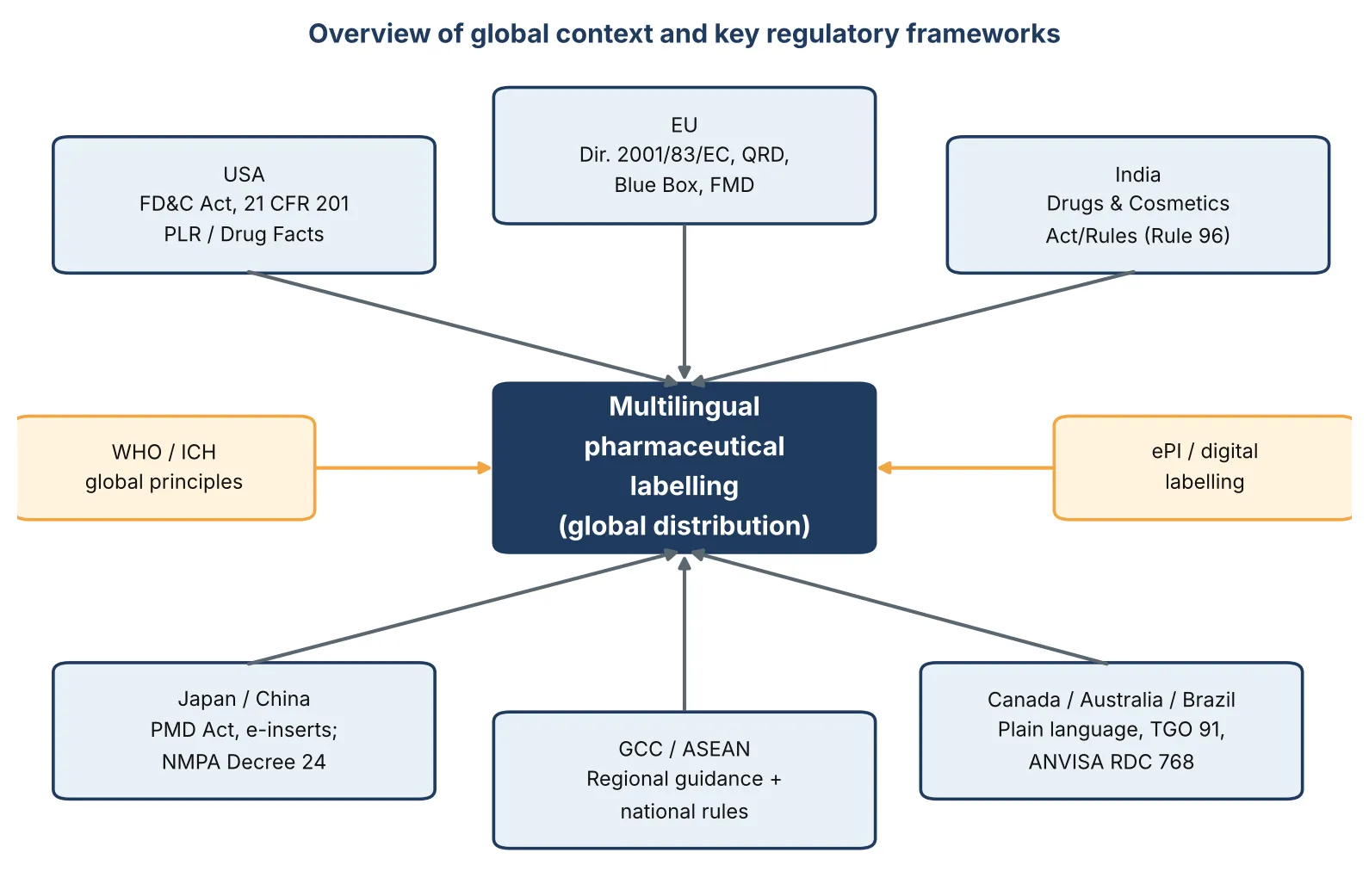
figure

Figure 1: Global Context and Principal Regulatory Frameworks Affecting Multilingual Pharmaceutical Labelling.

In the EU, Directive 2001/83/EC (Title V) governs the particulars on outer packaging and leaflets, Braille on packaging, consultation with patient groups on leaflets, and language.[6] Regulation (EC) No 726/2004 governs centralised authorisation, and Quality Review of Documents (QRD) templates standardise product information in all official languages.[20,21] The Commission's packaging guideline includes provisions for the optional 'blue box' for national particulars.[22] Falsified-medicines legislation adds mandatory safety features that compete for space on the pack.[23,24]

India regulates labelling through the Drugs and Cosmetics Act, 1940 and Rules, 1945, with Rule 96 prescribing the manner of labelling, and the New Drugs and Clinical Trials Rules, 2019 apply to new drugs.[25–27] The Constitution recognises 22 languages, which makes language accessibility a practical as well as legal consideration.[28] Japan requires Japanese-language information and has moved to electronic package inserts;[10] China regulates inserts and labels through SFDA Decree No. 24 and the Drug Administration Law as revised in 2019;[29,30] and Brazil's ANVISA issued RDC 768/2022 on labelling and RDC 769/2022 on leaflets with digital access.[11,31]

Canada differentiates language obligations by product category and context, and states that additional languages may be included provided they do not impair the readability of English or French.[8,32] Australia regulates through Therapeutic Goods Orders, including TGO 91 for prescription and related medicines.[33] The GCC guidance requires Arabic translation for specified packaging components,[34] while ASEAN's common technical dossier harmonises submissions but leaves national labelling rules in place.[35]

3.2 Comparative observations

Table 1 summarises the language, format and digital provisions that could be identified from the official documents. Three patterns emerge. First, language rules attach to the market, the product category and the pack component rather than to the product alone: a general statement that a country 'requires bilingual labelling' is insufficient without the product class and the provision. Second, templates and formats differ by regulator, so one global artwork rarely satisfies every market. Third, digital provisions are changing quickly and unevenly.

These differences can be grouped into four models of language regulation. In the first, language is determined by the market within a supranational system, as in the EU, where Member State rules require the pack and leaflet to be available in the relevant official language (s). In the second, language obligations are conditional on product category and context, as in Canada. In the third, an additional language is layered on the original, as in the GCC requirement for Arabic on specified packaging components. In the fourth, a single national language is the basis of the label, as in Japan, China and Brazil, although additional-language text may be permitted subject to conditions. A manufacturer distributing in all four types of market must therefore maintain not only several translations but several rule sets, and must decide for each pack whether a single multilingual presentation or separate country packs is the compliant and practical option.

Table 1: Language, Format and Digital-Labelling Provisions Identified in Official Sources (Selected Jurisdictions)

Jurisdiction Principal instruments Language / format provisions identified Digital position identified
USA FD&C Act; 21 CFR 201 [7,16] PLR and Drug Facts formats No general paper replacement identified
EU Dir. 2001/83/EC; QRD; Vol. 2C [6,21,22] Official language(s) of Member State; Braille; blue box ePI pilot; 2025 draft reflection paper [36]
Japan PMD Act; PMDA [10] Japanese-language information Electronic inserts since August 2021
China SFDA Decree 24 [29] Standard Chinese characters as basis None identified
GCC SFDA/GCC guidance v3.2 [34] Arabic translation for specified components None identified
Canada FDR; plain-language guidance [8] English/French by product and context; other languages if readability preserved Not addressed in guidance reviewed
Brazil RDC 768/2022; 769/2022 [11,31] Portuguese-language labelling and leaflets Digital access mechanism from 2023

Regional harmonisation does not remove these differences. Studies of review models in African regional economic communities show that regional initiatives improve alignment but still depend on national procedures and timelines,[37–39] and the WHO's good reliance practices emphasise that relying on another regulator's work does not eliminate the need for local verification.[40,41] The same logic applies to labelling.

Post-approval change illustrates the practical effect of divergence. A safety update to warnings or dosing may be approved at different times in different markets, may be categorised differently by each regulator, and may require different implementation periods for packs already in the supply chain. Manufacturers therefore operate with several concurrent label versions for the same product. This is not a defect in itself, but it increases the risk that an outdated statement persists in one market, and it is the main reason why version control is treated as a core labelling control and not as an administrative detail.[42]

4. Language, Literacy and Medication Safety

The case for multilingual labelling rests on evidence that language and literacy affect how information is understood. Health literacy, defined as the skills that determine the ability to access, understand and use health information, is associated with health outcomes, including medicine use.[43,44] Studies of English-language prescription labels show that low literacy impairs comprehension of warning labels and that wording and format influence understanding.[45,46] A systematic review identified the textual elements that affect how comprehensible label instructions are.[47]

Language barriers add a further layer. Pharmacy surveys found that patients with limited English proficiency often received prescriptions without translated labels or interpretation,[48] and studies have examined the association between limited proficiency and understanding of prescription labels.[49] Reviews show that professional interpreters improve the quality of care and that language-concordant care is associated with better outcomes.[50,51] Errors by unqualified interpreters are common and sometimes clinically consequential,[52] which is a useful analogy for written translation: the quality of the intermediary determines whether meaning survives.

Direct evidence on bilingual or multilingual medicine labels is limited. A UK exploratory evaluation of bilingual dispensing labels reported high understanding when labels were provided in the patient's preferred language,[53] and a Taiwanese national survey showed that label misunderstanding occurs even in a single-language setting.[54] South African studies of pictograms and quick-response (QR) codes illustrate that literacy and technology access must be considered alongside language.[55,56] No study identified quantified how the number of languages on a single pack affects legibility or error rates.

A methodological caution follows. Medication errors are multifactorial; prescribing, dispensing, administration, packaging and system factors all contribute.[2,3] Labelling should therefore be treated as a plausible risk factor and a modifiable control, not as an established cause of a measured error rate. Claims about the frequency of translation-related harm in marketed products currently lack empirical support.

Particular groups may be more exposed to communication risk. Older adults often manage complex regimens and may have reduced visual acuity, so type size and contrast matter,[57] children depend on carers whose language and literacy determine how doses are understood, and people with low literacy may rely on pictograms and verbal counselling in addition to text.[55,58] Standardised, patient-centred instructions are intended to reduce this vulnerability, but their cross-language equivalence has seldom been tested.

There is also an ethical dimension. Access to medicine information that a person can understand is part of equitable care, and populations with limited proficiency in the dominant language are exposed to higher communication risk. Language-concordant care is associated with better outcomes,[51] which supports the view that language provision is a safety measure and not an optional courtesy. At the same time, simply adding languages is not sufficient: information must also be written plainly, because technically accurate translations of complex terminology can remain difficult for people with limited health literacy.[46,47]

5. Translation Quality Assurance

5.1 Standards, error metrics and validation

Translation quality can be governed through process standards, error typologies and adaptation guidelines (Table 2). ISO 17100 requires qualified translators and an independent revision step, and ISO 18587 addresses human post-editing of machine output.[59,60] The Multidimensional Quality Metrics (MQM) framework supplies a customisable typology of errors and severities that can be applied to label text.[61,62] Guidelines developed for translating patient-reported outcome measures combine forward translation, reconciliation, back-translation and cognitive debriefing,[63–65] and back-translation, first described by Brislin, is best viewed as a supplementary check rather than proof of equivalence.[66]

Table 2: Frameworks for Quality Assurance of Pharmaceutical Translation

Framework Type Core idea Application to labels
ISO 17100 [59] Process standard Qualified translator plus independent revision Benchmark for the translation workflow
ISO 18587 [60] Process standard Human post-editing of machine output Governs MT/AI-assisted drafts
MQM [62] Error typology Categories and severities of errors Scoring of safety-critical elements
ISPOR / cross-cultural guidelines [63,64] Adaptation guideline Reconciliation, back-translation, debriefing Model for validation steps

Equivalence in this context means semantic and functional equivalence of safety-critical elements (strength, dose, frequency, route, warnings and storage), not word-for-word identity. A discrepancy matters when it changes meaning, omits a required element, alters a number, or makes essential information unclear. Terminology control supports this goal: controlled vocabularies such as MedDRA and the EDQM Standard Terms, and the data elements defined in ISO 11615, give each concept a stable identity across languages.[67–69]

In practice, a robust workflow has several linked stages: approval of the source text; selection of controlled terminology; translation by a qualified translator; independent revision by a second qualified linguist; reconciliation of differences; medical and regulatory review of safety-critical content; proofing of the translated text in the artwork; and a final verification against the approved source before release. Back-translation or cognitive debriefing may be added for high-risk products or new languages. Each stage should leave a documented record. This sequence corresponds to the requirements of ISO 17100 and to the adaptation guidelines used in health research,[59,63,65] and its value is that errors introduced at one stage can be detected by a different person at the next.

5.2 Machine translation and artificial intelligence

Neural machine translation and Transformer-based models have transformed the speed and fluency of automated translation,[70,71] but claims of human parity depend on evaluation conditions and domain.[72] Clinical evaluations show why caution is required for medicine information: the accuracy of freely available engines varied by language in medical phrases,[73] differed between Spanish and Chinese discharge instructions,[74] and errors persisted in later assessments.[75] Authors in family medicine have concluded that machine translation may assist but should not replace qualified translation.[76]

Regulators are converging on a risk-based position. The EMA's reflection paper on AI in the medicinal product lifecycle and the FDA's 2025 draft guidance emphasise credibility assessment, data quality, transparency and human oversight.[13,14] A review of AI in regulatory submissions describes growing but uneven implementation.[77] The practical reading for labelling is that AI-assisted translation can improve productivity where qualified reviewers verify safety-critical content and the process is documented within the quality system. Evidence specific to pharmaceutical labels is lacking, and benchmarking AI output against MQM-style metrics is an obvious research priority.

Large language models introduce specific risks that differ from those of earlier engines: plausible but incorrect output, inconsistent rendering of the same term between runs, drift from approved terminology, and the handling of confidential unpublished labelling text on external platforms. Controls proposed in regulatory and quality thinking include restricting use to defined tasks, supplying approved glossaries, validating performance on representative text before use, keeping a documented human review of every safety-critical element, and recording the tool version used.[13,14,60] These controls reflect the human-in-the-loop principle in current regulatory expectations and should be adapted to each organisation's quality system.

6. Label Design, Readability and Packaging Space

Adding languages increases the text that must fit on a finite surface. Typical consequences include smaller type, denser text, reduced separation between warnings and dosage instructions, and a weaker information hierarchy (Figure 2). Differences in word length, script density and writing direction compound the problem. Studies of typefaces and font size for older readers show that legibility is sensitive to script and size,[57] and European readability guidance sets expectations for layout, type size and contrast.[78] Health Canada recognises that bilingual text needs additional space and recommends planning for it early in label development.[8]
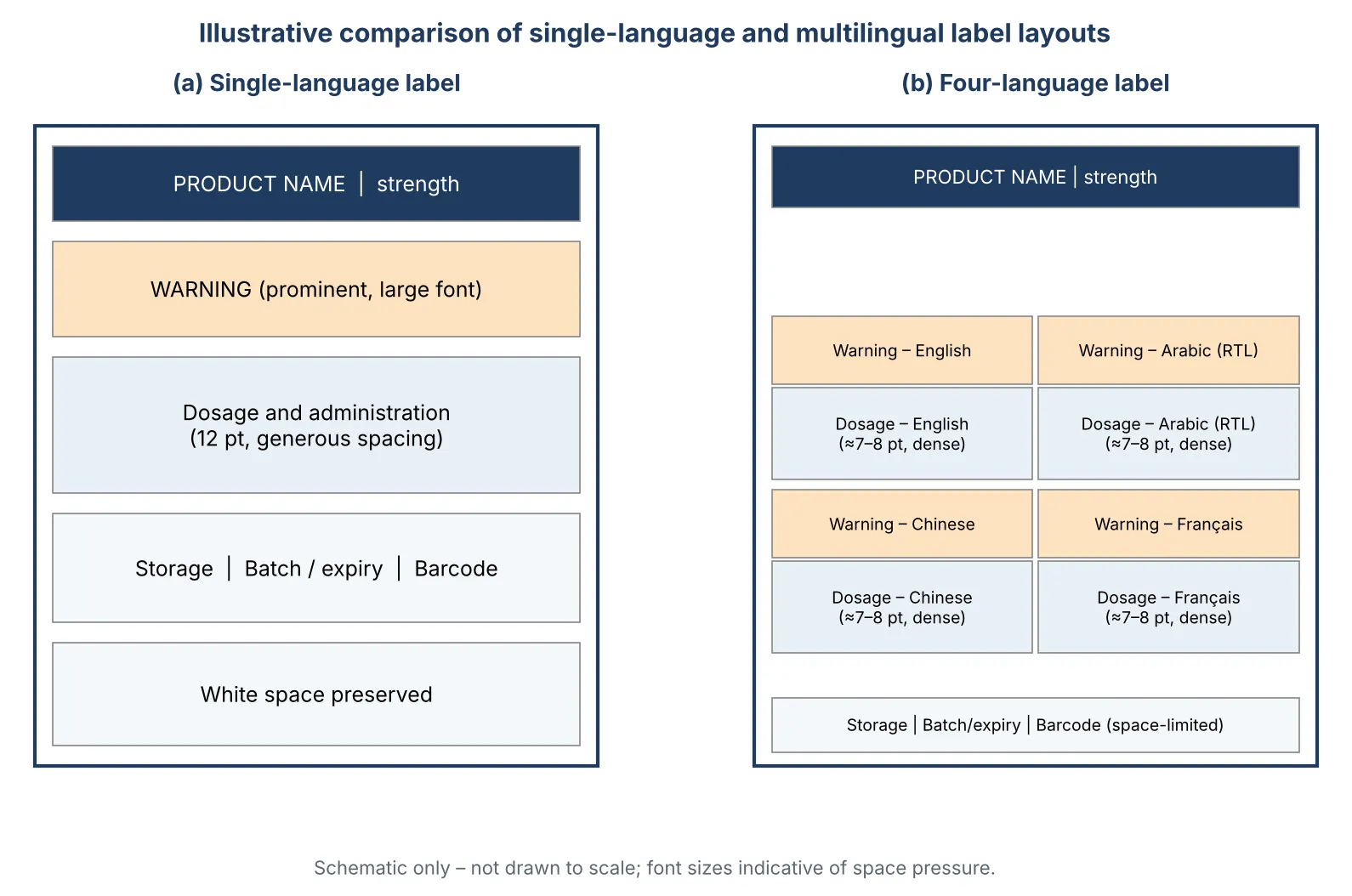
figure

Figure 2: Schematic Comparison of a Single-Language Label and a Four-Language Label, Illustrating Space Pressure on Warnings and Dosage Information (Not to Scale).

Readability and legibility are distinct. Readability concerns how easily text can be understood; legibility concerns the visual clarity of characters. Classic readability formulas such as Flesch Reading Ease, Flesch–Kincaid and SMOG were derived for English,[79–81] and language-specific adaptations such as the Fernández Huerta formula for Spanish show that formulas cannot be transferred blindly.[82] For scripts such as Chinese or Arabic, syllable-based formulas do not apply, and expert review and legibility testing are more appropriate.

Leaflet research reinforces the need for user testing. Systematic reviews show that many leaflets are difficult to read,[83] structured headline sections help patients find key information,[84] and EU user-testing policy faces unresolved questions about how results from one language apply to others.[85] Pictograms may relieve text pressure and can support comprehension, but they can also create false confidence if misinterpreted and require testing in the target population.[58,86,87] The design implication is that space, readability and translation review should be handled together, and that assessment should be performed on final artwork, because a text-only review cannot show whether information remains clear on the actual pack.

Several compliant strategies are available when space is limited. These include restructuring the layout so that safety-critical elements keep a clear hierarchy; using the package leaflet for information that the law allows to be carried there; using tested pictograms to support, not replace, text; separating national packs where multilingual packs are not required; and, where permitted, using an electronic layer for additional information. Reducing or omitting required information without regulatory justification is not an acceptable solution. Accessibility is a further constraint: Braille on outer packaging is mandated in the EU, and older readers are particularly sensitive to type size and contrast.[6,57]

7. Electronic and Digital Labelling

Electronic labelling can offer more extensive information than a pack can carry, multiple language versions through one platform, faster updates after approved changes, and more flexible patient-directed formats. Technical enablers include the EU ePI Common Standard and GS1 Digital Link, which allows product identifiers to be carried in web-resolvable 2D barcodes.[9,88] In 2023 the EMA, the Heads of Medicines Agencies and the European Commission published the first ePI for selected medicines under a pilot, and a 2025 draft reflection paper explores linking to ePI from existing pack codes.[9,36]

Adoption differs markedly (Table 3). Japan replaced paper inserts for most prescription drugs with electronic inserts from 2021;[10] Brazil introduced a digital access mechanism for leaflets;[11] and Singapore extended e-labelling to pharmacy-only and general sales list medicines in 2026.[12] Comparative policy analyses document wide variation in regulatory readiness for paper replacement.[89,90]

Table 3: Observed Positions on Electronic Labelling in Selected Jurisdictions

Jurisdiction Position in reviewed sources Implication for multilingual packs
EU Pilot and common standard; draft linking guidance; paper retention advocated [9,36,91] Digital layer complements printed leaflets
Japan Electronic inserts for most prescription drugs [10] Japanese-language e-insert is the primary version
Brazil Digital access to leaflets from 2023 [11] Supplements Portuguese leaflet
Singapore E-labelling extended to P and GSL products in 2026 [12] Illustrates national variation within ASEAN

Equity is the central safeguard. European pharmacist, physician and patient organisations support ePI as a supplement but warn against replacing paper where patients lack access or digital skills.[91] Studies in Hong Kong and South Africa explored pharmacists' perceptions of ePI and QR-code delivery of leaflets,[56,92] and commentators argue that ePI must meet the needs of patients, clinicians and medical writers alike.[93] Key questions for any digital layer are its legal status, accessibility, language availability, version control, consistency with authorised information, and the effect of limited connectivity or digital literacy.

Governance of the digital layer deserves explicit design. A single controlled source should feed the electronic document, the display should identify the current approved version, language selection should be easy and consistent with the languages authorised for the market, the content should match the authorised information, and a route to paper or other support should remain for those who cannot use digital channels. Whether the same 2D code can serve traceability and information access is addressed in the EMA reflection paper on linking from existing pack codes,[36] and the answer will shape how much label space digital solutions can actually free.

Digital channels also interact with anti-counterfeiting. WHO surveillance documents the continuing problem of substandard and falsified medicines,[94] and serialisation requirements such as the EU safety features and the US Drug Supply Chain Security Act compete with other elements for pack space.[23,24,95] Coordinating a single 2D code for traceability and digital access is an active design question.

8. Lifecycle Management and an Integrated Framework

A change to approved source text can affect every language version, pack component and market. If the change is not propagated, discrepancies arise between approved and circulating information. ICH Q12 provides a risk-based vocabulary for post-approval change management, including change categorisation and documentation, which is transferable to product information even though Q12 itself addresses chemistry, manufacturing and controls.[42] Data standards such as ISO 11615 and the EU ePI Common Standard provide technical bases for linking each language version to a controlled source record.[9,69]

Synthesising the evidence, we propose that multilingual labelling be managed around three interdependent dimensions: regulatory compliance (meeting each market's requirements), information equivalence (preserving meaning and completeness across languages), and operational control (maintaining readable packs, accurate artwork and coordinated updates). A translation may be accurate yet need modification for a market's format; a layout may comply yet communicate incompletely if translation quality is uncontrolled.

Responsibility for these controls is distributed. Regulatory affairs typically owns the requirements matrix and submissions; linguists own translation and terminology; medical and safety functions own the content of warnings; quality assurance owns artwork release and traceability; and packaging teams own layout. Indicative performance measures could include the weighted translation error score per 100 words, the proportion of language versions reconciled to the current source text, the time taken to implement an approved change across all markets, and the number of packs released with an out-of-date element. These indicators are proposals; they would need to be defined and tested before use as benchmarks.

8.1 Implications for stakeholders

For manufacturers, the central implication is to treat labelling as a controlled system: maintain the requirements matrix, qualify translation suppliers, integrate language planning into early packaging design, and keep a register that links every language version to its source. For regulatory authorities, clearer public explanation of language requirements by product category, of what must appear on the immediate container, outer packaging and leaflet, and of the permitted role of electronic information would reduce uncertainty without lowering standards; such clarification does not imply that existing rules are inadequate. For regulatory-affairs professionals, a documented review record that captures the requirement, the evidence reviewed, the discrepancy found, the corrective action and the approval status provides defensibility. For researchers, the priority is to generate empirical evidence that connects label characteristics to comprehension and use.

9. Gaps and Future Directions

Four gaps stand out. First, the evidence is fragmented, and few studies treat multilingual labelling as a combined regulatory, linguistic and human-factors problem. Second, most empirical work concerns single-language label comprehension or spoken interpretation, not the written translation of medicine information on packs. Third, comparative regulatory research on labelling is scarce and has mostly concentrated on content rather than language, legibility and lifecycle control; one comparison of antineoplastic and supportive medicine labelling in China, Japan and the United States shows that such work is feasible. Fourth, digital labelling is developing faster than evidence on its equity and accessibility effects.

Research priorities follow directly: (i) audits of authentic multinational labels using MQM-type metrics to estimate the frequency and severity of translation and legibility problems; (ii) user-testing studies of multilingual labels and leaflets among patients of differing literacy and language backgrounds; (iii) empirical evaluation of AI-assisted pharmaceutical translation against quality benchmarks; (iv) validation of review checklists and frameworks through expert consensus and pilot use; and (v) longitudinal monitoring of electronic-labelling policy and its effects on access. Comparative regulatory studies of the kind already performed for review models in other regions provide methodological templates for the regulatory strand.

9.1 Limitations of this review

This review is narrative and its source selection, although structured, was not exhaustive. Regulatory provisions in several jurisdictions were identified at instrument level and require clause-level confirmation, particularly the US, Indian and Australian language provisions and recent updates in China. Many empirical studies were conducted in English-speaking settings and may not transfer to other languages and scripts. Evidence on multilingual labels specifically is sparse and mostly exploratory, and the proposed framework and checklist are derived from document analysis and are not validated. Finally, regulation of electronic labelling and AI is changing rapidly, and statements reflect the sources available in October 2026.

CONCLUSIONS

Multilingual pharmaceutical labelling is a coordinated regulatory and operational activity, not a translation task. Requirements depend on market, product category and pack component; regional harmonisation helps but does not replace national verification. Essential information must remain semantically equivalent across languages, translation should be a controlled process, readability and packaging space must be addressed together on final artwork, digital labelling should supplement rather than silently replace access to essential information, and every change to approved text must be propagated across all language versions. Treating compliance, equivalence and operational control as a single system offers a practical route to safer, more accessible medicine information, but the effectiveness of the proposed measures remains to be tested empirically.

Conflict of interest: None

REFERENCES

  1. Kohn LT, Corrigan JM, Donaldson MS, editors. To Err Is Human: Building a Safer Health System. Washington (DC): National Academy Press; 2000.
  2. Aspden P, Wolcott JA, Bootman JL, Cronenwett LR, editors. Preventing Medication Errors: Quality Chasm Series. Washington (DC): National Academies Press; 2007. Available from: https://www.nationalacademies.org/read/11623
  3. Aronson JK. Medication errors: definitions and classification. Br J Clin Pharmacol. 2009;67 (6):599-604. doi:10.1111/j.1365-2125.2009.03415.x
  4. World Health Organization. Medication Without Harm: Global Patient Safety Challenge on Medication Safety. Geneva: WHO; 2017. Available from: https://www.who.int/publications/i/item/the-third-global-patient-safety-challenge-tackling-medication-related-harm
  5. Donaldson LJ, Kelley ET, Dhingra-Kumar N, Kieny M-P, Sheikh A. Medication Without Harm: WHO's Third Global Patient Safety Challenge. Lancet. 2017;389 (10080):1680-1. doi:10.1016/S0140-6736 (17)31047-4
  6. European Parliament and Council. Directive 2001/83/EC of 6 November 2001 on the Community code relating to medicinal products for human use. Off J Eur Communities. 2001;L311:67-128. Available from: https://eur-lex.europa.eu/legal-content/EN/TXT/?uri=CELEX:32001L0083
  7. US Food and Drug Administration. Code of Federal Regulations, Title 21, Part 201: Labeling. Washington (DC): US Government Publishing Office; current edition. Available from: https://www.ecfr.gov/current/title-21/chapter-I/subchapter-C/part-201
  8. Health Canada. Guidance Document: Questions and Answers - Plain Language Labelling Regulations for Non-prescription Drugs. Ottawa: Health Canada; effective 1 April 2020. Available from: https://www.canada.ca/en/health-canada/services/drugs-health-products/drug-products/applications-submissions/guidance-documents/questions-answers-plain-language-labelling-non-prescription-drugs-2019/document.html
  9. European Medicines Agency, Heads of Medicines Agencies, European Commission. First electronic product information (ePI) published for selected human medicines [news item]. 8 November 2023. Available from: https://www.ema.europa.eu/en/news/first-electronic-product-information-epi-published-selected-human-medicines
  10. Pharmaceuticals and Medical Devices Agency (PMDA), Japan. Information regarding newly introduced electronic package inserts. Tokyo: PMDA; 2021. Available from: https://www.pmda.go.jp/english/safety/info-services/e-pack-ins/0001.html
  11. Agência Nacional de Vigilância Sanitária (ANVISA), Brazil. Resolução da Diretoria Colegiada RDC nº 769, de 12 de dezembro de 2022: altera a RDC 47/2009 (bulas) e institui mecanismo de acesso digital. Diário Oficial da União, 2022 (effective 2 January 2023).
  12. Health Sciences Authority, Singapore. Extension of e-labelling to P and GSL medicines: regulatory update for therapeutic product registration, 30 June 2026. Singapore: HSA; 2026. Available from: https://www.hsa.gov.sg/announcements/extension-of-e-labelling-to-p-and-gsl-medicines/
  13. European Medicines Agency. Reflection paper on the use of artificial intelligence (AI) in the medicinal product lifecycle (EMA/CHMP/CVMP/83833/2023). Amsterdam: EMA; adopted September 2024.
  14. US Food and Drug Administration. Considerations for the Use of Artificial Intelligence to Support Regulatory Decision-Making for Drug and Biological Products: Draft Guidance for Industry. Silver Spring (MD): FDA; January 2025.
  15. Page MJ, McKenzie JE, Bossuyt PM, Boutron I, Hoffmann TC, Mulrow CD, et al. The PRISMA 2020 statement: an updated guideline for reporting systematic reviews. BMJ. 2021;372:n71. doi:10.1136/bmj.n71
  16. United States Congress. Federal Food, Drug, and Cosmetic Act, 21 U.S.C. 301 et seq. Washington (DC): US Government; 1938, as amended.
  17. US Food and Drug Administration. 21 CFR 201.57: Specific requirements on content and format of labeling for human prescription drug and biological products described in §201.56 (b)(1). Available from: https://www.ecfr.gov/current/title-21/chapter-I/subchapter-C/part-201/subpart-B/section-201.57
  18. US Food and Drug Administration. 21 CFR 201.66: Format and content requirements for over-the-counter (OTC) drug product labeling. Available from: https://www.ecfr.gov/current/title-21/chapter-I/subchapter-C/part-201/subpart-C/section-201.66
  19. US Food and Drug Administration. Labeling for Human Prescription Drug and Biological Products: Implementing the PLR Content and Format Requirements. Guidance for Industry. Silver Spring (MD): FDA; 2013. Available from: https://www.fda.gov/regulatory-information/search-fda-guidance-documents/labeling-human-prescription-drug-and-biological-products-implementing-plr-content-and-format
  20. European Parliament and Council. Regulation (EC) No 726/2004 of 31 March 2004 laying down Community procedures for the authorisation and supervision of medicinal products for human and veterinary use and establishing a European Medicines Agency. Off J Eur Union. 2004;L136:1-33.
  21. European Medicines Agency. Product-information requirements: Quality Review of Documents (QRD) templates for human medicines. Amsterdam: EMA; current version. Available from: https://www.ema.europa.eu (accessed 2026).
  22. European Commission, DG Health and Food Safety. Guideline on the Packaging Information of Medicinal Products for Human Use Authorised by the Union, Revision 14.8. Notice to Applicants, EudraLex Volume 2C. Brussels: European Commission; September 2023. Available from: https://health.ec.europa.eu/system/files/2023-09/2018_packaging_guidelines_en_1.pdf
  23. European Parliament and Council. Directive 2011/62/EU of 8 June 2011 amending Directive 2001/83/EC as regards the prevention of the entry into the legal supply chain of falsified medicinal products. Off J Eur Union. 2011;L174:74-87.
  24. European Commission. Commission Delegated Regulation (EU) 2016/161 of 2 October 2015 supplementing Directive 2001/83/EC by laying down detailed rules for the safety features appearing on the packaging of medicinal products for human use. Off J Eur Union. 2016;L32:1-27.
  25. Government of India. The Drugs and Cosmetics Act, 1940 (Act 23 of 1940), as amended. New Delhi: Ministry of Health and Family Welfare; Central Drugs Standard Control Organisation. Available from: https://cdsco.gov.in
  26. Government of India. The Drugs and Cosmetics Rules, 1945, as amended (Rule 96: Manner of labelling). New Delhi: Ministry of Health and Family Welfare; CDSCO. Available from: https://cdsco.gov.in
  27. Ministry of Health and Family Welfare, Government of India. New Drugs and Clinical Trials Rules, 2019. G.S.R. 227 (E), 19 March 2019. New Delhi: CDSCO. Available from: https://cdsco.gov.in/opencms/opencms/en/Acts-and-rules/New-Drugs/
  28. Government of India. The Constitution of India, Eighth Schedule (Articles 344 (1) and 351): languages recognised in the Constitution. New Delhi: Ministry of Law and Justice.
  29. State Food and Drug Administration, China. Provisions for Drug Insert Sheets and Labels (SFDA Decree No. 24). Beijing: SFDA; 2006 (effective 1 June 2006). Available from: https://english.nmpa.gov.cn/2019-07/25/c_390582.htm
  30. Standing Committee of the National People's Congress, China. Drug Administration Law of the People's Republic of China (revised 2019). Beijing; 2019.
  31. Agência Nacional de Vigilância Sanitária (ANVISA), Brazil. Resolução da Diretoria Colegiada RDC nº 768, de 12 de dezembro de 2022: estabelece as regras para a rotulagem de medicamentos. Diário Oficial da União, 14 December 2022.
  32. Health Canada. Guidance Document: Plain Language Labelling Regulations for Prescription Drugs (Questions and Answers). Ottawa: Health Canada; effective 1 April 2020. Available from: https://www.canada.ca/en/health-canada/services/drugs-health-products/drug-products/applications-submissions/guidance-documents/questions-answers-plain-language-labelling-2019.html
  33. Therapeutic Goods Administration, Australia. Therapeutic Goods Order No. 91 - Standard for labels of prescription and related medicines (F2016L01285). Canberra: Federal Register of Legislation. Available from: https://www.legislation.gov.au/F2016L01285/latest/text
  34. Saudi Food and Drug Authority (for GCC states). Guidance for Labeling, SPC and PIL (Version 3.2). Riyadh: SFDA; implementation 1 March 2021. Available from: https://www.sfda.gov.sa/sites/default/files/2021-08/GuidanceLabelingSPCandPILv32_0.pdf
  35. ASEAN. ASEAN Common Technical Dossier (ACTD) for the Registration of Pharmaceuticals for Human Use, Revision 1: Doc 1 - Table of Contents and Organization of Dossier. Jakarta: ASEAN Secretariat; 2019. Available from: https://asean.org/wp-content/uploads/Doc-1.-ACTD-Rev.1-TOC-and-Organization-of-Dossier.pdf
  36. European Medicines Agency. Reflection paper on linking to electronic product information (ePI) from EU medicine packages (draft; EMA/95076/2025). Amsterdam: EMA; 31 March 2025.
  37. Sithole T, Mahlangu G, Capote V, et al. Evaluation of the review models and approval timelines of countries participating in the Southern African Development Community: alignment and strategies for moving forward. Front Med (Lausanne). 2021;8:742200. doi:10.3389/fmed.2021.742200
  38. Ngum N, Ndomondo-Sigonda M, Habonimana R, et al. Evaluation of the review models and approval timelines of authorities participating in the East African Medicine Regulatory Harmonisation initiative: alignment and strategies for moving forward. Front Med (Lausanne). 2024;11:1438041. doi:10.3389/fmed.2024.1438041
  39. Owusu-Asante M, Darko DM, Seaneke S, et al. Comparison of the review models and regulatory timelines of seven countries participating in the ECOWAS-MRH initiative: identifying opportunities for improvement. Front Med (Lausanne). 2025;12:1587761. doi:10.3389/fmed.2025.1587761
  40. World Health Organization. Good reliance practices in the regulation of medical products: high level principles and considerations. WHO Technical Report Series No. 1033, Annex 10. Geneva: WHO; 2021.
  41. Danks L, Semete-Makokotlela B, Otwombe K, et al. Evaluation of the impact of reliance on the regulatory performance in the South African Health Products Regulatory Authority: implications for African regulatory authorities. Front Med (Lausanne). 2023;10:1265058. doi:10.3389/fmed.2023.1265058
  42. International Council for Harmonisation. ICH guideline Q12 on technical and regulatory considerations for pharmaceutical product lifecycle management (Step 5). EMA/CHMP/ICH/804273/2017. Amsterdam: EMA; 2020.
  43. Nutbeam D. Health literacy as a public health goal: a challenge for contemporary health education and communication strategies into the 21st century. Health Promot Int. 2000;15 (3):259-67.
  44. Berkman ND, Sheridan SL, Donahue KE, Halpern DJ, Crotty K. Low health literacy and health outcomes: an updated systematic review. Ann Intern Med. 2011;155 (2):97-107.
  45. Davis TC, Wolf MS, Bass PF 3rd, Middlebrooks M, Kennen E, Baker DW, et al. Low literacy impairs comprehension of prescription drug warning labels. J Gen Intern Med. 2006;21 (8):847-51. doi:10.1111/j.1525-1497.2006.00529.x
  46. Shrank W, Avorn J, Rolon C, Shekelle P. Effect of content and format of prescription drug labels on readability, understanding, and medication use: a systematic review. Ann Pharmacother. 2007;41 (5):783-801.
  47. Maghroudi E, van Hooijdonk CMJ, van de Bruinhorst H, van Dijk L, Rademakers J, Borgsteede SD. The impact of textual elements on the comprehensibility of drug label instructions (DLIs): a systematic review. PLoS One. 2021;16 (5):e0250238. doi:10.1371/journal.pone.0250238
  48. Bradshaw M, Tomany-Korman S, Flores G. Language barriers to prescriptions for patients with limited English proficiency: a survey of pharmacies. Pediatrics. 2007;120 (2):e225-35. doi:10.1542/peds.2006-3151
  49. Masland MC, Kang SH, Ma Y. Association between limited English proficiency and understanding prescription labels among five ethnic groups in California. Ethn Health. 2011 (published online April 2011). PMID 21491287.
  50. Karliner LS, Jacobs EA, Chen AH, Mutha S. Do professional interpreters improve clinical care for patients with limited English proficiency? A systematic review of the literature. Health Serv Res. 2007;42 (2):727-54. doi:10.1111/j.1475-6773.2006.00629.x
  51. Diamond L, Izquierdo K, Canfield D, Matsoukas K, Gany F. A systematic review of the impact of patient-physician non-English language concordance on quality of care and outcomes. J Gen Intern Med. 2019;34 (8):1591-606. doi:10.1007/s11606-019-04847-5
  52. Flores G, Abreu M, Barone CP, Bachur R, Lin H. Errors of medical interpretation and their potential clinical consequences: a comparison of professional versus ad hoc versus no interpreters. Ann Emerg Med. 2012;60 (5):545-53. doi:10.1016/j.annemergmed.2012.01.025
  53. Herrera H, Alsaif M, Khan G, Barnes NJ, Rutter P. Provision of bilingual dispensing labels to non-native English speakers: an exploratory study. Pharmacy (Basel). 2019;7 (1):32. doi:10.3390/pharmacy7010032
  54. Tsai T-I, Lee S-YD, Chang L-Y. Misunderstanding of medication labels: results of a national survey in Taiwan. Taiwan J Public Health. 2014;33 (3):238-50. doi:10.6288/TJPH201433102080
  55. Dowse R, Okeyo S, Sikhondze S, Khumalo N. Pharmaceutical indication pictograms for low literacy viewers: health literacy and comprehension. Health SA Gesondheid. 2023;28:a2192. doi:10.4102/hsag.v28i0.2192
  56. Singh G, Brand SJ, Steenkamp V. Transitioning to quick response codes for patient information leaflet delivery. Explor Res Clin Soc Pharm. 2025;17:100563.
  57. Kwok BS-H. Legibility of medicine labels: user studies on Chinese typefaces and font size for senior citizens in Hong Kong. Inf Des J. 2016;22 (3):202-20. doi:10.1075/idj.22.3.02kwo
  58. van Beusekom MM, Land-Zandstra AM, Bos MJW, van den Broek JM, Guchelaar H-J. Pharmaceutical pictograms for low-literate patients: understanding, risk of false confidence, and evidence-based design strategies. Patient Educ Couns. 2017;100 (5):966-73. doi:10.1016/j.pec.2016.12.015
  59. International Organization for Standardization. ISO 17100:2015 Translation services - Requirements for translation services. Geneva: ISO; 2015.
  60. International Organization for Standardization. ISO 18587:2017 Translation services - Post-editing of machine translation output - Requirements. Geneva: ISO; 2017.
  61. Lommel A, Burchardt A, Uszkoreit H. Multidimensional quality metrics: a flexible system for assessing translation quality. In: Proceedings of Translating and the Computer 35. London; 2013. Available from: https://aclanthology.org/2013.tc-1.6
  62. Lommel A, Uszkoreit H, Burchardt A. Multidimensional Quality Metrics (MQM): a framework for declaring and describing translation quality metrics. Rev Tradumàtica. 2014;12:455-63. doi:10.5565/rev/tradumatica.77
  63. Wild D, Grove A, Martin M, Eremenco S, McElroy S, Verjee-Lorenz A, et al. Principles of good practice for the translation and cultural adaptation process for patient-reported outcomes (PRO) measures: report of the ISPOR Task Force for Translation and Cultural Adaptation. Value Health. 2005;8 (2):94-104.
  64. Beaton DE, Bombardier C, Guillemin F, Ferraz MB. Guidelines for the process of cross-cultural adaptation of self-report measures. Spine (Phila Pa 1976). 2000;25 (24):3186-91.
  65. Sousa VD, Rojjanasrirat W. Translation, adaptation and validation of instruments or scales for use in cross-cultural health care research: a clear and user-friendly guideline. J Eval Clin Pract. 2011;17 (2):268-74. doi:10.1111/j.1365-2753.2010.01434.x
  66. Brislin RW. Back-translation for cross-cultural research. J Cross Cult Psychol. 1970;1 (3):185-216.
  67. Brown EG, Wood L, Wood S. The Medical Dictionary for Regulatory Activities (MedDRA). Drug Saf. 1999;20 (2):109-17. doi:10.2165/00002018-199920020-00002
  68. European Directorate for the Quality of Medicines & HealthCare (EDQM). Standard Terms database: pharmaceutical dose forms, routes of administration and packaging. Strasbourg: Council of Europe. Available from: https://standardterms.edqm.eu
  69. International Organization for Standardization. ISO 11615:2017 Health informatics - Identification of medicinal products - Data elements and structures for the unique identification and exchange of regulated medicinal product information (with Amendment 1:2022). Geneva: ISO.
  70. Wu Y, Schuster M, Chen Z, Le QV, Norouzi M, Macherey W, et al. Google's neural machine translation system: bridging the gap between human and machine translation. arXiv:1609.08144; 2016.
  71. Vaswani A, Shazeer N, Parmar N, Uszkoreit J, Jones L, Gomez AN, et al. Attention is all you need. In: Advances in Neural Information Processing Systems 30 (NeurIPS 2017). 2017. p. 5998-6008. arXiv:1706.03762
  72. Castilho S, Moorkens J, Gaspari F, Calixto I, Tinsley J, Way A. Is neural machine translation the new state of the art? Prague Bull Math Linguist. 2017;108:109-20.
  73. Patil S, Davies P. Use of Google Translate in medical communication: evaluation of accuracy. BMJ. 2014;349:g7392.
  74. Khoong EC, Steinbrook E, Brown C, Fernandez A. Assessing the use of Google Translate for Spanish and Chinese translations of emergency department discharge instructions. JAMA Intern Med. 2019;179 (4):580-2.
  75. Taira BR, Kreger V, Orue A, Diamond LC. A pragmatic assessment of Google Translate for emergency department instructions. J Gen Intern Med. 2021;36 (11):3361-5.
  76. Randhawa G, Ferreyra M, Ahmed R, Ezzat O, Pottie K. Using machine translation in clinical practice. Can Fam Physician. 2013;59 (4):382-3.
  77. Podichetty JT, Bauer A-M, Xu R, et al. How AI transforms regulatory submission: current clinical implementation and future prospects. Clin Transl Sci. 2025;18 (12):e70434. doi:10.1111/cts.70434
  78. European Commission. Guideline on the readability of the labelling and package leaflet of medicinal products for human use, Revision 1. EudraLex Volume 2C. Brussels: European Commission; 12 January 2009.
  79. Flesch R. A new readability yardstick. J Appl Psychol. 1948;32 (3):221-33. doi:10.1037/h0057532
  80. Kincaid JP, Fishburne RP, Rogers RL, Chissom BS. Derivation of new readability formulas (Automated Readability Index, Fog Count and Flesch Reading Ease Formula) for Navy enlisted personnel. Research Branch Report 8-75. Millington (TN): Naval Technical Training Command; 1975.
  81. McLaughlin GH. SMOG grading: a new readability formula. J Read. 1969;12 (8):639-46.
  82. Fernández Huerta J. Medidas sencillas de lecturabilidad. Consigna. 1959;214:29-32.
  83. Pires C, Vigário M, Cavaco A. Readability of medicinal package leaflets: a systematic review. Rev Saude Publica. 2015;49:4. doi:10.1590/S0034-8910.2015049005559
  84. Dickinson R, Raynor DK, Knapp P, MacDonald J. Do patients use a headline section in a leaflet to find key information about their medicines? Findings from a user-test study. Ther Innov Regul Sci. 2016;50 (5):581-91. doi:10.1177/2168479016639080
  85. Pelizzari N. The challenges for EU user testing policies for patient information leaflets. Int J Environ Res Public Health. 2024;21 (10):1301. doi:10.3390/ijerph21101301
  86. Katz MG, Kripalani S, Weiss BD. Use of pictorial aids in medication instructions: a review of the literature. Am J Health Syst Pharm. 2006;63 (23):2391-7. doi:10.2146/ajhp060162
  87. Mansoor LE, Dowse R. Effect of pictograms on readability of patient information materials. Ann Pharmacother. 2003;37 (7-8):1003-9. doi:10.1345/aph.1C449
  88. GS1. GS1 Digital Link Standard: URI syntax, version 1.5.0. Brussels: GS1; June 2024. Available from: https://www.gs1.org/standards/gs1-digital-link
  89. Dangy-Caye A, Lebreton V, Lumsden R, et al. Global trends in e-labeling: a comprehensive geographical perspective. Front Med (Lausanne). 2025;12:1662782. doi:10.3389/fmed.2025.1662782
  90. Lee DE, Chun JS, Kim M, Kim IW, Oh JM. Regulatory readiness for paper replacement in global pharmaceutical electronic labeling: cross-sectional comparative policy analysis. J Med Internet Res. 2026;28:e96787. doi:10.2196/96787
  91. EAHP, CPME, PGEU, BEUC, AGE Platform Europe, HOPE, AIM, EFN. Joint statement on electronic product information (ePI). Brussels; 15 November 2024. Available from: https://eahp.eu/wp-content/uploads/2024/11/2411_Joint-Statement-ePI.pdf
  92. Fung EWT, Au-Yeung GTF, Tsoi LM, Qu L, Cheng TKW, Chong DWK, et al. Pharmacists' perceptions of the benefits and challenges of electronic product information system implementation in Hong Kong: mixed-method study. J Med Internet Res. 2020;22 (11):e20765. doi:10.2196/20765
  93. Bahador B, Bharadia T, Stewart D, Winchester CC. Towards electronic product information that meets the needs of everyone: implications for patients, clinicians, and medical writers. Med Writ. 2025;34 (2):21-5. doi:10.56012/tcvr4151
  94. World Health Organization. WHO Global Surveillance and Monitoring System for Substandard and Falsified Medical Products. Geneva: WHO; 2017. ISBN 978-92-4-151342-5.
  95. United States Congress. Drug Quality and Security Act, Public Law 113-54 (Title II: Drug Supply Chain Security Act). Washington (DC); 2013.

Reference

  1. Kohn LT, Corrigan JM, Donaldson MS, editors. To Err Is Human: Building a Safer Health System. Washington (DC): National Academy Press; 2000.
  2. Aspden P, Wolcott JA, Bootman JL, Cronenwett LR, editors. Preventing Medication Errors: Quality Chasm Series. Washington (DC): National Academies Press; 2007. Available from: https://www.nationalacademies.org/read/11623
  3. Aronson JK. Medication errors: definitions and classification. Br J Clin Pharmacol. 2009;67 (6):599-604. doi:10.1111/j.1365-2125.2009.03415.x
  4. World Health Organization. Medication Without Harm: Global Patient Safety Challenge on Medication Safety. Geneva: WHO; 2017. Available from: https://www.who.int/publications/i/item/the-third-global-patient-safety-challenge-tackling-medication-related-harm
  5. Donaldson LJ, Kelley ET, Dhingra-Kumar N, Kieny M-P, Sheikh A. Medication Without Harm: WHO's Third Global Patient Safety Challenge. Lancet. 2017;389 (10080):1680-1. doi:10.1016/S0140-6736 (17)31047-4
  6. European Parliament and Council. Directive 2001/83/EC of 6 November 2001 on the Community code relating to medicinal products for human use. Off J Eur Communities. 2001;L311:67-128. Available from: https://eur-lex.europa.eu/legal-content/EN/TXT/?uri=CELEX:32001L0083
  7. US Food and Drug Administration. Code of Federal Regulations, Title 21, Part 201: Labeling. Washington (DC): US Government Publishing Office; current edition. Available from: https://www.ecfr.gov/current/title-21/chapter-I/subchapter-C/part-201
  8. Health Canada. Guidance Document: Questions and Answers - Plain Language Labelling Regulations for Non-prescription Drugs. Ottawa: Health Canada; effective 1 April 2020. Available from: https://www.canada.ca/en/health-canada/services/drugs-health-products/drug-products/applications-submissions/guidance-documents/questions-answers-plain-language-labelling-non-prescription-drugs-2019/document.html
  9. European Medicines Agency, Heads of Medicines Agencies, European Commission. First electronic product information (ePI) published for selected human medicines [news item]. 8 November 2023. Available from: https://www.ema.europa.eu/en/news/first-electronic-product-information-epi-published-selected-human-medicines
  10. Pharmaceuticals and Medical Devices Agency (PMDA), Japan. Information regarding newly introduced electronic package inserts. Tokyo: PMDA; 2021. Available from: https://www.pmda.go.jp/english/safety/info-services/e-pack-ins/0001.html
  11. Agência Nacional de Vigilância Sanitária (ANVISA), Brazil. Resolução da Diretoria Colegiada RDC nº 769, de 12 de dezembro de 2022: altera a RDC 47/2009 (bulas) e institui mecanismo de acesso digital. Diário Oficial da União, 2022 (effective 2 January 2023).
  12. Health Sciences Authority, Singapore. Extension of e-labelling to P and GSL medicines: regulatory update for therapeutic product registration, 30 June 2026. Singapore: HSA; 2026. Available from: https://www.hsa.gov.sg/announcements/extension-of-e-labelling-to-p-and-gsl-medicines/
  13. European Medicines Agency. Reflection paper on the use of artificial intelligence (AI) in the medicinal product lifecycle (EMA/CHMP/CVMP/83833/2023). Amsterdam: EMA; adopted September 2024.
  14. US Food and Drug Administration. Considerations for the Use of Artificial Intelligence to Support Regulatory Decision-Making for Drug and Biological Products: Draft Guidance for Industry. Silver Spring (MD): FDA; January 2025.
  15. Page MJ, McKenzie JE, Bossuyt PM, Boutron I, Hoffmann TC, Mulrow CD, et al. The PRISMA 2020 statement: an updated guideline for reporting systematic reviews. BMJ. 2021;372:n71. doi:10.1136/bmj.n71
  16. United States Congress. Federal Food, Drug, and Cosmetic Act, 21 U.S.C. 301 et seq. Washington (DC): US Government; 1938, as amended.
  17. US Food and Drug Administration. 21 CFR 201.57: Specific requirements on content and format of labeling for human prescription drug and biological products described in §201.56 (b)(1). Available from: https://www.ecfr.gov/current/title-21/chapter-I/subchapter-C/part-201/subpart-B/section-201.57
  18. US Food and Drug Administration. 21 CFR 201.66: Format and content requirements for over-the-counter (OTC) drug product labeling. Available from: https://www.ecfr.gov/current/title-21/chapter-I/subchapter-C/part-201/subpart-C/section-201.66
  19. US Food and Drug Administration. Labeling for Human Prescription Drug and Biological Products: Implementing the PLR Content and Format Requirements. Guidance for Industry. Silver Spring (MD): FDA; 2013. Available from: https://www.fda.gov/regulatory-information/search-fda-guidance-documents/labeling-human-prescription-drug-and-biological-products-implementing-plr-content-and-format
  20. European Parliament and Council. Regulation (EC) No 726/2004 of 31 March 2004 laying down Community procedures for the authorisation and supervision of medicinal products for human and veterinary use and establishing a European Medicines Agency. Off J Eur Union. 2004;L136:1-33.
  21. European Medicines Agency. Product-information requirements: Quality Review of Documents (QRD) templates for human medicines. Amsterdam: EMA; current version. Available from: https://www.ema.europa.eu (accessed 2026).
  22. European Commission, DG Health and Food Safety. Guideline on the Packaging Information of Medicinal Products for Human Use Authorised by the Union, Revision 14.8. Notice to Applicants, EudraLex Volume 2C. Brussels: European Commission; September 2023. Available from: https://health.ec.europa.eu/system/files/2023-09/2018_packaging_guidelines_en_1.pdf
  23. European Parliament and Council. Directive 2011/62/EU of 8 June 2011 amending Directive 2001/83/EC as regards the prevention of the entry into the legal supply chain of falsified medicinal products. Off J Eur Union. 2011;L174:74-87.
  24. European Commission. Commission Delegated Regulation (EU) 2016/161 of 2 October 2015 supplementing Directive 2001/83/EC by laying down detailed rules for the safety features appearing on the packaging of medicinal products for human use. Off J Eur Union. 2016;L32:1-27.
  25. Government of India. The Drugs and Cosmetics Act, 1940 (Act 23 of 1940), as amended. New Delhi: Ministry of Health and Family Welfare; Central Drugs Standard Control Organisation. Available from: https://cdsco.gov.in
  26. Government of India. The Drugs and Cosmetics Rules, 1945, as amended (Rule 96: Manner of labelling). New Delhi: Ministry of Health and Family Welfare; CDSCO. Available from: https://cdsco.gov.in
  27. Ministry of Health and Family Welfare, Government of India. New Drugs and Clinical Trials Rules, 2019. G.S.R. 227 (E), 19 March 2019. New Delhi: CDSCO. Available from: https://cdsco.gov.in/opencms/opencms/en/Acts-and-rules/New-Drugs/
  28. Government of India. The Constitution of India, Eighth Schedule (Articles 344 (1) and 351): languages recognised in the Constitution. New Delhi: Ministry of Law and Justice.
  29. State Food and Drug Administration, China. Provisions for Drug Insert Sheets and Labels (SFDA Decree No. 24). Beijing: SFDA; 2006 (effective 1 June 2006). Available from: https://english.nmpa.gov.cn/2019-07/25/c_390582.htm
  30. Standing Committee of the National People's Congress, China. Drug Administration Law of the People's Republic of China (revised 2019). Beijing; 2019.
  31. Agência Nacional de Vigilância Sanitária (ANVISA), Brazil. Resolução da Diretoria Colegiada RDC nº 768, de 12 de dezembro de 2022: estabelece as regras para a rotulagem de medicamentos. Diário Oficial da União, 14 December 2022.
  32. Health Canada. Guidance Document: Plain Language Labelling Regulations for Prescription Drugs (Questions and Answers). Ottawa: Health Canada; effective 1 April 2020. Available from: https://www.canada.ca/en/health-canada/services/drugs-health-products/drug-products/applications-submissions/guidance-documents/questions-answers-plain-language-labelling-2019.html
  33. Therapeutic Goods Administration, Australia. Therapeutic Goods Order No. 91 - Standard for labels of prescription and related medicines (F2016L01285). Canberra: Federal Register of Legislation. Available from: https://www.legislation.gov.au/F2016L01285/latest/text
  34. Saudi Food and Drug Authority (for GCC states). Guidance for Labeling, SPC and PIL (Version 3.2). Riyadh: SFDA; implementation 1 March 2021. Available from: https://www.sfda.gov.sa/sites/default/files/2021-08/GuidanceLabelingSPCandPILv32_0.pdf
  35. ASEAN. ASEAN Common Technical Dossier (ACTD) for the Registration of Pharmaceuticals for Human Use, Revision 1: Doc 1 - Table of Contents and Organization of Dossier. Jakarta: ASEAN Secretariat; 2019. Available from: https://asean.org/wp-content/uploads/Doc-1.-ACTD-Rev.1-TOC-and-Organization-of-Dossier.pdf
  36. European Medicines Agency. Reflection paper on linking to electronic product information (ePI) from EU medicine packages (draft; EMA/95076/2025). Amsterdam: EMA; 31 March 2025.
  37. Sithole T, Mahlangu G, Capote V, et al. Evaluation of the review models and approval timelines of countries participating in the Southern African Development Community: alignment and strategies for moving forward. Front Med (Lausanne). 2021;8:742200. doi:10.3389/fmed.2021.742200
  38. Ngum N, Ndomondo-Sigonda M, Habonimana R, et al. Evaluation of the review models and approval timelines of authorities participating in the East African Medicine Regulatory Harmonisation initiative: alignment and strategies for moving forward. Front Med (Lausanne). 2024;11:1438041. doi:10.3389/fmed.2024.1438041
  39. Owusu-Asante M, Darko DM, Seaneke S, et al. Comparison of the review models and regulatory timelines of seven countries participating in the ECOWAS-MRH initiative: identifying opportunities for improvement. Front Med (Lausanne). 2025;12:1587761. doi:10.3389/fmed.2025.1587761
  40. World Health Organization. Good reliance practices in the regulation of medical products: high level principles and considerations. WHO Technical Report Series No. 1033, Annex 10. Geneva: WHO; 2021.
  41. Danks L, Semete-Makokotlela B, Otwombe K, et al. Evaluation of the impact of reliance on the regulatory performance in the South African Health Products Regulatory Authority: implications for African regulatory authorities. Front Med (Lausanne). 2023;10:1265058. doi:10.3389/fmed.2023.1265058
  42. International Council for Harmonisation. ICH guideline Q12 on technical and regulatory considerations for pharmaceutical product lifecycle management (Step 5). EMA/CHMP/ICH/804273/2017. Amsterdam: EMA; 2020.
  43. Nutbeam D. Health literacy as a public health goal: a challenge for contemporary health education and communication strategies into the 21st century. Health Promot Int. 2000;15 (3):259-67.
  44. Berkman ND, Sheridan SL, Donahue KE, Halpern DJ, Crotty K. Low health literacy and health outcomes: an updated systematic review. Ann Intern Med. 2011;155 (2):97-107.
  45. Davis TC, Wolf MS, Bass PF 3rd, Middlebrooks M, Kennen E, Baker DW, et al. Low literacy impairs comprehension of prescription drug warning labels. J Gen Intern Med. 2006;21 (8):847-51. doi:10.1111/j.1525-1497.2006.00529.x
  46. Shrank W, Avorn J, Rolon C, Shekelle P. Effect of content and format of prescription drug labels on readability, understanding, and medication use: a systematic review. Ann Pharmacother. 2007;41 (5):783-801.
  47. Maghroudi E, van Hooijdonk CMJ, van de Bruinhorst H, van Dijk L, Rademakers J, Borgsteede SD. The impact of textual elements on the comprehensibility of drug label instructions (DLIs): a systematic review. PLoS One. 2021;16 (5):e0250238. doi:10.1371/journal.pone.0250238
  48. Bradshaw M, Tomany-Korman S, Flores G. Language barriers to prescriptions for patients with limited English proficiency: a survey of pharmacies. Pediatrics. 2007;120 (2):e225-35. doi:10.1542/peds.2006-3151
  49. Masland MC, Kang SH, Ma Y. Association between limited English proficiency and understanding prescription labels among five ethnic groups in California. Ethn Health. 2011 (published online April 2011). PMID 21491287.
  50. Karliner LS, Jacobs EA, Chen AH, Mutha S. Do professional interpreters improve clinical care for patients with limited English proficiency? A systematic review of the literature. Health Serv Res. 2007;42 (2):727-54. doi:10.1111/j.1475-6773.2006.00629.x
  51. Diamond L, Izquierdo K, Canfield D, Matsoukas K, Gany F. A systematic review of the impact of patient-physician non-English language concordance on quality of care and outcomes. J Gen Intern Med. 2019;34 (8):1591-606. doi:10.1007/s11606-019-04847-5
  52. Flores G, Abreu M, Barone CP, Bachur R, Lin H. Errors of medical interpretation and their potential clinical consequences: a comparison of professional versus ad hoc versus no interpreters. Ann Emerg Med. 2012;60 (5):545-53. doi:10.1016/j.annemergmed.2012.01.025
  53. Herrera H, Alsaif M, Khan G, Barnes NJ, Rutter P. Provision of bilingual dispensing labels to non-native English speakers: an exploratory study. Pharmacy (Basel). 2019;7 (1):32. doi:10.3390/pharmacy7010032
  54. Tsai T-I, Lee S-YD, Chang L-Y. Misunderstanding of medication labels: results of a national survey in Taiwan. Taiwan J Public Health. 2014;33 (3):238-50. doi:10.6288/TJPH201433102080
  55. Dowse R, Okeyo S, Sikhondze S, Khumalo N. Pharmaceutical indication pictograms for low literacy viewers: health literacy and comprehension. Health SA Gesondheid. 2023;28:a2192. doi:10.4102/hsag.v28i0.2192
  56. Singh G, Brand SJ, Steenkamp V. Transitioning to quick response codes for patient information leaflet delivery. Explor Res Clin Soc Pharm. 2025;17:100563.
  57. Kwok BS-H. Legibility of medicine labels: user studies on Chinese typefaces and font size for senior citizens in Hong Kong. Inf Des J. 2016;22 (3):202-20. doi:10.1075/idj.22.3.02kwo
  58. van Beusekom MM, Land-Zandstra AM, Bos MJW, van den Broek JM, Guchelaar H-J. Pharmaceutical pictograms for low-literate patients: understanding, risk of false confidence, and evidence-based design strategies. Patient Educ Couns. 2017;100 (5):966-73. doi:10.1016/j.pec.2016.12.015
  59. International Organization for Standardization. ISO 17100:2015 Translation services - Requirements for translation services. Geneva: ISO; 2015.
  60. International Organization for Standardization. ISO 18587:2017 Translation services - Post-editing of machine translation output - Requirements. Geneva: ISO; 2017.
  61. Lommel A, Burchardt A, Uszkoreit H. Multidimensional quality metrics: a flexible system for assessing translation quality. In: Proceedings of Translating and the Computer 35. London; 2013. Available from: https://aclanthology.org/2013.tc-1.6
  62. Lommel A, Uszkoreit H, Burchardt A. Multidimensional Quality Metrics (MQM): a framework for declaring and describing translation quality metrics. Rev Tradumàtica. 2014;12:455-63. doi:10.5565/rev/tradumatica.77
  63. Wild D, Grove A, Martin M, Eremenco S, McElroy S, Verjee-Lorenz A, et al. Principles of good practice for the translation and cultural adaptation process for patient-reported outcomes (PRO) measures: report of the ISPOR Task Force for Translation and Cultural Adaptation. Value Health. 2005;8 (2):94-104.
  64. Beaton DE, Bombardier C, Guillemin F, Ferraz MB. Guidelines for the process of cross-cultural adaptation of self-report measures. Spine (Phila Pa 1976). 2000;25 (24):3186-91.
  65. Sousa VD, Rojjanasrirat W. Translation, adaptation and validation of instruments or scales for use in cross-cultural health care research: a clear and user-friendly guideline. J Eval Clin Pract. 2011;17 (2):268-74. doi:10.1111/j.1365-2753.2010.01434.x
  66. Brislin RW. Back-translation for cross-cultural research. J Cross Cult Psychol. 1970;1 (3):185-216.
  67. Brown EG, Wood L, Wood S. The Medical Dictionary for Regulatory Activities (MedDRA). Drug Saf. 1999;20 (2):109-17. doi:10.2165/00002018-199920020-00002
  68. European Directorate for the Quality of Medicines & HealthCare (EDQM). Standard Terms database: pharmaceutical dose forms, routes of administration and packaging. Strasbourg: Council of Europe. Available from: https://standardterms.edqm.eu
  69. International Organization for Standardization. ISO 11615:2017 Health informatics - Identification of medicinal products - Data elements and structures for the unique identification and exchange of regulated medicinal product information (with Amendment 1:2022). Geneva: ISO.
  70. Wu Y, Schuster M, Chen Z, Le QV, Norouzi M, Macherey W, et al. Google's neural machine translation system: bridging the gap between human and machine translation. arXiv:1609.08144; 2016.
  71. Vaswani A, Shazeer N, Parmar N, Uszkoreit J, Jones L, Gomez AN, et al. Attention is all you need. In: Advances in Neural Information Processing Systems 30 (NeurIPS 2017). 2017. p. 5998-6008. arXiv:1706.03762
  72. Castilho S, Moorkens J, Gaspari F, Calixto I, Tinsley J, Way A. Is neural machine translation the new state of the art? Prague Bull Math Linguist. 2017;108:109-20.
  73. Patil S, Davies P. Use of Google Translate in medical communication: evaluation of accuracy. BMJ. 2014;349:g7392.
  74. Khoong EC, Steinbrook E, Brown C, Fernandez A. Assessing the use of Google Translate for Spanish and Chinese translations of emergency department discharge instructions. JAMA Intern Med. 2019;179 (4):580-2.
  75. Taira BR, Kreger V, Orue A, Diamond LC. A pragmatic assessment of Google Translate for emergency department instructions. J Gen Intern Med. 2021;36 (11):3361-5.
  76. Randhawa G, Ferreyra M, Ahmed R, Ezzat O, Pottie K. Using machine translation in clinical practice. Can Fam Physician. 2013;59 (4):382-3.
  77. Podichetty JT, Bauer A-M, Xu R, et al. How AI transforms regulatory submission: current clinical implementation and future prospects. Clin Transl Sci. 2025;18 (12):e70434. doi:10.1111/cts.70434
  78. European Commission. Guideline on the readability of the labelling and package leaflet of medicinal products for human use, Revision 1. EudraLex Volume 2C. Brussels: European Commission; 12 January 2009.
  79. Flesch R. A new readability yardstick. J Appl Psychol. 1948;32 (3):221-33. doi:10.1037/h0057532
  80. Kincaid JP, Fishburne RP, Rogers RL, Chissom BS. Derivation of new readability formulas (Automated Readability Index, Fog Count and Flesch Reading Ease Formula) for Navy enlisted personnel. Research Branch Report 8-75. Millington (TN): Naval Technical Training Command; 1975.
  81. McLaughlin GH. SMOG grading: a new readability formula. J Read. 1969;12 (8):639-46.
  82. Fernández Huerta J. Medidas sencillas de lecturabilidad. Consigna. 1959;214:29-32.
  83. Pires C, Vigário M, Cavaco A. Readability of medicinal package leaflets: a systematic review. Rev Saude Publica. 2015;49:4. doi:10.1590/S0034-8910.2015049005559
  84. Dickinson R, Raynor DK, Knapp P, MacDonald J. Do patients use a headline section in a leaflet to find key information about their medicines? Findings from a user-test study. Ther Innov Regul Sci. 2016;50 (5):581-91. doi:10.1177/2168479016639080
  85. Pelizzari N. The challenges for EU user testing policies for patient information leaflets. Int J Environ Res Public Health. 2024;21 (10):1301. doi:10.3390/ijerph21101301
  86. Katz MG, Kripalani S, Weiss BD. Use of pictorial aids in medication instructions: a review of the literature. Am J Health Syst Pharm. 2006;63 (23):2391-7. doi:10.2146/ajhp060162
  87. Mansoor LE, Dowse R. Effect of pictograms on readability of patient information materials. Ann Pharmacother. 2003;37 (7-8):1003-9. doi:10.1345/aph.1C449
  88. GS1. GS1 Digital Link Standard: URI syntax, version 1.5.0. Brussels: GS1; June 2024. Available from: https://www.gs1.org/standards/gs1-digital-link
  89. Dangy-Caye A, Lebreton V, Lumsden R, et al. Global trends in e-labeling: a comprehensive geographical perspective. Front Med (Lausanne). 2025;12:1662782. doi:10.3389/fmed.2025.1662782
  90. Lee DE, Chun JS, Kim M, Kim IW, Oh JM. Regulatory readiness for paper replacement in global pharmaceutical electronic labeling: cross-sectional comparative policy analysis. J Med Internet Res. 2026;28:e96787. doi:10.2196/96787
  91. EAHP, CPME, PGEU, BEUC, AGE Platform Europe, HOPE, AIM, EFN. Joint statement on electronic product information (ePI). Brussels; 15 November 2024. Available from: https://eahp.eu/wp-content/uploads/2024/11/2411_Joint-Statement-ePI.pdf
  92. Fung EWT, Au-Yeung GTF, Tsoi LM, Qu L, Cheng TKW, Chong DWK, et al. Pharmacists' perceptions of the benefits and challenges of electronic product information system implementation in Hong Kong: mixed-method study. J Med Internet Res. 2020;22 (11):e20765. doi:10.2196/20765
  93. Bahador B, Bharadia T, Stewart D, Winchester CC. Towards electronic product information that meets the needs of everyone: implications for patients, clinicians, and medical writers. Med Writ. 2025;34 (2):21-5. doi:10.56012/tcvr4151
  94. World Health Organization. WHO Global Surveillance and Monitoring System for Substandard and Falsified Medical Products. Geneva: WHO; 2017. ISBN 978-92-4-151342-5.
  95. United States Congress. Drug Quality and Security Act, Public Law 113-54 (Title II: Drug Supply Chain Security Act). Washington (DC); 2013.

Photo
Keshav
Corresponding author

B.D.M. College of Pharmacy, Chhuchhakwas, Jhajjar, Haryana, India.

Photo
Varun
Corresponding author

B.D.M. College of Pharmacy, Chhuchhakwas, Jhajjar, Haryana, India.

Varun, Keshav, Regulatory Challenges in Multilingual Pharmaceutical Labelling for Global Drug Distribution, Int. J. of Pharm. Sci., 2026, Vol 4, Issue 11, 1642-1656. https://doi.org/10.5281/zenodo.24143227

More related articles
Emerging Herbal Strategies for the Management of H...
Shubhangi Kasture, Shrutika Patil, Dnyaneshwar Sutar, Divesh Gavi...
Clitoria ternatea Flower and ITS Bioactive Compoun...
Snehal Jadhav, Sneha Jankar, Shreya Tondlikar, Saurabh Patara, Ad...
Phytosomes: A NOVEL Approach for HERBAL Drug Deliv...
Sahil Shirose, Suyog Vishe, Monika Vinchu, Harshali Shelar, Adity...
A Review on Particle Size Reduction of Active Pharmaceutical Ingredients (APIs) ...
Saurabh Patara, Snehal Jadhav, Sneha Jankar, Shreya Tondlikar, Pratiksha Pandit, Aditi Bangar...
High-Fat Diet-Induced Obesity in Rodents: Dietary Composition, Adipose Remodelin...
Hajera Begum, Dr. Koppala R. V. S. Chaitanya, Mahadev Anitha, Bommu Vaishnavi...
Biosurfactants as Pharmaceutical Excipients: Emerging Applications...
Shahil Ghadage, Tushar Shelke, Priya Daingade...
Related Articles
Artificial Intelligence and Machine Learning in Pharmacovigilance: Transforming ...
Aditya Ghavat, Yash Mulay, Yash Ghodke, Shreyash Pardeshi, Raj Dohale...
DNA Barcoding and Molecular Techniques for Authentication of Aloe vera – Revie...
Sumit Kor, Shreyash Pardeshi, Aditya Jamghare, Sahil Shirose, Avadhoot Partole, Raj Dohole, Yash Mul...
Emerging Herbal Strategies for the Management of Hyperpigmentation : Comprehensi...
Shubhangi Kasture, Shrutika Patil, Dnyaneshwar Sutar, Divesh Gavit, Ancy Keerthika, Akash Jambhale...
More related articles
Emerging Herbal Strategies for the Management of Hyperpigmentation : Comprehensi...
Shubhangi Kasture, Shrutika Patil, Dnyaneshwar Sutar, Divesh Gavit, Ancy Keerthika, Akash Jambhale...
Clitoria ternatea Flower and ITS Bioactive Compounds;Potential Use as Microencap...
Snehal Jadhav, Sneha Jankar, Shreya Tondlikar, Saurabh Patara, Aditi Bangar, Pratiksha Pandit...
Phytosomes: A NOVEL Approach for HERBAL Drug Delivery – Review Article...
Sahil Shirose, Suyog Vishe, Monika Vinchu, Harshali Shelar, Aditya Jamghare, Avadhoot Partole...
Emerging Herbal Strategies for the Management of Hyperpigmentation : Comprehensi...
Shubhangi Kasture, Shrutika Patil, Dnyaneshwar Sutar, Divesh Gavit, Ancy Keerthika, Akash Jambhale...
Clitoria ternatea Flower and ITS Bioactive Compounds;Potential Use as Microencap...
Snehal Jadhav, Sneha Jankar, Shreya Tondlikar, Saurabh Patara, Aditi Bangar, Pratiksha Pandit...
Phytosomes: A NOVEL Approach for HERBAL Drug Delivery – Review Article...
Sahil Shirose, Suyog Vishe, Monika Vinchu, Harshali Shelar, Aditya Jamghare, Avadhoot Partole...