

We use cookies to ensure our website works properly and to personalise your experience. Cookies policy
JES, SND institute of pharmacy Babhulgaon Yeola Nashik-423401.
Transthyretin amyloid cardiomyopathy (ATTR-CM) is a progressive cardiac disease caused by accumulation of misfolded transthyretin (TTR) amyloid fibrils in the heart. TTR normally exists as a stable tetramer, but aging or disease-causing variants can reduce its stability. Dissociation of the tetramer into unstable monomers is an important step in amyloid formation. Tafamidis is a smallmolecule TTR kinetic stabilizer that binds to the thyroxine-binding sites of TTR and helps maintain the tetrameric structure. By reducing tetramer dissociation, tafamidis reduces the formation of new amyloid material. The clinical importance of tafamidis was demonstrated in the ATTR-ACT phase 3 trial. In 441 patients with ATTR-CM, tafamidis treatment was associated with lower all-cause mortality and cardiovascularrelated hospitalization compared with placebo over 30 months. Tafamidis also slowed deterioration in exercise capacity and health-related quality of life. Subsequent systematic reviews and meta-analyses have supported these findings. A 2023 meta-analysis involving 15 studies and 2765 patients found a lower risk of all-cause death or heart transplantation and a lower risk of composite adverse cardiovascular outcomes. A 2025 systematic review and meta-analysis also found lower mortality and fewer congestive heart failure exacerbations. More recent evidence has investigated cardiac imaging, biomarkers, myocardial strain and serial bone scintigraphy. A 2025 study reported reductions in cardiac [99mTc]Tc-DPD uptake after tafamidis treatment in patients with wild-type ATTR-CM. A 2026 systematic review reported potential stabilization of global longitudinal strain, preservation of functional status and lower all-cause mortality, although heterogeneity remained among studies. Overall, available evidence supports tafamidis as a disease-modifying treatment that slows the progression of ATTR-CM. Early diagnosis, appropriate patient selection, long-term treatment and further research into amyloid regression and disease monitoring remain important.
Amyloidosis is a group of diseases in which abnormal proteins form insoluble fibrils and deposit in tissues and organs. When these deposits occur in the heart, they can interfere with normal cardiac structure and function. Transthyretin amyloid cardiomyopathy (ATTR-CM) is an important form of cardiac amyloidosis in which transthyretin-derived amyloid fibrils accumulate mainly in the myocardium. The disease is progressive and may eventually result in restrictive cardiomyopathy and heart failure. [1,2]
Transthyretin, also called prealbumin, is a transport protein mainly produced by the liver. It is composed of 127 amino acids and normally exists as a tetramer. The protein transports thyroxine and the retinolbinding protein–vitamin A complex. Under normal conditions, the tetrameric structure is relatively stable. However, genetic variants or age-related changes can reduce this stability. [2,3]
The development of ATTR-CM can be broadly described as: TTR tetramer instability → tetramer dissociation → unstable monomers → misfolding → amyloid fibril formation → myocardial deposition → cardiac dysfunction. This process makes stabilization of the TTR tetramer an important therapeutic approach.
Tafamidis is a small-molecule TTR kinetic stabilizer. It binds to the thyroxine-binding sites of the TTR tetramer and decreases its tendency to dissociate. Therefore, tafamidis acts at an early stage of the amyloid formation pathway rather than directly removing already deposited amyloid fibrils.
[2,4]
II. Objectives of the Review
1. To explain the pathophysiology of transthyretin amyloid cardiomyopathy.
2. To describe the structure and biological role of transthyretin.
3. To explain the pharmacological properties of tafamidis.
4. To describe the mechanism of action of tafamidis.
5. To review evidence from the ATTR-ACT clinical trial.
6. To summarize evidence from systematic reviews and meta-analyses.
7. To discuss effects on mortality, hospitalization and functional capacity.
8. To describe effects on cardiac structure and biomarkers.
9. To summarize recent evidence involving cardiac scintigraphy and imaging.
10. To discuss safety, limitations and future research directions.
III. Transthyretin Amyloid Cardiomyopathy
ATTR-CM is a form of cardiac amyloidosis caused by extracellular deposition of amyloid fibrils derived from transthyretin. The accumulated amyloid material can increase myocardial wall thickness and reduce normal relaxation and filling of the heart. As the disease progresses, patients may develop restrictive cardiomyopathy and heart failure. [2,3]
ATTR-CM is generally divided into two major forms: wild-type ATTR-CM (ATTRwt-CM) and variant/hereditary ATTR-CM (ATTRv-CM). The reviewed literature describes both forms and emphasizes that genetic variants can destabilize TTR tetramers, while wild-type disease is associated with age-related instability. [2]
IV. Pathophysiology of ATTR-CM
TTR normally circulates mainly as a tetramer consisting of four identical subunits. Each monomer contains 127 amino acids. The tetramer has a central channel containing thyroxine-binding sites. [2]
The tetramer is important because the stable tetrameric form is less likely to form amyloid. The key event in amyloid formation is dissociation of the tetramer. Once dissociation occurs, unstable TTR monomers can undergo structural changes. These monomers may misfold, aggregate and form amyloid fibrils. The fibrils can then accumulate in the myocardium. [2,4]
The dissociation of the TTR tetramer is considered an important rate-limiting step in TTR amyloidogenesis. Therefore, preventing or slowing tetramer dissociation is an important therapeutic strategy. [2]
Table 1: Major Forms of Attr-Cm
| Feature | Wild-type ATTR-CM | Variant/hereditary ATTR-CM | |
|---|---|---|---|
| Basic cause | Age-related instability wildtype TTR | of | Disease-causing TTR genetic variant |
| Genetic mutation | Absent | Present | |
| Inheritance | Not inherited | Usually autosomal dominant | |
| Typical presentation | Mainly cardiac in patients |
older | Cardiac and/or neurological involvement depending on variant |
| Mechanism | TTR destabilization misfolding | and | Variant TTR reduces tetramer stability |
| Tafamidis action | Stabilizes TTR tetramer | Stabilizes TTR tetramer | |
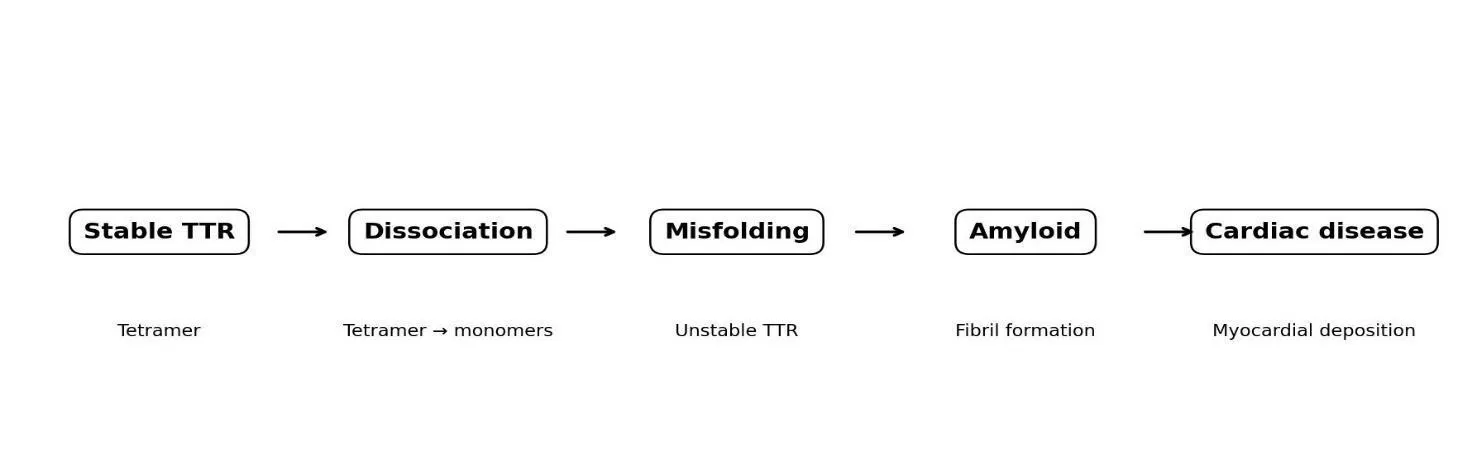
Figure 1: Simple Pathway of TTR Amyloid Formation
V. Clinical Features of ATTR-CM
ATTR-CM can produce several cardiac and extracardiac manifestations. Common cardiac features include breathlessness, reduced exercise tolerance, peripheral edema, heart failure, increased ventricular wall thickness, diastolic dysfunction, arrhythmias and conduction abnormalities. Cardiac biomarkers may also be increased. [2]
Echocardiography may show increased ventricular wall thickness and reduced global longitudinal strain. ECG findings can include low voltage or a pseudo-infarction pattern. [2]
Table 2: Important Clinical Findings in Attr-Cm
| Investigation/feature | Possible finding |
|---|---|
| ECG | Low voltage or pseudo-infarct pattern |
| Echocardiography | Increased ventricular wall thickness |
| Echocardiography | Reduced global longitudinal strain |
| Cardiac biomarkers | Increased NT-proBNP and/or troponin |
| Clinical examination | Peripheral edema |
| Functional status | Reduced exercise capacity |
| Nuclear imaging | Cardiac tracer uptake |
| Cardiac MRI | Abnormal myocardial enhancement |
VI. Diagnosis and Disease Assessment
Diagnosis may involve a combination of clinical findings, ECG, echocardiography, cardiac magnetic resonance imaging, nuclear scintigraphy and, in selected cases, tissue biopsy. [2] Nuclear imaging with technetium-labelled bone tracers can demonstrate cardiac uptake in ATTR-CM. The 2025 study included in this review used [99mTc]Tc-DPD scintigraphy and Perugini scoring to assess cardiac tracer uptake. [5]
Disease progression may be assessed using NYHA functional class, 6-minute walk test, KCCQ, NTproBNP, troponins, LVEF, global longitudinal strain, echocardiography, cardiac MRI and bone scintigraphy.
Table 3: Basic Pharmacological Profile of Tafamidis
| Parameter | Description |
|---|---|
| Drug | Tafamidis |
| Drug class | TTR kinetic stabilizer |
| Chemical class | 1,3-Benzoxazole |
| Main target | Transthyretin tetramer |
| Binding site | Thyroxine-binding site |
| Main action | Stabilization of TTR tetramer |
| Main therapeutic objective | Slow disease progression |
VII. Tafamidis
Tafamidis is a small-molecule transthyretin stabilizer belonging to the 1,3-benzoxazole class. The reviewed literature identifies its chemical name as 2-(3,5-dichlorophenyl)-1,3-benzoxazole-6carboxylic acid. [2]
Tafamidis was developed to stabilize TTR and prevent the initial step of amyloid formation. It is different from drugs that directly remove amyloid deposits; its main action is to stabilize circulating
TTR and reduce production of additional amyloid fibrils. [2]
VIII. Mechanism of Action of Tafamidis
Tafamidis binds selectively to the thyroxine-binding sites located in the central channel of the TTR tetramer. By binding to these sites, tafamidis increases the kinetic stability of the tetramer and reduces the rate at which it dissociates into monomers. [2,4]

Figure 2: Simplified Mechanism of Action of Tafamidis IX. Pharmacokinetic and Pharmacological Features
The reviewed pharmacology paper describes tafamidis as having good oral bioavailability and a relatively low toxicity profile. In healthy volunteer studies, median time to maximum concentration was approximately 2 hours and mean half-life was approximately 59 hours. [2]
The reviewed source reports that tafamidis stabilizes both wild-type and mutant TTR proteins. Tafamidis meglumine 80 mg once daily or tafamidis 61 mg once daily are described as equivalent therapeutic options for ATTR cardiomyopathy in the reviewed source. [2]
Table 4: Selected Pharmacological Characteristics
| Characteristic | Information |
|---|---|
| Administration | Oral |
| Tmax reported in reviewed pharmacology source | Approximately 2 hours |
| Mean half-life | Approximately 59 hours |
| Target | TTR tetramer |
| Binding | Thyroxine-binding sites |
| Main pharmacological effect | Kinetic stabilization |
| Effect on amyloid formation | Reduces formation of new amyloid fibrils |
X. ATTR-ACT: Landmark Clinical Trial
The most important randomized clinical evidence for tafamidis in ATTR-CM comes from the ATTRACT trial published by Maurer and colleagues. [1] ATTR-ACT was a multicenter, international, doubleblind, placebo-controlled phase 3 study. A total of 441 patients with ATTR- CM were randomized to tafamidis 80 mg, tafamidis 20 mg or placebo for 30 months. [1]
The primary analysis assessed all-cause mortality and cardiovascular-related hospitalizations.
Secondary outcomes included changes in the 6-minute walk test and KCCQ-OS score. [1]
Table 5: Main Features of the Attr-Act Trial
| Feature | Description |
|---|---|
| Study | ATTR-ACT |
| Design | Randomized, double-blind, placebo-controlled |
| Number of patients | 441 |
| Treatment duration | 30 months |
| Tafamidis doses studied | 20 mg and 80 mg tafamidis meglumine |
| Primary outcomes | All-cause mortality and cardiovascular hospitalization |
| Functional outcome | 6-minute walk test |
| Quality-of-life outcome | KCCQ-OS |
Mortality: During 30 months, all-cause mortality was 29.5% with tafamidis versus 42.9% with placebo; HR 0.70 (95% CI 0.51–0.96). [1]
Cardiovascular hospitalization: The reported hospitalization rate was approximately 0.48 events/year with tafamidis versus 0.70 events/year with placebo; relative risk ratio approximately 0.68. [1] Exercise capacity and quality of life: Tafamidis was associated with slower decline in 6-minute walk distance and KCCQ-OS compared with placebo. [1]
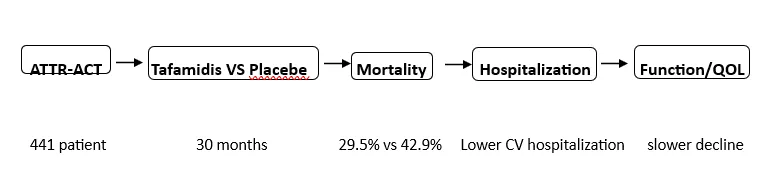
Figure 3: Major Findings of Attr-Act
XI. Evidence from Systematic Review and Meta-analysis
A 2023 systematic review and meta-analysis searched PubMed, Ovid Embase, Scopus, Cochrane Library and Web of Science. Fifteen studies involving 2765 patients were included. Mean age was approximately 75.9 years, 83.7% were male and mean follow-up was approximately 18.7 months. [3]
Tafamidis was associated with a lower risk of all-cause death or heart transplantation (RR 0.44;
95% CI 0.31–0.65) and a lower risk of a composite adverse cardiovascular endpoint (RR 0.57; 95% CI 0.42–0.77). The analysis found no consistent significant difference in interventricular septal thickness or GLS, while the overall LVEF finding did not represent a clear deterioration in the wildtype subgroup.
[3]
XII. Evidence from the 2025 Systematic Review and Meta-analysis
A 2025 systematic review and meta-analysis included seven studies comparing tafamidis-treated and untreated patients with ATTR-CM. The review screened 976 studies from PubMed and Embase. Tafamidis was associated with lower mortality and fewer congestive heart failure exacerbations. The analysis did not find statistically significant differences in CHF hospitalization, atrial arrhythmias,
LVEF, left ventricular end-diastolic diameter or interventricular septal thickness. [4]
Table 6: Major Findings from Clinical Evidence
| Outcome | Main finding |
|---|---|
| All-cause mortality | Reduced with tafamidis |
| Death/heart transplantation | Lower risk in meta-analysis |
| CHF exacerbations | Reduced in 2025 meta-analysis |
| Cardiovascular hospitalization | Reduced in ATTR-ACT |
| 6-minute walk distance | Slower decline |
| Quality of life | Slower decline |
| LVEF | No consistent major improvement |
| IVS thickness | No consistent significant change |
| GLS | Results heterogeneous |
| Atrial arrhythmias | No clear significant difference |
XIII. Real-world and Long-term Evidence
The 2024 narrative review summarized clinical trials, long-term extension studies and real-world cohorts. It reported that tafamidis treatment was associated with reductions in morbidity and mortality and slower disease progression. [7]
Real-world studies are useful because routine clinical populations may be older, have different disease severity and have more comorbidities than randomized-trial populations. However, observational studies can be affected by treatment-selection bias, confounding, differing follow-up periods and varying outcome definitions. Therefore, real-world evidence should be interpreted together with randomized trial evidence.
XIV. Tafamidis and Cardiac Imaging
Recent research has investigated whether tafamidis influences measurable structural or functional cardiac characteristics. Imaging methods include echocardiography, global longitudinal strain, cardiac magnetic resonance imaging and nuclear scintigraphy.
A 2026 systematic review reported that tafamidis was potentially associated with stabilization of global longitudinal strain and preservation of functional status. However, studies were heterogeneous and many were observational. [6]
XV. Tafamidis and [99mTc]Tc-DPD Scintigraphy
A 2025 study investigated serial [99mTc]Tc-DPD scintigraphy in 39 patients with wild-type ATTRCM receiving tafamidis. Scintigraphy was performed at baseline and during follow-up. The investigators reported significant declines in Perugini score and quantitative cardiac DPD uptake at 6 and 12 months, together with improvement in NYHA class and reduction in NT-proBNP. A reduction in right ventricular
DPD uptake at least as large as the median reduction was associated with improved survival. [5]
These findings suggest that serial nuclear imaging may provide information about treatment response, but the study was relatively small and larger prospective studies are needed before imaging can be considered a definitive marker of response. [5]
Table 7: Findings from the 2025 DPD Scintigraphy Study
| Parameter | Finding |
|---|---|
| Number of patients | 39 |
| Disease type | ATTRwt-CM |
| Treatment | Tafamidis |
| Imaging | [99mTc]Tc-DPD scintigraphy |
| Follow-up | 6 and 12 months |
| Perugini score | Significant reduction |
| Cardiac tracer uptake | Significant reduction |
| NYHA class | Improvement |
| NT-proBNP | Reduction |
| RV tracer reduction ≥ median | Associated with improved survival |
XVI. Safety and Tolerability
The safety profile of tafamidis has generally been favorable in the reviewed studies. In ATTR-ACT, the incidence and types of adverse events were similar between tafamidis and placebo groups. [1] The 2021 pharmacology review also described a favorable tolerability profile. [2] A 2026 systematic review found tafamidis generally well tolerated, although safety data varied among studies. [6]
Table 8: Safety Considerations
| Safety aspect | Evidence from reviewed literature |
|---|---|
| Overall tolerability | Generally favorable |
| Adverse-event profile | Similar to placebo in ATTR-ACT |
| Long-term safety | Generally favorable in available studies |
| Major new safety concern | Not identified in recent reviews |
| Evidence limitation | Long-term real-world data remain less extensive than randomized evidence |
XVII. Advantages of Tafamidis
XVIII. Limitations of Tafamidis and Current Evidence
Tafamidis stabilizes TTR but does not directly remove already deposited amyloid fibrils. Therefore, patients with advanced structural cardiac damage may not experience rapid reversal. [2]
Other limitations include delayed clinical benefit, heterogeneity among real-world studies, inconsistent findings for imaging/structural measures, and high treatment cost. The 2026 systematic review specifically noted heterogeneity and the predominance of observational evidence in much of the recent literature. [6,7]
XIX. Recent Evidence: 2023–2026
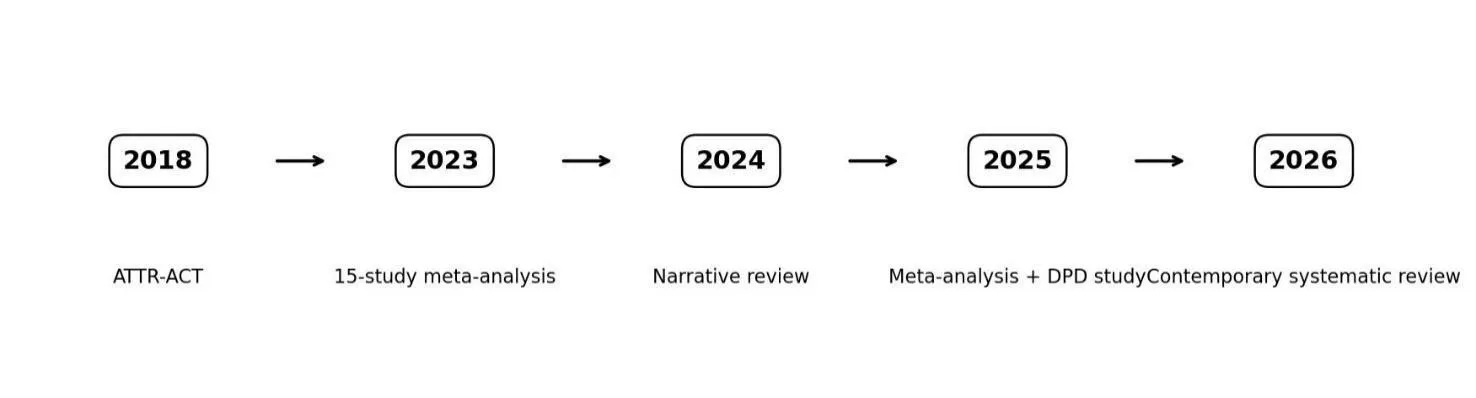
Figure 4: Development of Evidence for Tafamidis
The evidence base has continued to expand. The 2023 meta-analysis synthesized 15 studies and 2765 patients. The 2024 narrative review integrated clinical trials and real-world evidence. In 2025, a metaanalysis reported lower mortality and CHF exacerbations, while a separate imaging study reported reduced DPD uptake. A 2026 systematic review incorporated 17 studies and 1890 patients and evaluated mortality, function, biomarkers and imaging. [3-7]
XX. Comparison of Major Evidence Sources
Table 9: Summary of Important Tafamidis Studies
| Study/review | Year | Design | Population | Main findings |
|---|---|---|---|---|
| Maurer et al. / ATTR-ACT |
2018 | Randomized controlled trial |
441 ATTR-CM patients |
Reduced mortality and CV |
| hospitalization; slower functional/QOL decline |
||||
| Kim et al. | 2021 | Clinical/pharmacology review | ATTR-CM | TTR stabilization and clinical trial summary |
| Wang et al. | 2023 | Systematic review/meta-analysis |
2765 patients; 15 studies |
Lower death/transplant and composite cardiovascular risk |
| Ogieuhi et al. | 2024 | Narrative review | Clinical + realworld evidence |
Supports survival, functional and disease-control benefits |
| Hussain et al. | 2025 | Systematic review/meta-analysis |
7 comparative studies |
Lower mortality and CHF exacerbations |
| Ungericht et al. | 2025 | Imaging study | 39 ATTRwt-CM patients |
Reduced DPD uptake and improved clinical/biomarker parameters |
| Nasser et al. | 2026 | Systematic review | 17 studies; 1890 patients | Potential stabilization of GLS, preserved function and lower mortality |
DISCUSSION
ATTR-CM is a progressive disease in which the underlying molecular problem involves instability and dissociation of TTR tetramers. Tafamidis targets this process by stabilizing the tetramer rather than directly removing amyloid. [2]
The strongest evidence for clinical efficacy comes from ATTR-ACT, which demonstrated reductions in mortality and cardiovascular hospitalization and slower decline in exercise capacity and quality of life.
[1] Subsequent systematic reviews generally support these findings. [3,4]
Recent imaging evidence provides an additional research direction. The 2025 DPD scintigraphy study reported reductions in cardiac tracer uptake after tafamidis treatment. [5] If confirmed in larger prospective studies, imaging may help monitor disease progression and response.
The 2026 systematic review reported potential preservation of global longitudinal strain and functional status, but also emphasized heterogeneity. [6] Thus, current evidence is strongest for major clinical outcomes, while imaging and biomarker evidence remains an evolving area.
XXII. Future Perspectives
Earlier diagnosis before extensive cardiac damage.
Development of biomarkers that more directly reflect amyloid burden or treatment response.
Further validation of serial nuclear imaging and strain imaging.
Long-term studies in different ATTR subtypes and disease stages.
Research on combination strategies that address different stages of the amyloid pathway.
Improved affordability and access to disease-modifying therapy.
CONCLUSION
Transthyretin amyloid cardiomyopathy is a progressive disease caused by deposition of misfolded transthyretin amyloid fibrils in the heart. Dissociation of the TTR tetramer is an important step in amyloid formation.
Tafamidis is a TTR kinetic stabilizer that binds to thyroxine-binding sites and reduces tetramer dissociation. ATTR-ACT demonstrated reduced all-cause mortality and cardiovascular hospitalization and slower decline in exercise capacity and quality of life. [1]
Subsequent systematic reviews and meta-analyses have generally supported these findings. Recent studies have expanded the evidence to cardiac strain, biomarkers and nuclear imaging. [3-7] Overall, tafamidis represents an important disease-modifying approach for ATTR-CM. Early diagnosis, longterm follow-up and further research into disease monitoring and amyloid regression remain important.
XXIV. Key Points for Pharmacy Students
1. ATTR-CM is caused by deposition of transthyretin amyloid in the heart.
2. TTR normally exists as a tetramer.
3. Tetramer dissociation is an important step in amyloid formation.
4. Tafamidis is a TTR kinetic stabilizer.
5. It binds to the thyroxine-binding site of TTR.
6. It reduces TTR tetramer dissociation and formation of new amyloid fibrils.
7. ATTR-ACT showed reduced mortality and cardiovascular hospitalization.
8. Tafamidis also slows decline in exercise capacity and quality of life.
9. Recent studies are investigating biomarkers and imaging as measures of treatment response.
10. Tafamidis is generally well tolerated in the reviewed studies.
11. It does not directly remove already deposited amyloid.
REFERENCES

Ghule Ganesh, Pratik More, Pooja Gadhe, Santosh Sarode, Piyush Sonawane, Chetan Salave, Manish Ahire, Tafamidis in Transthyretin Amyloid Cardiomyopathy, Int. J. of Pharm. Sci., 2026, Vol 4, Issue 11, 2027-2041. https://doi.org/10.5281/zenodo.24189400
 10.5281/zenodo.24189400