
Sigma Institute of Pharmacy, Sigma University
Fast-dissolving tablets (FDTs) are oral solid dosage forms that rapidly disintegrate in the mouth without the need for water, improving patient compliance, especially in pediatric, geriatric, and dysphagic patients. This review summarizes the advantages, limitations, formulation criteria, and challenges associated with FDTs. It highlights the role of superdisintegrants, their mechanisms of action, and different manufacturing techniques such as direct compression, freeze-drying, and sublimation. Evaluation parameters and stability considerations are also briefly discussed.
1.1 Overview of Fast-Dissolving Tablets1
Orally disintegrating tablets (ODTs) and fast dissolving tablets (FDTs) are solid oral dose forms that dissolve quickly in the mouth, typically in a matter of seconds to a minute, without the need for water. An ODT is "a solid dosage form containing medicinal substances which disintegrates rapidly, usually within a matter of seconds, when placed upon the tongue," according to the U.S. Food and Drug Administration (FDA). These tablets are especially helpful in settings when water is not easily accessible and for patients who have trouble swallowing traditional tablets or capsules, such as pediatric, elderly, or mental patients. Many methods, including lyophilization, direct compression, spray drying, and sublimation, are used to create FDTs. FDTs include benefits such better bioavailability, quicker start of action, and more patient compliance in addition to being simple to administer.
Superdisintegrants like sodium starch glycolate, croscarmellose sodium, and crospovidone, which facilitate rapid tablet breakup upon contact with saliva, are the main means of achieving this rapid disintegration. In addition to being easy to administer, FDTs offer benefits like improved bioavailability, faster onset of action, and increased patient compliance.
The most common dosage forms are tablets and capsules, but one significant disadvantage of these forms is "dysphagia," or difficulty swallowing, which is linked to a number of conditions like:
1.2 The Development of Fast-Dissolving Tablets (FDTs)2
By creating a convenient dosage form for administration and improving patient compliance, recent developments in innovative drug delivery systems (NDDS) seek to improve the safety and toxicity of pharmacological compounds. One such strategy is the creation of oral disintegrating pills, which enhance patient compliance and are helpful for dysphagic, elderly, and pediatric patients. Without the need for water, this dose form quickly dissolves or disintegrates in the oral cavity in a matter of seconds. Faster medication release has been thought to be limited by tablet disintegration. The pharmaceutical industry has extensively investigated the use of natural gums and mucilage as thickeners, stabilizers, gelling agents, emulsifiers, granulating agents, binder, suspending agents, film formers, disintegrants, and sustain release matrices.
2. Advantages and Challenges of FDTs2
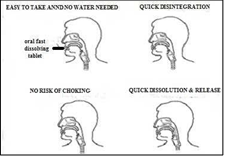
Figure 1 Advantages of FDTs
3. Fast-dissolving pill drawbacks: [3–4]
4. Criteria for fast dissolving tablets
Fast-dissolving tablets (FDTs) are designed to disintegrate and dissolve rapidly in the moth without need of water. The key criteria for formulating FDTs include:
5. CHALLENGES IN FORMULATING FDTs: 13
FDTs are either crushed into tablets with a very low compression force or have an extremely porous, softmolded matrix to enable oral disintegration. Because of this, the tablets are sometimes brittle and/or friable, challenging to handle, and often need special peel-off blister packaging, which can raise the price. The only technologies capable of producing tablets sturdy and hard enough to fit in multiple-dose bottles are the wow tab and Durasolv.
5.1 Hygroscopicity 15
Due to their hygroscopic nature, a number of FDTs are unable to retain their physical integrity in typical humidity and temperature circumstances. They therefore require humidity protection, necessitating the use of specialist product packaging.
Quantity of medication: The drug dose for lyophilized dosage forms must be less than 60 mg for soluble pharmaceuticals and less than 400 mg for insoluble drugs.
5.2 Amount of Drug18
The quantity of drugs that can be included in each unit dose limits the amount of Drug18 ODTS technology.
The dosage in lyophilized form must be less than 60 mg for poorly dissolving pharmaceuticals and less than 400 mg for insoluble substances. When making oral films and wafers that disintegrate quickly, this feature poses a unique challenge.
5.3 Solubility in water 15
Water-soluble medications create eutectic mixtures, which induce a freezing-point depression and a glassy solid that may crumble when it dries due to the sublimation process' loss of supporting structure.
5.4 Water solubility15
Water-soluble drugs form eutectic mixtu.res, which result in freezing-point depression and the formation of a glassy solid that may collapse upon drying because of loss of supporting structure during the sublimation process. Size of tablet: It has been reported that the easiest size of tablet to swallow is 7-8 mm while the easiest size to handle was larger than 8 mm. Therefore, the tablet size that is both easy to take and easy to handle is difficult to achieve.
5.5 Tablet size
The tablet's dimensions dictate It's simple to take. According to reports, tablets that are between 7 and 8 mm in length are the easiest to handle, while those that are longer than 8 mm are the easiest to ingest.
5.6 Mouth Feel18
FDTs shouldn't shatter in the mouth. bigger particles. The particles that are created when the FDTs break down ought to be as little as feasible. Additionally, adding flavors and cooling ingredients like menthol improves the texture. Additionally, adding flavors and cooling ingredients like menthol improves the texture. In the oral canal, mouth feel-FDTs shouldn't break up into bigger particles. The texture is further improved by incorporating flavors and cooling components like menthol.
6. Mechanism of action of disintegrants (2,19,20)
The tablet breaks to primary particles by one or more of the mechanisms listed below,
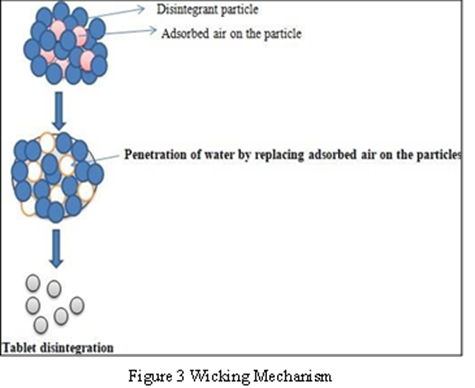
1. Through capillary action
The initial step is always disintegration through capillary action. The intermolecular bond is weakened and the tablet is broken up into tiny particles when it is submerged in the proper aqueous medium. The medium enters the tablet and replaces the air adsorbed on the particles. The hydrophilicity of the medicine or excipient and the tableting conditions impact how much water tablets absorb.
2. Through swelling
Swelling Superdisintegrants that function through this mechanism operate on the basis of "swell" and "burst." When the superdisintegrants come into touch with water or saliva, the aqueous phase applies more adhesive force to the superdisintegrants than to other excipients and drugs, which causes the tablet to expand, thrust, or break apart. Superdisintegrants swell quickly when they come into contact with water, including cross-linked polymers like crospovidone (PVPP) and croscarmellose sodium (CCS). The tablet matrix is compressed by this swelling, which causes it to break apart and disintegrate.
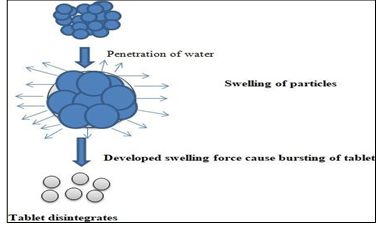
Figure 2 Swelling mechanism
3. Due of the wetting's heat
Capillary air expansion creates localized stress when exothermic disintegrants are wetted, which facilitates tablet breakdown. However, this hypothesis only applies to a small number of disintegrants and does not account for the behaviour of most contemporary disintegrating agents.
4. Due of the gasses' release
When certain super disintegrants come into contact with water, such as sodium bicarbonate, they produce gas. The tablet disintegrates as a result of the internal pressure created by this gas production.
5. By enzymatic action
Through an enzymatic process the body's enzymes function as disintegrants. These enzymes aid in breakdown by interfering with the binder's ability to bind. In reality, the tablet ruptures due to expansion, pressure exerted radially or externally, or the rapid absorption of water, which greatly increases the number of granules and encourages disintegration.
6. Due to disintegrating particle/particle repulsive forces
This perspective holds that tablets containing "non-swellable" disintegrants are the source of the swelling. Tablet disintegration is the outcome of particles rejecting one another due to the electric repulsive force. Biological enzymes are used as disintegrants in this method. Salivary enzymes can readily break down the binder in the pill. These binders are catalyzed and the pill dissolves when they come into contact with saliva. Additionally, this technique releases the drug as granules by combining the swelling and rupture. Binder starch is broken down by amylase. Carragenase breaks down alginate, hemicellulose breaks down gums, and invertase breaks down sucrose.
7. Due to deformation
Certain disintegrants contain a high degree of flexibility. Upon exposure to water, they distort and produce channels within the tablet, enabling water penetration and dissolution. Because starch grains are "elastic," they can bend under pressure and then revert to their original shape when the pressure is released. Because tableting permanently distorts the grains, "energy rich" starch granules are more capable of swelling than starch grains that have not undergone pressure-induced distortion.
7. Ideal properties of Fast Dissolving tablets:11
8. Super disintegrants (synthetic, natural, co-processed) (5,21)
Super disintegrants the fundamental strategy for creating MDTs is the use of disintegrants. Disintegrants are crucial to the dissolution and disintegration of MDT. To guarantee rapid disintegration and high dissolution rates, it is crucial to select an appropriate disintegrant at the ideal concentration. Super disintegrants offer rapid disintegration because of the formulation's combined impact of swelling and water absorption. Super disintegrants expand, increasing the carrier's wetted surface. This increases the system's wettability and dispersibility, which improves disintegration and dissolution. The critical concentration of the disintegrant can be used to determine the ideal concentration of the super disintegrants.
8.1 Types of super disintegrants
1. Natural super disintegrants
Mucilage from Ispaghula husks (Plantago ovata)
The dried seeds of the plant known as Plantago ovata are included in ispaghula husk, together with the mucilage found inside the seeds' skin. Plantagoovata mucilage serves a variety of purposes, including binding, dissolving, and preserving qualities. Compared to other super disintegrants, mucilage has a very high percentage of swelling index (around 89±2.2% v/v), making it a super disintegrating agent utilized in the formulation of fast-dissolving tablets.
Gum made of xanthan
Xanthan gum that's derived from Xanthomonas campestris is official in usp with excessive hydrophilicity and poor gelling tendency. It has poor water solubility and large swelling properties for faster disintegration.
Gellan gum
Gellan gum's strong hydrophilicity and on-the-spot swelling properties when it comes into touch with water could be the cause of the tablet's disintegration. When using gellan gum at a 4% w/w concentration, the tablet completely dissolves in 4 minutes.
Silicon dioxide, chitin, and chitosan
Through a deacetylation reaction in an alkaline media, chitin is naturally removed from the shell wastes of shrimp, crab, lobster, krill, and squid and utilized to make chitosan. Chitosan is a well-known herbal polysaccharide with a wide range of uses in the pharmaceutical sector.
2. Synthetic super disintegrants
Modified starch (primojel, sodium starchglycolate)
The sodium salt of starch's carboxymethyl ether is known as sodium starch glycolate. These modified starches are created by cross-linking potato starch to provide a product with improved disintegration qualities.
Crospovidone, or cross-linked polyvinyl pyrrolidone
In order to create the volume expansion and hydrostatic pressure necessary for speedy disintegration within the mouth, crospovidone quickly wicks saliva into the tablet.
Modified celluloses (sodium croscarmellose)
Even though it quickly grows to four to eight times its original volume when in contact with water, it is completely insoluble in water. Croscarmellose sodium has a specific surface area of 0.81-0.83 m2/g and a swelling index of 65±1.7% v/v. It can be used in both wet-granulation and direct compression tablet formulations.
3. Co-processed super disintegrants:
This is mainly predicated on the radical notion that two to three excipients interact at the particle level, with the goal of providing a synergy of functionality development and altering the taste of an individual's undesirable characteristics. Excipient granules with enhanced characteristics are created when excipients are co-processed. in contrast to physical additive combinations such as enhanced compressibility and flow characteristics. reduced susceptibility to lubricants and improved complete uniformity and dilution capacity.
|
Table 1: List of super disintegrants14 |
|||
|
Sr. No. |
Superdisintegrant |
Mechanism of action |
Specific properties |
|
1 |
Croscarmellose Sodium |
Swells 4–8 folds in<10 s. Swelling and wicking action |
Effective in low concentration (0.5– 2.0%), high swelling capacity, crosslinking of the carboxyl ester groups. |
|
2. |
Crospovidone |
Combination of swelling and wicking action. Swells 7–12 folds in<30 s. |
The effective concentration is 1–3%. Rapidly disperses and swells in water, available in micronized grades. |
|
3. |
Cross-linked alginic acid |
Hydrophilic colloidal substance which has high sorption capacity. |
The combination of swelling and wicking action causes disintegration. |
|
4. |
Gellan gum |
Strong swelling properties upon contact with water. |
Anionic polysaccharide of linear tetrasaccharides, good superdisintegrants property similar to the modified starch and celluloses. |
|
5. |
Sodium starch glycolate |
Strong swelling properties upon contact with water. Swells 7–12 folds in<30s. |
Rapid absorption of water results in swelling up to 6%, high concentration causes gelling. |
|
6. |
Soy polysaccharide |
Rapid dissolving |
Does not contain starch or sugar so can be used in products meant for diabetics. |
|
7.
|
Xanthan gum |
Extensive swelling properties for faster disintegration. |
High hydrophilicity and low gelling tendency, low water solubility. |
9. Manufacturing Techniques6
Some of the methodologies which are employed for the formulation of FDTs are
1. Disintegrant addition method
One of the often-used methods for creating FDTs is the disintegrant addition procedure. This method is inexpensive and simple. This method involves adding various excipients and the necessary concentration of super disintegrants to the medication, which is then compacted into tablets. Super disintegrants that are frequently used include calcium silicate, gellan gum, xanthan gum, sodium starch glycolate, crospovidone, and croscarmellose. This method is used to set up oxybutynin FDTs.
2. Freeze-drying/Lyophilization
It is a pharmaceutical process that makes it possible to dry biological materials and heat-sensitive medications at low temperatures by utilizing the valuable resource of sublimation and the vacuum's ability to remove water. The process involves dissolving or dispersing drugs in a carrier's aqueous medium, transferring them to premade blister packs, flushing them with nitrogen to prevent freezeout, and placing them inside the refrigerator to complete the process. Lyophilization techniques are characterized by their high porosity, distinct surface area, and rapid oral dissolution, which results in high medication bioavailability. The main disadvantages are the high cost, time-consuming process, fragility, and stability issues under stress conditions, rendering typical packing unnecessary for this dosage form.
3. Direct compression
It is the most straightforward method of producing tablets. Direct compression involves a small number of processing stages, widely accessible excipients, and standard equipment.
Additionally, the final weight of the pill can easily surpass that of previous production methods, and high doses can be allowed.
Direct Compression Method

Advantages of direct compression
Disadvantages of direct compression
4. Sublimation
Because the sublimation method uses volatilized solid chemicals like camphor, ammonium bicarbonate, naphthalene, urea, urethane, etc., the very porous compressed tablets are quickly dissolved in the mouth. The sublimation procedure eliminates the volatile ingredient, creating a porous compacted tablet that dissolves quickly in saliva. The materials utilized to create the tablet matrix are mannitol and camphor. This method often results in tablets that dissolve in ten to twenty seconds.
5.Spray drying
Spray drying can produce extremely thin and porous powders that dissolve quickly. This method creates a fine, extremely porous powder by spray-drying a wet mixture of support matrix and various excipients. The resulting fine powder is then combined with a medicinal substance and compacted to create tablets. Acids like citric acid, alkali like sodium bicarbonate, mannitol as a bulking agent, hydrolyzed and nonhydrolyzed gelatine as a supportive agent, and crosscarmellose as super disintegrants all help the formulation to increase the rates of disintegration and dissolution. When spray-dried powder tablets are submerged in an aqueous media, they dissolve in about 20 seconds.
6. Tablet Molding:10
Because water-soluble excipients are present in this technology, tablets dissolve and disintegrate quickly. The blends are moistened with hydroalcoholic solvents, and tablets are compressed into shape. The solvent is eliminated by the air-drying process. Because produced tablets are porous and have low mechanical strength, binding agents like sucrose, acacia, or polyvinyl pyrrolidone are employed to boost mechanical strength. Compared to compressed regular tablets, the tablets produced in this way are less compact.
7. Mass-Extrusion:16
Using a solvent mixture of water-soluble polyethylene glycol and methanol, the active blend is softened. The softened mass is then expelled through an extruder or syringe to create a cylinder of the product that is divided into even segments using a hot blade to produce tablets. Taste masking can also be accomplished by coating bitter medication granules with the ried cylinder.
8. Melt granulation
Melt granulation is a combination of an active substance and a water-soluble carrier that has been heated to a melting point. The melts are forcefully agitated, crushed, and sieved while being rapidly solidified in an ice bath. Rapid congealing is desired because of the drug's super saturation brought on by the solute molecules becoming trapped in the solvent matrix by quick solidification. The solidification process can be carried out using stainless steel plates that are coupled to a cooling system for rapid heat dissipation. The melt granulation process has two advantages: it is economical and simple to use because no solvents are employed.
10. EVALUATION OF TABLETS12
All the formulated Gliclazide fast dissolving tablets were subjected to the following quality control tests:
1. Weight variation17
The weight variation test is carried out to ensure uniformity in the weight of the pills in each batch. Weighing all 20 tablets in each formulation and calculating the average is the first step. Each tablet's unique weight is also determined in order to calculate the weight variance. Weight variation is provided by the formula.
Individual weight minus average weight divided by average weight times 100 is the percentage of weight variation.
2. Friability17
The tablet's friability was assessed using the Roche friabilator. Friability is the weight loss of the tablet in the container due to the tiny particles being removed from its surface. A friability test is carried out to ascertain the tablet's resistance to abrasion during handling, packing, and transportation. Before being put in a Roche friabilator that rotates at 25 rpm for four minutes, each batch of twenty tablets should be weighed. Reweigh each tablet after dusting it. The friability (F) is provided by the formula.
F is equal to W(initial)-W(final)/W(final).
3. Hardness17
The force required to break a tablet in a diametric compression was measured using a Monsanto tablet hardness tester. Another name for hardness is the tablet's crushing strength (fc). The unit of measurement is kg/cm2.
4. Disintegration17
After receiving tablets from the optimal formulation, six healthy volunteers were asked how long it took for the tablets to fully dissolve in their mouths. The water absorption ratio was measured by placing a piece of twice-folded tissue paper in a tiny Petri dish with six milliliters of water. The time it took for the tablet to get fully wet was noted after it was placed on the paper. The wet tablet was then weighed. The water absorption ratio, denoted by R, was determined using the following formula: R = 10(wa/wb), where wb is the tablet's weight before to water absorption and wa is its weight following water absorption.
5. Wetting Time15
The dosage form's wetting time is correlated with the contact angle. A shorter wetting time suggests that the tablet will dissolve more quickly.
6. Water absorption Ratio16
Six milliliters of water were added to a small Petri dish along with a piece of tissue paper that had been folded twice. A tablet was placed on the paper, and the amount of time needed to completely wet it was recorded. After that, the tablet was wetted and weighed. The following formula was used to calculate the water absorption ratio, or R:
R=10(wa/wb),
where wa is the weight of the tablet following water absorption and Wb is the weight of the tablet prior to water absorption.
7. Taste / Mouth feel12
Patients should be given a product that feels good in their mouths since mouthfeel is important. The sensation of one pill from each batch was evaluated by putting it on the tongue. Mouth sensation was assessed using human volunteers in good health. A panel of five people evaluated the taste using the time intensity approach. A 40 mg sample, or dose of medication, was kept in the mouth for ten seconds. Taste was recorded immediately, as well as after 10 seconds, 1 minute, 2 minutes, and 6 minutes. The flavor was scored by volunteers using a variety of score values, such as 0 for good, 1 for tasteless, 2 for mildly bitter, 3 for bitter, and 4 for dreadful.
8. In vitro Dissolution17
The paddle was rotated at 50 rpm using the USP 2 Paddle device. The drug was released in vitro by measuring the dissolution profile using phosphate buffer (PH 6.8) (900 ml) as a dissolving media.
9. Stability studies15
According to ICH standards for accelerated research, the fast-dissolving tablets should be kept in the following conditions for a certain amount of time.
After 15 days, the tablets were removed and examined for physical characteristics such hardness, friability, disintegrations, dissolution, and visual flaws. The kinetics of degradation are ascertained by fitting the collected data into first-order equations.
REFERENCES


Rinal Padhiyar, Ria Patel, Priyanka Patil, A Comprehensive Review on Fast Dissolving Tablets: Formulation Technique and Evaluation Parameter, Int. J. of Pharm. Sci., 2026, Vol 4, Issue 2, 4381-4393. https://doi.org/10.5281/zenodo.18791333
 10.5281/zenodo.18791333
