

We use cookies to ensure our website works properly and to personalise your experience. Cookies policy
School of pharmacy, Rai University, Ahmedabad.
Contraceptive is an essential component of reproductive health, yet many synthetic options are associated with side effects, limited accessibility, and cultural resistance in certain communities. The growing demand for safe, affordable, and natural alternatives has directed attention toward medicinal plants. Neem (Azadirachta indica), a tree widely used in traditional medicine, has been recognized for its diverse pharmacological activities, including antifungal, antibacterial, antiviral, and antifertility properties. Neem seed oil, in particular, has demonstrated contraceptive potential through spermicidal, anti-implantation, and immunomodulatory effects. Preclinical and limited clinical studies suggest that neem seed oil may serve as a promising herbal contraceptive. However, challenges such as formulation standardization, safety validation, and large-scale human trials remain. This review summarizes the mechanisms, evidence, advantages, limitations, and prospects of neem seed oil as a contraceptive.
Globally, an estimated 214 million women of reproductive age in low- and middle-income countries have an unmet need for contraception.
Contraception plays a crucial role in family planning and population control. Conventional options such as hormonal contraceptives, intrauterine devices (IUDs), and barrier methods are effective but often come with challenges, including hormonal imbalance, menstrual irregularities, cost, and cultural acceptance issues[1]. These limitations have increased interest in plant-derived contraceptives, which are seen as safer and more acceptable. Neem (Azadirachta indica), commonly known as the “Indian Lilac,” is a tree native to the Indian subcontinent and widely found in tropical and subtropical regions. Traditionally, neem has been used for its antimicrobial, anti-inflammatory, insecticidal, and fertility-regulating properties.[2] Plant-based contraceptives have gained attention as potential on-demand, low-cost, and culturally acceptable solutions. Neem (Azadirachta indica A. Juss.), commonly known as the “village pharmacy” of India, among its derivatives, neem seed oil (NSO) has shown potential as a contraceptive in experimental models. Famous Unani physician Azam Khan stated in his book Akseer Azam that women who take 4.5 grams of neem oil orally become sterile[3]
Contraceptives are basically BIRTHCONTROLS, it is the use of medicines, devices, or surgery to prevent pregnancy.[4] Contraception can be defined as the inhibition of conception, but generally, they are taken to mean the prevention of pregnancy. Family planning has been encouraged through numerous means of contraception, but these contraceptives have several side effects produced by their steroid content.[5] Contraceptive pills are generally female sex hormones such as estrogen, progesterone, or their derivatives, either single or together.[6] There are many different types. Some are reversible, while others are permanent. Some types can also help prevent Sexually Transmitted Infections (STIs)
Different types of birth control
1. Barrier methods: • Female condom • Male condom • Contraceptive sponge
• Spermicide • Diaphragm and Cervical cap[7].
2. Hormonal methods: • Oral contraceptives ("the pill") • Contraceptive patch • Vaginal ring • Injectable birth control • Implant[8].
3. Long-acting reversible contraceptives (LARCs): • Intrauterine device (IUD) • Birth-control implant [9].
4. Emergency Contraceptives: Emergency contraception is not a regular method of birth control. But it can be used to prevent pregnancy after unprotected intercourse or if a condom breaks. There are two types: • Copper IUD, which is a small, T-shaped device that a provider inserts into the within 120 hours of unprotected intercourse. • Emergency contraceptive pills (ECPs) which are hormonal pills which the woman takes as soon as possible after unprotected intercourse[10].
Daily Herbal Contraceptives: Some herbal contraceptives have a cumulative effect in the body, they need to be taken regularly (usually daily) to maintain the contraceptive effect[11]. They often need a period of time to establish their effectiveness and have a barrier method should be employed; examples are wild yam and neem.
Herbal contraceptives: Herbal contraceptives are a category of herbs that have an anti-fertility effect. There are many different ways in which herbs can impair fertility[12]. Some herbs may affect the ovary, while others act upon the uterus, affect normal hormone production or block certain hormones[13]. Some herbs have the ability to interfere with implantation, these herbs can be taken on as needed basis, and are useful as an emergency contraceptive[14]. There are also some herbs that have been found to interfere with normal sperm production, or mobility. Each herb is used in its own way, so it’s important to have some idea of how they are used, or could be used. Medicinal plants with potential contraceptive properties have been reported in several studies. Anecdotal data provides evidence for the usage of herbal extracts as contraceptives to either arrest ovulation, prevent implantation, emmenagogue, or oxytocic[15]For centuries herbal preparations have been connected with the goal of preventing, and or disrupting pregnancy. There are commercial preparations available that can be used for contraception for both men and women. For women it is used vaginally as a spermicide, and men use it orally as a daily contraceptive to induce temporary sterility.
Implantation inhibitors: Herbal contraceptives have the ability to interfere with implantation, the actual effect in the body can vary from herb to herb, but the end result makes it difficult for the egg to implant or maintain its grip on the uterine wall[16]. Implantation occurs about 6 days after the egg has been fertilized[17]. If the egg is unable to get a grip on the uterine wall, it cannot survive, it begins to break down, and menstruation will arrive as usual.
Neem as a Contraceptive: Neem as a contraceptives can be prepared from natural as well as synthetic sources. These contraceptives work by preventing the fusion of sperm into the ovum, changing female hormonal levels and spermicidal activity[18]. Neem leaf extracts a traditional plant product, for long-term and reversible blocking of fertility after a single intrauterine application, is described[19]. A vaginal contraceptive has also been developed from NIM-76, it is found that 3mg of neem leaf extract immobilizes and kills 100% of spermatozoa within 20 second[20]. Whereas newer studies showed that neem oil contraceptive indeed kills sperm in the vagina within 30 seconds and remains active for five hours. It causes no irritation or discomfort like the chemical based spermicidal foams do. Sodium nimbinate and sodium nimbidinate are the main constituents for the spermicidal and antifertility activity of neem oil[21]. However, the block in fertility is reversible. Its action can be temporary and can be reversed once the intake is been stopped. Neem is a tree which is very common and old with its valuable medicinal parts. Its potential use of neem leaf extract as contraceptive are not newer but, is not known to all. Research on its spermicidal activity is being carried out since 1960’s. Neem is currently being used in India for contraceptive purposes for both men (orally) and women (as a spermicide ) [22]. Neem oil was found to be a promising Precoital Vaginal Contraceptive and a Post-Coital Contraceptive preventing implantation and also An Abortifacient agent[23]. All these effects are reversible. Only one ml of oil is to be applied for these effects every time. Hence, one litre of neem oil can be used for 30 cycles by a woman if it is daily used as a pre-coital vaginal contraceptive. It is purely of herbal origin.
Neem (Azadirachta indica) belongs to the family Meliaceae. Its leaves, bark, flowers, and seeds are widely used in Ayurveda and traditional medicine. Neem seed oil is extracted from the kernels of neem seeds, producing a bitter, yellowish-brown oil high in bioactive compounds. Phytochemical analyses have identified azadirachtin, nimbin, nimbidin, and salannin as key components.[24] These compounds are responsible for neem’s various pharmacological effects, including antifertility properties. Neem seed oil, extracted from the kernels of the neem fruit, is a dark yellow, bitter oil with a strong sulfurous odor. Its traditional use as a vaginal contraceptive and as an ingredient in preparations to prevent pregnancy has been documented. Modern scientific inquiry has sought to validate these traditional claims and understand the underlying biological mechanisms, positioning neem seed oil as a promising candidate for non-hormonal, user-controlled contraception[25]
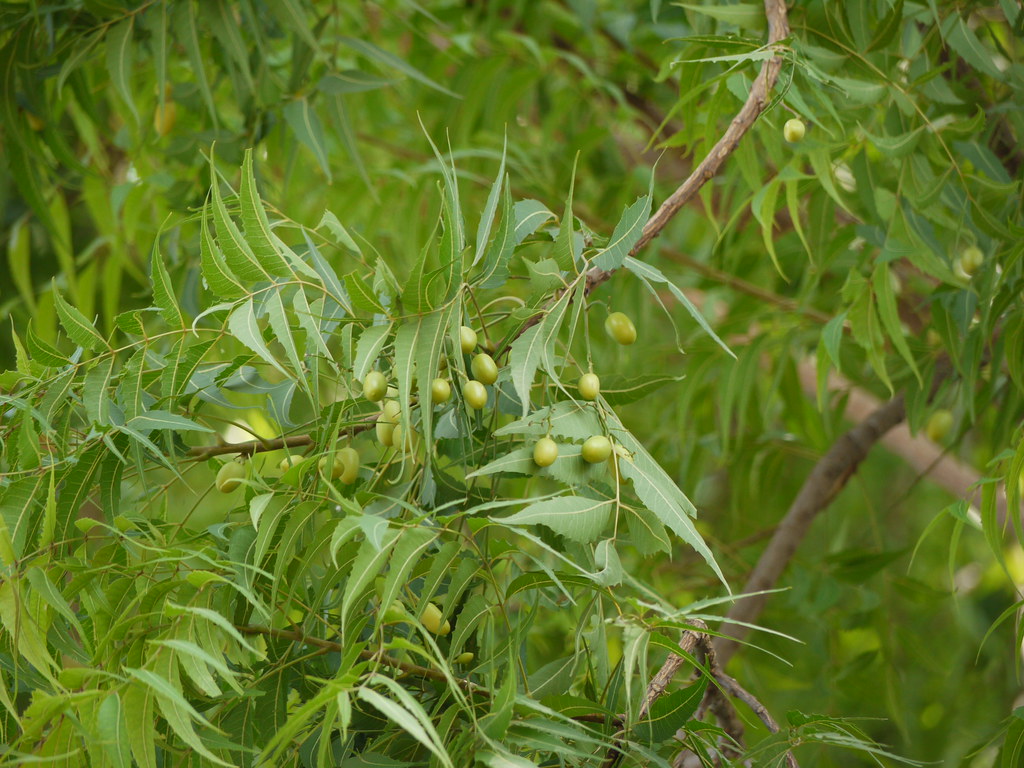
Neem tree plant [Figure no. 1.1][26]
1.3 Mechanisms of Contraceptive Action [27]
Research, primarily conducted in rodent and primate models, has demonstrated that neem oil exerts its contraceptive action through several distinct mechanisms:
NSO exhibits antibacterial and antifungal activity, suggesting potential as a multipurpose prevention technology(MPT) for contraception and infection prevention.
1.3 method of extraction Extraction of plant material: The ripe fruit of Neem was collected .After collection, they were cleaned, depulped, and dried in bright sunlight for about 10–12 h and decorticated mechanically by double roller miles. The crushed kernels were initially blended with the hexane. The crushed material was packed into cellulose thimble and placed in extractor. Hexane was recovered by distillation and the residue left after distillation was collected and to prevent oxidation Neem seed oil was stored under refrigeration. Fractionation: 50 g of Neem seed oil was chromatographed over deactivated silica gel in a glass column, and six major fractions were eluted with EtOH/hexane in six different proportions (Table 1)
Table 1.1: Weight of eluted six major fractions [28]
|
Fractions |
Amount of EtOH (%) |
Amount of hexane (%) |
Weight of the fraction (g) |
|
i |
0 |
100 |
2.232 |
|
ii |
7 |
93 |
2.438 |
|
iii |
20 |
80 |
4.680 |
|
iv |
30 |
70 |
7.128 |
|
v |
80 |
20 |
2.844 |
|
vi |
100 |
0 |
1.44 |
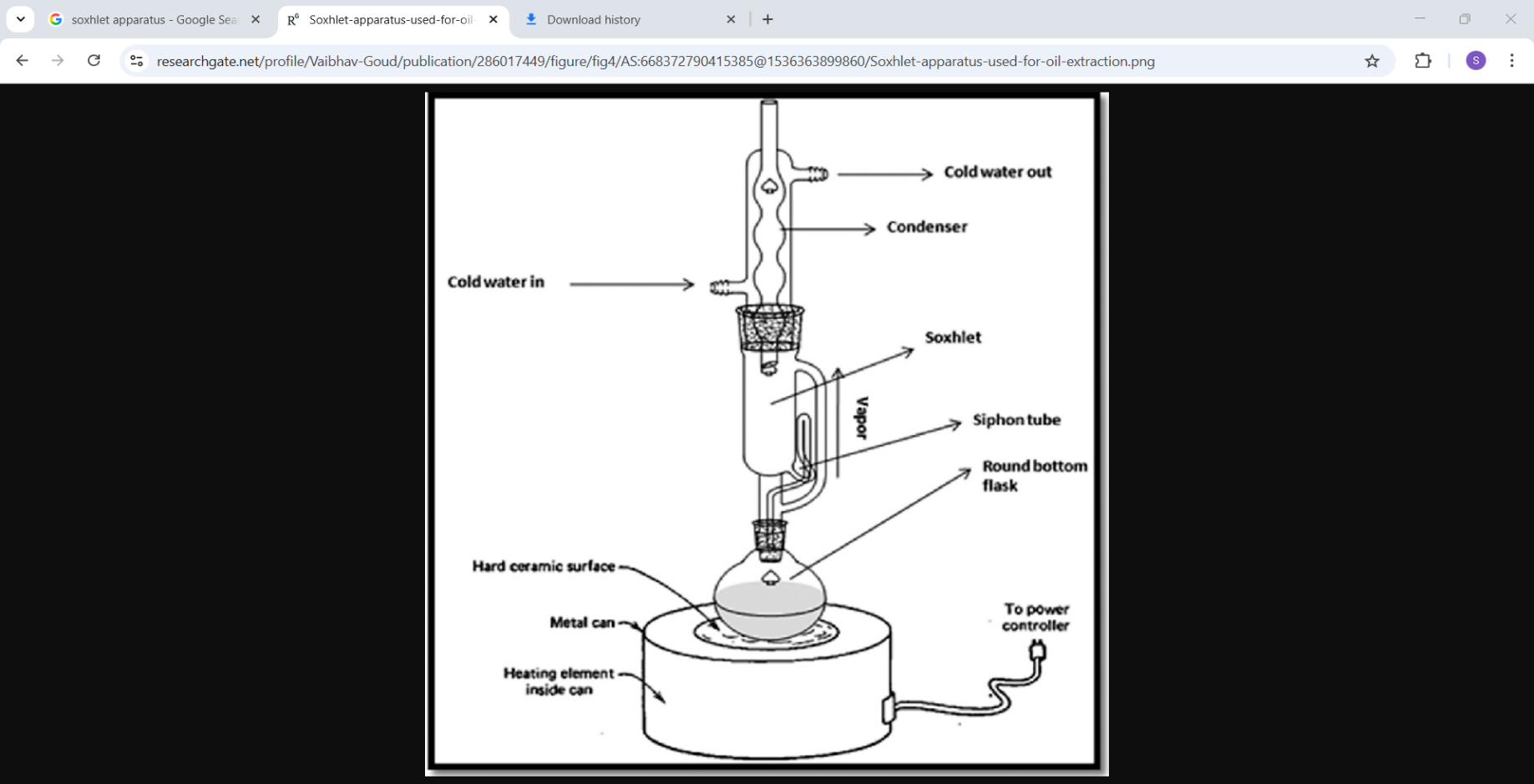
Soxhlet Apparatus [Figure no. 1.2][29]
1.4.1 In vitro studies
NSO shows rapid spermicidal action against human and rabbit sperm.
CASA (computer-assisted sperm analysis) confirms dose-dependent loss of motility and viability.
Rats and rabbits: Vaginal application of NSO prevents pregnancy when applied pre- or post-coitally.
Reversibility: Fertility restored after cessation in most studies, suggesting a reversible effect.
Table 1.2 [30]
|
Species |
Route/Dose |
Effect |
|
Rat |
Intrauterine 20µl NSO |
100% pregnancy prevention |
|
Rabbit |
Vaginal NSO gel |
Reduced implantation |
|
Mouse |
Oral limonoid fractions |
Decreased fertility, embryotoxicity |
Limited small-scale clinical studies report immobilization of sperm and reduced pregnancy rates with intravaginal application.
1.5 Comparison between Neem Seed Oil and Synthetic Spermicides (Nonoxynol-9) [31]
Neem Seed Oil and Nonoxynol-9 (Synthetic Spermicide)
Source: Natural product (extracted from Azadirachta indica seeds) Synthetic surfactant (nonionic detergent)
Mechanism of Action Disrupts sperm plasma membrane, immobilizes sperm; also has anti-implantation and immunomodulatory effects. Disrupts sperm cell membrane, immobilizes, and kills sperm
Additional Benefits: Antimicrobial, antifungal, antiviral, may offer some protection against STIs No antimicrobial benefit; frequent use may increase risk of HIV/STI transmission due to epithelial irritation
Efficacy (in vitro): High spermicidal activity, immobilizes sperm within 20–30 seconds ).
Formulations: Oil, vaginal cream, suppository, gel (experimental), Vaginal foams, creams, gels, suppositories
Side Effects: Local irritation, variability in potency, potential toxicity if ingested. Vaginal irritation, epithelial disruption, higher STI susceptibility with frequent use.
Clinical Evidence: Limited human studies; strong animal evidence. Extensive clinical use, FDA-approved, widely studied.
Cost & Accessibility: Inexpensive, easily available in tropical regions. Commercially available but relatively more expensive
Regulatory Status: Not yet approved as a contraceptive drug. Approved and marketed as a contraceptive spermicidal
It shows how Neem seed oil acts as a contraceptive through three main mechanisms:
Synthetic spermicides (Nonoxynol-9)
While Nonoxynol-9 (N-9) is an established spermicide, public-health assessments concluded it does not protect against HIV and frequent use may increase HIV risk due to epithelial irritation—an important benchmark when considering any topical contraceptive/microbicide strategy. This shifted research interest toward safer alternatives and careful mucosal safety profiling for future candidates.
Synthesis:
Collectively, the literature supports that neem seed oil (and defined fractions) exhibits multi-modal antifertility activity: (1) direct spermicidal effects, (2) pre-implantation/endometrial effects, and (3) local immunomodulation. Findings are robust in animals and suggestive in small human studies, but translation is constrained by lack of modern, randomized human trials, variable extraction/standardization, and regulatory-grade safety data. Rigorous development would require: GMP-grade standardized extracts/fractions, dose-ranging Phase I/II trials with mucosal safety endpoints, and comparative effectiveness vs. existing vaginal contraceptives/microbicides.
Based on its mechanisms, neem seed oil could be developed into several contraceptive formulations:
Natural origin: Widely accepted in traditional medicine, particularly in India and Southeast Asia.
Cost-effective: Readily available and inexpensive compared to hormonal contraceptives.
Multiple formulations: Can be prepared as vaginal cream, suppository, or directly as oil.
Additional benefits: Neem also possesses antimicrobial properties, potentially offering protection against sexually transmitted infections.
Despite the promising preclinical data, several significant challenges hinder the translation of neem seed oil into a clinically approved contraceptive:
2.Conclusion and Future Directions
Neem seed oil (Azadirachta indica) has emerged as a potent natural contraceptive due to its multifaceted mechanisms, including spermicidal, anti-implantation, and immunomodulatory actions. The preclinical evidence strongly supports its reversible antifertility effect, making it a potential alternative to synthetic contraceptives that often cause hormonal imbalance and mucosal irritation. However, the direct application of neem oil is limited by its strong odor, potential mucosal irritation, and variable composition. Therefore, the formulation of neem seed oil into a mucoadhesive gel presents a promising approach to enhance its efficacy, safety, and patient compliance. A mucoadhesive vaginal gel can provide localized, sustained release of active constituents, improve retention at the site of action, and minimize systemic exposure and irritation. In conclusion, neem seed oil holds significant potential as a natural, safe, and reversible contraceptive, and transforming it into a mucoadhesive gel formulation could overcome its current limitations. This formulation approach may offer a dual benefit of contraception and protection against sexually transmitted infections (STIs), thereby contributing to safer reproductive health management. Future research should focus on standardization, stability studies, and clinical validation to establish neem mucoadhesive gel as a viable, user-friendly herbal contraceptive product.
REFERENCES


Navinraj D. Mourya*, Sneha Kumari, A Comprehensive Review on Neem Seed Oil as a Natural Contraceptive, Int. J. of Pharm. Sci., 2025, Vol 3, Issue 11, 2470-2480 https://doi.org/10.5281/zenodo.17627622
 10.5281/zenodo.17627622