

We use cookies to ensure our website works properly and to personalise your experience. Cookies policy
Yashwant Ayurved College PGT & RC Kodoli.
Kasa, described in Ayurveda as both an independent disease and a symptom of other disorders, originates from vitiation of the Pranavaha Srotas rooted in the Hridya and Mahasrotas. Predominantly caused by Vata and Kapha imbalance, it presents with distinct Doshaja Lakshanas crucial for diagnosis and prognosis. In children, respiratory disorders are frequent due to immune immaturity, underdeveloped structures, poor hygiene, nutritional deficiencies, and environmental exposures. Ayurveda considers Bala Avastha a Kapha-dominant stage, predisposing children to such conditions, especially when reflexes like coughing or sneezing are suppressed. Understanding the types of Kasa—Vataja, Pittaja, and Kaphaja—and their Lakshanas ensures effective management.Since untreated Kasa can lead to several complications,studying its Doshaja lakshna aids both diagnosis and prognosis. Classical texts advocate principles such as Vatanulomana and the use of antitussive, expectorant, mucolytic, and immune-enhancing remedies, forming a rational and holistic approach to pediatric respiratory care.
Kasa (cough) is described in Ayurvedic literature as both an independent disease and a symptom associated with various disorders. If left untreated, it can progress to serious conditions such as Kshaya 1 (tissue depletion), making early intervention essential. In modern terms, cough represents one of the most common manifestations of respiratory diseases, accounting for nearly 30% 2 of primary healthcare visits, with a prevalence of 5– 10% 3 in India. Environmental and socioeconomic factors—including poor housing, use of biomass fuels, inadequate sanitation, and exposure to pollution, tobacco smoke, and allergens—contribute significantly to its occurrence in both rural and urban populations. The differential diagnosis of cough remains complex due to its diverse etiologies involving the respiratory tract. Enquire the Vega dharana hanits or withholding of the natural urges,especially Kasa,Kshavathu etc by child as this will be a strong precipitating factor for Respiratory infections.4
Classical texts advocate multiple forms of therapy, including Bhojya (dietary), Pana (drinks), Leha (lickables), Ksheera (milk preparations), Sarpi (ghee-based), and
Dhoomapana (medicated inhalation), administered Muhur Muhur to restore the balance of Vata and Kapha. The interrelationship between Kasa and Shwasa (dyspnea) is also emphasized, as one may lead to or aggravate the other. Understanding Kasa through Ayurvedic principles provides valuable insight for comprehensive and holistic management of respiratory disorders.
MATERIAL AND METHODS
For this conceptual study various Ayurveda Samhitas –Charaka Samhita, SushrutaSamhita, Astang Hridya,Madhav Nidana, Bhaishjya Ratnavali, Literatures and articles have been reviewed.
Nirukti (Etymological Definition):
Acharya Caraka 5 defines Kasa as-
?????? ?? ???? ????? ????????? ??????|
The production of abnormal sound in the process of release of vayu that was obstructed is termed as Kasa.
Acharya Sushruta 6 defines Kasa as
?????????????????????????? ?????”
The disease that produces a typical sound, which mimics the sound produced from a broken bronze vessel
Nidana:7&8
The Nidana of Kasa described in Ayurvedic texts are broadly divided into Samanya and Vishesh types. As noted by Acharya Sushruta and Acharya Madhava, the general causes include exposure to Dhooma, Dhooli, and Raja, Ativyayama, Ruksha Ahara, Bhojana Vimargamana, and suppression of Kshavathu Vega Avarodha. Vishesh Nidana are further detailed depending on the predominance of the involved Dosha.
Samprapti:
According to Acharya Charaka 9 , aggravation of Vata Dosha—particularly Prana Vayu—leads to obstruction in its normal downward course, causing it to move upward along with Udana Vayu and become localized in the throat and chest. This results in accumulation of Vayu within the channels of the head and neck, producing tension and sudden jerky movements of the jaw, neck, and body. Constriction of the thoracic cage and increased intrathoracic pressure forcefully expel air through the glottis, creating the characteristic sound of Kasa. Depending on the presence or absence of mucus, it manifests as either dry or productive cough. Acharya Vagbhata 10 adds that due to Vata Prakopa, obstruction of Apana Vayu leads to its reversal in direction, contributing further to the upward movement and manifestation of Kasa.
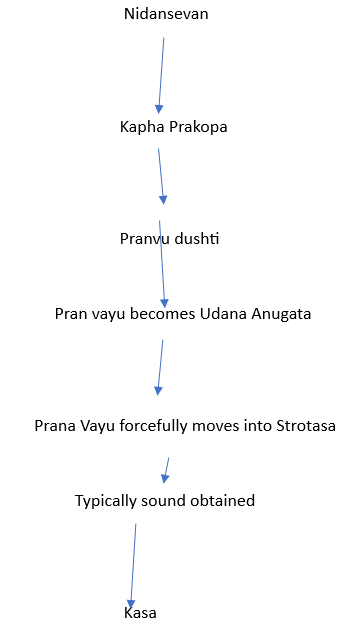
Samprapti Ghataka (Pathological Factors):
Dosha: Vata + Kapha
Dushya: Rasa, Anna
Srotas: Rasavaha, Pranavaha
Srotodusti Lakshana: Sanga
Adhisthana: Ama, Pakwashaya, Pranavaha Srotas, Ura–Kantha
Swabhava: Ashukari
Sadhya–Asadhyata: Naveen – Sadhya; Jirna – Krichchasadhya
Agnidusti: Agnimandya
Purvaroopa (Premonitory Symptoms)
Acharya Charaka 11 mentioned:
• Shooka Poorna Gala Asyata (sensation in throat and mouth)
• Kanthe Kandu (itching in the throat)
• Bhojyanam Avarodha (obstruction to the normal flow of food)
In addition to these Purvaroopa, Acharya Sushruta 12 has mentioned:
• Kantha Kandu
• Bhojanavrodha
• Gala–Talu Lepa (coating in the throat and palate)
• Arochaka (anorexia)
• Swara Vaishmya (hoarseness of voice)
• Agnisada (reduced appetite)
Madhava Nidana mentions Purvaroopa similar to Charaka.13
Types of Kasa (According to Brihatrayee and Laghutrayee):
Kshaja Kasa and Kshtaja Kasa are produced by the aggravation of all three Doshas.
Roopa (Symptoms) 14,15
|
Vataja Kasa |
Pittaja Kasa |
Kaphaja Kasa |
|
Hridayashool |
Mukha-kantha Shushka |
Nishthivateghanam kapha |
|
Murdhashool |
Jwara |
Kanthe kandu |
|
Parshwahool |
Aruchi |
Utklesh |
|
Udarshool |
Chardi |
Peenasa |
|
Shankhashool |
Urovidaha |
Murdhashool |
|
Kasatishushkamev |
Pandu |
Mandagni |
|
Prasektvegastu |
Pitta nishthivana |
Guruta |
|
Bhinnaswara |
Triahna |
Vamana |
|
Ksheen bala |
Bhrama |
|
Upashaya and Anupashaya:
Upashaya (Relieving Factors) and Anupashaya (Non-Relieving Factors):
Upashaya and Anupashaya assist in the diagnosis of diseases 16 Although classical texts do not explicitly mention these for Kasa, they can be inferred from the etiology of each type:
Vataja Kasa:
• Anupashaya: Ruksha (dry), Sheeta (cold), and Laghu (light) foods, lifestyle, and medications
• Upashaya: Snigdha (unctuous), Ushna (warm), and Guru (heavy) regimens
Pittaja Kasa:
• Anupashaya: Snigdha (unctuous), Ushna (warm), and Laghu (light) foods and lifestyle
• Upashaya: Ruksha (dry), Sheeta (cold), and Guru (heavy) measures
Kaphaja Kasa:
• Anupashaya: Snigdha (unctuous), Sheeta (cold), and Guru (heavy) regimens
• Upashaya: Ruksha (dry), Ushna (warm), and Laghu (light) interventions
Updrava:
In Ayurveda, untreated or poorly managed Kasa may act as a Nidanarthakara Roga 17, leading to further diseases. Acharya Charaka 18 states that persistent cough can cause Kshaya (tissue depletion). Ashtang hridaya and Sangraha 19,20 describe that neglected Kasa may progress to Shwasa (dyspnea), Chardi (vomiting), Swarabheda (hoarseness), and reduced Varna, Ojas, Bala, and Mamsa Dhatu. Bhavaprakasha 21 additionally mentions Jwara (fever), Arochaka (anorexia), dyspnea, hoarseness, and tissue depletion as possible complications. These highlight the need for early treatment to prevent secondary disorders and progressive tissue deterioration.
Sadhya–Asadhyata:
In Ayurveda, Sadhya denotes curable diseases, while Asadhya refers to those difficult or impossible to cure. Acharya Charaka 22 states that most Doshaja Kasa are Sadhya, as they arise from a single Dosha. However, in elderly individuals, Kasa becomes Yapya, meaning partially manageable give temporary relief with frequent relapses.
Chronic or untreated Doshaja Kasa may progress to Kshataja Kasa, marked by structural and functional lung damage. Patients may develop recurrent fever, Oja Kshaya, weight loss, blood-stained sputum, anorexia, emaciation, and complications like bronchial obstruction. Advanced stages show fibrosis, calcification, or consolidation, indicating Asadhya status.
Management at this stage focuses on supportive care through Madhura, Bruhmana, and Rasayana therapies, such as Makardwaja, Abhraka Bhasma, Rajata Bhasma, and nutritive formulations like Vidharyadi Ghrita. Progression to Kshayaja Kasa represents the terminal phase with extensive tissue loss and severe lung compromise, where prognosis remains extremely poor despite Rasayana and Jeevaneeya measures.
Pathya-Apathya 23
|
|
Pathya |
Apathya |
||
|
|
Aahara |
Vihara |
Aahara |
Vihara |
|
Vataja kasa |
Shalu Goduma Amla |
Snaihika Dhumpana |
Laghu Ruksha sheeta Katu Tikta Kashaya rasa |
Vegavidharana Sheeta jala Ativyayama |
|
Pittaja kasa |
Ghrita Pippali Godhuma |
Virechna |
Ushna Vidahi katu anna |
Ushme kale Aatapsevana |
|
Kaphaja kada |
Ushnodaka Madhu Laghu anna |
Swedana |
Guru Snigdha Madhura anna |
Diwaswapa Asyasukama |
Investigation:
Laboratory investigations help the physician confirm the diagnosis, though much can be diagnosed based on the clinical signs and symptoms.
5.Bronchoscope or laryngoscope may be used to inspect the interior of bronchi and larynx when a physician cannot come to a conclusion with radiograph.
Chikitsa Sidhanta:24
General Approach
In Kasa, treatment focuses on restoring the normal downward flow of Apana Vata, which reverses into Udana Vata during pathogenesis. Vatanulomana using Haritaki, Agastya Haritaki Leha, or warm water with ginger is essential. Local Abhyanga with medicated oils and Srotoshodhana herbs like Shunthi and Maricha help regulate Vata. Vatanulomana and Strotas shodhana significantly reduce cough intensity across all types of Kasa.
Vataja Kasa Chikitsa:
Dry, irritating cough with chest/flank pain, dryness of mucosa, and restlessness.
Management Principle 25: Vata Shamana + Vatanulomana
Internal Therapy
• Madhura Rasa drugs (e.g.Yashtimadhiu) to pacify Vata
• Warm preparations and Ushna Jala for Vata normalization
• Milk with Haridra for nourishment and Vata pacification
• Mild antitussives (Bharangi, Vasa, Vibhitaki, Tagara, Gojihwa, Shati)
External Therapy
• Local Abhyanga with Tila Taila or Saidhava Taila
• Pata Swedana over chest and neck to reduce mucosal irritation
• Use of soothing aromatics like Ela
Associated Doshic States
• Vata-Pitta: Use Rasna Ghrita
• Vata-Kapha: Use Chitrakadi Leha, Agastya Haritaki Leha, or Kantakari Avaleha
Pittaja Kasa Chikitsa:
Pittaja Kasa occurs when Vataja Kasa is poorly managed or immunity is low, leading to mucosal irritation and inflammation. Symptoms include fever or feverishness, burning in the respiratory tract, bitter taste, persistent cough (3–4 days), and thick, foul-smelling sputum.
Management Principles:
Specific Presentations 27:
• Pitta + Bahu Kapha: Thick, copious sputum → use Pramathi & Kapha-shodhana herbs (Yastimadhu, Vacha).
• Pitta + Tanu Kapha: Mild sputum → use Tikta Rasa drugs for Pitta pacification.
Kaphaja Kasa Chikitsa:
Kaphaja Kasa often follows unmanaged Pittaja Kasa and resembles bronchitis. It presents with loss of appetite, heaviness, sweet taste, thick sweet sputum, and Kaphapoorna Deha. Chronicity is aggravated by low immunity, faulty diet, and allergens,Khavaigunya,Doshika vishishta exposure.28
Management Principles:
Targeted Therapy:32
This approach reduces sputum, controls hypersensitivity, and restores respiratory function.
DISCUSSION:
Diagnosing Kasa is challenging because it can present either as a primary disease Or as a Upadrava of other conditions. Accurate diagnosis requires understanding its Nidana, Purva Roopa , Roopa , Samprapti , and Samprapti Ghataka, with special focus on the involved Dosha and Dushya.As noted by Charaka, Kasa is a potential Nidanarthakara Vyadhi, capable of progressing to Kshaya. In its acute Stage, it is generally curable through avoidance of causative factors.and adherence to Pathya . If neglected, it may become chronic, leading to sequential depletion of Dhatus—beginning with Rasa , followed by Rakta, Mamsa , and ultimately affecting all bodily tissues. Early dietary modifications, proper lifestyle, and adherence to Pathya while avoiding Apathya can prevent disease progression and improve prognosis.
CONCLUSION:
Identification of the stage and the specific dosha involvement in Kasa is essential for effective management. Early intervention through appropriate dietary and lifestyle modification specifically by adopting pathya and avoiding apathya regimen can cure or prevent complications in Kasa. Classical principles tailored to the doshik type must be applied rigorously, and medicines should be customized as per the patient’s condition and physician’s judgment. Timely management is crucial, as neglect may result in chronic, difficult-to-treat disease with poor prognosis
REFERENCES

Dr. Gitanjali Pawar*, Dr. P. K. Dash, A Comprenhsive Review on Doshika Kasa and its Ayurvedic Management in Children, Int. J. of Pharm. Sci., 2025, Vol 3, Issue 11, 3197-3205 https://doi.org/10.5281/zenodo.17667608
 10.5281/zenodo.17667608