
TMV’s Lokmanya Tilak Institute of Pharmacy, Kharghar, Navi Mumbai, Maharashtra.
The emergence of the global opioid crisis as a severe public health emergency has greatly affected morbidity, mortality, and healthcare systems linked with it. Just as alarming are the overdose death rates being reported in the USA-72,000 in 2021 alone. (Woldemariam Y. et al, 2021) Nevertheless, the opioid misuse is on the rise in Europe, Asia, and parts of Africa. Urban misuse of heroin, tramadol, and prescription opioids is rising in India and sub-Saharan Africa because of weak regulatory frameworks and poor oversight of pharmacies. As in most countries, pharmacists are accessible healthcare providers carrying the major responsibility in combating the problem of opioid misuse via patient education, monitoring prescriptions, and harm-reducing interventions. (Choi NG. et al, 2024) This narrative review analyses global research undertaken between 2000 and 2025 to assess the role of community pharmacists in prescribing and dispensing of opioids, emphasize regulatory compliance, patient safety, and inter-professional collaboration. Evidence highlights common barriers across countries including lack of training, poor enforcement, pressure from corporate entities, and limited privacy offered to patient counseling. This review suggests integrated policy reform, providing an avenue for the empowerment of pharmacists through education and clarity in law, and expansion of pharmacist-led interventions, such as naloxone, digital screening tools, and opioid safety education. (Bratberg JP., 2017) Ultimately, coordinated global efforts are essential in enhancing the ability of community pharmacists to tackle the multifaceted opioid epidemic and promote safer use of controlled substances.
The global opioid crisis has developed into one of the most pressing public health emergencies of the 21st century, with the aftermath echoing through morbidity, mortality, and health care systems across the globe. Among other things, the epidemic is characterized by growing misuse of prescription and illicit opioids—namely heroin, fentanyl, and tramadol—largely enabled by overprescribing, inadequate education of patients, and poor disposal practices. In the United States alone, opioid overdoses accounted for over seventy thousand deaths in 2021, and increasingly, such patterns of misuse are being observed in Europe and Asia. In India, while the intensity of the epidemic remains lower than in the West, growing dependence on heroin and tramadol among, especially urban, populations points to a rising threat needing immediate preventive intervention. Because of their accessibility, pharmacists are uniquely placed among health professionals to act as intermediaries for the mitigation of this disease through education, prescription monitoring, and harm-reduction programs. (Woldemariam Y. et al, 2021) Misuse of prescription opioids among older adults is a growing concern as this population often manages multiple chronic conditions requiring pain relief. Age-related declines in organ function and widespread polypharmacy increase susceptibility to adverse drug interactions, overdose, and hospitalization. Studies show rising rates of opioid-related poisonings and serious medical outcomes in adults aged 50 and older. Addressing opioid misuse in this group is vital to improving safety and healthcare outcomes. (Choi NG. et al, 2024) Misuse of opioids has disproportionately affected rural and underserved communities that have limited access to addiction treatment and mental health services. (Bratberg JP., 2017) In rural areas, substantial barriers exist in terms of longer distances to services, greater costs of treatment, and the insufficient number of health workers, putting additional pressure on already burdened populations suffering from opioid dependence. (Piper BJ. et al, 2016) These areas see community pharmacies play key roles in providing access to healthcare and often serve as the only formal source of professional medical advice and medication supply. (Quest TL. et al, 2012) Previous studies have established that patients are more successful in achieving health-related goals when a pharmacist guides them through education and structured interventions. Pharmacist-led goal setting and counseling in community pharmacies may assist patients in reducing opioid misuse and improving medication safety. (Cook HE. et al, 2024) Hence, pharmacists have known to extend their role beyond dispensing to include community interventions, like opioid safety counseling, medication take-back programs, and naloxone distribution. (Strand MA. et al, 2016) A greater empowerment of pharmacists to independently dispense naloxone and give clinical support in services for treating persons with opioid addiction signals a wider paradigm shift towards interventions supported by public health pharmacists. (United States., 2000) Nevertheless, active hindrance has still been posed through attitudinal gaps in training, workforce growth, and policy enhancement to realize fully this ability. (Carpenter JE. et al, 2016) Many studies reveal that, despite acknowledging the necessity of their involvement in opioid stewardship, pharmacists have poor compliance to pharmaceutical law regarding dispensing in certain regions. In some areas of Africa and Asia, duly noted is a trend in private pharmacy establishments distributing highly potent narcotics without a prescribed order of either pethidine or morphine. This act is being marketed as a serious attempt to better patient welfare while allowing encroachment into the realm of law. However, this is a symptom of such widespread structural inadequacies as lack of enforcement, lack of inspection, and lack of education of dispensing agents about narcotic control regulations. The absence of harm-reduction measures such as naloxone in the majority of retail pharmacies represents another public health challenge and demonstrates the urgent need for structured pharmacy training engrossed in these issues, along with regulatory audits. To better curb opioid abuse and firm up healthcare governance, it would be equally important to promote adherence to the controlled drug regulations, keep accurate records, and develop stronger accountability in the pharmacy sector. (Teddlie C, Yu F., 2007) (Rai A., 2025) With the implicit intention to describe the various aspects therein, these pieces of evidence assert that this is a global disaster concerning opioids and that pharmacists must be at its forefront. With the right education and policy framework, and harm-reduction approaches embedded in community pharmacy practice, pharmacists have a chance to significantly ameliorate opioid-related morbidity and mortality. Embracing regulatory reform, public health collaboration, and community engagement will facilitate the foundation of an effective and sustainable response addressing the global opioid epidemic. (Prabhu R. et al, 2019) (Kruzich DJ. et al, 2021)
METHODOLOGY :
Design and Justification of the Study
The present paper has been structured as a narrative review because opioid misuse encompasses a broad range of issues, from the attitudes of pharmacists and behaviour such as dispensing to the regulatory frameworks that influence patients. Due to the heterogeneity between different healthcare systems and research designs all around the world, it was found that synthesis by the means of a narrative review fit better than systematic application for creating evidence subtitles in differing contexts.
Data Sources
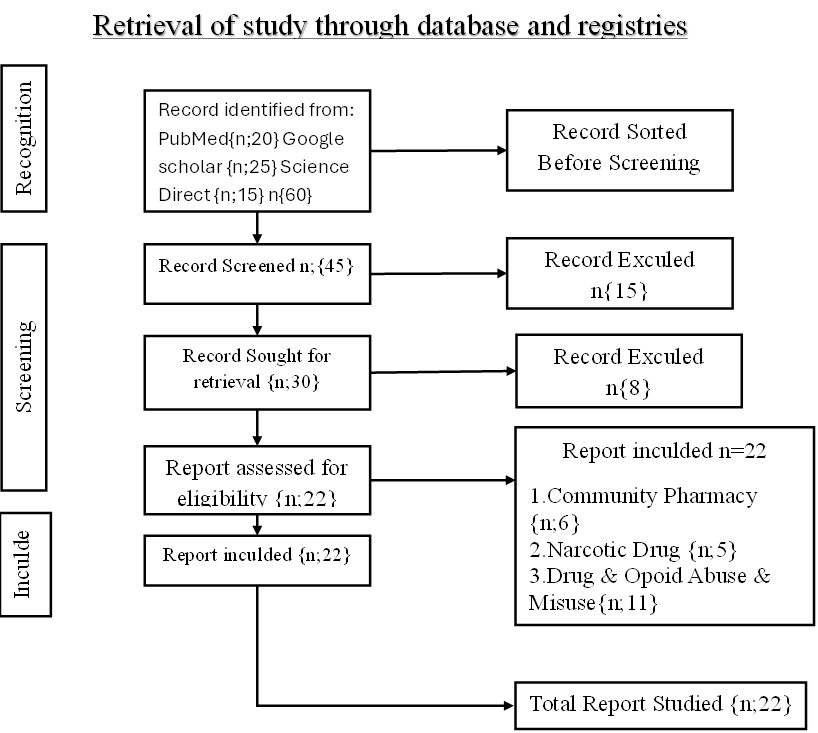
This information was Retrieved from PubMed, Google Scholar, ScienceDirect and the OIDA Archive. These databases include both peer-reviewed studies and industry documentation. Other reference materials include policy papers, national guidelines, as well as international references such as WHO guidelines on opioids stewardship and the U.S. DEA regulations.
Search Strategy
Search was conducted using keywords and Boolean combinations like opioid misuse, opioid dispensing, community pharmacy, pharmacist role, opioid regulations, opioid safety, and opioid harm reduction. The timeframe of the included literature was from 2000 to 2025 to capture the modern-day challenges of opioid misuse during the past two decades.
Inclusion and Exclusion Criteria
Studies were included if they: Study focus: opioid misuse, prevention, or safety outcomes within community pharmacy settings; dispensing practices; pharmacist knowledge/attitudes; patient interventions Regulatory compliance or misuse prevention strategy Articles published in English Exclusions apply to studies that were only conducted in a hospital or inpatient setting; anything specific to non-opioid medications; and studies that were methodologically or contextually unclear.
Data Extraction and Organization
Data extracted were brought into two levels: Regional clustering (e.g., North America, Europe, Asia, Middle East, Africa), and Thematic domains, such as pharmacist knowledge/attitudes, practices in dispensing opioids, regulatory adherence, harm reduction interventional strategies. This dual framework will also bring out how variations coexist in the community pharmacy approach to opioid misuse while ensuring comparability across the globe.
Validation against Policy Contexts
Achieved by cross-referencing the evidence derived from research studies to those opioid policies and regulations such as U.S. Controlled Substances Act, India's NDPS Act, and Saudi narcotics control laws. This was also the validation of findings beyond academic discussions to actual governance.
Analytical Approach
An interpretive synthesis was executed, where similarities and differences were compared among countries. This process demonstrated how different pharmacy systems counter the challenges of opioid misuse, and where gaps remain in community-level prevention and intervention.
Overall Trends Across Studies
Across these studies, however, one consistent pattern is that community pharmacists play an important part in the detection of and preventing the misuse of opioids; however, several problems such as limited in-service training, lack of standardized tools, regulatory gaps, and especially time or privacy constraints during patient counselling affect their performance. Surveys and interviews from different countries also reveal the existence of inappropriate prescriptions, early refill requests, and signs of misuse for such patients, while systemic factors such as weak monitoring system, corporate pressures, and inconsistent enforcement counteract effective intervention. Structured interventions, such as screening tools, brief motivational counselling, prescription monitoring programs, and education initiatives, would enhance pharmacists' capacity in managing the problem of opioid misuse. Findings show that these barriers exist in both urban and rural settings, but rural areas may generally experience more barriers stemming from limited access to treatment facilities. These studies in general portray that despite the good position of pharmacists in influencing opioid safety, coordinated training, policy reform, and patient-centred strategies are needed to optimize this.
METHODS AND DISCUSSION
The cross-sectional study conducted in different cities across Saudi Arabia ran for the six months between May and October 2023. A total of 226 pharmacists participated in the study. They reported that they use counselling, restrictions on products, and referrals for opioid misuse prevention. However, the training provided to them on addiction management was rather limited. Many were insufficiently confident to handle suspected misuse cases. The knowledge gaps were observed in regulatory compliance and appropriation of those medicines with opioids; hence, there is an urgent need to develop structured educational programs and national prescription monitoring systems to ensure safe dispensing practices. (Alomi YA. et al, 2018) Like-wise, Koch et al. (2022) used CFIR in depth to conduct one qualitative study of in-depth interviews with both patients and pharmacists in one Midwestern state in the USA. Patient data had been analysed using inductive method and showed preference towards stigma-free confidential education and support, while pharmacists' data analysed through template analysis revealed barriers-they include inadequate training, limited resources, and workflow. All patients and pharmacists highly supported screening of opioid misuse and distribution of naloxone as well as advocated flexible patient-centred interventions, including tailored educational materials and workflow-integrated tools with continuous training sessions for pharmacists to enhance individuals' safety with opioids and to engage them with the patient. (Woldemariam Y. et al, 2021) In India, the 2022 survey assessed how knowledgeable, what attitudes, and which practices community pharmacists have regarding opioid abuse prevention. Even though pharmacists agree with the fact of the threats posed by opioid misuse, considerable lack of awareness is about the existing narcotic regulations, the dispensing of narcotics, and the early detection of misuse behaviours. The study highlighted the need for continuing educational programs, compliance with legal principles, and national prescription monitoring systems, in which regulatory authorities, professional bodies, and community pharmacies can cooperate in formulating standardized safe procedures for opioid dispensing and patient counselling. (Matheson C. et al, 2019)
In 2021 there was conducted a multicentre cross-sectional survey among various cities of Saudi Arabia that involved 226 pharmacists, using REDCap questionnaires. They also revealed that they could adopt measures such as hiding high-risk products and limiting sales to prevent misuse; however, for the most part, formal training in addiction had been entirely lacking as well as their capacity to identify and manage potential cases of opioid misuse effectively. This calls for the introduction of prescription monitoring systems and reforms in pharmacy curricula to enhance pharmacists' competence and awareness concerning safe dispensing practices . (Rai A., 2025) That same year, a study in Tennessee, USA, questioned 2,302 pharmacists through mailed questionnaire patient case scenarios asking about preventive practices. According to the results, risk assessments and naloxone counselling were infrequently performed and barriers included stigma related to opioid use, corporate pressures within pharmacy chains, and lack of privacy during patient interactions. All these things brought out the need for more comprehensive training programs, clear guidance on the law, and supportive frameworks for pharmacists to give safe and effective care to patients. (Cochran G. et al, 2020) Similarly, a 2021 study in Bengaluru, India, using cross-sectional surveys and direct observation of dispensing practices, showed that opioids and NRX drugs were mostly dispensed without proper prescriptions. Weak regulatory enforcement and commercial motivation were singled out as the main stimulants behind this kind of practice, stressing the urgent need for much more stringent regulation scrutiny, common dispensing protocols, and increased accountability for future safe use of controlled medicines. (Elfituri AA. et al, 2021) All together, such research represents the global highlights of community pharmacists' challenges in the management of opioid- and NRX-associated drugs with common gap areas in training, regulatory compliance, and patient safety interventions.
The study in Mangalore, India, in 2020 was a cross-sectional survey that examined the role of pharmacists in preventing opioid misuse. Although, in general, pharmacists were aware of the risks associated with opioid misuse, the lack of formal training, insufficient awareness of regulatory compliance, and the absence of effective monitoring systems sometimes impeded their interventions. These limitations inhibited pharmacists from performing consistent counselling or preventive interventions whereby there exists a very pronounced dichotomy between knowledge and practice affecting opioid safety. (Prabhu R. et al, 2019) That same year a cross-sectional study in Saudi Arabia's Eastern Province adopted purposive sampling (n=101) whereby data using online and face-to-face questionnaires were collected from pharmacists on their practice and perception. Active patient counselling was performed by some pharmacists; however, serious impediments such as time constraints, lack of privacy for confidential discussions, and absence of standardized protocols for either opioid or codeine-containing medications existed. This opinion was for stricter regulation of codeine dispensing and more structured guidance and institutional support toward pharmacy practice for safer dispensing. (Al-Arifi MN. et al, 2020) The other sociological study conducted in Ethiopia with simulated client visits focused on the dispensing practices regarding narcotics and psychotropic substances within community pharmacies in 2020. The results obtained indicated recurrent violations of rules that included the dispensing of controlled substances without the authority to do so, asserting altogether that the system of checks is not only poorly coordinated but also, in execution, is not very consistent. This calls for an elaborate mechanism for monitoring checks, followed by avenues for enforcement of the legal framework and educational interventions directed toward building the capacity of the pharmacists in the area of prevention of drug misuses while ensuring safety for patients. (Woldemariam Y. et al, 2021) The above-mentioned studies highlight continuous challenges encountered by pharmacists around different countries, including gaps in knowledge and training, regulatory compliance, and practical implementation of preventive measures. This highlights the need for coordinated effort in reforming education, policies, and stricter regulatory enforcement to effectively ensure responsible dispensing practices and reduce the risk for opioid and psychotropic drug misuse at the global level.
A descriptive cross-sectional study was conducted in Riyadh, Saudi Arabia, in 2019 using a validated questionnaire of 25 items completed by 350 pharmacists to evaluate their practices and perspectives on opioid dispensing. The study demonstrated that most of the respondents had no formal training in managing opioids. Further, a considerable number of respondents admitted that they dispense opiates without prescriptions preferring weak regulations and absence of a strict monitoring mechanism. Despite these challenges, the majority of pharmacists were aware that opioids could be misused, hence endorsing the necessity for more educational programs and stringent regulation alongside planned interventions to avoid inappropriate dispensing. (Aljhani S. et al, 2020) The study further pointed out barriers to efficient practice: resources, training, and incentives were lacking so that pharmacists could intervene actively in circumstances of possible misuse, while workflow pressures, stigma for the category of handling controlled substances, and limited referral pathways further imposed restrictions on their application. To address these deficiencies, the study recommended developing structured referral pathways while promoting interprofessional collaboration between pharmacists and physicians and other health-care providers and implementing broad training initiatives to enhance the capacity of pharmacists to detect and deal with misuse. (Kim HS. et al, 2019) The Quebec Canada complementary study conducted in 2016 held an online survey using a 40-item validated questionnaire to obtain the behaviors of pharmacists, the challenges in prescribing, and those with physicians. Pharmacists reported that they had most problems deciphering the accuracy of prescriptions owing to the incomplete or unclear information prescribers had given. These, in turn, contact gaps in communication between healthcare professionals but do not only affect pharmacists because it does not guarantee good dispensing but raises safety for patients and misuse in respect to opioid. It was emphasized that establishing good communication channels between prescribers and pharmacists, alongside offering clarifying guidelines and decision-support tools, will help empower pharmacists to effect better risk assessments and interventions. (Woldemariam Y. et al, 2021) Overall, these studies depict a global pattern of challenges faced by pharmacists in managing opioid dispensing-from knowledge to training to regulatory enforcement, workflow pressures, and interprofessional collaboration. They underscore the pressing need for different interventions: formal education, monitoring and regulatory frameworks, referral systems, and better communication between healthcare professionals. Such efforts can enhance proactive and effective pharmacists' role in preventing opioid misuse and practice safe and responsible dispensing in different healthcare contexts.
In Wisconsin, USA, in 2015, a study was undertaken examining county-level opioid overdose deaths using ICD-10 codes. The overdose deaths were mapped using ArcGIS and analysed in Stata to detect patterns and possible risk factors. The results showed that overdose deaths were disproportionately higher in rural areas, where access to addiction treatment and support services was limited. The study argued that community pharmacies have the potential to be important access points for addiction prevention and treatment; however, a range of barriers to this--not limited to restrictive legislation, lack of reimbursement for pharmacy-based interventions, and limited training of pharmacy staff--render such access less effective in contributing to opioid misuse prevention. (Teddlie C, Yu F., 2007) Complementary to the findings, a retrospective content analysis in an observational study format was performed on 630 selected internal Walgreens documents from the Opioid Industry Documents Archive (OIDA) for the years 1997-2020 in the USA. The analysis found that corporate priorities, including sales targets, combined with a lack of independence among its pharmacists and influenced by pharmaceutical marketing, have all played a significant role even after policy changes, making for unsafe dispensing practice of opioids. Various reforms were recommended to lessen risk and promote safe dispensing in community pharmacies, including removal of opioids from sales targets, increased independence for pharmacists, and enhanced corporate accountability. (Davis CS,. et al, 2023)
CONCLUSION:
The information in this paper includes global evidence which indicates that community pharmacists play a crucial role as stakeholders in counteracting the ever-increasing epidemic of the opioid crisis. The entire spectrum of international healthcare systems-from the United States and Canada to Saudi Arabia, India, and Ethiopia-pharmacists serve as the best gateway for patients regarding safety, education, and harm reduction in opioids. The unique position of these individuals within community settings enables them to recognize early indicators of abuse within an encounter, dispense prudently, and educate patients on the safer use of opioids. However, the full potential of pharmacists in opioid stewardship is stunted by a uniform set of obstacles: insufficient training on addiction management, limited access to monitoring systems for prescriptions, weak regulatory enforcement, poor communication channels with prescribers, and, in some settings, commercial interests that supersede ethical practice. Synthesis from such studies reveals a critical disparity between desired awareness levels for pharmacists concerning opioid misuse risks and the capability to execute action in most cases as a standard preventive measure. Such kinds of deficiencies are much more rampant in rural and underserved areas, where pharmacies may actually be the only health facility in reach, but are not sufficiently equipped to address problems related to opioids. The variation in the national narcotic laws and their implementation also further creates inconsistencies in practices as well as weakening accountability. Such systemic weaknesses thus call for a coordinated evidence-based plan to empower pharmacists with continuous education, standardized dispensing protocols, and increased regulatory oversight. In fact, integration of pharmacists into national and global opioid response frameworks is needed urgently now. Health systems should prioritize capacity building and technology integration, especially electronic prescription monitoring, and collaboration between healthcare professions for pharmacists, physicians, and policymakers. Empowering community pharmacies by allowing pharmacists to screen patients, provide brief interventions, and dispending naloxone independently will turn the establishments into effective community health centers for the reduction of opioid-related problems. Ultimately, the review presents the picture that, when put in place, community pharmacists can play a vital role as change agents in reducing the morbidity and mortality associated with opioid misuse. Through integration of opioid stewardship into pharmacy practice, alignment of regulatory systems, and creating a culture of accountability and collaboration-facilitate health systems across the world in attaining safer, sustainable opioid use. Strengthening pharmacist roles is not an added element but actually an urgent public health challenge in terms of the global response to the opioid epidemic.
REFERENCES






Anju K R, Nikita Yadav, Bhavesh Choudhary, Sanjiv Vishwakarma, Shruti Palaskar, Dr. Shrutika Patil, A Narrative Review on The Role of Community Pharmacists in Opioid Misuse Prevention: Global Perspectives and Policy Implications, Int. J. of Pharm. Sci., 2026, Vol 4, Issue 3, 35-44. https://doi.org/10.5281/zenodo.18839265
 10.5281/zenodo.18839265
