
1 Shri Prakashchand Jain College of Pharmacy and Research, Palaskheda (Bk), Jamner, Jalgaon, Maharashtra, India 424206
2 The Jamner Taluka Education Society's Shree Suresh Dada Jain Institute of Pharmaceutical Education and Research College, Jamner, Jalgaon, Maharashtra, India 424206
The human eye is like a camera. The highest resolution of the photograph that we can see is provided by Macula. The use of bionic eyes for artificial vision is currently appropriate. Nowadays, technology has advanced to the point where a single electronic chip can control every part of the human body. To address these issues, a new biomedical technology was developed, and research is currently underway to help blind people see. The visual prosthesis, often known as a bio-electronic eye or bionic eye, is an experimental visual aid designed to help people who are partially or completely blind regain functional vision. In order to provide these patients with vision, the gadget uses the remaining retinal tissue instead of the malfunctioning portion. Bionic implants, such as cochlear and retinal implants, are one area where computer-related image processing technology has a lot of potential for the future. In an effort to help individuals with certain disorders regain meaningful vision, retinal implants are being developed all around the world. A developing device called the Bionic Eye seeks to help people with various eye diseases see better such as retinitis pigmentosa (RP) and age-related macular degeneration (AMD).There are glasses available for the millions among us whose vision isn't flawless. However, for the hundreds of thousands of blind people, tools that only help the eyes are insufficient. Instead, they require other pathways that allow the world's sights to reach their eyes and be interpreted. Numerous avenues for human progress have been made possible by technology. Prosthetics have been used to assist people in overcome disabilities. A person with this type of sickness loses vision power as a result of the photoreceptor cells degenerating and damaging the retina. Therefore, by restoring vision, the bionic eye performs a crucial role. The creation of bionic eyes gives blind people hope. They can see more clearly thanks to this technology.
As engineers, we are able to overcome any obstacle. If scientists generate ideas, we engineers are the ones who bring those ideas to life. Today, we discuss artificial intelligence, which has sparked a surge of interest in robotics. Because of the bioelectronic bond, Bionic Eye. With this technology, their blind eyes can come to life. Nerves that are stimulated by electrical impulses cause the bionic eye to weaken. Although it's still in its very early stages of development, if it works, it could help people who have lost their sight in their lifetime. Many cells are excited when light falls, which aids in the brain's ability to perceive images. It's a dark world for blind people. Those who are here hope to see at least a glimmer of hope. Artificial vision may be possible once this has been made possible. An electronic device that replaces the functionality of a portion or the entire eye is known as a "bionic eye" or "bioelectronic eye". Though Jameson didn't suffer from that condition, the fungal damage to his eye was similar, making him an ideal candidate for the eye surgery.[1] The current population of blind people is 285 million and with the brod for eye donors increasing, the actual amount of people willing to donate is much less.[2] While the first generation of implant contained 16 electrudes laid out in array, the Argus is meant to contain 60 electrodes, which would further help in branding higher resolution images.[3] 200 years ago, there was no solution to this problem. After that many solutions came like eye implantation, cornea transplantation, but it is mainly for the disorders like cataract and glaucoma.[4] The word Bionic Eye is used to refer to an electronic device enabling the re-establishment of lost vision due to problems in the visual pathway i.e., it is a mixture of physics (electronics in specific) and physiology of vision in right proportions to form a miracle.[5] The Macula is the central and most sensitive area. The function of macula is to collect the information or images received at the center of the field of vision and all those information is send to the optic nerve to the brain.[6] The retina's job is to collect the light that the lens has focused, transform it inte neural signals, and convey those signals to the brain for visual identification.[7] Eye diseases may have an impact on our entire way of life because the eye constitutes the most sensitive portion of our body. The external world is visible through the eyes.[8] Blindness means loss of vision, Rods and Cones, millions of then are in the back of every healthy.[9]
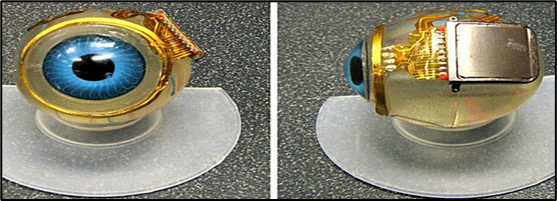
Fig. 1 Bionic Eye[10]
1.1 What is Blindness?
The absence of vision is called blindness. A loss of vision that cannot be restored with glasses or contact lenses may also be referred to by this term. When you are partially blind, your vision is severely impaired. When you are completely blind, you are unable to see anything, including light. The term "blindness" is typically used to refer to total blindness.
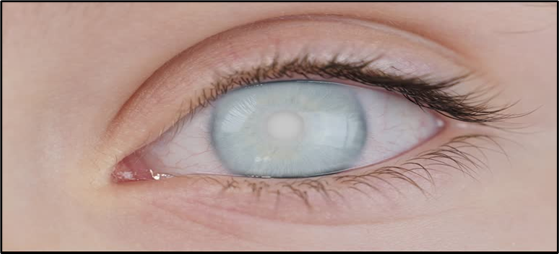
Fig. 2 Blindness Eye[11]
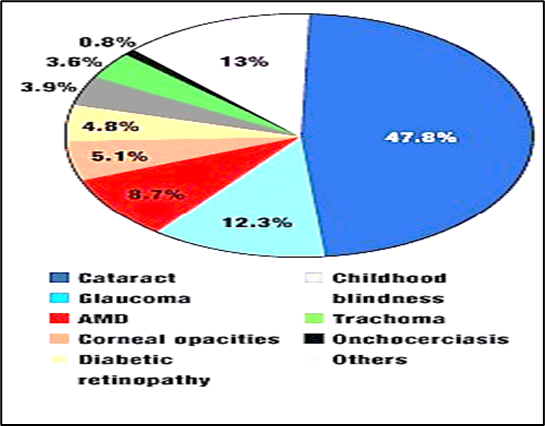
Fig. 3 Reasons of Blindness
1. Age-related macular degeneration (AMD):
One of the most common causes of blindness is age-related macular degeneration (AMD), which impacts around 11 million people in the USA.[12]
2. Glaucoma:
Glaucoma is another leading cause of blindness and is caused by an increase in pressure in the eye. This pressure can damage the optic nerve, which carries signals from the eye to the brain. [12]
3. Cataract:
A cataract is a clouding of the eye’s lens, which can affect your vision. In normal eyes, the light passes through the lens to the retina which then transforms into the image. Whereas in the case of cataracts, the lens loses transparency, which is why the light is blocked and the image gets distorted. [12]
4. Trachoma:
Trachoma is one of the leading causes of blindness worldwide. It is an eye infection caused by the bacteria named Bacterium Chlamydia Trachomatis and can make the inner surface of the eyelids rough. [12]
5. Diabetic Retinopathy:
Diabetic retinopathy is a debilitating eye condition that can lead to blindness. It causes vision loss in people with diabetes. Diabetic retinopathy is caused by damage to the blood vessels in the retina, the light-sensitive layer of tissue at the back of the eye. [12]
6. Uncorrected refractive errors:
Uncorrected refractive errors are a leading cause of visual impairment and blindness worldwide. The four most common types of refractive errors are myopia (nearsightedness), hyperopia (farsightedness), astigmatism, and presbyopia. [12]
7. Corneal opacity:
Corneal opacity is a condition in which the clear, front surface of the eye becomes cloudy or opaque. It can occur in one or both eyes and can range from mild to severe. [12]
1.2 Treatment and Prevention of blindness:
1. Medication:
Some forms of blindness caused by infections are treated with anti-infective medications. [13]
2. Surgery:
Cataracts can usually be successfully treated with surgery.
Transplant of the cornea: A provider may be able to replace your damaged cornea. [13]
3. Retinal surgery:
A doctor may be able to repair damaged retinal tissue with surgery or a laser. [13]
4. Vitamin supplements:
Taking vitamin A supplements could help stop the blindness that results from xerophthalmia. You may need to take vitamin B or vitamin D supplements to reverse the effects of diet-related vision loss. [13]
5. Bionic eye : Treatment way of blindness.
1.3 Blindness Patient % India & Global:
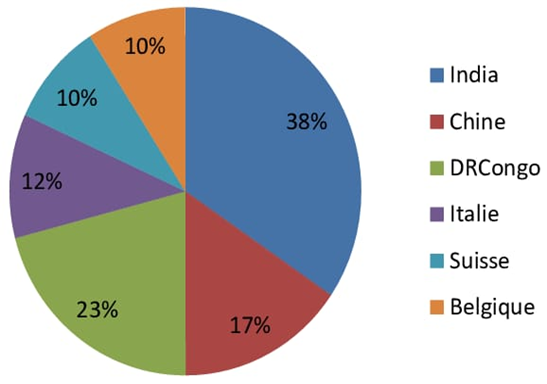
Fig: 4 Blindness Patient % India & Global
2. MATERIALS:
2.1 Parts of Bionic Eye:
1. Camera: A tiny camera that records video signals and is fixed to glasses or headgear.
2. Video Processing Unit (VPU): A tiny computer that generates electrical signals from visual signals.
3. Transmitter: An apparatus that provides the implanted device with electrical impulses.
4. Power Source: The source of power that gives the gadget its power.
5. Control System: A system that manages and modifies the apparatus.
6. Implantable Device: A tiny gadget that is placed in the eye to receive electrical impulses and translate them into visual data.
7. Electrodes: The implanted device's electrodes that provide visual data to the retina.
8. Retina Implant: A device that is positioned on the retina and analyzes and sends visual data to the brain.
9. Software: The program that manages and modifies the apparatus.
10. Sensors: Sensors that provide the gadget information about its surroundings.
2.2 Artificial Retina Prosthesis:
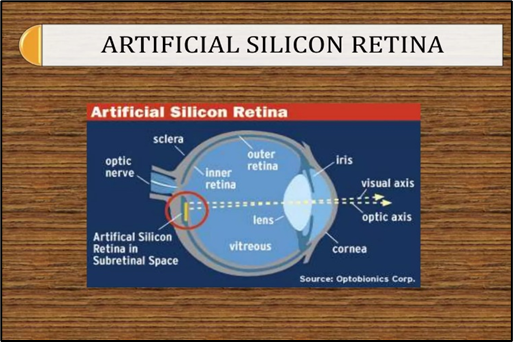
Fig. 5 Artificial Silicon Retina[14]
3. WORKING OF BIONIC EYE:
Electrical impulses trigger nerves, which is how a bionic eye functions. In this instance, the patient has a tiny gadget that can receive radio signals and send them to nerves implanted in their body. The Argus II implant gives implanted people a basic form of sight by attaching an array of electrodes to the retina and using them in combination with an external camera and video processing system. The Argus II Retinal Prosthesis System can provide sight, the detection of light, to people who have gone blind from degenerative eye diseases.[15] The cells at the rear of the retina called photoreceptors are harmed by diseases. These cells detect patterns in light and transmit those patterns to the brain as nerve impulses, which are subsequently converted into images. These photoreceptors are replaced with the Argus II system.
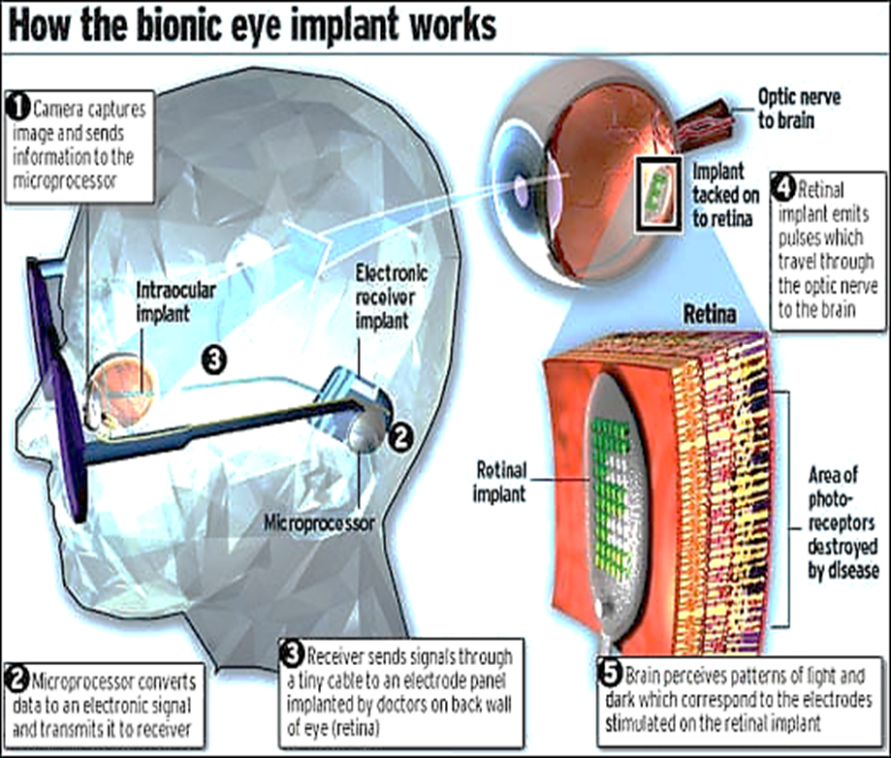
Fig 6:- Working Of Bionic Eye [15]
4. ADVANTAGES OF BIONIC EYE:
5. CONCLUSION:
For those who are blind or visually impaired, the bionic eye has revolutionized their lives. In the future, they are certain that better quality, resolution, and even color will be achievable. The development of bionic devices goes beyond simply replacing broken components. Millions of individuals worldwide will have their lives changed if this system is fully established. Even while they might not be able to completely restore their vision, we can still assist them in reading books, identifying faces, navigating, telling the difference between plates and cups, and, most importantly, living an independent life. The road has been set, even if there are still many obstacles to overcome before this technology is accessible to the average person. A patient who was previously blind has been able to, definitely. A bionic eye may provide a good solution for visionless people.
6. FUTURE ASPECTS:
By Analyze Current Economic Status, Review government policies affecting taxation, social security, and subsidies. Identify potential reforms that could enhance middle-class welfare.
7. ACKNOWLEDGEMENT:
First and foremost, I would like to thank a God for creating so much, so beautiful that one would never get bored exploring things. The creation of bionic eyes is a monument to human creativity and the persistent quest of innovation. This technology has the potential to alter the lives of persons with visual impairments, allowing them a chance to regain their sight and freedom.
REFERENCES

Fakir Raza Shah Firoz Shah, Tarannum Sayyad, A Review Article on Bionic Eye: A New Invention Int. J. of Pharm. Sci., 2026, Vol 4, Issue 1, 1116-1123. https://doi.org/10.5281/zenodo.18213662
 10.5281/zenodo.18213662
