

We use cookies to ensure our website works properly and to personalise your experience. Cookies policy
IVM’s Krishnarao Bhegade Institute of Pharmaceutical Education and Research, Talegaon Dabhade, Pune-410507, Maharashtra, India
Ocimum tenuiflorum L. (Holy basil or Tulsi) is a prominent medicinal plant extensively used in traditional systems of medicine for the management of inflammatory, infectious, metabolic, and stress-related disorders. Contemporary pharmacological investigations have validated many of these traditional applications and revealed a wide spectrum of biological activities attributable to its rich phytochemical composition, including flavonoids, phenolic acids, terpenoids, sterols, and triterpenoids. This review critically synthesizes preclinical evidence on the therapeutic potential of O. tenuiflorum, highlighting its anticancer and chemo preventive effects mediated through antioxidant reinforcement, induction of phase II detoxifying enzymes, immune modulation, and regulation of apoptosis and cell proliferation. The plant also exhibits significant cardioprotective and antihypertensive activities via peripheral vasodilation, prostaglandin modulation, and protection against ischemic myocardial injury. Neuropharmacological studies demonstrate central nervous system depressant, anticonvulsant, antistress, and antidepressant-like effects, while antipyretic and immunomodulatory properties further support its role in inflammatory and infectious conditions. Additionally, O. tenuiflorum shows reversible antifertility effects in male experimental models through disruption of spermatogenesis and hormonal regulation. Collectively, the multitargeted pharmacological actions of Ocimum tenuiflorum underscore its potential as a complementary therapeutic agent in integrative medicine, although further research focusing on standardization, pharmacokinetics, and clinical validation is required to translate these findings into clinical practice.
Ocimum Tenuiflorum L. (syn. Ocimum sanctum L.), commonly known as Holy Basil or Tulsi, is an aromatic medicinal plant belonging to the family Lamiaceae. The plant is widely distributed throughout the Indian subcontinent and cultivated in tropical and subtropical regions of Asia. O. tenuiflorum has been extensively used in traditional systems of medicine, including Ayurveda, Siddha, and Unani, for the treatment of various ailments such as respiratory disorders, inflammatory conditions, metabolic disturbances, and infectious diseases.
Traditional Ayurvedic literature describes O. tenuiflorum as a rasayana plant with adaptogenic and rejuvenating properties. Different parts of the plant, particularly the leaves, are employed in the management of stress-related disorders, cognitive impairment, fever, cough, bronchial asthma, and gastrointestinal disturbances. The long-standing traditional use of O. tenuiflorum has prompted extensive scientific investigations to validate its therapeutic claims and elucidate its pharmacological mechanisms.
Phytochemical analyses of O. tenuiflorum have revealed the presence of a wide range of bioactive constituents, including phenylpropanoids, flavonoids, triterpenoids, and essential oils. Major compounds such as eugenol, ursolic acid, rosmarinic acid, apigenin, luteolin, and β-caryophyllene have been identified and reported to contribute to its pharmacological activities. These phytoconstituents exhibit diverse biological effects, including antioxidant, anti-inflammatory, antimicrobial, immunomodulatory, antidiabetic, and neuroprotective properties.
Recent experimental and clinical studies have demonstrated that O. tenuiflorum possesses significant adaptogenic and nootropic potential, making it relevant in the management of stress-induced cognitive dysfunction and neurodegenerative conditions. The plant has been shown to modulate oxidative stress, inflammatory mediators, neurotransmitter levels, and hypothalamic–pituitary–adrenal (HPA) axis activity, thereby supporting its traditional use in mental health and cognitive enhancement.
Given the growing interest in plant-based therapeutics and the increasing prevalence of chronic and lifestyle-related disorders, O. tenuiflorum has gained considerable attention as a potential source of novel bioactive compounds. The present review aims to compile and critically analyse the available literature on the botanical characteristics, phytochemical composition, and pharmacological activities of O. tenuiflorum, with emphasis on its neuroprotective an adaptogenic effects, in order to provide a scientific basis for its future therapeutic applications.
Taxonomical Classification of Ocimum Tenuiflorum L.
Morphology of Ocimum Tenuiflorum
Ocimum Tenuiflorum L. is a perennial, erect, and branched aromatic herb that typically grows 30–90 cm in height. The stems are quadrangular, slightly purplish, and hairy, becoming woody at the base with age. Leaves are opposite, decussate, ovate to lanceolate, with serrated margins, and are highly aromatic due to essential oils. Inflorescences arise as terminal or axillary spikes, 5–15 cm long, bearing whorls (verticillasters) of small purplish-pink or lilac zygomorphic flowers. The flowers are bilabiate with a tubular calyx, an upper hooded lip, a spreading lower lip, didynamous stamens, and a superior two-locular ovary. The fruit is a schizocarp that splits into four one-seeded nutlets, dark brown at maturity. The plant possesses a moderately deep taproot system with fibrous and branched roots anchoring it firmly. The aromatic nature of leaves and flowers, along with the distinct quadrangular stems and characteristic inflorescence, make O. tenuiflorum easily recognizable among Lamiaceae members.
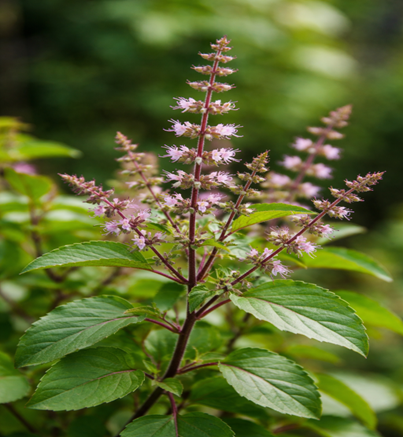
Figure 1. Ocimum Tenuiflorum
Chemical constituents:
Ocimum Tenuiflorum (Holy Basil) is a phytochemically rich plant, containing essential oils, phenolics, flavonoids, and terpenoids that drive its therapeutic effects. Its leaves and flowers yield aromatic oils dominated by eugenol, along with methyl eugenol, caryophyllene, linalool, α-humulene, β-pinene, camphor, and cineole, contributing to antioxidant, anti-inflammatory, antimicrobial, and adaptogenic activities. Key phenolic acids including rosmarinic, caffeic, chlorogenic, and protocatechuic acids enhance neuroprotective and antioxidant effects. Flavonoids such as apigenin, luteolin, orientin, vicenin, and isorientin support anti-inflammatory, antioxidant, and cognitive benefits. Triterpenoids like ursolic acid, oleanolic acid, and β-sitosterol provide anticancer, hepatoprotective, and anti-inflammatory actions. Minor components saponins, tannins, polysaccharides, alkaloids, vitamins, and minerals further enrich its pharmacological and nutritive profile, collectively underpinning Tulsi’s wide-ranging medicinal value.
Biological Activities of Ocimum Tenuiflorum
Ocimum Tenuiflorum L. (syn. Ocimum sanctum), commonly known as Tulsi, is a medicinal plant widely recognized for its potent antioxidant activity. In vitro studies demonstrate strong, concentration-dependent free radical–scavenging effects in standard assays, including DPPH, ABTS, hydroxyl radical, and hydrogen peroxide models. Antioxidant efficacy varies with extraction solvent, with methanolic and other moderately polar extracts showing superior activity, reflecting the presence of phenolic acids, flavonoids, and related phytochemicals. In vivo evidence further supports its protective role against oxidative stress by reducing lipid peroxidation and enhancing endogenous antioxidant enzymes, highlighting its therapeutic relevance in oxidative stress–related disorders.
Ocimum Tenuiflorum L. (Tulsi) exhibits broad-spectrum antimicrobial activity against Gram-positive and Gram-negative bacteria, including Bacillus subtilis, Staphylococcus aureus, Escherichia coli, and Pseudomonas aeruginosa, as well as fungi such as Candida albicans and dermatophytes. Methanolic, ethyl acetate, and essential oil extracts show superior efficacy due to enhanced solubilization of phenolics, flavonoids, and lipophilic constituents. Key phytochemicals, notably eugenol, methyl eugenol, estragole, and ursolic acid, disrupt microbial membranes, inhibit enzymes, induce oxidative stress, and impair biofilm formation. The synergistic action of these compounds targets multiple microbial pathways, reducing resistance risk and supporting O. tenuiflorum as a natural antimicrobial agent.
Ocimum Tenuiflorum L. (Tulsi) is a medicinal plant with notable antidiabetic effects. Research shows that compounds in Tulsi leaves can slow carbohydrate digestion by inhibiting α-amylase and α-glucosidase, helping control post-meal blood sugar. Animal studies further demonstrate that Tulsi lowers fasting and random glucose levels, protects pancreatic β-cells, boosts insulin secretion, and improves tissue insulin sensitivity. Its antioxidant and anti-inflammatory properties reduce oxidative stress, prevent cellular damage, and calm inflammatory responses associated with diabetes. Together, these mechanisms support Tulsi as a natural, complementary therapy for maintaining blood sugar balance and promoting long-term metabolic health.
Ocimum Tenuiflorum L. (Tulsi) exhibits dose- and duration-dependent antifertility effects in male animals through reversible modulation of spermatogenesis and hormonal regulation. Long-term oral administration reduces testicular and epididymal weights, disrupts seminiferous tubules, and decreases sperm count, motility, and viability, indicating impaired sperm production. Histological changes in the epididymis and reduced fructose suggest altered sperm energy metabolism. Importantly, normal reproductive parameters are restored after treatment withdrawal, highlighting the reversible, non-toxic nature of these effects. Triterpenoids like ursolic acid and oleanolic acid mediate these actions by affecting androgen metabolism, Sertoli cell function, and epididymal physiology, supporting Tulsi as a potential plant-based male contraceptive.
Ocimum Tenuiflorum L. (Tulsi) is widely recognized for its potent anti-inflammatory effects. Experimental studies show that Tulsi extracts reduce inflammation in animal models, sometimes matching or exceeding standard NSAIDs, by inhibiting cyclooxygenase and lipoxygenase pathways. Both methanolic and aqueous extracts decrease edema, while iron nanoparticles synthesized from Tulsi enhance anti-inflammatory activity. Mechanistically, Tulsi inhibits protein denaturation, suppresses matrix metalloproteinase-9, and downregulates pro-inflammatory cytokines such as TNF-α, IL-1β, and IL-6. Key bioactive compounds, including rosmarinic acid, eugenol, ursolic acid, apigenin, and luteolin, contribute synergistically, highlighting Tulsi’s therapeutic potential as a natural, multi-target anti-inflammatory agent.
Ocimum Tenuiflorum L. (Tulsi) demonstrates significant adaptogenic and antistress effects. Studies show that Tulsi extracts reduce stress biomarkers, including cortisol, restore stress-induced weight loss, and improve metabolic stability. Behavioral and endurance tests indicate enhanced physical performance and reduced signs of stress-related despair. These effects are linked to modulation of the hypothalamic–pituitary–adrenal axis and overall neuroendocrine balance. Collectively, Tulsi supports stress resilience and offers potential as a natural therapeutic agent for managing chronic stress and related physiological and psychological disorders.
Ocimum Tenuiflorum L. exhibits potent anticancer potential, attributed to its diverse phytochemicals, including flavonoids, phenolic acids, terpenoids, and sterols. Preclinical studies demonstrate concentration-dependent cytotoxicity, apoptosis induction, cell cycle arrest, and inhibition of tumour migration and invasion across multiple cancer models. In vivo, Tulsi extracts reduce tumour burden, enhance survival, and modulate oncogenic and metabolic pathways. These multi-targeted mechanisms underscore its promise as a complementary anticancer agent, highlighting the need for mechanistic studies and clinical validation to translate preclinical efficacy into therapeutic applications.
Ocimum Tenuiflorum L. exhibits potent antipyretic effects by modulating inflammatory pathways, including prostaglandin E? synthesis and pro-inflammatory cytokine release. Its bioactive compounds flavonoids, phenolic acids, and terpenoids reduce fever while preserving immune function. Preclinical studies show dose-dependent reductions in experimentally induced pyrexia, with effects comparable to standard antipyretics. Ethanolic extracts often demonstrate superior efficacy, highlighting the role of alcohol-soluble phytochemicals. These findings support Tulsi as a natural, balanced antipyretic agent with potential therapeutic relevance.
Ocimum Tenuiflorum L. demonstrates significant cardioprotective and antihypertensive effects through multi-target mechanisms. Preclinical studies show that its fixed oil and extracts prevent cerebral ischemia, reduce oxidative stress, and attenuate inflammatory responses, while lowering arterial blood pressure via peripheral vasodilation. Bioactive constituents, including linoleic and linolenic acids, modulate prostaglandin pathways to support vascular health and cardiomyocyte protection. Long-term supplementation preserves cardiac architecture and mitigates myocardial injury, highlighting Tulsi’s potential as a natural, multi-functional agent for cardiovascular health management.
Ocimum Tenuiflorum strengthens the body’s natural defenses against carcinogenesis by inducing phase II detoxifying enzymes, elevating glutathione levels, and maintaining redox balance, thereby reducing oxidative stress and DNA damage. Its extracts also enhance immune surveillance by modulating humoral and cell-mediated responses, potentially via GABAergic pathways. These combined actions antioxidant reinforcement, detoxification, immunomodulation, and antiproliferative effects support Tulsi’s role as a multifaceted natural chemopreventive agent, highlighting its promise in integrative and preventive oncology.
Ocimum Tenuiflorum (holy basil) exhibits multifaceted neuropharmacological effects, including CNS depressant, anticonvulsant, antistress, and neuromodulator activities. Its extracts reduce neuronal excitability, enhance inhibitory neurotransmission, and attenuate seizure severity, while also modulating the HPA axis, lowering cortisol, and improving stress resilience. These effects likely involve GABAergic, dopaminergic, and neuroendocrine pathways. Collectively, Tulsi demonstrates potential as a natural adaptogen and psychotropic agent, supporting its relevance in managing stress, mood disorders, and neurobehavioral dysfunctions.
REFERENCES


Sumit S Kamble, Sanjay R Arote, Ganesh R Phadtare, Karan S Chothe, Hitesh K Sirvi, A Review on: Nootropics as Cognitive Enhancers: Pharmacological Mechanisms and Therapeutic Potential of Ocimum Tenuiflorum L, Int. J. of Pharm. Sci., 2026, Vol 4, Issue 2, 1746-1753. https://doi.org/10.5281/zenodo.18613152
 10.5281/zenodo.18613152