

We use cookies to ensure our website works properly and to personalise your experience. Cookies policy
Department of Pharmacy, M.J.P. Rohilkhand University Bareilly UP, IN.
Self-nanoemulsifying drug delivery systems (SNEDDS) have emerged as an extendable strategy to overcome the challenge that comes along with the drugs possessing low solubility, which are grouped under Biopharmaceutics Classification System (BCS) Class II and IV. Isotropic blends of oils, surfactants, and co-surfactants spontaneously create thin oil-in-water nanoemulsions (SNEDDS) on dilution in gastrointestinal fluids by mild agitation. The resulting droplets, commonly less than 200 nm in diameter, present a large surface area that maximizes solubilization and dissolution, hence increasing oral bioavailability. Beyond enhancing solubilization, SNEDDS promote lymphatic transport and minimize first-pass metabolism, further maximizing systemic exposure of the drug. The performance of the formulation depends heavily on the selection of oil phase, surfactant, and surfactant-to-co-surfactant ratio, which all control self-emulsification efficiency, droplet size, and stability. Progress in such areas as supersaturable SNEDDS and solid SNEDDS has broadened their utility. SNEDDS have shown consistent enhancements in drug candidate pharmacokinetic profiles, underpinned by well-documented in vitro testing and validation in vivo. In sum, SNEDDS form a strong, adaptable, and scalable platform with considerable potential for the oral delivery of next-generation drugs
The ease, lack of invasiveness, and feasibility of long-term patient compliance make oral drug delivery a favoured approach in clinical medicine. Even with these advantages, a high percentage of novel therapeutic drugs developed over the past few decades possess poor oral bioavailability. Replacing the dissolution phase with a direct enhancement of drug dispersion and absorption, SNEDDS are designed to spontaneously form nano-sized oil-in-water emulsions when they come in contact with gastrointestinal fluids1. The main offenders are low gastrointestinal permeability and limited aqueous solubility, two Physico-chemical characteristics that immensely compromise absorption2.
Of the two, Class II and Class IV drugs of the Biopharmaceutics Classification System (BCS), which are typically hydrophobic, oftentimes do not achieve therapeutic plasma levels due to poor solubility in the aqueous environment of the gut3. As many drug candidates of high potency contain lipophilic pharmacophores that limit oral activity, this issue is particularly germane to contemporary drug discovery. The drug industry has operated towards the creation of novel drug delivery systems that enhance the bioavailability and solubility of hydrophobic drugs to overcome such challenges. Such an invention includes the Self-Nanoemulsifying Drug Delivery System (SNEDDS), a lipid composition of drug, oils, surfactants, and co-solvents4.
The droplet size in the nanoemulsions tends to be less than 100 nm, which results in:
• Increased surface area available for drug absorption.
• Improved stability of lipophilic drugs in aqueous media.
• Increased lymphatic transport, avoiding first-pass metabolism.
The pharmacokinetic behaviour of low-solubility drugs is completely changed through the addition of SNEDDS, with a higher bioavailability and decreased dose variability. In addition, SNEDDS formulations are comparatively easy to produce and scale up, providing both clinical and industrial practicability. Starting from antiviral agents to anticancer agents, SNEDDS have demonstrated their utility and efficacy across various therapeutic classes. They thus offer a new avenue of transforming "brick dust" molecules into effective oral medications
Self Emulsifying Drug Delivery System (SEDDS)
Self Emulsifying Drug Delivery System is a new approach to surmounting long-standing issues with oral drug delivery. It makes possible the therapeutic potential of water-insoluble drugs that would be inactive in traditional oral formulations to be realized using lipid-based systems and micro as well as nanoscale design. SEDDS continues to hold promise5, 6.
The self-emulsifying types of drug delivery systems constitute lipid-based formulations meant for boost up the solubility and oral bioavailability of hydrophobic drugs. Two major subcategories are considered in SEDDS with respect to size and behaviour of droplets upon dilution in gastrointestinal fluids: Self-microemulsifying Drug Delivery (SMEDDS) and Self-Nanoemulsifying Drug Delivery System (SNEDDS) 7.
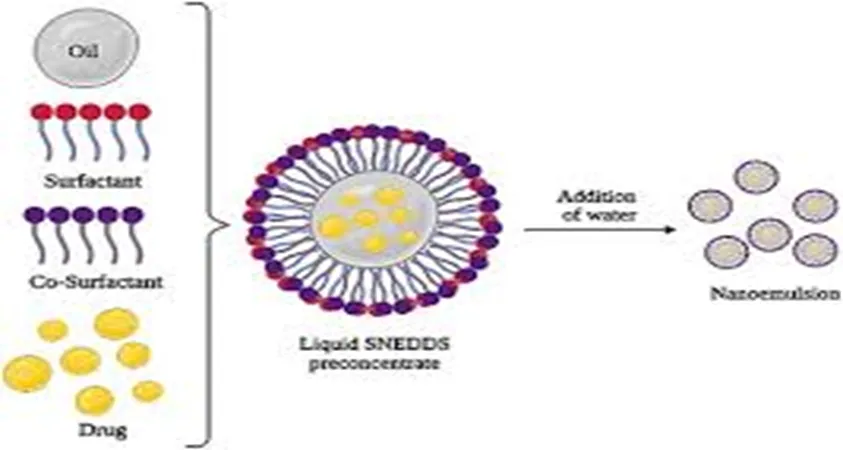
Figure.1. Formation of self nanoemulsifying Drug Delivery
Table.1. Comparison between SMEDDS and SNEDDS 8, 9
|
Parameter |
SMEDDS |
SNEDDS |
|
Droplet Size Range |
100-250 nm (micro-emulsion range) |
20-100 nm (nanoemulsion range, finer dispersion) |
|
Appearance |
Transparent to slightly turbid emulsions |
Transparent, isotropic nano-emulsions |
|
Thermodynamic stability |
High but sometimes less stable than nanoemulsions |
Higher stability due to smaller droplet size and higher surface energy |
|
Drug Loading Capacity |
Moderate, limited by solubilization capacity of oils/surfactants |
Higher drug loading due to larger surface area and stronger solubilization |
|
Drug Release |
Relatively slower release due to larger droplet size |
Faster drug release and absorption due to smaller droplets and larger interfacial area |
|
Bioavailability Enhancement |
Improves bioavailability compared to conventional formulations, but less than SNEDDS |
greater bioavailability enhancement due to efficient absorption and lymphatic uptake |
|
In-Vivo Performance |
Improved absorption but variable due to larger droplets |
More consistent and predictable absorption due to nanosized droplets |
|
Stability Issues |
Phase separation or drug precipitation on dilution |
More resistant to phase separation and drug precipitation |
COMPOSITION OF SNEDDS:
Self-Nanoemulsifying Drug Delivery Systems (SNEDDS) are prepared by judicious mixing of oils, surfactants, and co-surfactants or co-solvents which are crucial in the solubilization, emulsification, and enhancing the oral bioavailability of the drug 10.
Oils phase:
Play a significant role in drug solubilization. Oils form the lipophilic component of SNEDDS and are crucial for solubilizing hydrophobic drug molecules. Medium-chain triglycerides (MCT) like Captex 355 and Miglyol 812 are derived from palm kernel or coconut oil. They facilitate rapid digestion and absorption and possess a solvent capacity suitable for most hydrophobic drugs. They are suitable for rapid release due to their low viscosity and good dispersion. Long-chain triglycerides (LCT) like soybean oil and corn oil are more slowly metabolized and provide prolonged release of the drug. Capryol 90 is a caprylic/capric acid mono-/di-glyceride with effective emulsifying properties and excellent solubilizing capacity. Due to its partial polarity, it has high compatibility with a range of drugs 11, 12.
Surfactants
Enable oil droplets when diluted in the GI tract, to spontaneously disperse as nano-sized emulsions by lowering the interfacial tension between the aqueous and lipid phases. This decrease in droplet size enhances the drug surface area, which greatly accelerates absorption and dissolution. The amount of surfactant in the SNEDDS has a major impact on the droplet size of nanoemulsions 13, 14. Cremophor EL Polyoxyl 35 Castor Oil, or Cremophor EL, is a high HLB (~13) non-ionic surfactant with excellent solubilizing properties. It promotes drug permeability and stabilizes emulsions. But when formulating, the potential toxicity and hypersensitivity risks should be considered. When taken orally, Cremophor EL is well tolerated; however, when given intravenously, it may cause histamine release and anaphylactic shock 15. Tween 80 Besides, also called Polysorbate 80, is a surfactant of about HLB 15 and is generally combined with O/W nanoemulsions. In most SNEDDS formulations, it has been shown to aid drug dispersion and solubilization and was found to be very much physiologically acceptable.
Co-Surfactants and Co-Solvents
These are used to further reduce interfacial tension, provide flexibility in formulation, and enhance the nanoemulsion area in phase diagram studies. They assist in controlling the polarity of the interfacial layer and enhancing the stability and spontaneity of emulsification 16. Transcutol P (Diethylene Glycol Monoethyl Ether) is well known for its good solvent property, and it enhances drug solubility and facilitates penetration through biological membranes. Polyethene Glycol 400 (PEG 400) a hydrophilic solvent improves miscibility among system components and contributes to rapid emulsification 17. Ethanol is a cosolvent with the capability to dissolve hydrophilic and lipophilic drugs. Volatility and potential irritation limit its concentration in oral drug delivery, but it is a convenient ingredient to use in pre-formulation testing and solubility screening 18.
Active pharmaceutical moiety
Certain active pharmaceutical ingredients are formulated as SNEDDS that is Cyclosporine A (Neoral), Ritonavir (Novir), Fenofibrate (Lipirex), Calcitriol (Rocaltrol), Tipranavir (Aptivus). 9
Mechanism of Self-Emulsification:
Self-emulsification in SNEDDS is governed by both pharmacological and physicochemical principles that permit spontaneous nano-sized emulsion formation on dilution within the digestive system. It is important to understand this process in order to develop efficacious formulations with the ability to upgrade the oral bioavailability of hydrophobic active moiety.
The process of emulsification can be thermodynamically represented as follows: 19
ΔG = Σ N π r² σ
Where,
ΔG = Free energy of emulsification,
N = Number of droplets formed,
r = Radius of the droplets
σ = Interfacial tension between oil and water
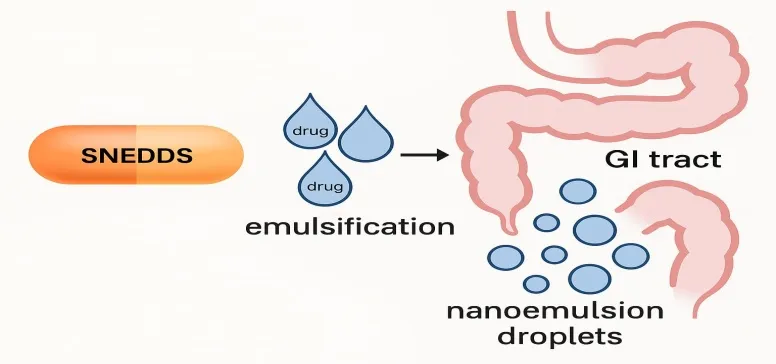
Figure.1. Mechanism of Self-Emulsification
Droplet formation under gastrointestinal agitation
During oral administration, SNEDDS experience minimal agitation as a result of gastrointestinal peristaltic movements and motility. This mechanical stimulus helps disintegrate the formulation and evenly distribute its elements throughout the aqueous medium. In contrast to traditional emulsions that need significant shear forces, SNEDDS exploit the physiological agitation to trigger emulsification. The surfactant molecules align at the oil-water interface to reduce interfacial tension and facilitate the disruption of the oil phase into microscopic droplets 20.
Formulation Design
Solubility screening
The very first step in SNEDDS formulation involves solubility screening, wherein the drug is tested for solubility in several oils, surfactants, and co-solvents. The solubility data provide an insight into the excipients that can dissolve the maximum concentration of the drug without it precipitating out. They also help decide upon the loading of the drug and avoid supersaturation upon dilution of the system in the GI tract. Techniques involving the equilibrium shake-flask method, followed by HPLC or UV analysis, are most commonly employed 21.
Emulsification efficiency
Once the potential excipients are selected, the spontaneous emulsification behaviour of each potential excipient is tested by visual inspection and droplet size analysis. A Small amount of the preconcentrate was added to the simulated gastric fluid (pH 1.2) or distilled water, with a little agitation. Efficient systems disperse to yield transparent or slightly opalescent solutions within minutes. Emulsification time would be noted, along with the clarity of the system and any signs of phase separation to conclude surfactant-to-oil ratios 22, 23.
Phase Diagram (Pseudo Ternary Phase Diagram in SNEDDS Development)
Ternary Phase Diagram is a triangular plot representing the phase behavior of a system containing exactly three components, typically oil, surfactant and water. Each vertex of the triangle denotes 100% of one component and any internal point corresponds to a unique ratio of the three. Ternary phase diagrams are useful in studying simple surfactant-oil-water mixtures and identifying nano-emulsion region 24.
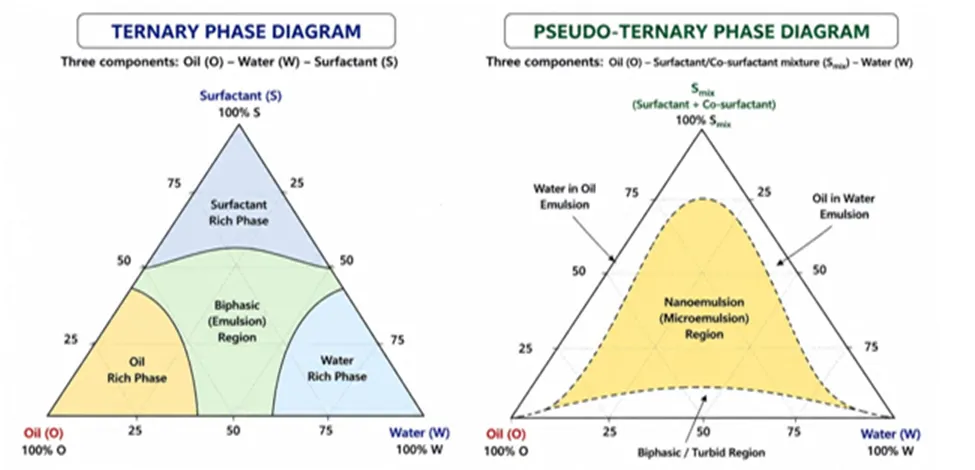
Figure 2: comparing a traditional ternary phase diagram (Oil, Surfactant and Water) with a pseudo-ternary phase diagram (Oil, Water and Smix (Surfactant and co-surfactant). In SNEDDS research, surfactant and co-surfactant are grouped as Smix to allow mapping of four-component systems within a three-component triangular diagram.
A pseudo-ternary phase diagram is an extension of the ternary system that accounts for four functional components oil, surfactant, co-surfactant and water. They guide researchers in selecting the most suitable excipient ratios to improve the solubility, stability, and bioavailability of medications that aren't very soluble in water. To simplify plotting the surfactant and co-surfactant are combined into a single surfactant mixture (Smix), considered as on “pseudo-component”. This enables mapping of self-emulsification and nanoemulsion regions making pseudo-ternary phase diagrams particularly valuable in development and optimization of SNEDDS. The diagrams further aid in eliminating trial and error processes used to pinpoint suitable formulation, thereby contributing to the rationalization of the design process. With titration techniques in conjugation with suitable with software, accurate plots can be prepared. 25, 26
CHARACTERIZATION PARAMETERS:
The following checklist summarizes key optimization and characterization parameters for SNEDDS formulations. Use this as a practical guide during formulation development and preclinical evaluation. Acceptance criteria shown are typical ranges and should be adjusted based on drug-specific requirements and regulatory guidance 26, 27, 28.
Table.3. Characterisation parameters
|
Parameter |
Method/Instrument |
Acceptance Criteria |
Purpose |
|
Visual appearance/clarity |
Visual inspection; % transmittance(UV-Vis,400-600 nm) |
Clear nanoemulsion (>80-90% transmittance) |
Detect phase separation, turbidity, precipitation (Supports droplet size and PDI data) |
|
Self-emulsification time |
Visual test / USP dissolution |
Rapid (<1-2 min) |
Quick dispersion preferred for consistent in vivo performance |
|
Droplet / Globule size (Z-average) |
Dynamic Light Scattering (DLS) |
< 200 nm (ideally 20–100 nm) |
Smaller size → higher surface area and faster absorption |
|
Polydispersity Index (PDI) |
Dynamic Light Scattering (DLS) |
< 0.3 (≤0.2 preferred) |
Indicates uniformity of droplet population |
|
Zeta potential |
Electrophoretic light scattering |
|±30 mV| for electrostatic stability; non-ionic systems rely on steric stabilization |
Predicts aggregation propensity; consider surfactant type |
|
Morphology |
TEM, cryo-TEM, SEM |
Spherical, uniform droplet |
Confirm droplet shape and aggregation |
|
Thermodynamic stability |
Centrifugation; heating- cooling; freeze- thaw |
No phase separation or precipitation |
Assesses physical robustness of the preconcentrate |
|
Drug content / Assay |
HPLC or validated UV method |
>95% of label claim |
Ensures accurate dosing |
|
In vitro dissolution / Release |
Dissolution apparatus with bio-relevant media |
Improved release vs control (quantified) |
Predicts in vivo release; use bio-relevant conditions |
|
Lipolysis & digestion behavior |
In vitro lipolysis model |
Maintains drug solubilization profile |
Predicts fate in GI tract and release kinetics |
|
Permeability |
Caco-2, using chamber, ex-vivo gut sac |
Higher Papp vs suspension |
Predict absorption enhancement |
RECENT APPROACHES IN SNEDDS TECHNOLOGY:
Supersaturated SNEDDS (S-SNEDDS)
To break the barrier of drug loading of conventional SNEDDS, S-SNEDDS was introduced to the market. The main feature of S-SNEDDS is that they can retain a higher concentration of dissolved drug than the equilibrium solubility of the same drug in the carrier system, with supersaturation obtained by some transient thermodynamic manipulation with precipitation inhibitors, e.g., hydrophilic polymers like HPMC or PVP. Such stabilizers retard drug crystallization in a metastable solubilized state during gastrointestinal transit S-SNEDDS.
Solid SNEDDS (S-SNEDDS)
For remediation of problems posed by liquid handling, incompatibility with the capsule shell, and stability during transport, S-SNEDDS were developed as a significant advancement. It involves adsorption of the liquid SNEDDS onto solid carriers like porous silica, cellulose derivatives, or crospovidone that convert the formulation into a free-flowing powder that can then be filled into tablet or hard gelatin capsule, thus improving patient convenience and manufacturability. The procedures for solidification include spray drying, freeze drying, and melt granulation, all of which preserve the potential to produce nanoemulsions when reconstituted in aqueous media.
Self-Double Emulsifying Systems
SDEDDSs are an interesting and more recent offshoot from the SNEDDS strategy, having been formulated to create water-in-oil-in water (W/O/W) double emulsions in the body. These kinds of systems provide both hydrophilic and lipophilic delivery of drugs, assisting co-encapsulation of active and sequential release. SEDDS are typically prepared form a base SNEDDS preconcentrate blended with hydrophilic stabilizers or bioadhesive polymers 30, 11.
FUTURE PERSPECTIVES AND CONCLUSION:
Self Nano-emulsifying Drug Delivery Systems (SNEDDS) are remodelling current medicine via expansion in nanotechnology, personalized medicine, and individualized medication. Innovations in SNEDDS technology have created new possibilities for expanded applications and greater functionality, building upon the original success of conventional SNEDDS in improving oral drug absorption. Initially SNEDDS developed as manageable transporter for magnify the oral bioavailability; SNEDDS have now evolved through synergistic nanotechnology to become highly precise and environment sensitive delivery systems. Adding extremely stimuli-sensitive materials to SNEDDS can result in smart drug delivery systems that release the drug at a target spot in reaction to particular triggers, such as pH, enzymes, or redox conditions.
SNEDDS are Precise versatility and well-suited for personalized medicine, since their amount, constituents and release timing can be made to order for individual patients. In cancer treatment, SNEDDS can orally deliver low hydrophilic cytotoxic drugs, bypassing the liver's first-pass metabolism and diminish overall toxicity. Their ability to enhance lymphatic transport also improves the delivery of agents that target metastases and modulate the immune system. SNEDDS are considered an advanced oral drug delivery system that bridges the gap between scientific formulation and therapeutic innovation. Their compatibility with smart technology, usefulness for potent drugs, and suitability for large-scale manufacturing make them a valuable asset in the next generation of pharmaceuticals. As more research emerges, SNEDDS are expected to become a cornerstone of personalized, targeted, patient-centered medicine.
CONFLICT OF INTEREST
The authors declared no conflict of interest
ACKNOWLEDGEMENT
Authors would like to thanks Department of Pharmacy Mahatma Jyotiba Phule Rohilkhand University, Bareilly, Uttar Pradesh, India for providing the necessary facilities and support to complete this review work.
REFERENCES

Sashin Kumar, Dr. Kaushal Kumar, From Solubility Limitation to Therapeutic Excellence: The Expanding Role of SNEDDS, Int. J. of Pharm. Sci., 2026, Vol 4, Issue 5, 6926-6935, https://doi.org/10.5281/zenodo.20396013
 10.5281/zenodo.20396013