

We use cookies to ensure our website works properly and to personalise your experience. Cookies policy
P. R. Patil Institute of Pharmacy, Talegaon, Ashti, Wardha, 442202, Maharashtra, India.
Liposomes are spherical vesicles composed of one or more phospholipid bilayers encapsulating an aqueous core, widely used as drug delivery systems due to their biocompatibility, biodegradability, and capacity to encapsulate both hydrophilic and hydrophobic molecules. Their preparation typically involves lipids (such as synthetic or natural phosphatidylcholines, cholesterol) and aqueous media, employing methods like thin-film hydration, ethanol injection, reverse-phase evaporation, and extrusion. Critical formulation parameters (e.g., lipid composition, lipid-to-drug ratio, chain length, unsaturation, presence of cholesterol) strongly influence properties such as particle size, lamellarity, polydispersity, and encapsulation efficiency. Characterization and evaluation of liposomes involve a set of physicochemical and performance parameters: particle size and size distribution (often via Dynamic Light Scattering), zeta potential (for surface charge and colloidal stability), morphology (by electron microscopy), encapsulation efficiency (percentage of drug loaded), in vitro release profiles, membrane fluidity, and sometimes in vitro/in vivo stability or biodistribution. Optimization of these features is essential for ensuring effective delivery, minimizing toxicity, and achieving controlled release. liposomal properties are highly dependent on both formulation and process variables, a systematic design and thorough analytical characterization are critical in developing clinically viable liposome-based therapeutics.
The name liposome is derived from two Greek words: Lipo = "fat" and Soma = "body". A liposome is the drug delivery system which is structurally seeing like a colloidal, vesicular and made up one or more than one lipid bilayer (outer layer) in which the equal number of aqueous layer (inner layer) is inclosed into it shown in Figure 1 which contains a substance like peptides and protein, hormones, enzymes, antibiotics, antifungal and anticancer agent in this delivery system drug achieve the long therapeutic effect for the treatment of particular disease without affected to another part of the body.1,2 Liposomes are composed of small vesicles of phospholipids encapsulating an aqueous space ranging from about 0.03-to 10 µm in diameter.3 Liposomes can be produced with various lipid compositions or by different methods, leading to differences in parameters such as size, size distribution, surface electrical potential, number of lamellae, and encapsulation efficiency. Surface modification offers significant advantages in generating liposomes with distinct mechanisms, kinetic properties, and biodistribution profiles. Available products include Doxorubicin (Doxil, Myocet) for Kaposi's sarcoma, Daunorubicin (Daunoxome), and Cytarabine. These artificial microscopic vesicles consist of an aqueous core surrounded by one or more layers of phospholipids and are utilized to deliver vaccines, drugs, enzymes, or other agents to specific cells or organs.4 Liposomes are nano-sized artificial vesicles characterized by a spherical shape. They can be created from natural phospholipids and cholesterol. When phospholipids interact with water, they immediately form a double-layered sphere.5 Consequently, Dr. Bauman Cosmetic exclusively creates liposome products that are free from fragrances and artificial preservatives. The same phospholipids that make up the liposome membrane also constitute the walls of skin cells. Likewise, the substance found between skin cells is made up of phospholipids, ceramides, triglycerides, free fatty acids, cholesterol, and water. If skin cells are slightly compromised or if the intercellular substance is diminished due to harsh cleansing practices, liposomes can effectively restore the missing lipids. Thus, the combination of phospholipids, ceramides, and other lipids naturally found in the skin is beneficial. A liposome is a small bubble (vesicle) composed of materials similar to those of the cell membrane. Liposomes can be loaded with medications and utilized to deliver drugs for cancer treatment and other illnesses.6,7,8
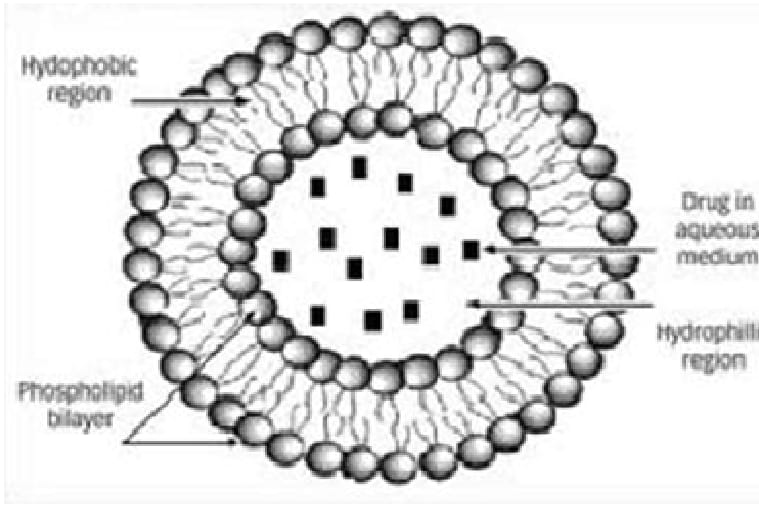
Fig No1: Structure of liposome
Structure of liposomes:9,10
Phospholipids
Cholesterol
Cholesterol can be incorporated into phospholipid membranes at very high ratios, reaching up to 1:1 or 2:1 molar ratio of cholesterol to phosphatidylcholine. As an amphipathic molecule, cholesterol embeds itself within the membrane with its hydroxyl group directed towards the aqueous environment and its aliphatic chain aligned parallel to the acyl chains in the interior of the bilayer. Additionally, it increases the spacing between choline head groups and disrupts the usual electrostatic and hydrogen bonding interactions.

Fig No2: An illustration of liposome and its structural component
History Of Liposome:
Liposomes were initially identified in the mid-1960s by British hematologist Dr. Alec D. Bangham. His research focused on the structure of cell membranes, and he inadvertently discovered liposomes while using an electron microscope. Liposomes are minuscule spherical entities composed of lipid bilayers, resembling the architecture of cell membranes. Dr. Bangham's pioneering research established the groundwork for comprehending and developing liposomes for a variety of applications.11
In the subsequent decades, liposomes were acknowledged for their promise in drug delivery. Their capability to encapsulate pharmaceuticals and transport them to targeted areas within the body transformed the landscape of pharmacology. Liposomal drug delivery systems enabled controlled release and minimized the side effects associated with numerous medications.12
Over time, liposomes have been utilized not only in drug delivery but also in cosmetics, food technology, and gene therapy. Researchers have created various liposome types featuring different sizes, compositions, and surface modifications to enhance their performance for particular uses.13,14
ADVANTAGES:15,16
DISADVANTAGES:15,16
Classification of Liposomes:17
A] Based on structure parameter
B] Based on Method of Preparation
C] Based on Composition and Application
Mechanism of formation of Liposome
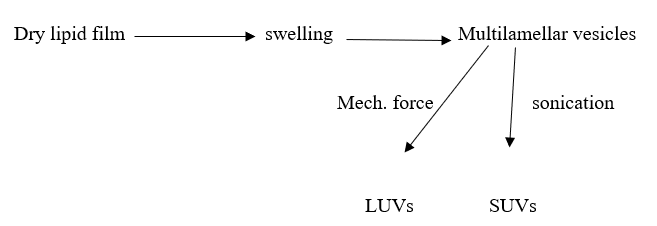
Fig No3: Mechanism of liposome preparation
Method Of Preparation:
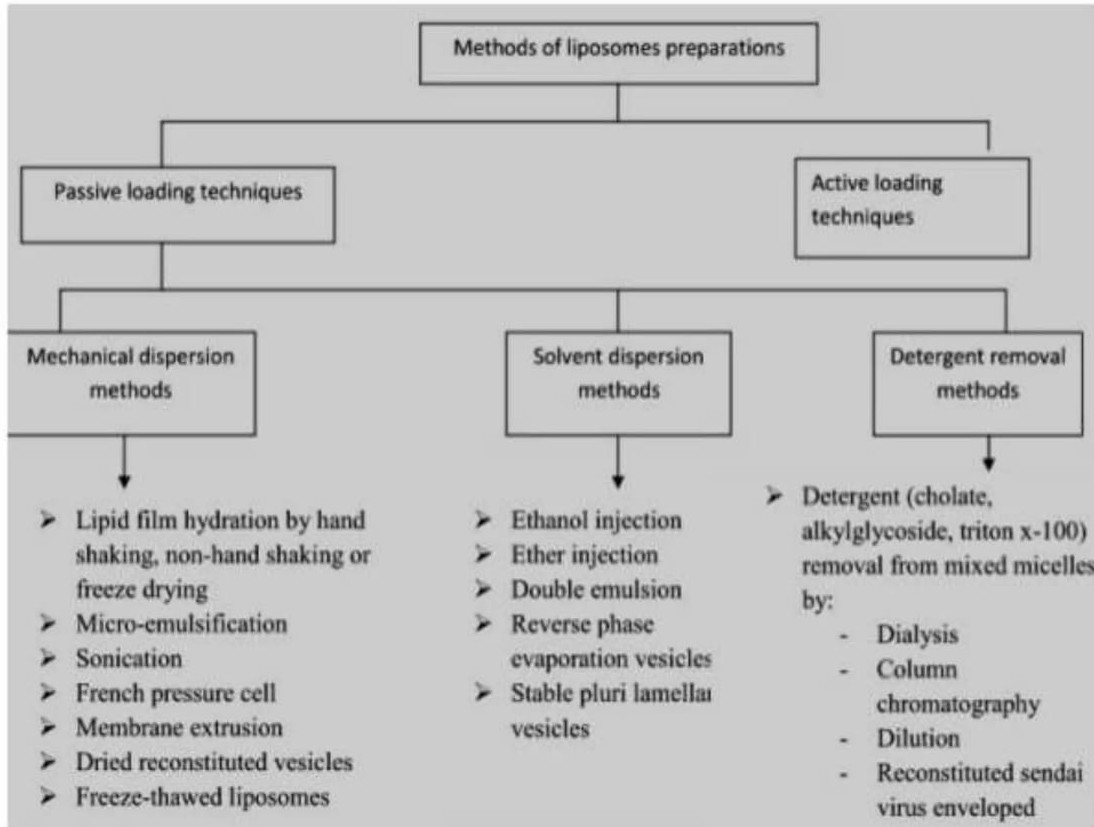
Fig No4: Different Methods of Liposome Preparations
A] Mechanical Dispersion Method
1) Lipid Film Hydration by hand shaking method:20
Liposomes were created using a physical dispersion technique with varying ratios of lipids. In this process, the lipids were dissolved in chloroform. This chloroform solution of lipids was spread over a flat-bottomed conical flask. The solution was then evaporated at room temperature without disturbing it. The hydration of the lipid film was performed with phosphate buffer (pH 7.4) while tilting the flask to one side, and the aqueous medium containing the drug to be encapsulated was introduced into the side of the flask as it was slowly returned to an upright position. The fluid was gently allowed to flow over the lipid layer, and the flask was left standing for 2 hours at 37°C for complete swelling; after swelling, the vesicles were collected by swirling the contents of the flask to produce a milky white suspension. The formulations were then subjected to centrifugation. Various batches of liposomes were prepared to identify the optimum formulation.
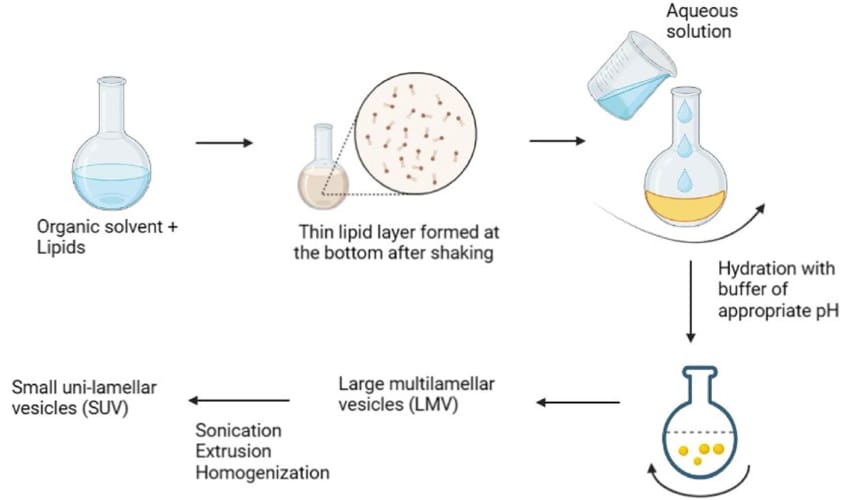
Fig No5 : Lipid Film Hydration method
2) Micro-emulsification:21
“Micro fluidizer” is used to prepare small MLVs from concentrated Lipid dispersion. Micro fluidizer pumps the fluid at very at very high pressure (10,000 psi), through a 5 micrometer orifice. Then, it is forced along defined micro channels which direct two streams of fluid to collide together at the right angles at a very high velocity, there by affecting an efficient transfer of energy. The lipids can be introduced into the fluidizer, either as large MLVs or as the slurry of un hydrated lipid in organic medium. The fluid collected can be recycled through the pump and interaction chamber until vesicles of spherical dimensions are obtained. diameter After a single pass, the size of vesicles is reduced to a size 0.1 and 0.2um .
3) Sonication:
This is the procedure by which Multi Lamellar Vesicles (MLVs) are converted into small Uni Lamellar Vesicles (SUVs). Ultrasonic irradiation is applied to the MLVs to produce the SUVs. Two techniques are utilized: a) Probe sonication method, and b) Bath sonication method. The probe method is used for dispersion and requires high energy for small volumes (for instance, high concentrations of lipids or a viscous aqueous phase), while bath sonication is better suited for larger volumes of diluted liquids. The probe tip sonicator delivers a substantial amount of energy to the liquid dispersion but can lead to overheating of the liposomal dispersion, resulting in lipid degradation. Additionally, the sonication tip may introduce titanium into the liposome dispersion, which can be removed through centrifugation before use. For these reasons, bath sonicator tend to be more commonly employed. The sonication of MLVs is performed by either placing the dispersion in a bath sonicator or immersing the probe tip into the test tube containing the dispersion (for a duration of 5-10 minutes). Following sonication, the resulting dispersion is centrifuged, and as illustrated in the diagram, the SUVs will remain at the top while the smaller MLVs and aggregated lipids settle at the bottom. The upper layer consists of a pure dispersion of SUVs with varying diameters, as size is influenced by factors such as composition, concentration, temperature, duration of sonication, volume, and sonication tuning.
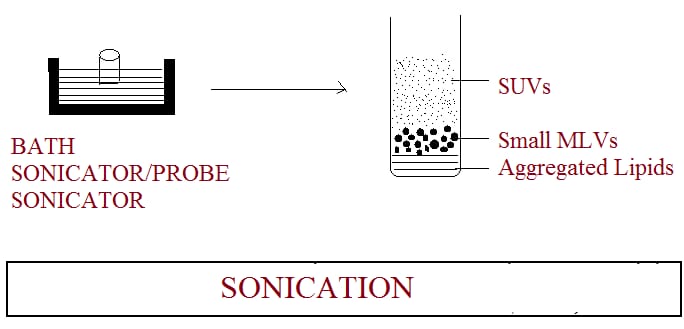
Fig No6 : Method of preparation of liposomes by sonication
4) French-Pressure Cell :22,23
The French pressure cell technique consists of extruding MLV through a small orifice. A key characteristic of the French pressure vesicle method is that proteins do not seem to be significantly altered during the process, unlike in sonication. This technique involves gentle handling of sensitive substances. It offers several benefits compared to sonication. The resulting liposomes are generally larger than the small unilamellar vesicles produced by sonication. However, the method has some limitations, such as the difficulty in achieving high temperatures and the relatively small working volumes, which are capped at about 50 ml.
5) Membrane Extrusion :
This technique can effectively process both LUVs and MLVs. The liposome size is minimized by gently forcing them through a membrane filter with a specific pore size, achieved at much lower pressures (<100 psi). During this process, the contents of the vesicles are exchanged with the dispersion medium as the phospholipid bilayers break and reseal while passing through the polycarbonate membrane. Liposomes generated through this method are referred to as LUVETs. This technique is the most commonly utilized method for producing SUVs and LUVs for both in vitro and in vivo research.
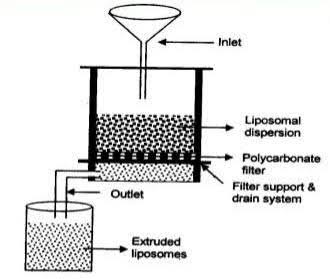
Fig No7 : Liposome Prepared by Membrane Extrusion method
6) Dried Reconstituted Vesicles:
This method starts with freeze drying of a dispersion of empty SUVs. After freeze drying the freeze dried membrane is obtained. Then these freeze dried SUVs are rehydrated with the use aqueous fluid containing the material to be entrapped. This leads to formation of the solutes in oligolamellar vesicles.
7) Freeze Thaw Sonication:
This method is based upon freezing of a unilamellar dispersion(SUV). Then thawing by standing at room temperature for 15min.Finally subjecting to a brief Sonication cycle which considerably reduces the permeability of the liposomes membrane. In order to prepare GIANT VESICLES of diameter between 10 and 50um, the freeze thaw technique has been modified to incorporate a dialysis step against hypo- osmolar buffer in the place of sonication. The method is simple, rapid and mild for entrapped solutes, and results in a high proportion of large unilamellar vesicles formation which are useful for study of membrane transport phenomenon. This method is based upon freezing of a unilamellar dispersion(SUV). Then thawing by standing at room temperature for 15min. Finally subjecting to a brief Sonication cycle which considerably reduces the permeability of the liposomes membrane. In order to prepare GIANT VESICLES of diameter between 10 and 50um, the freeze thaw technique has been modified to incorporate a dialysis step against hypo- osmolar buffer in the place of sonication. The method is simple, rapid and mild for entrapped solutes, and results in a high proportion of large unilamellar vesicles formation which are useful for study of membrane transport phenomenon.3,24,25

Fig No8: Liposome Prepared by Dried Reconstitute Vesicles/Freeze Thaw Sonication Method
B] Solvent Dispersion Method
1) Ethanol Injection Method :26
A lipid solution containing ethanol is quickly injected into a large amount of buffer, resulting in the immediate formation of MLVs. The challenges associated with this method include a heterogeneous population size (ranging from 30 to 110 nm), a very low concentration of liposomes, difficulties in completely removing all ethanol due to its formation of an azeotrope with water, and the risk of inactivating various biologically active macromolecules even with minimal ethanol exposure.
2) Ether Injection Method :
A lipid solution in diethyl ether or an ether/methanol combination is gradually added to an aqueous solution containing the material intended for encapsulation at a temperature of 55-65°C or under reduced pressure. Removing the ether under vacuum afterwards results in the creation of liposomes. The key disadvantages of this method include a heterogeneous particle
size distribution (ranging from 70 to 190 nm) and the exposure of the encapsulated compounds to organic solvents or elevated temperatures.
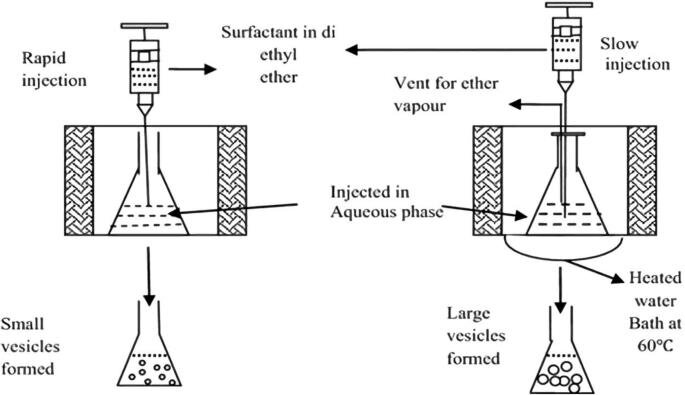
Fig No9 : Liposomes prepared by (1) Ethanol injection and (2) Ether injection method
3) Reverse Phase Evaporation Method :27
Initially, a water-in-oil emulsion is created by briefly sonicating a biphasic system that includes phospholipids dissolved in an organic solvent (such as diethyl ether, isopropyl ether, or a combination of isopropyl ether and chloroform) along with an aqueous buffer. The organic solvents are subsequently eliminated under low pressure, leading to the development of a thick gel. Liposomes are produced when the remaining solvent is effectively removed through ongoing rotary evaporation under reduced pressure. This technique can achieve a high encapsulation efficiency of up to 65% in a medium with low ionic strength, for instance, 0.01M NaCl. This method has been utilized for encapsulating both small molecules and large macromolecules. A significant drawback of this technique is that it exposes the encapsulated materials to organic solvents and to short intervals of sonication.
C] Detergent Removal Method :28
Detergents at their critical micelle concentrations have been utilized to solubilize lipids. As the detergent is eliminated, the micelles gradually become more enriched in phospholipids and ultimately merge to create IUVs. The removal of detergents can be achieved through dialysis. The benefits of the detergent dialysis method include high reproducibility and the generation of liposome populations that are uniform in size. The primary disadvantage of this technique is the potential for residual detergent(s) remaining within the liposomes. A commercial device known as LIPOPREP (Diachema AG, Switzerland), which is a type of dialysis system, is available for detergent removal. Other methods that have been employed for detergent removal include (a) Gel Chromatography using a Sephadex G-25 column, (b) the adsorption or binding of Triton X-100 (a detergent) to Bio-Beads SM-2, and (c) the binding of octyl glucoside (a detergent) to Amberlite XAD-2 beads.
Evaluation Of Liposome29
The liposomal formulation and processing for a designated purpose are defined to guarantee their consistent performance both in vitro and in vivo. The characterization parameters for evaluation can be categorized into three stages: physical, chemical, and biological parameters. Physical characterization focuses on evaluating aspects such as size, shape, surface characteristics, and drug release profiles. Chemical characterization involves studies that determine the purity and potency of various lipophilic components. Biological characterization parameters aid in establishing the safety and appropriateness of the formulation for therapeutic use. Some of the parameters include:28
Characterization of Liposome Structure
Morphology:
Size and Size Distribution:
Zeta Potential:30
Lipid Composition Analysis:
Liposome Properties:
Encapsulation Efficiency :
Stability:
Drug Release Kinetics:
Biological Evaluation:31
In vitro Cell Studies:
In vivo Studies:
Biocompatibility and Toxicity Assessment:
Drug Release Studies
Surface Modification Analysis
Marketed Formulations of Liposomes:18
|
Product |
Drug |
Company |
|
AmbisomeTM |
Amphotericin B |
Nexstar pharmaceuticals Inc., CO |
|
AbelcetTM |
Amphotericin B |
The Liposome Company, NJ |
|
AmphocilTM |
Amphotericin B |
Sequus pharmaceuticals, Inc., C.A |
|
DoxilTM |
Doxorubicin |
Sequus pharmaceuticals, Inc., C.A |
|
DaunoxomeTM |
Daunorubicin |
Nexstar pharmaceuticals, Inc., CO |
|
MikasomeTM |
Amikacin |
Nexstar pharmaceuticals, Inc., CO |
|
DC99TM |
Doxorubicin |
Liposome CO., NJ, USA |
|
EpaxelTM |
Hepatitis A Vaccine |
Swiss Serum Institute, Switzerland |
|
ELA-MaxTM |
Lidocaine |
Biozone Labs, CA, USA |
Applications Of Liposome:
Drug Delivery:32
Vaccines:33
Cosmetics and Skincare:
Gene Delivery:34
Diagnostics:
Cancer Therapy:35
Food Technology
Biotechnology
Transdermal Drug Delivery:36
Personal Care Products
Veterinary Medicine
Environmental Remediation:
Intracellular Delivery:37
Nutraceuticals:33
Wound Healing
CONCLUSION
Liposomes are a promising and groundbreaking system for delivering drugs, with numerous applications in the pharmaceutical sector. Extensive studies over the years have shown their ability to address many challenges linked to conventional drug delivery methods. Liposomes have become an encouraging category of drug delivery systems that provide considerable benefits for improving the effectiveness and safety of various medications. Although challenges persist, ongoing innovations and improvements in liposomal technologies offer great potential for the future of drug delivery within the pharmaceutical domain. Liposomes offer an exciting and adaptable strategy for drug delivery, with the capacity to transform the pharmaceutical landscape by enhancing drug effectiveness, minimizing side effects, and allowing targeted therapies. Further progress in liposomal technology is expected to broaden their application across a diverse array of medical uses.
Conflict Of Interest
The authors declare that there is no conflict of interest.
ACKNOWLEDGMENT
The authors would like to acknowledge the library facility of the college for this work.
REFERENCES






Snehal Salve*, Suyog Ghatol, Tanuja Agole, Vaishnavi Kadu, Yogita Talmale, Vaishnavi Bahe, An Overview of Liposome, Int. J. of Pharm. Sci., 2025, Vol 3, Issue 11, 4191-4206 https://doi.org/10.5281/zenodo.17724000
 10.5281/zenodo.17724000