

We use cookies to ensure our website works properly and to personalise your experience. Cookies policy
Mahavir Institute of Pharmacy, Nashik.
Bio-analytical assay methods play a crucial role in the quantitative estimation of drugs in biological matrices for pharmacokinetic, bioequivalence, and therapeutic monitoring studies. Among various analytical techniques, liquid chromatography coupled with tandem mass spectrometry (LC–MS/MS) has emerged as a highly sensitive, selective, and robust tool for drug analysis in human plasma. This review provides a comprehensive overview of bio-analytical methods employed for the estimation of drugs in biological matrices using LC–MS/MS.The review discusses the two fundamental components of bio-analytical method development, namely sample preparation and instrumental analysis. Various extraction techniques, including protein precipitation, liquid–liquid extraction, and solid-phase extraction, are critically evaluated with respect to their efficiency in sample clean-up and analyte recovery. The principles of chromatographic separation and mass spectrometric detection, including ionization modes and multiple reaction monitoring, are also summarized. Furthermore, this article highlights regulatory requirements for bio-analytical method validation as outlined by international agencies such as the US Food and Drug Administration (USFDA) and European Medicines Agency (EMA). Key validation parameters including selectivity, sensitivity, linearity, accuracy, precision, recovery, and stability are discussed in detail. The application of validated LC–MS/MS methods in the quantification of drugs in human plasma for clinical and bioequivalence studies is also reviewed. Overall, this review emphasizes the significance of LC–MS/MS–based bio-analytical methods in modern drug development and clinical research.
Bio-analytical methods are essential tools in pharmaceutical research and development for the quantitative determination of drugs and their metabolites in biological matrices such as plasma, serum, urine, and tissues. These methods play a critical role in pharmacokinetic, bioavailability, bioequivalence, and therapeutic drug monitoring studies. Accurate and reliable bio-analytical techniques are therefore necessary to support drug discovery, clinical development, and regulatory approval processes.
Among the various analytical techniques available, liquid chromatography coupled with tandem mass spectrometry (LC–MS/MS) has become the method of choice for bio-analysis due to its high sensitivity, selectivity, and wide dynamic range. LC–MS/MS enables the simultaneous separation and detection of analytes at very low concentrations in complex biological matrices, making it particularly suitable for human plasma analysis. The technique offers superior performance compared to conventional analytical methods such as high-performance liquid chromatography (HPLC) with ultraviolet detection.
A critical step in bio-analytical method development is sample preparation, which is required to remove endogenous interferences and enhance analyte recovery. Commonly employed extraction techniques include protein precipitation, liquid–liquid extraction, and solid-phase extraction. The selection of an appropriate extraction method depends on the physicochemical properties of the analyte, matrix complexity, sensitivity requirements, and regulatory expectations.
In addition to method development, bio-analytical methods must be validated to ensure reliability and reproducibility of analytical results. International regulatory agencies such as the United States Food and Drug Administration (USFDA) and the European Medicines Agency (EMA) have established guidelines outlining validation parameters including selectivity, sensitivity, linearity, accuracy, precision, recovery, matrix effects, and stability. Compliance with these guidelines is mandatory for the acceptance of bio-analytical data in regulatory submissions.
This review aims to provide a comprehensive overview of LC–MS/MS–based bio-analytical assay methods for the estimation of drugs in human plasma. The article focuses on sample preparation techniques, instrumental considerations, and regulatory validation requirements, highlighting the importance of LC–MS/MS in modern pharmaceutical analysis and clinical research.
The developed method should have the following merits:
Application of these methods for bioequivalence/bioavailability studies of the drugs in healthy human volunteers. In the present study, the following important drug has been studied for their bioanalytical method development, method validation and their application to bioequivalence / bioavailability studies in human plasma.
Chromatography, a physical method of separation in which the components/solutes to be separated are distributed between two phases, one of which is stationary (stationary phase) while the other (the mobile phase) moves in a definite direction. It is an analytical tool widely employed for the separation, identification of chemical/ pharmaceutical components in complex mixtures. The components must interact with the stationary phase to be retained and separated by it. The mobile phase may be a gas, liquid or a supercritical fluid which moves over or through the stationary phase, carrying the components along with it. Mass spectrometer is generally used for quantification of compounds in different biological matrices/complex mixtures. Analysis of drugs using liquid chromatography-mass spectrometry is extensively used in pharmaceutical industry.
Liquid chromatography (LC):
Liquid chromatography (LC) was the first type of chromatography to be discovered and, in the form of liquid-solid chromatography (LSC) was originally used in the late 1890s by the Russian botanist, Tswett to separate and isolate various plant pigments. The coloured bands he produced on the adsorbent bed evoked the term chromatography (colour writing) for this type of separation. In the late 1930s and early 1940s Martin and Synge introduced a form of liquid-liquid chromatography by supporting the stationary phase, in this case water, on silica gel in the form of a packed bed and used it to separate some acetyl amino acids.
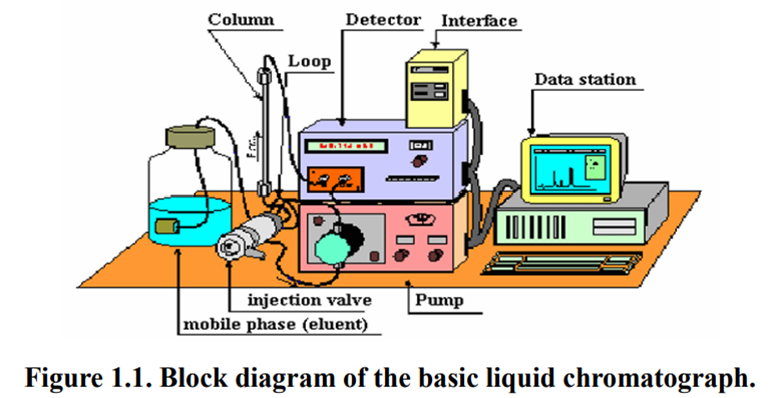
They published their work in 1941 and in their paper recommended the replacement of the liquid mobile phase with a suitable gas which would accelerate the transfer between the two phases and provide more efficient separations. Thus, the concept of gas chromatography was born. In the same paper in 1941, Martin and Synge suggested the use of small particles and high pressures in LC to improve the separation which proved to be the critical factors that initiated the development of high-performance liquid chromatography. The basic liquid chromatograph consists of six fundamental units. They are the mobile phase supply system, the pump and programmer, the sample injection valve, the column, the detector and finally a means of presenting and processing the results. A block diagram of the basic liquid chromatograph is shown in Figure 1.1.
Types of Liquid Chromatography Liquid chromatography can be classified into four different types based on mechanism of separation.
This type of chromatography makes use of a solid stationary phase (silica gel or any other silicabased packing) and a liquid or gaseous mobile phase. The solute gets adsorbed on the surface of the solid particles. Equilibration between the stationary phase and the mobile phase accounts for separation of different analytes.
The separation of analytes is afforded by differential partitioning between a liquid stationary phase coated on the surface of a solid support. The solute equilibrates between the stationary liquid and the mobile phase.
The stationary bed has an ionically charged surface of opposite charge to the sample ions. This technique is used almost exclusively with ionic or ionizable samples. Solute ions of the opposite charge are attracted to the stationary phase by electrostatic force. The mobile phase is an aqueous buffer, where both pH and ionic strength are used to control elution time.
Also called gel filtration or gel permeation chromatography, this technique separates molecules by size. The stationary phase is a porous gel with precisely controlled pore sizes through which the liquid mobile phase passes. The pores are small enough to exclude large solute molecules but not small ones. The sample is simply screened or filtered according to its solvated molecular size. Larger molecules are rapidly washed through the column; smaller molecules penetrate inside the porous of the packing particles and elute later. Unlike other forms of liquid chromatography, there is no attractive interaction between the stationary phase and the solute, only physical entrapment. Adsorption chromatography on bare silica is an example of normal-phase chromatography, in which a polar stationary phase and a less polar solvent is used. Reversed-phase chromatography is more commonly used in which the stationary phase is non-polar or weakly polar and the mobile phase is more polar. Reversed-phase chromatography eliminates peak tailing because the stationary phase has few sites that can strongly adsorb a solute to cause tailing. Thus, majority of chromatographic applications are executed using reversed-phase chromatography.
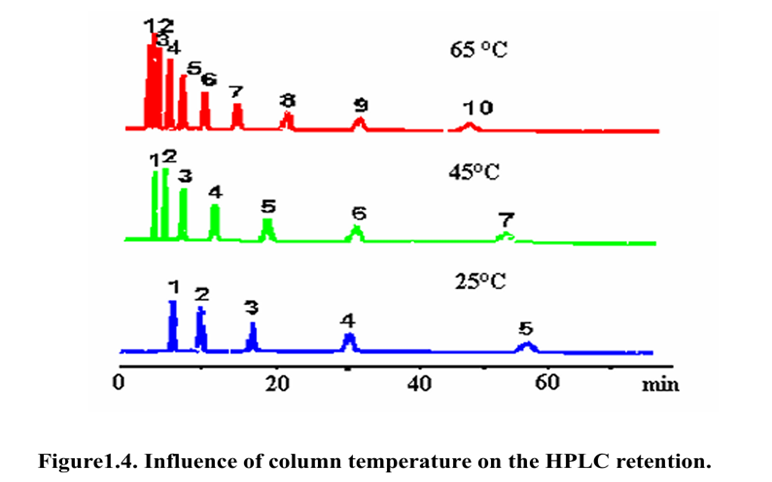
Temperature effects in HPLC are not as significant as in gas chromatography. Volatile solvents are not allowed to rise to higher temperatures too much, and the stability of the attached bonded ligands on the adsorbent surface may be influenced by the high temperature. So, the main temperature range is from ambient temperature to 60 or 70 °C. Picture below illustrates the influence of the column temperature on the HPLC retention (Figure 1.4).
Mass Spectrometry Mass spectrometry (MS):
Has progressed to become a powerful analytical tool for both quantitative and qualitative applications. Over the past decade, mass spectrometry has undergone tremendous technological improvements allowing for its application to proteins, peptides, carbohydrates, DNA, drugs, and many other biologically relevant molecules. Due to ionization sources such as electrospray ionization and matrix assisted laser desorption/ ionization (MALDI), mass spectrometry has become an irreplaceable tool in the biological sciences. The MS principle consists of ionizing chemical compounds to generate charged molecules or molecule fragments and measurement of their mass-to-charge ratio.
HPLC- Mass spectrometry:-
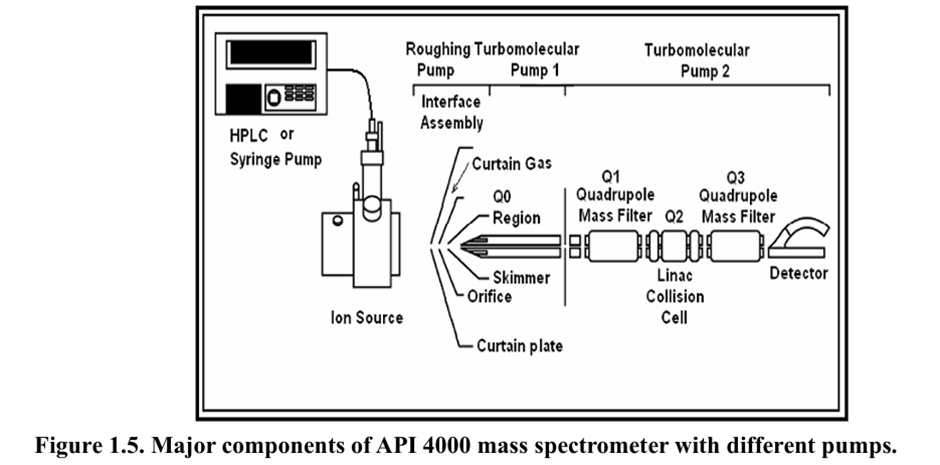
High performance liquid chromatography (HPLC) coupled with mass spectrometry is an extremely powerful and indispensable methodology practiced in virtually every stage of pharmaceutical discovery and development process, including biological target discovery, biological assay for high throughput screening, characterization of physiochemical properties of drug candidates, drug metabolism and pharmacokinetics. Compounds are separated on column in HPLC and then enter into mass spectrometer where they are first ionized in the source (parent ions). ESI, APCI and APPI are the ionization techniques mostly used for analysis of pharmaceutical compounds in biological fluids. Figure 1.5 represents major components of MS with pumps used to maintain vacuum in instrument.
Tandem mass spectrometry (LC–MS/MS) has become the gold standard in bioanalytical laboratories for the quantification of drugs in human plasma (El Orche, 2024; Lu et al., 2022). Its high sensitivity, selectivity, and speed are essential for pharmacokinetic (PK), bioequivalence, and therapeutic drug monitoring (TDM) studies (Ranganathan et al., 2019; Lu et al., 2022). This review outlines the essential workflow of LC–MS/MS bioanalysis, from sample preparation to regulatory validation.
Before LC–MS/MS analysis, drugs must be isolated from the complex human plasma matrix to minimize "matrix effects"—ion suppression or enhancement caused by endogenous substances like lipids and proteins (El Orche, 2024; Jagli?ska et al., 2021).
|
Technique |
Description |
Advantages |
|
Protein Precipitation (PP) |
Adding organic solvents (e.g., acetonitrile, methanol) to denature and precipitate plasma proteins (Lu et al., 2022). |
Fastest, simplest, and high-throughput. |
|
Liquid-Liquid Extraction (LLE) |
Using an immiscible organic solvent to extract the drug from the aqueous plasma (Ranganathan et al., 2019). |
Provides cleaner extracts than PP; effectively removes salts. |
|
Solid-Phase Extraction (SPE) |
Passing samples through sorbent cartridges to selectively bind the analyte (Anusha & Sowjanya, 2024). |
Highest selectivity and cleanliness; can be automated. |
The analytical power of this method stems from the combination of high-resolution separation and specific mass detection.
To ensure data integrity for regulatory submission (FDA/EMA/ICH M10), methods must be rigorously validated (El Orche, 2024; Anusha & Sowjanya, 2024).
4. Current Trends and Future Directions
Recent advancements focus on miniaturization and hybrid assays. Hybrid LBA-LC–MS/MS (combining ligand-binding assays with MS) is now being used for complex molecules like antibody-drug conjugates (ADCs) to achieve site-specific information that traditional methods cannot provide (Suh et al., 2025). Furthermore, the integration of machine learning for predictive modeling and the move toward environmentally friendly "Green" bioanalysis are shaping the next generation of assay development (Anusha & Sowjanya, 2024).
The Landscape of Modern Drug Development
The journey of a drug from a laboratory bench to a patient’s bedside is a multi-billion dollar process governed by rigorous scientific scrutiny. Central to this process is the ability to track how a drug behaves within the human body—a field known as Pharmacokinetics (PK). To understand a drug's absorption, distribution, metabolism, and excretion (ADME), researchers require analytical tools that can "see" a needle in a haystack: a few nanograms of a drug molecule hidden within a liter of complex human plasma.
The Complexity of the Human Plasma Matrix
Human plasma is one of the most challenging matrices for any analytical chemist. It is a dense "soup" of:
Historical Context: From UV to MS
To fill the pages, you must discuss the technological shift.
The Physics of LC–MS/MS (The "Gold Standard")
Here, you should describe the synergy of the two technologies:
Regulatory Imperatives (FDA, EMA, and ICH M10)
Bioanalysis isn't just about "good science"; it’s about compliance. The introduction must address why we need validated methods. The recent ICH M10 guideline harmonized global standards for bioanalytical method validation. Discuss the transition from regional guidelines to this global standard, emphasizing:
Current Challenges and the Scope of This Review
The final portion of your introduction should define the "Problem Statement."
Historical Shift in Technology
For decades, High-Performance Liquid Chromatography (HPLC) coupled with Ultraviolet (UV) or Fluorescence detection was the industry standard. However, as drug discovery shifted toward more potent molecules with lower therapeutic doses, the limitations of UV detection—namely, lack of sensitivity and poor selectivity in complex matrices—became apparent. The "MS Revolution" of the 1990s, driven by the development of Electrospray Ionization (ESI), allowed for a robust interface between liquid chromatography and mass spectrometry (1.2). This combination created a "two-dimensional" screening process:
Theoretical Framework:
While bioanalysis can be performed on urine, saliva, or hair, human plasma remains the primary matrix for regulatory submissions (4.2).
A. Protein Precipitation (PP)
B. Liquid-Liquid Extraction (LLE)
C. Solid-Phase Extraction (SPE)
4. The Regulatory Landscape: ICH M10 Harmonization
Key ICH M10 Validation Parameters (5.2, 5.4):
5. Modern Trends: The Future of LC–MS/MS
To conclude your review, discuss where the field is heading:
CONCLUSION:
The Future of Quantitative Bioanalysis
The evolution of LC–MS/MS has fundamentally transformed the landscape of pharmaceutical research, elevating the standards for drug estimation in human plasma from simple detection to high-precision quantification. As this review has demonstrated, the synergy between robust sample preparation, high-resolution chromatography, and the specificity of tandem mass spectrometry provides an unparalleled platform for supporting the complex demands of modern drug development.
In conclusion, while the core principles of LC–MS/MS are well-established, the methodology is far from static. The continuous refinement of ionization techniques, the shift toward "Green Bioanalysis" (using sustainable solvents), and the integration of artificial intelligence for data processing will ensure that LC–MS/MS remains at the forefront of bioanalytical science. For the analytical chemist, the challenge remains to balance sensitivity and speed with the rigorous demands of regulatory compliance, ensuring that every nanogram measured contributes to the safe and effective delivery of new therapies to patients.
REFERENCES

Swapnil Shelke, Dr. Atul Bendale, Bio-Analytical Assay Methods for Estimation of Drugs in Human Plasma using LC–MS/MS: A Review, Int. J. of Pharm. Sci., 2026, Vol 4, Issue 2, 3718-3730. https://doi.org/10.5281/zenodo.18746640
 10.5281/zenodo.18746640