1,4The Royal Gondwana College of Pharmacy, Nagpur. 2Assistant Professor, Faculty of Pharmaceutical Sciences, ICFAI University, Himachal Pradesh. 3F&D Trainee, Synokem Life sciences Pvt Ltd, Haridwar.
Continuous manufacturing (CM) and Process Analytical Technology (PAT) represent transformative advancements in pharmaceutical production. Unlike traditional batch production, which involves discrete sequential steps and significant human intervention, CM integrates raw material input to finished product output into a seamless, uninterrupted flow. This innovation reduces production times, energy consumption, and risks of human error while enhancing output consistency and scalability. Regulatory agencies such as the FDA and EMA have increasingly supported CM due to its potential to improve quality, reduce shortages, and accelerate time-to-market, especially demonstrated during the COVID-19 pandemic. PAT plays a critical role in CM by enabling real-time monitoring and control of critical quality attributes through embedded sensors and analytical tools like near-infrared and Raman spectroscopy. This continuous feedback facilitates immediate process adjustments, reduces waste, and supports quality by design principles and real-time release testing. The integration of advanced technologies including AI, digital twins, and modular manufacturing further enhances process optimization, allowing flexible scaling, rapid product changeover, and supply chain resilience. Despite significant benefits, challenges such as high capital investment, workforce retraining, regulatory harmonization, and retrofitting legacy facilities pose barriers to widespread adoption. Nevertheless, industry adoption by leading pharmaceutical companies demonstrates commercial viability. The market for pharmaceutical continuous manufacturing is rapidly growing, driven by demand for personalized medicines, biologics, and advanced therapies.
Keywords
Real-time release testing (RTRT), Critical quality attributes (CQAs), Critical process parameters (CPPs), Biologics and advanced therapies, Workflow integration, Product quality assurance, Lifecycle management, Industry adoption and case studies
Introduction
×
Historical Overview: Batch vs. Continuous Production
For over 50 years, batch production has been standard in pharmaceuticals, with separate, sequential steps for each batch and significant human intervention.1 This approach allows thorough in-process quality testing and is well-suited for small-volume or niche products but imposes slower throughput, inventory buildup, and higher potential for human error.2 Continuous manufacturing, by contrast, processes raw materials to finished products in a seamless, uninterrupted flow, substantially reducing production times, energy, and manual oversight. Regulatory agencies like the FDA now support continuous methods due to their ability to reduce inefficiency, improve consistency, and increase overall output.?3
Importance of Manufacturing Innovation
Innovation in pharmaceutical manufacturing—such as implementing continuous processes, automation, and advanced analytics—drives enhanced efficiency, maintains high product quality, and lowers costs. New technologies like high-performance liquid chromatography (HPLC), mass spectrometry, and integrated AI monitoring have enabled faster, real-time quality control and reduced waste. This consistency is essential to meet regulatory standards and maintain healthcare trust, while also supporting scalable, cost-effective drug delivery.?
Drivers for Change: Speed, Resilience, and Compliance
Key drivers pushing the industry toward new production paradigms include:
Growing demand for rapid, large-scale production (seen notably during crises like the COVID-19 pandemic).?
Heightened need for supply chain resilience, minimizing risks like shortages from delays, disruptions, or global instability.?
Stringent compliance requirements, including real-time traceability, data integrity, and accountability throughout the supply chain, as mandated by evolving regulatory frameworks.?
Fundamentals of Continuous Manufacturing
Definition and Workflow
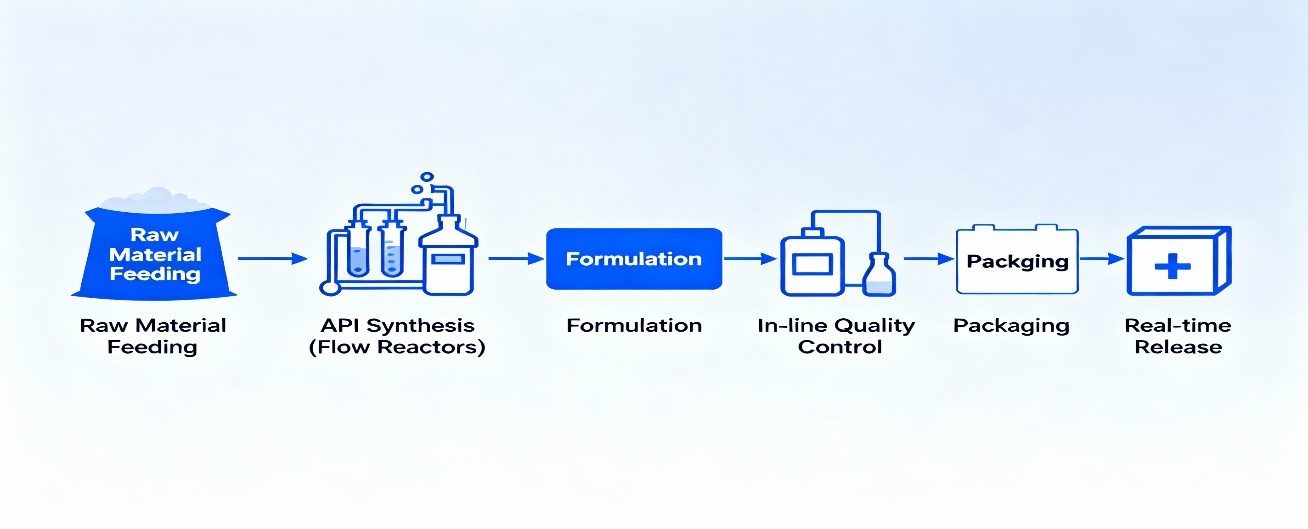
Continuous manufacturing is defined as a process where every production step—from API synthesis, formulation, to packaging—is merged into a single, seamless flow. Unlike traditional batch methods that rely on transferring materials between stages, continuous workflows employ automated feeding, real-time monitoring, and ongoing discharge, which enables instant adjustments and eliminates downtime. Process Analytical Technology (PAT) and in-line sensors are used throughout to assure product quality and compliance—critical for regulatory inspections and market needs.?
Typical Workflow Diagram Steps (description):
Raw material feeding (API, excipients, solvents enter system)
API synthesis (flow reactors—modular, automated control)
Formulation (continuous blending, granulation, tableting or film casting)
In-line quality control (PAT, sensors for content uniformity, moisture, etc.)
Every stage operates without stopping, minimizing intermediate storage or wait times, so product moves forward as soon as it's ready for the next phase.?
Reduced costs for labor, energy, facilities, and inventory due to streamlined processes.?
Higher scalability via modular equipment and flexible throughput, quickly meeting varying demand.?
Improved quality with automated, in-line monitoring and feedback loops that reduce human error.?
Minimized downtime, since processes run uninterrupted and repairs/adjustments can be made on the fly.?
Substantial reduction in waste via optimized material flow, reaction conditions, and immediate corrections.?
Enhanced supply chain resilience, allowing rapid response to shortages, surges, or disruptions.?5
Core Technologies
Continuous manufacturing relies on several technologies:
API synthesis: Modular flow reactors and automated synthesis platforms facilitate nonstop raw material transformation, introducing precise dosing and control.?
Formulation: Continuous blending, wet granulation, drying, and tableting (or film-forming for mucoadhesive systems) allow constant input/output and fine-tuned adjustments.?
Packaging: Inline packaging machines provide seamless transfer from product creation to packing, including serialization and data logging.6?
Modular approach: Equipment and units are configured as plug-and-play modules, which can be re-arranged or scaled up/down as needed to match varied production volumes.?
Process Analytical Technology (PAT): Real-time spectroscopic and sensor-based monitoring provides continuous feedback for content uniformity, moisture, purity, and defect detection at every stage.?7
Process Analytical Technology (PAT)
Process Analytical Technology (PAT) in pharmaceuticals is a framework for designing, analyzing, and controlling manufacturing processes by monitoring critical process parameters (CPPs) that affect critical quality attributes (CQAs) in real-time.?
PAT Concept: Monitoring Modes
PAT employs three primary monitoring approaches:
On-line: Direct monitoring where samples are automatically taken from the process stream and analyzed immediately in an adjacent analyzer.?
In-line: Sensors and analytical devices are embedded directly in the process flow for real-time measurement without sample removal.?
At-line: Samples are taken manually or semi-automatically near the process line and analyzed outside the flow but still in close proximity for quick feedback.?8
This versatility enables continuous insight into the process dynamics, enabling rapid response and control.?
Real-Time Process Monitoring for CQAs
PAT systematically monitors CQAs such as chemical composition, moisture content, particle size, uniformity, dissolution rate, and other quality metrics critical for product efficacy and safety. Measurements are continuously collected to ensure that these attributes remain within predefined limits, supporting quality by design (QbD) principles. Real-time monitoring reduces batch variability, waste, reprocessing, and rejects by allowing immediate correction of deviations.?
Key PAT Tools
Near-Infrared (NIR) Spectroscopy: Non-destructive, rapid chemical analysis for content uniformity, moisture, and API quantification.?
Raman Spectroscopy: Complementary to NIR, effective for molecular structure analysis and in-line monitoring of formulation blending.?
Chromatography (e.g., HPLC): Precise separation and quantification of components, often used at-line or off-line but can be adapted for on-line monitoring in integrated systems.?
Feedback Controls: PAT integrates sensor data with automated process controls; for example, adjusting feed rates, temperature, or mixer speed in real-time based on measured CQAs to maintain consistent output quality.?9
Role of PAT in Continuous Manufacturing
In continuous manufacturing, PAT is indispensable for maintaining product consistency and ensuring regulatory compliance. It enables immediate detection and correction of process shifts without halting production lines. This continuous feedback loop enhances process understanding, facilitates real-time release testing (RTRT), and supports continuous process verification (CPV) reducing overall cycle time and improving yield.?
Raw Materials → [Flow Reactor + PAT sensors (NIR, Raman)] → Formulation + PAT sensors → Continuous Monitoring & Feedback Control → Packaging10
Industrial Adoption and Case Studies
Regulatory Support
The FDA's 2023 Q13 guidance outlines scientific and regulatory considerations for CM of drug substances and products, covering development, operation, control strategies, lifecycle management, and bridging batch to continuous methods. It endorses CM for chemical entities, therapeutic proteins, biosimilars, and supports flexibility in scaling production with real-time process monitoring and control.?
EMA’s ICH Q13 guidelines complement FDA’s by emphasizing quality by design, control strategies, and lifecycle management specifically for CM, applicable to new drugs, generics, biosimilars, and conversions from batch manufacturing. EMA also leads on Real Time Release Testing (RTRT) that works synergistically with PAT.?
Both agencies recognize that CM and PAT can improve product quality, reduce shortages, shorten time-to-market, and enhance supply chain resilience by enabling flexible, robust manufacturing paradigms.?11
Industrial Adoption and Case Examples
Large pharmaceutical companies and generics manufacturers have implemented CM systems to modernize production. Notable examples include GEA Group, which provides modular, integrated pharmaceutical continuous manufacturing units, and Thermo Fisher Scientific, offering end-to-end continuous platforms that integrate API synthesis, formulation, PAT monitoring, and packaging.?
These companies demonstrate how modular design allows rapid configuration of production lines for different drugs and volumes. Their platforms support effective process control and real-time quality assurance through PAT integration.?12
Role During COVID-19 Vaccine and Biologics Production
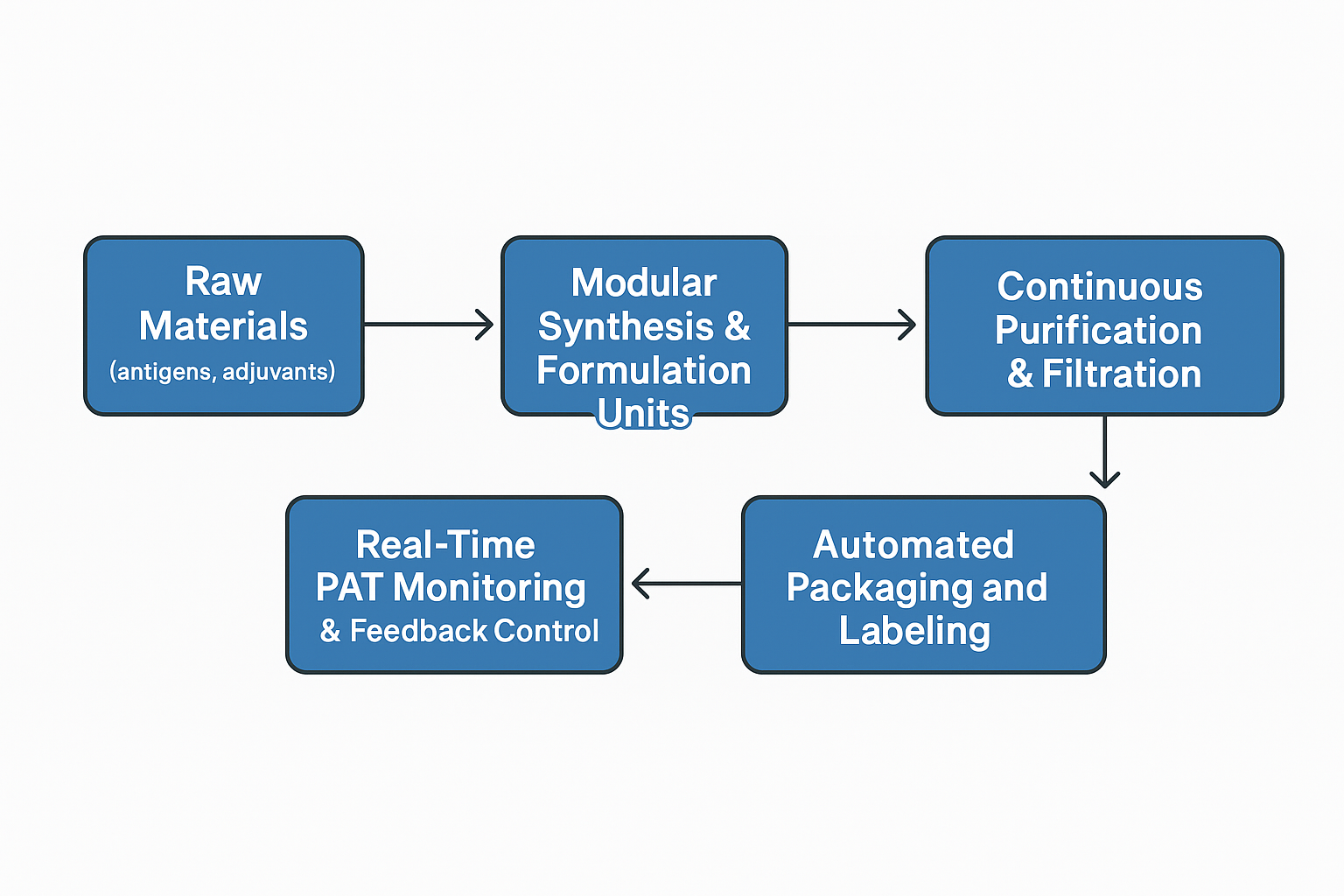
Modular and integrated continuous manufacturing systems proved vital during the COVID-19 pandemic by enabling rapid vaccine and biologics production at scale.13 These systems enabled accelerated vaccine synthesis, formulation, purification, and packaging in a fully integrated, automated workflow, drastically reducing production timelines.?14
A typical simplified flowchart of such a system illustrates:
This streamlined the supply chain, reduced human intervention, and ensured consistent quality, facilitating expedited regulatory approvals and faster delivery to global populations.?15
Technological Advances
Automation and digitalization: The impact of Artificial Intelligence (AI), real-time analytics, and digital twins has been profound. AI-enabled digital twins are virtual replicas of physical manufacturing processes that operate in real time alongside actual production. They simulate and optimize processes, provide predictive maintenance, enable smart closed-loop control, and support real-time quality assurance. AI integrates complex data streams from Process Analytical Technology (PAT) sensors and other sources to enhance process understanding and control, leading to improved yield, consistency, and efficiency.
Modular manufacturing systems: These systems provide flexible scaling and fast change-over capabilities. Modular designs enable rapid adaptation of production capacity or product formulation without extensive downtime or revalidation, supporting personalized medicine and smaller batch sizes while maintaining continuous production efficiency.
PAT-enabled advanced quality control and regulatory compliance: Integration of PAT sensors such as NIR and Raman spectroscopy facilitates continuous monitoring of critical quality attributes. Combined with AI and digital twins, PAT enables real-time release testing, supports Quality by Design (QbD) principles, and ensures compliance with regulatory frameworks including FDA’s Q14 guidance and ICH Q8/Q9/Q10 standards. Together, these advances contribute to the realization of Pharma 4.0—a smart, flexible, and fully integrated pharmaceutical manufacturing environment that maximizes product quality, minimizes waste, and shortens production timelines.16
Challenges in Adoption
Capital investment and retrofitting legacy plants: Transitioning from batch to continuous manufacturing requires significant upfront investment in new equipment, infrastructure, and automation technologies. Retrofitting existing older batch facilities to accommodate continuous processes can be complex, costly, and time-consuming, serving as a barrier for many companies.?
Training and workforce transition: Continuous manufacturing involves advanced technologies such as PAT sensors, AI-based monitoring, and digital twins. This shift requires hiring skilled personnel and retraining existing staff to operate, maintain, and manage the new systems efficiently. Workforce transition and ongoing training programs pose challenges in skill availability and change management.?17
Regulatory harmonization between global authorities: Different regulatory agencies worldwide have varying guidelines and expectations for continuous manufacturing processes. Achieving regulatory approval requires navigating evolving, sometimes fragmented regulations. Harmonization efforts by bodies like the International Council for Harmonization (ICH) and increased regulatory flexibility are ongoing but still present challenges for global pharmaceutical manufacturers.? These challenges underscore the need for strategic planning, investment in human capital, and proactive engagement with regulatory authorities to facilitate smooth adoption of continuous manufacturing technology in the pharmaceutical industry.18
Impact of Continuous Manufacturing on the Pharmaceutical Supply Chain
Supply Chain Resilience: Continuous manufacturing contributes significantly to supply chain resilience by enabling more agile, flexible, and responsive production capabilities. It allows for uninterrupted production flows, which help address drug shortages and respond swiftly to pandemic-related demand spikes. Real-time monitoring and AI-driven analytics optimize inventory management and reduce lead times, enhancing the ability to maintain consistent drug supply even during disruptions.?19
Personalized Medicine: Continuous manufacturing supports the production of small-batch, flexible medications essential for personalized medicine. Modular and scalable process designs allow for rapid change-overs and customization, accommodating diverse patient needs with shorter lead times and reduced waste. This capability fosters closer alignment between drug manufacturing and patient-centric therapies, driving innovation in treatment approaches.? Thus, continuous manufacturing reshapes pharmaceutical supply chains from rigid, forecast-driven models to flexible, demand-responsive systems that improve drug availability, quality, and patient outcomes in a rapidly evolving healthcare landscape.20,21
Market Outlook and Economic Impact
Growth Trends
The global pharmaceutical continuous manufacturing market was valued around USD 1.5 to 1.64 billion in 2024-2025 and is projected to grow at a CAGR of approximately 9.5% to 9.6% over 2025-2033. Market valuations are expected to reach around USD 3.3 to 3.4 billion by 2033.
Leading geographies include North America, which holds the largest market share (~40%), followed by Europe and Asia-Pacific, with Asia-Pacific expected to exhibit the fastest growth rate of over 10% CAGR driven by China, India, and Japan. The U.S. is the major market within North America.?
The market segments into Active Pharmaceutical Ingredients (APIs), biologics, and dry powders, with solid dosages currently dominant but biologics showing the fastest growth potential due to expanding bioprocessing investments.?22
Cost-Benefit Analysis
Continuous manufacturing offers faster development speeds, improved process safety, superior scalability, and more efficient raw material utilization compared to batch processes.
Reduced production times and enhanced process control lead to cost savings in manufacturing, quality control, and compliance.
Modular and portable systems allow flexible production, reducing inventory and improving responsiveness to market demand.
While substantial capital investment is required, the long-term operational efficiencies, reduced waste generation, and regulatory acceptance increasingly justify the economic benefits.?23
Future Expansion
Expansion is anticipated in complex products such as APIs, biologics, and emerging areas like cell and gene therapies.
Continuous manufacturing is being adapted for these advanced therapies to improve quality, scalability, and supply chain resilience.
Advances in automation, PAT integration, and AI-driven control are key enablers for expanding the technology to new drug modalities.24
Regulatory Developments and Quality by Design (QbD)
Support and Guidance from FDA and EMA
Regulatory agencies such as the U.S. Food and Drug Administration (FDA) and the European Medicines Agency (EMA) increasingly support modern, science- and risk-based manufacturing approaches.
Guidance documents encourage continuous manufacturing, digital process control, and the integration of Process Analytical Technology (PAT) as part of QbD frameworks.
Both agencies provide pathways for regulatory flexibility when robust QbD data and real-time monitoring demonstrate process understanding and control.25
QbD Principles Enabled by Real-Time PAT
Real-time PAT tools provide continuous measurement of critical quality attributes (CQAs) and critical process parameters (CPPs), enabling precise control.
PAT-driven feedback loops allow adaptive process adjustments, reducing variability and enhancing product consistency.
The integration of PAT within a QbD approach supports: Enhanced process understanding, Improved design space definition, More robust continuous and modular manufacturing systems, Faster regulatory approval, due to transparent, data-rich process justification.26
CONCLUSIONS AND FUTURE DIRECTIONS
Continuous manufacturing (CM) and Process Analytical Technology (PAT) represent a profound paradigm shift in the pharmaceutical industry. Unlike traditional batch processing, CM enables seamless, uninterrupted production, resulting in enhanced efficiency, reduced costs, and improved product quality. This approach fosters supply chain resilience by enabling agile, responsive manufacturing capable of swiftly addressing market demands and emergencies such as pandemics. The widespread adoption of CM is well underway, with major pharmaceutical companies demonstrating its commercial success and regulatory agencies increasingly supporting this transition.? Digital transformation is a key driver of this shift, with Industry 4.0 technologies like advanced sensor systems, AI, real-time analytics, and digital twins enabling unprecedented control and transparency over manufacturing processes. Smart factories equipped with these next-generation technologies automate quality assurance and optimize production dynamically, ensuring consistent compliance with regulatory standards. This convergence of digital and manufacturing innovation is setting the stage for highly flexible, efficient, and sustainable pharmaceutical production environments that can adapt rapidly to evolving healthcare needs.?
REFERENCES
Continuous manufacturing vs batch manufacturing overview. NNIT Digital Manufacturing; 1999.
FDA. Q13 Guidance on Continuous Manufacturing of Drug Substances and Drug Products. Silver Spring (MD): U.S. Food and Drug Administration; 2023.
GillsProcess. Benefits of continuous manufacturing in pharmaceutical industry. 2025 Apr 01.
Benefits of continuous manufacturing in pharmaceuticals. Gills Process; 2025 Apr 01.
Continuous manufacturing platform features. Syntegon; 2021 Dec 07.
Why adopt continuous processing? WSP; 2025 Jun 22.
FDA. Process Analytical Technology Guidance for Industry. Silver Spring (MD): U.S. Food and Drug Administration; 2004.
Process Analytical Technology (PAT) in pharmaceutical manufacturing. PharmaNow; 2024 Jun 01.
Process Analytical Technology tools for monitoring pharmaceutical manufacturing processes. NCBI PMC; 2021 Jun 20.
U.S. Food and Drug Administration. Q13 Guidance on Continuous Manufacturing of Drug Substances and Drug Products. Silver Spring (MD): FDA; 2023.
European Medicines Agency. ICH Q13: Continuous Manufacturing. London: EMA; 2023.
GEA Group and Thermo Fisher Scientific continuous manufacturing platforms. Pharma Industry Reports; 2025.
Pfizer expands manufacturing efforts to increase COVID-19 vaccine access. Pfizer; 2021 Nov 07.
Warne N. Delivering 3 billion doses of Comirnaty in 2021. Nature; 2023 Feb 01.
King ML. How manufacturing won or lost the COVID-19 vaccine race. PMC NCBI; 2024 Feb 14.
Van Deusen RA. AI-Enabled Digital Twins in Biopharmaceutical Manufacturing. BioProcess Int. 2025 Nov 11 [cited 2025 Nov 17]. Available from: https://bioprocessintl.com
Digital Twins: Reshaping the Pharmaceutical Sector. PharmaNow. 2024 Jun 01 [cited 2025 Nov 17]. Available from: https://pharmanow.live
Understanding Digital Twins in Pharma Manufacturing. Cleanroom Technology. 2024 Dec 31 [cited 2025 Nov 17]. Available from: https://cleanroomtechnology.com
GillsProcess. Benefits of Continuous Manufacturing in Pharma [Internet]. 2025 Apr 01 [cited 2025 Nov 17]. Available from: https://gillsprocess.com/benefits-continuous-manufacturing-pharma
Dr. Reddy’s Laboratories. Continuous Manufacturing Process and Its Impact on Pharmaceutical Supply Chains [Internet]. 2025 Oct 31 [cited 2025 Nov 17]. Available from: https://api.drreddys.com/continuous-manufacturing-process-impact
Srai JS, et al. Future Supply Chains Enabled by Continuous Processing of Pharmaceuticals [Internet]. PMC NCBI. 2015 Jan 27 [cited 2025 Nov 17]. Available from: https://www.ncbi.nlm.nih.gov/pmc/articles/PMCxxxxxxxx
IMARC Group. Pharmaceutical Continuous Manufacturing Market Size 2033 [Internet]. 2024 Feb 29 [cited 2025 Nov 17]. Available from: https://www.imarcgroup.com/pharmaceutical-continuous-manufacturing-market
Transparency Market Research. Pharmaceutical Continuous Manufacturing Market Insight 2025 [Internet]. 2011 Feb 13 [cited 2025 Nov 17]. Available from: https://www.transparencymarketresearch.com/pharmaceutical-continuous-manufacturing-market.html
Data Bridge Market Research. Global Pharmaceutical Continuous Manufacturing Market Size and Forecast 2024-2032 [Internet]. 2023 Dec 31 [cited 2025 Nov 17]. Available from: https://www.databridgemarketresearch.com/reports/global-pharmaceutical-continuous-manufacturing-market
European Medicines Agency. ICH guideline Q13 on continuous manufacturing of drug substances and drug products [Internet]. London: EMA; 2023 Jan 05 [cited 2025 Nov 17]. Available from: https://www.ema.europa.eu/en/documents/scientific-guideline/ich-guideline-q13-continuous-manufacturing-drug-substances-products_en.pdf
International Council for Harmonisation of Technical Requirements for Pharmaceuticals for Human Use. Quality Guidelines (Q2(R2), Q8, Q9, Q10, Q14) [Internet]. ICH; 2023 [cited 2025 Nov 17]. Available from: https://www.ich.org/page/quality-guidelines.
Reference
Continuous manufacturing vs batch manufacturing overview. NNIT Digital Manufacturing; 1999.
FDA. Q13 Guidance on Continuous Manufacturing of Drug Substances and Drug Products. Silver Spring (MD): U.S. Food and Drug Administration; 2023.
GillsProcess. Benefits of continuous manufacturing in pharmaceutical industry. 2025 Apr 01.
Benefits of continuous manufacturing in pharmaceuticals. Gills Process; 2025 Apr 01.
Continuous manufacturing platform features. Syntegon; 2021 Dec 07.
Why adopt continuous processing? WSP; 2025 Jun 22.
FDA. Process Analytical Technology Guidance for Industry. Silver Spring (MD): U.S. Food and Drug Administration; 2004.
Process Analytical Technology (PAT) in pharmaceutical manufacturing. PharmaNow; 2024 Jun 01.
Process Analytical Technology tools for monitoring pharmaceutical manufacturing processes. NCBI PMC; 2021 Jun 20.
U.S. Food and Drug Administration. Q13 Guidance on Continuous Manufacturing of Drug Substances and Drug Products. Silver Spring (MD): FDA; 2023.
European Medicines Agency. ICH Q13: Continuous Manufacturing. London: EMA; 2023.
GEA Group and Thermo Fisher Scientific continuous manufacturing platforms. Pharma Industry Reports; 2025.
Pfizer expands manufacturing efforts to increase COVID-19 vaccine access. Pfizer; 2021 Nov 07.
Warne N. Delivering 3 billion doses of Comirnaty in 2021. Nature; 2023 Feb 01.
King ML. How manufacturing won or lost the COVID-19 vaccine race. PMC NCBI; 2024 Feb 14.
Van Deusen RA. AI-Enabled Digital Twins in Biopharmaceutical Manufacturing. BioProcess Int. 2025 Nov 11 [cited 2025 Nov 17]. Available from: https://bioprocessintl.com
Digital Twins: Reshaping the Pharmaceutical Sector. PharmaNow. 2024 Jun 01 [cited 2025 Nov 17]. Available from: https://pharmanow.live
Understanding Digital Twins in Pharma Manufacturing. Cleanroom Technology. 2024 Dec 31 [cited 2025 Nov 17]. Available from: https://cleanroomtechnology.com
GillsProcess. Benefits of Continuous Manufacturing in Pharma [Internet]. 2025 Apr 01 [cited 2025 Nov 17]. Available from: https://gillsprocess.com/benefits-continuous-manufacturing-pharma
Dr. Reddy’s Laboratories. Continuous Manufacturing Process and Its Impact on Pharmaceutical Supply Chains [Internet]. 2025 Oct 31 [cited 2025 Nov 17]. Available from: https://api.drreddys.com/continuous-manufacturing-process-impact
Srai JS, et al. Future Supply Chains Enabled by Continuous Processing of Pharmaceuticals [Internet]. PMC NCBI. 2015 Jan 27 [cited 2025 Nov 17]. Available from: https://www.ncbi.nlm.nih.gov/pmc/articles/PMCxxxxxxxx
IMARC Group. Pharmaceutical Continuous Manufacturing Market Size 2033 [Internet]. 2024 Feb 29 [cited 2025 Nov 17]. Available from: https://www.imarcgroup.com/pharmaceutical-continuous-manufacturing-market
Transparency Market Research. Pharmaceutical Continuous Manufacturing Market Insight 2025 [Internet]. 2011 Feb 13 [cited 2025 Nov 17]. Available from: https://www.transparencymarketresearch.com/pharmaceutical-continuous-manufacturing-market.html
Data Bridge Market Research. Global Pharmaceutical Continuous Manufacturing Market Size and Forecast 2024-2032 [Internet]. 2023 Dec 31 [cited 2025 Nov 17]. Available from: https://www.databridgemarketresearch.com/reports/global-pharmaceutical-continuous-manufacturing-market
European Medicines Agency. ICH guideline Q13 on continuous manufacturing of drug substances and drug products [Internet]. London: EMA; 2023 Jan 05 [cited 2025 Nov 17]. Available from: https://www.ema.europa.eu/en/documents/scientific-guideline/ich-guideline-q13-continuous-manufacturing-drug-substances-products_en.pdf
International Council for Harmonisation of Technical Requirements for Pharmaceuticals for Human Use. Quality Guidelines (Q2(R2), Q8, Q9, Q10, Q14) [Internet]. ICH; 2023 [cited 2025 Nov 17]. Available from: https://www.ich.org/page/quality-guidelines.
Nishita Nagpure*, Deepak Askar, Harshal Raut, Dr. Tirupati Rasala, Continuous Manufacturing and Process Analytical Technology in the Pharmaceutical Industry: Advances, Challenges, and Future Prospects, Int. J. of Pharm. Sci., 2025, Vol 3, Issue 11, 3940-3949 https://doi.org/10.5281/zenodo.17701996



 10.5281/zenodo.17701996