Cosmetic products have become an integral part of modern life, offering enhancement of beauty, hygiene, and personal confidence. However, the growing global use of cosmetics has raised significant concerns regarding their potential adverse effects on both human health and the environment. Many cosmetic formulations contain synthetic chemicals such as parabens, phthalates, triclosan, microplastics, and heavy metals that can penetrate the skin or enter the body through inhalation and ingestion, leading to dermatological irritation, hormonal disruption, reproductive toxicity, and other systemic effects. In parallel, the environmental consequences of cosmetic residues are alarming — persistent compounds and microplastics often escape wastewater treatment, contaminating aquatic ecosystems and bioaccumulating in the food chain. Moreover, excessive plastic packaging contributes to long-term environmental pollution. This review summarizes the current understanding of cosmetic composition, their toxicological effects on humans, and ecological impacts, while also highlighting global regulatory frameworks and sustainable alternatives such as green chemistry and biodegradable formulations. The paper emphasizes the urgent need for stricter regulation, consumer awareness, and adoption of eco-friendly cosmetic practices to ensure both human well-being and environmental protection.
Keywords
Cosmetics, Human Health, Environmental Pollution, Endocrine Disruptors, Microplastics, Skin Toxicity, Eco-friendly Formulations, Green Chemistry, Sustainable Cosmetics
Introduction
×
Cosmetics are among the most commonly used consumer products worldwide, contributing not only to hygiene and aesthetics but also to social identity and emotional well-being. From the use of kohl in ancient Egypt to complex anti-aging serums in modern times, cosmetics have reflected cultural values, technological progress, and evolving beauty standards.
In the modern world, cosmetics include a broad range of items—skincare (cleansers, creams, sunscreens), haircare (shampoos, conditioners, dyes), makeup (foundation, lipstick, eye shadow), deodorants, perfumes, and oral care products. The global cosmetic marketexceeds USD 500 billion, with steady annual growth due to urbanization, digital marketing, and increasing consumer awareness of personal care.
However, the cosmetic industry also faces scrutiny regarding health safety, environmental sustainability, and ethical transparency. While these products are intended for external use, the potential for chemical absorption, bioaccumulation, and ecological persistence raises important concerns.
According to the U.S. Food and Drug Administration (FDA), cosmetics are “articles intended to be applied to the human body for cleansing, beautifying, promoting attractiveness, or altering the appearance.” The World Health Organization (WHO)andInternational Organization for
Standardization (ISO) add that they should not alter the body’s structure or functions. Under this framework, cosmetics encompass both personal care productsanddecorative cosmetics, with nearly every human interacting with them multiple times daily.
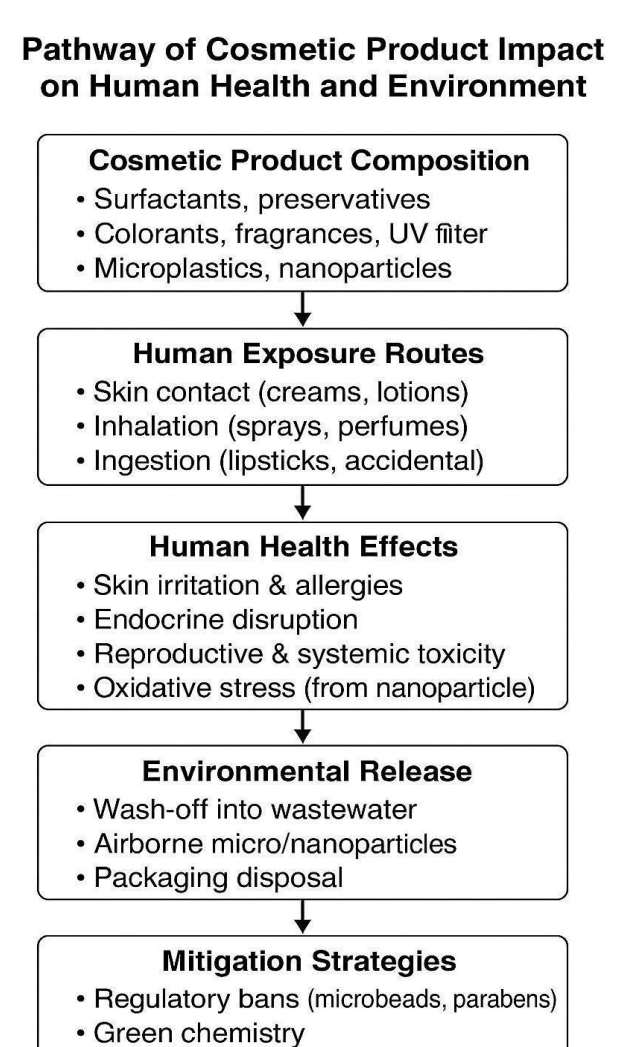
Fig no.1 Impact Pathway of Cosmetic Products
Composition of Hazards Cosmetic Products:
Modern cosmetic formulations are sophisticated chemical systems balancing function, stability, and sensory appeal. They typically consist ofbase materials, active ingredients, additives, andaesthetic modifiers.
Surfactants
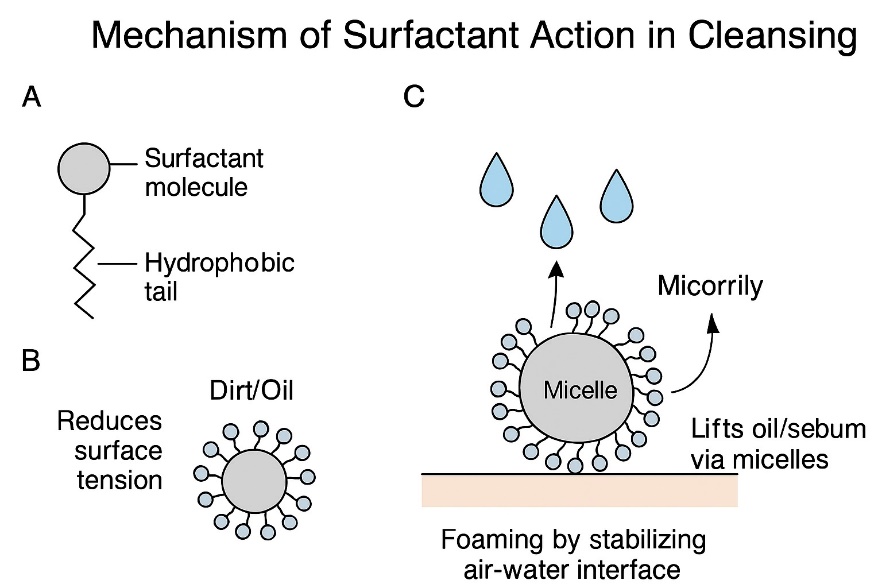
Surfactants are surface-active agents that reduce surface tension between substances, enabling cleansing, foaming, emulsification, and dispersion.
Types: anionic (e.g., sodium lauryl sulphate), cationic (used in conditioners), non-ionic (gentler for sensitive skin), and amphoteric.
Applications: Soaps, shampoos, face washes, and shaving foams.
Concerns: Prolonged exposure to harsh surfactants can disrupt the skin barrier, leading to dryness and irritation.
Mechanism of action: Surfactants-How They Work
A. Cleansing Action-Surfactantsareliketinycleanerswith two sides:a water-loving head and an oil-loving tail.When applied to skin or hair,the oily tails latch onto sebum,dirt,and oils.The Water-loving heads face outward,forming little spheres called micelles.When you rinse,the micelles trap the dirt and oil,washing them away.
B.foam Forming-Surfactants also help create foam.They lower the surface tension between water and air,stabilizing bubbles and giving you that satisfying lather in soaps and shampoos.
C.Emulsification:In creams and lotions,surfactants act as mediators between oil and water.They reduces tension at the boundary,allowing stable mixtures(emulsions)to form,so your moisturizer or shampoo doesn`t separate .
D.Possibleskin Irritation:Some harsh surfactants(likeSLS) can stirp away natural skin lipids.This leads to water loss,dryness and sometimes irritation or inflammation.
Preservative
Due to their high-water content, most cosmetics are prone to microbial contamination.
Preservatives extend shelf life and ensure safety.
Common Examples: Parabens, formaldehyde releasers, benzyl alcohol, phenoxyethanol, and organic acids.
Health Issues: Some, like parabens and formaldehyde donors, can act as endocrine disruptors or cause allergic dermatitis.
Mechanism of action: keeping Products safe
A.fightingMicrobes-Preservatives protect cosmetics from bacteria,yeast,and mold inthree main ways:
MembraneAttack:Chemicals like parabens or phenoxyethanol poke holes in microbial membranes,causing them to leak and die.
Enzyme Blocking:Some preservatives interfere with microbial enzymes,slowing or stopping their metabolism.
Proteins Crosslinking:Formaldehyde-releasing agents create links in microbial protiens,effectively freezing their activity.
B.Possible Health Concerns:Parabens can act a bit like estrogen,potentially affecting hormone balance.Formaldehyde donors can bind skin proteins,sometimes triggering allergic reactions.
Colorants
Colorants enhance the aesthetic value of cosmetics.
Synthetic Colorants: Include azo dyes, coal tar colours, and FD&C pigments.
Natural Alternatives: Derived from plants (e.g., beetroot, turmeric), minerals (e.g., iron oxides), or insects (e.g., carmine).
Safety Considerations: Some synthetic dyes may contain heavy metal impurities or exhibit mutagenic potential.
Mechanism of action:Adding Beauty
A.How Color Appears: Synthetic dyes absorb specific wavelengths of light,giving bright,vivid colors.Mineral pigments reflect light off their surface,creating color without dissolving.
B.Stability:Water-soluble dyes blend evenly into lations and geles.Pigments,on the other hand,stay suspended in products like lipsticks and foundations.
C.SafetyNotes:Some synthetic dyes break down into potentially harmful compounds. Heavy metal traces in pigments may generate harmful molecules(ROS) in the body.
Fragrances
Fragrances mask unpleasant odours and create signature scents. A single fragrance mixture can contain 50–300 different compounds, including phthalates, musk compounds, linalool, and limonene.
Health Impact: Allergic contact dermatitis, respiratory irritation, and possible endocrine disruption.
Transparency Issue: Companies often list “fragrance” as a single term, concealing the actual ingredients.
Mechanism of action:Smell and Sensory experiens
A.SmellMechanism:Fragrance molecules evaporate from the skin and to olfactory receptors,creating the scent you perceive.
B.Odor masting:Certain fragrance compounds can overpower or neutralize unpleasants smells,improving the sensory experience.
C.Skin sensitivity:Some Fragrance ingredients, like limonene or linalool, can oxidize and form allergens.These may bind skin proteins and trigger allergic reaction.
D.Hormonal Concerns:Some fixatives, such as phthalates, can mimic hormones and may interfere with the body`s endocrine system.
UV Filters
UV filters protect skin from solar radiation by either absorbing (organic filters) or reflecting (inorganic filters) harmful rays.
Organic Filters: Oxybenzone, avobenzone, octocrylene—effective but linked to hormone disruption and coral bleaching.
Inorganic Filters: Titanium dioxide (TiO?) and zinc oxide (ZnO)—safer alternatives but can produce reactive oxygen species in nano-form.
Mechanism of action: Protecting Your Skin
A. Chemical(Organic)Sunscreens: Absorb harmful UV light and convert it into heat or harmless energy.Some can break down under sun exposure,producing reactive molecules or slightly affecting hormones.
B.Physcial(Inorganic)Sunscreens:Titanium dioxide (Tio2)and zinc oxide (ZnO)reflect and scatter UV rays,protecting your skin.In nanoparticle form,they are very effective but may generate reactive oxygen species if not properly coated.
Microbeads and Microplastics
Microbeads are plastic particles (usually polyethylene) under 5 mm, used for exfoliation in scrubs and toothpaste.
Environmental Issues: Persistent, non-biodegradable, and accumulate in aquatic ecosystems, affecting plankton and fish.
Current Status: Banned in the EU, U.S., Canada, and India for rinse-off products, though microplastics from packaging remain a concern.
Mechanism of action:Tiny Scrubbers,Big Problems
A.Exfoliation:Plastic microbeads gently scrub away dead skin cells in face washes,scrubs,and toothpaste.
Environmental Impact:These tiny plastics don`t break down,end up in rivers and oceans, and accumulate in marine life.Over time,they can cause oxidative stress and inflammation in aquatic organisms.
Nanoparticles
Nanotechnology has revolutionized cosmetics by improving texture, absorption, and efficacy.
Common Nanomaterials: TiO?, ZnO, silica, silver, liposomes.
Advantages: Enhanced UV protection, longer shelf life, controlled release of active ingredients.
Concerns: Potential skin penetration, oxidative stress, and cellular toxicity.
Health Effects of Cosmetics:
Dermatological Effects
The skin is both a target and a barrier for cosmetic ingredients. Adverse effects depend on skin type, exposure duration, and formulation.
Irritation & Contact Dermatitis: Commonly triggered by preservatives (parabens, isothiazolinones) and fragrances (eugenol, limonene).
Phototoxicity: UV filters and essential oils like bergamot can react under sunlight, causing hyperpigmentation or rashes.
Mechanism of action:Nanoparticles-Tiny but Powerful
A.Skin Pentration and Delivery:Because of their small size,nanoparticles can sit on the skin or penetrate superficial layers.Liposome-based nanoparticles fuse with skin lipids,helping deliver active ingredients more effectively.
B.UV Protection:Nano-sized TiO2 and provide transparent yet strong UV protection,scattering and absorbing sunlight.
C.Controlled Release:Nanocarriers release actives gradually,improving effectiveness while minimizing irritation.
D.Safety Considerations:Some nanoparticles may generate reactive oxygen species, cause oxidative stress,or interact with cells if they penetrate damaged skin.
Systemic and Endocrine Effects
Cosmetic chemicals can enter the body through dermal absorption, inhalation, or ingestion (e.g., lip products).
Endocrine Disruption: Parabens, phthalates, and benzophenone mimic hormones, affecting reproduction and metabolism.
Reproductive Toxicity: Linked to reduced fertility, sperm abnormalities, and developmental disorders in fetuses.
Carcinogenicity: Chronic exposure to formaldehyde, coal tar dyes, or arsenic impurities is associated with certain cancers.
Nanoparticle Penetration
TiO? and ZnO Nanoparticles: Provide invisible sun protection but may induce oxidative stress in cells.
Cellular Impacts: Laboratory studies suggest nanoparticles can generate reactive oxygen species (ROS), damage DNA, and disrupt cellular signalling.
Inhalation Risks: Nano-sized powders may reach the lungs, causing inflammation or respiratory issues.
Environmental Impact of Cosmetic:
Water and Soil Contamination
Cosmetic residues enter the environment via wastewater, runoff, and industrial discharge.
Persistence: Conventional treatment plants cannot remove all synthetic chemicals.
Aquatic Toxicity: Compounds like triclosan and oxybenzone affect algae, fish, and corals by altering growth and reproduction.
Bioaccumulation: Persistent organic pollutants (POPs) such as phthalates and parabens accumulate in aquatic organisms and may re-enter the human food chain.
Microplastic Pollution
Microplastics, derived from exfoliants and degraded packaging, represent a severe ecological challenge.
They are ingested by aquatic life, impairing feeding and reproduction.
Studies have detected microplastic particles in marine species consumed by humans, indicating indirect exposure.
Packaging Waste and Carbon Footprint
Most cosmetic packaging consists of single-use plastics, glass, or aluminium.
Production Impact: Manufacturing and transportation contribute significantly to carbon emissions.
Decomposition: Conventional plastics can persist for centuries; even “biodegradable” variants often require industrial composting conditions.
Solutions: Refillable containers, recyclable materials, and minimalist designs are gaining popularity.
Global Regulatory Framework:
European Union (EU)
The EU Cosmetic Regulation (EC)No1223/2009 is one of the most comprehensive regulatory frameworks globally. It mandates that:
All cosmetic products must br safe for human health under normal or reasonably foreseeable
Ingredients with known carcinogenic,mutagenic,or toxic effect on reproduction (CMR) are prohibited or restricted.
Microplastics and certain UV filters are monitored for environment safety.
Companies must maintain a Product Information File (PIF),including toxicological data,safety assessments, and product labelling.
United States (FDA)
Oversees cosmetics under the Federal Food, Drug, and Cosmetic Act (FD&C Act).
Requires pre-market approval only for colour additives; other ingredients rely on manufacturer responsibility.
Recently strengthened oversight through the Modernization of Cosmetics Regulation Act (MoCRA, 2022).
India (BIS and CDSCO)
In Indian, cosmetic are regulated under the drugs and Cosmetic Act,1940, and associated rules. Regulatory bodies ensure:
Products meet safety, labelling, and quality standards.
Harmful chemicals such as mercury, lead, certain parabens, and microbeads are restricted.
Import and manufacturing licenses are issued based on compliance with safety norms.
Other Global Bodies
Health Canada, Japan’s Ministry of Health, andAustralia’s TGA enforce ingredient safety and labelling.
International collaboration through ISO standards promotes harmonization and consumer safety.
Regulatory Trends
Microbead Bans: Implemented globally due to marine pollution.
Nanomaterial Oversight: Transparency in labelling and toxicological evaluation.
Green Chemistry Encouragement: Preference for biodegradable and renewable ingredients.
Sustainable and Green Alternatives:
Natural and Biodegradable Formulations
Sustainable cosmetics aim to minimize toxicity and ecological harm through natural ingredients.
Rising consumer awareness, driven by education and social media, motivates brands to adopt transparent and sustainable practices.
Future Perspectives:
Clean Beauty Movement
Focuses on minimalist, non-toxic formulations free from parabens, sulphates, phthalates, and synthetic fragrances. Transparency and traceability are key values.
Bio-Innovation and Green Chemistry
Emerging materials such as algae-based emulsifiers, microbial biosurfactants, and biodegradable nanocarriers offer safer and eco-friendly alternatives.
Artificial Intelligence and Digital Toxicology
AI-driven models predict chemical safety, replacing animal testing and accelerating innovation.
In silico methods analyze molecular structures and simulate biological responses.
Digital product life-cycle assessment (LCA) tools evaluate environmental footprints.
Global Policy Integration
Future success depends on harmonized international standards that define “green,” “bio degradable,” and “nano-enabled” cosmetics consistently. Global cooperation can simplify compliance and promote sustainability.
CONCLUSION:
Cosmetics are indispensable in modern society, symbolizing self-care, confidence, and personal identity. However, their widespread use and chemical complexity demand careful management to safeguard human health and the environment.
The transition toward sustainable, transparent, and science-based innovation is essential. Through collaboration among regulators, manufacturers, scientists, and consumers, the cosmetic industry can redefine beauty—not merely as an external quality but as a reflection of health, ethics, and ecological responsibility.
REFERENCES
U.S. Food and Drug Administration (FDA). (2022). Cosmetics Overview: Definitions, Regulation, and Safety Requirements. Center for Food Safety and Applied Nutrition. → Official FDA definition and scope of cosmetic regulation.
Piccinini, P., Piecha, M., & Bianchi, I. (2016). Safety of cosmetic ingredients: Regulatory and scientific perspectives. Regulatory Toxicology and Pharmacology, 80, 27–36. → Discusses chemical safety and evolving regulatory frameworks.
Bhattacharya, S., & Dasgupta, S. (2020). Impact of cosmetic chemicals on human health and the environment. Environmental Toxicology and Pharmacology, 78, 103370.
Hernandez, L. M., Yousefi, N., et al. (2022). Microplastics in cosmetics: A threat to environmental sustainability. Environmental Science & Technology Letters, 9(5), 407–415.
Gago-Ferrero, P., Díaz-Cruz, M. S., & Barceló, D. (2017). UV filter residues and cosmetic pollutants in surface waters. Environmental International, 99, 124–138. → Evidence of environmental contamination by cosmetic residues.
European Chemicals Agency (ECHA). (2023). REACH Annex XVII: Restrictions on the Manufacture and Use of Hazardous Cosmetic Ingredients.
Díaz, A., & Espinosa, M. (2022). Cosmetic ingredients and their impact on health: A review of hazardous substances in beauty products. Environmental Toxicology and Pharmacology, 93, 103864.
Nnorom, I. C., & Igwe, J. C. (2021). Emerging concerns of microplastics in personal care products: A global review. Ecotoxicology and Environmental Safety, 213, 111948.
Gupta, P., & Kumar, R. (2020). Chemical ingredients in cosmetics and their potential health risks. International Journal of Cosmetic Science, 42(5), 489–502.
SCCS (Scientific Committee on Consumer Safety). (2021). Opinion on parabens, phthalates, and formaldehyde releasers in cosmetics. European Commission, Brussels.
Raj, S., Prasad, R., & Kumar, A. (2019). Nanotechnology in cosmetics: Opportunities and challenges. Journal of Applied Toxicology, 39(1), 75–90.
Kumar, V., & Singh, S. (2018). Surfactants in cosmetic formulations: An overview. Cosmetics, 5(1), 13.
Gago-Ferrero, P., Díaz-Cruz, M. S., & Barceló, D. (2017). UV filters bioaccumulation and ecotoxicological effects in aquatic environments. Environmental International, 99, 124– 138.
Browne, M. A., Niven, S. J., et al. (2016). Microplastic movement through the environment and food chain: Implications from cosmetic microbeads. Environmental Science & Technology, 50(7), 4037–4044.
Lohani, A., Verma, A., Joshi, H., & Yadav, N. (2020). Natural versus synthetic cosmetics: Safety, efficacy, and environmental implications. Journal of Cosmetic Dermatology, 19(5), 1099–1109.
Ramos, S., & Silva, M. (2019). Fragrance allergens in cosmetic products: Regulatory updates and analytical advances. Analytical and Bioanalytical Chemistry, 411(14), 3205– 3218.
Tian, L., Zhang, C., & Zhao, Y. (2023). Environmental implications of silicone-based ingredients in cosmetics. Science of the Total Environment, 875, 162672.
United States Food and Drug Administration (FDA). (2022). Cosmetic Ingredients and Their Safety. Center for Food Safety and Applied Nutrition.
Nadim, F., & Abbas, A. (2017). Role of preservatives and their toxicity in cosmetics. Asian Journal of Pharmaceutics, 11(4), 785–791.
Abreu, R. D., & Monteiro, R. (2024). Bioaccumulation and ecotoxicity of benzophenone type UV filters: A comprehensive review. Chemosphere, 356, 140556.
Reference
U.S. Food and Drug Administration (FDA). (2022). Cosmetics Overview: Definitions, Regulation, and Safety Requirements. Center for Food Safety and Applied Nutrition. → Official FDA definition and scope of cosmetic regulation.
Piccinini, P., Piecha, M., & Bianchi, I. (2016). Safety of cosmetic ingredients: Regulatory and scientific perspectives. Regulatory Toxicology and Pharmacology, 80, 27–36. → Discusses chemical safety and evolving regulatory frameworks.
Bhattacharya, S., & Dasgupta, S. (2020). Impact of cosmetic chemicals on human health and the environment. Environmental Toxicology and Pharmacology, 78, 103370.
Hernandez, L. M., Yousefi, N., et al. (2022). Microplastics in cosmetics: A threat to environmental sustainability. Environmental Science & Technology Letters, 9(5), 407–415.
Gago-Ferrero, P., Díaz-Cruz, M. S., & Barceló, D. (2017). UV filter residues and cosmetic pollutants in surface waters. Environmental International, 99, 124–138. → Evidence of environmental contamination by cosmetic residues.
European Chemicals Agency (ECHA). (2023). REACH Annex XVII: Restrictions on the Manufacture and Use of Hazardous Cosmetic Ingredients.
Díaz, A., & Espinosa, M. (2022). Cosmetic ingredients and their impact on health: A review of hazardous substances in beauty products. Environmental Toxicology and Pharmacology, 93, 103864.
Nnorom, I. C., & Igwe, J. C. (2021). Emerging concerns of microplastics in personal care products: A global review. Ecotoxicology and Environmental Safety, 213, 111948.
Gupta, P., & Kumar, R. (2020). Chemical ingredients in cosmetics and their potential health risks. International Journal of Cosmetic Science, 42(5), 489–502.
SCCS (Scientific Committee on Consumer Safety). (2021). Opinion on parabens, phthalates, and formaldehyde releasers in cosmetics. European Commission, Brussels.
Raj, S., Prasad, R., & Kumar, A. (2019). Nanotechnology in cosmetics: Opportunities and challenges. Journal of Applied Toxicology, 39(1), 75–90.
Kumar, V., & Singh, S. (2018). Surfactants in cosmetic formulations: An overview. Cosmetics, 5(1), 13.
Gago-Ferrero, P., Díaz-Cruz, M. S., & Barceló, D. (2017). UV filters bioaccumulation and ecotoxicological effects in aquatic environments. Environmental International, 99, 124– 138.
Browne, M. A., Niven, S. J., et al. (2016). Microplastic movement through the environment and food chain: Implications from cosmetic microbeads. Environmental Science & Technology, 50(7), 4037–4044.
Lohani, A., Verma, A., Joshi, H., & Yadav, N. (2020). Natural versus synthetic cosmetics: Safety, efficacy, and environmental implications. Journal of Cosmetic Dermatology, 19(5), 1099–1109.
Ramos, S., & Silva, M. (2019). Fragrance allergens in cosmetic products: Regulatory updates and analytical advances. Analytical and Bioanalytical Chemistry, 411(14), 3205– 3218.
Tian, L., Zhang, C., & Zhao, Y. (2023). Environmental implications of silicone-based ingredients in cosmetics. Science of the Total Environment, 875, 162672.
United States Food and Drug Administration (FDA). (2022). Cosmetic Ingredients and Their Safety. Center for Food Safety and Applied Nutrition.
Nadim, F., & Abbas, A. (2017). Role of preservatives and their toxicity in cosmetics. Asian Journal of Pharmaceutics, 11(4), 785–791.
Abreu, R. D., & Monteiro, R. (2024). Bioaccumulation and ecotoxicity of benzophenone type UV filters: A comprehensive review. Chemosphere, 356, 140556.
Phapale Rutuja
Corresponding author
Shri Swami Samarth Institute Of Pharmacy Malwadi (Bota).
Shelke Akash
Co-author
Shri Swami Samarth Institute Of Pharmacy Malwadi (Bota).
Gadekar Sakshi
Co-author
Shri Swami Samarth Institute Of Pharmacy Malwadi (Bota).
Phapale Rutuja*, Shelke Akash, Gadekar Sakshi, Cosmetic Products and Their Implications for Human Health, Int. J. of Pharm. Sci., 2025, Vol 3, Issue 12, 506-516 https://doi.org/10.5281/zenodo.17799351




 10.5281/zenodo.17799351