
PG Scholar School of Pharmacy YBN University, Associate Professor school of Pharmacy YBN University, Dean & Principal School of Pharmacy YBN University Ranchi, Jharkhand-834010
The objective of this study is to enhance the oral bioavailability of furosemide by the development and evaluation of furosemide matrix tablets that are made using the solid dispersion technique. Following the manufacture of furosemide solid dispersions by the use of solvent evaporation and kneading techniques, the solubility, drug content, and practical yield of these dispersions were evaluated. PVP K-30 was used as the hydrophilic carrier. On the other hand, the solubility of SDS3 (1:2 ratio, solvent evaporation) was about four times higher than that of pure furosemide, coming in at 0.2746 mg/ml. In order to obtain a sustained release of the medicine, matrix tablets were filled with solid dispersions that were tuned and then polymerized with xanthan gum. All of the tablets' physical characteristics, including their hardness, friability, weight uniformity, thickness, and drug content, were examined, and it was discovered that they met all of the pharmacopeial requirements. In agreement with the models that were presented by Higuchi and Korsmeyer-Peppas, the kinetic analysis suggested that the release was regulated by diffusion. Furthermore, the in-vitro dissolution experiments demonstrated that the release was maintained for a period of fifteen to twenty-four hours. The findings of this study demonstrate that the combination of the matrix tablet formulation with the solid dispersion method has the potential to significantly enhance the controlled release and solubility of furosemide products. Consequently, this has the potential to boost the oral bioavailability of the medication as well as its therapeutic efficacy.
Utilizing matrix tablets is one option that may be considered when looking for a straightforward and effective approach of developing a medication delivery system that offers sustained release. These include not only the drug but also a polymer that slows down the release of the medicament. The purpose of these systems is to improve therapeutic efficacy, reduce the frequency of administration, and promote patient compliance by managing the release of the medicine. Over the last several years, the use of natural gums, particularly for the purpose of delaying the release of medicine, has been more prevalent in sustained-release formulations [1,2,3,4]. Natural polymers have the potential to govern the dispersion and release of medications over extended periods of time. This is because natural polymers are biodegradable, does not contain any hazardous substances, and has the capacity to swell when exposed to water. Natural gums provide a number of advantages to synthetic polymers, including the fact that they are less expensive, more widely available, non-toxic, and compatible with medications. These natural gums are some of the most often utilized in pharmaceutical formulations. Guar gum, Xanthan gum, pectin, and gum tragacanth are some of the most prevalent. The stability of the formulation may be improved with the help of these gums, and the release of the medication can be prolonged with their incorporation. One of them is Xanthan gum, which is an extracellular polysaccharide with a high molecular weight. It is produced in a commercial setting by fermenting the gram-negative bacteria Xanthomonas campestris in a viscous way [5]. The molecular structure of this substance, which consists of a cellulose-like backbone coupled to alternating glucose residues with trisaccharide side chains, is responsible for its hydrophilicity, swelling capacity, and gel-forming properties. This polymer has a long history of application in aqueous system thickening, suspending, and emulsifying; nevertheless, due to its ability to maintain drug release, it has becoming increasingly used in matrix tablet technology, namely in the formulation of controlled-release tablets. In order to inhibit sodium and chloride reabsorption, furosemide (4-chloro-2-furfurylamino-5-sulfamoyl benzoic acid) acts on the ascending limb of the loop of Henle. As a result, it is a popular choice for treating edema in liver cirrhosis, congestive heart failure, and renal disorders [6]. Furosemide is one of the most effective loop diuretics. The pharmacological properties of furosemide include a low oral bioavailability of 43-69%, a narrow absorption window, and poor water solubility. Despite its therapeutic significance, furosemide presents a number of challenges because of these characteristics. As a result of the medicine's low acidity, the majority of its absorption occurs in the stomach and the upper portion of the small intestine. First-pass metabolism is performed on it, which further reduces the amount of it that is available to the body systems. Due to the fact that furosemide has a very short biological half-life of around one hundred minutes, patients may be less inclined to take the medication as directed, and the therapeutic efficacy of the medication may be diminished. It is possible that the solid dispersion approach, which has the ability to improve the solubility and rate of dissolution of drugs that are not highly water-soluble, might be a response to these concerns. In order to enhance the wettability and solubility of the medication, as well as perhaps boost its oral bioavailability, this process includes molecularly distributing the medication inside a hydrophilic polymer matrix structure. It is not sufficient to just improve the solubility of pharmaceuticals like furosemide in order to ensure that therapeutic levels are maintained. Instead, a combination of solid dispersion and a polymeric matrix tablet technology is required in order to provide controlled release in addition to improved solubility. Within the scope of this study, the manufacture of furosemide solid dispersions in matrix tablets based on xanthan gum was covered. The dispersions were produced by employing the processes of solvent evaporation and kneading, with PVP-K30 serving as the hydrophilic carrier through the process. We investigated the matrix tablets' physical features, dissolving profile, and release kinetics in order to develop a more effective formulation that may potentially boost oral bioavailability while preserving the therapeutic impact. The purpose of this approach is to address the issues of furosemide bioavailability and dose by combining the enhancement of solubility by solid dispersion with the control of release through the use of matrix technology.
OBJECTIVES
MATERIAL AND METHOD
Furosemide (FUR) was a free sample from a major pharmaceutical business. Pharmaceutical businesses supplied PVP K-30, xanthan gum, MCC 102, talc, magnesium stearate, lactose monohydrate, and croscarmellose sodium. Methanol, ethanol, hydrochloric acid, and others were analytical chemicals. Distilled water was utilized throughout the experiment.
Preparation of Furosemide Solid Dispersions
Hydrophilic PVP K-30 solid dispersions increased furosemide solubility and oral absorption.
1. Solvent Evaporation Method
Furosemide and PVP K-30 were tested at 1:1, 1:2, and 1:1 drug-to-polymer ratios. The drug and polymer were mixed continuously for one hour at room temperature after dissolving in a little quantity of methanol. A revolving 40 °C evaporator extracted solvent at reduced pressure. A 24-hour hot air oven at 40 °C dried the solid bulk. It was crushed, sieved through a 60-mesh sieve, and stored in a desiccator until required [7].
2. Kneading Method
A physical mixture of furosemide and PVP K-30 (1:0.5, 1:1, and 1:2) was moistened with a little volume of 1:1 v/v ethanol-water. The mixture was aggressively kneaded for 30 minutes. After 24 hours of drying at 40 °C, the kneaded mass was crushed, passed through a 60-mesh screen, and packed in containers to avoid airtightness.
Evaluation of Solid Dispersions
1. Percentage Practical Yield: To determine how effective the preparation procedure was, the solid dispersions were weighed and the percentage practical yield was computed.
2. Drug Content: A solid dispersion containing 10 mg of furosemide was dissolved in methanol, adjusted to the appropriate concentration, and then measured using spectrophotometry at 245 nm [8].
3. Solubility Studies: After adding surplus pure medicine and solid dispersions to distilled water, the mixture was stirred for 24 hours at 25 °C. The materials were filtered and spectrophotometrically analyzed for drug solubility.
4. FT-IR Studies
PVP K-30, solid dispersions, and pure furosemide FT-IR spectra were collected to investigate drug-polymer interactions [9]. The best solid dispersion for tablet formulation was determined based on solubility and medication content [10].
Preparation of Sustained Release Matrix Tablets Using Solid Dispersion
Direct compression was employed to make sustained release matrix tablets from enhanced furosemide solid dispersion. Matrix tablets (SX1-SX5) were manufactured with 1:2, 1:3, 1:4, and 1:5 solid dispersion equivalent drug:xanthan gum ratios. MCC filler, PVP K-30 binder, magnesium stearate lubricant, talc glidant, lactose weight adjuster. The components were mixed properly, filtered through a 60-mesh filter, then crushed using a single-punch tablet compression machine to produce uniform tablet sizes.
Table 1: Composition of matrix tablets of furosemide.
|
Ingredients mg/tablet |
Formulation code |
|||||
|
SF0 |
SX1 |
SX2 |
SX3 |
SX4 |
SX5 |
|
|
Furosemide |
20 |
20 |
20 |
20 |
20 |
20 |
|
Xanthan gum |
--- |
20 |
40 |
60 |
80 |
100 |
|
Microcrystalline cellulose |
113 |
93 |
73 |
53 |
33 |
13 |
|
Talc |
2.0 |
2.0 |
2.0 |
2.0 |
2.0 |
2.0 |
|
Magnesium stearate |
2.0 |
2.0 |
2.0 |
2.0 |
2.0 |
2.0 |
|
PVP K 30 |
3.0 |
3.0 |
3.0 |
3.0 |
3.0 |
3.0 |
|
Lactose |
10 |
10 |
10 |
10 |
10 |
10 |
|
Total weight |
150 |
150 |
150 |
150 |
150 |
150 |
SF = Sustained formulation not containing any polymer.SXF = Sustained formulation containing Xanthan Gum.
Pre-Compression Evaluation
Angle of repose, bulk and tapped densities, and Carr's compressibility index were used to evaluate the powder blend's flow characteristics and direct compression appropriateness.
Post-Compression Evaluation of Matrix Tablets
The matrix tablets that were made were tested for:
The pharmacopoeial criteria were followed in all experiments.
In-Vitro Drug Release Studies
A USP Type II (paddle) dissolution apparatus was used to evaluate furosemide solid dispersion matrix tablets in-vitro. The experiment used 900 cc of phosphate buffer with a pH of 6.8, maintained at 37 ± 0.5 °C and 50 rpm. Samples were removed at pre-arranged intervals of up to 12 hours, replaced with fresh dissolving medium, filtered, and recorded for 276 nm spectrophotometric analysis [11].
Release Kinetic Studies
The dissolution data were fitted to various kinetic models:
examine how matrix tablets release medicines.
Wokhardth Aurangabad gave away furosemide. Bangalore Fine Chem supplied xanthan gum. SD fine chem, Mimbai supplied MCC, PVP K-30, talc, and magnesium stearate.
RESULT
Hardness test: It was discovered that the tablet hardness ranged from 4.86±0.11 to 5.08 ±0.82 kg/cm2.
Friability test: Friability tests showed that all formulations lost less than 1% of their original weight, indicating mechanical shock and handling stress resistance.
Weight Variation Test
The average tablet weight for all formulations was 149–152 mg. Weight consistency indicated good quality in all recipes. Standard deviation values were neither high nor low [12].
Table 2: Results of physical characteristics of Matrix tablets with Xanthan gum
|
Formulation Code |
Hardness (kg/cm2) Mean ± SD (n=3) |
Thickness (mm) Mean ± SD (n=3) |
Average weight (mg) Mean ± SD (n=10) |
Friability (%) |
Drug content (%) Mean ± SD (n=3) |
|
SX1 |
4.86 ± 0.11 |
3.22 ± 0.11 |
150.4 ± 0.9 |
0.19 |
97.49 ± 1.08 |
|
SX2 |
4.87 ± 0.06 |
3.31 ± 0.06 |
151.7 ± 0.8 |
0.12 |
99.78 ± 0.96 |
|
SX3 |
4.91 ± 0.18 |
3.21 ± 0.18 |
149.3 ± 1.1 |
0.70 |
98.22 ± 0.69 |
|
SX4 |
5.08 ± 0.12 |
3.16 ± 0.12 |
149.2 ± 0.9 |
0.75 |
97.75 ± 0.38 |
|
SX5 |
4.93 ± 0.11 |
3.25 ± 0.11 |
152.4 ± 0.8 |
0.86 |
101.21 ± 1.07 |
Drug Content Uniformity
According to the I.P. standards, the drug content was determined to be uniform, with a proportion of more than 95%. Every one of the recipes is up to code with the government.
Preparation of solid dispersions
Using PVP-K30 as a drug carrier, solid FUR dispersions were produced by kneading and solvent evaporation techniques. The current study included the preparation and coding of six different formulations; the table displays the full composition of each. The solid dispersions that were created were identified as a fine, yellowish powder.
Table 3: Formulations of Furosemide Solid Dispersions
|
Preparation Method |
Batch Code |
Drug:Carrier Ratio |
|
Solvent Evaporation |
SDS1 |
1:0.5 |
|
SDS2 |
1:1 |
|
|
SDS3 |
1:2 |
|
|
Kneading Method |
SDK1 |
1:0.5 |
|
SDK2 |
1:1 |
|
|
SDK3 |
1:2 |
Evaluation of FUR solid dispersion
Researchers investigated the solubility, drug concentration, and percentage of practical yield of all of the solid dispersions that were produced by the kneading process and the evaporation of the solvent. [13] provides a summary of the results that were obtained.
Table 4: Practical Yield, Drug Content, and Solubility of Furosemide Solid Dispersions
|
Batch Code |
Practical Yield (%) |
Drug Content (%) |
Solubility (mg/ml) |
|
Pure FUR |
– |
– |
0.0699 ± 0.001 |
|
SDS1 |
95.2 |
97.67 ± 0.005 |
0.1101 ± 0.002 |
|
SDS2 |
77.6 |
99.63 ± 0.271 |
0.1271 ± 0.051 |
|
SDS3 |
85.5 |
98.13 ± 0.007 |
0.2746 ± 0.002 |
|
SDK1 |
54.9 |
96.63 ± 0.005 |
0.1041 ± 0.002 |
|
SDK2 |
75.7 |
98.50 ± 0.270 |
0.1169 ± 0.001 |
|
SDK3 |
79.4 |
98.60 ± 0.002 |
0.1522 ± 0.001 |
Percentage of practical yield by weight
All samples exhibited practical yields between 54.9% and 95.2%. SDS1 had the best yield of 95.2% using solvent evaporation to create a 1:0.5 drug:carrier ratio.
Drug content
The existing methods may produce solid dispersions with consistently high drug content, 96.63% to 99.63%. The maximum drug concentration was 99.63% in SDS2 [14].
Evaluation of solubility
Compared to pure FUR, all solid FUR dispersions with PVP-K30 had better water solubility. FUR dissolves 0.0699 mg/ml in water at 25 °C. Solid dispersions generated by solvent evaporation exhibited the highest FUR solubility. SDS3(1:2 ratio generated by solvent evaporation) was the highest water-soluble solid dispersion formulation at 0.2746 mg/ml, four times greater than pure FUR. This was the best FUR solid dispersions tablet formula.
Fourier transforms infrared (FT-IR) study
Figure shows FT-IR spectra of solid dispersions, PVP-K30, and pure FUR. Pure FUR (A) showed four absorption peaks in its spectrum: 3398, 3352, 3286 (stretched vibration), and 1670 cm−1 (bending vibration). The amino group is related with these peaks, whereas the carboxyl and sulphonyl groups have asymmetric stretching vibrations at 1561 and 1322 cm−1, respectively. The spectra of PVP (B) showed substantial stretching of C-H bonds at 2954 cm−1 and C=O bonds at 1670 cm−1. Both the SDS3(C) and SDK3(D) spectra showed PVP-K30 peaks, however the SDS3(C) spectra did not show FUR peaks, suggesting that FUR was trapped in the PVP matrix. No new peaks were identified and the absorption band positions remained unaltered, suggesting no significant interactions between FUR and PVP-K30 during solid dispersion manufacturing and storage.
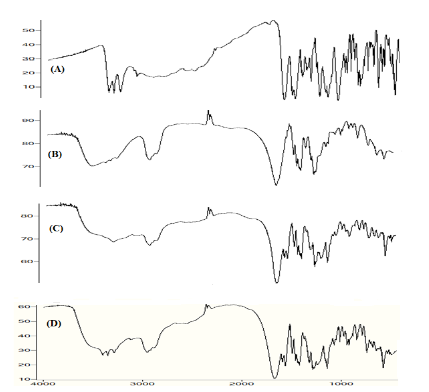
Figure 1. FT-IR Spectra of (A) = Pure FUR, (B) = PVP-K30, (C) = ???????????????? and (D) =????????????????
Pre-compression evaluation
SDS3 has a 16.3% compressibility index (Carr's Index) and 32.27° angle of repose. The sample's compressibility and fluidity make it suitable for tableting [15].
Post compression evaluation of FUR solid dispersion tablets
Physical characterization
The improved furosemide solid dispersions (SDS3) tablet formulation generated round, yellowish-colored, flat, smooth-surfaced tablets of normal size, texture, thickness, and diameter. With a low variation of 0.571 percent, the average weight was 216.2 mg ±1.67. Tablets had an average hardness of 5.171 kg/cm2±0.3848, falling within the typical range of 4.36-5.87 kg/cm2. Additionally, friability was 0.842%, less than 1%. The drug concentration was 100.44% ±4.14, and disintegration time was under 15 minutes, meeting USP Pharmacopeial restrictions [16].
In vitro drug release study
An Electrolab TDT-08L instrument, which is authorized for use with USP XXIII tablets, was used in order to conduct the in vitro drug release analysis. The dissolving solution, which had a volume of 900 milliliters, was maintained at 37\1 degrees Celsius for a duration of 12 hours at a rotational speed of 50 revolutions per minute. The phosphate buffer that has a pH of 6.8 is the medium that is used for dissolving. At the end of each hour, five milliliters of the sample were taken out and replaced with five milliliters of fresh dissolving medium that had the same pH. An examination using spectrophotometry was carried out on the samples that were collected at a wavelength of 272 nanometers in order to ascertain the cumulative percentage of the drug that was released [17]. For the purpose of conducting the in-vitro dissolution research, the gathered data were classified according to the following four types of data treatment:
1. Cumulative percentage drug released Vs time in hrs.
2. Cumulative percentage drug released Vs square root of time in hrs. (Higuchi’s classical diffusion)
3. Cumulative percentage drug released Vs time in hrs [18].
4. Cumulative percentage drug released Vs square root of time in hrs. (Higuchi’s classical diffusion)
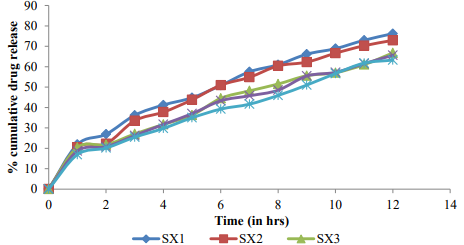
Figure 2: Plots illustrating the cumulative percentage of medication released vs time (zero order) for formulations SX1, SX2, SX3, SX4, and SX5
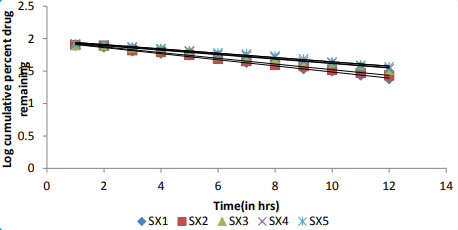
Figure 2: First-order log cumulative percent medication released vs time charts for formulations SX1, SX2, SX3, SX4, and SX5
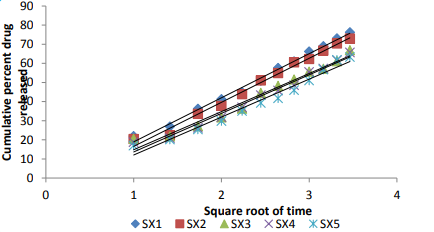
Figure 4: Higuchi plots showing the cumulative percentage of medication released vs square root of time for formulations SX1, SX2, SX3, SX4, and SX5
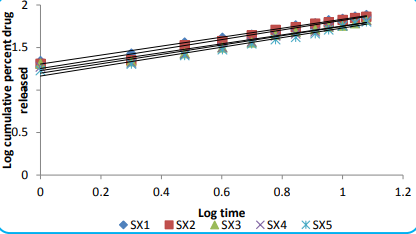
Figure 5: For formulations SX1, SX2, SX3, SX4, and SX5, log cumulative percent medication released vs log time (Peppas plots)
Table 5: Kinetic information for the formulas
|
Formulation code |
Zero order |
First order |
Higichi equation |
Peppas equation |
|
|
SX1 |
a |
14.33 |
1.957 |
4.057 |
1.305 |
|
b |
5.620 |
0.047 |
23.02 |
0.528 |
|
|
r2 |
0.945 |
0.994 |
0.993 |
0.988 |
|
|
SX2 |
a |
12.65 |
1.961 |
6.487 |
1.253 |
|
b |
5.533 |
0.044 |
23.04 |
0.562 |
|
|
r2 |
0.947 |
0.996 |
0.989 |
0.975 |
|
|
SX3 |
a |
11.06 |
1.959 |
5.087 |
1.1227 |
|
b |
4.487 |
0.034 |
19.93 |
0.525 |
|
|
r2 |
0.954 |
0.987 |
0.974 |
0.953 |
|
|
SX4 |
a |
10.45 |
1.965 |
6.458 |
1.199 |
|
b |
4.855 |
0.034 |
20.15 |
0.550 |
|
|
r2 |
0.962 |
0.990 |
0.981 |
0.967 |
|
|
SX5 |
a |
8.923 |
1.974 |
7.803 |
1.164 |
|
b |
4.755 |
0.033 |
19.84 |
0.565 |
|
|
r2 |
0.971 |
0.982 |
0.973 |
0.972 |
|
Table 6: The formulas' dissolution parameters
|
Sl.No |
Formulation code |
t25 (hrs) |
t50 (hrs) |
t75 (hrs) |
Cumulative % drug release in 12 hrs |
|
1 |
SX1 |
1.36 |
5.48 |
10.12 |
76.23 |
|
2 |
SX2 |
2.24 |
5.48 |
11 |
72.92 |
|
3 |
SX3 |
2.36 |
7.36 |
--- |
66.79 |
|
4 |
SX4 |
2.48 |
8.12 |
--- |
65.63 |
|
5 |
SX5 |
2.48 |
8.48 |
--- |
63.24 |
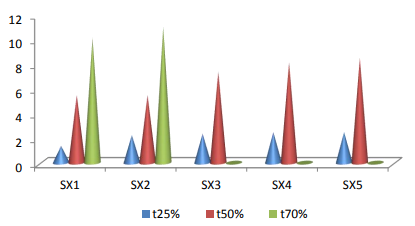
Figure 6: Comparison of furosemide sustained tablet dissolving characteristics (t25%, t50%, and t70%).
It was discovered via research that the water solubility of furosemide was significantly enhanced by the use of PVP-K30 solid dispersions. The SDS3 formulation, which was prepared using a solvent evaporation approach and a ratio of 1:1, had the highest solubility at 0.2746 mg/ml, which is almost four times greater than the solubility of pure furosemide. Tablets made of a matrix composed of xanthan gum were successful in incorporating the ideal solid dispersion, which led to positive outcomes. The tablets exhibited consistent physical features, including an appropriate hardness (range from 4.86 to 5.08 kg/cm2), low friability (less than 1%), steady weight (149 to 152 mg), and an acceptable drug content (more than 95%). These aforementioned characteristics were observed in the tablets. In the in-vitro dissolving experiments of the matrix tablets, which produced sustained drug release for up to 12 hours, release kinetics following diffusion-controlled mechanisms were observed. These findings were in accordance with the models proposed by Higuchi and Korsmeyer-Peppas. Based on the dissolving parameters (t25, t50, and t75), it was shown that increasing the polymer concentration was effective in delaying the release of the medication while simultaneously retaining a high level of drug content homogeneity. When taken as a whole, the findings indicate that the solubility of furosemide, as well as its release control and oral bioavailability, may be enhanced by the use of a combination of the matrix tablet formulation and the solid dispersion approach. This method has potential for long-term treatment efficacy, which is encouraging.
CONCLUSION
A formulation known as SDS3 was shown to be the most effective. This formulation was accomplished by solid dispersing furosemide with PVP-K30, which resulted in an increase in the drug's solubility and dissolution. The incorporation of this solid dispersion into matrix tablets by the use of xanthan gum resulted in the production of tablets that had appropriate physical features and a continuously released drug for a period of twelve hours. As shown by dissolving and kinetic studies, which indicated controlled, diffusion-based release, the combination of solid dispersion and matrix tablet techniques has the potential to effectively boost the oral bioavailability of medications that are poorly soluble. A workable approach is provided by this study in order to enhance the effectiveness of furosemide therapy and the degree to which patients comply with their medication prescriptions.
REFERENCES


Ankit Kumar, Dr. Afrin Alam, Dr. Ashish Sarkar*, Design And Evaluation of Furosemide Matrix Tablets Using Solid Dispersion Technique for Enhanced Oral Bioavailability, Int. J. of Pharm. Sci., 2026, Vol 4, Issue 2, 580-591. https://doi.org/10.5281/zenodo.18484867
 10.5281/zenodo.18484867
