
1,2,3 Govindrao Nikam College of Pharmacy, Sawarde, Ratnagiri, Maharashtra, India 415606
4 Dnyandeep College of Pharmacy, Khed, Ratnagiri, Maharashtra, India 415709
The present study focuses on the development and evaluation of a sustained-release polyherbal antidiabetic tablet formulated using extracts of Momordica dioica fruit, Holarrhena antidysenterica bark, and Costus igneus leaves. The plant materials were extracted using Soxhlet extraction methanol for M. dioica and ethanol for H. antidysenterica and C. igneus and concentrated by distillation. Phytochemical screening confirmed the presence of flavonoids, alkaloids, glycosides, and saponins, while thin-layer chromatography identified quercetin, kaempferol, and conessine as key constituents associated with antidiabetic activity. UV–Visible spectroscopy validated their ?max values. In vitro antidiabetic evaluation using ?-amylase inhibition and glucose uptake by yeast cells demonstrated strong, dose-dependent activity of all extracts, comparable to metformin. The sustained-release tablets were formulated by wet granulation and compressed using a 16-station rotary press, producing four formulations (F1–F4) that complied with Indian Pharmacopoeia standards. Among these, F4 exhibited superior hardness, friability, weight uniformity, drug content, and extended drug release up to 12 hours. Kinetic modelling revealed first-order release (R² = 0.977), indicating a concentration-dependent mechanism. The F4 formulation also enhanced glucose uptake by 89%, closely matching the effect of metformin. Overall, this study demonstrates that combining traditionally used antidiabetic herbs with modern formulation approaches can yield a safe, effective, and patient-friendly sustained-release herbal tablet with promising potential to improve glycemic control and enhance patient compliance.
Diabetes mellitus is a chronic, multifactorial metabolic disorder characterized by persistent hyperglycaemia due to defects in insulin secretion, action, or both. It is classified into Type 1 diabetes (autoimmune β-cell destruction causing absolute insulin deficiency), Type 2 diabetes (insulin resistance with relative insulin deficiency, influenced by lifestyle and genetics), and gestational diabetes (glucose intolerance during pregnancy). Uncontrolled diabetes can lead to microvascular complications, including retinopathy, nephropathy, and neuropathy, as well as macrovascular complications such as cardiovascular diseases.[1]
Conventional antidiabetic drugs including sulfonylureas, biguanides, thiazolidinediones, DPP-4 inhibitors, and insulin effectively control glycaemia but may cause adverse effects like hypoglycaemia, weight gain, gastrointestinal disturbances, and hepatotoxicity[2], [3], [4]. This has fuelled interest in herbal alternatives, which are traditionally used, safer, and sustainable. Medicinal plants are rich in bioactive compounds such as alkaloids, flavonoids, saponins, and terpenoids, many of which exert glucose-lowering, antioxidant, anti-inflammatory, and organ-protective effects. However, poor solubility, chemical instability, rapid metabolism, and low oral bioavailability limit their clinical translation.
Modern formulation strategies including nanoparticles, phytosomes, microspheres, liposomes, and sustained-release matrix tablets aim to overcome these barriers by enhancing stability, absorption, circulation time, and targeted delivery, while reducing dosing frequency and side effects. [5], [6], [7], [8]
Among promising medicinal plants, Momordica dioica (spiny gourd) exhibits antidiabetic, hepatoprotective, antioxidant, and anti-inflammatory activities through saponins, flavonoids, and phenolics. Costus igneus (insulin plant) contains flavonoids, triterpenoids, alkaloids, and minerals, supporting its hypoglycaemic effects. Holarrhena antidysenterica (kutaja) is known for antidiabetic, antimicrobial, antioxidant, and wound-healing properties, largely attributed to conessine and other alkaloids.[9-12]
Although the antidiabetic potential of these individual plants has been extensively reported, there is a clear lack of research exploring their combined pharmacological efficacy in a standardized, sustained-release polyherbal formulation.
No study to date has optimized such a combination using pharmaceutical approaches like wet granulation and polymer-controlled drug release to ensure consistent bioactivity and improved patient compliance.
Collectively, these plants are promising candidates for advanced herbal formulations that integrate traditional knowledge with modern pharmaceutical technology. This research therefore aims to develop and evaluate a sustained-release polyherbal antidiabetic tablet combining Momordica dioica, Holarrhena antidysenterica, and Costus igneus, thereby addressing the existing gap in formulation-based standardization and controlled delivery of herbal antidiabetic therapy.
MATERIALS AND METHODS
All instruments and equipment used in this study, along with their model and manufacturer details, are listed as follows:
The plant materials used in this study were collected from various regions of Ratnagiri district, Maharashtra, and authenticated at Sharadchandraji Pawar Krushi Mahavidyalaya, Sahyadri Shikshan Sanstha, Sawarde, Ratnagiri. Mature fruits of Momordica dioica were collected from the wild forest areas, Holarrhena antidysenterica bark was obtained from local forests, and leaves of Costus igneus were harvested from plants cultivated near the researcher’s residence in Khedshi, Ratnagiri.
The collected plant materials were processed to obtain coarse powders for extraction. Momordica dioica fruits were washed with distilled water, shade-dried, oven-dried at 50?°C, and pulverized. Holarrhena antidysenterica bark was cleaned, shade-dried, oven-dried at 50?°C, and ground using a mechanical grinder. Costus igneus leaves were washed, shade-dried, oven-dried at 50?°C, and powdered for extraction.[13], [14], [15]
The solubility of the plant extracts in water, methanol, ethanol, and phosphate buffer was determined using the shake-flask method. Excess extract was added to 2?mL of each solvent, and the mixtures were agitated in a shaking water bath at 25?°C for 24?h to reach equilibrium. After incubation, samples were filtered through a 0.22?µm membrane filter and centrifuged to remove undissolved particles. The clear filtrates were analyzed using a UV–visible spectrophotometer at the respective λmax to quantify the dissolved extract in each solvent.[16], [17], [18]
The powdered plant materials fruits of Momordica dioica, bark of Holarrhena antidysenterica, and leaves of Costus igneus were subjected to Soxhlet extraction at a 1:10 (w/v) solvent-to-drug ratio. Methanol was used for Momordica dioica due to its higher efficiency in extracting flavonoids and saponins,[19] while ethanol was chosen for Holarrhena antidysenterica and Costus igneus as it provides optimal recovery of alkaloids and terpenoids with lower toxicity, Extraction continued until the siphon solution became colorless, indicating exhaustive phytoconstituent extraction. The solvents were then removed by simple distillation, and the residues were concentrated to semisolid masses. Soxhlet extraction was chosen due to its documented efficiency and reliability for herbal materials.[20]
Preliminary phytochemical tests were carried out on the obtained plant extracts to detect the presence of primary and secondary metabolites. Standard qualitative methods were employed to evaluate the extracts for alkaloids, saponins, flavonoids, carbohydrates, tannins, phenols, proteins, glycosides, and steroids.[21], [22], [23]
TLC was performed for the identification of flavonoids in the extracts of Momordica dioica, Holarrhena antidysenterica, and Costus igneus. Pre-coated silica gel 60 F??? plates were used as the stationary phase, and the extracts were dissolved in ethanol. Standard markers (quercetin, kaempferol, and conessine) were co-spotted for comparison.[24]
The mobile phases employed were: ethyl acetate: formic acid: glacial acetic acid: water (10:1:1:2.5 v/v) for M. dioica (quercetin marker), ethanol: acetic acid (8:2 v/v) for H. antidysenterica (conessine marker), and toluene: ethyl acetate: formic acid (5:4:1 v/v) for C. igneus (kaempferol marker). Plates were developed, air-dried, and visualized under UV light after spraying with aluminum chloride. Rf values were calculated using the standard formula.[25], [26]
Accurately weighed 10 mg of each extract (Momordica dioica fruit, Holarrhena antidysenterica bark, and Costus igneus leaves) was transferred into separate 100 mL volumetric flasks, dissolved in a small volume of ethanol, and the volume was made up to 100 mL with ethanol to obtain stock solutions (100 µg/mL). Suitable dilutions were prepared in ethanol, and the solutions were scanned over 200–400 nm using a UV–Visible spectrophotometer to determine the maximum absorption wavelength (λmax) of each extract.[27]
The antidiabetic activity of Momordica dioica, Holarrhena antidysenterica, and Costus igneus extracts was assessed using a yeast cell glucose uptake assay. Commercial baker’s yeast was repeatedly centrifuged at 3000 rpm for 5 min in distilled water until a clear supernatant was obtained, and a 10% (v/v) yeast suspension was prepared. Different concentrations of extracts (1–5 mg/mL) were incubated with glucose solutions (5, 10, and 25 mM) at 37 °C for 10 min, followed by the addition of 100 µL yeast suspension. The mixture was vortexed and incubated further at 37 °C for 60 min, then centrifuged at 2500 rpm for 5 min. Glucose content in the supernatant was quantified spectrophotometrically at 540 nm. Metformin served as the reference drug. All experiments were carried out in triplicate. The percentage increase in glucose uptake was calculated using the formula:[28]
% Glucose Uptake=Abs Control-Abs SampleAbs Control×100

Where:
Abs control = Absorbance of control sample (without extract)
Abs sample = Absorbance of test sample (with extract)
The α-amylase inhibitory potential of the herbal extracts (Momordica dioica, Holarrhena antidysenterica, and Costus igneus) was evaluated using a standard protocol.
Procedure:
A mixture of 200 µL phosphate buffer (pH 6.8) and 200 µL α-amylase enzyme solution was prepared in clean test tubes. To this, 500 µL of each herbal extract at different concentrations (5–25%) was added separately and incubated at room temperature for 15 minutes to facilitate enzyme extract interaction. Subsequently, 200 µL of a 1% starch solution was added as a substrate, and the tubes were further incubated at 37 °C for 10 minutes. The reaction was terminated by the addition of 400 µL of freshly prepared 3,5-dinitrosalicylic acid (DNS) reagent, followed by heating in a boiling water bath for 5 minutes. After cooling to room temperature, the reaction mixture was diluted with 15 mL of distilled water. The absorbance was measured at 540 nm using a double-beam UV-Visible spectrophotometer. Control samples (without extract) were prepared under identical conditions. All experiments were conducted in triplicate to ensure reproducibility.[28], [29], [30]
Calculation of % Inhibition:
% Inhibition=Abs Control-Abs SampleAbs Control×100

Where:
Abs control = Absorbance of control sample (without extract)
Abs sample = Absorbance of test sample (with extract)
Angle of Repose, Bulk Density, Tapped Density, Compressibility Index and Hausner’s Ratio were determined.
Polyherbal tablets containing Momordica dioica, Holarrhena antidysenterica, and Costus igneus extracts were prepared using the wet granulation method. The extracts were mixed uniformly with HPMC K100M, MCC, and starch. A starch paste was prepared separately and employed as a binder to form a cohesive wet mass, which was then passed through a sieve to obtain granules. The granules were dried, lubricated with lactose, talc, and magnesium stearate, and finally compressed using a 16-station rotary tablet press equipped with 13 mm flat-faced punches at a compression force of 8 kN. Four formulations (F1–F4) were developed to evaluate the influence of varying concentrations of the release-retardant polymer (HPMC K100M) and binder (starch) on tablet properties and drug release behaviour, following a trial-based optimization approach. [32]The detailed composition of each formulation is presented in Table No. 1.
Table No 1: Formulation table of herbal tablet
|
Ingredients |
Role |
F1 (mg) |
F2 (mg) |
F3 (mg) |
F4 (mg) |
|
M. dioica extract |
API |
120 |
120 |
120 |
120 |
|
H. antidysenterica extract |
API |
90 |
90 |
90 |
90 |
|
C. igneus extract |
API |
90 |
90 |
90 |
90 |
|
HPMC K100 M |
Release retardant |
40 |
20 |
30 |
40 |
|
Starch |
Binder |
30 |
15 |
15 |
30 |
|
Lactose |
Diluent |
60 |
85 |
75 |
60 |
|
MCC |
Disintegrant |
40 |
50 |
50 |
40 |
|
Magnesium Stearate |
Lubricant |
5 |
5 |
5 |
5 |
|
Starch Paste |
Granulating Agent |
20 |
20 |
20 |
20 |
|
Talc |
Glidant |
5 |
5 |
5 |
5 |
The prepared polyherbal sustained-release tablets were subjected to various post-formulation evaluation parameters to ensure their quality, reproducibility, and compliance with pharmacopeial standards.[33], [34]
Twenty tablets were randomly selected, and their thickness and diameter were measured using a Vernier caliper. The mean values and standard deviation were calculated to evaluate dimensional uniformity across the batch.
The mechanical strength of the tablets was determined using a Monsanto hardness tester to ensure their ability to withstand handling, packaging, and transportation.[35]
Friability was assessed using a Roche Friabilator. Twenty pre-weighed tablets were subjected to 100 revolutions in 4 minutes. The tablets were then dedusted and reweighed, and the percentage weight loss was calculated using the following formula.[11]
Twenty tablets were weighed individually using an analytical balance. The mean weight and percentage deviation were calculated to assess uniformity of tablet weight as per pharmacopeial limits.
Tablets were finely powdered, and a quantity equivalent to 10 mg of drug was dissolved in 100 ml phosphate buffer (pH 6.8). The solution was filtered, diluted, and analyzed using a UV-visible spectrophotometer at 260 nm. The drug content was determined against established calibration curve.
The disintegration time of the herbal sustained-release tablets was determined using the USP disintegration test apparatus. Tablets were placed in 900 ml phosphate buffer (pH 6.8) maintained at 37 ± 0.5 °C, with the medium stirred at 50 rpm, to simulate intestinal conditions.
In vitro dissolution was carried out using USP apparatus II (Paddle method). Tablets were placed in 900 ml phosphate buffer (pH 6.8) maintained at 37 ± 0.5 °C and stirred at 50 rpm. Samples were withdrawn at specific intervals, replaced with fresh medium, and analyzed spectrophotometrically at 260 nm after filtration through Whatman filter paper. All studies were performed in triplicate.[36]
RESULTS AND DISCUSSION
Momordica dioica fruits, Holarrhena antidysenterica bark, and Costus igneus leaves were collected from Ratnagiri district, Maharashtra, and authenticated by the Head, Department of Botany, Sharadchandraji Pawar Krushi Mahavidyalaya, Kharawate. Voucher specimens were deposited for future reference.
Crude extracts of Momordica dioica fruits, Holarrhena antidysenterica bark, and Costus igneus leaves were obtained by Soxhlet extraction (drug-to-solvent ratio 1:10, w/v) using methanol and ethanol. The concentrated, air-dried semisolid extracts showed distinct colors and characteristic odors, suggestive of bioactive phytoconstituents. All three herbal extracts exhibited distinct organoleptic properties and extractive yields, as presented in Table 2
Table No 2: Description of herbal extracts
|
Sample |
% Yield |
Description |
|
Methanolic Extract of M. dioica |
8.15 |
Green semi-solid sticky mass with characteristic odor |
|
Ethanolic Extract of H. antidysenterica |
9.10 |
Dark brown semi-solid mass with slightly bitter odor |
|
Ethanolic Extract of C. igneus |
10.05 |
Reddish-brown sticky semi-solid mass with mild pleasant odor |
The solubility profiles of the herbal extracts in various solvents are shown in Table 3.
Table No 3: Solubility of herbal extracts
|
Sr. No |
Solvents |
M.dioica (%) |
H. antidysenterica (%) |
C. igneus (%) |
|
1. |
Methanol (mg/ml) |
5.84 |
7.19 |
9.28 |
|
2. |
Ethanol (mg/ml) |
5.52 |
10.87 |
12.66 |
|
3. |
Phosphate Buffer (6.8)(mg/ml) |
4.43 |
5.34 |
6.97 |
|
4. |
Water (mg/ml) |
0.57 |
3.95 |
5.48 |
Phytochemical evaluation confirmed the presence of multiple bioactive classes such as flavonoids, alkaloids, and saponins, which contribute to the antidiabetic potential of the extracts (Table 4).
Table No 4: Phytochemical screening of herbal extracts
|
Phytoconstituents |
Momordica dioica |
Costus igneus |
Holarrhena antidysenterica |
|
Alkaloids |
+ |
+ |
+ |
|
Flavonoids |
+ |
+ |
+ |
|
Saponins |
+ |
+ |
+ |
|
Tannins |
+ |
+ |
+ |
|
Glycosides |
+ |
+ |
+ |
|
Steroids |
– |
– |
+ |
TLC analysis of the methanolic extracts of Momordica dioica, Costus igneus, and Holarrhena antidysenterica confirmed the presence of key phytoconstituents through comparison with standard markers. M. dioica showed an Rf value of 0.41, close to quercetin (0.45), indicating flavonoids; C. igneus exhibited an Rf of 0.40, comparable to kaempferol (0.44), suggesting flavonoid glycosides; and H. antidysenterica showed an Rf of 0.51, similar to connesine (0.55), indicating alkaloids. These results support the traditional use of these plants in managing diabetes and related complications. TLC analysis confirmed the presence of key phytoconstituents in each extract (Table 6).
Table No 6: Rf value of TLC
|
Sr. No |
Extract |
Rf Value |
Standard |
Rf Value |
|
1 |
M. dioica |
0.41 |
Quercetin |
0.45 |
|
2 |
C. igneus |
0.40 |
Kaempferol |
0.44 |
|
3 |
H. antidysenterica |
0.51 |
Conessine |
0.55 |
The UV spectrophotometric analysis of the herbal extracts was performed to determine the characteristic absorption maxima (λmax) of the crude extracts for qualitative identification and standardization purposes. Each extract was scanned in the wavelength range of 200–400 nm. The methanolic extract of Momordica dioica exhibited a λmax at 270 nm, suggesting the presence of quercetin-like flavonoids; the ethanolic extract of Holarrhena antidysenterica showed a λmax at 281 nm, corresponding to alkaloids such as conessine; and Costus igneus extract displayed λmax at 278 nm, indicating flavonoid glycosides. Calibration plots were constructed for the crude extracts only to verify linearity between concentration and absorbance (R² > 0.97), not for quantitative estimation of any specific marker compound. Thus, the λmax determination primarily served for qualitative identification and spectral profiling of each extract
The in vitro α-amylase assay demonstrated that all three plant extracts exhibited significant inhibitory activity. Momordica dioica showed the strongest effect (82.79–95.36% at 100–500 µg/mL), closely comparable to metformin (96%), while Costus igneus and Holarrhena antidysenterica showed inhibition ranges of 80.79–90.39% and 79.79–91.05%, respectively. These results highlight the potent α-amylase inhibitory potential of all extracts, with M. dioica emerging as the most promising natural candidate for diabetes management. The results of the α-Amylase inhibition assay are presented in Graph No.1
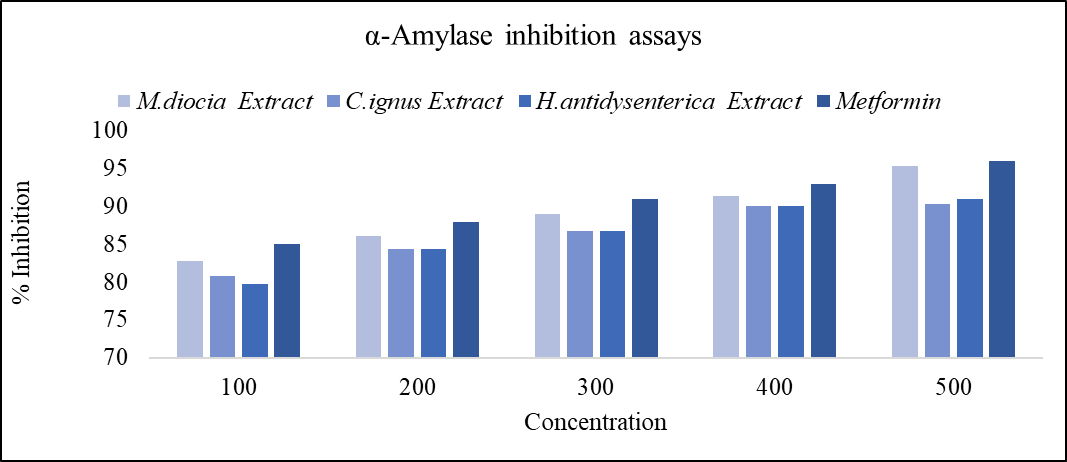
Graph No 1: α-amylase inhibition assay
Momordica dioica showed uptake ranging from 83.17% (100 µg/mL) to 92.75% (500 µg/mL), while Costus igneus exhibited 82.6% to 92.36% and Holarrhena antidysenterica 80.28% to 91.30% across the same range. In comparison, Metformin recorded 84.77% to 95.75%. Notably, C. igneus displayed the closest activity to Metformin. The results of the glucose uptake by yeast cell assay are presented in Graph No. 2
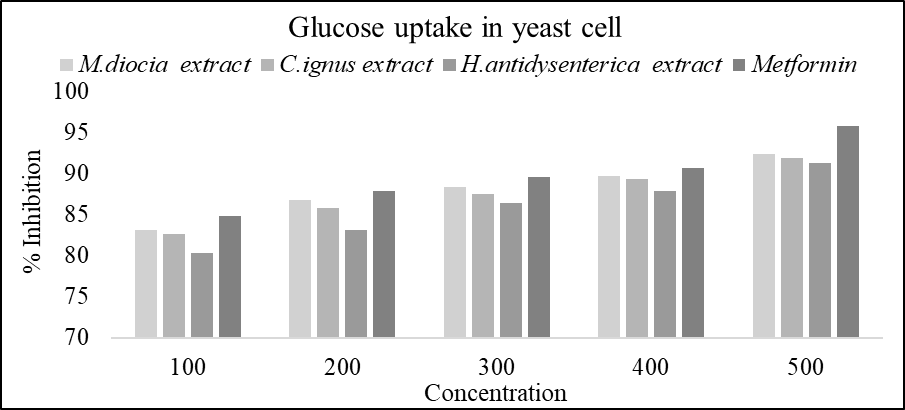
Graph No 2: Glucose uptake in yeast cell
The results indicate good flow properties with acceptable limits of bulk density, tapped density, Carr’s index, Hausner’s ratio, and angle of repose. The pre-formulation parameters of granules are summarized in Table 6.
Table No 6: Pre-formulation study for tablet
|
Formulation |
Bulk Density (g/ml) |
Tapped Density (g/ml) |
Angle of Repose (°) |
Carr’s Index (%) |
Hausner’s Ratio |
Flow Property |
|
F1 |
0.60 |
0.556 |
31.8 |
20.00 |
1.25 |
Fair |
|
F2 |
0.56 |
0.588 |
28.3 |
14.96 |
1.18 |
Good |
|
F3 |
0.50 |
0.666 |
33 |
24.91 |
1.33 |
Fair |
|
F4 |
0.40 |
0.50 |
28.4 |
10.07 |
1.11 |
Excellent |
Table No 7: Evaluation study for tablet
|
Formulation |
Thickness (mm) |
Diameter (mm) |
Hardness (kg/cm2) |
Friability (%) |
Drug Content (%) |
Disintegration Time (Min) |
Uniformity of Weight |
|
F1 |
4.00±0.02 |
13.09 |
4.00±0.02 |
0.67% |
100.07% |
More than 120 min |
± 5% As per IP
|
|
F2 |
4.00±0.05 |
13.06 |
3.03±0.04 |
0.59% |
94.43% |
More than 110 min |
|
|
F3 |
4.00±0.03 |
13.05 |
3.07±0.05 |
0.93% |
96.37% |
More than 150 min |
|
|
F4 |
4.05±0.02 |
13.07 |
4.02±0.02 |
0.29% |
105.07% |
More than 150 min |
The % cumulative drug release data for all formulations (F1–F4) compared with the standard are presented in Table No. 8, showing the sustained release profile over a 12-hour period.
Table No 8 : % Cumulative Drug Release
|
Time (hours) |
% Cumulative Drug Release |
||||
|
F1 |
F2 |
F3 |
F4 |
F5 (standard) |
|
|
0 |
7.90 |
1.12 |
1.77 |
2.92 |
0 |
|
2 |
16.80 |
5.44 |
7.68 |
6.13 |
30.5 |
|
4 |
35.19 |
12.85 |
17.89 |
10.23 |
41.9 |
|
6 |
56.92 |
24.61 |
38.43 |
25.52 |
65.3 |
|
8 |
68.84 |
33.76 |
53.00 |
45.65 |
74.2 |
|
10 |
70.05 |
64.92 |
55.70 |
68.12 |
88.8 |
|
12 |
82.50 |
77.43 |
78.95 |
92.09 |
95.8 |
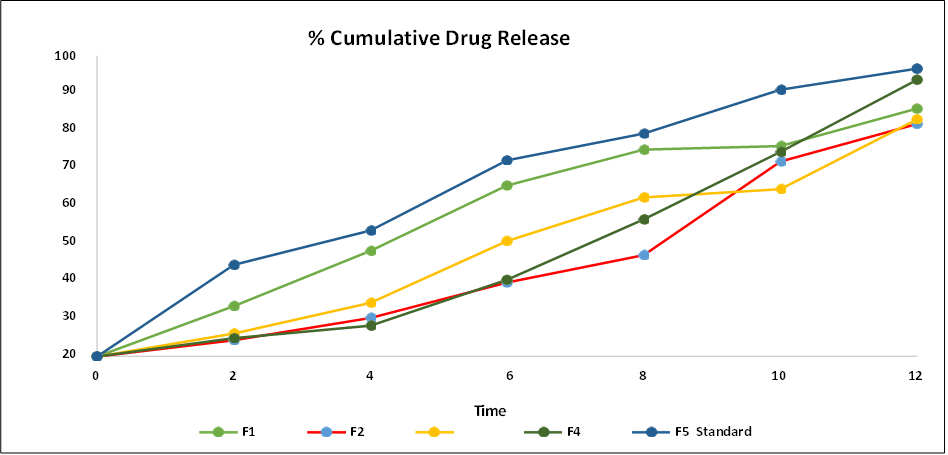
Graph No 3: % Cumulative Drug Release
The drug release kinetic profile of the optimized formulation (F4) is illustrated in Graph No.5, depicting the first-order release pattern with an R² value of 0.9797.
Table No 9 : Drug release kinetic
|
Batch |
F4 |
|
R2 |
0.9797 |
|
Model fit |
1st order |
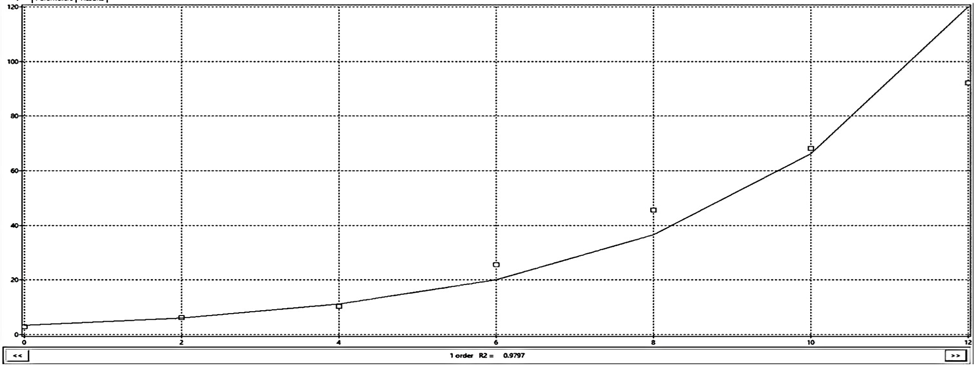
Graph No 4: First-order release kinetics with an R² value 0.9797
The in-vitro antidiabetic activity of the polyherbal antidiabetic tablet is presented in Table No. 10, showing the percentage inhibition of α-amylase by the standard drug, combined extract, and optimized formulation (F4)
Table No 10: In-vitro anti-diabetic activity of polyherbal antidiabetic tablet
|
Sample |
% Inhibition |
|
Standard |
96% |
|
Combined Extract |
91% |
|
Formulation (F4) |
89% |
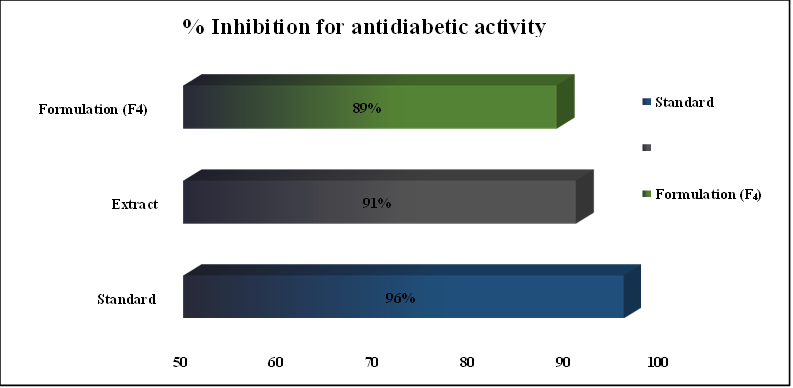
Graph No 5: % Inhibition of antidiabetic activity
CONCLUSION
The present study successfully formulated and evaluated a polyherbal antidiabetic tablet containing Momordica dioica fruit, Holarrhena antidysenterica bark, and Costus igneus leaves, each possessing strong ethnomedicinal backgrounds and documented pharmacological efficacy in glycemic regulation. The methanolic and ethanolic extracts were efficiently prepared and concentrated into solid residues suitable for formulation.
TLC analysis confirmed the presence of key bioactive constituents Quercetin, Kaempferol, and Conessine while UV-visible spectroscopic studies validated their identity and purity, with calibration curves demonstrating excellent linearity (R² > 0.99).
In vitro antidiabetic evaluation revealed significant efficacy of the individual extracts through glucose uptake and α-amylase inhibition, comparable to the standard drug metformin. The formulated tablets complied with Indian Pharmacopoeia standards for hardness, friability, weight uniformity, drug content, and disintegration.
Among the four formulations (F1–F4), batch F4 was identified as the optimized formulation based on its superior physicochemical and in vitro performance. The optimized concentration of HPMC K100M provided effective release retardation by forming a strong hydrophilic gel matrix, ensuring sustained drug release for up to 12 hours. The combination of MCC and lactose offered excellent compressibility, mechanical strength, and uniform drug distribution. F4 exhibited ideal hardness, low friability, uniform weight, and satisfactory drug content as per IP standards. The drug release profile followed first-order kinetics (R² = 0.977), indicating a concentration-dependent release mechanism. Furthermore, in vitro glucose uptake (89%) confirmed the superior antidiabetic potential of F4 compared to other formulations.
Thus, the optimized ratio of polymer and diluent in F4 provided a desirable balance between sustained drug release and tablet quality attributes.
This study demonstrates the effective integration of traditional herbal knowledge with modern pharmaceutical technology to develop a safe, effective, and patient-friendly polyherbal antidiabetic tablet. The formulation offers sustained release, reduced dosing frequency, improved compliance, and potentially fewer side effects. Encouraged by these in vitro results, future in vivo studies are warranted to validate its efficacy, pharmacokinetics, and safety, thereby highlighting its promising role in diabetes management.
REFERENCES

Ashish Mote, Madan Pomaje, Ashwini Patil, Vipul Sansare, Development of a Polyherbal Antidiabetic Tablet from Traditional Medicinal Plants, Int. J. of Pharm. Sci., 2026, Vol 4, Issue 2, 2161-2174. https://doi.org/10.5281/zenodo.18635223
 10.5281/zenodo.18635223
