
Raosaheb Patil Danve College of Pharmacy Badnapur, Jalna
Targeted drug delivery to a specific site is a significant problem faced by researchers. The development of a new colloidal carrier called nanosponges has the potential to solve this problem. Nanosponges play a vital role in targeted drug delivery. A wide variety of drugs can be loaded into nanosponges for this purpose. They enhance solubility, improve bioavailability, reduce side effects, and modify drug release. Nanosponges are highly porous, with the unique ability to entrap active molecules and offer the advantage of programmable release. They are biologically safe and simple to produce. Because of their three-dimensional network and nanometric activity, nanosponges are tiny in size yet highly effective. Nanosponge technology is both novel and emerging. It can precisely control the release rate of drugs, especially for controlled drug delivery in topical use. Nanosponges also protect drugs from degradation caused by environmental factors such as light and heat. These minuscule sponges can move through the body, bind to the surface of drugs, and release them in a regulated and predictable way. Nanosponges are created by crosslinking cyclodextrins with carbonyl or dicarboxylate , resulting in cross-linked structures. They have assumed a significant role not only in pharmaceuticals but also in other areas such as farming, horticulture, high–molecular-weight proteins, innovative fire retardants, gas transporters, and water filters. They serve as effective transporters for biologically active ingredients and are broadly employed in anticancer, antiplatelet, and antilipidemic therapies. Medical domains such as immunology, cardiology, endocrinology, ophthalmology, and pulmonology could greatly benefit from nanosponges-based nanotechnology.
The medicine delivery technology has clearly a new interest for medicines by furnishing them new life through their remedial targets. currently, targeting medicine delivery is the major problem which is being faced by the experimenters. Target acquainted medicine administration with advancements in remedial efficacity, reduction in side goods and optimized dosing authority, shall be the leading trends in the area of rectifiers.1
Targeted medicine delivery implies for picky and effective localization of pharmacologically active half at pre-identified( pre-selected) target in remedial attention, while confining its access to non-target normal cellular stuffings and therefore minimizing poisonous goods and maximizing remedial indicator of the medicine.1
Nanosponge is a new approach which offers controlled medicine delivery for topical use. Nanosponge is an arising technology for topical medicine delivery. Nanosponge medicine delivery system is employed for the enhancement of performance of topically applied medicines.1
Nanosponges are bitsy bloodsuckers with a size of about a contagion, which can be filled with a wide variety of medicines. These bitsy bloodsuckers can circulate around the body until they encounter the specific target point and stick on the face and begin to release the medicine in a controlled and predictable manner.1
Nanosponges have surfaced as one of the most promising fields of life wisdom because of their operation in controlled medicine delivery.1
Nanosponge technology offers ruse of constituents and is believed to contribute towards reduced side goods, bettered stability, increased fineness and enhanced expression inflexibility.1
Nanosponges are non-irritating, non-mutagenic, nonallergenic and non-toxic. Nanosponges are bitsy mesh- suchlike structures that may revolutionise the treatment of numerous conditions and this technology is five times further effective at delivering medicines for bone cancer than conventional styles.1
Nanosponges are made up of bitsy patches with many nano measures wide depressions, in which a large variety of substances can be reprised.1
Nanosponges were first formally appertained to in 1998 by DeQuan Li and Min Ma as" cyclodextrin nanosponges." This original work described across-linked β- cyclodextrin polymer that formed an undoable network with a high addition constant, meaning it could effectively trap other motes within its pervious structure.
Nanosponges are like a Three- dimensional net work or altar, ” Whose backbone is long- length polyester.
It's mixed in result with small motes called cross-linkers that act like bitsy scuffling hooks to fasten different corridor of the polymer together.
The net effect is to form spherically shaped patches filled with depressions where medicine motes can be stored.
The polyester is biodegradable, so it breaks down gradationally in the body. The exploration has shown that medicine delivery system they're lower than 100 nm, the nanosponge patches used in the current study were 50 nm in size.2
Nanosponges are made up of bitsy patches with many nano-meters wide depressions, in which a large variety of substances can be reprised. These patches are able of carrying both lipophilic and hydrophilic substances and of perfecting the solubility of inadequately water answerable motes.2
As compared to other nanoparticles, nanosponges are undoable in water and organic detergents, pervious, non poisonous and stable at high temperatures up to 3000 c.2
The nanosponges are recapitulating type of nanoparticles which encapsulates the medicine motes within its core. By the system of associating with medicines, the nanoparticles can be classified into recapitulating nanoparticles, sophisticating nanoparticles & conjugating nanoparticles.3
The first type is represented by nanosponges and nanocapsules. Nanosponges similar as alginate nanosponge, which are spongelike nanoparticles containing numerous holes that carry the medicine motes. Nanocapsules similar as poly( isobutylcyanoacrylate)( IBCA) are also recapitulating nanoparticles. They can entrap medicine motes in their waterless core.3
The alternate order is sophisticating nanoparticle, which attracts the motes by electrostatic charges.3
The third type is Conjugating nanoparticle, which links to medicines through covalent bonds.3
The periphery of Nanosponges is between 10 – 25 µm with a void space of 5 – 300 μm but the periphery of microsponges is lower than 1 µm, hence NSs offer an advantage over the microsponges.4
Nanosponges are an recapitulating type of nanomaterials that are composed of bitsy patches with little nanometres-wide depressions, hence furnishing a medium to incorporate and synopsize a variety of medicines.4
Nanosponges give us the advantage of delivering medicine to the aimed point in a precise and foreseeable style. They don't beget any mutations, vexations, antipathetic responses or toxin.4
These are spongy spheres that have in numerous connected empty spaces called voids.4
Nanosponges are solid in nature and are set up to be safe to be administered by other routes. For administering parenteral phrasings, waterless results like saline and sterile water are used as detergents for incorporating Nanosponges containing medicine.4
For administering medicines via topical route, topical hydrogel is used to incorporate the Nanosponges. The topical Nanosponges give the advantage for lesser case compliance, reduced dosing and reduced side goods.4
Nanosponges are water answerable but doesn't bifurcation chemically in water. They mix with water and use it as a transport fluid. They can be used to mask unwelcome flavours, to convert liquid substances to solids. The chemical linkers enable the nanosponges to bind preferentially to the target point.5
Nanosponges show a remarkable advantage in comparison with the common nanoparticles. Indeed, they can be fluently regenerated by different treatments, similar as washing with eco-compatible detergents, stripping with relatively inert hot feasts, mild heating or changing pH or ionic strength. For all these characteristics, nanosponges have been formerly employed in different applied fields, similar as ornamental and pharmaceutical sectors.5
Preparation Methods of Nanosponges :-
A] Solvent Method6
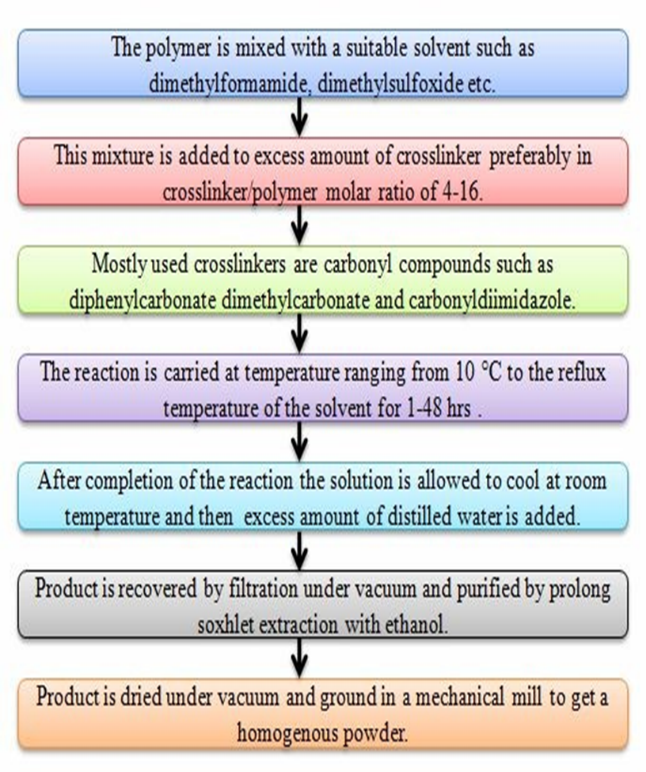
Figure 1: Solvent Method
B] Ultrasound- Assisted Synthesis6
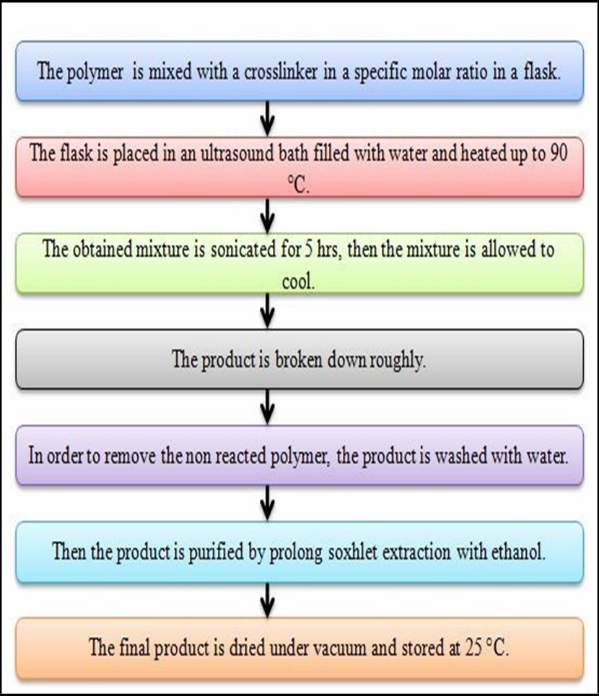
Figure 2: Ultrasound Assisted Synthesis
C] Melting Method6
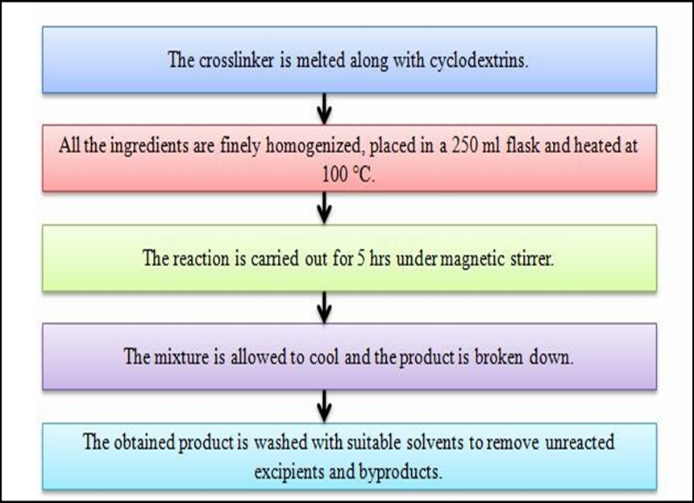
Figure 3: Melting method
D] Emulsion solvent diffusion method:-
Nanosponges can be prepared by using ethyl cellulose which is dissolved in dichloromethane. This admixture is added to the waterless result of polyvinyl alcohol stirred at 1000rpm for 2 hrs with a glamorous stirrer. also the product is filtered and dried in an roaster at 40oC for 24 hours.7
E] From hyper cross- linked beta cyclodextrin:-
In this the beta cyclodextrin is used as a carrier and this carrier is replied with the cross-linker in neutral or acid form for the conflation of nanosponges. The average periphery of a Nanosponge is below 1 μm but fragments below 500 nm can be named.7
Advantages of nanosponges:8
Disadvantages of nanosponges:8
Factors Influence Nanosponges Formation :-
Type of polymer: Type of polymer used can impact the conformation as well as the performance of Nanosponges. for complexation, the depression size of nanosponge should be suitable to accommodate a medicine patch of particular size.9
Type of medicines: medicine motes to be perplexed with nanosponges should have certain characteristics mentioned below.
Complexation Temperature: The stability constant of a complex is dependent on temperature changes. The stability constant and temperature rise are equally identified. At increased temperature, the magnitude of apparent stability constant diminishments due to reduction in medicine/ nanosponge commerce forces. Hence, a thorough control over the temperature should be maintained when nanosponges are set.10
Degree of Substitution: The number, type and position of the substituent on the polymeric patch affect the complexation capability of nanosponges. The type of negotiation is important because β- CD derivations are available in colour full forms differing in functional groups present on the face of the cyclodextrin outgrowth.
Advanced degree of crosslinking will yield largely pervious nanosponges due to further interconnections between polymers forming a mesh type network. The position of negotiation depends on the product conditions.10
Evaluation of Nanosponges :-
Microscopic studies: To study the bitsy aspects of a medicine, Nano sponger, or the product it can be subordinated to Scanning Electron Microscopy( SEM) and Transmission Electron Microscopy( TEM). The difference in the crystallization state indicates the conformation of addition complexes.11
Loading efficiency: It can be determined by quantitative estimation of the medicine which is loaded into the nanosponge using either by UV spectrophotometer or HPLC system. The lading effectiveness can be calculated by11
???????????????????????????? ???????????????????????????????????????? =
???????????????????????? ???????????????? ???????????????????????????? ???????? ???????????????????????????????????????? × 100
????????????????????????????????????????? ???????????????? ????????????????????????????
Solubility studies: The phase solubility system is the most extensively habituated system to study about addition complexation, which examines the effect of nanosponges on the solubility of medicine.12
Determination of zeta potential: implicit Zeta eventuality is the dimension of face charge. It can be measured by using fresh electrode in the flyspeck size outfit.12
Thermoanalytical Method: These styles determine whether the changes occurs in medicine substance before the thermal declination of the nanosponges. These changes may be melting, oxidation, corruption & evaporation. The thermogram prepared by DTA and DSC can be observed for broadening, shifting and appearance of new pe11ak or exposure of definite peaks.12
Application of Nanosponges :-
Nanosponges for medicine Delivery:
Due to the bitsy pervious structure of nanosponges, it can suitable to carry water- undoable medicines. The Nanosponges complex plays a major part in enhancing the dissolution rate, permeability, and solubility of a medicine. When compared to direct injection, B cyclodextrin grounded nanosponges will deliver the medicine three to five times further to the target point. medicines which have solubility problem could be delivered successfully by investing them into the nanosponges. They're solid in nature and prepared for topical, oral, maternal lozenge forms. For formulating tablets or capsules the complexes are diffused in a matrix of diluents, excipients, anti-caking agents, lubricants for oral administration.13
Nanosponges in solubility improvement:
Itraconazole is a BCS Class II medicine that has a dissolution rate limited poor bioavailability. Nanosponges bettered the solubility of the medicine further than27-fold. When copolyvidonum was added as a supporting element of the nanosponge expression, this exceeded to55-fold. Nanosponges solubilize medicine by conceivably masking the hydrophobic groups of itraconazole, by adding the wetting of the medicine, and/ or by dwindling the crystallinity of the medicine.14
Nanosponges in enzyme immobilization:
The issue of enzyme immobilization is particularly applicable for lipases, as it improves their stability and modulates parcels similar as enantio selectivity and response rates. As a consequence, the demand for new solid supports, suitable for this family of enzymes is constantly growing. For this Boscolo et al., reported high catalytic performances of Pseudomonas fluorescens lipase adsorbed on a new type of cyclodextrin- grounded nanosponges.14
As a carrier for delivery of feasts:
Feasts (gas) play an important part in drug for individual or the treatment purposes. The insufficiency of further oxygen force, named hypoxia, is related to colourful pathologies, from inflammation to that of cancer. So, it is eventually delicate to deliver oxygen gas in applicable form and lozenge in clinical practice. Cavalli et al. developed NSs phrasings as oxygen delivery systems for topical operation which have the capability to store and to release the oxygen sluggishly over time.15
For Cancer:
Targeting medicine to specific point avoiding the handicap created by vulnerable system. Different cancer cells had been treated by nanosponges like bone cancer or fast amusement glioma type with help of single cure of injections.16
Antiviral operation:
Nanosponges used in nasal, pulmonary route of administration. It give particularity to deliver antiviral medicine on RNA to lungs or nasal route through nanocarriers for targeting contagion which may beget infection to RTI similar as influenza contagion, rhinovirus. medicines used as nano carriers are- Zidovudine, Saquinavir.16
Other Applications of Nanosponges :-
Nanosponges grounded on cyclodextrins can explosively bind organic motes and remove them from water indeed at veritably low attention.
The same conception can be useful for elimination of bitter factors from grape fruit juice by picky combination of polymer and crosslinker.
The microporous hyperactive cross linked nanosponges have been used in picky separation of inorganic electrolytes by size rejection chromatography.
The three dimensional nanosponges will play important part in the bifurcation of peptides for proteomic operations.
Nanosponges can be used as carrier for feasts like oxygen and carbon dioxide. These nanosponges could be useful for numerous biomedical operations.
In particular the oxygen- filled nanosponges could supply oxygen to the hypoxic apk ins which are present in various deseases.
Nanosponges can widely soak up biomarkers for the opinion. One study concluded that nanosponges can gather rare cancer marker from blood.17
Need of Study :-
To Improve Drug Solubility and Stability : Nano- bloodsuckers can synopsize inadequately answerable medicines and cover them from declination( e.g., enzymatic or environmental).
To Enable Controlled and Sustained Release :- studying nano- bloodsuckers helps in developing systems that release medicines over time, maintaining remedial situations with smaller boluses.
To Achieve Targeted Drug Delivery:- With applicable face revision, nano- bloodsuckers can target specific cells or apkins, especially useful in cancer remedy or point-specific infections.
To Reduce Side Effects and Toxicity:- By minimizing medicine commerce with non-target apkins, nano- bloodsuckers can reduce dangerous side goods.
To Enhance Patient Compliance:- Sustained release and reduced dosing frequence ameliorate easy to use and adherence to treatment rules.
To Support a Wide Range of Therapeutics:- Nano- bloodsuckers can carry hydrophilic and hydrophobic medicines, proteins, peptides, and indeed genes, making them largely protean.
To Explore New Biomedical Applications:- On going exploration reveals nano- bloodsuckers' eventuality in areas like Cancer medicine delivery, Antibiotic resistance operation.
Aim :- To analyse the role of nano-sponges in increasing drug bioavailability and permeability.
Objective :-
CONCLUSION
From the above study it's concluded that nanosponges include lipophillic or hydrophilic medicines and release medicine at target point in controlled manner. Polymer and cross-linker rate can be balanced and release rate can be modified. Nanosponges permit the undoable medicines and help the physiochemical declination of active contents and controlled release. Their small size and globular shaped had handed nanosponges to develop as different lozenge forms like parenteral, aerosol, topical, tablets and capsules.18
SUMMARY
The nano- bloodsuckers have the capability to include either lipophilic or hydrophilic medicines and release them in a controlled and predictable manner at the target point. By controlling the rate of polymer to the cross-linker the flyspeck size and release rate can be modulated. Nano- bloodsuckers enable the undoable medicines and cover the active halves from physicochemical declination and controlled release. Because of their small size and globular shape nano- bloodsuckers can be developed as different lozenge forms like parenteral, aerosol, topical, tablets and capsules. Nanosponges are new, pervious, and nanosized carriers designed to ameliorate the solubility, stability, and bioavailability of medicines. Nanosponges are particularly useful in reducing medicine toxin, enhancing solubility of inadequately water-answerable medicines, and perfecting remedial efficacity. operations of nanosponges include delivery of anticancer agents, antibiotics, antifungal medicines, and anti-inflammatory medicines. Overall, nanosponges represent a protean and effective approach in ultramodern pharmaceutics, able of prostrating several limitations of conventional medicine delivery systems by offering controlled release, point-specific targeting, and bettered patient compliance.
FUTURE SCOPE
Personalized and Targeted Therapy:-
Cancer Therapy: Nano-sponges will be designed to precisely target tumors, delivering drugs directly to cancerous cells while sparing healthy tissue to minimize side effects.
Enhanced Bioavailability and Solubility:-
BCS Class II and IV Drugs: Nano-sponges will significantly improve the absorption of poorly soluble drugs, making them more effective for systemic use.
Advanced Manufacturing and Characterization:-
Scale-Up: The focus will be on developing cost-effective and scalable manufacturing processes to enable mass production of nano-sponge-based pharmaceuticals.
Expanding Applications Beyond Drug Delivery:-
Biocatalyst and Enzyme Carriers: Nano-sponges will serve as stable carriers for enzymes and proteins, with potential uses in biotechnology and industrial processes.
REFERENCE


Suchita Lathi, Pawan Hanute, Rushikesh Thorat, Nanosponges as Novel Approach in Drug Delivery System, Int. J. of Pharm. Sci., 2025, Vol 3, Issue 11, 4730-4740. https://doi.org/10.5281/zenodo.17758626
 10.5281/zenodo.17758626
