
Pharmacology, Pravara Rural College of Pharmacy.
Cordia sinensis Lam. is a type of plant known for its medicinal properties. It belongs to the Boraginaceae family and is typically found in warm and temperate regions of Africa, Asia, and arid regions of India. The genus comprises more than 300 species of trees and shrubs found in tropical and subtropical regions. People have been using this plant in different cultures for a long time to treat various health issues like fever, respiratory problems, stomach troubles, and skin conditions. Traditional healers have used various parts of the plant to treat a wide range of ailments such as headache, cough, digestive issues, eye infections, joint pain, swelling, dental pain, and as diuretics. The decoction of plant roots is used to treat malaria, relieve stomachache, and chest pain. Scientists have studied this plant and found that it contains certain chemicals that are good for our health. These chemicals, such as flavonoids, glycosides, terpenoids, and phenolic acids, have different effects on our bodies. For example, Cordia sinensis has been shown to have antimicrobial (fight germs), anti-inflammatory (reduce swelling), antioxidant (fight harmful molecules), hepatoprotective (protect liver), and anticancer properties. The diverse pharmacological activities of Cordia sinensis are primarily attributed to its rich phenolic profile, which includes protocatechuic acid, caffeic acid, rosmarinic acid, and various flavonoid glycosides. These compounds work synergistically through antioxidant mechanisms, free radical scavenging, and enzyme inhibition. Studies confirm the presence of secondary metabolites, mainly flavonoids, with ethanolic extracts showing greater therapeutic effects for bioactive compounds. Based on these findings, researchers believe that Cordia sinensis could be used as a valuable treatment for various health issues. By learning more about this plant and how it works, we can potentially use it more effectively in modern medicine. This could also help us protect and preserve Cordia sinensis for future generations. It is a plant with many health benefits that scientists continue to study to see how it can work effectively to help us treat different diseases.
Diabetes is a major global health concern. In 2022, 14% of adults worldwide suffered from diabetes, and this number is projected to reach 643 million by 2030. This escalating problem is made worse by the widespread consumption of synthetic medicines, which can increase insulin resistance and make patients increasingly dependent on such medications. Therefore, traditional herbal medicines have played an integral role in global healthcare. The rich diversity of the plant kingdom, abundant in secondary metabolites, forms the basis of traditional herbal medicine practices in India. The genus Cordia, belonging to the Boraginaceae family, comprises more than 300 species of trees and shrubs found in tropical and subtropical regions of Africa, Pakistan, Rajasthan (India), and Sri Lanka. Cordia sinensis, a species within this genus, contains a variety of compounds including alkaloids, triterpenoids, flavonoid glycosides, phenols, and coumarins. Traditional healers have used various parts of the plant to treat a wide range of ailments such as headache, cough, digestive issues, eye infections, joint pain, swelling, dental pain, parasitic infections, and as diuretics. The decoction of the plant’s roots is used to treat malaria, relieve stomachaches, and alleviate chest pain. Diabetes is a condition that occurs when blood sugar (glucose) becomes too high. It develops when the pancreas does not produce enough insulin, or when the body does not respond properly to insulin's effects. Diabetes can affect people of all ages. Although most forms of diabetes are chronic, all forms can be managed with medication and/or lifestyle changes. Glucose primarily comes from the carbohydrates in food and drinks and serves as the body's main source of energy. Blood transports glucose to all cells for use as energy. If the pancreas does not produce sufficient insulin, or the body is not using it effectively, glucose accumulates in the bloodstream, resulting in high blood sugar (hyperglycemia).
Types: Type 1diabetes mellitus
Type -2diabetes mellitus
Type -1diabetes mellitus
It is an autoimmune condition where the body immune system destroy the insulin producing cell in pancreas, leading to severe lack of insulin Causes due to Autoimmune destruction of the immune system mistakenly attack and destroy beta cell in the pancreas, which responsible for producing insulin 2-genetic and environmental factor
Type -2diabetes mellitus
It is a condition causing high blood sugar level because the body does not produce enough insulin or does not use it effectively
Causes
Symptoms of diabetes mellitus - Increased thirst, Frequent urination, Hunger, Fatigue, Blurred vision, feeling tired and weak, Feeling irritable
Risk factor of type 2diabtes mellitus
Obesity, Impaired glucose tolerance, Insulin resistance, Family history, Age, Polycystic ovary syndrome
Morphology
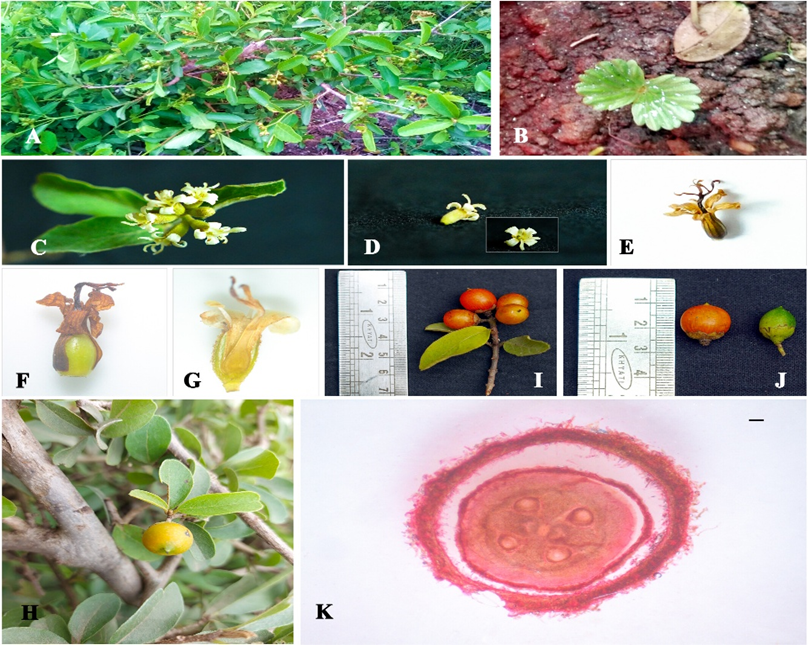
Cordia sinensis commonly shows a growth patter as shrub the plant reaches the height of 4 to meters as bush tree. Baik of this species are typically greyish brown a colour
Leaves are opposite and sub opposite alternate 6.3 to 10 by 2.3-2 cm, oval and round at the tip in has less hairy structure and imperceptibly pinnate below mid base narrows below petiole, The petiole is 1.5-1.5 cm long
Flowers the plant contains small flower usually white in colour and shows tetramerous arranged in terminal and axillary cymes. The flower haun short pedicels and peduncles about the size of 2. 2.5 cm in length. The calyx measuring 4-5mm in vain shaped and rounded when blooming tubular lobes are blunt and bent backward Hair-like structures cover the filaments.[4]
Fruits have a come-shaped appearance and typically hold one seed, with dimensions of about 1-13 cm in length. During maturation, they develop an orange coloration, which shifts to yellow or reddish brown as they dry out. These fruits possess a sticky, gum like consistency and ate safe for consumption[4]
The seeds exhibit a hard, rough texture with a pale yellowish-cream appearance. Growing conditions. This species flourishes in various soil types including alluvial deposits, sandy terrain. red clay loam, and rocky substrates, showing particular preference for humid areas near river[4]
Microscopy: Macroscopic Assessment
The external bark of Cordia sinensis Lam, steam displays a brown coloration, which differs markedly from the light cream-brown internal bark. The external surface shows slight grooves and scarring, whereas the internal bark presents delicate striations. The stem surface appears smooth bur possesses a firm and fragile texture After dehydration, the stem bark curves and creates a single cylindrical barks It lacks any distinct odour, and presents a mildly bitter flavour
Microscopic assessment: cross sectional analysis
The developed bark of Cordia sinensis Lam. demonstrates 8–15 cork layers consisting of horizontally stretched, stratified cells and dead rhytidome tissue. The cork cells, both external and internal, display variable dimensions and configurations, containing yellow-brown materials. The cortical cells feature thin walls and sporadically include sclereid cells and angular calcium oxalate crystals. The phloem fibers consist of thick-walled, extensively lignified bast fibers with sharp ends and accompanying cells. The medullary rays appear multiseriate, undulating, and expanded toward the exterior, comprising thin-walled, radially extended cells. The vascular bundles show a bicollateral arrangement, indicating cambial activity with outer metaxylem and protoxylem oriented toward the central pith, surrounded by heavily lignified xylem fibers that provide structural support. Furthermore, numerous, highly lignified pericyclic fibers are present in the stem's cortical area.
Microscopic Assessment: Powder Analysis
Microscopic investigation identified cork cells containing yellow and brown materials at the surface. Cortical parenchyma cells contained tannins and reserve substances. Lignified phloem fiber segments showed net-like thickening, while xylem vessels demonstrated reticulated designs and bordered perforations. Wood components, including tracheids and vessel elements, were also detected. Sclereid cells appearedrarely. Furthermore, starch granules and angular calcium oxalate crystals were dispersed throughout the powder sample.
Physicochemical Properties
The physicochemical evaluation of Cordia sinensis Lam. stems determined key parameters, including total ash content, acid-resistant ash, and water-soluble ash, together with ethanol and aqueous extractive values. These analytical findings are summarized, offering a comprehensive summary of mineral content and extractable components.[10]
Materials and Methods for Extraction of Cordia sinensis
Materials Required
Plant Material Collection and Preparation
Extraction Equipment
Solvents and Chemicals
Reagents for Analysis
TLC plates: Silica gel F254 with fluorescent indicator
Mobile Phase Solvents: Chloroform, methanol, formic acid (4.4:0.35:0.25 ratio)
Visualization Reagents: AIC13 (1% ethanolic solution), various spray reagents
Phytochemical screening reagents: Standard reagents for alkaloid, flavonoid, and phenolic detection
Detailed Extraction Methodology
Method 1: Soxhlet Extraction (Recommended for Maximum Yield)
Sample Preparation
1. Authentication: Obtain authenticated plant material with proper botanical identification
2. Drying. Shade-dry collected plant parts under ambient conditions to prevent degradation of heat-sensitive compounds
3. Size reduction: Grind dried material to fine powder (40-60 mesh size) to increase surface area for extraction
4. Weight determination: Accurately weigh the powdered sample (typically 10-50g depending on apparatus size)
Sequential Soxhlet Extraction Protocol
1. Apparatus assembly.
2. Sample loading:
3. Sequential extraction procedure:
Step 1: Extract with petroleum ether (6-8 hours) for lipophilic compounds
Step 2: Dry the defatted residue and extract with chloroform (8-12 hours)
Step 3: Extract residue with ethanol (12-24 hours) for polar compounds
Step 4: Final extraction with water (decoction method, 2-4 hours at 65°C)
4. Solvent recovery and concentration:
Method 2: Cold Maceration (Alternative Method)
Room Temperature Extraction Protocol
1. Sample preparation: Use sande sample preparation as Soxhlet method
2. Sequential extraction:
3. Shaker-assisted extraction:
Method 3: Bioassay-Guided Fractionation
Advanced Fractionation Protocol
1. Primary extraction: Large-scale methanol extraction (Sample: Solvent ratio 1:6)
2. Liquid-liquid partitioning:
Suspend crude extract in water
Successive extraction with n hexane, dichloromethane, ethyl acetate, and n-butanol
Each partition performed 3 times with equal volumes
3. Column chromatography:
Quality Control and Standardization
Physicochemical Parameters
Extractive values: Calculate alcohol-soluble and water-soluble extractives
TLC Analysis Protocol
1. Sample Preparation: Prepare 10 mg/ml. solutions in methanol
2. TLC conditions:
3. Visualization
UV light at 254 am and and 366 nm Spray with 1% ethanolic AJC13 for flavonoid detection
Calculate Rf values for compound identification
Expected Yields and Results
Typical Extractive Values for Cordia sinensis
Phytochemical Profile
The extraction typically yields compounds including flavonoids, phenolics, alkaloids, tannins, steroids, triterpenoids, and saponins, with ethanol and water extracts showing highest concentrations of bioactive polar compounds
This comprehensive methodology ensures efficient extraction of diverse phytochemicals from Cordia sinensis while maintaining scientific rigor and reproducibility for pharmaceutical applications.
Expected Phytochemical Profile
Major Compound Classes Identified
Phytochemicals in Cordia sinensis: A Comprehensive Analysis
Cordia sinensis Lam. is a rich source of diverse secondary metabolites that contribute to its wide pharmacological spectrum.The phytochemical profile includes multiple classes of bioactive compounds identified through various analytical techniques.
Major Phytochemical Classes
Phenolic Compounds
Flavonoids and Flavonoid Glycosides
The total flavonoid content reaches 0.747 mg/100mg (expressed as quercetin equivalents.
Phytochemical In Cordia Sinensis
|
Part of the plant |
Phytochemical |
Phytochemical constituent |
|
Aerial parts |
phenolic compounds |
Bosmarinic acid, methyl rosmarinic acid trans-caffeic acid protocatechuic acid. |
|
|
Flavonoid glycoside |
Quercitin-3-0-B-D-glucopyranoside, kaempferol-3-O-B-D-glucopyranoside kaempferide-3-O-B-D-glucopyranoside, kaempferol-3-O-a-L-rhamnopyranosyl (1-6)-B-D-glucopyranoside, kaempferide-3-O-a-L-rhamnopyranosyl (1-6) -β-D-glucopyranoside |
|
leaves |
Fatty acid methyl esters |
methyl octanoate, methyl-9-oxo-nonanoate, methyl dodecanoate, methyl tetradecanoate, methyl pentadecanoate, methyl hexadec-9Z-enoate, methyl bexadecanoate, methyl heptadecanoate, methyl octadec-92,12Z-dienoate, methyl octadec-9Z, 122, 15Z-trienoate, methyl octadecanoate, methyl eicosanoate, methyl docosanoate, methyl tricosanoate, methyl tetracosanoate |
|
|
glycoside |
Syringaresingl mono-?-D-glucoside, 6-hydroxy-3-oxo-a-ionol 9-O-B-D-glucopyranoside, Staphylionoside D, 3-(3',5'-dimethoxy-4'-O-B-D-glucopyranosyl-phenyl)-prop-2E-en-1-ol |
|
|
terpens |
2,7-dimethyl-1,6-octadiene, 1,2,3,4,4a,5,6,8a-octahydro-7-methyl-4-methylene-1-(1-methylethyl)-naphtahlaene, 3,7,11,15-tetramethyl-2-hexadecen-1-ol |
|
Roots |
Terpenoid quinones & hydroquinone |
Cordial A cordiachrome Acordiachrome C cordiaquinol C. |
|
|
phytosterol |
Stigmasta-3,5-diene B-sitosterol, stigmasterol |
|
|
triterpenes |
Cycloartenol, 24-methylenecycloartanol cycloeucalenol |
|
Seeds |
Fatty acids |
Bicinoleic acid, oleic acid, steric acid, steruculic acid. |
|
fruits |
carbohydrates |
Dextro isomerase of glucose, galactose, fructose, xylose, rhamnose, |
Fatty Acids and Fatty Acid Derivatives
GC-MS analysis has identified 33 compounds (~69%) in stem extracts, with fatty acids being predominant:
Major Fatty Acids:
Fatty Acid Esters:
Steroids and Phytosterols
The steroid profile includes 3 phytosterols identified through GC-MS analysis:
Triterpenoids
Cordia sinensis contains various triterpenoid compounds:
Alkaloids
Essential Oil Components
While specific essential oil composition data for C. sinensis is limited, related Cordia species show characteristic patterns:
Typical Sesquiterpenes:
Monoterpenes:
Other Secondary Metabolites
The phytochemical composition varies significantly based on extraction solvents:
Quantitative Analysis
Chemotaxonomic Significance
The identified secondary metabolites serve as chemotaxonomic markers for the genus Cordia and family Boraginaceae. The presence of specific flavonoid glycosides, particularly kaempferol derivatives, adds to the documented chemical diversity of the Cordia genus. This comprehensive phytochemical profile explains the diverse pharmacological activities of Cordia sinensis and validates its traditional medicinal uses. The synergistic effects of these compounds likely contribute to the plant's therapeutic potential across multiple biological systems.
Pharmacological Activities of Cordia sinensis
Cordia sinensis Lam., belonging to the Boraginaceae family, demonstrates a broad spectrum of pharmacological activities that validate its traditional medicinal use. The plant's therapeutic potential is attributed to its rich phytochemical profile, particularly flavonoids, phenolic compounds, alkaloids, and triterpenoids.
Antidiabetic Activity
Cordia sinensis exhibits significant antidiabetic properties through multiple mechanisms. Hydroalcoholic extracts of the leaves demonstrate potent glucose-lowering effects in alloxan-induced diabetic rats. Studies show that 100-200 mg/kg body weight of the extract administered orally for 15 days produces significant reduction in blood glucose levels (P < 0.01), comparable to glibenclamide. The extract also improves biochemical parameters associated with diabetes, including cholesterol and triglyceride levels, while restoring normal body weight and organ function in diabetic animals. The antidiabetic mechanism likely involves enhanced insulin sensitivity and improved glucose utilization, attributed to phenolic compounds and flavonoids present in the extract. Total phenolic content measures 0.895 mg/100mg (gallic acid equivalents) and flavonoid content reaches 0.747 mg/100mg (quercetin equivalents).
Anti-inflammatory Activity
The plant demonstrates potent anti-inflammatory effects through isolated phenolic constituents. Nine compounds isolated from the ethyl acetate fraction, including protocatechuic acid, caffeic acid, rosmarinic acid, and various kaempferol and quercetin glycosides, show significant anti-inflammatory activity in carrageenan-induced rat paw edema tests. Notably, kaempferide-3-O-β-d-glucopyranoside exhibits 62.4% anti-inflammatory activity, while kaempferol derivatives demonstrate comparable potency.
Antioxidant Properties
Cordia sinensis possesses excellent antioxidant capacity through multiple mechanisms. The isolated phenolic compounds, particularly protocatechuic acid, caffeic acid, rosmarinic acid, and quercetin-3-O-β-D-glucopyranoside (compounds 1, 2, 4, and 7-9), exhibit marked DPPH radical scavenging activity comparable to standard BHA. The ethanolic extract shows stronger antioxidant properties compared to aqueous extracts, with enhanced extraction efficiency for certain phytochemicals.[18]
Antimicrobial Activity
The plant demonstrates broad-spectrum antimicrobial activity against both gram-positive and gram-negative bacteria, as well as fungal pathogens. Acetone extracts of stems, leaves, and roots show excellent antibacterial activity against Staphylococcus aureus, Pseudomonas aeruginosa, and Klebsiella pneumonia. The stem acetone extract exhibits the strongest activity against S. aureus (30.2 ± 1.53 mm inhibition zone). Antifungal activity is demonstrated against Aspergillus niger, Candida albicans, and Penicillium notatum. The methanolic extract shows the strongest antimicrobial potency (60%), followed by ethyl acetate (52%), chloroform (48%), and petroleum ether (32%) extracts.[3][6][8]
Hepatoprotective Activity
Related Cordia species demonstrate significant hepatoprotective effects, suggesting similar potential for C. sinensis. Cordia rothii extract significantly reduces ALT and AST levels in hepatotoxic rats while improving TNF-α, NFκB, and Nrf2 expressions. The hepatoprotective mechanism involves antioxidant activity and inhibition of lipid peroxidation through flavonoids and triterpenoids.[15]
Anthelmintic Activity
Studies on closely related Cordia dichotoma demonstrate significant anthelmintic activity, with aqueous extracts showing stronger effects than ethanolic extracts. The activity occurs in a dose-dependent manner (10-100 mg/ml) against Eudrilus euginiae earthworms, causing paralysis followed by death. This activity is attributed to flavonoids and saponins present in the plant.
Anti-glycation Activity
Isolated phenolic compounds from C. sinensis exhibit significant anti-glycation inhibitory activity. This property is particularly relevant for diabetic complications, as advanced glycation end-products (AGEs) contribute to diabetic pathogenesis.[3][6][7]
Cytotoxic and Anticancer Potential
While specific data for C. sinensis is limited, related Cordia species demonstrate promising anticancer activity. Cordia dichotoma bark shows cytotoxicity against various cancer cell lines, including A-549 lung cancer cells, through ROS generation and apoptosis induction. The presence of bioactive compounds like gallic acid, caffeic acid, and palmitic acid suggests similar potential for C. sinensis.
Additional Activities
Traditional uses indicate potential for treating respiratory disorders, digestive issues, eye infections, joint pain, and parasitic infections. The plant also demonstrates wound healing properties through flavonoids, saponins, and amino acids.
Mechanistic Insights
The diverse pharmacological activities of Cordia sinensis are primarily attributed to its rich phenolic profile, including protocatechuic acid, caffeic acid, rosmarinic acid, and various flavonoid glycosides. These compounds work synergistically through antioxidant mechanisms, free radical scavenging, enzyme inhibition, and modulation of inflammatory pathways. The standardization studies confirm the presence of significant secondary metabolites, particularly flavonoids and phenolics, with ethanolic extracts showing greater extraction efficiency for bioactive compounds. This comprehensive pharmacological profile supports the traditional therapeutic uses and positions Cordia sinensis as a promising candidate for modern drug development.
REFERENCE

Vaibhav Thite*, Sapna Khemnar, Sayali Thete, Ashwini Zagade, Exploring the Therapeutic Arsenal of Cordia sinensis Lam.: An Integrated Review of Bioactive Compounds and Pharmacological Properties, Int. J. of Pharm. Sci., 2025, Vol 3, Issue 9, 2836-2848 https://doi.org/10.5281/zenodo.17193107
 10.5281/zenodo.17193107
