

We use cookies to ensure our website works properly and to personalise your experience. Cookies policy
Department of Pharmaceutics, Ikon College of Pharmacy
In this present study, an attempt was made to formulate and evaluate herbal mouth ulcer gel using Basella alba extract. “Herbal components are preferred due to their lower incidence of adverse effects and affordability. In this formulation, Basella alba is used as the primary active ingredient because of its reported anti-ulcer, anti-inflammatory and wound-healing activities.” The excipients used in this formulation are Carbopol 934 (polymer), glycerin (humectant), methylparaben and propylparaben (preservative), sodium saccharin (sweetener), triethanolamine (to adjust pH). Four gel batches (F1–F4) were developed by altering the amounts of the extract and selected excipients. The herbal mouth ulcer gel was formulated and evaluated. The evaluation studies such as FT-IR studies, spreadability, pH, organoleptic properties, viscosity, in-vitro release studies were carried out for all the four formulation and F1& F4 was found to have good spreadability, viscosity, pH. Thus, the gel containing herbal ingredient was developed for management of mouth ulcer.
Mouth ulcers are localized disruptions in the oral mucosal lining that present as small, painful lesions These lesions usually appear as circular or oval-shaped spots, commonly located on the inner cheeks or lips, and often cause discomfort.[1] Mouth ulcers are widely prevalent and may develop due to several underlying health conditions or triggering factors, but usually there is no serious underlying cause. Mouth ulcers can arise from several factors, such as inadequate intake of vital nutrients like iron and vitamins (particularly B12 and C), poor oral hygiene, infections, stress, indigestion, mechanical injury, food allergies, hormonal imbalance, skin disease etc. Aphthous ulcers often become more painful during routine activities like chewing, drinking, or brushing.
Factors responsible for the mouth ulcers
Multiple triggers may contribute to the development of mouth ulcers, including SLS-containing oral care products, irritation from sharp teeth or dental appliances, emotional stress, nutritional imbalance, allergies, hormonal fluctuations, genetic factors, and microbial infections.
Mouth ulcer symptoms
Although the symptoms differ based on the underlying cause, common clinical features include
Medicines used to treat mouth ulcers:
Herbal medicines:
Herbal medicines refer to preparations made from plant materials, including leaves, roots, seeds, or flowers, used for therapeutic purposes.[4]
Herbal treatments are generally more affordable and are often preferred for minor conditions because they tend to produce fewer side effects and are widely accessible.
Example:
The main aim of the study was to formulate and evaluate herbal mouth ulcer gel using Basella alba, because it is composed of flavonoids and phytochemicals known for their anti-ulcer, anti-inflammatory, and wound-healing actions.
Prevalence of mouth ulcer:
In total,71.1% had experienced oral aphthous ulceration. When both the genders were compared, RAS more commonly affected females (60.33%) than males (39.69). The regression coefficient for gender revealed that females were more prone to RAS than males.705 patients of total 3244 patients presented with recurrent aphthous ulcer at the time of examination. Giving an overall prevalence of 21.7% (table 1). Patients in the third (20.7) and fourth (26.5) decade were most commonly affected.
MATERIALS AND METHODOLOGY
Basella alba
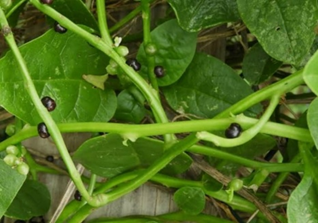
Figure 1: Basella alba
Synonym: Basella rubra Roxb or Basella alba L
Common name: Malabar Spinach
Family: Basellaceae
Chemical constituents: Dried leaves (per 100 gm) contain proteins 20%, fat 3.5%, carbohydrates 54%, fiber 9%, ash 19%.
Uses:
Pharmacological activity:
The materials used in this study included Carbopol 934 obtained from LOBO Chem, Mumbai; Triethanolamine procured from SDF Chem Ltd; Propylparaben and Methylparaben sourced from LOBO Chem, Mumbai; Sodium saccharin purchased from LOBA Chem Pvt. Ltd; and Glycerin obtained from SDF Chem Ltd.
Preformulation study:
Preformulation testing is essential to support the development of a stable, safe, and efficacious dosage form. It is a stage of development during which the pharmacist characterizes the physico–chemical properties of the drug substances and its interaction with various formulation components.
Goals of preformulation study
To determine the necessary physico-chemical parameter of a new drug substance.
Organoleptic evaluation:
Organoleptic characters such as color, odor, taste should be observed.
pH Determination
Topical cosmetic preparation should be within mouth skin layer pH, i.e., 6 – 7.5.
Measurement of pH (acidity) is performed by calibrating the pH meter.
Solubility
The solubility of herbal extract in various solvents was measured. Solubility was determined by taking 10 mg of drug sample in 10 ml of solvent as water, methanol, ethanol and chloroform.
Compatibility studies
Method of preparation of gel
The preparation of herbal mouth ulcer gel involves the use of natural ingredients and certain pharmaceutical excipients to create an effective topical medication. In this procedure, Basella alba (Malabar spinach), carbopol 934 (a carbomer), sodium saccharin, methyl paraben, propyl paraben, distilled water and triethanolamine are employed.[8]
Method of preparation of herbal gel
Step1: Harvesting and drying
Step 2: Extraction
Step 3: Preparation of gel
Step 4: Packaging
Table 2: Formulation table
|
Ingredients |
F1 |
F2 |
F3 |
F4 |
|
Basella alba |
10 ml |
12 ml |
8 ml |
10 ml |
|
Carbopol 934 |
1.2 g |
0.8 g |
0.6 g |
1.0 g |
|
Sodium saccharin |
0.5 g |
0.5 g |
0.5 g |
0.5 g |
|
Propyl paraben |
0.1g |
0.1 g |
0.1 g |
0.1 g |
|
Methyl paraben |
0.2 g |
0.2 g |
0.2 g |
0.2 g |
|
Triethanolamine |
q.s |
q.s |
q.s |
q.s |
|
Glycerin |
1.0 g |
1.5 g |
2.0 g |
1.0 g |
|
Distilled water |
q.s |
q.s |
q.s |
q.s |
Evaluation of gel:
The evaluation of gel formulation including assessments of visual appearance, pH, homogeneity, and spread ability, with spread ability quantified using a standardized formula involving the weight, slide length and separation time.
Visual appearance: The color, clarity, texture, transparency and occurrence of any gritty particles.
Measurement of pH: 1 gm of gel should be taken and distributed in 10 ml of distilled water and keep it aside for 2 hours. The measurement of pH of formulation is carried out in 3 times and the average values are stated.
Homogeneity: Gel formulations is tested for homogeneity by visual appearance after the gels were poured into the container. The gel is examined for the presence and visual appearance of any aggregate’s masses.
Spread ability Spread ability is expressed in terms of time in seconds taken by 2 slides to slip off from gel that is placed in between the slides under the direction of certain weight. If the time taken for separation of 2 slides is fewer than well the spread ability.
Spread ability is calculated by using the formula:
S = M × L / T
Where, M = weight tied to upper slide
L = length of glass slides
T = time taken to separate the slides
Viscosity: The viscosity is analyzed by the brooked fields viscometer with Heli path using spindle number 64 at 10 rpm.
In vitro drug release study:
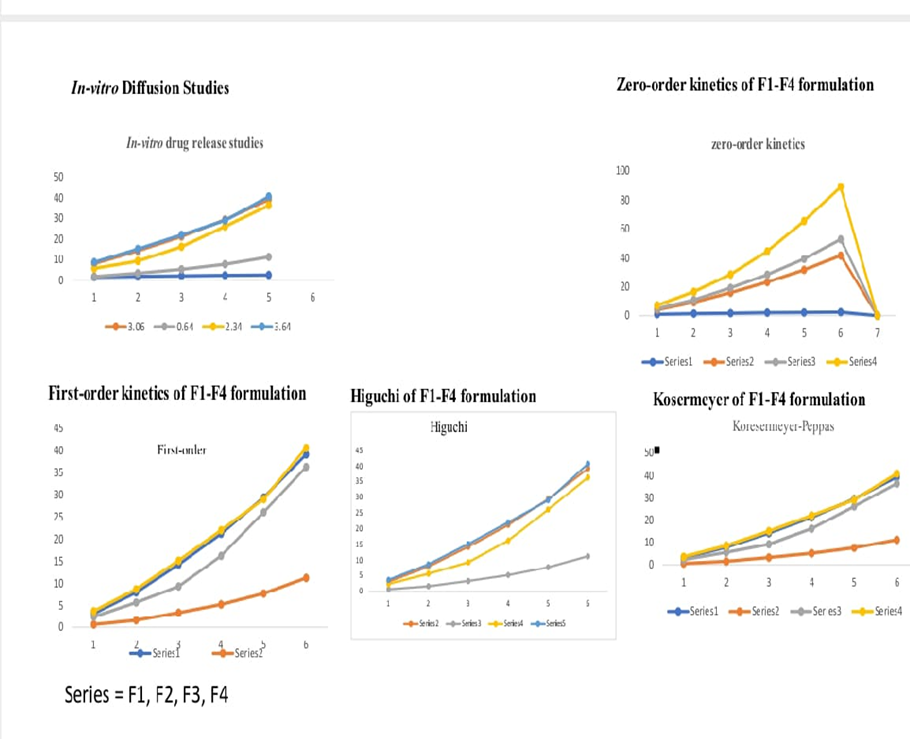
Franz diffusion cell was used to conduct an in vitro drug release study of an in herbal gel. In the donor compartment, 1 ml of formulation (equal to 1 g of gel) was deposited, and in the receptor compartment, freshly produced phosphate buffer solution (pH 6.8) was poured. The egg membrane was fitted between the chambers. One cell as blank was filled with only filled phosphate buffer solution. The units were then placed on a magnetic stirrer with thermostat. The medium was maintained at a constant temperature of 37 °C ± 0.5. After each 1 h interval, 1 ml of sample was withdrawn and same amount of phosphate buffer solution from blank was transferred into the sample cell for maintaining sink condition. Then, withdrawal amount was diluted to 10 ml in PBS pH 6.8, and concentration was measured using a UV-visible spectrophotometer at 200-400 nm with phosphate buffer solution pH 6.8 as a blank. The calibration curve was plotted and used to determine the percent cumulative drug release. The best fit model was tested for Korsmeyers, Peppas, and Fickinian diffusion mechanism for their kinetics.15,18[10]
RESULT AND DISSCUSION
Preformulation studies
Any formulation development work has to be preceded by preformulation studies. This preformulation study includes selection of method of preparation, selection of polymers, drug- polymer compatibility study and analytical investigation of drug.
API characterization of the drug
Table 3: Organoleptic properties of Basella alba
|
Property |
Specification |
Observation |
|
Colour |
Deep light green |
Deep light green |
|
Odour |
Musky odour |
Musky odour |
|
Visual |
Liquid |
Liquid |
Solubility
Solubility studies are carried out in different solvents as per IP and observation were showed.
Table 4: Solubility of Basella alba
|
Solvents |
Solubility |
Inference |
|
Water |
1 ml in 10 ml |
Soluble but colour changes |
|
Ethanol |
1 ml in 10 ml |
Soluble |
|
Methanol |
1 ml in 10 ml |
Completely soluble |
|
Chloroform |
1 ml in 10 ml |
Partially soluble |
Solubility is an important factor focused onto know the solubility of the drug with different solvent which is important criteria for formulating the medication. Basella alba was found to be completely soluble in methanol, soluble in ethanol and in other solvents like water drug was soluble but changes its color and partially soluble in chloroform.
pH studies of Basella alba
Table 5: pH of Basella alba
|
Trials |
Observed pH |
|
1 |
5.9 |
|
2 |
5.7 |
|
3 |
5.8 |
The pH range of the drug Basella alba is between 5.5 to 6 and the values are in the ranges as shown above.
Drug excipient compatibility study
The compatibility study between drug and the carriers was carried out using FTIR spectrometer. The peak numbers of the drug exhibiting C-H, C=C, C-H, C-C stretching was observed and are depicted as below.
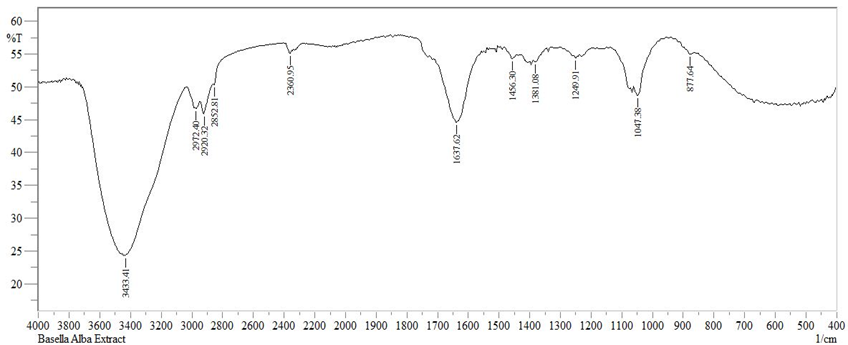
Figure 8: FT-IR spectrum of Basella alba
|
Functional group |
Frequency (1/cm) |
|
O-H |
3433cm-1 |
|
C-H |
2927-2852 cm-1 |
|
C=O |
1637 cm-1 |
|
C-O |
1249 cm-1 |
|
C-O [secondary alcohol] |
1047.38 cm-1 |
6: Interpretation of FT-IR spectral data of Basella alba

Figure 8: FT-IR spectrum of Drug + Polymer
Table 7: Interpretation of FT-IR spectral data of Drug + Polymer
|
Functional group |
Frequency (1/cm) |
|
O-H |
3398.69cm-1 |
|
C-H |
1454 cm-1 |
|
C=O |
1639 cm-1 |
|
C-O [secondary alcohol] |
1043.52 cm-1 |
Evaluation of herbal mouth ulcer gel
Physical evaluation
Table 8: Physical evaluation of gel
|
Formulations |
Color |
Odor |
Texture |
State |
|
F1 |
Light green |
Musky |
Smooth |
Semi solid gel |
|
F2 |
Dark green |
Musky |
Smooth |
Semi solid gel |
|
F3 |
Dark green |
Musky |
Smooth |
Semi solid gel |
|
F4 |
Light green |
Musky |
Smooth |
Semi solid gel |
The physical evaluation of the formulation was carried out to ensure safety efficacy and quality control of the gel. The gel was found to be dark/light green in color and has musky odor and the gel is in semisolid state. The texture of gel was found to be smooth.
Determination of homogeneity
Table 9: Determination of homogeneity
|
Formulations |
Visual appearance |
Touch |
|
F1 |
Light green, semi-solid with a gel type appearance |
Greasy and thick consistency |
|
F2 |
Light green, semi-solid with a gel type appearance |
Greasy and thick consistency |
|
F3 |
Light green, semi-solid with a gel type appearance |
Greasy and thick consistency |
|
F4 |
Light green, semi-solid with a gel type appearance |
Greasy and thick consistency |
Determination of Homogeneity was performed for ensuring product effectiveness, safety and user satisfaction. The visual appearance of the gel was found to be light green and dark green in colors and semisolid with gel type appearance the touch of the gel was found to be greasy and thick consistency.
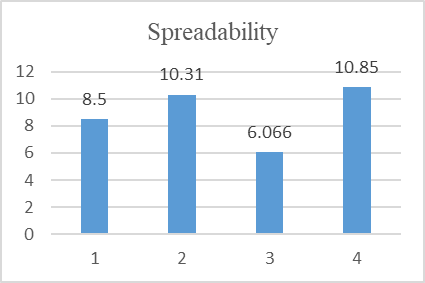
Determination of spreadability:
Table 10: Determination of spreadability
|
Formulations |
Mass (m) in g |
Length (l) in cm |
Time (t) in seconds |
Spreadability |
|
F1 |
27.5 |
7 |
24 |
8.5 |
|
F2 |
27.5 |
7 |
36 |
10.31 |
|
F3 |
27.5 |
7 |
34 |
6.066 |
|
F4 |
27.5 |
7 |
20 |
10.85 |
Determination of viscosity
Table 11: Determination of Viscosity
|
Formulations |
Revolutions per minute (RPM) |
|
At 10 rpm |
|
|
F1 |
40,860 |
|
F2 |
35,580 |
|
F3 |
37,620 |
|
F4 |
47,820 |

Figure 10: Viscosity of gel formulation
The rheological properties of the solution are of importance in viewing of their proposed oral administration. The formulation should have an optimum viscosity that will allow easy swallowing as a liquid, which then undergoes a rapid Sol-gel transition due to ionic interaction. The prepared formulation was evaluated for their rheological property using a Brookfield viscometer. The order of viscosity of all formulations were F2<F3<F1<F4.
Determination of pH
Table 12: Determination of pH of gel
|
Formulations |
pH |
Average |
||
|
Trial1 |
Trial2 |
Trial3 |
||
|
F1 |
6.7 |
6.8 |
6.8 |
6.76 |
|
F2 |
6.9 |
6.9 |
6.7 |
6.83 |
|
F3 |
6.5 |
6.8 |
6.7 |
6.6 |
|
F4 |
6.7 |
6.9 |
6.9 |
6.8 |
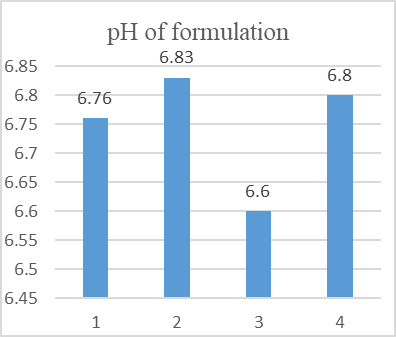
Figure11: pH of formulation
In-vitro drug release studies
In-vitro diffusion study was carried out for all the prepared formulations from F1 to F4 and the result of diffusion profile for all the formulation were tabulated in the below.
Table 13: In-vitro drug release studies of herbal mouth ulcer gel of F1 formulation
|
Time (hrs) |
Absorbance (nm) |
Conc µg/ml |
Conc µg/10ml |
Conc µg/200ml |
Loss |
CDL |
CDR |
%CDR |
|
1 |
0.153 |
0.1530 |
0.00153 |
0.306 |
0 |
0 |
0.306 |
3.06 |
|
2 |
0.241 |
0.2410 |
0.00241 |
0.482 |
0.306 |
0.306 |
0.788 |
7.88 |
|
3 |
0.316 |
0.3160 |
0.00316 |
0.632 |
0.482 |
0.788 |
1.42 |
14.2 |
|
4 |
0.351 |
0.3510 |
0.00351 |
0.702 |
0.632 |
1.42 |
2.12 |
21.2 |
|
5 |
0.412 |
0.4120 |
0.00412 |
0.824 |
0.702 |
2.12 |
2.94 |
29.4 |
|
6 |
0.492 |
0.4920 |
0.00492 |
0.984 |
0.824 |
2.94 |
3.92 |
39.2 |
Table 14: In-vitro drug release studies of herbal mouth ulcer gel of F2 formulation
|
Time (hrs) |
Absorbance (nm) |
Conc µg/ml |
Conc µg/10ml |
Conc µg/200ml |
Loss |
CDL |
CDR |
%CDR |
|
1 |
0.032 |
0.0320 |
0.00032 |
0.064 |
0 |
0 |
0.064 |
0.64 |
|
2 |
0.048 |
0.0480 |
0.00048 |
0.096 |
0.064 |
0.064 |
0.16 |
1.6 |
|
3 |
0.084 |
0.0840 |
0.00084 |
0.168 |
0.096 |
0.16 |
0.328 |
3.28 |
|
4 |
0.094 |
0.0940 |
0.00094 |
0.188 |
0.168 |
0.328 |
0.516 |
5.16 |
|
5 |
0.125 |
0.1250 |
0.00125 |
0.25 |
0.188 |
0.516 |
0.766 |
7.66 |
|
6 |
0.179 |
0.1790 |
0.00179 |
0.352 |
0.25 |
0.766 |
1.11 |
11.18 |
Table 15: In-vitro drug release studies of herbal mouth ulcer gel of F3 formulation.
|
Time (hrs) |
Absorbance (nm) |
Conc µg/ml |
Conc µg/10ml |
Conc µg/200ml |
Loss |
CDL |
CDR |
%CDR |
|
1 |
0.117 |
0.1170 |
0.00117 |
0.234 |
0 |
0 |
0.234 |
2.34 |
|
2 |
0.143 |
0.1430 |
0.00143 |
0.286 |
0.234 |
0.234 |
0.56 |
5.6 |
|
3 |
0.202 |
0.2020 |
0.00202 |
0.404 |
0.286 |
0.56 |
0.924 |
9.24 |
|
4 |
0.347 |
0.3470 |
0.00347 |
0.694 |
0.404 |
0.924 |
1.618 |
16.18 |
|
5 |
0.495 |
0.4950 |
0.00495 |
0.99 |
0.694 |
1.618 |
2.608 |
26.08 |
|
6 |
0.512 |
0.5120 |
0.00512 |
1.024 |
0.99 |
2.608 |
3.632 |
36.32 |
Table 16: In-vitro drug release studies of herbal mouth ulcer gel of F4 formulation.
|
Time (hrs) |
Absorbance (nm) |
Conc µg/ml |
Conc µg/10ml |
Conc µg/200ml |
Loss |
CDL |
CDR |
%CDR |
|
1 |
0.182 |
0.1820 |
0.00182 |
0.364 |
0 |
0 |
0.364 |
3.64 |
|
2 |
0.248 |
0.2480 |
0.00248 |
0.496 |
0.364 |
0.364 |
0.86 |
8.6 |
|
3 |
0.324 |
0.3240 |
0.00324 |
0.648 |
0.496 |
0.86 |
1.508 |
15.08 |
|
4 |
0.346 |
0.3460 |
0.00346 |
0.692 |
0.648 |
1.508 |
2.2 |
22 |
|
5 |
0.352 |
0.3520 |
0.00352 |
0.704 |
0.692 |
2.2 |
2.904 |
29.04 |
|
6 |
0.582 |
0.5820 |
0.00582 |
1.164 |
0.704 |
2.904 |
4.068 |
40.68 |
CONCLUSION
Basella alba (Malabar spinach), a medicinal plant traditionally used for its anti-inflammatory, antioxidant, antimicrobial, wound healing, and antiulcer properties. The leaves contain phytochemicals such as flavonoids, alkaloids, phytosterols, and saponins, which contribute to therapeutic action. Four herbal gel formulations (F1–F4) were prepared using Carbopol 934 as a gelling agent, glycerin as humectant, parabens as preservatives, sodium saccharin as sweetener, triethanolamine as neutralizer, and distilled water as solvent. This concluded that Basella alba-based herbal mouth ulcer gel possesses favorable physicochemical properties, effective antimicrobial activity, and sustained drug release profile. The formulation was safe, biocompatible, stable, and effective in treating oral ulcers. he formulated herbal gel shows potential as a natural substitute for conventional synthetic ulcer treatments, offering therapeutic benefits with fewer adverse effects.
REFERENCE

Misbah Nikhath, Anusha CS, Keerthana AR, Nagendra BN, Suhas R, Pooja RS, Formulation and Evaluation of Mouth Ulcer Gel Using Basella Alba Extract, Int. J. of Pharm. Sci., 2025, Vol 3, Issue 11, 3425-3437. https://doi.org/10.5281/zenodo.17678094
 10.5281/zenodo.17678094