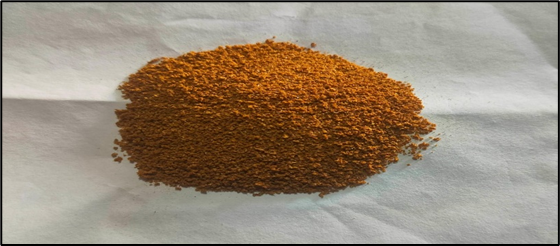
View Article

Abstract

The current study’s objective was to create Polyherbal granules by combining liquorice, cinnamon, and shatavari leaf extracts. The dried leaf powder of the plant was used for extraction and was subjected to preliminary chemical tests. The formulation was examined for characteristics including angle of repose, bulk density, tapped density, disintegration time, and stability investigations. Preliminary chemical analyses revealed that the extract contained proteins, glycosides, flavonoids, carbohydrates, and alkaloids. Excellent flow characteristics, including a good angle of repose, bulk density, and tapped density, were demonstrated by the Polyherbal granules. Granulation was a process used in the pharmaceutical industry to produce large granules, which ranged from 0.1 mm to 5.0 mm in size. These granules were formed by grouping particles and strengthening their connections using compression or binding agents. The mechanism of granulation involved four main types of bonding between particles: cohesion and adhesion, forces at the granule–mobile liquid film interface, solid bridge formation after solvent evaporation, and mechanical interlocking mechanisms. Herbal granules were used to treat various diseases, but their efficacy in treating these conditions was not well established.

Keywords

Shatavari, Cinnamon, Liquorice, Polyherbal granules, Method Extraction

Introduction

Granulation is a procedure used in the pharmaceutical field to create large granules that form when powder particles bind together. Depending on their intended use, they can range in size from 0.1 mm to 5.0 mm. These are created by grouping particles together and strengthening their bonds. The bonds are formed either through compression or the use of binding agents. Granules are a type of formulation composed of aggregates of powdered, dried solid particles that may or may not include other components known as excipients as well as one or more active medicinal ingredients. Granules have two types of bonds: slugging and utilizing binding chemicals [1].

The English word "granulated" comes from the Latin word "granulatum," which signifies grain. Many industries employ agglomeration techniques to improve material utility, facilitate handling, and lower dust. Granulation is the process that produces the particles. Granulation is required to improve flow properties, improve compaction, and avoid segregation [2].

Granulation method

  1. Dry granulation method

Dry granulation is a simple and technology that is affordable that is gaining popularity because to its ease of usage and cost effectiveness. Salt production and the addition of solvents or surface-active chemicals are among the methods available for improving dissolution. In the dry granulation process, the original powder particles are aggregated under high pressure. There are two major processes: either an as large tablet (known as slug) is created in a heavy-duty tableting press, or powder is compressed between two rollers to generate a sheet of material (roller compaction).

Advantages: -

  • Reduces moisture and drying.
  • Eliminates the need for binding solutions.

Disadvantages:

  • Dusty procedure
  • Not appropriate for all compounds
  • Slow process. [4]
  1. Wet granulation method

In wet granulation, dry primary powder particles are mixed with a granulating solution and rubbed together.  The solvent in the granulating solution needs to be volatile in order to be eliminated by drying. Water, ethanol, and isopropanol are common solvents that can be used singly or in combination. Wet granulation has many more technological and technical innovations than dry granulation.  Particles having poor flow, low bulk density, and no binding properties are among those that need wet granulation. The wet granulation process and its visual representation. It is the earliest and most conventional way to make tablets.  Wet granulation is one of the most popular and adaptable techniques.  The process is costly, time-consuming, and labor-intensive. The powders are transformed into granules by the binding property of the liquid binder, and the particles form aggregates with adhesive and cohesive forces.  Adhesion refers to bonding between unlike particles, whereas cohesion refers to bonding between like particles.

However, the fundamental principles involved in the aggregation or growth of particles include: 

    • Intermolecular and electrostatic forces. 
    • Bridging between solids and liquids (Binder solution).

The wet granulation method includes the following processing processes.

  1. Weighing and mixing formulation ingredients and excipients (except the lubricant). This process involves weighing and sifting drug material (API) and excipients (such as bulking agent, filler, or diluents, as well as disintegration) into a powder mixer. These ingredients are combined with a mixer to create a homogenous powder mixture.
  2. Preparing the dump mass this phase combines a binder solution with the powder mixture to create a dump or cohesive mass. An excessive amount of binder solution produces hard tablets with slow dissolving qualities, whereas inadequate binder causes poor adhesion, capping, and soft tablet manufacture.
  3. Wet screening.  To screen the moist powder mixture, use sieve numbers 8 or 10.  These can be completed by hand or with the appropriate tools.  The resulting wet granules are evenly placed on a tray and roasted until dry. 
  4. Drying moist granules.  The damp granules are dried in a hot air oven set to 60 degrees Celsius.  The drying temperature and duration have also been adjusted. 
  5. Dry screening the granules to produce granules of constant size; the dried granules are then passed through sieve no. 20. 
  6. The granule is lubricated with the necessary amount of lubricant.  At this moment, the final disintegrant is added.
  7. Granules are compressed into tablets.  The mixed grains are compacted in a tablet using a single punch or many stations equipped with the appropriate punches and dies[5].

 Granulation serves several purposes, including

  • improving flow,
  • densifying materials,
  • improving content uniformity,
  • improving compression,
  • controlling drug release rate,
  • facilitating metering or volume dispensing,
  • reducing dust generation and employee exposure to drug product, and
  • Improving tablet appearance [7].

MATERIAL AND METHODS

Plant material

The botanical sample consisting of three medicinal plants Glycyrrhiza glabra linn (rhizomes and roots), Asparagus racemosus Willd (root) and Cinnamomum trees(bark), were procured from the authenticated local market (mogadpalli) of Nanded district.

Dried material is coarsely powdered in grinder and powder was used for extraction.

Excipients

Collect various excipients in the store room at Shri Sambhaji College of Pharmacy for granule manufacturing, including starch, magnesium stearate, calcium phosphate dibasic, citric acid, properly parabens, flavouring agent, sucralose and colouring agents.

Plant profile of Herbal drug:-

1. Liquorice
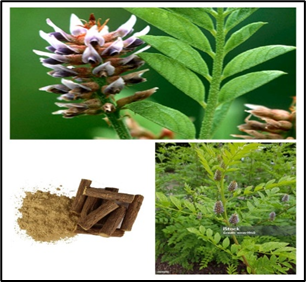
Fig.No.1. Liquorice

Synonyms: Liquorice, Sweet Root , Glycyrrhizin, Bois Doux (French), Yasti-Madhu (Ayurvedic)

Biological Source:    It consists of dried peeled or unpeeled rhizomes and roots of Glycyrrhiza glabra linn belonging to family Fabaceae.

Botanical Name:  Glycyrrhiza glabra Linn.

Family:  Fabaceae (Leguminosae)

2. Shatavari
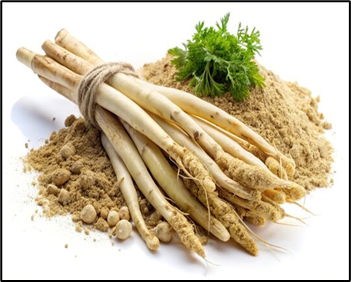
Fig No :- 02 Shatavari

Synonyms: Asparagus racemosus Wild Asparagus, Satamuli, Satavari, Satavare, Indivari, Narayani, Abhiru

Biological Source: It consists of dried roots of Asparagus racemosus Willd belonging to family Asparagaceae.

Botanical Name: Asparagus racemosus Willd.

Family: Asparagaceae

3. Cinnamon
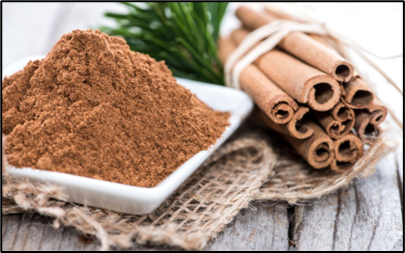
Fig No:- 03 Cinnamon

Synonyms: Dalchini, Ceylon Cinnamon, Cinnamon bark , Cinnamomum verum , Cinnamomum zeylanicum

Biological Source: It consists of dried bark of various species of Cinnamomum trees, primarily Cinnamomum zeylanicum (Ceylon cinnamon) and Cinnamomum cassia (Cassia cinnamon) belonging to family Lauraceae.

Method of Extraction:-

Maceration is a simple extraction method that involves immersing the powdered or coarsely ground plant-prepared raw material in an appropriate solvent at room temperature for at least three days, stirring periodically. The mixture is filtered using sieves or a net with microscopic holes after the extraction procedure. After the marc is squeezed and let to stand, the liquid extract is cleaned using filtration or decantation. Maceration is best carried out in a stoppered container to minimize solvent loss by evaporation [23].
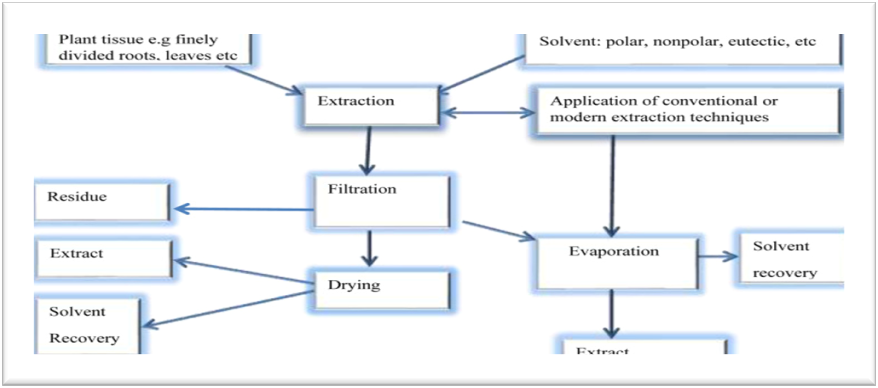
Fig No: - 04 Maceration process
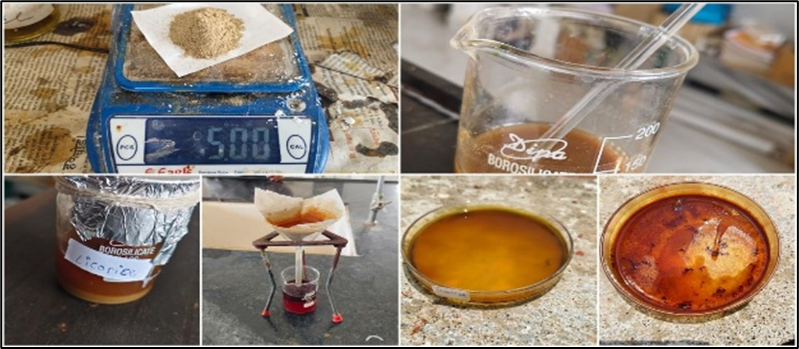
Fig No:-05 Extraction process by maceration

Preliminary phytochemical screening for various extracts:-

  1. Detection of Alkaloids
    1. Mayer’s test: Mayer’s reagent was added to five ml extract. The presence of a creamy white precipitate in the sample indicated the presence of alkaloids.
    2. Dragendroff’s test: Five ml of extract were mixed with two ml of Dragendroff’s reagent. The presence of alkaloids is established by the reddish-brown colour precipitation.
  2. Detection of Glycosides
    1. Borntrager’s test, filtered (2 mL) extract was mixed with 3 mL CHCI3 and 109% ammonia solution yielding a pink colour that indicated glycoside presence.
  3. Detection of Saponins
    1. Foam Test: In a test tube, around 0.5 gram of the extracts were diluted with 2 ml of water. Saponins were detected by the presence of foam that lasted for around ten (10) minutes after being shaken.
  4. Detection of flavonoids.

The extract was treated with few drops of sodium hydroxide solution. It initially produce a deep yellow colour which become colourless when dilute acid is added to it , this colour change represents presence of flavonoid.

  1. Detection of phenol-

Plant extract were treated with a few drops of ferric chloride solution. Bluish colour formation indicates the presence of phenols.

  1. Detection of Resins:

One ml of extract was dissolved in acetone before being added to distilled water. The presence of resins was suggested by the presence of turbidity [24].

Formulation of herbal granules:

The wet granulation process was used to prepare the granules. In a mortar, extract (powder) and citric acid were combined with sucralose.

After that, starch, calcium phosphate dibasic, and therefore the parabens were added.

Granules were formed by passing the lumpy substance through sieve number 22 after a sufficient amount of distilled water was supplied.

 "The granules were dried in the oven. Finally, magnesium stearate was added for lubrication [25].

Table No 01:- Composition of Polyherbal Granules

Sr. No.

Ingredients

F1 Quality(gm)

F2

Category

  1.  

Extract  Liquorice

2.5 gm

2.5

API

  1.  

Extract of Shatavari

2

3

API

  1.  

Extract of Cinnamon

2.5

2

API

  1.  

Starch paste

1.5

1.5

Disintegrant

  1.  

Magnesium stearate

2.5

2.5

Antiadherant

  1.  

Calcium phosphate dibasic

3.5

3.5

Bulking agent

  1.  

Citric acid

2

2

Taste masker

  1.  

Propyl parabens

0.5ml

0.5 ml

Preservative

  1.  

Flavouring agent

Qs

Qs

Flavouring agent

  1.  

Sucralose

Qs

Qs

Sweetening agent

  1.  

Colour

Qs

Qs

Colouring agent

EVALUATION OF HERBAL GRANULES:

Angle of Repose:

The angle of repose is that the angle formed by the horizontal base of the bench surface and the edge of a cone-like pile of granules. After the cone from 5 g of sample was built, height of the granules forming the cone (h) and therefore the radius(r) of the base were measured.

The angle of repose (θ) was calculated as follows:

θ = tan-1 (h/r)

Results were only considered valid when a symmetrical cone of powder was formed. The funnel method was used to perform the test.

Bulk density:

It is that the ratio of total mass of powder to the bulk volume of powder.

Db = m / V0

  • Where, m: Mass of the blend
  • V0: Untapped Volume
  • A graduated glass cylinder was used to perform the test

Tapped Density:

Tapped density is the ratio of mass of powder to the tapped volume. Tapped volume is the volume occupied by the same mass of the powder after a standard tapping of a measure.

Dt= m / Vi

  • Where, m: Mass of the blend.
  • Vi: Tapped Volume

Graduated glass cylinder was used for the test which was subjected to 50tappingand the volume was noted [25].

Disintegration test

A drug in solution form is readily available to the body. Disintegration is the first important step involving the breakdown of tablet into smaller particles or granules. The USP disintegration device utilises 3 inches long 6 glass tubes which are open at the top and held against a 10 mesh screen at the bottom end of the basket rack assembly. Disintegration test involves placing a tablet in each tube, and keeping the basket rack in a beaker filled with 1 L of water or simulated gastric fluid maintained at 37 ±2°C temperature. On moving upward the tablet should remain 2.5cm below the liquid surface and on downward movement it should remain 2.5cm above the bottom of the beaker. The basket assembly is moved up and down (using a standard motor) through a distance of 5-6 cm at a frequency of 28-32 cycles per minute.

2 grams of formulation were accurately weighed and placed in a basket rack assembly.  Granule disintegration time was measured in a pH 6.8 phosphate buffer at 37ºC [25].

EXPERIMENTAL RESULT AND DISCUSSION:-

Physical properties

Table No 02 physical properties of Medicinal plant

Properties

Liquorice

Shatavari

Cinnamon

Appearance

Light yellow to tan roots; powder is yellow-brown.

Pale beige or off-white when powdered; roots are long, tapering, and tuberous.

Brown to reddish-brown bark; often curled into quills or ground into powder.

Texture

Fibrous root; smooth powder.

Smooth and powdery when ground; fibrous as whole roots.

Brittle bark when dried; fine when powdered.

Odour

Sweet, characteristic liquorice smell.

Mild, earthy, and somewhat nutty.

Warm, sweet, and spicy

Taste

Very sweet (due to glycyrrhizin).

Slightly sweet and bitter.

Sweet, pungent, and slightly astringent.

Solubility

Water-soluble constituents; extracts often made in water or alcohol.

Mostly insoluble in water; decoctions made by boiling in water.

Partially soluble in water; essential oils are soluble in alcohol.

Phytochemical screening:-

Phytochemical screening of Liquorice, Shatavari and Cinnamon was done and following Phytoconstituents like alkaloids, glycosides, flavonoids, phenols and saponin was present but resins  was absent.

Table No. 03:- Preliminary Phytochemical Screening

Type of Phytoconstituents

(Liquorice, Shatavari, Cinnamon)

Inference

Alkaloids

+

Glycosides

+

Flavonoids

+

Saponin

+

Phenol

+

Resins

_

+   :- Presence of Phytoconstituents

-    :- Absence of Phytoconstituents

NP: - Not performed
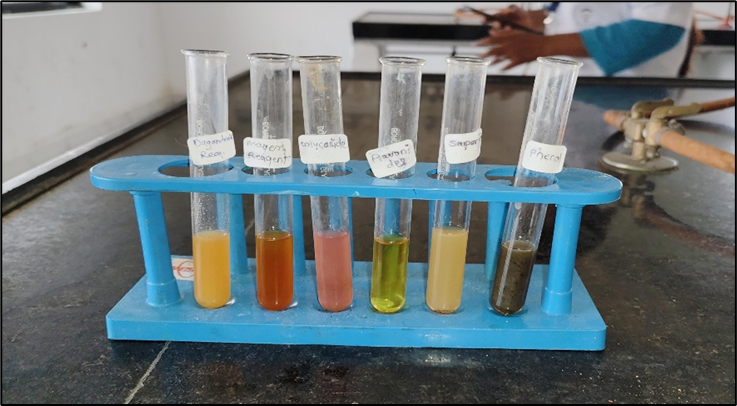
Fig no. 6. Phytochemical test for Liquorice
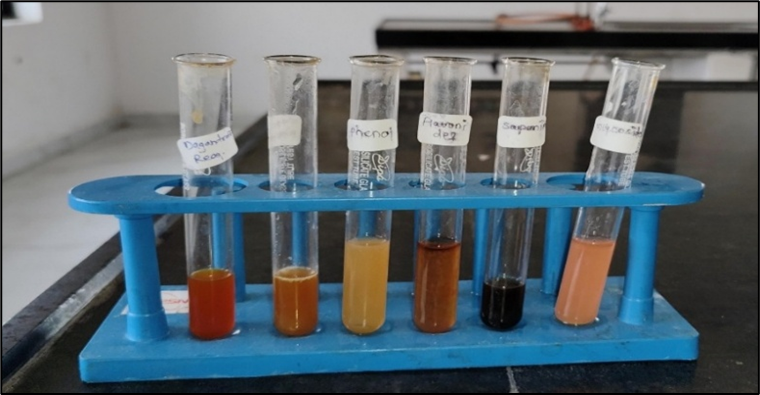
Fig no.7. Phytochemical test for Shatavari
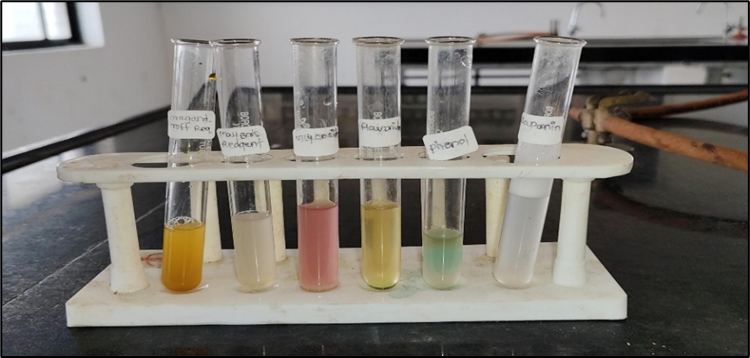
Fig no.8. Phytochemical Test for Cinnamon.

Table No 04:- Organoleptic characteristics of polyherbal granules

Sr No

Parameters

Observation

1

Description

Yellowish Brown colour round shape granules

2

Colour

Yellowish Brown

3

Odour

Characteristics odour

4

Taste

Bitter taste

5

Solubility

Soluble in aqueous solvent

Evaluation of herbal Granules Results:-

The values of angle of repose are below 30? thereby indicating excellent flow properties. Lower values of bulk and tapped density indicate higher porosity implying the time required for disintegration would be lower. The disintegration test implies that the granules can disintegrate within 15 sec, thereby leading to quicker absorption and onset of action of the drug as compared to that in its other dosage form.

Better flow characteristics are indicated by a lower Hausner’s ratio (<1.25), intermediate flow is indicated by a ratio between 1.25 and 1.5, and bad flow characteristics are indicated by a ratio greater than 1.5. The Hausner’s ratio of granules was found to be less than the 1.25.

Table No 05:- Evaluation parameters of herbal granules

Sr No

Parameters

F1 Results

F2 Results

1

Angle of repose

25°

22°

2

Bulk density

0.823 gm/ml

0.523 gm/ml

3

Tapped density

1.63 gm/ml

1.63 gm/ml

4

Hausner’s Ratio

1.10 gm/ml

3.11 gm/ml

5

Disintegration Time

Within 20 sec

Within 25 sec

Fig No 09:- Polyherbal Granules

Stability Study:-

Following a three-month period, the samples were visually examined for colour changes. As a result, no colour changes resulting from physical or chemical interactions between the medicine and excipients were found. To test the durability of pharmaceutical formulations, they must be exposed to increased temperature and relative humidity.

Table No 06:- Stability test of Polyherbal granules at different temperatures

Temperatures condition

Duration of time

1 hr

2 hr

3 hr

4 hr

5 hr

25

-

-

-

-

-

30

-

-

-

-

-

40

-

-

-

-

-

45

-

-

-

-

-

50

-

-

-

+

+

60

-

-

+

+

+

-  No change in formulation

+ Degradation of granules

Table No 07:- Stability Study of granules at different relative humidity:-

Temperature

Relative Humidity

20%

30%

40%

50%

70%

20

-

-

-

-

-

30

-

-

-

-

-

40

-

-

-

+

+

50

-

-

-

+

+

60

-

-

-

+

+

-  No change in formulation

+ Degradation of granules

CONCLUSION:-

The aim of dissertation entitled “Formulation and Evaluation Polyherbal Granules by incorporating the leaves extract of cinnamon (Cinnamomum zeylanicum), Shatavari, (Asparagus racemosus) liquorice (Glycyrrhiza glabra)” is to formulate for a stable, Safe, Efficient as well as qualitative dosage form. The dried leaves powder of the plant was extracted and subjected to preliminary chemical tests. The preliminary chemical studies show that the extract contains Tannin, alkaloids, flavonoid, Saponins, glycoside. Then it was formulated and then evaluated for various parameters like angle of repose, bulk density, tab. Density, disintegration time and stability studies. The formulated poly herbal granules exhibited excellent flow properties which showed good angle of repose, bulk density and tapped density. Flow properties All formulation F1 and F2 are acceptable limit. Formulation F1 had good flow properties as compared to Formulation F1 hence Formulation F1 was selected as final formulation. From the experimental results showed that the developed Polyherbal granules was yellowish in colour with absence of lumps and good uniformity.

REFERENCES

  1. Amtul Hafsa,S.A Azeez, "Preparation and characterization of herbal granules using spray drying technique"Journalof Pharmaceutical Sciences,2020,109,(3),1231-1238. DOI: 10.1016/j.xphs.2019.12.00
  2. Shailesh Pradhan, Neha Dubey, "Development and evaluation of herbal granules using freeze-drying technique", Journal of Herbal Medicine,2019,15,100-107. DOI: 10.1016/j.hermed.2019.02.002
  3. Shilpa S. N.,Dayanand R.D., "Herbal granules: A review on preparation, characterization, and applications" (2018) - Journal of Pharmacy and Pharmacology,2018,70(8),1043-1055. DOI: 10.1111/jphp.12955
  4. Thalari Sravani, Kommuri Mounica, Chava Lakshmi Narayanamma, “A Review of Recent Techniques for Granulation”, UPI Journal of Pharmaceutical Medical, and Health Sciences,2024,7(3),1-5 https://doi.org/10.37022/jpmhs.v7i3.113
  5. Shailesh Pradhan, Neha Dubey, Shiv Shankar Shukla, “A Review of the Fundamentals of Pharmaceutical Granulation Technology”, International Journal of Pharmaceutical and Phytopharmacological Research (eIJPPR),2023,13( 2),1-17. https://doi.org/10.51847/Ep1i15qVC4
  6. Dr. A.A. hajare, Dr. D.A. Bhagwat, “Introduction of granules in pharmaceutics – I”, published by nirali prakashan, 2019, 4th edition, 2.8- 2.9.
  7. L.P. PATIL, V.P Rawal, “Review Article on Granulation Process with Novel Technology: An overview”, Indian Journal of Applied Research, 2017, 7(6),79-96.
  8. P J Prasuna Sundari, Jadhav Soundarya, “Formulation and Evaluation of Prebiotic Herbal Granules”, International Journal of Pharmaceutical Sciences Review and Research, 2024,84(2), 41-46. DOI no 10. 47583/ijpsrr. 2024. v84i02.006
  9. Aslam R, Dutta D, Patni Pant S, Joshi S., Bhatt V et.al, “Development and Evaluation af Herbal Effervescent Granules of Trachyspermum Ammi Seed Extract”, International Journal of Creative Research Thoughts (IJCRT) ,2023,11(7),2320-2882, DOI no. www.ijcrt.org
  10. Prachi N Dighe, Ganesh N Kardile1, Vishal L Khilari, Rutuja A Shinde, “Formulation and Evaluation of Poly Herbal Granules As Dietary Supplement”, international journals of creative reasearch thoughts, 2021, 2320-2882, DOI no. www.ijcrt.org
  11. Ms. Bangar Mayuri S*, Ms. BalsarafChetana D, Ms. DhamdhereSampada K, Mr. Patel Salim G, Dr. Jadhav S. L, Dr. Gaikwad D. D, “Formulation and evaluation of Vasaka granules for asthma”, Journal of Drug Delivery and Therapeutics,2019,9(2),296-299. DOI no http://jddtonline.info
  12. Prakash Pandey, Prabhakar Sharma, Ramchandra Gupta, “Formulation And Evaluation Of Herbal Effervescent Granules Incorporated With Martynia Annua Extract”, Journal of Drug Discovery and Therapeutics, 2013,1 (5), 54-57
  13. Jalal BayatiZadeh, Zahra MoradiKor, MasoudKarimiGoftar, “Liquorice (Glycyrrhiza glabra Linn) As a Valuable Medicinal Plant”, International journal of Advanced Biological and Biomedical Research,2013,1(10),1281-1288, https://www.ijabbr.Com.
  14. ShadmaWahab, SivakumarAnnadurai, ShahabeSaquib etl., “Glycyrrhiza glabra (liquorice): A Comprehensive Review on its Phytochemistry, Biological Activities”, Clinical Evidence and Toxicology, 2021, 10, 2751. https://doi.org/10.3390/plants10122751.
  15. Nutan Sharma1, Omprakash Sharma and Naresh Garg etl., “Shatavari (Asparagus RacemosusWilld): A review on its cultivating”, World journal of Pharmaceutical And medicals research morphological , Biological  activites& pharmacologically  important  ,2021,7(9), 41– 48. www.wjpmr.com
  16. AdishKurdukar and SangitaJogdand etl., “Brief Review on Shatavari (Asparagus racemosus) and Its Medicinal Use”, Journal of Pharmaceutical Research International ,2021,33(60B): 1552-1559.
  17. Shashi Alok1, Sanjay Kumar Jain, AmitaVerma, Mayank Kumar, AlokMahor, Monika Sabharwal, “Plant profile, phytochemistry and pharmacology of Asparagus racemosus (Shatavari): A review”, Asian Pacific Journal of Tropical Disease, 2013; 3(3): 242-251.
  18. Yadav Ashwani, Piyush Yadav, ShradhaSahu, ShashikantMaurya, Tushar Yadav etl., “A Review on Cinnamon species”, International journal of creative research thoughts ,2021,9(1),2320-2882, www.ijcrt.org.
  19. VaibhaviJakhetia, Rakesh Patel, Pankaj Khatri, NeerajPahijeetl., “Cinnamon: A pharmacological Review”, Journal of Advanced Scientific Research,2010,1(2); 19-23, https://www.sciensage.info.
  20. OrasYaseen , Mustafa Taha Mohammed , “Review  Article : Effects of Cinnamon and their beneficial Content on Treatment of Oxidative Stress” , A multifaceted review journal in the field of pharmacy, 2020, 11(9):661-665, https://www.researchgate.net/publication/344804072.
  21. Manav Jadav, Dr. Jitendra Patel and Dr. Umesh Upadhyay, “Pharmaceutical excipients”, National Journal of Pharmaceutical Sciences 2022,2(2),24-36. www.pharmajournal.ne
  22. Abhishek Soni, Hemant Kumar Verma, “Methods of Extraction of Pharmaceutical Excipients From Natural Resources: A Review”, World Journal of Pharmaceutical and Life Science,2019,5,(5),118-121 www.wjpls.org
  23. ChibuyeBitwell, Singh Sen Indra , ChimukaLukec, Maseka Kenneth Kakoma , “A review of modern and conventional extraction techniques And their applications for extracting phytochemicals from Plants”,Scientific African,2023,19,1-3. www.elsevier.com/locate/Sciaf
  24. Aishwarya S. Patil1, Rani A. Puri, Mohini S. Mane At. el, “Formulation, Development and Evaluation of Giloy Candy as a Novel Approac”, Nanotechnology Perceptions, 2024,20(16),372, www.nano-ntp.com
  25. Prachi N Dighe, Ganesh N Kardile, Vishal L Khilari, Rutuja A Shinde, “Formulation and Evaluation of Poly Herbal Granules as Dietary Supplement”, International Journal of Creative Research Thoughts (IJCRT), 2021,9(9),2320-2882
  26. Shalini Sharma, “Industrial pharmacy – I”, published by the s. Vikas and company publisher, 2019, 67.

Reference

  1. Amtul Hafsa,S.A Azeez, "Preparation and characterization of herbal granules using spray drying technique"Journalof Pharmaceutical Sciences,2020,109,(3),1231-1238. DOI: 10.1016/j.xphs.2019.12.00
  2. Shailesh Pradhan, Neha Dubey, "Development and evaluation of herbal granules using freeze-drying technique", Journal of Herbal Medicine,2019,15,100-107. DOI: 10.1016/j.hermed.2019.02.002
  3. Shilpa S. N.,Dayanand R.D., "Herbal granules: A review on preparation, characterization, and applications" (2018) - Journal of Pharmacy and Pharmacology,2018,70(8),1043-1055. DOI: 10.1111/jphp.12955
  4. Thalari Sravani, Kommuri Mounica, Chava Lakshmi Narayanamma, “A Review of Recent Techniques for Granulation”, UPI Journal of Pharmaceutical Medical, and Health Sciences,2024,7(3),1-5 https://doi.org/10.37022/jpmhs.v7i3.113
  5. Shailesh Pradhan, Neha Dubey, Shiv Shankar Shukla, “A Review of the Fundamentals of Pharmaceutical Granulation Technology”, International Journal of Pharmaceutical and Phytopharmacological Research (eIJPPR),2023,13( 2),1-17. https://doi.org/10.51847/Ep1i15qVC4
  6. Dr. A.A. hajare, Dr. D.A. Bhagwat, “Introduction of granules in pharmaceutics – I”, published by nirali prakashan, 2019, 4th edition, 2.8- 2.9.
  7. L.P. PATIL, V.P Rawal, “Review Article on Granulation Process with Novel Technology: An overview”, Indian Journal of Applied Research, 2017, 7(6),79-96.
  8. P J Prasuna Sundari, Jadhav Soundarya, “Formulation and Evaluation of Prebiotic Herbal Granules”, International Journal of Pharmaceutical Sciences Review and Research, 2024,84(2), 41-46. DOI no 10. 47583/ijpsrr. 2024. v84i02.006
  9. Aslam R, Dutta D, Patni Pant S, Joshi S., Bhatt V et.al, “Development and Evaluation af Herbal Effervescent Granules of Trachyspermum Ammi Seed Extract”, International Journal of Creative Research Thoughts (IJCRT) ,2023,11(7),2320-2882, DOI no. www.ijcrt.org
  10. Prachi N Dighe, Ganesh N Kardile1, Vishal L Khilari, Rutuja A Shinde, “Formulation and Evaluation of Poly Herbal Granules As Dietary Supplement”, international journals of creative reasearch thoughts, 2021, 2320-2882, DOI no. www.ijcrt.org
  11. Ms. Bangar Mayuri S*, Ms. BalsarafChetana D, Ms. DhamdhereSampada K, Mr. Patel Salim G, Dr. Jadhav S. L, Dr. Gaikwad D. D, “Formulation and evaluation of Vasaka granules for asthma”, Journal of Drug Delivery and Therapeutics,2019,9(2),296-299. DOI no http://jddtonline.info
  12. Prakash Pandey, Prabhakar Sharma, Ramchandra Gupta, “Formulation And Evaluation Of Herbal Effervescent Granules Incorporated With Martynia Annua Extract”, Journal of Drug Discovery and Therapeutics, 2013,1 (5), 54-57
  13. Jalal BayatiZadeh, Zahra MoradiKor, MasoudKarimiGoftar, “Liquorice (Glycyrrhiza glabra Linn) As a Valuable Medicinal Plant”, International journal of Advanced Biological and Biomedical Research,2013,1(10),1281-1288, https://www.ijabbr.Com.
  14. ShadmaWahab, SivakumarAnnadurai, ShahabeSaquib etl., “Glycyrrhiza glabra (liquorice): A Comprehensive Review on its Phytochemistry, Biological Activities”, Clinical Evidence and Toxicology, 2021, 10, 2751. https://doi.org/10.3390/plants10122751.
  15. Nutan Sharma1, Omprakash Sharma and Naresh Garg etl., “Shatavari (Asparagus RacemosusWilld): A review on its cultivating”, World journal of Pharmaceutical And medicals research morphological , Biological  activites& pharmacologically  important  ,2021,7(9), 41– 48. www.wjpmr.com
  16. AdishKurdukar and SangitaJogdand etl., “Brief Review on Shatavari (Asparagus racemosus) and Its Medicinal Use”, Journal of Pharmaceutical Research International ,2021,33(60B): 1552-1559.
  17. Shashi Alok1, Sanjay Kumar Jain, AmitaVerma, Mayank Kumar, AlokMahor, Monika Sabharwal, “Plant profile, phytochemistry and pharmacology of Asparagus racemosus (Shatavari): A review”, Asian Pacific Journal of Tropical Disease, 2013; 3(3): 242-251.
  18. Yadav Ashwani, Piyush Yadav, ShradhaSahu, ShashikantMaurya, Tushar Yadav etl., “A Review on Cinnamon species”, International journal of creative research thoughts ,2021,9(1),2320-2882, www.ijcrt.org.
  19. VaibhaviJakhetia, Rakesh Patel, Pankaj Khatri, NeerajPahijeetl., “Cinnamon: A pharmacological Review”, Journal of Advanced Scientific Research,2010,1(2); 19-23, https://www.sciensage.info.
  20. OrasYaseen , Mustafa Taha Mohammed , “Review  Article : Effects of Cinnamon and their beneficial Content on Treatment of Oxidative Stress” , A multifaceted review journal in the field of pharmacy, 2020, 11(9):661-665, https://www.researchgate.net/publication/344804072.
  21. Manav Jadav, Dr. Jitendra Patel and Dr. Umesh Upadhyay, “Pharmaceutical excipients”, National Journal of Pharmaceutical Sciences 2022,2(2),24-36. www.pharmajournal.ne
  22. Abhishek Soni, Hemant Kumar Verma, “Methods of Extraction of Pharmaceutical Excipients From Natural Resources: A Review”, World Journal of Pharmaceutical and Life Science,2019,5,(5),118-121 www.wjpls.org
  23. ChibuyeBitwell, Singh Sen Indra , ChimukaLukec, Maseka Kenneth Kakoma , “A review of modern and conventional extraction techniques And their applications for extracting phytochemicals from Plants”,Scientific African,2023,19,1-3. www.elsevier.com/locate/Sciaf
  24. Aishwarya S. Patil1, Rani A. Puri, Mohini S. Mane At. el, “Formulation, Development and Evaluation of Giloy Candy as a Novel Approac”, Nanotechnology Perceptions, 2024,20(16),372, www.nano-ntp.com
  25. Prachi N Dighe, Ganesh N Kardile, Vishal L Khilari, Rutuja A Shinde, “Formulation and Evaluation of Poly Herbal Granules as Dietary Supplement”, International Journal of Creative Research Thoughts (IJCRT), 2021,9(9),2320-2882
  26. Shalini Sharma, “Industrial pharmacy – I”, published by the s. Vikas and company publisher, 2019, 67.

Photo
Dr. Vaishali Kadam
Corresponding author

Shri Sambhaji College of Pharmacy Khadkut, Nanded, Maharashtra

Photo
Vishal Rathod
Co-author

Shri Sambhaji College of Pharmacy Khadkut, Nanded, Maharashtra

Photo
Abhishek Gore
Co-author

Shri Sambhaji College of Pharmacy Khadkut, Nanded, Maharashtra

Photo
Krushna Chavan
Co-author

Shri Sambhaji College of Pharmacy Khadkut, Nanded, Maharashtra

Photo
Santosh Chavan
Co-author

Shri Sambhaji College of Pharmacy Khadkut, Nanded, Maharashtra

Dr. Vaishali Kadam, Vishal Rathod, Abhishek Gore, Krushna Chavan, Santosh Chavan, Formulation and Evaluation of Polyherbal Granules, Int. J. of Pharm. Sci., 2026, Vol 4, Issue 1, 89-99. https://doi.org/10.5281/zenodo.18117713

More related articles
Pharmacological Activity of Eclipta Alba Linn...
Pranali Mahajan, Shital Patil, Prajakta Kamble, Yogita Budhe, Dr....
Development and Characterization of Sesbania Grand...
Pranjali Bhise , Ravishankar Jeure, Shruti Rupunar, Yogesh Throat...
Formulation and Evaluation of Flaxseed Hair Gel...
HEMAPRIYA. M, KODHAI. V, PAVITHRA. N, MOUNIKA. R, PERARASU. P, Se...
A Development of Varicose Vein: Today & Tomorrow...
Ishita Vekariya, Vandana Ghul, Morvi Raval, Arati Bhetariya, Dr. Chintankumar Tank, Yash Mori, Drash...
Related Articles
Phytochemical Analysis and Antidepressant activity of Ethanolic Extract of Amara...
Rimsha Parveen, Dilip Kumar Tiwari, Abhishek Sharma, Mehta Parulben D, Priyanka Namdeo, ...
A Review On Analytical And Clinical Applications Of Anti Sense Oligonucleotides ...
DR SHAIK MASTANAMMA, Md.Naseemunnisa, Telugu.Kalavathi, ...
Preclinical Evaluation of Eclipta Alba Against Curdlan Induced Spondyloarthritis...
Tanvi Patil, Vaishnavi Kumbhar , Dr. Anilkumar Shinde, Aajit Patil, ...
The Future Revolution in the Pharmaceutical Industry: Impact of AI, Robotics, an...
Tushar Kanti Das, Nityapriya Maharana, Biswa Bhusan Padhi, Chandrakanta Das, Sai Swagatika Das, Jeeb...
Pharmacological Activity of Eclipta Alba Linn...
Pranali Mahajan, Shital Patil, Prajakta Kamble, Yogita Budhe, Dr. Dhanraj Jadge, ...
More related articles
Pharmacological Activity of Eclipta Alba Linn...
Pranali Mahajan, Shital Patil, Prajakta Kamble, Yogita Budhe, Dr. Dhanraj Jadge, ...
Development and Characterization of Sesbania Grandiflora Face Serum with Enhance...
Pranjali Bhise , Ravishankar Jeure, Shruti Rupunar, Yogesh Throat, Avinash Hosmani, ...
Formulation and Evaluation of Flaxseed Hair Gel...
HEMAPRIYA. M, KODHAI. V, PAVITHRA. N, MOUNIKA. R, PERARASU. P, Senthilraja M., ...
Pharmacological Activity of Eclipta Alba Linn...
Pranali Mahajan, Shital Patil, Prajakta Kamble, Yogita Budhe, Dr. Dhanraj Jadge, ...
Development and Characterization of Sesbania Grandiflora Face Serum with Enhance...
Pranjali Bhise , Ravishankar Jeure, Shruti Rupunar, Yogesh Throat, Avinash Hosmani, ...
Formulation and Evaluation of Flaxseed Hair Gel...
HEMAPRIYA. M, KODHAI. V, PAVITHRA. N, MOUNIKA. R, PERARASU. P, Senthilraja M., ...