
Hindustan College of Pharmacy, Chenappady, Kanjirappally
The present study aimed to formulate and evaluate a topical emulgel containing papaya seed oil for its anti-acne activity. Cosmetics have been used since ancient civilizations such as the Egyptians and Sumerians and have continued through the Middle Ages for aesthetic enhancement and personal care. These products consist of natural or synthetic chemical compounds and are available in various dosage forms, including creams, lotions, serums, ointments, powders, and emulgels. Emulgel is an advanced topical formulation that combines the properties of emulsions (oil-in-water or water-in-oil) and gels through the incorporation of suitable gelling agents. This system provides enhanced drug penetration, improved stability, controlled drug release, and prolonged contact time due to its mucoadhesive nature. Acne vulgaris is a common chronic inflammatory disorder of the pilosebaceous unit, primarily affecting the face, chest, and back, with a prevalence of up to 80% among adolescents. The major pathogenic factors involved include excessive sebum production, follicular hyperkeratinization, colonization by Propionibacterium acnes, and inflammation, often leading to comedone formation and scarring. Topical drug delivery offers targeted treatment while minimizing systemic side effects. Although gels allow rapid drug release, their limited ability to incorporate hydrophobic drugs led to the development of emulgels. Emulgels offer improved drug loading, better stability, enhanced patient compliance, and prolonged therapeutic action, making them a promising delivery system for acne management.
Cosmetics have been used for thousands of years, beginning with ancient civilizations such as the Egyptians and Sumerians, who incorporated them into daily routines for personal care and beautification. This practice continued in Europe during the Middle Ages, where pale skin and rouged cheeks were considered ideals of beauty. Cosmetics are formulated as mixtures of chemical compounds derived from natural or synthetic sources and are intended to cleanse, protect, and maintain the skin. They are available in various dosage forms, including creams, lotions, serums, ointments, powders, and emulgels, and often contain active ingredients such as vitamins, antioxidants, moisturizers, preservatives, and fragrances to enhance product performance. Acne vulgaris is one of the most common disorders of the pilosebaceous unit and predominantly affects areas rich in sebaceous glands, such as the face, chest, and back. It usually begins during early adolescence and affects up to 80% of individuals, with severity and duration varying among patients. Emulgel is an advanced topical delivery system formed by incorporating emulsions into a gel base. This formulation improves drug stability, penetration, and provides dual controlled drug release. Emulgels are non-greasy, easily spreadable, cosmetically acceptable, and prolong drug contact with the skin. Papaya (Carica papaya) seeds, often discarded as waste, are rich in unsaturated fatty acids, vitamins, antioxidants, and bioactive compounds, making papaya seed oil a promising ingredient for anti-acne emulgel formulations. (1)(3)
Emulgel:
Emulgel is a topical formulation that combines gels and emulsions. It consists of oil-in-water or water-in-oil emulsions incorporated into a gel base. Emulgels provide better stability and skin penetration than conventional gels. They offer dual-controlled drug release from both gel and emulsion phases. Drug release and stability depend on the type and concentration of gelling polymer. Emulgels are non-greasy, easily spreadable, mucoadhesive, and cosmetically acceptable.(2)
Advantages
Disadvantages
MATERIALS AND METHODS
FOR THE EXTRACTION OF PAPAYA SEED OIL
FOR THE PREPARATION OF TOPICAL EMULGEL
Apparatus used:
Equipment used:
METHODOLOGY
Collection of papaya seed
Papaya fruits were collected from the market in kanjirappally. Cut the ripe papaya and take out the black seeds. The seeds were washed thoroughly to remove the sticky pulp.
Extraction of papaya seed oil
The extraction of oil from the collected papaya seeds was performed at a laboratory scale using the procedure described below. The seeds were dried in a thin layer for 3 hours at room temperature (22 °C) with periodic stirring (every 30 min). The dried seeds were ground to a fine powder (particle size less than 1 mm). The seed oil from different papaya samples was extracted by using the Soxhlet apparatus and ethanol as a solvent. The Soxhlet apparatus was approximately set to a temperature of 70 °C, and the whole process took 12 hrs. At the end of the process, the seed oil was separated from the ethanol, dried at 60 °C, and weighed. The oil yield was calculated based on the dry weight of the material. (5)(4)(7)
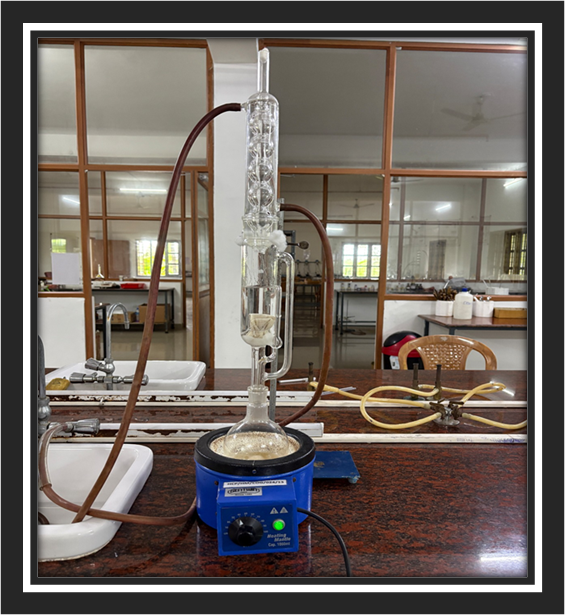
Fig No.1: Extraction of papaya seed oil
METHOD OF PREPARATION
The formulation of the emulgel preparation was carried out in various steps:
Preparation of gel: Accurately weigh Carbopol 940 are slowly dissolved it in a specified amount of distilled water with continuous stirring. Then add glycerine and propylene glycol and mix thoroughly. Add TEA dropwise with gentle stirring.
Preparation of oil phase: Take papaya seed oil and light liquid paraffin in a beaker and add span 60. Heat the oil phase to70º C.
Preparation of aqueous phase: In another beaker take the required quantity of distilled water and dissolve tween 80 and methyl paraben in it. Heat the aqueous phase to 70 ºC.
Preparation of emulsion: Slowly add the oil phase to the aqueous phase with continuous stirring using a magnetic stirrer. Allow the emulsion to cool to room temperature.
Incorporation of emulsion into gel: Add the prepared emulsion into the gel base in a 1:1 ratio with continuous stirring. Make up the final volume with distilled water and transfer the prepared emulgel into a suitable container. (8)
Table 1: Formulation table for papaya seed oil emulgel (100 gm)
|
SR.NO |
MATERIALS |
QUANTITY |
|
1 |
Papaya seed oil |
5 ml |
|
2 |
Span 60 |
2 gm |
|
3 |
Light liquid paraffin |
5 ml |
|
4 |
Tween 80 |
2 ml |
|
5 |
Glycerine |
10 ml |
|
6 |
TEA |
0.5 gm |
|
7 |
Propylene glycol |
10 ml |
|
8 |
Methyl paraben |
0.2 gm |
|
9 |
Carbopol 940 |
1 gm |
|
10 |
Distilled water |
q.s 100 |
EVALUATION PARAMETERS: -
The prepared emulgel formulations were inspected visually for their color, odour, state, and texture. A digital pH meter was used to determine the pH of the formulation. The pH meter electrode was cleaned in distilled water before being put into the mixture to measure pH three times.
The viscosity of the emulgel formulation is determined using a Brookfield viscometer.
Place approximately 2g of the emulgel on the ground slide fixed to the wooden block. Place a second glass slide over the emulgel so that the formulation is sandwiched between the two slides. Place a heavy weight (about 1kg) on top of the slides for 5 minutes to expel air and ensure a uniform film of the emulgel. Remove the 1kg weight. Attach a string to the upper slide and pass it over the pulley, attaching a smaller weight (e.g., 20g) to the other end. Release the weight and record the time (T) in seconds required for the top slide to cover a specific distance (L) and detach from the bottom slide.
It is calculated by using the formula:
S=M.L/T
Where,
S= Spreadability
M= weight placed to upper slide.
L= length moved on the glass slide.
T= time taken to separate the slides completely.
The formulation was tested for the homogeneity by visual appearance and by touch.
To determine how easily a topical emulgel can be removed from the skin using water. Apply a fixed amount of an emulgel on a definite area of glass slide. Let it stay for 5-10 minutes. Rinse the area gently with running tap water and use cotton to gently wipe the area. Observe and record the result.
Stability studies were performed on the formulated emulgel by maintaining at room temperature for 1 month. During the stability studies the parameters like homogeneity, viscosity, pH was studied.
Preparation of agar plate method
Weigh the necessary amount of nutrient agar precisely, then mix the agar powder with the measured amount of distilled water. Gently heat the mixture while stirring to dissolve the agar completely and produce a clear solution. Autoclave the medium for 15 minutes at 121°C with 15 pounds of pressure to sterilize it, then let it set at room temperature. The agar plates are prepared for use once they have solidified.
Prepare a fresh subculture of P. aeruginosa in Nutrient Broth. Incubate for 18-24 hours at 37 ºC. Inoculate the surface of an Agar plate by spread plate method and rotate the plate 60ºeach time to ensure an even, confluent lawn of growth. Allow the plate to dry for 5-10 minutes at room temperature. Using sterile forceps, place pre-sterilized filter paper disks (typically 6mm diameter) onto the agar surface. Precisely load the disks with a known volume of the emulgel, papaya seed oil and the antibiotic solution. Apply gentle pressure to the disks to ensure complete contact with the agar surface. Invert the plates and incubate them at 37ºC for 18-24 hours. Post incubation, examine the plates for clear areas surrounding the disks where bacterial growth is absent. Measure the Zone of Inhibition (ZOI) in millimeters(mm) using a digital caliper or a specialized antibiotic zone scale. Measurement should be taken across the diameter of the clear zone. (9)
RESULTS AND DISCUSSION
1. Physical evaluation: The prepared formulation was white and creamy in appearance with a pleasant odour. It exhibited a semisolid state and possessed a smooth, non-sticky texture, indicates good acceptability and suitability for topical application.

Fig No.2: Topical emulgel
2. Rheological studies: The viscosity of the formulation was measured using a Brookfield viscometer and was found to be 5320 centipoises.
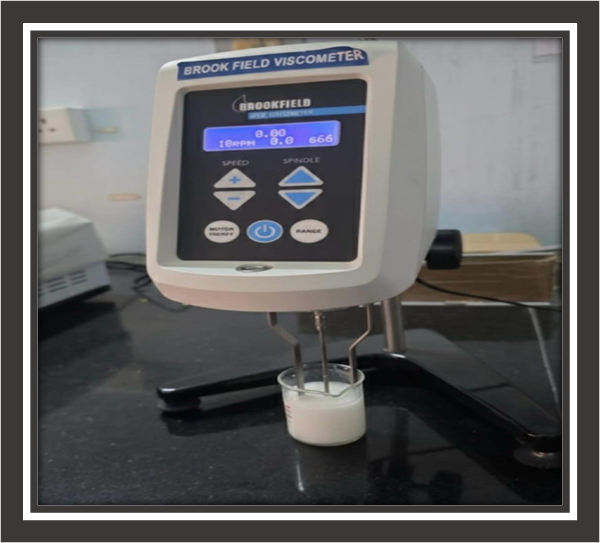
Fig No.3: Brookfield viscometer showing viscosity of the formulation
3. Spreadabilty: The spreadability of the formulation was evaluated, and the results showed that the formulation exhibited good spreadability with a value of 37.5 g·cm/sec, requiring 20 seconds for uniform spreading, indicating ease of application on the skin.
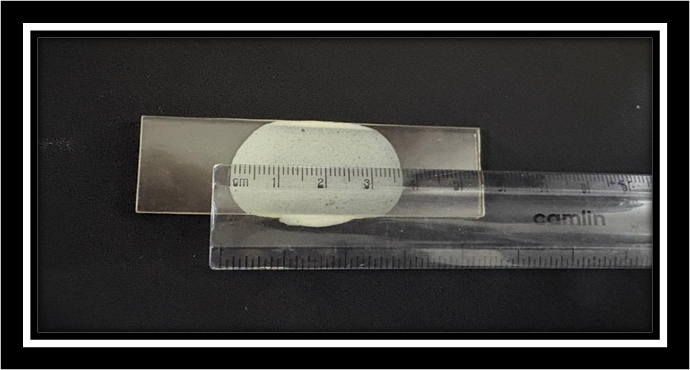
Fig No.4: Spreadability of the formulation
4. Washability: The emulgel shows good washability and was easily removed with water.
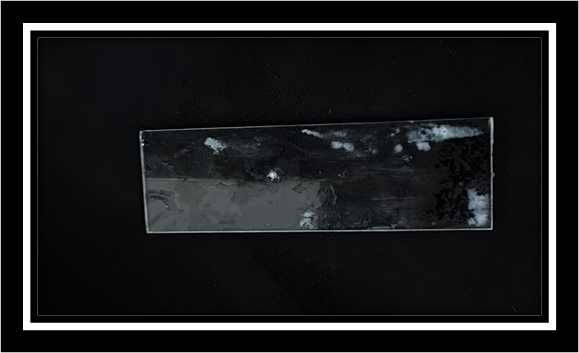
Fig No.5: Washability study of the formulation
5. Stability studies: Stability studies were done for initial days and first month for the formulations. Formulation showed good stability and homogeneity.
6. Antimicrobial studies: The zone of inhibition for the control, test, and standard formulations was found to be 22 mm, 15 mm, and 24 mm, respectively. The prepared emulgel exhibited antibacterial activity against Staphylococcus aureus. The control showed a zone of inhibition almost similar to the standard. The test formulation also demonstrated effectiveness against S. aureus, as evidenced by the formation of a clear zone of inhibition . Although the test formulation exhibited a comparatively smaller zone of inhibition, it still confirms antibacterial efficacy. Despite the minimum zone of inhibition, the test formulation effectively inhibited the growth of S. aureus, indicating its potential as a topical antibacterial emulgel.(10)

Fig No.6: Antimicrobial studies
CONCLUSION
The present study successfully formulated and evaluated a topical emulgel containing papaya seed oil for its anti-acne activity. The developed emulgel exhibited acceptable physicochemical characteristics such as suitable pH, good spreadability, appropriate viscosity, homogeneity, washability, and stability, indicating its suitability for topical application. Rheological evaluation confirmed a semisolid consistency that ensures ease of application and prolonged residence time on the skin. The formulation also demonstrated significant antimicrobial activity against Staphylococcus aureus, highlighting its potential in acne management. Additionally, the incorporation of papaya seed oil, a natural bioactive ingredient, enhances the safety and therapeutic value of the formulation. Overall, the results suggest that papaya seed oil–based emulgel can serve as an effective, patient-friendly, and promising topical delivery system for the treatment of acne vulgaris.
ACKNOWLEDGEMENT
The authors sincerely thank the Department of Pharmaceutics, Hindustan College of Pharmacy, Chenappady, Kanjirappally, for providing the necessary facilities to conduct this research. The guidance and support of the faculty members and laboratory staff during the study are gratefully acknowledged.
REFERENCES

Ardra Dileep, Arya Ajayan, Faheema Thajudeen, Shiby John, Sona Sajeev, Formulation and Evaluation of Topical Emulgel Containing Papaya Seed Oil for Anti Acne Activity, Int. J. of Pharm. Sci., 2026, Vol 4, Issue 3, 15-21. https://doi.org/10.5281/zenodo.18834703
 10.5281/zenodo.18834703
