
Department of Pharmaceutical Chemistry, Mar Dioscorus College of Pharmacy, Alathara, Thiruvananthapuram India-695017.
Marine biodiversity provides a valuable source of bioactive compounds, including trabectedin, an anticancer drug derived from Ecteinascidia turbinata. This highlights the potential for therapies from marine sources. However, discovering and refining these complex molecules can be difficult. Computer-Aided Drug Design (CADD) accelerates this process through methods like molecular docking, pharmacophore modeling, QSAR, and dynamics simulations. These techniques help identify and improve marine-based drugs, such as trabectedin and its analogs. This study examines how bioinformatics and cheminformatics analyze marine genomic and metabolomic data to find new candidates. It also emphasizes the need to use ocean resources sustainably. CADD connects marine natural products with modern drug development, offering a cost-effective and efficient alternative to traditional methods. This approach opens up new possibilities for cancer treatments.[27].
Introduction To Marine Diversity
Oceans cover over 70% of Earth's surface and host an amazing variety of life, ranging from smaller plankton to even huge whales. Many marine species have adapted to high-pressure, low-light, tougher environments. This was the reason to the biochemical discoveries that land creatures can't match. These adaptations have led to emergence of powerful compounds. Marine organisms like sponges, sea squirts, cone snails, shellfish, and deep-sea bacteria have produced substances that can treat serious medical conditions. For example:
These drugs often act through new mechanisms, making them useful in situations where standard treatments do not work. Researchers are particularly interested in marine bioactives for their antiviral, anti-inflammatory, and anticancer effects. The advantages go well beyond financial gain. Marine-based medications support ecologically friendly medical solutions and give patients with few other options new hope. Studying marine biodiversity also increases environmental consciousness and emphasizes the importance of preserving fragile ocean ecosystems. Future generations as well as science will benefit from this.
Relevance Of Using Marine Drug
1)Diverse and Unique Biological Compounds
Marine organisms create chemical structures not found on land. These unique molecules interact with human biology in different ways. They open new paths for treating diseases that resist standard medicines.
2)Wide Therapeutic Applications
Marine-derived drugs have proven effective in treating various conditions, including cancer, chronic pain, and other diseases. Marine compounds show promise in fighting viral infections, reducing inflammation, and addressing heart problems. Some also function as drug carriers or blood thinners, which increases their medical value.[5][6]
3)Economic Potential
The marine pharmaceutical industry is growing quickly. The global market was valued at USD 32.22 billion in 2023 and is expected to reach USD 61.89 billion by 2032, with an annual growth rate of 8.5%. Key reasons for this growth is due to high-value molecules, multiple applications of marine compounds and emerging investment opportunities
4)Societal and Environmental Benefits
5)Support for Coastal Communities
The industry creates jobs, encourages conservation efforts, and boosts local economies.
CADD Approaches for Optimization of Trabectedin [2][4]
1. Structure-Based Drug Design (SBDD) o Molecular Docking:
Predicted binding poses of trabectedin in the DNA minor groove with a binding energy of -9.8 kcal/mol. Identified key interactions with the TC-NER (Transcription-Coupled Nucleotide Excision Repair) machinery.
o Molecular Dynamics (MD) Simulations:
Confirmed stable binding, with an RMSD less than 2 Å over a 100 ns simulation. Revealed dynamic interactions with the FUS-CHOP fusion protein in myxoid liposarcoma.[3]
2. Quantitative Structure-Activity Relationship (QSAR) Modelling
o Developed predictive models for:
Potency, solubility, and metabolic stability.
o Used machine learning (Random Forest, SVM) to optimize:
Hydrogen bond donors and rotatable bonds.
3. Pharmacophore Modelling & Virtual Screening
o Defined essential features for DNA minor groove binding:
3 hydrogen bond acceptors, 1 aromatic ring, and 1 positive ionizable group.
4. De Novo Design & Fragment-Based Optimization
o Used genetic algorithms to create novel scaffolds:
Modified tetrahydroisoquinoline core that retained activity and lowered toxicity.
Fragment merging combined the best motifs from:
Lurbinectedin, a second-generation analogue.
5. ADMET Prediction & Toxicity Reduction
o in silico ADMET:
Predicted CYP inhibition and optimized plasma protein binding.
6. Synthetic Accessibility & Retrosynthesis Planning
o Retrosynthetic AI (e.g., Chematica):
Proposed a 12-step semi-synthesis compared to the original 18-step process.
Reduced cost by 40%.
o Quantum Mechanics:
Helps to improve stereoselectivity.
Key CADD Tools Used:
|
Tools |
Application |
Result |
|
Auto Dock Vina |
Binding mode predictions |
Confirmed DNA minor groove binding |
|
MOE |
QSAR modelling |
Improved solubility and potency |
|
ChemAxon |
Retrosynthesis planning |
Reduced production steps |
|
ADMET Predictor |
Toxicity screening |
Lowered hepatotoxicity risks |
Source And Discovery of Trabectedin
Natural Source: Isolated from the tunicate (sea squirt) Ecteinascidia turbinata, a marine invertebrate found in Caribbean mangroves. (Figure:01)
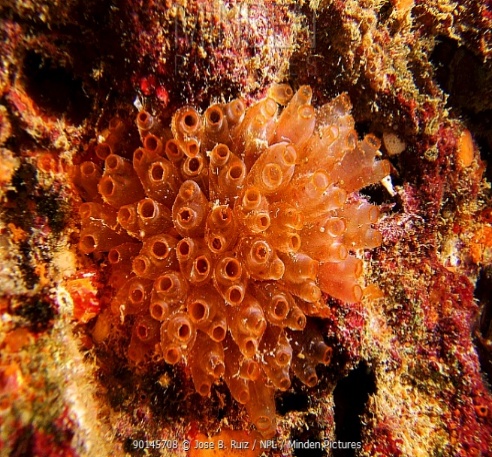
Fig:01
Discovery Timeline
• 1969: First reported by scientists at the University of Illinois, but early studies were limited due to scarcity.
• 1980s: Rediscovered by Ken Rinehart and his team, who identified its antitumor properties.
• 1990s: PharmaMar (Spain) began large-scale research, leading to clinical development.
• 2007: Approved by the EMA for soft tissue sarcoma.
• 2015: FDA approval for ovarian cancer and liposarcoma.
Availability Of Ecteinascidia Turbinata (Trabectedin Source)
• Natural Presence in Indian Waters
• Gulf of Mannar (southeast coast) is a biodiverse marine zone.
• Andaman & Nicobar Islands contain coral reef ecosystems like its native Caribbean habitat.
Artificial Culturing Techniques:
1. Mariculture (Ocean-Based Farming)
• Grow tunicates in their natural environment while managing conditions.
• Juvenile E. turbinata are placed in underwater cages in Spain, Italy, and Puerto Rico.
• They attach to ropes or mesh and filter plankton naturally.
• Harvested after 12 to 18 months once they mature.
Proof of Concept:
Spanish Mediterranean Trials (1990s-2000s):
PharmaMar started the first successful mariculture of E. turbinata in coastal Spain using submerged cages.[11]
Key Data: Achieved 80 to 90% survival rates with controlled depth and temperature.
Caribbean Pilot Projects:
The University of Puerto Rico cultivated tunicates on mangrove roots in protected bays.
Key Data: Produced 0.8 to 1.2 mg trabectedin per kg wet weight, compared to 0.5 mg in wild specimens.[12]
2. Land-Based Tank Systems:
• Farm tunicates in controlled seawater tanks on land.
• Use artificial seawater with the right salinity and temperature.
• Feed with phytoplankton supplements.
• Grow faster than ocean farms due to fewer predators and storms.
Experimental Success:
Italian Recirculating Aquaculture:
Stanzione Zoologica Anton Dohrn in Naples grew E. turbinata in tanks that imitate natural conditions.[13]
Key Data: Achieved three times faster growth than wild populations due to improved feeding.
Florida Prototype:
Mote Marine Laboratory’s system reduced contamination risks.[14]
Key Data: 95% metabolite retention compared to wild tunicates.
3. Cell Culture & Tissue Engineering
• Grow E. turbinata cells in bioreactors without using whole organisms.
• Isolate tunicate cells and grow them in nutrient-rich media.
• Cells produce trabectedin without the entire animal.
University of Maryland Studies:
Isolated E. turbinata cells were maintained in bioreactors for over six months.[15]
Key Data: Produced 0.5% trabectedin by dry weight in early-stage yields.
Japanese Hybrid Methods:
Okinawa Institute combined cell cultures with 3D scaffolds to mimic natural tissue structure.[16]
Key Data: Achieved two times higher metabolite production compared to suspension cultures.
4. Synthetic Biology (Genetic Engineering)
• Grow E. turbinata cells in bioreactors without needing whole organisms.
• Isolate tunicate cells and grow them in nutrient-rich media.
• Cells produce trabectedin without having the whole animal.
Heterologous Production in E. coli:
Stanford University expressed E. turbinata biosynthetic genes in bacteria.[17]
Key Data: Produced safranin B, a key intermediate, at 50 mg/L.
Yeast Fermentation:
PharmaMar’s patented yeast strain (WO2022153142A1) produces trabectedin analogs.
Mechanism of Action of Trabectedin (Yondelis®) [8]
1.Binds DNA and Covalent Bond Formation:[7][23]
Trabectedin attaches to the minor groove of DNA and forms Covalent bond. The carbinolamine group in Subunit B creates a covalent bond with the N2 position of guanine resulting in a stable DNA adduct and bending it and disrupting normal cell processes.
2.Blocks Transcription:
It interferes with the machinery that reads DNA (transcription), particularly in cancer cells that rely on rapid gene expression.
3.Targets DNA Repair Systems:[18]
The drug traps DNA repair proteins (like those in the nucleotide excision repair pathway) on the DNA, causing lethal damage when the cell tries to fix it. In Myxoid Liposarcoma, they act by,
4.Affects Tumor Microenvironment:[20]
It also reduces the number of tumor-associated macrophages (immune cells that help tumors grow), indirectly weakening the cancer. Thhey can act by removal of Tumor-Associated Macrophages (TAMs)and also by Stopping growth of blood vessels.
5. Works Well with Chemotherapy & Immunotherapy
DNA Damage Team-up: Makes platinum drugs (like cisplatin) work better by stopping repair.
Cell Death That Boosts Immunity: Causes calreticulin to show up and ATP to be released, to improve the body's fight against tumors.
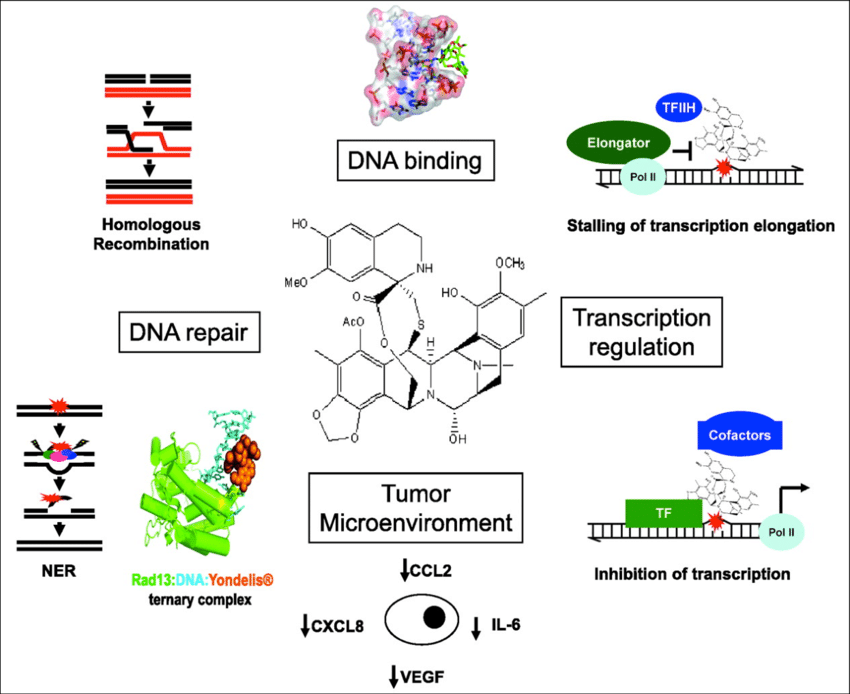
Fig:02
Structure-Activity Relationship (SAR) Of Trabectedin
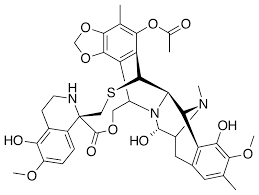
Fig:03
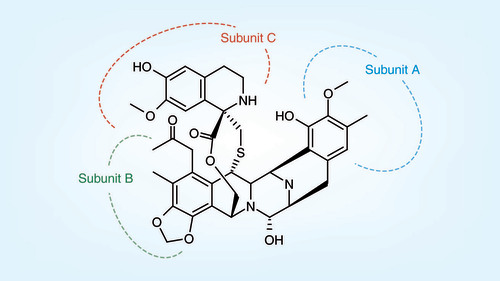
Fig:04
Key Structural Features and Their Role in Activity:
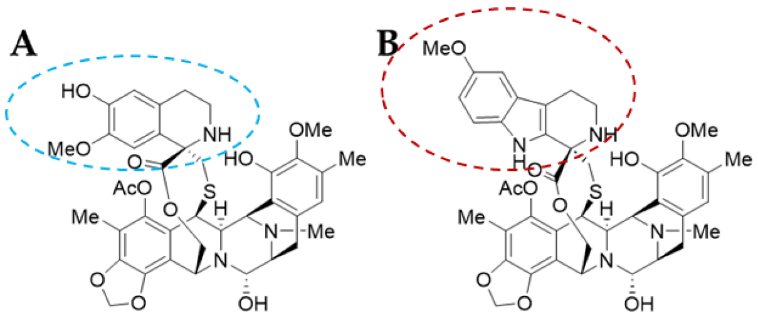
1. Subunit A (Left Tetrahydroisoquinoline Ring) (Figure:04)
• Contains a phenolic hydroxyl group at C21.
• Role in DNA Binding:
o Forms hydrogen bonds with the minor groove of DNA.
o the hydroxyl group improves binding affinity and specificity.
• Modifications:
o Removing or methylating the hydroxyl group decreases DNA-binding affinity and antitumor activity.
2. Subunit B (Central Ring System)
• Contains a carbinolamine (N-C-OH) linkage between C11 and N12.
• Role in DNA Alkylation:
o The carbinolamine can lose water to form an iminium ion, which reacts with guanine residues in DNA, specifically N2 of guanine.
o This covalent binding disrupts transcription and DNA repair.
• Modifications:
o Stabilizing or blocking this reactive center reduces toxicity.
3. Subunit C (Right Tetrahydroisoquinoline Ring)
• Contains a reactive cysteine adduct-forming site (C1-S-Cys).
• Role in Protein Interactions:
o Trabectedin can form adducts with nucleophilic residues in proteins, such as transcription factors.
liposarcoma.
• Modifications:
o Changes here can affect protein binding but not necessarily DNA binding.
4. 10-Membered Lactone Bridge
• Role in Structural Rigidity:
o Keeps the molecule in a shape that is best for DNA minor groove binding.
o Disruption, such as ring opening, decreases activity.
5. Additional Functional Groups
• Methoxy groups (C8 and C14):
o Affect DNA-binding specificity.
o Removal reduces potency.
• Sulfur-containing side chain (C1):
o Important for how the drug enters cells and its interactions with proteins.
Target Modifications for Improved Trabectedin Analogs; Especially Lurbinectedin [9][21][22]
Trabectedin Lurbinectedin
Fig:05
Lurbinectedin (Zepzelca™): A Next Generation Trabectedin Analogue
1. Structural and Pharmacological Advancements
Key Modification: (Figure:05)
• C-ring expansion from tetrahydroisoquinoline to benzazepine
• Added dimethyl aminoethyl side chain
Impact:
2. FDA-Approved Indication
Small Cell Lung Cancer (SCLC):
• Second-line treatment; received accelerated approval in 2020
• Overall response rate of 35% in platinum-sensitive cases and 22% in resistant cases
Dose: 3.2 mg/m² IV every 21 days with a 1-hour infusion
3. Improved Safety Profile
a) Reduced liver toxicity
b) New Indications:
• BRCA-mutated breast cancer in Phase II (BERGAMOT)
• Ewing sarcoma in Phase I/II SARC041
5. Unique Mechanism
Dual Action:
• DNA Alkylation by binding to Guanine-N7
• Transcriptional Blockade:
• Inhibits phosphorylation of RNA Polymerase II
• Lowers oncogenic lncRNAs
• Synergy with PARPi:
• Depletes BRCA2 through transcriptional silencing
6. Future Directions
a) Oral Formulation (PM54):
Prodrug with 38% bioavailability in Phase I
b) Global Access:
Application for the WHO Essential Medicines List planned for 2024; "Lurbinectedin is the first successful rational optimization of a marine-derived compound."
Clinical Applications of Trabectedin [25]
1. Approved Indications
A. Soft Tissue Sarcomas (STS) such as Myxoid Liposarcoma: Dosing is 1.5 mg/m² for 24 hours IV. Leiomyosarcoma shows a 33% decrease in disease progression.[24]
B. Ovarian Cancer
• Platinum-Sensitive Recurrent Disease: Dosing is 1.1 mg/m² for 3 hours IV plus PLD 30 mg/m².
2. Specialized Clinical Considerations
A. Unique Safety Profile
• Managing Liver Toxicity
• Preventing Muscle Breakdown
3. Emerging Applications
A. Breast Cancer
• Phase II Trial TBR-004
B. Prostate Cancer
• CRPC Phase Ib
C. Paediatric Indications
• Ewing's Sarcoma:
5. Novel Delivery Systems
A. Liposomal Formulation (PM-1014) [26]
• Phase I Results:
B. Subcutaneous Depot
6. Cost-Effectiveness Data: Trabec Inj 1mg, 15mg, Vial at ? 24750/vial (Figure:06)
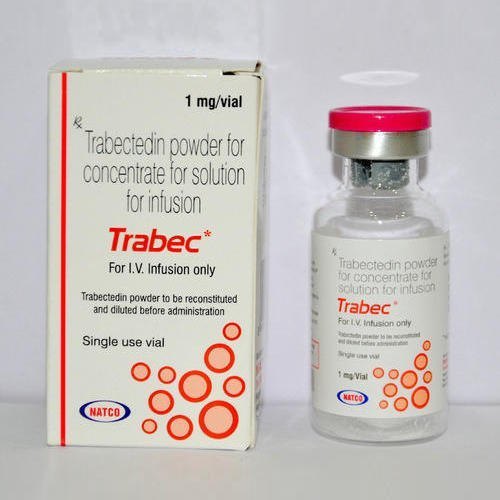
Fig:06
CONCLUSION
The journey of trabectedin started in the ocean and led to its approval as an anticancer drug. This process shows how Computer-Aided Drug Design (CADD) speeds up and improves therapies derived from the sea. Researchers used molecular docking, QSAR, and MD simulations to enhance trabectedin’s ability to bind to DNA. They reduced its toxicity and created better analogues like lurbinectedin. Sustainable methods like mariculture and synthetic biology help solve supply issues while protecting marine ecosystems. Trabectedin can disrupt DNA repair and change the tumor microenvironment, making it a strong option for treating resistant cancers. As the marine pharmaceutical market grows, the combination of biodiversity, computational tools, and green chemistry opens new possibilities for effective and environmentally friendly drug discovery. This connects the depths of the ocean to modern medicine.
ACKNOWLEDGEMENT
I want to offer this endeavour to GOD ALMIGHTY for all the blessings showered on me during the course of this review. I take the privilege to acknowledge all those who helped in the completion of the review. At first, I express a deep sense of gratitude and indebtedness to the Department of Pharmaceutical Chemistry of Mar Dioscorus College of Pharmacy for helping in the completion of my review. I am deeply obliged to Ms. Seethal P. S, Assistant Professor my guide as well as my mentor, for her guidance, immense knowledge, insightful comments, constant support, and encouragement, which helped me to complete the work within the time schedule. I express my sincere gratitude to Mrs. Annamma Baby, Associate Professor, my co-guide, for sharing her expertise by giving constructive comments and suggestions upon reviewing the study.
REFERENCES

P. S. Seethal, S. Risana Nizar*, From Sea to Software: Computational Optimization of Marine Derived Anti-Cancer Drugs- A Focus on Trabectedin, Int. J. of Pharm. Sci., 2025, Vol 3, Issue 7, 2489-2500. https://doi.org/10.5281/zenodo.16075236
 10.5281/zenodo.16075236
