
Department of Pharmacology, Pune University, Ahilya nagar, India
Infections caused by Candida albicans are a major health concern, especially among individuals with weakened immune systems. Conventional antifungal treatments are often hindered by challenges such as low patient adherence, unwanted systemic side effects, and suboptimal drug retention. This research focuses on the formulation of a novel topical antifungal stick designed for targeted and sustained delivery of the active ingredient. The formulation combines both natural and synthetic excipients, optimizing drug release, stability, and ease of application. A potent antifungal agent effective against Candida albicans is incorporated, along with skin penetration enhancers and moisturizing agents to improve comfort and enhance drug absorption. Various physicochemical properties, including melting point, spreadability , drug content uniformity, and in vitro release rates, were analyzed to assess the formulation's effectiveness and stability. Antifungal activity was further confirmed through agar diffusion assays. The results indicate that the antifungal stick exhibits desirable physicochemical properties, sustained drug release, and strong antifungal activity. This innovative formulation offers a promising alternative to traditional topical antifungal treatments, improving patient compliance, convenience, and therapeutic outcomes.
Herbal extract from plants are commonly used in medicine and act as natural substitutes for synthetic drugs. Plants have a significant role in healing, with many modern medicines being derived from them. Turmeric, known for its medicinal properties in Ayurveda, is also utilized in Unani and Siddha systems of medicine. Scientifically referred to as Curcuma longa, it belongs to the Zingiberaceae family. Often termed the "Indian Golden Spice" due to its numerous health benefits, Curcuma longa is a tall, perennial plant with underground rhizomes that are usually ovate, oblong, pear-shaped, and slightly branched. It acts as an oxygen free radical scavenger, protecting hemoglobin from oxidation. Additionally, turmeric aids in inhibiting the growth of cancer cells and has shown potential in managing prostate and breast cancer. Plant-based therapies, known for their lower toxicity and historical effectiveness in treating various ailments, continue to offer promising alternatives in modern medicine[Mankad,pandya,&joshi,2018]. Curcumin is a versatile compound, first identified for its antibacterial properties in 1949. Since then, research has demonstrated its ability to act as an anti-inflammatory, hypoglycemic, antioxidant, wound-healing, antimicrobial and antifungal agent. Over the last thirty years, numerous preclinical studies have highlighted curcumin's potential to treat a wide variety of human diseases[Barchiesi,Falconi&Francesco,1997],[Barchiesi,Orsetti,Santelli,&Manso,2016]. Furthermore, curcumin has been shown to interact directly with several signaling molecule. These preclinical findings provide a strong foundation for assessing curcumin's effectiveness in clinical trials. Curcumin, the active compound in turmeric rhizomes, exhibits antifungal properties by inhibiting the release of hydrogen ions from fungal cells, both with and without the presence of peripheral glucose[Barchiesi,Schimizzi,&Caselli,Novelli,2000],[Bartroli,&Merlos,2011]. It also reduces the levels of cellular ergosterol, which leads to a significant decrease in the secretion of proteinase from the fungal cells. This disruption leads to the disintegration of the cell membrane, causing leakage of intracellular fluids and ultimately resulting in the death of the fungal cells[Bassetti,Righi&Pascale,2014],[Batovska,Parushev,&Najdenski,2009]
MATERIALS AND METHODS:
Collection And Sterilization Of Samples: Samples of Curcuma longa were obtained from local sources in both fresh and dried forms. The samples were placed in clean, sterile bags and processed within a few hours of collection to prevent contamination. Bottom of Form
Extraction Of The Compound: Curcumin was extracted from Curcuma longa using the Soxhlet extraction method. A dried turmeric sample was first weighed, and 10.44 g was selected for the extraction. Methanol was chosen as the solvent due to its ability to dissolve curcumin[Anderson,Mitchell&Mohan],[Gantait,Barman&Mukherjee]. The solvent was added to a round-bottom flask, which was then connected to the Soxhlet extractor and condenser, and placed on a heating mantle. The flask was filled to approximately 75% capacity with methanol, and glass beads were added to maintain stable heating. The crushed turmeric was wrapped in filter paper and placed inside the thimble of the Soxhlet extractor. The apparatus was then heated, keeping the temperature below 60°C to facilitate extraction. The heated solvent evaporates, moves through the apparatus to the condenser, and then drips back into the thimble's reservoir. As the solvent reached the siphon, it flowed back into the flask, completing one extraction cycle. The process continued for four hours to ensure thorough extraction. Once completed, the setup was allowed to cool before dismantling. The round-bottom flask was then carefully removed from the Soxhlet apparatus, and the extracted solution was transferred to a beaker. After further cooling, the solvent was concentrated using a heating mantle, leaving behind a small amount of extracted curcumin[Smith,&Witowska],[Shankar,Palani,&Nivedha,2022],[Gupta,cooper,&chow,2004].
Formulation:
Formulation of medicated herbal antifungal stick:
Preparation of Medicated Stick by heating and congealing method
Taking in consideration of thickness, weight and length of sticks, the formula was selected for incorporating the drug[Kodama,Ichikawa,&Hayashi,1993],[Orchan,Ozcelik,&Ergun,2010].
Step 1: Ingredient Measurement and Weighing
Measure and weigh the ingredients according to the desired formulation.
Step 2: Wax Melting
Place beeswax and carnauba wax into a clean, dry beaker.
Heat the mixture using a water bath at around 70-75°C until fully melted.
Stir continuously to ensure the wax melts evenly.
Step 3: Oil Mixing
After the waxes have melted, gradually add coconut oil and castor oil while stirring.
Maintain the temperature at approximately 50-60°C to prevent the wax from solidifying.
Step 4: Adding Turmeric Extract
Lower the temperature to 40-50°C to avoid the degradation of curcumin.
Gradually incorporate the turmeric extract and stir thoroughly to ensure even distribution.
Continue mixing until a uniform consistency is achieved.
Step 5: Pouring into Molds
After the mixture is well blended, transfer it into stick molds or containers.
Let the mixture cool down and solidify at room temperature.
Let it set for 2-3 hours until fully hardened[Rezabek,&Friedman,1992],[Zubaid,Abdullah,&Noor,2004],[Eidi,Azadi,&Mehmannavaz,2015].(Table no:1)
Table 1 shows the ingredient used in the preparation of the antifugal stick.
|
Sr.no |
Ingredients |
Quantity for 20gm F1 |
Quantity for 20gm F2 |
Quantity for 20gm F3 |
|
1 |
Extract of curcuma longa |
2 |
2 |
2 |
|
2 |
Coconut oil |
1 |
2 |
3 |
|
3 |
Castor oil |
5 |
5 |
5 |
|
4 |
Bees wax |
9 |
8 |
7 |
|
5 |
Carnauba wax |
3 |
3 |
3 |
|
6 |
Colouring agent |
q.s |
q.s |
q.s |
|
7 |
Flavouring agent |
q.s |
q.s |
q.s |
Evaluation test for medicated herbal stick:
1. Physical appearance:
The physical evaluation of a topical antifungal stick is a crucial step in ensuring the product quality, stability, and consumer acceptability. This evaluation involves assessing various visual and tactile parameter to confirm the formulations uniformity. The prepared stick formulations were visually examined to asses their color, odor and overall appearance[Da silva,Guterres,&Schapoval,2008],[R,A.N,&Rafiq,2022].
2. Physical Evaluation:
a. Melting point: The melting point of the formulated stick was measured using the capillary tube method. A capillary tube was filled with the sample and placed in the capillary apparatus. Initially, the substance began to melt gradually. After some time, the product was fully melted. The melting point was recorded for all formulations.
b. Breaking point: The stick was positioned horizontally in a socket, placed a certain distance from the support edge. The weight was incrementally increased by 10 grams every 30 seconds, and the point at which the stick fractured was recorded as its breaking point.
c. Solubility: To evaluate how the active ingredients of the antifungal stick dissolve in different solvents or simulated biological environments, in order to predict the drug's release behavior. Solubility was observed in water, ethanol and methanol[Watts,Wagner,&Sohnle,2009].
d. PH: Ten milliliters of 70% ethanol were poured to a 25 milliliter dry beaker containing a 100 milligram stick sample. After ten minutes of heating on a water bath set at between 60°C and 70°C, the beaker was allowed to cool to room temperature. A digital pH meter was used to measure the water extract's pH, and the glass electrode was submerged in the ointment formulation.
3. Weight Variation Test: For the weight variation test, a total of twenty antifungal sticks were chosen from each formulation. Each stick's weight was determined and contrasted with the standard weight listed in the Pharmacopoeia 2022.
4. Skin irritation test: Three human volunteers in good health were selected for the study, and one volunteer was used to test each formulation. The medicated stick was applied after the test region had been cleansed with surgical spirit. The site was then monitored for signs of erythema and edema at 24, 48, and 72 hours after application. This test aimed to assess the potential irritancy of the medicated stick on intact skin.
5. Hardness test:
The hardness test evaluate the mechanical strength of the antifungal stick ensuring it is firm enough for smooth application. This test is a crucial to assess the formulation durability, stability and user experience. Six antifungal sticks in total, chosen at random from each formulation, were subjected to a hardness test. A tablet hardness tester was used to measure each stick's hardness along its diameter.
6. Softening time/ temperature:
Using a specifically made device, a liquefaction or softening temperature/time test was carried out. It was a big pipette with a wide hole at one end and a narrow one at the other. With the narrow end facing the water, the pipette was immersed in hot water that was kept at 35±0.2°C. Through the pipette's broad end, an antifungal stick was inserted, and it was gently pushed until it reached the narrow end. The antifungal stick was then topped with a glass rod. The liquefaction temperature was defined as the temperature at which the glass rod began to fall. The liquefaction time was the amount of time it took for the glass rod to reach the narrow end after the antifungal stick had completely melted. This procedure was repeated for each formulation[Sharma,&Rangari,2015].
7. Stability test: After being properly packaged, three antifungal sticks were tested for stability both in a refrigerator and at ambient temperature (25°C). After 45 days, the formulation was examined for any physical alterations and medication content. After the 45 days analysed the test parameter like the physical appearance, ph measurement, weight variation, melting point etc[Shino,Peedikayli,&Jose,2016].
8. Antifungal activity test:
The agar well diffusion method was used to assess the plant extract's antifungal efficacy against Candida albicans. In a 250 ml conical flask, the ingredients of Sabouraud's dextrose agar were dissolved in 100 ml of distilled water. After adjusting the medium's pH to 5.6, it was autoclaved for 20 minutes at 15 pounds of pressure to sanitize it. The medium was allowed to cool to room temperature after sterilization was finished. To generate an infected layer, the culture was then added to 100 ml of the medium, which was kept at 47±2°C. To ensure consistent thickness, the medium (20 ml) was put into sanitized Petri dishes to a depth of 3–4 mm. The dishes were then placed on a level platform. For two days, the fungal cultures were incubated at 25°C on Sabouraud dextrose agar media. Melting the mixture at 60°C produced Formulations F1, F2, and F3, each of which contained 10% w/w of the extract. A sterile cork borer was then used to cut 5 mm wells into the solidified media, and the formulation was added to each well. For three days, the discs were incubated. The Herbal stick base, which had all of the ingredients but the extract, was used as a negative control (blank), and fluconazole was used as a positive control.[Da Silva,Vasconcelos,&Monteiro,2018],[Garg,Sharma,&Rath,2020],[Ajiboye,Sadiq,&Adedayo,2020].
RESULT:
Organoleptic properties: The organoleptic properties of the antifungal turmeric stick formulations (F1, F2, and F3) were evaluated based on color, odor, and appearance. All formulations exhibited a consistent yellow color with a distinctive turmeric scent, ensuring user acceptance through familiar sensory attributes. The consistency in appearance across the formulations indicates uniformity in preparation, which is critical for consumer confidence and product quality.
Physical Evaluation: The physical characterizations of the formulations (F1, F2, and F3), including melting point, breaking point, solubility, and pH, were assessed (Table 4). The melting points ranged from 49°C to 50°C, indicating good thermal stability suitable for topical application. The breaking point results suggest that the formulations have adequate mechanical strength, as they can withstand handling during transport and storage. The solubility in both methanol and ethanol suggests that the active ingredient, curcumin, can be effectively released upon application. The pH values, nearing neutral, further indicate compatibility with human skin, which is vital for minimizing skin irritation.
Weight Variation Test: The weight variation test for stick formulations F1, F2, and F3 showed consistent results. Formulation F1 had a weight of 1.002±6 g, F2 measured 1.005±4 g, and F3 showed 1.010±8 g. These values indicate acceptable uniformity in weight across all three formulations. (Table no:2)
Table: 2 Weight variation for stick formulation
|
Formulation |
Weight variation (gm) |
|
F1 |
1.002±6 |
|
F2 |
1.005±4 |
|
F3 |
1.010 ±8 |
Skin irritation test: The antifungal turmeric stick formulations (F1, F2 and F3) exhibited no significant irritation on the healthy human volunteers. The formulations are considered safe for topical application.
5. Hardness test: Tablet hardness tests revealed variations among formulations. F3 showed the highest hardness (4.2 kg), indicating strong compressibility and binder efficiency. F1 followed with 4.0 kg, while F2 had the lowest (3.5 kg), suggesting weaker interparticle bonding. These differences may influence tablet durability and performance.
6. Softening time/ temperature: The softening temperature of the stick formulations ranged between 45°C to 48°C. Formulation F1 had the lowest softening temperature (45±1.10°C) with a softening time of 17±0.5 min. Both F2 and F3 showed slightly higher softening temperatures (48±1.31°C and 48±1.00°C, respectively) with softening times of 20±0.4 min and 18±0.5 min, indicating good thermal stability of the formulations (Table no :3)
Table: 3 Softening time/ temperature
|
Formulation |
Softening temperature (°C) |
Softening time (min) |
|
F1 |
45 ±1.10 |
17±0.5 |
|
F2 |
48±1.31 |
20±0.4 |
|
F3 |
48±1.00 |
18±0.5 |
7. Stability test: The antifungal stick maintained good physical stability over the period of observation. Drug content remained within acceptable limit (±5%). Overall, the formulation demonstrated satisfactory stability for at least two month under both storage conditions.
8. Antifungal activity test: The antifungal activity test shows that the control had no zone of inhibition (0 mm). Among the formulations, F1 exhibited a 12 mm inhibition zone, F2 showed 14 mm, and F3 demonstrated the highest activity with an 18 mm zone. The standard antifungal agent, fluconazole, produced a 20 mm inhibition zone. This indicates that while all formulations have measurable antifungal effects, F3 performs closest to the standard fluconazole (Table no: 4)
Table: 4 Antifungal activity test result
|
Formulations |
Zone of Inhibition (mm) |
|
Control |
0 |
|
F1 |
12 |
|
F2 |
14 |
|
F3 |
18 |
|
Fluconazole |
20 |
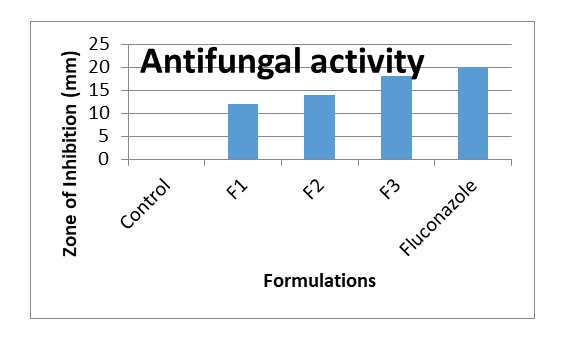
All data represents mm value, F1, F2, F3, Fluconazole compare with control.
DISCUSSION
A topical antifungal stick made with extract from turmeric (Curcuma longa) showed strong antifungal action against Candida albicans in this investigation. The extract of curcumin obtained from curcuma longa by soxhlet extraction. Topical antifungal sticks were successfully developed by incorporating the methanolic extract of curcuma longa with carnauba and bee’s wax. The formulation of the antifungal sticks, as outlined in Table 1. The optimized formulation showed desirable physicochemical properties such as adequate hardness, smooth texture, uniformity, and acceptable pH suitable for skin application. The presence of curcumin, a bioactive compound in turmeric, contributed to the antifungal efficacy, which was confirmed through zone of inhibition studies. It passed the weight variation test, with each stick weighing approximately 1 gram. No skin irritation was observed when the formulation was tested for skin irritation. Additional evaluations of the formulation, including melting point, breaking point, and pH, showed satisfactory results, with Formulation F3 meeting the required standards. Antifungal testing revealed significant activity against Candida albicans. Comparable activity was shown by the F3 formulation, indicating that it may be used topically to treat fungal infections of the skin. This study offers a strong basis for thinking of the created formulation as a potential topical remedy for fungus infections. The results suggest that this turmeric-based antifungal stick offers a promising alternative to conventional antifungal treatments, especially for localized fungal infections. Its ease of application, stability, and natural composition enhance its potential as an effective and safe remedy. Future studies focusing on long-term stability, in vivo efficacy, and clinical trials are recommended to further validate its therapeutic potential.
FUNDING: This research received no external funding.
CONFLICT OF INTEREST: The authors declare no conflict of interest.
ETHICAL APPROVAL: This study did not involve human participants or animals. Therefore, ethical approval was not required.
ABBREVIATIONS:
°C: Degree Celsius
gm: Gram
%: Percent
mm: Millimeter
mL: Milliliter
kg: Kilogram
min: Minute
CONCLUSION:
To sum up, the topical antifungal stick made from turmeric and curcumin extract from Curcuma longa has demonstrated encouraging antifungal activity against Candida albicans. A viable substitute for traditional therapies for localized fungal infections, the formulation demonstrated favorable physicochemical characteristics, safety in skin irritation tests, and notable antifungal activity. With its natural composition and ease of application, this innovative formulation presents a viable option for topical fungal infection management, warranting further investigation in long-term stability and clinical trials.
REFERENCES:

Saurabh Wade, Vaishnavi Vikhe, Varsha Patole*, Novel Topical Stick for C. albicans, Int. J. of Pharm. Sci., 2026, Vol 4, Issue 1, 1549-1557. https://doi.org/10.5281/zenodo.18260171
 10.5281/zenodo.18260171
