
View Article

Abstract

The present work aim to FTIR method development of finish product anti pigmentation topical formulation using herbal product like Aloe ( Aloevera), Calendula Officinalis (Pot marigold), Lavendula angustifoli (Lavender) and Honey. The goal of review is to method development of the finished product herbal anti pigmentation topical formulation by using FTIR method. Hyperpigmentation, characterized by the excessive darkening of the skin due to melanin deposition, is a common cosmetic concern often triggered by UV radiation and hormonal changes. Fourier Transform Infrared (FTIR) spectroscopy has emerged as a powerful, rapid, non-destructive, and cost-effective analytical technique for the quality control of herbal medicines. A robust Fourier Transform Infrared (FTIR) spectroscopic method was developed to characterize functional groups, confirm ingredient identity, and evaluate potential interactions between herbal actives and excipients. The FTIR spectra exhibited characteristic peaks corresponding to major phytoconstituents, providing a reliable fingerprint for quality control. The formulation demonstrated satisfactory stability and adherence to cosmetic quality standards. Overall, the study establishes an integrated framework for quality assurance and analytical characterization of herbal topical anti-pigmentation products, reinforcing the importance of FTIR spectroscopy as a rapid, non-destructive tool for routine standardization in herbal cosmetic formulations

Keywords

Cosmetic formulation analysis, Analytical characterization, Finished product evaluation, FTIR spectroscopy

Introduction

Pigmentation disorders, including melasma, hyperpigmentation, and post-inflammatory pigmentation, represent some of the most prevalent dermatological concerns affecting individuals worldwide. Conventional treatments often rely on synthetic agents such as hydroquinone,kojic acid, and retinoids; however, long-term use of these compounds may be associated with adverse effects including irritation, rebound pigmentation, and potential toxicity. As a result, there has been growing interest in herbal and plant-based alternatives that offer safer and more biocompatible depigmenting activity with minimal side effects. Herbal formulations rich in phenolics, flavonoids, and antioxidant constituents have gained prominence due to their ability to inhibit tyrosinase activity, reduce melanin synthesis, and promote overall skin rejuvenation.

Quality control and standardization of herbal cosmetic preparations remain a major challenge due to the inherent variability of plant-derived ingredients and the complexity of multi-component formulations. Ensuring batch-to-batch consistency requires robust analytical tools capable of verifying the identity, purity, and performance of both raw materials and finished products. In this context, Fourier Transform Infrared (FTIR) spectroscopy has emerged as a rapid, non-destructive, and highly reliable technique for the qualitative and semi-quantitative assessment of herbal formulations. FTIR allows the identification of functional groups, detection of molecular interactions between actives and excipients, and establishment of characteristic spectral fingerprints essential for routine quality assurance.  The demand for herbal anti-pigmentation products has surged, driven by the increasing consumer preference for natural alternatives to conventional skin lightening agents, which are often associated with side effects. Herbal formulations, targeting issues like melasma and dark spots, typically contain complex mixtures of plant extracts known for their antioxidant and melanin-regulating properties (e.g., Turmeric, Aloe Vera, Lavender, Calendula). However, the efficacy and safety of these products rely heavily on strict quality control. The complex, multi-component nature of herbal products makes authentication, stability monitoring, and detection of adulteration. unauthorized addition of synthetic, regulated drugs.

HERBAL CREAM:   

Herbal formulations is defines as dosage form containing of one or more herbs or processed in determined quantity to provide specific nutritional cosmetic benefits meant for use to diagnose, treat, mitigate, disease of a person or animal. Herbal products or herbal formulations have less side effects. Different herbal formulations include tinctures extracts essential oils, expressed juices, exudates and powdered extracts. Developing herbal drug involves collection and authentication of the material. Herbal cream is semi-solid formulation intended for topical application. The cream formulation is prepared by using various herbal extracts, almond oil and various excipient. Pharmacognostic, phytochemical and pharmacological evaluation and standardization.
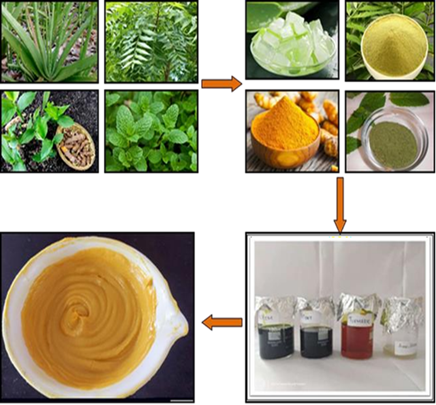


Uses herbal cream in pigmentation:

1. Lightening Dark Spots

2. Treating Hyperpigmentation.

3. Healing Sunburn and UV Damage

4. Reducing Acne and Post-Acne Marks

HERBAL INGREDIENTS USED IN TREATMENT OF ANTI PIGMENTATION

Following are the herbal ingredients used in preparation of polyherbal cream

1.   Aloe (Aloevera)

2.   Calendula officinalis (Calendula)

3.   Lavendula angustifoli (Lavender)

4.   Curcuma longa (Turmeric)

5.   Honey

FTIR METHOD DEVELOPMENT:

1. Sample Preparation:

FTIR sample prep depends on the formulation type:

a) Cream/Gel/Lotion (semi-solid)

1.  Direct ATR method (preferred):

  • Place a thin layer of the formulation on the ATR crystal.
  • Apply gentle pressure to ensure good contact.

2. KBr pellet method (if ATR is unavailable):

  • Dry the sample completely (moisture can interfere with IR signals).
  • Mix ~1–2 mg of the dried sample with ~100 mg of dry KBr.
  • Compress into a transparent pellet.

b) Ointment (lipophilic bases)

  • Lipid-rich samples can mask IR peaks.
  • Consider solvent extraction (e.g., ethanol or methanol) to isolate actives, then dry and analyze.

3.  Instrument Parameters

  • Wavenumber range: 4000–400 cm?¹
  • Resolution: 4 cm?¹ (common for herbal matrices)
  • Number of scans: 32–64 for good signal-to-noise ratio
  • Background spectrum: recorded before sample measurement

Method and Preparations:

Step 1: Identify Characteristic Peaks

  • Obtain FTIR spectra of pure reference standards of active ingredients.
  • Note key functional group peaks (e.g., hydroxyl –OH, carbonyl C=O, aromatic C=C).

Step 2: Analyze Formulation

  • Record FTIR spectra of the finished product.
  • Compare with standard spectra.
  • Confirm the presence of active ingredients by identifying matching characteristic peaks.

Step 3: Check for Interactions

  • Look for shifts, disappearance, or broadening of peaks that may indicate interactions between actives and excipients.

For example:

  • Hydrogen bonding may shift –OH peaks.
  • Esterification or oxidation may alter carbonyl peaks.

Step 4: Create Reference Library

  • Develop a spectral library of approved batches for future batch-to-batch comparison.
  • Can use peak ratios for semi-quantitative assessment (if concentration differences are large).

4. Validation Parameters (as per ICH Q2 (R1))


Parameter

FTIR Approach

Specificity

Confirm that peaks of actives are distinguishable from excipients

Precision (repeatability)

Measure the same sample multiple times; compare peak positions

Robustness

Slight changes in sample thickness, ATR pressure, or instrument settings

Linearity/Quantitation

Optional; can use peak area ratios for semi-quantitative purposes


Procedure:

      • Record FTIR spectra of pure reference standards of all active ingredients.
      • Place the prepared formulation sample on the ATR crystal (or KBr pellet in the holder).
      • Collect the spectrum over the defined wavenumber range.
      • Compare the sample spectrum with reference spectra to identify characteristic peaks of the actives.
      • Observe any shifts, disappearance, or broadening of peaks that may indicate interactions with excipients.

ATR-FTIR METHOD:

1.  Instrument Performance Verification:

Ensure the FTIR instrument and ATR accessory are calibrated. Wavenumber accuracy and spectral resolution are typically checked using a NIST-traceable polystyrene film standard.

Log in and allow the system to pass performance tests.

2.  ATR Crystal Preparation and Background Measurement:

Clean the ATR crystal (e.g., diamond, ZnSe) with an appropriate solvent like alcohol or acetone and a lint-free wipe to remove any residue. Run a background spectrum measurement with the clean, empty crystal to subtract atmospheric interferences (like water vapor and \(\text{CO}_{2}\)) from the sample spectra.

3. Sample Application:

Place a small amount (around 10 mg) of the topical formulation (cream, gel, ointment) directly onto the center of the ATR crystal. For semi-solid samples, ensure sufficient and consistent contact with the crystal surface, often by using an anvil with appropriate pressure. Consistent pressure is crucial for reproducible results.

4. Spectra Acquisition:

Optimize instrumental parameters like the number of scans (e.g., 32 scans/minute), resolution (e.g., 4 or 8 cm?¹), and spectral range (e.g., 4000–400 cm?¹). Acquire the sample spectrum using the instrument's software. The spectrum is typically displayed in absorbance mode.

5. Qualitative Analysis and Data Processing:

Identify characteristic peaks for the active pharmaceutical ingredient (API) and excipients to confirm chemical identity and check for interactions or polymorphic changes (e.g., crystallization). Apply pre-processing techniques as needed, such as baseline correction, smoothing, and normalization, to enhance spectral quality and minimize artifacts.

6. Quantitative Analysis (if applicable):

Prepare a calibration curve using a series of standard concentrations of the API in a suitable matrix or solvent. Measure the absorbance of characteristic peaks for each standard and plot against concentration to establish a linear relationship (Beer-Lambert law). Use chemometric methods like Partial Least Squares (PLS) or Principal Component Regression (PCR) for complex formulations where spectral overlap may occur.

7. Method Validation:

Validate the method according to regulatory guidelines (e.g., ICH or FDA) for parameters including selectivity, linearity, accuracy, precision, and limits of detection/quantification (LOD/LOQ).

Specificity is confirmed by ensuring no interference from excipients is observed at the chosen analytical wavelength.

8. Application:

The validated method is then used for quality control, stability studies, or monitoring dynamic processes like drug release into a medium or penetration into a membrane.

CONCLUSION

The developed FTIR methodology provides a rapid, reliable, and non-destructive approach to identify key herbal actives in the finished topical formulation.It enables the detection of functional groups, verification of active ingredients, and monitoring of potential interactions with excipients. This method ensures batch-to-batch consistency and serves as an effective quality control tool, complementing other quantitative analytical techniques for comprehensive evaluation of herbal anti-pigmentation products.

ACKNOWLEDGEMENTS

I express my sincere gratitude to Dr. Vedprakash Patil Pharmacy College for providing the necessary facilities and academic environment to carry out this research work entitled. I would like to convey my deep sense of appreciation and heartfelt thanks to my research guide Prof. Vaibhav Changdiye Sir for their invaluable guidance, constant encouragement, and constructive suggestions throughout the course of this work. Their expertise and continuous support were instrumental in the successful completion of this study.

REFERENCES

    1. Somnath S. Dawkhar, Aarti S. Bhandari, Sanjivani A. Akolkar Formulation and Evaluation of Multipurpose Herbal cream. Sys Rev Pharm 2023;14(1): 23-28.
    2. Prashant Chavan, Mallinath Kalshetti, Nikhil Navindgikar Formulation And Evaluation Of Polyherbal Cream Int J Sci Res.2020;12(1): 75-77.
    3. Manisha Yogesh Sonalkar, Sachin Annasaheb Nitave. Formulation and evaluation of polyherbal cosmetic cream. World J Pharm Pharm Sci 2016;5:772-9.
    4. Benson,M. B. M. FManisha Yogesh Sonalkar, Sachin Annasaheb Nitave. Formulation and evaluation of polyherbal cosmetic cream. World J Pharm Pharm Sci 2016;5:772- 9.
    5. Chellathurai BJ, Anburose R, Alyami MH, Sellappan M,Bayan MF, et al. (2023) Development of a PolyherbalTopical Gel for the Treatment of Acne. Gels 9(2): 163.
    6. Zhang Q, Tu Y, Gu H, Sun D, Wu W, et al. (2019) A cream of herbal mixture to improve melasma, J Cosmet Dermtol 18(6):1721-1728.
    7. Rajat Rana, Ajay Kumar, Rohit Bhatia. Impact of Infra Red Spectroscopy in Quantitative Estimation: An Update. Asian J. Pharm. Ana. 2020; 10(4): 218-230.
    8. Hemashree T, Prasunna Sree G, Sakthiselvan P. Synthesis of Keratin Nanoparticle and Characterization using FTIR. Research J. Pharm. and Tech. 2019; 12(6): 2664-2668.
    9. Ebin CJ, Nasrin S, Muhsina P P, Sheeja V K, Haribabu Y. FT-IR method development and validation for quantitative estimation of Mycophenolate mofetil bulk and tablet dosage form. International Journal of Novel Trends in Pharmaceutical Sciences. 2017; 7(6): 221-6.
    10. Dubey S, Pandey R, Shukla, SS, A Validated Method Development for Quantification of Pravastatin Sodium using Diffuse Reflectance Fourier Transform Spectroscopy. Indian Journal of Pharmaceutical Education and Research. 2017; Apr 1; 51(2): S115-21.
    11. Nugrahani I, Ibrahim SL, Mauludin R, Almira MI, Hydrate transformation study of fluoroquinolone antibiotics using Fourier transform infrared spectroscopy (FTIR). International Journal of Pharmacy and Pharmaceutical Science. 2015; 7: 246-52.
    12. Sheeja V. K., Swapna. A. S. Method Development and Validation for the Simultaneous Estimation of Clonazepam and Paroxetine in Combined Dosage Form using FT-IR. Asian J. Research Chem. 2020; 13(1): 12-14.
    13. Y. Padmavathi, N. Raghavendra Babu, K. Rohini, Ashraf A. Khanam, R. Padmavathi. Development and Validation of Chemometric Assisted Fourier Transform Infrared Spectroscopic Method for Simultaneous Determination of Montelukast Sodium and Fexofenadine Hydrochloride in Pharmaceutical Dosage Forms.
    14. Ashok KS. Development and Validation of a Stability-Indicating Liquid Chromatographic method for determination of Valsartan and Hydrochlorothiazide using Quality by Design. Oriental Journal of Chemistry.2016;32(02):777-88.. Research Journal of Pharmacy and Technology. 2022; 15(5): 2261-7.
    15. Wadher SJ, Kalyankar TM, Puranik MP, Swami J. A Stability Indicating Validated Method for the Quantitation of hydrochlorothiazide by using Diffuse Reflectance Infrared Fourier Transform Spectroscopy in bulk and tablet dosage form. International Journal of Medi Pharm Research. 2016;02(01):32-41.
    16. Xuân TB, Thi KTN, Thi HD, Si HL, Thi TT. FTIR Combined with Chemometrics for Fast Simultaneous Determination of Penicillin and Cephalexin in Pharmaceutical Tablets. International Journal of Sciences: Basic and Applied Research (IJSBAR).2017;36(6):87-94.
    17. Venkateswara RB, Vidyadhara S, Basaveswara MVR. A novel stability indicating RP-HPLC method development and validation for the determination of valsartan and hydrochlorothiazide in bulk and pharmaceutical formulations. Indian Drugs. 2017;54(08):54-61.

Reference

    1. Somnath S. Dawkhar, Aarti S. Bhandari, Sanjivani A. Akolkar Formulation and Evaluation of Multipurpose Herbal cream. Sys Rev Pharm 2023;14(1): 23-28.
    2. Prashant Chavan, Mallinath Kalshetti, Nikhil Navindgikar Formulation And Evaluation Of Polyherbal Cream Int J Sci Res.2020;12(1): 75-77.
    3. Manisha Yogesh Sonalkar, Sachin Annasaheb Nitave. Formulation and evaluation of polyherbal cosmetic cream. World J Pharm Pharm Sci 2016;5:772-9.
    4. Benson,M. B. M. FManisha Yogesh Sonalkar, Sachin Annasaheb Nitave. Formulation and evaluation of polyherbal cosmetic cream. World J Pharm Pharm Sci 2016;5:772- 9.
    5. Chellathurai BJ, Anburose R, Alyami MH, Sellappan M,Bayan MF, et al. (2023) Development of a PolyherbalTopical Gel for the Treatment of Acne. Gels 9(2): 163.
    6. Zhang Q, Tu Y, Gu H, Sun D, Wu W, et al. (2019) A cream of herbal mixture to improve melasma, J Cosmet Dermtol 18(6):1721-1728.
    7. Rajat Rana, Ajay Kumar, Rohit Bhatia. Impact of Infra Red Spectroscopy in Quantitative Estimation: An Update. Asian J. Pharm. Ana. 2020; 10(4): 218-230.
    8. Hemashree T, Prasunna Sree G, Sakthiselvan P. Synthesis of Keratin Nanoparticle and Characterization using FTIR. Research J. Pharm. and Tech. 2019; 12(6): 2664-2668.
    9. Ebin CJ, Nasrin S, Muhsina P P, Sheeja V K, Haribabu Y. FT-IR method development and validation for quantitative estimation of Mycophenolate mofetil bulk and tablet dosage form. International Journal of Novel Trends in Pharmaceutical Sciences. 2017; 7(6): 221-6.
    10. Dubey S, Pandey R, Shukla, SS, A Validated Method Development for Quantification of Pravastatin Sodium using Diffuse Reflectance Fourier Transform Spectroscopy. Indian Journal of Pharmaceutical Education and Research. 2017; Apr 1; 51(2): S115-21.
    11. Nugrahani I, Ibrahim SL, Mauludin R, Almira MI, Hydrate transformation study of fluoroquinolone antibiotics using Fourier transform infrared spectroscopy (FTIR). International Journal of Pharmacy and Pharmaceutical Science. 2015; 7: 246-52.
    12. Sheeja V. K., Swapna. A. S. Method Development and Validation for the Simultaneous Estimation of Clonazepam and Paroxetine in Combined Dosage Form using FT-IR. Asian J. Research Chem. 2020; 13(1): 12-14.
    13. Y. Padmavathi, N. Raghavendra Babu, K. Rohini, Ashraf A. Khanam, R. Padmavathi. Development and Validation of Chemometric Assisted Fourier Transform Infrared Spectroscopic Method for Simultaneous Determination of Montelukast Sodium and Fexofenadine Hydrochloride in Pharmaceutical Dosage Forms.
    14. Ashok KS. Development and Validation of a Stability-Indicating Liquid Chromatographic method for determination of Valsartan and Hydrochlorothiazide using Quality by Design. Oriental Journal of Chemistry.2016;32(02):777-88.. Research Journal of Pharmacy and Technology. 2022; 15(5): 2261-7.
    15. Wadher SJ, Kalyankar TM, Puranik MP, Swami J. A Stability Indicating Validated Method for the Quantitation of hydrochlorothiazide by using Diffuse Reflectance Infrared Fourier Transform Spectroscopy in bulk and tablet dosage form. International Journal of Medi Pharm Research. 2016;02(01):32-41.
    16. Xuân TB, Thi KTN, Thi HD, Si HL, Thi TT. FTIR Combined with Chemometrics for Fast Simultaneous Determination of Penicillin and Cephalexin in Pharmaceutical Tablets. International Journal of Sciences: Basic and Applied Research (IJSBAR).2017;36(6):87-94.
    17. Venkateswara RB, Vidyadhara S, Basaveswara MVR. A novel stability indicating RP-HPLC method development and validation for the determination of valsartan and hydrochlorothiazide in bulk and pharmaceutical formulations. Indian Drugs. 2017;54(08):54-61.

Photo
Amruta Shinde
Corresponding author

Dr. Vedprakash Patil College of Pharmacy, Chh. Sambhajinagar, Maharashtra, India.

Photo
Vaibhav Changediya
Co-author

Dr. Vedprakash Patil College of Pharmacy, Chh. Sambhajinagar, Maharashtra, India.

Photo
Dr. Vikas Rajurkar
Co-author

Dr. Vedprakash Patil College of Pharmacy, Chh. Sambhajinagar, Maharashtra, India.

Amruta Shinde, Vaibhav Changdiye, Dr. Vikas Rajurkar, Quality Assessment and ATR-FTIR Method Development of Finished Product Herbal Anti Pigmentation Topical Formulation, Int. J. of Pharm. Sci., 2026, Vol 4, Issue 2, 4067-4072. https://doi.org/10.5281/zenodo.18770801

More related articles
Medical Use of Cocculus Hirsutus in the Management...
Sammek Awachar, Aditya Unhale, Dr. Swati Deshmukh, ...
‘’Folate From Strawbeeries’’ A Sustainable...
Mounika K., K. B. Ilango, Ajith M. S., Babu S., Kalpana D., Nisha...
Analytical Method Development for Determination of...
Dr. Chandrakant Suryawanshi, Dr. Rajendra Wagh, Dnyaneshwari Maha...
Synthesis and Characterization of Novel Benzoxazole Schiff Base Derivatives...
Naresh payyaula, A. Bhavani, Mamatha Kalyankar, K. Akhila, T. Nandinii, ...
Phytochemistry And Materials Method of Cathanthus Roseus...
Pooja Gidhad, Shivam Gangurde , Smita Ghuge, Ujjwala Ghule, ...
Mentha Spicata – Scent of Wellness: Investigating the Health Benefits of Spear...
Dr. Bhushan Pimple , Geetanjali Bhale , Vaishnavi Adhalrao, Shrutika Akolkar, ...
Related Articles
Liquid – Liquid Fractionation and Evaluation of In-Vitro Anti-Inflammatory Act...
Shambhulingaiah. H. M., Kruthika K. N., Harshitha M. P. M., Jashwini, Shivatejaswi J. M., Sudeep B. ...
Medicinal and Therapeutic Benefits of Coffee and Its By-products...
Annapurna Uppala, Gunasekhar Pasala, Padma Sree Sadhu, ...
Medical Use of Cocculus Hirsutus in the Management of Various Diseases...
Sammek Awachar, Aditya Unhale, Dr. Swati Deshmukh, ...
More related articles
Medical Use of Cocculus Hirsutus in the Management of Various Diseases...
Sammek Awachar, Aditya Unhale, Dr. Swati Deshmukh, ...
‘’Folate From Strawbeeries’’ A Sustainable Solution for Anemia, Preventi...
Mounika K., K. B. Ilango, Ajith M. S., Babu S., Kalpana D., Nishanth Kannan B., Ramya R., Selvakumar...
Analytical Method Development for Determination of Salasia and Guduchi in Pharma...
Dr. Chandrakant Suryawanshi, Dr. Rajendra Wagh, Dnyaneshwari Mahale, ...
Medical Use of Cocculus Hirsutus in the Management of Various Diseases...
Sammek Awachar, Aditya Unhale, Dr. Swati Deshmukh, ...
‘’Folate From Strawbeeries’’ A Sustainable Solution for Anemia, Preventi...
Mounika K., K. B. Ilango, Ajith M. S., Babu S., Kalpana D., Nishanth Kannan B., Ramya R., Selvakumar...
Analytical Method Development for Determination of Salasia and Guduchi in Pharma...
Dr. Chandrakant Suryawanshi, Dr. Rajendra Wagh, Dnyaneshwari Mahale, ...