

We use cookies to ensure our website works properly and to personalise your experience. Cookies policy
12345Mount Zion College of Pharmaceutical Sciences and Research. Chayalode PO Ezhamkulam, Adoor, Pathanamthitta, Kerala – 691556, India.
6Associate Professor, Department of Pharmaceutical Chemistry and Analysis, Mount Zion College of Pharmaceutical Sciences and Research. Chayalode PO Ezhamkulam, Adoor, Pathanamthitta, Kerala – 691556, India.
"Quality by Design" is a systematic approach to product creation that emphasizes integrating safety into the entire procedure from the outset, particularly in the pharmaceutical industry. It explains how to apply Safety by Design to guarantee pharmaceutical quality. This review outlines Quality by Design and identifies some of its components. Quality qualities and process parameters are determined for every activity of the device. The advantages, possibilities, and procedures associated with pharmaceutical product quality by design are explained.The ICH Guidelines Q8 for pharmaceutical development, Q9 for quality risk management, and Q10 for pharmaceutical quality systems serve as its foundation. It also provides application of Quality by Design in pharmaceutical development and manufacturing. The goal of pharmaceutical growth is to develop a quality product and its manufacturing process to consistently deliver the intended performance of the product; quality cannot be tested into products but needs to be established in by design. It includes the Quality target product profile, critical quality attributes, and key aspects of Quality by Design. Lastly, it compares the quality of the product by Quality by Design and the product quality by end product testing
A methodical approach to product development, especially in the pharmaceutical sector, called "Quality by Design", places a strong emphasis on incorporating quality into the process from the very beginning.Every regulatory body that oversees pharmaceutical products has placed a high value on quality. Satisfying clients regarding service, product, and procedure is what quality is all about. Many of these quality-related initiatives reflect businesses' need to succeed in the global marketplace. Customers expect high-quality, reliable, cost-effective, and timely performance. There are two methods to satisfy customers: by making sure the products are feature-rich and devoid of defects.The product must have built-in attributes including performance, dependability, reliability, and ease of utilization and serviceability. It should also be free from shortcomings. There are relationships between the term’s quality, productivity, cost, cycle time, and value. The goal of quality activities should be to identify quality issues early enough to allow for intervention without sacrificing budget, timeline, or quality. Precaution must be prioritized over merely fixing issues with quality. Quality may be the motivating factor for improving the outcome in other areas.
Therefore, to prevent future failures, quality must be incorporated into both the product and the services through careful planning. "The majority of quality deficiencies occur during the process, and quality could be planned.1
Quality
"The extent to which a product, system, or process's inherent properties meet requirements." (ICHQ9) A pharmaceutical product of high quality carries a tolerably low chance of not producing the intended therapeutic results.
Design-Based Pharmaceutical Quality
The QbD is an organized method of development that starts with predetermined goals and priorities product and Process comprehension and control grounded in good science and high-quality risk handling (ICH Q8(R)).Designing and creating manufacturing procedures and formulas to guarantee predetermined good quality is known as QbD. Understanding and managing the variables that affect product quality during the formulation and manufacturing processes is therefore necessary for QbD.
Related articles about the International Meeting on Standardization of the Technical Standards for Registration of Medicines for Human Consumption (ICH), including ICH Q8, Pharmaceutical Development, ICH Q9, Drug Risk Control, and ICH Q10, Pharmaceutical Quality Systems, provide an abstract understanding of how quality by design contributes to the quality of drug products.2
Advantages of QbD3
Benefits of QbD4
Quality-by-design measurements:5,6
Different QbD measurements are
1. Quality Target Product Profile (QTPP):
The QTPP serves as the foundation for the product's development design. Its primary Concerns are efficacy and safety.
The following factors may be considered for the qualitative target product profile:
The following are some advantages of QTPP:
2. Critical Quality Attributes (CQAs):
To guarantee the intended product quality, a Critical Quality Attribute (CQA) is a chemical, psychological, biological, or microbiological feature that must fall within a suitable limit, range or distribution. CQAs are typically and drug substance linked to the drug product, intermediates (materials used during process) excipients. The following factors usually affect CQAs of solid oral dosage forms:
More product-specific elements, such as
CQAs for raw materials, intermediates, and pharmacological compounds consist of:
3. Risk Assessment:
A useful science-based procedure in quality risk management, risk assessment may help determine which process characteristics and material qualities may have an impact on the final product CQAs. Usually carried out very early in the development of pharmaceuticals process, risk assessment is repeated when new data becomes available, and more understanding is gained. Once the important parameters have been determined, they may be further examined to gain a deeper comprehension of the process. For instance, by combining mathematical models, experimental design, or research that results in mechanistic insight.
Risk assessment tools are:
4. Design Space:
The correlation between process input and Critical Quality Attributes is delineated within the concept of design Space Working in a design environment is not regarded as a modification. Exciting the design area is seen as a change and often starts the regulatory post-approval change procedure.
5. Control Strategy:
A control strategy may consist of: Controlling the properties of input materials based on knowledge of how they affect their processing ability or quality of the goods. For instance, the major packaging materials, excipients, and the medication ingredient. Product specifications and unit operational controls affect further processing or the quality of the product. For instance, how drying affects degradation and how the granulates particle size distribution affects dissolution. Instead of testing the result, use in-process or ongoing release testing. For instance, a monitoring program includes the measurement and management of CQAs throughout processing. For instance, doing thorough product testing on a regular basis to validate multivariate prediction models.
Development process in QbD7
Commence by creating a profile for the target product that outlines the product's use, safety, and efficacy; establish a target manufacturing quality profile that formulators and process engineers will utilize as a quantitative stand-in for clinical safety and efficacy aspects throughout the product development process; and compile pertinent prior knowledge about the drug substance, possible excipients, and process operations into a knowledge space. Prioritize areas of knowledge for additional research using risk assessment. Create a formulation and determine the essential material (quality) characteristics of the finished product that need to be managed to achieve the desired product quality profile. Create a manufacturing procedure that yields a finished product with these essential material qualities. To attain these important material qualities of the finished product, determine which initial material attributes and critical process factors need to be regulated. Prioritize process variables and material characteristics for experimental validation using risk assessment. Create a design space or other representation of comprehension of processes by combining experiments and past information. Create a process-wide control plan that may involve input material controls, process controls and monitors, design areas around single or multiple unit activities, and/or testing of the finished product. A risk assessment can serve as a guide for the control approach, which should take into account anticipated scale changes. To ensure constant quality, continuously review and update the procedure.
Quality risk management8
The methodical process of evaluating, controlling, communicating, and reviewing threats to the pharmaceutical product's quality is known as quality risk management. It can be used both in advance and after that fact. The creation and implementation of QbD are significantly facilitated by quality risk management, or QRM. According to ICH Q9 Quality Risk Management, there is always some risk involved in the production and use of pharmaceutical products essential to Quality by Design. During the product lifecycle, decisions are made using risk management strategies. Making wise risk management decisions depends on the knowledge you get during the product development stage and during full-scale production.The following should be guaranteed by a good risk management system:
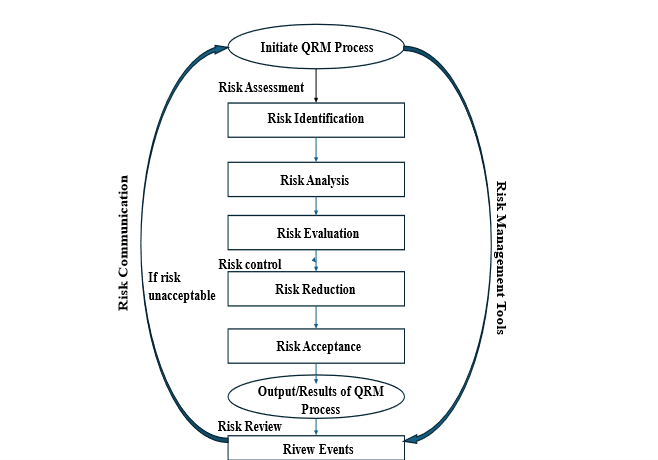
Figure no :1 Overview of a typical quality risk management process9
ICH GUIDELINES
The International Council for Harmonization (ICH) created ICH guidelines, which are globally accepted standards for medicines and medical items, to guarantee the efficacy, safety, and quality of these goods everywhere.10
Different types of ICH guidelines of QbD are,
"Quality must be incorporated into a product or manufacturing process; it cannot be tested or examined into a finished product," according to ICH Q8 (R2).11
According to ICH Q9, "the assessment of risks related to quality should be grounded in scientific knowledge that ultimately links to patient protection, and the degree of effort, formality, and verification of the QRM system should correspond with the extent of risk."12
The three primary goals of ICH Q10 are to facilitate ongoing drug product improvement, achieve product realization, and establish and maintain a condition of control. Based on ISO quality ideas, it outlines a comprehensive model for an efficient pharmaceutical quality system and incorporates pertinent GMPs.13
APPLICATION14
CONCLUSION
There is potential for far more regulatory flexibility with QbD. It emphasizes continual process improvement and integrating quality into the production and product processes, which lowers variability. Analytical method development and assessment can benefit from the application of QbD. In order to ascertain the linkages, every key analytical response (the outputs) and every prospective element (the inputs) are examined during method development. Similar to the process development technique outlined in ICH Q8 and Q9, critical analytical variables are discovered. A business knowledge base is necessary at every stage to guarantee that important data is recorded that can be examined and expanded in the future so that the knowledge gained may be used to both the particular approach being considered and other comparable approaches being used for different goods. According to the ideas outlined in the draft ICH Q10, such a repository will allow for method change control and continual improvement throughout the course of its existence. Instead of carrying out ICH validation and analytical technology transfer activities, a QbD strategy built on a risk-assessed change control mechanism ought to be used. A risk assessment must to be carried out each time a procedure is modified.
REFERENCE

Ciril J Varghese, Jesna Nizam, Ayshath A, Jishana N, Ramsy S, Jisha M S, Quality by Design (QbD): A Detailed Study, Int. J. of Pharm. Sci., 2026, Vol 4, Issue 1, 3075-3081. https://doi.org/10.5281/zenodo.18382934
 10.5281/zenodo.18382934