
Ashokrao Mane Institute of Pharmaceutical Sciences and Research, Save.
Green Analytical Chemistry (GAC) is a growing branch of chemistry that applies green chemistry principles to analytical methods to protect the environment and human health. Its main goal is to design safer and sustainable analytical procedures that use fewer and less harmful chemicals, consume less energy, and produce very little waste, while still giving accurate and reliable results. GAC puts importance on eco-friendly steps such as green sample preparation, safe solvent selection, and proper waste disposal. New green extraction techniques like Solid Phase Extraction (SPE), Microwave-Assisted Extraction (MAE), and Supercritical Fluid Extraction (SFE) help reduce the use of dangerous solvents and save energy. To check how green an analytical method is, researchers use evaluation tools such as NEMI, GAPI, and AGREE. In short, GAC encourages replacing traditional laboratory methods with cleaner, safer, and more sustainable techniques to support scientific progress and environmental care.
The green approach in chemical processes is a new issue that has emerged from scientists' concerns about sustainability, human health, and environmental protection."The design of chemical products and processes that are more environmentally benign" is one definition of "green chemistry." Analytical chemistry can directly adopt some of the Green Chemistry concepts. The field of chemistry known as "green analytical chemistry" (GAC) is concerned with conducting chemical analysis—that is, testing, measuring, and identifying substances—in a manner that is less harmful to the environment, people, and resources.It entails conducting chemical tests with fewer chemicals and energy, staying away from hazardous or toxic materials, cutting waste, and making the procedure sustainable and environmentally friendly.There are two ways to approach the connection between analytical chemistry and green chemistry. Green chemistry is controlled and justified by analytical chemistry. Analytical chemistry is a useful tool for confirming the environmentally friendly outcome of a chemical product or technology in this situation.[1][2] GAC applies Green Chemistry to analytical methods to cut environmental and health impacts. Emerging in 1995 and first noted in The Analyst, it grew with sustainability demands, aided by tools like NEMI (2002)[3]
KEY COMPONENTS:
Principle:
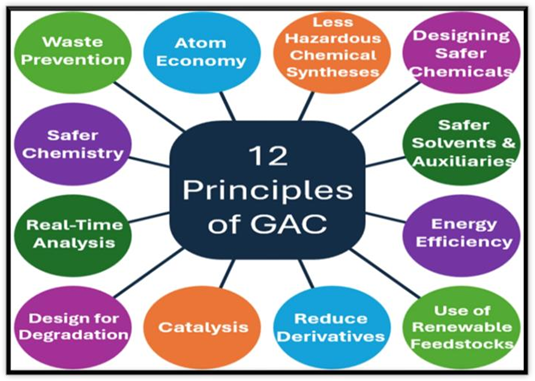
Fig no.1 Principle of GAC[5]
IMPACT OF ANALYTICAL CHEMISTRY:
Chemical-pharmaceutical residues must be pre-treated before returning to the enclosure, and the cost depends on solvent toxicity. Toxic solvents like acetonitrile can still harm humans despite waste-reduction steps. Incinerating acetonitrile produces acidic emissions that can worsen acid rain. Overall, solvent toxicity affects both human health and environmental safety.
Chemistry impacts people in many ways, especially patients exposed to reagents and analytical methods used in pharmaceutical analysis. Complex and toxic chemical processes increase production costs, which lead to expensive medicines for consumers. Many high-priced accessories and steps used in production are not always necessary. Overall, inefficient processes affect human health and raise market prices.
The text highlights that analytical chemistry principles and extraction guidance are defined in the Platea Pharmaceutical template. Chemistry education, training, and collaboration should aim to build better communities and a healthier world. Companies adopting a modern, eco-friendly mindset are likely to grow and succeed. The main goal is to make the full supply chain—not just the final product-sustainable and environmentally clean.
Greener alternatives to traditional solvents and reagents are not always available. Some analytical reactions still rely on organic solvents for better efficiency and accuracy. This makes it difficult to fully replace traditional methods.
Some green methods may be less sensitive, less reproducible, or more complex compared to conventional techniques. For example, miniaturized methods may require highly skilled handling, and results may vary if the instruments are not properly optimized.
Green analytical techniques require modern instruments and new methods. Lab staff and students must receive special training to use them correctly. A lack of expertise can delay adoption and lead to more errors.[6]
BENEFITS OF GREEN ANALYTICAL CHEMISTRY:
Cleaner air and water reduce lung injuries and health risks from toxic waste. Fewer harmful chemicals improve worker safety and lower risks of fires and explosions. Safer, short-lived pesticides and removal of persistent toxins make food safer. Overall, green practices minimize exposure to harmful substances like hormone disruptors.
Green chemicals decompose safely or can be recovered for reuse, reducing pollution from disposal or chemical releases. Toxic harm to plants, animals, and ecosystems is minimized. Greener chemistry lowers the risk of global warming, ozone damage, and smog. It also reduces hazardous landfilling while supporting careful resource use like water in agriculture.
Higher-yield processes produce more output using less raw material (feedstock). Fewer synthesis steps increase production capacity and reduce energy and water use. Reusing waste as feedstock lowers cost and improves efficiency. Better performance means smaller product amounts are needed, boosting competition in the chemical market.[7]
COMPARISON BETWEEN ANALYTICAL CHEMISTRY AND GREEN ANALYTICAL CHEMISTRY
|
TITLE |
ANALYICAL CHEMISTRY |
GREEN ANALYTICAL CHEMISTRY |
|
Definition |
It is branch of chemistry deal with the separation, identification and qualification of chemical substance. |
The design of chemical product and process that more environmentally benign. |
|
Main focus |
Accuracy and precision. |
Accuracy +reduced hazardous and waste. |
|
Solvent reagent use |
Harmful solvent and reagent. |
Safer, eco-friendly solvents. |
|
Waste generation |
Generate more chemical waste. |
Minimize or eliminates waste. |
|
Instrumental methods |
High energy requires. |
Minimized energy requires |
|
Safety concerns |
Higher Exposure risk. |
Safer for analysts and environment. |
|
Cost |
High cost |
Cheaper cost |
Green Sample Preparation:
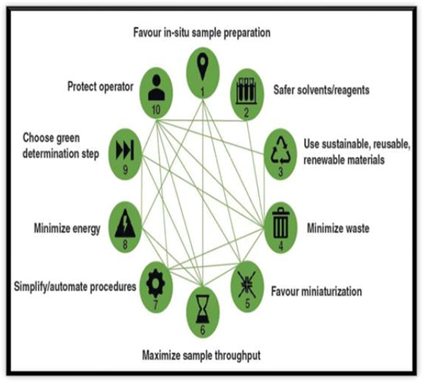
Fig no.2 Green Sample Preparation
SPE traps analytes on a solid sorbent. Uses very little solvent and creates less waste. Easy to automate and gives accurate results. Uneven packing can reduce efficiency. Polar compounds may not retain well. Matrix interference can lower recovery. Needs proper optimization for good extraction
Quenchers are a fast and simple green extraction method. Uses very little organic solvent. Sample is shaken with buffer, MgSO?, and NaCl for extraction. Cleanup uses MgSO? and PSA to remove impurities. Removes fats, sugars, and other matrix interferences. Used to extract drugs like amphetamines, opiates, cocaine, and THC from blood.
MgSO? removes leftover water. PSA sorbent removes matrix impurities. Improves extract quality in dispersive SPE. Quenchers extracts drugs (amphetamine, opiates, cocaine, THC) from blood. SPME isolates food sample compounds with GC–MS, LC–MS, HPLC, or GC.SPME is cheap, simple, fast, and solvent-free. SPME drawbacks: fragile fiber, coating damage, temperature effects, matrix interference.
SBSE is a green, solvent-free extraction method. Uses a PDMS-coated magnetic stir bar instead of a fiber. Works for volatile and non-volatile analytes. Larger coating gives higher sensitivity than SPME. Volatiles are thermally desorbed; non-volatiles use very little solvent
Uses three phases: aqueous sample, extraction solvent, disperser solvent. Rapid mixing forms fine emulsion for quick analytes transfer. Centrifugation separates phases after extraction.
Dense extractant phase collected using a microsyringe. Uses very small solvent/sample volume. Gives high enrichment and recovery. Fast equilibration due to large contact surface.
ASE uses high temperature and pressure to speed up extraction. High temperature lowers solvent viscosity and increases analyte solubility. High pressure helps solvent enter matrix pores effectively. Uses less solvent than conventional methods. Allows green solvents like ethanol/methanol. Fast, efficient, and energy-saving extraction method.
Microwave radiation heats polar molecules to speed up extraction. Heat transfers to solvent, improving analytes release. Microwave range: 300 MHz–100 GHz, ovens use 2.45 GHz.Fast heating and high temperature are major advantages. Simple and efficient operation. Limited solvent heating due to dielectric properties is a drawback.
MAE uses microwave radiation to speed up extraction. Polar molecules absorb microwaves, causing rapid heating. Solvent heats quickly when in contact with the sample. Microwaves operate from 300 MHz–100 GHz, unlike fixed-frequency ovens. Benefits: fast heating, high temperature, easy operation. Limitation: solvent heating depends on its dielectric constant.
SFE is an easy, automatic, and eco-friendly extraction method. Uses safe solvents like supercritical CO?. Works fast with low temperature, protecting sensitive compounds. Gives clean extracts with little or no extra cleanup. Uses very little solvent, making it greener.CO? is the most common fluid because it is safe and non-toxic. SFE is quick, selective, and environmentally friendly.[8][9]
EXPERIMENTAL METHODS:
It covers 4 experimental methods are as follows:
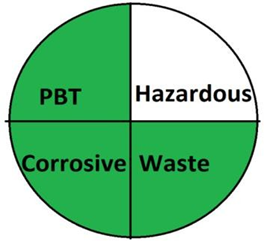
Fig no.3 NEMI
NEMI is an eco-assessment tool shown as a circular greenness profile divided into four sections (PBT, hazardous components, waste, and corrosiveness).If a section is green, the method is considered green; if blank, it is not. It includes factors like waste levels, pH, and toxic properties, allowing easy visual comparison. Analysts use it to judge and compare the eco-friendliness of analytical techniques.
The measure evaluates how environmentally sustainable an analytical method is using a total score out of 100. Points are deducted for harmful solvents, high energy use, and environmental impact. Non-hazardous materials get 0 penalty points, mild hazards get 1 point, and major hazards get more than 1, lowering the final sustainability score.
GAPI is a tool for measuring the environmental impact of an analytical process from sample collection to final result, introduced by J. Potka-Wasylka in 2018. It assesses stages using a pictogram-colored green (eco-friendly), yellow (moderate impact), or red (not green). The system analyzes the full method across 15 categories shown in 5 pentagram sections.
AGREE is a thorough, adaptable, and transparent evaluation method that yields an understandable and illuminating outcome. AGREE evaluates criteria derived from the 12 GAC principles using a standardized 0–1 scale. One significant benefit of this statistic is the availability of free software, which facilitates its use [10]
APPLICATIONS OF GREEN SOLVENTS:
Sample extraction or preparation involves the use of materials derived from biodegradable or renewable sources. For instant biopolymers, natural fibers, or environmentally acceptable coatings made of silica.
FUTURE PERSPECTIVES:
Green measurements will advance in sophistication in tandem with the expansion of green chemical principles. It's possible that new measures will be developed to evaluate analytical methods' sustainability over the course of the drug development lifecycle, in addition to their greenness. Green analytical technologies will be increasingly integrated into routine pharmaceutical processes in the next year’s .Pharmaceutical discovery, quality assurance, and stability testing will increasingly employ greener alternatives to traditional methods, including as MAE, SFC, and green solvents. Consequently, additional regulatory bodies will use these indicators, helping to standardize the concept of greener drugs and guarantee their consistent use across the industry. GAC has the potential to revolutionize the pharmaceutical sector by improving the efficiency, affordability, and environmental sustainability of analytical procedures. Using GAC in pharmaceutical analysis has several advantages, including decreased waste, lower solvent use, energy savings, and improved safety, all of which greatly support the sector's sustainability objectives. Advances in analytical technologies will have a big impact on GAC's future in the pharmaceutical industry. Newer technologies that consume less energy, generate less trash, and employ cleaner chemicals will soon be available. Creating portable analytical tools and downsizing equipment’s can not only increase analytical efficiency but also lessen environmental Influence. More cooperation between academic institutions, pharmaceutical businesses, regulatory bodies, and green chemistry organizations will be a part of GAC in the pharmaceutical industry going forward. More encouraging laws will probably be created to promote the use of green analytical methods as government and regulatory bodies come to understand the significance of sustainability. Regulatory agencies like the FDA and EMA might update their policies to specifically incorporate green chemistry concepts, creating more open avenues for the promotion of environmentally beneficial practices.[11]
CONCLUSION:
By fusing innovation with environmental responsibility, GAC is providing the way for a more sustainable future in science. Green chemistry's tenets include cutting waste, utilizing safer chemicals, and increasing energy efficiency. Green solvents like water and bio-based substitutes, as well as energy-saving approaches like microwave and ultrasound-assisted procedures, demonstrate that analytical chemistry may be both efficient and environmentally friendly. GAC is revolutionizing the way we approach analytical techniques. GAC measures that make it possible to compare various analytical method parameters and procedures in order to identify the less environmentally friendly parts.An great semi-quantitative instrument for lab practice and teaching is the Analytical Eco-scale. In the field of analytical chemistry, a significant application of greenness evaluation methodology has taken place, monitoring the growth of the idea of green chemistry when selecting a solvent or reagent for optimal operation. Environmental impacts of analytical methods must be taken into account. It is necessary to develop solvent selection techniques, chemical digestion methods, and agent assessment systems that are pertinent to analytical chemistry. GAC's review facilities incorporate eco-friendly approaches from a variety of industries, such as food analysis, medicines, environmental monitoring, and more. Furthermore,By highlighting topics for additional study and improvement, this review takes into account the continuous innovation in the field of analytical chemistry. To improve the eco- friendliness and analytical performance of green analytical methods, it promotes the investigation of new green solvents, alternative separation processes, and innovative equipment. The evaluation covers innovative techniques, cutting-edge technology, and new procedures that haven't received much attention. In order to identify the less ecologically friendly parts of the analytical process, green extraction methods, such as solid-phase microextract and superficial fluid extraction, could have long-lasting positive benefits on the environment and research.
REFERENCES



N. B. Patil Thorat, A. S. Kulkarni, R. P. Raula, V. A. Neje, M. M. Pawar, Review on Green Analytical Chemistry, Int. J. of Pharm. Sci., 2026, Vol 4, Issue 1, 621-628. https://doi.org/10.5281/zenodo.18173607
 10.5281/zenodo.18173607
