

We use cookies to ensure our website works properly and to personalise your experience. Cookies policy
Ashokrao Mane Institute of Pharmaceutical Sciences & Research, Save
Green synthesis aims to design chemical processes and products that minimize or eliminate the use and generation of hazardous substances, aligning with the 12 principles of green chemistry. Ionic liquids (ILs), salts liquid at temperatures below 100°C, represent a significant advancement as green solvents due to their unique properties such as negligible vapor pressure, high thermal stability, tunability, and high solvation ability. These qualities make ILs versatile solvents across various industries, including pharmaceuticals, biotechnology, and chemical manufacturing. Their ability to dissolve a wide range of compounds, coupled with recyclability and non-flammable nature, contributes significantly to reducing waste, toxicity, and environmental impact. The synthesis of ILs involves routes like alkylation, anion exchange, and solvent-free methods, with ongoing innovations to develop task-specific and chiral ionic liquids. ILs have broad applications in catalysis, separation processes, nanocatalyst stabilization, and biomass conversion, often replacing traditional volatile organic solvents (VOCs) and enhancing reaction efficiency and sustainability. Overall, ILs play a pivotal role in promoting safer, cost-effective, and environmentally friendly chemical processes, underpinning modern green chemistry initiatives.
Green Synthesis :
Green synthesis is design of chemicals products and processes that reduce or eliminate the use or generation of hazardous substances. Green synthesis used across the life cycle of a chemical products, including its designs, manufacture, used and ultimate disposal.[1] Green synthesis, with its core principles of minimizing waste, reducing toxicity, and conserving resources, has been a driving force in transforming the landscape of chemical processes [2].
Their ability to dissolve a wide range of compounds, coupled with the option to tailor their chemical structure for specific applications, makes ionic liquids versatile in dissolving both polar and non-polar substances. This versatility extends their utility across diverse industries, including pharmaceuticals, biotechnology, and chemical manufacturing. Furthermore, ionic liquids contribute to the concept of green chemistry by minimizing waste generation and enabling more efficient recycling. Their non-flammable nature and low vapor pressure enhance workplace safety, reducing the risk of accidents associated with traditional solvents. While the "green" reputation of ionic liquids is well-founded, ongoing research focuses on addressing challenges such as cost, potential toxicity, and the development of more sustainable production methods. As advancements continue, the application of ionic liquids as green solvents holds significant promise for environmentally conscious and efficient industrial processes [3].
Green Solvent:
Green Solvents define a major part of the environmental performance of processes in chemical industry and also impact on cost, safety and health issues. The idea of “green” solvents expresses the goal to minimize the environmental impact resulting from the use of solvents in chemical production. This concept and application of green chemistry over the past two decades has led to the development of so-called neoteric or modern solvents.
Ionic liquid:
Ionic liquids are magnificently distinct from ionic salts such as NaCl. Ionic salts exist as solid at room temperature and have electrostatics interaction with normally metallic cations and non-metallic anions. On the whole, ionic materials such as NaCl can be in a liquid or molten state at high temperatures so can not be used in organic synthesis. Whereas, ionic liquids, a category of ionic salts which have melting points below 100°C, are soluble in organo-metallic as well as inorganic-organic compounds and are used in organic synthesis. Ionic liquids are salts composed entirely of ions that remain in the liquid state below 100 °C [4]. Beginning with Welton's 1914 publication on room-temperature molten salts, early research by Wilkes, Hussey, and Seddon established the groundwork for ionic liquids. The field was advanced by Osteryoung in 1978, and Hussey and Wilkes then discovered dialkylimidazolium ILs. Due to the hygroscopicity of first-generation AlCl?-based ILs, second-generation ILs that are stable in both water and air were developed. Later, Rogers developed more environmentally friendly ILs that could dissolve cellulose. Task-specific ILs were introduced by Wasserscheid, and Welton increased uses in synthesis and catalysis. Reversible IL production was made possible by the use of pressurized CO2, which made solvent removal easier [3].
ADVANTAGES OF IONIC LIQUID IN GREEN SYNTHESIS
1. Eco-friendly and Non-volatile
2. Recyclable and Reusable
3. Enhanced Reaction Efficiency
4. Wide Solubility Range:
5. Controlled Selectivity and Mild Conditions
6. Biocompatibility (for certain ILs)
DISADVANTAGES OF IONIC LIQUID IN GREEN SYNTHESIS
1. High Cost of Synthesis
2. Toxicity Issues
3. Difficult Recovery and Recycling
4. Limited Biodegradability
5. High Viscosity
6. Lack of Complete Data on Environmental Impact
7. Moisture Sensitivity
8. Limited Long-term Data
CHARACTERISTICS OF IONIC LIQUIDS AND SOLVENT
1. Density
Density of the ionic liquids is generally higher than the density of water. The magnitude of density, ρ, depends upon the constituent cation and anion. For instance the ρ, value of ionic liquid varies with the length of the N-alkyl chain on the imidazolium cation. As a thumb rule, the density of comparable ionic liquids decreases with the increase in the bulkiness of the organic cation. It lies in the range 0.80-2.10 g/cm2.
2. Viscosity
Viscosity of ionic liquids is of immense importance and plays a major role in many conditions. Ionic liquids are generally viscous with a broad range of viscosity from 7-1800 mPa-s when compared with aqueous amine solvents.
3. Hydrophobicity
The formation of hydrophilic or hydrophobic ionic liquids depends upon proper selection of cations and anions. The increase in the length of alkyl chain in the cations is responsible for the development of hydrophobicity.
4. Melting Point
This is the most significant characteristic property of ionic liquids that can be correlated with the structure and composition of ionic liquids. Selection of both the cation and anion determine the melting point of an ionic liquid. The melting point of the ionic liquids is very less. It ranges between –100 to 113°C. Most of the ionic liquids are in molten form at the room temperature. By increasing the substituent chain length, the melting point can be increased. Melting point of the ionic liquids decreases with the increase in the amount of water molecules available in the ionic liquids.
5. Vapor Pressure
The vapor pressure of the ionic liquids at room temperature is negligible.
6. Polarity
Polarity is one of the most important properties of ionic liquids and an essential requirement when choosing an IL for a specific industrial application. It is a description of the potential behaviors of the solvent in a relationship with the solute but not an absolute property of the pure liquid. Hence, there is no single measure of polarity. Kamlet–Taft solvent polarity scales a, b, and p have been adapted for use with ionic liquids.
7. Thermal stability
Most of the ionic liquids are stable at and above 400°C. The thermal decomposition depends on the nature of anions rather than on that of cations. Further thermal decomposition also decreases with increase in hydrophilicity of anions Low Volatility.
BASIC PRINCIPLE OF GREEN SYNTHESIS
Green chemistry is generally based on the 12 principles proposed by Anastas and Warner. Now-a-days, these 12 principles of green chemistry are considered the fundaments to contribute to sustainable development. The principles comprises instructions to enhances new chemical products, new synthesis and new processes.
1. Waste Prevention
Prioritize the prevention of waste, rather than cleaning up and treating waste after it has been created. Plan ahead to minimize waste at every step.
2. Atom economy
Reduce waste at the molecular level by maximizing the number of atoms from all reagents that are incorporated into the final products. Use atom economy to evaluate reaction efficiency.
3. Less hazardous chemical synthesis
Design chemicals reactions and synthetic routes to be as safe as possible. Consider the hazards of all substances handled during the reaction, including waste.
4. Designing safer chemicals
Minimize toxicity directly by molecular design. Predict and evaluate aspects such as physical properties, toxicity and environmental fate throughout the design process.
5. Safer solvents and auxiliaries
Choose the safest solvents available for any given step. Minimize the total amount of solvents and auxiliary substances used, as these make up a large percentage of the total waste created.
6. Design for energy efficiency
Choose the least energy — intensive chemical route. Avoid heating and cooling, as well as pressurized and vacuum conditions (i.e. ambient temperature and pressure are optimal).
7. Use of renewable feedstocks
Use of chemicals which are made from renewable (i.e. plant-based) sources, rather than other equivalent chemicals originating from petrochemical sources.
8. Reduce derivatives
Minimize the use of temporary derivatives such as protecting groups. Avoid derivatives to reduce reaction step, resources required, and waste created.
9. Catalysts
Use catalytic instead of stoichiometric reagents in reactions. Choose catalysts to help increase selectivity, minimize waste, and reduce reaction times and energy demands.
10. Design for degradation
Design chemicals that degrade and can be discarded easily. Ensure that both chemicals and their degradation products are not toxic, bio-accumulative, or environmentally persistent.
11. Real-time pollution prevention
Monitor chemicals reactions in real-time as they occur to prevent the formation and release of any potentially hazardous and polluting substances.
12. Safer chemistry for accident prevention
Choose and develop chemical procedures that are safer and inherently minimize the risk of accidents. Know the possible risks and assess them beforehand.[1]
ROLE OF VARIOUS TYPES OF SOLVENTS AND IONIC LIQUIDS USED IN GREEN SYNTHESIS
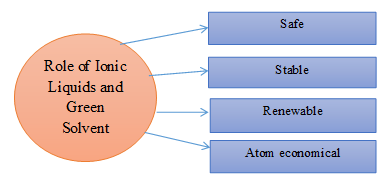
Fig No.5.1 Role of Ionic Liquids and Green Solvent
In the 21st century our world faces the many problems related to environment, so green chemistry is useful in the pharmaceutical and the other chemical industries. It play the important role for our environment. US Environmental Protection Agency (EPA) give the suggestion for innovative techniques the reduce toxic, undesirable waste, and environmental impact. Green solvents are environmentally friendly solvents or bio-solvents which are derived from the processing of agriculture crops.
TYPES OF SOLVENT
There are mainly consist of 3 types
1. Oxygenated Solvents
2. Hydrocarbon Solvents
3. Halogenated Solvents
1) Oxygenated solvent : An oxygenated solvent is an organic solvent that contains oxygen atoms in its molecular structure.
Common examples: Alcohols.
2) Hydrocarbon solvent : A hydrocarbon solvent is a petroleum-based liquid used to dissolve, dilute, or extract materials, especially oils, resins, fats, and rubber.
Examples include: Hexane, Toluene, Xylene
3) Halogenated solvent : Halogenated solvents are organic solvents containing halogen atoms (dichloromethane, chloroform)
Examples : green solvents developed as alternative to petrochemical solvents. Ethyl lactate is green solvents derived from processing corn.
METHODS FOR THE SYNTHESIS OF IONIC LIQUIDS
1] Alkylation
Alkyl cation in many ammoniums, imidazole, pyridinium, and phosphonium-based ionic liquids is obtained by using a suitable precursor (a nucleophile) with the help of an alkylating agent such as haloalkane or a d-alkyl sulk. For example, alkyl imidazole, which are the basic building blocks of imidazole-based ionic liquids, are easily prepared by alkalizing imidazole.
2] Anion exchange
Many of the ionic liquids used in conventional studies, such as the tetrafluoroborate and hexafluorophosphate ionic liquids, are made in a two-step process with imidazole diacetyl cations. First, the halide salt is prepared by reacting the alkyl with the desired cation. The anion halide is then moved by double replacement with the desired anion. In this process, an anion of an elemental salt is replaced by a mineral anion, such as metal salt group or silver salt.
3] Solvent-free synthesis
The synthesis of non-alcoholic ionic liquids mainly involves two steps: The use of a haloalkane as an alkylating agent and then the production of unwanted halide salts during the process of double anion exchange. It should be noted that haloalkanes, especially those with high boiling points, are difficult to separate from the product at the end of the reaction. Also, halide salts, which are produced in a double substitution reaction, have a significant effect on the physical properties of ionic liquids. Halide salt impurities may cause poisoning or inactivation of catalysts in which ionic liquid is the solvent of the accelerated reaction with the help of intermediate metals.
4] Synthesis of chiral
Crystal ionic fluids as a catalyst and solvent are particularly important in asymmetric synthesis. These compounds are derived from chiral sources, which include a wide range of pre-crystal precursors, including synthetic enantiomers (produced on an industrial scale) and amino acids, sugars, terpenes, and other chiral compounds that are naturally derived from plants and animals are obtained. These ionic liquids are usually obtained by alkalizing a pre-crystal precursor and then by the anionic exchange.
5] Synthesis of ionic liquids with a special performance
The range of applications of ionic liquids contains large-scale cations or anions. Functional ionic liquids, or in other words, ionic liquids with special performance are used as useful solvents in chemical synthesis, catalysts, and materials such as lubricants, missile propulsion, and pharmaceutically active substances. Therefore, there is a growing trend in research into the manufacture of these materials. Various methods have been reported for the preparation of ionic liquids with a special performance. Commonly acting haloalkane is used to make ionic fluids with the causative agents of imidazolium, phosphonium, and pyridinium. One of the first reports on the development of immunosuppressive ionic liquids focused on the extraction of metal ions from aqueous solutions. It is possible to prepare different ionic liquids with an ionized agent due to anionic exchange with alkaline salts and commercial acids[7]
APPLICATIONS OF IONIC LIQUID AND SOLVENT
Ionic liquids, with their remarkable properties, have found extensive applications across a spectrum of fields. In this section, we explore the diverse and evolving uses of ionic liquids, shedding light on their pivotal role in shaping green solvent chemistry and related industries.
1.Catalysis
Ionic liquids have emerged as versatile and effective media for catalytic reactions. They are often used as solvents or co-solvents in catalyst, enhancing the selectivity and efficiency of various chemical transformations. Their use in catalysis extends to diverse areas, from petrochemical processes to pharmaceutical synthesis. In the petrochemical industry, for instance, ionic liquids have facilitated the selective conversion of biomass into valuable chemicals, contributing to the development of sustainable and renewable feedstocks. The unique solvation properties of ionic liquids enable them to dissolve and activate a wide range of reactants, making them valuable tools in sustainable catalysis. Additionally, their reusability and recyclability reduce waste generation and enhance cost-effectiveness in catalytic processes.
2. Extraction and separation processes
Ionic liquids are effective in separation and extraction processes, which are vital in the pharmaceutical, petrochemical, and environmental industries. Their ability to selectively dissolve specific compounds, combined with their low volatility, makes them ideal for applications such as liquid-liquid extraction and gas separation. In the pharmaceutical field, ionic liquids are employed in the extraction of active pharmaceutical ingredients (APIs) from natural sources, contributing to the development of novel drug formulations. Furthermore, in the petrochemical industry, ionic liquids are used in the removal of sulfur and nitrogen compounds from fuels, addressing environmental regulations and improving fuel quality. In environmental applications, ionic liquids have demonstrated their efficiency in carbon capture processes, contributing to efforts to mitigate greenhouse gas emissions. Their role in selective separation processes is vital for achieving both environmental and economic sustainability[1].
3. Stability of nanocatalysts in an ionic liquid medium
Metal nanocatalysts such as gold, platinum, palladium, rhodium, and ruthenium are widely used in organic reactions. The problem with nanocatalysts is that they bind together in reaction environments and become clumpy, greatly reducing their activity. A variety of ionic liquids are used to prevent this. Nano catalyst Rhodium (Rh) for example, are more active in the ionic liquids mentioned in the hydrogenation reaction of alkenes and rains.
4. Solvent
As mentioned, the main use of UV fluids like water, ethanol is as a solvent. One of the most important benefits of using ionic liquids is increasing the speed of reactions and improving orientation relative to other solvents[7].
5. Green Reaction Media
Ionic liquids (ILs) and green solvents (like water, ethanol, supercritical CO?, and deep eutectic solvents) are used as eco-friendly reaction media to replace harmful organic solvents.They provide high thermal stability, low vapor pressure, and recyclability, reducing air pollution and solvent waste[8].
6. In Biomass Conversion
Green solvents and ILs are used to dissolve cellulose, lignin, and chitin, enabling conversion of biomass into biofuels and valuable chemicals.
e.g.: 1-butyl-3-methylimidazolium chloride ([BMIM] Cl) dissolve [9].
APPROACHES OF THE ROLE OF IONIC LIQUIDS AND SOLVENTS IN GREEN SYNTHESIS
1. Replacement of Conventional Organic Solvents
Approach: Use ionic liquids or bio-based solvents instead of volatile organic solvents (VOCs).
Role: ILs are non-volatile and thermally stable, reducing air pollution.
Green solvents like water, ethanol, glycerol, or supercritical CO? offer safer and biodegradable alternatives.
e.g.: Ionic liquid [BMIM][BF?] used instead of acetonitrile in nanoparticle synthesis.
2. Catalyst and Reaction Medium Combination
Approach: Use ILs as dual-function materials both solvent and catalyst.
Role: ILs can enhance reaction rates and selectivity.
They dissolve both organic and inorganic compounds efficiently.
e.g.: Acidic ILs such as [HSO?–bmim][HSO?] act as both acid catalysts and solvents in esterification or oxidation reactions[10].
3. Recyclability and Reusability
Approach: Design solvents that can be easily recovered and reused after reaction.
Role: ILs and some green solvents are thermally stable and non-volatile, allowing multiple cycles of use.
This reduces overall waste and cost.
e.g.: Ionic liquid-based synthesis of metal nanoparticles where IL can be recycled for several reaction cycles.
4. Enhanced Product Purity and Yield
Approach: Use ILs or green solvents to control reaction kinetics and morphology.
Role: Better control of nucleation and growth leads to uniform particle size.
Enhances purity and selectivity of final products.
e.g.: IL-assisted synthesis of silver or gold nanoparticles with uniform shape and size.
5. Energy-Efficient Processes
Approach: Combine ILs with microwave or ultrasonic-assisted synthesis.
Role: ILs absorb microwaves efficiently, allowing rapid and uniform heating.
This reduces reaction time and energy consumption.
e.g.: Microwave-assisted green synthesis of nanoparticles in IL media[11].
6. Use of Natural and Biodegradable Solvents
Approach: Replace synthetic solvents with bio-derived solvents like glycerol, ethyl lactate, or deep eutectic solvents (DES).
Role: These are renewable, non-toxic, and biodegradable.
DES are cheaper and have properties similar to ILs.
Example: DES-based synthesis of metal oxides or organic compounds.
7. Environmentally Benign Reaction Pathways
Approach: Optimize reaction pathways that avoid toxic reagents and minimize by-products.
Role: ILs promote atom economy and clean transformations.
Green solvents reduce hazardous waste generation.
e.g.: Ionic liquid-mediated oxidation using hydrogen peroxide as an oxidant instead of heavy metal reagents [12].
CONCLUSION
Ionic liquids and green solvents have emerged as pivotal components in advancing sustainable chemical synthesis. Their distinctive physical and chemical properties contribute to energy-efficient, waste-minimizing, and safer industrial processes, aligning well with the core principles of green chemistry. The replacement of conventional volatile organic solvents with ionic liquids significantly reduces air pollution, enhances workplace safety, and enables more efficient recycling and catalysis. Despite challenges related to cost and toxicity, continued research and development are expanding the applicability of ILs across pharmaceuticals, environmental remediation, and material science. By fostering eco-friendly reaction media, facilitating biomass conversion, and supporting innovative catalysis, ILs and green solvents are shaping a more sustainable chemical industry for the 21st century and beyond.
REFERENCES



Nikitasha B. Patil Thorat, Aniket Sapatale, Prajakta Shelake, Prajakta Patil, Role of Ionic Liquids and Solvent used in Green Synthesis, Int. J. of Pharm. Sci., 2026, Vol 4, Issue 2, 1944-1953. https://doi.org/10.5281/zenodo.18622975
 10.5281/zenodo.18622975