

We use cookies to ensure our website works properly and to personalise your experience. Cookies policy
Malla Reddy College of Pharmacy (MRCP), Maisammaguda, Dhulapally, Secunderabad – 500100, Telangana, India.
Sustainability in the pharmaceutical industry has become a critical focus in recent years due to growing environmental concerns. Green chemistry, with its principles of waste reduction, safer solvents, and energy-efficient processes, provides a pathway for transforming traditional drug development into a more sustainable practice. This review highlights key innovations in green chemistry and eco-friendly pharmaceutical practices, examining how the integration of sustainable methods can reduce ecological footprints while maintaining drug efficacy and safety. Areas such as solvent substitution, biocatalysis, continuous flow synthesis, and lifecycle assessment are explored. The article also addresses regulatory frameworks and industry efforts aimed at promoting environmentally responsible practices.
The pharmaceutical industry significantly contributes to global pollution through high energy consumption, hazardous chemical usage, and substantial waste generation. Traditional drug development processes often rely on non-renewable resources and toxic reagents, posing risks to both the environment and human health (1,2). In response, green chemistry offers a set of principles to guide the design of products and processes that minimize environmental impact. Sustainable pharmaceutical practices aim to harmonize efficacy with ecological responsibility, encompassing innovations in synthesis, formulation, and waste management (3).
Principles of Green Chemistry in Pharmaceuticals:
Green chemistry focuses on designing chemical products and processes that reduce or eliminate the use and generation of hazardous substances (4). The twelve principles of green chemistry, introduced by Anastas and Warner, serve as a foundation for sustainable drug development. Key aspects include:
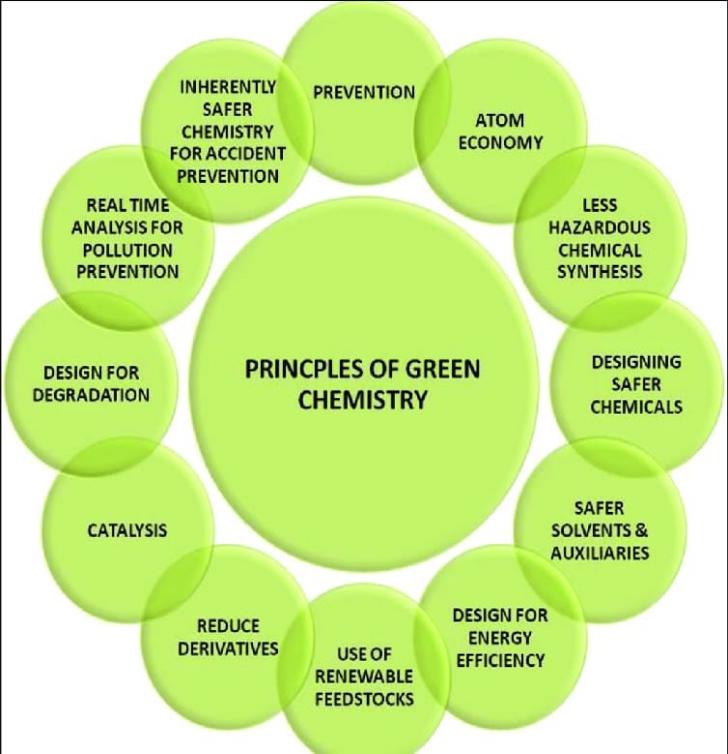
1. Prevention of Waste
It's better to prevent waste than to treat or clean it up after it’s created. In pharma, designing processes with fewer steps or byproducts reduces the burden of hazardous waste disposal and environmental contamination.
2. Atom Economy
This principle emphasizes maximizing the incorporation of all starting materials into the final product. It helps make synthesis routes more efficient and less wasteful, which is crucial in cost sensitive and large-scale drug production.
3. Use of Safer Solvents and Reaction
Conditions Traditional solvents like benzene and dichloromethane are toxic and volatile. Green chemistry promotes the use of safer alternatives like water, ethanol, or ionic liquids, minimizing health and fire hazards.
4. Designing Safer Chemicals
Molecules can be designed to be less toxic to humans and the environment without compromising their therapeutic effects. This reduces the ecological footprint of pharmaceuticals and enhances drug safety.
5. Energy Efficiency
Reactions carried out at room temperature and pressure require less energy, lowering emissions. This is especially relevant in the synthesis and purification of drugs, which often involve energy intensive processes.
6. Use of Renewable Feedstocks
Renewable raw materials like plant-based compounds (e.g., starch, cellulose) replace petroleum-based ones, making the drug manufacturing process more sustainable and less dependent on depleting fossil fuels.
7. Catalysis
Catalysts are not consumed in the reaction and can be reused. Using catalysts instead of large quantities of reagents reduces waste and improves reaction selectivity, benefiting both cost and environmental impact.
8. Reduction of Derivatives
Avoiding unnecessary steps like protection/deprotection or temporary modification of functional groups simplifies the synthesis process and reduces solvent and reagent use.
9. Real-time Analysis for Pollution Prevention
In-process monitoring helps detect and fix issues before waste or hazards are created. This increases the safety and efficiency of pharmaceutical manufacturing lines.
10. Inherently Safer Chemistry For Accident Prevention
Selecting less hazardous chemicals and designing benign processes minimize the risk of explosions, fires, or accidental releases—improving worker safety and regulatory compliance. These techniques lead to safer, more cost- effective production with a smaller environmental foot print.
11. Less hazardous chemical synthesis
It a principle of green chemistry that focuses on designing safer chemical processes. It aims to reduce or eliminate the use and production of toxic substances. Safer reagents and solvents, like water or supercritical CO?, are preferred. Mild reaction conditions are used to enhance safety and energy efficiency. Toxic byproducts are minimized to reduce environmental harm. This approach promotes sustainability and protects human health.
12. Design for degradation
It a principle of green chemistry that ensures chemical products break down into non-toxic substances after use. This prevents accumulation in the environment and reduces long-term pollution. Products are designed to degrade naturally through biological or environmental processes. For example, biodegradable plastics break down into water and carbon dioxide. This principle promotes sustainability and environmental safety. It helps reduce the impact of persistent and hazardous.
Innovations in Green Drug Synthesis
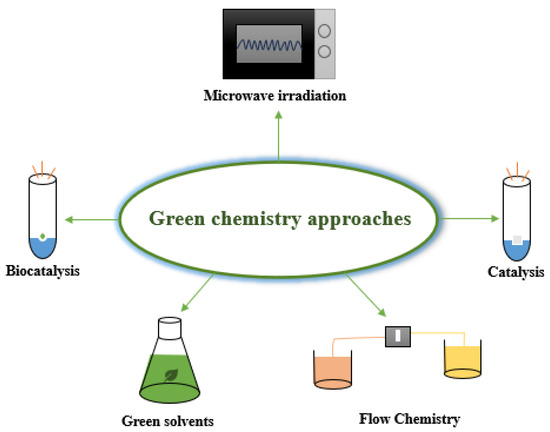
1.Green Solvents
Green solvents are environmentally friendly alternatives to traditional organic solvents used in chemical processes. They are non-toxic, biodegradable, and often derived from renewable resources. Examples include water, ethanol, supercritical CO?, ionic liquids, and deep eutectic solvents. These solvents reduce harmful emissions, improve safety, and support sustainable synthesis. In green chemistry, they help minimize environmental impact and enhance process efficiency. Green solvents are widely used in extractions, catalysis , and pharmaceutical manufacturing. Their adoption aligns with key green chemistry principles like waste reduction and safer chemical design.
2.Biocatalysis
Biocatalysis in green chemistry involves using natural catalysts, such as enzymes or whole cells, to carry out chemical reactions in an eco-friendly manner. It offers high selectivity, operating under mild conditions like low temperature and neutral pH, which reduces energy consumption and by-product formation. Biocatalysts are biodegradable and can be sourced from renewable materials, making them sustainable alternatives to harsh chemical reagents. They are widely used in pharmaceuticals, agrochemicals, and fine chemicals synthesis. Biocatalysis enhances atom economy and reduces the need for toxic solvents. Overall, it supports cleaner, safer, and more sustainable chemical processes.
3. Flow Chemistry
Flow chemistry, also known as continuous-flow processing, is a key technique in green chemistry that allows reactions to occur in a continuously flowing stream rather than in batch mode. It enhances reaction control, safety, and scalability while minimizing waste. Flow systems offer better heat and mass transfer, leading to higher efficiency and reduced reaction times. This method often requires smaller amounts of reagents and solvents, supporting greener practices. It also facilitates safer handling of hazardous materials and easier integration with renewable feedstocks. Overall, flow chemistry promotes sustainable, energy-efficient, and cleaner chemical production.
4.Catalysis
Catalysis plays a vital role in green chemistry by enhancing reaction efficiency and selectivity. Catalysts speed up chemical reactions without being consumed, reducing energy requirements and avoiding harsh conditions. They minimize waste by promoting high-yield, atom-economical processes. Both homogeneous and heterogeneous catalysts are used to replace stoichiometric reagents, reducing environmental impact. Biocatalysts, such as enzymes, offer highly specific and eco-friendly alternatives. Catalysis also enables cleaner industrial processes, supporting sustainable manufacturing. Overall, it aligns with several green chemistry principles, including waste prevention and energy efficiency.
5. Microwave Irradiation
Microwave-assisted techniques in green chemistry offer rapid, energy-efficient alternatives to conventional heating methods. They enable uniform and selective heating, which accelerates reaction rates and often improves yields. This method reduces reaction times from hours to minutes and minimizes the use of harmful solvents. It supports greener synthesis by enhancing atom economy and reducing waste. Microwave heating is particularly effective in organic synthesis, nanomaterial production, and pharmaceutical development. It often leads to cleaner reactions with fewer by-products. Overall, it aligns well with the principles of sustainable and eco-friendly chemistry.
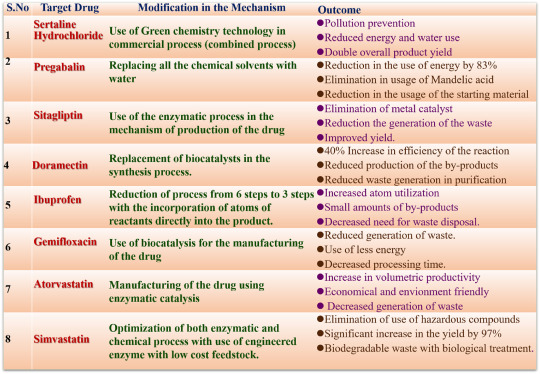
Below is a table describing the case studies of different drugs along with their outcomes and the structures of industrially manufactured drug molecules prepared by green synthesis methods.
CONCLUSION:
Green chemistry and sustainable practices are reshaping the landscape of pharmaceutical development. Innovations such as biocatalysis, continuous flow synthesis, and lifecycle assessments are enabling the industry to reduce its environmental impact without compromising product quality. Regulatory support and collaborative industrial efforts are crucial to mainstreaming these practices. Future advancements in green technology and policy will be key to achieving a truly sustainable pharmaceutical industry.
REFERENCES:
European Medicines Agency. Guideline on the environmental risk assessment of medicinal products for human use. EMA/CHMP/SWP/4447/00 corr 2; 2006.



Thangadipalli Kavya*, Sridhar Siddiraju, Muvvala Sudhakar, Sustainable Pharmaceutical Practices: Innovation in Green Chemistry and Eco-Friendly Drug Development, Int. J. of Pharm. Sci., 2026, Vol 4, Issue 2, 711-716. https://doi.org/10.5281/zenodo.18492176
 10.5281/zenodo.18492176