
View Article

Abstract

Tabernaemontana divaricata plant also known pinwheel and Tagar. There are various pharmacological actions like anti-cholinergic, brain tonic, antimicrobial, antidiabetic etc. The current study focuses on evaluation of dosage form for topical antifungal action using bioactive element derived from Tabernaemontana divaricata extract. First of all, leaves and stem are shelter dried and then ethanol was used for extraction. Antifungal activity of leave and stem extract was done by using well diffusion method, by comparing both extracts leave extract showed more activity against fungal strain. This study concluded that Tabernaemontana divaricata herbal leave extract shows the more antifungal activity than stem extract.

Keywords

Tabernaemontana divaricata, antifungal, Candida albicans

Introduction

Fungal infections also known as dermatomycoses are common in everyday life and can happen anywhere in the world. Trichophyton, Microsporum, and Epidermophyton are examples of the fungi that cause superficial fungal infections. Fungal diseases that affect the skin, hair, and nails are particularly strongly linked to these three generations. These infections are infectious illnesses brought on by dermatophyte (fungus) species that are either anthropophilic (affecting humans) or zoophilic (affecting animals). The common dermatophytosis is tinea pedis. Up to 70% of adults worldwide may be impacted. It affects the plantar surface and the space between the foot's fingers and can contain both inflammatory and non-inflammatory lesions. It is also referred to as athlete's foot or ringworm of the foot. Topical antifungal medications are effective in treating many tinea pedis cases. How well the medication penetrates the stratum corneum, the skin's outermost layer, and how long the treatment is applied determine how effective antifungal creams are.1

Fungi may be classified as yeasts or moulds according to their appearance and means of growth. Examples of yeasts are Candida and Cryptococcus Spp., while moulds include Aspergillus spp., the dermatophytes and, and the Mucorales fungi are termed dimorphic they appear to be yeast like in the host, but grow as moulds in-vitro. Blastomycosis, chromoblastomycosis, coccidioidomycosis, histoplasmosis, para coccidioidomycosis and sporotrichosis are examples of diseases caused by dimorphic fungi.2

COLLECTION OF TABERNAEMONTANA DIVARICATA: 14

The fresh leaves and stems of Tabermontana Divaricata were collected from Kuwarbav in Dist. Ratnagiri , Maharashtra State, India.Colour, taste of the leaves and stems were observed. After botanical evaluation, Size reduction to get coarse powder of plant material is done after shed-drying and then passed through sieve no. 43 to get uniform powder. Then, the uniform powder was subjected to standardization with different parameters as per literature. 

EXTRACTION:17

Preparation of Ethanolic Extract of Tabernaemontana divaricata

The leaves and stems used in this study were selected with care, cleaned to remove impurities, and then allowed to dry in the shade. The dried material was ground into a fine powder in the mechanical grinder. The fine powder was stored for subsequent use in an airtight container after passing through sieve number 43. About 100 grams of powdered material were extracted using a hot extraction method with ethanol as the solvent and a Soxhlet apparatus. The extraction procedure was continued until the solvent in the thimble became clear. Following each extraction, the extract was evaporated to dry it out.  Furthermore, some of the extract was used to make gel batches, while the rest was set aside for initial phytochemical screening to detect various plant components.

ANTIFUNGAL STUDY OF PREPARED HERBAL GEL IN-VITRO:

The agar well diffusion method was used to conduct antifungal tests on several gels. Candida albicans fungus strains were gathered from our facility. To activate the fungal strain, Sabaraud dextrose agar was utilized as the culture medium. Dissolve the Sabaraud dextrose agar medium in 100 milliliters of distilled water in a 250 milliliter conical flask. The medium was autoclaved for 15 minutes at 121°C. It was moved onto sterile petri plate plates that were situated beneath a laminar air flow machine once it had cooled to room temperature.

A diluted suspension culture loop (Candida albicans) was applied on the surface of the solidified agar and evenly disseminated with the help of a spreader culture after the medium-filled petri dishes had been allowed to solidify in a laminar airflow unit. Following the official procedures outlined in the microbial-type culture cultivation protocol, culture media were made, decrease up to 45 °C, thoroughly mixed, and then transferred into a sterile petri dish. allowed to solidify, and a sterile cork borer creates two wells.

Micropipettes were used to pour test samples gel with a concentration of 50 µg/ml into the appropriate well, and another well-marketed gel was taken. Petri dishes and inoculated plates were kept at room temperature in triplicate. For seven days, the petri dish was incubated at the fungal temperature to allow the sample to diffuse. The ZOI's diameter was measured in millimeters.

RESULT AND DISCUSSION:

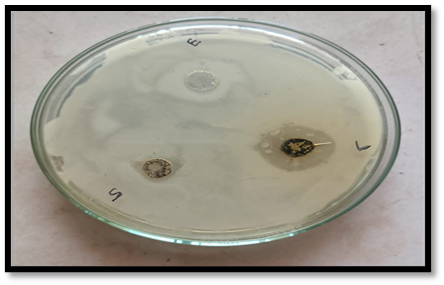
The antifungal spectrum showed that both the test samples were found to be effective against candida albicans concentration dependent manner. The zone of inhibition of the leaves extract is more than stem extract  at 50µg/ml, so that Leaves extract was found to be significantly more effective. The antifungal activity was shown by the ethanolic extract of leaves.
Sr. No.

Sample

Zone of inhibition

1

Leave extract

12mm

2

Stem extract

2mm

3

Ethanol

1mm

Antifungal study done by Agar diffusion method. Sabaraud dextrose agar is used for this method. Leave extract gives more zone of inhibition than stem extract. It means leaves extract shows more antifungal activity than stem extract. Therefore, the leaves extract used for further studies.

CONCLUSION

This study included formulation and evaluation of herbal antifungal gel containing Tabernaemontana divaricata herbal leave extract. Leave and stem extract were successfully extracted, in that leave extract showed more zone of inhibition than stem extract. This study significantly contributes to the field of Indian pharmaceutical by addressing the growing need for safe, effective, affordable alternative in management of fungal diseases. The formulated herbal gel exhibits promising potential to enhance patient compliance.

REFERENCES

  1. Ameen M. Epidemiology of superficial fungal infections Clinics in Dermatology 2010; 28(2): 197- 201.
  2. Shailesh Sharma1, Varunjot Kaur2, Kanika Mahajan2, Simran Pal Singh3, Pragi Arora2, Varun Arora2 and Geeta Yadav2 Antifungal Gel of Miconazole Nitrate: A Comparative Effect Study with  Accumulation of Antioxidants and Surfactants. Acta Scientific Pharmaceutical Sciences 2018, 2 (6) 51-55.
  3. Varun Thakur, B. P. S. A. Formulation and in Vitro Evaluation of Gel for Topical Delivery of Antifungal Agent Fluconazole Using Different Penetration Enhancers. Drug Invention Today  2012, 4 (8) 414-419.
  4. Aishwarya Jain, A. A. N. choudhari, S. R. R. U. R. B. FORMULATION AND EVALUATION OF POLYHERBAL GEL WITH ANTIFUNGAL PROPERTIES. International Journal of Creative Research Thoughts 2023, 11 (7) 688-712.
  5. KUSUM KAUSHIK, S. A. ROLE OF HERBAL ANTIFUNGAL AGENTS FOR THE MANAGEMENT OF FUNGAL DISEASES: A SYSTEMATIC REVIEW. Asian J Pharm Clin Res, 2019, 12 (7) 34-40.
  6. Koka Sweta S * , Pancholi Mamta, Sharma Vijay, Gayakwad Devshree, Darwhekar G N Formulation and Evaluation of Topical Antifungal Herbal Gels  Containing Hydroalcoholic Extract of Catharanthus Roseus and Aloe  Vera. International Journal of Pharmacognosy and Phytochemical Research  2019, 11 (3) 173-176.
  7. Neha Thakur, P. J. V. J. FORMULATION DEVELOPMENT AND EVALUATION OF TRANSFEROSOMAL GEL. Journal of Drug Delivery and Therapeutics 2018, 8 (5) 168-177.
  8. Zhang AY, Camp WL, Elewski BE. Advances in topical and systemic antifungals. Dermatol Clin. 2007 Apr;25(2):165-83, vi. doi: 10.1016/j.det.2007.01.002. PMID: 17430754.
  9. Shubhangi Vishwakarma Mansi Gupta. Formulation and Evaluation of Antifungal Herbal Gel Containing Ethanolic Extract of Senna Alata, MurrayaKoenigii and Aloe Vera. 2019, 9 (4) 518-522.
  10. Pawar Harshal Ashok, D. P. M. ANTIFUNGAL ACTIVITY OF METHANOLIC EXTRACT OF CASSIA TORA LEAVES  AGAINST CANDIDA ALBICANS. nternational Journal of Research in Ayurveda and Pharmacy 2011, 2 (3) 793-796.
  11. Fernando K. A. B, B. H. M. W. R. Evaluation of the Antifungal Activity of Ficus Bengalensis  against Candida Albicans; an Experimental Study. International Journal of Scientific and Research Publications, 2020, 10 (8) 996-1001.
  12. Hemendrasinh J Rathod and Dhruti P Mehta. A Review on Pharmaceutical Gel. Acta Scientifica International Journal of Pharmaceutical Science, 2015, 1 (1) 33-47.
  13. Saniya Tamboli, A. W. A. Formulation, Development and Evaluation of Herbal Antifungal Nanoemulgel Containing Neem Seed Oil and Aloe-Vera Gel. International Journal of All Research Education and Scientific Methods 2021, 9 (8), 400-411.
  14. Das, S.; Dubey, A.; Divya. Tabernaemontana Divaricata: A Herbal Panacea. Journal of Natural Remedies. Informatics Publishing Limited and Society for Biocontrol Advancement October 1, 2022, pp 549–562. https://doi.org/10.18311/jnr/2022/29962.
  15. Raut, S.; Shende, P.; Gargate, N.; Kapare, H. Pharmacognostic and Pharmacological Aspects on Tabernaemontana Divaricata Plant; 2022; Vol. 3.
  16. Traxler, F.; Zhang, H.; Mahavorasirikul, W.; Krivanek, K.; Cai, X. H.; Aiyakool, W.; Pfeiffer, M.; Brecker, L.; Schinnerl, J. Two Novel Iboga-Type and an Oxindole Glucuronide Alkaloid from Tabernaemontana Peduncularis Disclose Related Biosynthetic Pathways to Tabernaemontana Divaricata. Molecules 2023, 28 (18). https://doi.org/10.3390/molecules28186664.
  17. Poornima, K.; Chella Perumal, P.; Gopalakrishnan, V. K. Protective Effect of Ethanolic Extract of Tabernaemontana Divaricata (L.) R. Br. against DEN and Fe NTA Induced Liver Necrosis in Wistar Albino Rats. Biomed Res. Int. 2014, 2014. https://doi.org/10.1155/2014/240243.
  18. Selvakumar, S.; Kumar, A. Antiproliferative Efficacy of Tabernaemontana Divaricata against HEP2 Cell Line and Vero Cell Line. Pharmacogn. Mag. 2015, 11 (42), 46. https://doi.org/10.4103/0973-1296.157682.

Reference

  1. Ameen M. Epidemiology of superficial fungal infections Clinics in Dermatology 2010; 28(2): 197- 201.
  2. Shailesh Sharma1, Varunjot Kaur2, Kanika Mahajan2, Simran Pal Singh3, Pragi Arora2, Varun Arora2 and Geeta Yadav2 Antifungal Gel of Miconazole Nitrate: A Comparative Effect Study with  Accumulation of Antioxidants and Surfactants. Acta Scientific Pharmaceutical Sciences 2018, 2 (6) 51-55.
  3. Varun Thakur, B. P. S. A. Formulation and in Vitro Evaluation of Gel for Topical Delivery of Antifungal Agent Fluconazole Using Different Penetration Enhancers. Drug Invention Today  2012, 4 (8) 414-419.
  4. Aishwarya Jain, A. A. N. choudhari, S. R. R. U. R. B. FORMULATION AND EVALUATION OF POLYHERBAL GEL WITH ANTIFUNGAL PROPERTIES. International Journal of Creative Research Thoughts 2023, 11 (7) 688-712.
  5. KUSUM KAUSHIK, S. A. ROLE OF HERBAL ANTIFUNGAL AGENTS FOR THE MANAGEMENT OF FUNGAL DISEASES: A SYSTEMATIC REVIEW. Asian J Pharm Clin Res, 2019, 12 (7) 34-40.
  6. Koka Sweta S * , Pancholi Mamta, Sharma Vijay, Gayakwad Devshree, Darwhekar G N Formulation and Evaluation of Topical Antifungal Herbal Gels  Containing Hydroalcoholic Extract of Catharanthus Roseus and Aloe  Vera. International Journal of Pharmacognosy and Phytochemical Research  2019, 11 (3) 173-176.
  7. Neha Thakur, P. J. V. J. FORMULATION DEVELOPMENT AND EVALUATION OF TRANSFEROSOMAL GEL. Journal of Drug Delivery and Therapeutics 2018, 8 (5) 168-177.
  8. Zhang AY, Camp WL, Elewski BE. Advances in topical and systemic antifungals. Dermatol Clin. 2007 Apr;25(2):165-83, vi. doi: 10.1016/j.det.2007.01.002. PMID: 17430754.
  9. Shubhangi Vishwakarma Mansi Gupta. Formulation and Evaluation of Antifungal Herbal Gel Containing Ethanolic Extract of Senna Alata, MurrayaKoenigii and Aloe Vera. 2019, 9 (4) 518-522.
  10. Pawar Harshal Ashok, D. P. M. ANTIFUNGAL ACTIVITY OF METHANOLIC EXTRACT OF CASSIA TORA LEAVES  AGAINST CANDIDA ALBICANS. nternational Journal of Research in Ayurveda and Pharmacy 2011, 2 (3) 793-796.
  11. Fernando K. A. B, B. H. M. W. R. Evaluation of the Antifungal Activity of Ficus Bengalensis  against Candida Albicans; an Experimental Study. International Journal of Scientific and Research Publications, 2020, 10 (8) 996-1001.
  12. Hemendrasinh J Rathod and Dhruti P Mehta. A Review on Pharmaceutical Gel. Acta Scientifica International Journal of Pharmaceutical Science, 2015, 1 (1) 33-47.
  13. Saniya Tamboli, A. W. A. Formulation, Development and Evaluation of Herbal Antifungal Nanoemulgel Containing Neem Seed Oil and Aloe-Vera Gel. International Journal of All Research Education and Scientific Methods 2021, 9 (8), 400-411.
  14. Das, S.; Dubey, A.; Divya. Tabernaemontana Divaricata: A Herbal Panacea. Journal of Natural Remedies. Informatics Publishing Limited and Society for Biocontrol Advancement October 1, 2022, pp 549–562. https://doi.org/10.18311/jnr/2022/29962.
  15. Raut, S.; Shende, P.; Gargate, N.; Kapare, H. Pharmacognostic and Pharmacological Aspects on Tabernaemontana Divaricata Plant; 2022; Vol. 3.
  16. Traxler, F.; Zhang, H.; Mahavorasirikul, W.; Krivanek, K.; Cai, X. H.; Aiyakool, W.; Pfeiffer, M.; Brecker, L.; Schinnerl, J. Two Novel Iboga-Type and an Oxindole Glucuronide Alkaloid from Tabernaemontana Peduncularis Disclose Related Biosynthetic Pathways to Tabernaemontana Divaricata. Molecules 2023, 28 (18). https://doi.org/10.3390/molecules28186664.
  17. Poornima, K.; Chella Perumal, P.; Gopalakrishnan, V. K. Protective Effect of Ethanolic Extract of Tabernaemontana Divaricata (L.) R. Br. against DEN and Fe NTA Induced Liver Necrosis in Wistar Albino Rats. Biomed Res. Int. 2014, 2014. https://doi.org/10.1155/2014/240243.
  18. Selvakumar, S.; Kumar, A. Antiproliferative Efficacy of Tabernaemontana Divaricata against HEP2 Cell Line and Vero Cell Line. Pharmacogn. Mag. 2015, 11 (42), 46. https://doi.org/10.4103/0973-1296.157682.

Photo
Mayuri Bane
Corresponding author

Govindrao Nikam College of Pharmacy

Photo
Madan Pomaje
Co-author

Govindrao Nikam College of Pharmacy

Photo
Sumedha Bane
Co-author

Govindrao Nikam College of Pharmacy

Mayuri Bane, Madan Pomaje, Sumedha Bane, Comparative Analysis of Leaf and Stem Extracts of Tabernaemontana Divaricata Against Candida Strains, Int. J. of Pharm. Sci., 2025, Vol 3, Issue 12, 831-834. https://doi.org/10.5281/zenodo.17817223

More related articles
A Cross Sectional Interventional Study to Identify...
Ayisha Shiha, Christy Chacko, A. R. Shabaraya, ...
Non-Pharmacological Strategies for Drug-Resistant ...
Angel Ajith, Ann Maria John, Pooja Bab, Lincy George, ...
Artificial Intelligence in Drug Discovery and Pharmacokinetics &Pharmacodynamics...
Ghanshyam Bajulge, Kaufiya Sayyad, Rushikesh Shitole, Vitthal Survase, Gaurav Anture, Swapnil Patil,...
Clinical Profile and Associated Risk Factors of Iron Deficiency Anemia in Childr...
Dr. Balkrushna Solanki, Dr. Twisha Vaishnav, Dr. Anuya Chauhan, ...
Comparative Efficacy of Inositols and Quercetin in the Management of Polycystic ...
Yadunandan R., Dr. T. Haribabu, Dr. Manjunatha PM, Abhijeet Pandey Jamuna Prasad, Dr. Uday Raj Sharm...
Related Articles
Gangrene: Early Detection, Emerging Therapies, and The Role of Artificial Intell...
Faraz Pathan, Rubina Sheikh, Ayesha Siddiqua, Ashna Khan, Sana Malik, Prerona Das, ...
Review on Phytochemical Profiling and Antidiabetic Potential of Artocarpus heter...
Sukanya Kamane, Mugdha Joshi, Vilasini Pandav, Manisha Kasar, Prajwal Nimkarde, ...
Guava Leaf Extract as a Natural Antimicrobial Agent: Mechanisms of Action Agains...
Tushar Mahajan, Aarti Deore, Shruti Kharote, Yogesh More, Viabhav Dhanwate, Priyanka Ahire, Vivekana...