
View Article

Abstract

The integration of Artificial Intelligence (AI) and Machine Learning (ML) has revolutionized the field of drug discovery and precision medicine. Precision medicine aims to tailor treatment and prevention strategies based on individual genetic, environmental, and lifestyle factors, moving beyond the traditional “one-size-fits-all” approach. With the rapid expansion of biomedical and omics data, AI and ML offer powerful computational tools to analyze vast, heterogeneous datasets, enabling accurate disease diagnosis, personalized treatment, and efficient drug design. Techniques such as reinforcement learning, transfer learning, and multitask learning have shown high accuracy in modeling biological processes, predicting drug–target interactions, and optimizing post-manufacture drug evaluations. Despite significant advancements, challenges remain in data integration, skillset limitations, algorithm transparency, and financial investment. Nevertheless, AI-driven methods in pharmaceutical analysis—such as drug toxicity prediction and computational screening—promise reduced costs, increased efficiency, and ethical advantages over traditional methods. As AI algorithms evolve, their synergy with human expertise and automation technologies is expected to accelerate drug development cycles, minimize costs, and enhance success rates, marking a transformative era in pharmaceutical research and precision drug discovery

Keywords

Artificial Intelligence (AI); Machine Learning (ML); Precision Medicine; Drug Discovery; Drug Toxicity Prediction; Pharmacogenomics; Reinforcement Learning; Deep Learning; Pharmaceutical Data Integration; Personalized Medicine

Introduction

According to the Precision Medicine Initiative, precision medicine is ‘‘an emerging approach for disease treatment and prevention that takes into account individual variability in genes, environment and lifestyle for each person” [1]. This new approach allows physicians and researchers to increase accuracy in predicting disease treatment and prevention strategies that will work for particular groups of people. This approach contrasts with the ‘‘one size-fits-all” approach, more widely used until relatively recently, in which the strategies mentioned above are developed with the average person in mind, regardless of differences between individuals.

The  opportunity for the creation of new treatments offeredby precision medicine generates at the same time great difficulties in the development of new methodologies. For this reason, in recent years a large amount of biomedical data has been generated, coming from very diverse sources: from small individual laboratories to large international initiatives. These data, known mostly as omic data (genomic, proteomic, metabolomic, pharmacogenomic, etc.), are an inexhaustible source of information for the scientific community, which allows stratifying patients, obtaining specific diagnoses or generating new treatments.

Diagnostic tests are frequently performed in some disease areas, as they allow immediate identification of the most effective treatment for a specific patient through a specific molecular analysis. With this, the practice of trial-and-error medicine, which is often frustrating and considerably more expensive, is often avoided. In addition, drugs created from these molecular characteristics usually improve treatment results and reduce side effects. One of the most common examples can be found in the treatment of patients with breast cancer. A significant percentage of patients with this type of tumor are characterized by overexpression of human epidermal growth factor receptor 2 (HER2). For these patients, treatment with the drug trastuzumab (Herceptin) in addition to chemotherapy treatment can reduce the risk of recurrence to more than 50%.

On the other hand, there are also the so-called pharmacoge nomic tests that provide assistance in making decisions related to the drug and the dose formulated for each patient. These decisions are based on the genomic profiles of the patients, so that they can metabolize certain drugs in different ways according to their genetics, thus causing adverse reactions. These reactions are related to variants in the genes that encode drug metabolizing enzymes, such as cytochrome P450 (CYP450). Pharmacogenomic testing can contribute to the safe and effective application of drugs in many different areas of health, including heart disease, cancer adjunctive therapy, psychiatry, HIV and other infectious diseases, dermatology, etc.
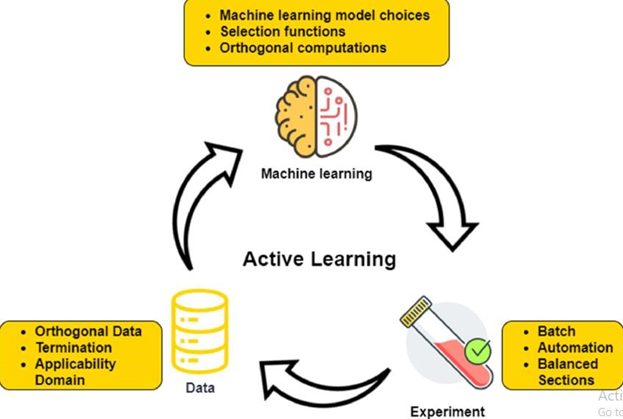
Table 1. An overview of additional studies that used machine learning for drug

Technique

Application

Methods

Accuracy

Traditional reinforcement learning [18]

New drug development

Integrating a number of machine learning techniques to create new molecules

Very accurate (95% of molecules were found to be feasible)

Transfer learning [19]

Emulating biological processes

Using regression-based transfer learning to model responses to anticancer medication

Very accurate

Multitask learning [20]

Drug development and testing

Using genetic and medicinal data to monitor the signals between the pathways where the molecules of the drug travelled

Accurate

Multitask analysis [21]

Drug–target interaction

Using a number of machine learning algorithms and sub-categories in order to analyze and monitor the interactions

of the drug with its target

Accurate

Multitask learning [22]

Post manufacture drug reviews

Using multitask learning and analysis algorithms in order to analyze data in bulk

Very accurate (4,200 reviews in a very short span of time)

Artificial intelligence in drug discovery

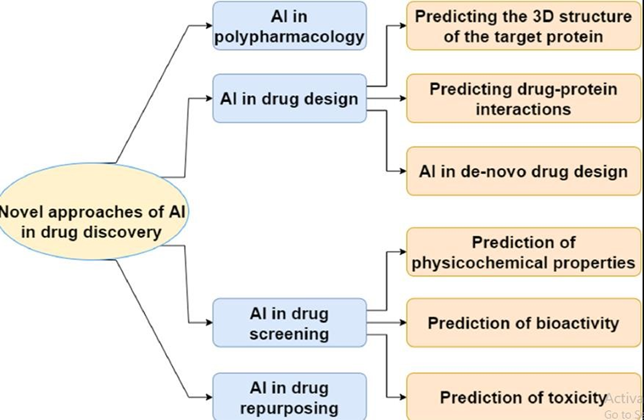
Enhanced computational power and the development of innovative techniques in the field of AI could be used to reform drug discovery and development processes. At the time of this literature review, the pharmaceutical industry is facing drops in efficiency of their drug improvement programs and simultaneous rises in research and development costs [23]. In recent years, there has been a radical expansion in the digitalization of information in the pharmaceutical industry; efficiently obtaining, examining, and applying this information to tackle complex clinical issues is a current challenge. AI can deal with enormous volumes of information with upgraded computerization. It can also integrate and use machine learning algorithms to increase efficiency and productivity. In this section, the main uses of AI to improve the effectiveness of the drug discovery cycle are discussed. above shows how and where AI can be integrated into drug discovery and development processes and the novel applications of AI in the pharmaceutical industry [25]. Drug discovery can be usefully split into four parts: drug design, polypharmacology, drug repurposing,  and drug screening. The primary use of AI is in predicting drug properties, which may reduce the need for clinical trials and live study participants, which would be beneficial from both financial and ethical standpoints. The studies identified in this review that support the integration of AI into the drug discovery procedure to improve efficiency, accuracy and productivity are discussed in this section.
Challenges  

  1. Despite advances in AI and machine learning algorithm technologies implemented in the pharmaceutical industry, there are still many challenges regarding the implementation and integration of these technologies into the drug discovery process specifically and the pharmaceutical industry in general.
  2. One problems is inefficient data integration. This problem results from diversity which exists between datasets, which may comprise raw data, processed data, metadata, or candidate data. These datasets must be collected and collated for efficient analysis, but currently, there is no established method of doing so. This is required before the drug discovery process begins, as without appropriately formatted data, the output of the machine learning algorithms will be inaccurate. More efficient methods for integrating available data into data banks before the drug discovery process begins are therefore required [38].
  3. Another problem is occupational and skillset immobility: many people currently working in the pharmaceutical industry do not have the necessary skills or the qualifications needed to operate AI systems. Many people are proficient in data science, and others in molecular chemistry and biology, but few are experts in both, with the right combination of skills to apply AI in a pharmaceutical context. A knowledge of the underlying chemistry is required to generate appropriate algorithms, and vice versa [38].
  4. A third but related difficulty is scepticism about machine learning and AI in the pharmaceutical industry owing to a lack of understanding on the methodology of algorithms, known as the “black box” phenomenon, and a lack of trust for the results generated. Those who are sceptical may be reluctant to use the data generated using AI and machine learning, wasting both time and money, and holding the industry back with regards to efficiency [24].
  5. This distrust of AI leads to another problem: lack of financing for the development of AI in the pharmaceutical industry. Scepticism about the role and results of AI and machine learning in drug development processes may lead to hesitancy to invest money in this technology. This may lead to slower, less efficient research and development compared with its potential, in turn leading to a reduction in AI-related advances in the pharmaceutical industry. These are the different barriers which stand in the way of true development and these are the challenges which have to be overcome for AI to be integrated into the drug development processes. 

Artificial Intelligence or machine learning in precision drug discovery:

National Institute of health NIH has highlighted the fact that precision medicine is an emerging strategy for the ‘purpose of drug prevention or treatment which also considers the other variations in genetics, libertines and environment. This allows the doctors and physicians to treat and recover diseases more accurately than that of another method employed so far [25]. In order to make this more powerful it requires super mount and fastidious techniques which can be later used in an unfrequented way for trained set of data. The field of artificial learning uses the cognitive ability of the physicians and doctors using biomedical and bioinformatics data to produce fruitful results. Artificial intelligence can be broadly classified into almost three categories which include artificial general intelligence, artificial narrow intelligence and super intelligence [26]. ANI or artificial natural intelligence is still in the process of development and aims to hit the market or research in next decade. It has the ability to develop new data set, analyze them, to find the correlation among them and draw the meaningful or useful conclusions 
Future scope

The main potential of AI in the pharmaceutical industry is to reduce costs and increase efficiency [39]. Extensive research has demonstrated that dynamic learning can distinguish profoundly exact AI models while using half or less information than traditional AI and information subsampling approaches. Although the reason for this increased productivity is not fully understood, it appears that reduced repetition and predisposition, as well as gaining more significant information to traverse choice limits, are key components in this improved execution. As a result, without taking into account the expected mechanical overhead for actually carrying out dynamic learning efforts, screening expenses appear to be reduced by up to 90% [12].

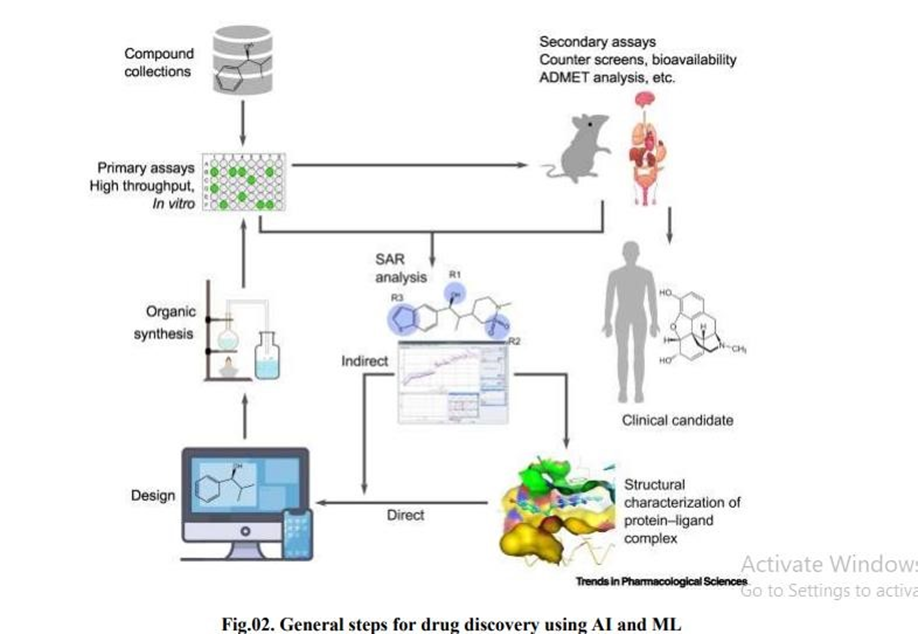
Machine learning techniques can manage complex analyzes with huge, heterogeneous, and high-dimensional information collections with no manual input, which has proved helpful in the writing business applications. Combining machine learning, particularly deep learning, with human skill and experience might be the best way to coordinate numerous enormous data stores. The amazing information-mining capacity of AI innovation has given new essentiality to computer supported medication plans that incorporate multiple clinical considerations are better than piecemeal information, which can speed up prescription processes. With the further gathering of clinical data and the improvement of AI calculations, AI innovation is expected to enable many aspects of drug discovery and development, and become the standard computer supported medication plan strategy. The coordinated development of mechanization and innovations resulting from combining technologies should lead to advancements in medication resulting from improved analysis of large and complex datasets. This will be necessary to shorten drug development cycles, reduce costs, and improve success rates: the ultimate goal of implementing AI in this context .

AI in Pharmaceutical Analysis 

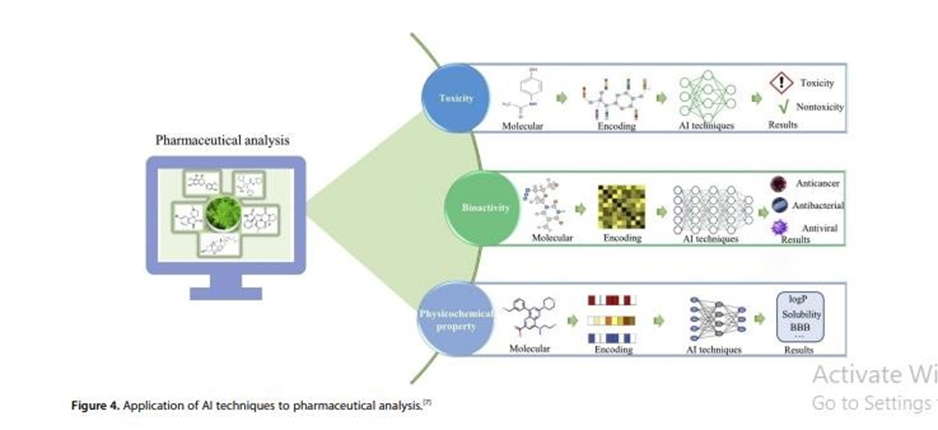
Pharmaceutical analysis encompasses the identification, determination, quantification, and purification of pharmaceutical substances, playing a crucial role in the drug discovery process. It primarily relies on qualitative and quantitative experimental methods. While these methods are highly accurate, the cost associated with screening new drug candidates from a vast array of natural products remains substantial. In contrast, computational methods offer a costeffective alternative. Therefore, AI technologies have been increasingly applied to enhance pharmaceutical analysis alongside traditional experimental methods.

Drug Toxicity Prediction

AI has become instrumental in advancing drug toxicity prediction, offering significant improvements in identifying potential adverse effects of novel drug candidates. Through meticulous training and validation, AI models adeptly delineate toxicity profiles, focusing on potential harm to specific organs or biological pathways. This capability enables the prioritization of compounds with minimized adverse effects, refining the selection of safer drug candidates 

Toxicity, a key indicator of a substance‘s harmful effects remains a central concern in drug development.[61] Traditional toxicity assessments often rely on in vivo animal testing, which not only raises ethical concerns but also significantly increases the cost of drug discovery.[61,119] In contrast, AI-powered computational methods present an efficient, cost-effective
CONCLUSION

Artificial Intelligence and Machine Learning are reshaping the landscape of modern drug discovery and precision medicine. Their ability to process and interpret vast, complex biomedical datasets allows for the identification of novel drug targets, prediction of molecular interactions, and optimization of therapeutic strategies with greater speed and accuracy than traditional methods. By integrating computational power with biological insights, AI-driven tools enhance every stage of the pharmaceutical pipeline—from early drug design and screening to post-market evaluation and toxicity prediction. However, widespread adoption still faces key challenges such as inefficient data integration, lack of multidisciplinary expertise, and skepticism regarding AI’s “black-box” nature. Overcoming these barriers through collaborative research, transparent algorithm development, and targeted training initiatives will be essential. As these technologies mature, AI and ML are expected to become indispensable in achieving cost-effective, efficient, and personalized healthcare solutions, ultimately transforming the future of drug discovery and development.  

REFERENCES

  1. Collins FS, Varmus H. A new initiative on precision medicine. New England J Med 2015;372(9):793–5. 
  2. Curtis C, Shah SP, Chin S-F, Turashvili G, Rueda OM, Dunning MJ, Speed D, Lynch AG, Samarajiwa S, Yuan Y, et al. The genomic and transcriptomic architecture of 2,000 breast tumours reveals novel subgroups. Nature 2012;486(7403):346–52. 
  3. Romond EH, Perez EA, Bryant J, Suman VJ, Geyer Jr CE, Davidson NE, Tan-Chiu E, Martino S, Paik S, Kaufman PA, et al. Trastuzumab plus adjuvant chemotherapy for operable her2-positive breast cancer. N Engl J Med 2005;353(16):1673–84. 
  4. Blanco JL, Porto-Pazos AB, Pazos A, Fernandez-Lozano C. Prediction of high antingiogenic activity peptides in silico using a generalized linear model and feature selection. Sci Rep 2018;8(1):1–11. 
  5. Munteanu CR, Fernández-Blanco E, Seoane JA, Izquierdo-Novo P, Angel RodriguezFernandez J, Maria Prieto-Gonzalez J, Rabunal JR, Pazos A. Drug discovery and design for complex diseases through qsar computational methods. Current Pharmaceutical Des 2010;16(24):2640–55.
  6. García I, Munteanu CR, Fall Y, Gómez G, Uriarte E, González-Díaz H. Qsar and complex network study of the chiral hmgr inhibitor structural diversity. Bioorganic Med Chem 2009;17(1):165–75. 
  7. Liu Y, Tang S, Fernandez-Lozano C, Munteanu CR, Pazos A, Yu Y-Z, Tan Z, GonzálezDíaz H. Experimental study and random forest prediction model of microbiome cell surface hydrophobicity. Expert Syst Appl 2017;72:306–16.
  8. Ezziane, Z., Applications of artificial intelligence in bioinformatics: A review. Expert Systems with Applications, 2006. 30(1): p. 2-10.
  9. Narayanan, A., E.C. Keedwell, and B. Olsson, Artificial intelligence techniques for bioinformatics. Applied bioinformatics, 2002. 1: p. 191-222. \
  10. Kim S, Chen J, Cheng T, Gindulyte A, He J, He S, Li Q, Shoemaker BA, Thiessen PA, Yu B, et al. Pubchem 2019 update: improved access to chemical data. Nucleic Acids Res 2019;47(D1):D1102–9. 
  11. Gaulton A, Bellis LJ, Bento AP, Chambers J, Davies M, Hersey A, Light Y, McGlinchey S, Michalovich D, Al-Lazikani B, et al. Chembl: a large-scale bioactivity database for drug discovery. Nucleic Acids Res 2012;40(D1): D1100–7. 
  12. Sterling T, Irwin JJ. Zinc 15–ligand discovery for everyone. J Chem Inform Modeling 2015;55(11):2324–37. [52] D.K. Duvenaud, D. Maclaurin, J. Iparraguirre, R. Bombarell, T. Hirzel, A. Aspuru-Guzik, R.P. Adams, Convolutional networks on graphs for learning molecular fingerprints, in: Advances in neural information processing systems, 2015, pp. 2224–2232.. 
  13. J. Bruna, W. Zaremba, A. Szlam, Y. LeCun, Spectral networks and locally connected networks on graphs, arXiv preprint arXiv:1312.6203.. 
  14. Masci J, Boscaini D, Bronstein M, Vandergheynst P. Geodesic convolutional neural networks on riemannian manifolds, in. In: Proceedings of the IEEE international conference on computer vision workshops. p. 37–45. 
  15. Coley CW, Jin W, Rogers L, Jamison TF, Jaakkola TS, Green WH, Barzilay R, Jensen KF. A graph-convolutional neural network model for the prediction of chemical reactivity. Chem Sci 2019;10(2):370–7.
  16. Merkwirth C, Lengauer T. Automatic generation of complementary descriptors with molecular graph networks. J Chem Inform Modeling 2005;45(5):1159–68. 
  17. Micheli A. Neural network for graphs: A contextual constructive approach. IEEE Trans Neural Networks 2009;20(3):498–511. 
  18. Kearnes S, McCloskey K, Berndl M, Pande V, Riley P. Molecular graph convolutions: moving beyond fingerprints. J Computer-aided Mol Design 2016;30(8):595–608
  19. Na GS, Chang H, Kim HW. Machine-guided representation for accurate graphbased molecular machine learning. PCCP 2020;22(33):18526–35. 
  20. Jippo H, Matsuo T, Kikuchi R, Fukuda D, Matsuura A, Ohfuchi M. Graph classification of molecules using force field atom and bond types. Mol Inform 2020;39(1–2):1800155. 
  21. Khemchandani Y, O’Hagan S, Samanta S, Swainston N, Roberts TJ, Bollegala D, Kell DB. Deepgraphmolgen, a multi-objective, computational strategy for generating molecules with desirable properties: a graph convolution and reinforcement learning approach. J Cheminformatics 2020;12(1):1–17. 
  22. Ye S, Liang J, Liu R, Zhu X. Symmetrical graph neural network for quantum chemistry with dual real and momenta space. J Phys Chem A 2020;124 (34):6945–53. [63] X. Sun, N.J. Krakauer, A. Politowicz, W.-T. Chen, Q. Li, Z. Li, X. Shao, A. Sunaryo, M. Shen, J. Wang, et al., Assessing graph-based deep learning models for predicting flash point, Molecular Informatics.. 
  23. Z. Xiong, D. Wang, X. Liu, F. Zhong, X. Wan, X. Li, Z. Li, X. Luo, K. Chen, H. Jiang, et al., Pushing the boundaries of molecular representation for drug discovery with the graph attention mechanism, Journal of Medicinal Chemistry.. 
  24. Tian S, Wang J, Li Y, Li D, Xu L, Hou T. The application of in silico drug-likeness predictions in pharmaceutical research. Adv Drug Delivery Rev 2015;86:2–10. 
  25. Burton ME. Applied pharmacokinetics & pharmacodynamics: principles of therapeutic drug monitoring. Lippincott Williams & Wilkins; 2006. 
  26. Liu K, Sun X, Jia L, Ma J, Xing H, Wu J, Gao H, Sun Y, Boulnois F, Fan J. Cheminet: a molecular graph convolutional network for accurate drug property prediction. Int J Mol Sci 2019;20(14):3389.

Reference

  1. Collins FS, Varmus H. A new initiative on precision medicine. New England J Med 2015;372(9):793–5. 
  2. Curtis C, Shah SP, Chin S-F, Turashvili G, Rueda OM, Dunning MJ, Speed D, Lynch AG, Samarajiwa S, Yuan Y, et al. The genomic and transcriptomic architecture of 2,000 breast tumours reveals novel subgroups. Nature 2012;486(7403):346–52. 
  3. Romond EH, Perez EA, Bryant J, Suman VJ, Geyer Jr CE, Davidson NE, Tan-Chiu E, Martino S, Paik S, Kaufman PA, et al. Trastuzumab plus adjuvant chemotherapy for operable her2-positive breast cancer. N Engl J Med 2005;353(16):1673–84. 
  4. Blanco JL, Porto-Pazos AB, Pazos A, Fernandez-Lozano C. Prediction of high antingiogenic activity peptides in silico using a generalized linear model and feature selection. Sci Rep 2018;8(1):1–11. 
  5. Munteanu CR, Fernández-Blanco E, Seoane JA, Izquierdo-Novo P, Angel RodriguezFernandez J, Maria Prieto-Gonzalez J, Rabunal JR, Pazos A. Drug discovery and design for complex diseases through qsar computational methods. Current Pharmaceutical Des 2010;16(24):2640–55.
  6. García I, Munteanu CR, Fall Y, Gómez G, Uriarte E, González-Díaz H. Qsar and complex network study of the chiral hmgr inhibitor structural diversity. Bioorganic Med Chem 2009;17(1):165–75. 
  7. Liu Y, Tang S, Fernandez-Lozano C, Munteanu CR, Pazos A, Yu Y-Z, Tan Z, GonzálezDíaz H. Experimental study and random forest prediction model of microbiome cell surface hydrophobicity. Expert Syst Appl 2017;72:306–16.
  8. Ezziane, Z., Applications of artificial intelligence in bioinformatics: A review. Expert Systems with Applications, 2006. 30(1): p. 2-10.
  9. Narayanan, A., E.C. Keedwell, and B. Olsson, Artificial intelligence techniques for bioinformatics. Applied bioinformatics, 2002. 1: p. 191-222. \
  10. Kim S, Chen J, Cheng T, Gindulyte A, He J, He S, Li Q, Shoemaker BA, Thiessen PA, Yu B, et al. Pubchem 2019 update: improved access to chemical data. Nucleic Acids Res 2019;47(D1):D1102–9. 
  11. Gaulton A, Bellis LJ, Bento AP, Chambers J, Davies M, Hersey A, Light Y, McGlinchey S, Michalovich D, Al-Lazikani B, et al. Chembl: a large-scale bioactivity database for drug discovery. Nucleic Acids Res 2012;40(D1): D1100–7. 
  12. Sterling T, Irwin JJ. Zinc 15–ligand discovery for everyone. J Chem Inform Modeling 2015;55(11):2324–37. [52] D.K. Duvenaud, D. Maclaurin, J. Iparraguirre, R. Bombarell, T. Hirzel, A. Aspuru-Guzik, R.P. Adams, Convolutional networks on graphs for learning molecular fingerprints, in: Advances in neural information processing systems, 2015, pp. 2224–2232.. 
  13. J. Bruna, W. Zaremba, A. Szlam, Y. LeCun, Spectral networks and locally connected networks on graphs, arXiv preprint arXiv:1312.6203.. 
  14. Masci J, Boscaini D, Bronstein M, Vandergheynst P. Geodesic convolutional neural networks on riemannian manifolds, in. In: Proceedings of the IEEE international conference on computer vision workshops. p. 37–45. 
  15. Coley CW, Jin W, Rogers L, Jamison TF, Jaakkola TS, Green WH, Barzilay R, Jensen KF. A graph-convolutional neural network model for the prediction of chemical reactivity. Chem Sci 2019;10(2):370–7.
  16. Merkwirth C, Lengauer T. Automatic generation of complementary descriptors with molecular graph networks. J Chem Inform Modeling 2005;45(5):1159–68. 
  17. Micheli A. Neural network for graphs: A contextual constructive approach. IEEE Trans Neural Networks 2009;20(3):498–511. 
  18. Kearnes S, McCloskey K, Berndl M, Pande V, Riley P. Molecular graph convolutions: moving beyond fingerprints. J Computer-aided Mol Design 2016;30(8):595–608
  19. Na GS, Chang H, Kim HW. Machine-guided representation for accurate graphbased molecular machine learning. PCCP 2020;22(33):18526–35. 
  20. Jippo H, Matsuo T, Kikuchi R, Fukuda D, Matsuura A, Ohfuchi M. Graph classification of molecules using force field atom and bond types. Mol Inform 2020;39(1–2):1800155. 
  21. Khemchandani Y, O’Hagan S, Samanta S, Swainston N, Roberts TJ, Bollegala D, Kell DB. Deepgraphmolgen, a multi-objective, computational strategy for generating molecules with desirable properties: a graph convolution and reinforcement learning approach. J Cheminformatics 2020;12(1):1–17. 
  22. Ye S, Liang J, Liu R, Zhu X. Symmetrical graph neural network for quantum chemistry with dual real and momenta space. J Phys Chem A 2020;124 (34):6945–53. [63] X. Sun, N.J. Krakauer, A. Politowicz, W.-T. Chen, Q. Li, Z. Li, X. Shao, A. Sunaryo, M. Shen, J. Wang, et al., Assessing graph-based deep learning models for predicting flash point, Molecular Informatics.. 
  23. Z. Xiong, D. Wang, X. Liu, F. Zhong, X. Wan, X. Li, Z. Li, X. Luo, K. Chen, H. Jiang, et al., Pushing the boundaries of molecular representation for drug discovery with the graph attention mechanism, Journal of Medicinal Chemistry.. 
  24. Tian S, Wang J, Li Y, Li D, Xu L, Hou T. The application of in silico drug-likeness predictions in pharmaceutical research. Adv Drug Delivery Rev 2015;86:2–10. 
  25. Burton ME. Applied pharmacokinetics & pharmacodynamics: principles of therapeutic drug monitoring. Lippincott Williams & Wilkins; 2006. 
  26. Liu K, Sun X, Jia L, Ma J, Xing H, Wu J, Gao H, Sun Y, Boulnois F, Fan J. Cheminet: a molecular graph convolutional network for accurate drug property prediction. Int J Mol Sci 2019;20(14):3389.

Photo
Dr. Santosh Dighe
Corresponding author

Pravara Rural College of Pharmacy, Loni, Ahilyanagar, Maharashtra, India-431736

Photo
Saurabh Shinde
Co-author

Pravara Rural College of Pharmacy, Loni, Ahilyanagar, Maharashtra, India-431736

Photo
Siddhi Shinde
Co-author

Pravara Rural College of Pharmacy, Loni, Ahilyanagar, Maharashtra, India-431736

Photo
Atharv Vike
Co-author

Pravara Rural College of Pharmacy, Loni, Ahilyanagar, Maharashtra, India-431736

Dr. Santosh Dighe, Saurabh Shinde, Siddhi Shinde, Atharv Vike, The Role of Artificial Intelligence and Machine Learning in Modern Drug Discovery, Int. J. of Pharm. Sci., 2025, Vol 3, Issue 11, 1-4. https://doi.org/10.5281/zenodo.17505357

More related articles
Antidiabetic Activity of Artocarpus Heterophyllus...
Radhika Deshpande, Roopa Sangvikar, ...
Formulate And Evaluate Of Herbal Cold Cream ...
vinod Ajinath pandav , Vasim pathan , Sanjay garje, Gaffer sayyed...
Formulation and Characterization of Risperidone Sustained Release Buccal Tablets...
Shivani Yadav, Avinash Kondalkar, Shankar, Narottam Singh, Muraree Lal, ...
Imidazole Derivatives: A Comprehensive Review of Their Pharmacological Potential...
Snehal Lahare, Archana Kadam , Pooja Nikam , Saniya Shaikh , Ashwini Landge , Samarth Bankar, Shivka...
Liposomes as Smart Drug Delivery Vehicles: Advances, Applications, And Future Pr...
Diksha Desai , Prachi Desai , Pratiksha Salokhe, Shweta Ambuskar , Omkar Chavan, ...
Related Articles
Formulation And Evaluation of Withania Somnifera Syrup for PCOD...
Komal Chavan , Madhavi Kakphale, Shalini Kisan Kawade, Rupal Vijay Kachkure, Maya Sahebrao Jadhav, A...
Ocusert – A Pioneering Ocular Drug Delivery System for Sustained Therapeutic A...
Tejaswini Pakade, Gayatri Gaykee, Chetana Chaudhari, Samruddhi Kajulkar, G. K. Brahma, ...
A Comparative Formulation Study of Furosemide Oral Film ...
Smita More ., Pratiksha Londhe, Sanskruti Khedkar, Snehal Thorat, ...
Preparation And Evaluation of Herbal Transdermal Patch for Management of Varicos...
Anjali Kide-Nandedkar, Nameera Sadiya Begum, Sudhakar Muvvala, ...
More related articles
Formulate And Evaluate Of Herbal Cold Cream ...
vinod Ajinath pandav , Vasim pathan , Sanjay garje, Gaffer sayyed , ...
Formulate And Evaluate Of Herbal Cold Cream ...
vinod Ajinath pandav , Vasim pathan , Sanjay garje, Gaffer sayyed , ...