

We use cookies to ensure our website works properly and to personalise your experience. Cookies policy
School of pharmacy, G.H. Raisoni university, saikheda, Dist-pandhurna, Madhya Pradesh, 480337.
Bio patches are a revolutionary approach in transdermal drug delivery system, providing controlled and sustained release of active pharmaceutical ingredients to improve patient compliance Annono squamosa also known as (custard apple) a medicinal plant which are rich in bioactive compound like alkaloids, flavonoids, and acetogenins. That are show various pharmacological activities such as antimicrobial, anti-inflammatory, antioxidant, and anticancer effects. In this review we are explore the integration of Annona squamosa into bio patches and focusing on its phytochemical properties, extraction methods, formulation techniques, characterization methods, therapeutic applications advantages and disadvantages. the review discusses Transdermal Drug Delivery Systems, Controlled and Sustained Release, challenges and future prospects, of Annona squamosa-loaded bio patches in innovative drug delivery systems.
According to (WHO) world health organization, approximately 80% of the world’s population are used herbal based medicine. An Annona Squamosa also known as custard apple, is an herbal medicinal plant with various therapeutic uses. The demand for new drug delivery system has led to major progress in pharmaceutical technology. with transdermal drug delivery systems (TDDS) for their non-invasive (not needing to cuts or needle in the skin), controlled release mechanisms different from oral and injectable routes, TDDS give stable plasma drug concentrations, bypass first-pass metabolism, and improve patient commitment, in short the transdermal drug delivery (TDDS) retain medicine levels stable to avoid liver damage, and make treatment easy for patients. In the past few years bioactive-loaded bio patches have shown good potential for delivering natural compounds derived from herbal medicinal plants. (1)Annona squamosa, is a part of Annonaceae family, is commonly known for its traditional medicinal uses. Naturally found in tropical and subtropical areas this plant has been traditionally used to treat diabetes, infections, hypertension, and inflammatory conditions.(2) In Recent scientific studies have show many of its traditional medicinal uses claims, showing effective antioxidant, antimicrobial, anti- inflammatory, and anticancer activities due to its rich phytochemical composition. (3)Because of increasing interest in natural, sustainable, and effective drug delivery technique, integrating Annona squamosa into bio patches offers a novel method of enhancing therapeutic efficacy for its broad spectrum of pharmacological properties. This review systematically discusses the botanical aspects, extraction methods, formulation strategies, characterization techniques, and applications of Annona squamosa-loaded bio patches, with focus on solving formulation challenges and future research directions (4)
The phytochemical profile of Annona squamosa commonly known as a custard apple or sugar apple, It is widely cultivated in tropical and subtropical regions such as India, the Philippines, Bangladesh, and parts of Africa and Central America. The plant generally grows up to 3–6 meters in height and grows well in warm climates with well drained soils.(5) Annona squamosa leaves are green with width of 3-5 cm and a length of up to 15 cm, the Annona squamosa plant dormancy can be caused by fluctuations in temperature, light, or rainfall. A. squamosa is also a type of plant with bisexual flowers with the groups of 2 to 4 and can reach a length of about 2.5 cm. (6)The leaves of Annona squamosa are simple, alternate, and ovate, while the flowers are small, greenish-yellow, and aromatic. The fruit is spherical or heart-shaped with a segmented, knobby surface and contains a sweet, creamy pulp. Traditionally, various parts of the plant have been used in ethnomedicine. The leaves, seeds, and fruit pulp are apply externally and internally for treating a range of health disorders, including diabetes, hypertension, bacterial and fungal infections, and inflammatory conditions. (7)
Kingdom:Plantae
Division: Magnoliophyta
Class: Magnoliopsida
Order: Magnoliales
Family: Annonaceae
Genus: Annona L.
Species: Annona squamosa (8)
The phytochemical composition of Annona squamosa has been widely studied, showing a rich source of bioactive compounds responsible for its diverse pharmacological properties. Key phytoconstituents include:
5.1 Alkaloids: Annonaceous acetogenins, such as squamocin and bullatacin, exhibit potent cytotoxic and antimicrobial activities. The Annonaceae is a large family of tropical plants which, it’s found to contain alkaloids. Annona squamosa belongs to Annonaceae family and generally distributed in the tropics. studied the inhibitive effect of Annona squamosa on the corrosion of mild steel in 1 M HCl and 0.5 M H2SO4 solutions. (9)
5.2 Flavonoids: Compounds such as quercetin and kaempferol help in antioxidant and anti-inflammatory activities. A squamosa are known to contain various types of flavonoids some of which can operate as phytoalexins these are mainly involved in the defense mechanisms of plants and some are known to possess significant antimicrobial and insecticidal properties on basis of the above facts an aqueous leaf extract of A squamosa was examined as a source of flavonoids to inhibit the proliferation of microorganisms and the insect pest C chinensis for the protection of pulses stored under Indian conditions.(10)
5.3 Tannins and Phenolics: These compounds are associated with antimicrobial and astringent properties. phenolic compound effects on diet health interaction in the human body. Polyphenols are the dominant plant compounds with antioxidant activity. Phenolic compounds are antioxidants that function as free radical scavengers. The free radical scavenging activity frequently correlates with the total phenolic content in plants. (11)
5.4 Terpenoids and Sterols: Found in the leaves and seeds, these compounds have shown various bioactivities. A. squamosa extracts contain several components such as saponin, alkaloid, coumarin, terpenoid, tannin, phenol and flavonoid. The secondary metabolites possess antioxidant potential due to the presence of phenolic groups. Recently, methanolic extract of A. squamosa demonstrate antioxidant activity of 135.2 mg/mL from fruits pulp source,12 51±1.6 µg/ml from leaves based on DPPH results. In addition, Al-Nemari et al. (2020) reported that methanolic extract of A. squamosa leaves contain sesquiterpenes, diterpene alcohol, triterpene and ketone. However, most of the component are sesquiterpenes hydrocarbon. (12)
5.5 Polysaccharides: Studies report bioactive polysaccharides that promote immunomodulatory and wound-healing effects. The extraction, purification and detailed structures of a newl polysaccharide (ASPW80-1) from the pulp tissues of custard apple using DEAE-52 cellulose column chromatography, sephadex G100, and sephacryl S-300 HR column chromatography, as well as physicochemical properties and instrumental analyses. Scanning electron microscopy (SEM) and atomic force microscopy (AFM) were applied to research the morphologies of ASPW80-1 and ASPW80-M1. In particular, the antioxidant activities and the immunomodulatory effects of ASPW80-1 and ASPW80-M1 were evaluated (13).Annona squamosa leaf extracts have large amounts of phenolic compounds help to increase high antioxidant capacity; The compound helps reduce oxidative stress associated with skin disorders. The phytochemical diversity of Annona squamosa makes it a suitable candidate for incorporation into bio patches, as these compounds can provide therapeutic effects directly at the target site, minimizing systemic side effects. (14)
The different parts of Annona squamosa exhibit various pharmacological properties, which are attributed to the presence of biologically active constituents responsible for its therapeutic potential. A considerable attention to the benefits of biologically active chemicals could attribute to the development of potent drugs to certain pathologies. The pharmacological activities of Annona squamosa have been widely studied, validating its use in traditional medicine and supporting its potential in modern pharmaceutical applications (15). Key activities include.
6.1 Anti-tumor Activity: Cancers are the leading cause of death worldwide. In recent years, researchers have emphasized on the anti-tumor actions of seeds, pericarp and bark of herbs, and active plant chemicals have been identified for their anti- cancer properties. Recently, phytochemical and pharmacological studies on A. squamosa seeds have shown that the major bioactive compounds are annonaceous acetogenins, which have a strong antitumor activity (16).
6.2 Antimicrobial Activity: Many studies have found that Annona squamosa leaf and seed extracts possess strong antibacterial and antifungal properties. These extracts inhibit the growth of pathogenic strains such as Staphylococcus aureus, Escherichia coli, and Candida albicans the presence of acetogenins and phenolic compounds is thought to break microbial cell walls and inhibit enzyme activity, contributing to these effects (17).
6.3 Antioxidant Activity: Phenolic compounds and flavonoids in Annona squamosa give strong antioxidant effects, removing free radicals and protecting cells from oxidative damage (Mohamad et al., 2022). This property is particularly valuable in skin-related applications such as wound healing and anti-aging bio patches (18).
6.4 Anti-thyroid Activity: 5,7,4’ trihydroxy-6,3’ dimethoxy-flavone 5-O-?- I- rhamnopyranoside (THDMF-Rha) isolated from Annona squamosa leaves has been known to be anti-thyroid. The oral intake of the THDHF-Rha at standardized dose for 15 days diminished the I-thyroxine-induced thyrotoxicosis in rats. The effect was comparable to that of propythiouracil. Possible mechanisms are suppression of T4 synthesis and secretion, and inhibition of peripheral deiodenase activity (19).
6.5 Anticancer Activity: Some acetogenins isolated from Annona squamosa show cytotoxic activity against various cancer cell lines by inducing apoptosis and inhibiting cell proliferation (20).
6.6 Anti-viral Activity: 16beta-, 17-dihydroxy-ent-kauran-19-oic acid isolated from the fruits of Annona squamosa was demonstrated to have antiviral activity against HIV replication in H9 lymphocyte cells with an EC50 value of 0.8 microgram/ml. Meanwhile, further investigations are still needed to understand antiviral property of Annona squamosa in some more details (21).
6.7 Antidiabetic Effect: The leaves have been shown to reduce blood glucose levels in experimental diabetic models, attributed to bioactive compounds that modulate glucose metabolism. The hot-water extract of leaves of A. squamosa at a dose 350 mg/kg between reduced the fasting blood glucose (FBG) level slightly by 6.5% within 1 h and the peak blood glucose at 1 h during glucose tolerance test (GTT) was reduced by 15% in normal healthy rats. The same dose of water extract showed antidiabetic activity in two species of animals, namely rabbits and rats with induced diabetes (22).
6.8 Wound Healing: The combination of antimicrobial, antioxidant, and anti- inflammatory properties supports accelerated wound healing when Annona squamosa extracts are applied topically. Wound healing is a process of well- recognised orchestrated and predictable events, in which there are four distinct inter-related phases: haemostasis, inflammation, proliferation and remodelling. Interplay between blood cells, endothelial cells, fibroblasts, keratinocytes and the local release of growth factors and cytokines influence the rate of wound repair. Any disruption in this interplay delays this process (23).
6.9 Anti-malarial Activity: Leaf ethyl extract of Annona squamosa has promising antimalarial activity against chloroquine-sensitive and chloroquine resistant strains of Plasmodium falciparum. N-Nitrosoxylopine, roemerolidine and Duguevalline isolated from Annona squamosa leaf extract are known alkaloids responsible for antimalarial properties. Similarly, the bark extract also exhibited IC50 of 30µg/ml against blood stage Plasmodium falciparum (24).
Biopatch is a novel product consisting of a small keyhole dressing impregnated with chlorhexidine. This is placed around the catheter (CVC or epidural) at the insertion site. Both Biopatch and insertion site are then covered with an occlusive dressing. Keyserling et al studied the use of Biopatch in a neonatal unit and found there was a reduced rate of blood-stream infection related to indwelling devices after the introduction of Biopatch .The aim of this trial was to determine the effect of Biopatch dressings on the rates of CVC-tip and exit-site infection colonisation in an adult ICU Bio patches are advanced drug delivery systems designed for transdermal administration of therapeutic agents(25). They offer several advantages over traditional drug delivery methods:
7.1Transdermal Drug Delivery Systems: Transdermal drug delivery systems (TDDS), also known as "patches," are dosage form designed to deliver a therapeutically effective amount of drug across a patient's skin. Transdermal drug delivery (TDD) is a painless technique for systemic drug administration by applying a drug formulation to intact, healthy skin. The drug first penetrates the stratum corneum and then moves through the deeper epidermis and dermis, without accumulating in the dermal layer. When drug reaches the dermal layer, it becomes available for systemic absorption via the dermal microcirculation (26). Transdermal drug delivery offers significant advantages over injectable and oral routes, as it enhances patient compliance and bypasses first-pass metabolism. (27).
7.2 Controlled and Sustained Release: Bio patches provide a stable and controlled release of active ingredients over prolonged period, reducing dosing frequency and enhancing therapeutic efficacy. Transportation of drug through the skin is affected by various factors, such as skin permeability, area, and duration of application, as well as metabolic activity of the skin (i.e., first pass metabolism). Each drug possesses defferent characteristics that influence its transdermal delivery. For effective skin absorption and penetration, the drug should be non-ionic and sufficiently lipophilic to pass through the skin barrier. Molecules larger than 500 Daltons make it difficult to cross the stratum corneum, and ideally the therapeutic dose of the drug should also be less than 10 mg per day (28).
7.3 Improved Patient Compliance: Bio patches are easy to use and do not cause pain. They are very helpful for people who have long-term diseases because such patients need to take their medicine every day for a long time. Since the patches are simple to apply and painless, patients feel more comfortable and usually take their medicine on time, which helps them get better results from the treatment.
7.4 Minimized Systemic Side Effects: Bio patches work directly to the affected area. This helps lower the amount of medicine that spreads through the whole body and reduces the chance of side effects.
The formulation of bio patches involves selecting appropriate materials that ensure the mechanical strength, stability, and effective delivery of the active compounds.
8.1 Polymers: Both natural and synthetic polymers are commonly used as matrices for bio patches the polymeric materials used in transdermal delivery systems, with emphasis on the materials’ physicochemical and mechanical properties, and it seeks to guide formulators in the selection of polymers. Polymers are utilized in transdermal delivery systems in several ways, such as serving as film-forming agents, drug release modulators, adhesives, or matrix formers that control the rate and duration of drug release through the skin.
A monolithic solid-state design often is preferred for passive transdermal delivery systems because of manufacturing considerations and cosmetic appeal. Although polymeric matrices are used for rate control, adhesion (e.g., a PSA), or encapsulation of a drug reservoir in transdermal delivery systems, limited to polymers that have been used Polymers play a key role in designing matrices, either with or without rate-controlling properties, to regulate the release and absorption of drugs in transdermal delivery systems.
Natural polymers such as chitosan, alginate, gelatin, and cellulose derivatives offer biocompatibility, biodegradability, and good film-forming properties.
Synthetic polymers like polyvinyl alcohol (PVA), polyethylene glycol (PEG), and polyvinylpyrrolidone (PVP) provide mechanical strength, flexibility, and controlled drug release properties (30)
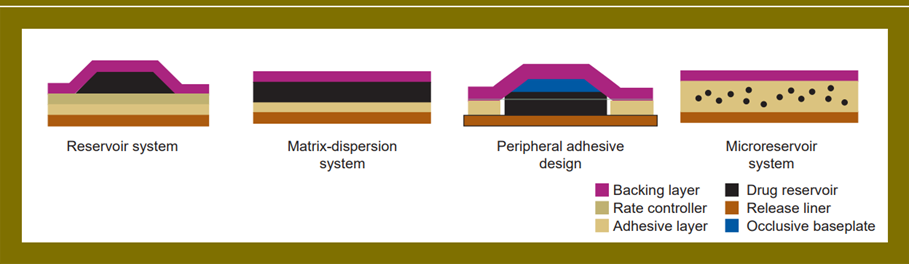
(Bio-Patches) fig. No. 01
8.2 Plasticizers: Many of the polymers used in pharmaceutical formulations are brittle and require the addition of a plasticizer into the formulation. Plasticizers are incorporated into pharmaceutical polymers to enhance thermal processability, modify drug release from polymeric systems, and improve the mechanical strength and surface characteristics of the dosage form. The plasticizers used in pharmaceutical formulations serve to enhance flexibility, improve mechanical strength, and modify the release characteristics of the dosage form (31).
8.3 Adhesives: Pressure-sensitive adhesives ensure proper contact of the patch with the skin for optimal drug permeation. Adhesive should enable the transdermal system to easily adhere to the skin and should not be irritant/allergen for skin. In transdermal systems, pressure-sensitive adhesives are commonly used.Commonly used pressure-sensitive adhesives are generally categorized into three classes: acrylic adhesives, silicone adhesives, and polyisobutylene-based adhesives (32).
8.4 Permeation Enhancers: Substances such as ethanol, oleic acid, and menthol are incorporated to enhance the transdermal permeation of bioactive compounds by disrupting the stratum corneum barrier (33).
8.5 Incorporation of Annona squamosa in Bio Patches: The successful incorporation of Annona squamosa extracts into bio patches depends on efficient extraction techniques, compatibility with the polymer matrix, and stability of bioactive compounds.
8.6 Extraction Methods: Soxhlet extraction is employed to isolate high-value compounds other than lipids from plant or natural materials. A mixture of water and ethanol was used as a solvent over 10 hours to determine the total extractive content and the biogas production potential of macroalgae Padina boergesenii , Colpomenia sinuosa, and Ulva sp. Other protocols aiming to obtain polysaccharides also mentioned the use of Soxhlet extractor as a pretreatment of the biomass to eliminate lipophilic compounds before extracting the carbohydrates. For example, Soxhlet extraction was used to eliminate lipids from Macrocystis pyrifera for bioethanol production and mixtures of methanol and acetone were employed in a Soxhlet apparatus to pretreat Red macroalgae, such as Chondracanthus chamissoi and Gelidium lingulatum, are processed to remove pigments and lipids during agar extraction. (34). Several extraction techniques are employed to obtain bioactive compounds from Annona squamosa leaves, seeds, or fruit pulp:
8.7 Solvent Extraction: Commonly using ethanol, methanol, or water to extract phytochemicals (35).
8.8 Supercritical Fluid Extraction (SFE): Provides high-purity extracts without solvent residues. Supercritical fluid extraction is another widely used method for extracting various bioactive compounds. The supercritical state is reached when both the temperature and pressure are raised above their critical value. This increases the fluidity which accounts for the increased mass transfer. It is a clean method, considered environmental friendly as CO2 is generally used as the solvent. It is a very efficient method for extraction of non-polar compounds, as CO2 is a non-polar solvent, however, to increase the solubility of polar compounds, solvent such as methanol, Solvents such as ethanol, acetonitrile, acetone, water, diethyl ether, and dichloromethane can also be used in the extraction process. This increases the extraction selectivity of this extraction method (36).
8.9 Microwave-Assisted Extraction (MAE): Microwaves are non-ionizing electromagnetic (EM) waves located between the radio-frequency range at the lower frequency and infrared at the higher frequency in the electromagnetic spectrum, within the frequency band of 300 MHz to 300 GHz; 915 MHz is considered most useful for industrial applications with its greater penetration depth, while 2,450 MHz frequency is generally used in domestic microwave ovens and for extraction applications with a wide range of commercial units designed for analytical chemistry purposes Reduces extraction time and enhances yield(37).
8.10 Incorporation Techniques: Once extracted, Annona squamosa bioactive compounds are incorporated into the polymer matrix of the bio patch using methods such as:
9.1Thickness of the patch: The thickness of the drug-loaded patch is measured at multiple points using a digital micrometer, and the average thickness along with the standard deviation is calculated. This is measured to ensure the uniform thickness of the prepared patch. The thickness of transdermal film is determined by traveling microscope dial gauge, screw gauge or micrometer at different points of the film (39).
9.2 Weight uniformity: The prepared patches are dried at 60°c for 4 hours before testing. A specified area of the patch is cut from different sections and weighed using a digital balance. The average weight and standard deviation values are to be calculated from the individual weights.
9.3 Percentage Moisture Content: Each prepared film is weighed individually and then placed in a desiccator containing fused calcium chloride at room temperature for 24 hours. After 24 hours the films are to be reweighed and determine the percentage moisture content
9.4Content uniformity test: 10 patches are selected, and content is determined for individual patches. If 9 out of 10 patches have content between 85% to 115% of the specified value and one has content not less than 75% to 125% of the specified If the measured value meets the specified criteria, the transdermal patches are considered to pass the content uniformity test. But if 3 patches have content in the range of 75% to 125%, then additional 20 patches are tested for drug content. If the content of these 20 patches falls within the range of 85% to 115%, the transdermal patches are considered to have passed the test.
9.5 Moisture Uptake: The weighed films are placed in desiccators at room temperature for 24 hours. These are then taken out and exposed to 84% relative humidity using saturated solution of Potassium chloride in desiccators until a constant weight is achieved.
9.6 Drug content: A specified area of patch is to be dissolved in a suitable solvent in specific volume. Then the solution is to be filtered through a filter medium and analyze the drug contain with the suitable method (UV or HPLC technique). Each value represents average of three different samples.
9.7 Water vapor transmission studies (WVT): For the determination of WVT, weigh one gram of calcium chloride and place it in previously dried empty vials having equal diameter. The polymer films are pasted over the brim with the help of adhesive like silicon adhesive grease and the adhesive was allowed to set for 5 minutes. Then, the vials are accurately weighed and placed in humidity chamber maintained at 68 % RH. The vials are again weighed at the end of every 1st day, 2nd day, 3rd day up to 7 consecutive days and an increase in weight was considered as It provides a quantitative measure of the moisture that passes through the patch. In other reported method, desiccators were used to place vials, in which 200 mL of saturated sodium bromide and saturated potassium chloride solution were placed. The desiccators were tightly sealed, and the internal humidity was measured using a hygrometer. The weighed vials were then placed in desiccators and procedure was repeated
9.8 Skin Irritation study: Skin irritation and sensitization testing can be performed on healthy rabbits (average weight 1.2 to 1.5 kg). The dorsal surface (50 cm²) of the rabbit should be cleaned, with hair removed by shaving, and the area further cleansed using rectified alcohol. spirit and the representative formulations can be applied over the skin. The patch should be removed after 24 hours, and the skin underneath should be examined.
9.9 Stability studies: Stability studies are to be conducted according to the ICH guidelines by storing the TDDS samples at 40±0.5°c and 75±5% RH for 6 months. The samples are withdrawn at 0, 30, 60, 90 and 180 days and analyze suitably for the drug content (40).
10. Characterization Techniques of Bio Patches
Characterization of bio patches plays an important role to make sure their quality, safety, and effectiveness. It ensures that each bio patch has uniform drug content, thickness, weight, and physical appearance, thereby maintaining product uniformity and quality. Characterization also show how the drug is released from the patch and absorbed into the body over time, to make sure proper drug delivery and performance.the drug and the polymer work well together.to prevent any unwanted reactions or degradation. Additionally, it checks the mechanical strength of the patch by evaluating flexibility, tensile strength, and adhesion, which are important for comfort and durability on the skin.
10.1 Fourier Transform Infrared Spectroscopy (FTIR): A non-destructive analytical technique widely used in pharmaceutical and chemical research to identify molecular structures, characterize functional groups, and assess the purity and stability of materials. When a drug sample is added to an FTIR machine, it undergoes infrared radiation analysis that records how molecular bonds within the drug interact with light producing a unique “spectral fingerprint” used for identification and evaluation.Used to analyze the chemical compatibility between the polymer matrix and the Annona squamosa extract. FTIR spectra help detect possible interactions or chemical changes that may affect bioactive compound stability.
When the drug sample is exposed to IR radiation, bond vibrations absorb energy at specific frequencies. The spectrometer measures this absorption pattern across a range of wavelengths (typically 4000–400 cm?¹ for mid-IR analysis).
The resulting FTIR spectrum displays transmission or absorbance as a function of frequency. Each peak corresponds to a characteristic bond vibration, giving insight into the molecular structure. Advanced software compares the spectrum to databases of known compounds to identify the sample or confirm purity (41).
10.2 Scanning Electron Microscopy (SEM):A highly advanced imaging technique that uses high speed beams of electrons to study the surface topography and composition of materials at micro- and nanometer scales. When a drug sample is introduced into the SEM, it is scanned by a focused electron beam that shows detailed morphological and structural information, enabling accurate analysis of drug formulation, particle behavior, and crystallography.
SEM provides information about the surface morphology of the bio patch. A smooth, homogeneous surface indicates good integration of the extract, while rough or porous surfaces may indicate poor dispersion or stability issues.
The generated images and spectra are analyzed to evaluate particle size distribution, crystalline forms, surface roughness, and presence of impurities. This analysis aids in assessing how surface characteristics influence dissolution rate and drug bioavailability.
SEM is very important for modern pharmaceutical investigations. Its nanometer- scale resolution allows for detail study of drug particle morphology, API dispersion, tablet coating uniformity, and controlled-release mechanism (42)
10.3 Differential Scanning Calorimetry (DSC): DSC measures the heat flow in or out of a sample as it is heated or cooled at a controlled rate, compared to an inert reference sample. When a drug sample is placed in the DSC instrument and subjected to a temperature program, any thermal events such as melting, crystallization, glass transition, or decomposition cause heat to be absorbed or released. These events make peaks or transitions in the DSC thermogram (heat flow vs temperature graph), giving insight into the substance’s thermal properties. thermal properties and helps assess the physical state of the incorporated compounds. It can detect crystalline or amorphous nature, indicating the stability of the bioactive components within the polymer matrix (43).
10.4 Mechanical Testing: In mechanical testing we are Evaluates properties such as tensile strength, elongation at break, and flexibility of the bio patch. An ideal bio patch should possess sufficient mechanical strength to remain intact during handling and application. Tensile strength measures the maximum stress of a bio patch can be handel before break down, that are showing how strong and stretchable the Bio patch are. Elongation at break shows the stretch of patch before breaking, which show its flexibility and elasticity. Folding endurance is determined by repeatedly folding the patch at the same spot until it breaks in two pieces, a higher number of folds indicates better flexibility and mechanical strength. The peel adhesion test measures the force are required to peel the patch from a skin-like surface, make sure it adheres well without causing discomfort during removal. Shear strength evaluates the patch’s ability to resist sliding or detachment under stress, ensuring it remains firmly attached during use (44).
10.5 In Vitro Release Studies: In vitro studies determine the release of Annona squamosa bioactive compounds slowly over time. The total release of bioactive compound helps to improve the formulation to ensure sustained and controlled drug delivery the In vitro release studies are performed to determine the drug release profile, showing how much drug is released from the bio patch over time. These studies make sure controlled and sustained drug release, which is important for maintaining consistent therapeutic effects.
They help to evaluate the formulation performance and comparison between different formulations to identify the most effective one. In vitro studies also provide knowledge into the mechanism of drug release, whether it occurs through diffusion, erosion, or degradation. Additionally, they help predict the in vivo behavior of the drug, indicating how it will perform inside the body. Overall, these studies ensure batch- to-batch consistency and serve as an important quality control measure in the development of bio patches (45).
10.6 Antimicrobial Assay: An antimicrobial assay is a laboratory method that are use used to evaluate the effectiveness of a substance against microbes, such as a drug, plant extract, or formulation, to inhibiting or killing microorganisms like bacteria, fungi, or yeast. It plays an important role to determining the antimicrobial activity of various compounds or formulations and helps to identify when they contain a broad or narrow spectrum of antimicrobial activity. Through these antimicrobial assays, researchers can find the minimum concentration of drug (sample) required to inhibit or kill the microorganisms, which is important for determining effective dosages.
An antimicrobial assays are also used to check new antibiotics, herbal extracts, or other bioactive materials to determine its therapeutic applications. and They also make sure the quality and safety of pharmaceutical and cosmetic products by confirming their ability to prevent microbial contamination and maintain product stability.
Area of inhibition are measured against various pathogenic species to confirm the antimicrobial efficacy of the bio patch. The presence of active compounds is essential for therapeutic effect, especially in wound-healing applications (46).
11. Applications of Annona squamosa-Loaded Bio Patches
The unique combination of Annona squamosa-loaded bio patches. these are following their pharmacological activities, and the advantages to create various therapeutic applications:
11.1 Wound Healing: Bio patches which are loaded with Annona squamosa extracts help in wound healing by giving a moist environment, antimicrobial protection, and antioxidant activity to the wound. The Studies show rapid healing of chronic and infected wounds, particularly due to the synergistic effects of the bioactive compounds.
11.2 Antimicrobial Therapy: Applications of Annona squamosa-Loaded Bio Patches in antimicrobial therapy, Due to the strong antibacterial and antifungal properties of Annona squamosa, the bio patches are used to treat localized skin infections. The sustained and controlled release of durg make sure prolonged effect of antimicrobial activity, to reducing the need for repeated applications.
11.3 Anti-inflammatory Applications: The anti-inflammatory properties of Annona squamosa are used in bio patches for the treating inflammatory skin conditions, such as eczema or dermatitis. The localized delivery of drug through the bio patches reduces systemic side effects while targeting inflamed tissues directly.
11.4 Cosmetic Applications: In cosmetic application of Annona squamosa due to its antioxidant and skin-protective properties, Annona squamosa-loaded bio patches are studied for its anti-aging and skin renewal applications and the A. squamosa promoting collagen synthesis and reducing oxidative damage (47).
14.1. Challenges
Even with good possibilities of Annona squamosloaded bio patches, that are many challenges and limitation with their common use:
FUTURE PERSPECTIVES
To overcome from these challenges and enhance the practical application of Annona squamosa loaded bio patches, these are the following future research should focus on:
The integration of Annona squamosa into bio patches presents a novel and promising approach to transdermal drug delivery. With its diverse pharmacological properties including antimicrobial, antioxidant, anti-inflammatory, and wound- healing activities Annona squamosa serves as an effective natural source for bioactive compounds.
Despite several formulation and regulatory challenges, advancements in extraction techniques, nanotechnology, and biocompatible materials offer solutions that could pave the way for commercial application. Continued research, especially clinical trials, is required to fully establish the therapeutic potential and safety of these bio patches.
In summary, Annona squamosa-loaded bio patches represent an innovative, sustainable, and effective solution for drug delivery in pharmaceutical and cosmeceutical application.
REFERENCES


Mohit Nikose, Anjali Toutam, Diksha Pawar, A Comprehensive Review on Annona squamosa Loaded Bio Patches, Int. J. of Pharm. Sci., 2026, Vol 4, Issue 2, 1238-1254. https://doi.org/10.5281/zenodo.18536083
 10.5281/zenodo.18536083