

We use cookies to ensure our website works properly and to personalise your experience. Cookies policy
1PG Scholar, M. Pharm, Sigma institute of pharmacy, Sigma University
2Assistant professor, Sigma institute of pharmacy, Sigma University
Ketoconazole is a synthetic imidazole antifungal agent that has been widely used in the treatment of a variety of superficial and systemic fungal infections. Since its introduction, the drug has played an important role in managing dermatophytosis, candidiasis, and infections caused by Malassezia species. Ketoconazole exerts its antifungal effect primarily by inhibiting fungal cytochrome P450–dependent enzymes involved in ergosterol biosynthesis, leading to disruption of cell membrane integrity and inhibition of fungal growth. In addition to its antifungal activity, ketoconazole demonstrates anti-inflammatory properties, which contribute to its clinical usefulness in inflammatory fungal skin disorders. Although the use of oral ketoconazole has declined due to concerns related to hepatotoxicity and drug–drug interactions, topical formulations continue to be widely prescribed owing to their favorable efficacy and safety profile. This review summarizes the pharmacological properties, mechanism of action, clinical applications, safety considerations, and current therapeutic relevance of ketoconazole, highlighting its continued importance in the management of fungal infections, particularly in dermatological practice.
Ketoconazole [1-5]
Ketoconazole is a synthetic imidazole antifungal agent that has been widely utilized in the treatment of fungal infections affecting the skin and mucous membranes. It demonstrates broad-spectrum activity against dermatophytes, yeasts, and lipophilic fungi, including species of Candida, Malassezia, and Trichophyton. Owing to its potent antifungal properties, ketoconazole has been extensively incorporated into topical preparations for the management of dermatomycoses, seborrheic dermatitis, and pityriasis versicolor.The mechanism of action of ketoconazole involves inhibition of cytochrome P450–dependent 14-α-demethylase, a key enzyme in the ergosterol biosynthetic pathway .Disruption of ergosterol synthesis leads to structural and functional alterations in the fungal cell membrane, resulting in impaired growth and cell death. In addition to its antifungal activity, ketoconazole exhibits anti-inflammatory effects by reducing leukotriene and prostaglandin synthesis, which contributes to symptomatic relief in inflammatory fungal skin conditions. Although systemic administration has become limited due to safety concerns such as hepatotoxicity and drug interactions, topical ketoconazole remains a first-line therapy because of its favorable efficacy and safety profile.
Regulatory Approval of Ketoconazole [6-7]
Ketoconazole was one of the earliest azole antifungal agents to gain regulatory approval for clinical use. It was first approved in the late 1970s and early 1980s for the treatment of both superficial and systemic fungal infections, marking a significant advancement in antifungal therapy due to its broad spectrum of activity and oral bioavailability. Initial approvals by regulatory authorities such as the United States Food and Drug Administration (FDA) supported its use in conditions including mucocutaneous candidiasis, dermatophytosis, and selected endemic mycoses when alternative therapies were limited or unavailable.
Mechanism of Ketoconazole [8-13]
Ketoconazole exerts its antifungal activity by interfering with the synthesis of ergosterol, a sterol that is essential for maintaining the structural integrity and function of fungal cell membranes. The drug selectively inhibits the cytochrome P450–dependent enzyme lanosterol 14-α-demethylase, which catalyzes a critical step in the conversion of lanosterol to ergosterol within fungal cells. Inhibition of this enzyme results in depletion of ergosterol and accumulation of toxic methylated sterol intermediates, leading to increased membrane permeability and disruption of membrane-bound enzymatic processes.The alteration of fungal cell membrane composition caused by ketoconazole impairs nutrient transport, inhibits cell growth, and ultimately leads to fungal cell death. At lower concentrations, ketoconazole exhibits a fungistatic effect by suppressing fungal proliferation, whereas at higher concentrations it may exert fungicidal activity against susceptible organisms . In addition to its primary antifungal mechanism, ketoconazole has been shown to suppress the synthesis of inflammatory mediators such as leukotrienes and prostaglandins, contributing to its therapeutic benefit in inflammatory fungal dermatoses .Ketoconazole also inhibits mammalian cytochrome P450 enzymes to some extent, which explains its potential for drug interactions and systemic adverse effects when administered orally. However, topical formulations minimize systemic absorption, allowing effective antifungal action at the site of infection with a reduced risk of toxicity
Drug Profile of Ketoconazole [14]
Table: 1 Drug Profile of Ketoconazole
|
Sr No. |
Name |
Ketoconazole |
|
|
IUPAC Name |
1-[4-[4-[[(2S,4R)-2-(2,4-dichlorophenyl)-2-(imidazol-1-ylmethyl)-1,3-dioxolan-4-yl] methoxy] phenyl] piperazin-1-yl]ethanone |
|
|
Class |
Imidazoles (Antifungal Drug) |
|
|
CAS Number |
65277-42-1 |
|
|
Molecular Formula |
C26H28Cl2N4O4 |
|
|
Structural Formula |
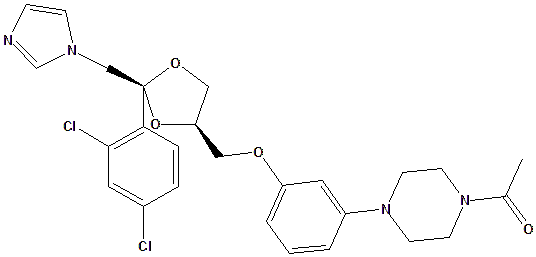
|
|
|
Molecular Weight |
531.4 g/mol |
|
|
Official Status |
US |
|
|
Appearance |
Colorless Crystals or Powder |
|
|
Physical State |
Solid |
|
|
Solubility |
Solubility in Water |
|
|
pKa |
3.96 |
|
|
Melting Point |
146 |
|
|
Partition coefficient (Log P) |
4.3 |
|
|
Mechanism of Action |
Ketoconazole interacts with 14-α-sterol demethylase, a cytochrome P-450 enzyme necessary for the conversion of lanosterol to ergosterol. This results in inhibition of ergosterol synthesis and increased fungal cellular permeability due to reduced amounts of ergosterol present in the fungal cell membrane. This metabolic inhibition also results in accumulation of 14α-methyl-3,6-diol, a toxic metabolite. The increase in membrane fluidity is also thought to produce impairment of membrane-bound enzyme systems as components become less closely packed. |
|
|
Uses |
Treatment of superficial and systemic fungal infections |
|
|
Side Effects |
Nausea Vomiting Constipation abdominal pain dry mouth flatulence, tongue discoloration severe liver injury jaundice |
Literature review:
Literature review of Ketoconazole:
Table 1: Literature review of Ketoconazole
|
Sr. No. |
Title |
Method |
Description |
Ref No. |
|
|
1 |
Ketoconazole USP 2025 |
USP |
Mobile Phase: 20 volume Ammonium acetate, 40 Volume of dioxan, 40 Volume of methanol. Stationary Phase: A stainless steel Colum Wavelenghth: 230 nm Flow Rate: 0.6 ml per min. |
15 |
|
|
2 |
First Derivative ultraviolet Spectrophotometric and high-performance liquid chromatographic determination of Ketoconazole in Pharmaceutical emulsion |
UV |
Solvent: Methanol Wavelength: 257 nm Linearity: 5.0 to 30.0 µg/mL
|
16 |
|
|
3 |
Simultaneous estimation of ketoconazole and salicylic acid in emulgel formulation by UV spectrophotometric methods |
UV |
Solvent: Phosphate buffer pH 6.8 Wavelength: Ketoconazole: 208, 244 nm Salicylic acid: 296 nm Linearity: Ketoconazole: 10-60 Salicylic acid : 5-30 |
17 |
|
|
4 |
Analytical method development and validation of ketoconazole by UV spectroscopy |
UV |
Solvent: ethanol, distilled water, Wavelength :301 nm |
18 |
|
|
5 |
New visible spectrophotometric method development and validation of ketoconazole in pure and semisolid dosage form |
UV |
Solvent: methanol Wavelength: 481 nm |
19 |
|
|
6 |
Development and validation of reverse-phase HPLC method for estimation of ketoconazole in bulk drug |
HPLC |
Mobile phase: acetonitrile: buffer ph 6.8 (51:45:4 % v/v) Stationary phase: promosil c-18 column (250 mm × 4.6 mm, 5 µm particle size) Wavelength: 238 nm Flow rate: 1.0 ml/minute λ max: 237?nm for (Metformin) and 267 nm for (Sitagliptin) Linearity: 4?14?µg/mL for (Metformin) and10-300 µg/ml for (Sitagliptin) |
20 |
|
|
7 |
A RP-HPLC method for the determination of ketoconazole in pharmaceutical dosage forms |
HPLC |
Mobile phase: mixture of methanol and water (90:10 v/v) Stationary phase: c-18 column Flow rate: 1.0 ml/minute Wavelength: 225 nm |
21 |
|
|
8 |
Simultaneous determination of ketoconazole and formaldehyde in a shampoo: liquid chromatography method development and validation |
HPLC |
Mobile phase: acetonitrile–phosphate buffer 0.025 m, ph 4.0, 45/55 % (v/v). Stationary phase: nucleosil (250×4.6 mm, 5 μm) c8 column Wavelength: ketoconazole: 250 nm Formaldehyde :345 nm Flow rate: 1.0 ml/minute |
22 |
|
|
9 |
Validation of RP-HPLC UV method for determination ketoconazole in rabbit plasma: an application to the pharmacokinetic study |
HPLC |
Mobile phase: nah2po4: acetonitrile % (30:70) Stationary phase: c18 column (250 x 4.6 mm, 5 µm) Wavelength: 240 nm Flow rate: 1.0 ml/minute |
23 |
|
|
10 |
High-performance thin-layer chromatographic determination of ketoconazole in pharmaceutical formulations |
HPTLC |
Mobile Phase: ethanol-acetone-1.0 mol l-1 H2SO4 Stationary Phase: silica gel plate Wavelength: 298 nm Concentration range: 3-20 μg/ml of ketoconazole |
24 |
|
|
11 |
A highly sensitive LC-MS/MS method for determination of ketoconazole in human plasma: Application to a clinical study of the exposure to ketoconazole in patients after topical administration
|
UV |
Stationary Phase: Hedera CN Mobile Phase: 10mM ammonium acetate containing 0.1% formic acid (45:55, v/v) Mass Spectrometric Detection: positive ion electrospray ionization mode using multiple reaction monitoring of the transitions of 531.2→489.3 and 286.1→217.1 Flow rate: 0.5mL/min Linearity: 0.01-12ng/mL |
25 |
CONCLUSION:
Ketoconazole remains a historically significant antifungal agent that has contributed substantially to the advancement of antifungal therapy. Its broad spectrum of activity and well-defined mechanism of action established an important foundation for the development of later azole antifungals. Although the systemic use of ketoconazole has been limited due to safety concerns, particularly hepatotoxicity and drug–drug interactions, its role in antifungal treatment has not been entirely diminished. Topical formulations continue to demonstrate consistent efficacy and acceptable safety in the management of superficial and inflammatory fungal infections, especially those involving Malassezia and dermatophyte species.
REFERENCE:


Shah Zeel, Dalwadi Mitali, A Comprehensive Review on Ketoconazole -As an Antifungle Drug, Int. J. of Pharm. Sci., 2026, Vol 4, Issue 1, 2435-2441. https://doi.org/10.5281/zenodo.18344900
 10.5281/zenodo.18344900