
Pachamuthu College of Pharmacy, Dharmapuri. Affiliated to The Tamil Nadu Dr. M. G. R. Medical University, Chennai, Tamil Nadu, India.
Fourier transform Infrared spectroscopy (FTIR) is used to study about the vibrational behavior of Samples, which has a range of even with very small structure variations. Although FTIR have a highly specific feature it to detect vibrations from many components at the same time, such as co factors, amino acid side chains, water molecules etc...This method helps identify vibrations from specific chemical group that take part in a particular reaction. FTIR spectroscopy is commonly used as a detector in gas chromatography. FTIR is mainly used in the medical research. The technique is especially useful for identifying molecular finger prints, detecting biochemical structure and biological samples. It is widely used for the analysis of both small and complex molecules. It can analyses different type samples such as solids, liquid and gas. It is spectral range for 12800 cm-1 to 10 cm-1. This methods is applied in many fields such as agriculture, food analysis, polymer science, and textiles.
The first low-cost instrument that measured an infrared spectrum was the Perkin–Elmer Infrared, made in 1957. It measured wavelengths from 2.5 µm to 15 µm, which is the same as 4000 to 600 cm?¹.The lower wavelength limit was chosen to include the highest molecular vibration energy. The upper limit was fixed due to the use of a rock-salt (NaCl) prism as the dispersing material. The prism becomes opaque at wavelengths above 15 µm, so this region was called the rock-salt region. Later, potassium bromide (KBr) prisms were used, extending the range up to 25 µm (400 cm?¹). This range is called the far-infrared region, which slightly merges into the microwave region. Far-IR radiation has very low energy, so more sensitive detectors than bolometers were needed to identify the chemical substance, such as the Golay detector. The Michelson interferometer was already known to be useful, but it took time to solve the technical problems. A computer was also required to perform the Fourier transformation, which became possible only after the invention of digital computers like the PDP-8, introduced in 1965.In 1969, Digi-lab introduced the world’s first commercial FTIR spectrometer, known as FTS-14.FTIR is one of the simple most commonly used spectroscopic techniques in organic and inorganic chemistry. Its work is based on the interaction of infrared radiation with the vibrational of the molecule. It collects a signal from the sample by interferometer and convert into a interfergram further it was converts it into an IR spectrum. FTIR can measure wide range of infrared regions, from Near Infrared (NIR) to Far Infrared (FIR).The basic principle of FTIR spectroscopy is the measurement of IR radiation absorbed, emitted or reflected by a substance. Each chemical bond absorbs IR radiation or a specific frequency, which helps in identifying the compound by comparing their IR spectra with Reference spectra. IR region is divided into three parts.
FTIR spectroscopy is a fast, real time and non-destructive technique. It is used for both the qualitative analysis (identification of compound) and quantitative analysis. The main purpose of the FTIR is to determination the concentration for solid, liquid and gas samples. For a molecule to the IR active, there will be a change in dipole moment during vibration. IR active molecule are polar bond and asymmetric molecules. IR inactive molecule are non-polar bond and symmetric molecules. IR spectroscopy is very useful for identifying substance, even compounds are very similar.
Principle:
In FTIR spectrometer there are two beams of Michelson interferometer present, which consist of two mirror that are mutually perpendicular to each other .One of the mirror is fixed and other mirror is movable. FTIR consisting source and detector, a beam emitted by a source and splitted into two beam by beam splitter which coherent they interference on recombination .The movement of sample to the mirror leaves the interferometer that can be focused by detector. A signal is detected by detector the conversion of interferogram into spectrum by using Fourier Transformation. One of the most essential steps in FTIR spectrum is first to produce interferogram with or without sample in beam. Second transform interferogram into spectrum source with or without sample absorption .Finally the value is observed in the interfogram
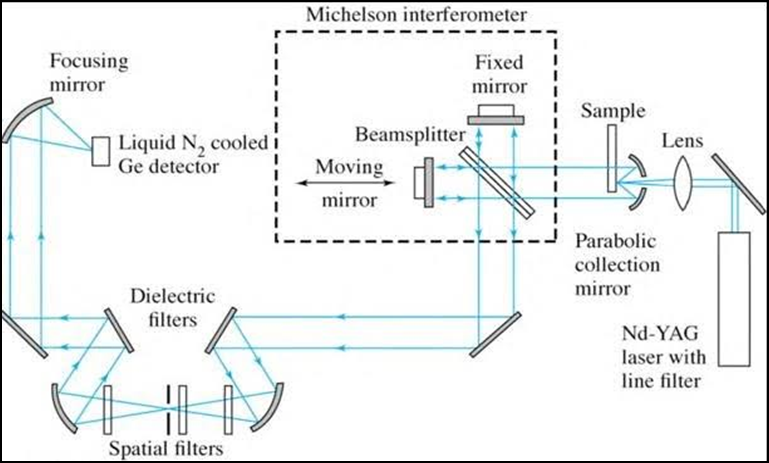
Fig.1 Block diagram of FTIR
Instrumentation:
FTIR instrumentation is simple and high accurate, except when synchrotron radiation is used. In FTIR region tungsten filament acts as light source which emits polychromatic radiation. The light is focused into a Michelson Interfometer containing a beam splitter divides the beam into two:
One beam is reflected to fixed mirror while other beam reflects to moving mirror
Both recombine at beam splitter and produce interference due to optical path difference. The interferogram obtained is processed to give spectrum with high resolution and accuracy.
Different Parts of FTIR Instrumentation
Source:
The source in the FTIR instrument provides infrared radiation needed for analysis of the drug substances. Infrared energy is emitted from a glowing wave body source are Nernst glower, Glober tungsten filament which emit the polychromatic radiation. It allows to pass through the aperture which controls the intensity and quality of beam and amount of energy. Commonly used FTIR light source are heated solids like a globar /silicon carbide Nernst glower.
Interferometer:
The interferometer is the main part of an FTIR instrument its work to split the infrared light into two beams and then recombine them. One beam travels to fixed mirror, other goes to moving mirror. When two beam come back together, they create an interference pattern called 'INTERFEROGRAM'. After passing through the sample the interferogram is sent to the detector.
Sample:
The interfered beam passes through or reflects from the sample compartment depending upon the type of analysis. Sampler can be solids, liquids, gases which is prepared by different ways such as KBr pellets, thin films, and liquid cells. Specific frequencies of IR radiation are absorbed by sample depending on its vibration and functional groups.
Detector:
In FTIR, the detector is used to measure the light that pass through or reflected from the sample, which converts this IR radiation or light into Electrical energy. Finally measure the interferogram .Common FTIR detector;
Computer:
The computer controls the FTIR instrument and process the signal received from detector. Fourier transformation converts the interferogram into normal IR spectrum. It can process store and displaying the IR spectrum and then plotted the graph absorbance vs wavelength.
Michelson Interferogram:
In an FTIR spectrometer, a Michelson interferometer is used to analyze infrared radiation. The IR light coming from the source is first collimated and then sent to a beam splitter. The beam splitter divides the light into two equal parts:
By changing the OPD and recording the detector signal, an interferogram is produced.
OPD = 0, constructive interference occurs and maximum intensity is produced.
OPD increases, the signal shows a series of “wiggles.”
Comparison between IR and FT-IR
|
Feature |
IR |
FTIR |
|
Signal to noise ratio |
Low |
Very high |
|
Wavenumber accuracy |
Low accuracy ( 2- 8 cm- 1) |
Very high accuracy (0.01 cm-1) |
|
Scanning speed |
Slow and take several minute (3-5) |
Very fast (few seconds) |
|
Mechanical design |
Many moving parts |
Only one moving parts |
|
Stray light |
Present ( incorrect reading) |
Negligible (no stray) |
|
Calibration |
Requires calibration with reference spectra |
No external calibration |
|
Resolution |
Low |
High |
|
Spectrum |
Discontinuous spectrum (limited range) |
Continuous spectrum |
|
Thermal effect |
Sample affected by heat |
No thermal effect |
|
Sensitivity |
Less |
High |
|
Beam optics |
Double beam |
Single beam |
|
Light detection |
Detector receives only small fraction of energy |
Detector receives up to 50% of energy |
Advantage:
Disadvantage:
Application:
Pharmaceutical application
Drugs and pharmaceutical dosage forms analyzed using FTIR
FTIR in herbal medicine analysis
FTIR identification of natural and fake diamonds
Application of ftir in food analysis
It is used for the rapid analysis of fat and protein content in meat products such as Fat, Protein and Total solids with an accuracy of about 0.2%
2) Fats and oils
FTIR is also useful for monitoring oil oxidation. As oxidation increases the peroxide peak in the FTIR spectrum also increase, allowing early dectection of oil degradation.
FTIR analysis the pharmaceutical drugs:
Eg: Aspirin and vitamins.
FTIR analysis of vitamins:
FTIR analysis of carbamazepine:
Future trends in FTIR spectroscopy for inorganic materials
Miniaturization and FTIR devices in a portable way
Improved sensitivity and resolution
FTIR imaging and micro spectroscopy
Integration with other analytical techniques
Development of advanced ATR accessories
Automation and artificial intelligence (AI) in FTIR spectroscopy
Automation and artificial intelligence in FTIR spectroscopy automation especially in data processing and interpretation to find a role. Automation of FTIR provides a number of benefits that facilitate the analysis, ranging from sample preparation to data acquisition and spectral analysis. These innovations are decreasing the analysis time while simultaneously increasing the accuracy and reproducibility of FTIR measurements.
CONCLUSION
FTIR spectroscopy is a powerful analytical technique used to determine the molecular structure of substances. It identifies functional groups by detecting characteristic infrared absorption bands and provides a unique molecular fingerprint for each compound.The method is rapid, accurate, and non-destructive, requiring only a small amount of sample. By analyzing the functional group region and fingerprint region, FTIR enables reliable identification and characterization of compounds. Due to its precision and versatility, FTIR is widely used in pharmaceutical analysis, quality control, chemical research, polymer studies, and herbal drug evaluation.
REFERENCES



Dharmasastha S, Lokesh M, Dr. M. Radhakrishnan, A Concise Overview of Infrared Spectroscopy by using the Fourier Transform (FTIR), Int. J. of Pharm. Sci., 2026, Vol 4, Issue 3, 898-906. https://doi.org/10.5281/zenodo.18925625
 10.5281/zenodo.18925625
