View Article

  • A First Principle Study on Geometrical and Electronic Properties of Chlorpheniramine: An Anti-Allergic Drug

  • 1Department of Chemistry, New Government Polytechnic, Patna (Bihar), India

    2Department of Chemistry, Sitamarhi Institute of Technology, Sitamarhi (Bihar), India

    3Department of Physics, Sitamarhi Institute of Technology, Sitamarhi (Bihar), India

Abstract

In the present work, a comprehensive first-principles investigation of the geometrical and electronic properties of chlorpheniramine, a widely used anti-allergic drug, has been carried out using density functional theory (DFT). The optimized molecular geometry of chlorpheniramine was obtained at the B3LYP/6-311++G(d,p) level of theory, and the structural parameters were analyzed to understand the stability and molecular configuration of the compound. The electronic properties were examined through frontier molecular orbital (FMO) analysis, including the highest occupied molecular orbital (HOMO) and lowest unoccupied molecular orbital (LUMO). The HOMO–LUMO energy gap provides valuable insight into the chemical stability, reactivity, and charge transfer characteristics of the molecule. Furthermore, the molecular electrostatic potential (MESP) surface was mapped to identify the electron-rich and electron-deficient regions responsible for possible electrophilic and nucleophilic interactions. The MESP analysis reveals the distribution of electrostatic potential over the molecular surface, highlighting the potential reactive sites within the drug molecule. The combined geometrical optimization, HOMO–LUMO analysis, and MESP mapping provide a detailed understanding of the electronic structure and reactivity of chlorpheniramine. These theoretical findings contribute to a deeper insight into the physicochemical behavior of chlorpheniramine and may be useful for further pharmacological and molecular design studies related to anti-allergic drugs.

Keywords

Chlorpheniramine, DFT, Frontier molecular orbital, MESP, Electronic parameter

Introduction

Antihistamines represent an important class of pharmaceutical compounds widely used for the treatment of allergic disorders such as rhinitis, urticaria, and conjunctivitis [1-4]. Among these, chlorpheniramine is a well-known first-generation antihistamine that acts as a histamine H? receptor antagonist and is commonly prescribed to relieve symptoms associated with seasonal allergies and the common cold [5]. Due to its significant pharmacological activity and widespread clinical use, understanding the molecular structure and electronic characteristics of chlorpheniramine is important for elucidating its physicochemical behavior, intermolecular interactions, and potential reactivity [6-9].In recent years, computational chemistry has become an essential tool for investigating the structural and electronic properties of biologically active molecules [10-16]. First-principles or ab initio methods based on density functional theory (DFT) provide reliable insights into molecular geometry, charge distribution, frontier molecular orbitals, and electronic transitions without relying on empirical parameters. These theoretical approaches enable detailed analysis of molecular systems at the atomic level and complement experimental techniques such as spectroscopy and crystallographyThe geometrical parameters of a molecule play a crucial role in determining its chemical stability and biological activity [17, 18]. Accurate prediction of bond lengths, bond angles, and molecular conformation helps in understanding the structural features responsible for molecular interactions with biological receptors. Furthermore, the study of electronic properties, including the highest occupied molecular orbital (HOMO) and lowest unoccupied molecular orbital (LUMO), provides valuable information about molecular reactivity, charge transfer processes, and chemical stability. The HOMO–LUMO energy gap is particularly important in determining the kinetic stability and electronic excitation behavior of a molecule.

In addition to structural and electronic characteristics, the optical properties of organic molecules have attracted increasing attention due to their relevance in photochemical processes and molecular interactions with electromagnetic radiation. Parameters such as polarizability, electronic transitions, and absorption characteristics can be effectively evaluated using quantum chemical calculations. Such analyses help in understanding the interaction of molecules with light and may provide insights into their spectroscopic signatures and potential applications in optoelectronic or photochemical systems. Chlorpheniramine contains aromatic rings, heteroatoms, and conjugated systems that may contribute significantly to its electronic distribution and optical response. Despite its pharmacological importance, comprehensive theoretical investigations focusing on its geometrical optimization, electronic structure, and optical behavior remain limited. Therefore, a detailed computational study is necessary to explore these properties and provide deeper insight into its molecular characteristics. In the present work, a first-principles investigation of  chlorpheniramine has been carried out to analyze its geometrical structure, electronic properties, and optical characteristics. The molecular geometry was optimized using density functional theory, and the resulting structural parameters were analyzed to understand the stability and conformation of the molecule. Furthermore, frontier molecular orbital analysis, energy gap evaluation, and optical property calculations were performed to elucidate the electronic behavior and photophysical characteristics of chlorpheniramine. The results obtained from this study provide valuable theoretical information that may contribute to a better understanding of the physicochemical and electronic features of this pharmaceutically important compound.

2. Computational details

The ab initio calculations employ a hybrid form of density functional, B3LYP in conjunction with 6-311++G(d, p) basis set for geometry optimization. The B3LYP combines Becke’s three parameter exchange term [19] with the functional devised by Lee-Yang-Parr to treat electron correlation [20, 21]. The Gaussian 09 package [22] is used to perform all computations and visual animation generated by GaussView 5.0 program [23]. The optimized geometry of chlorpheniramine has been shown in Figure 1. The structures of chlorpheniramine was minimized without any constraint in the potential energy surface at B3LYP level, adopting the standard 6-311++G(d,p) basis set.
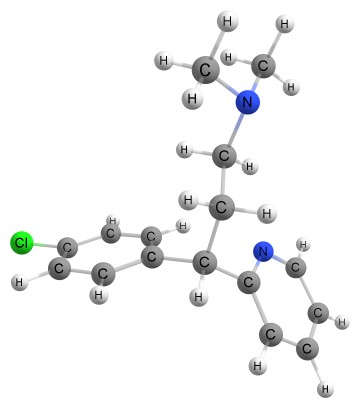


Figure 1. Optimized geometry of chlorpheniramine at B3LYP/6-311++G(d,p) level of theory


RESULT AND DISCUSSION

3.1. Frontier molecular orbital surfaces and MESP plot

The highest occupied molecular orbital (HOMO) and lowest unoccupied molecular orbital (LUMO) are the important electronic parameters associated with the orbital in a compound and the difference between them, results in an HOMO-LUMO energy gap. The HOMO primarily acts as an electron donor and the LUMO largely acts as the electron acceptor. The HOMO and LUMO plot of Chlorpheniramine is displayed in Figure 2. These orbitals find out the way the molecule interacts with other species and their HOMO-LUMO energy gap helps to describe the kinetic stability and chemical reactivity of the molecule [24, 25]. Thus the HOMO-LUMO energy gap is an important parameter measure for stability index of the compound [26] and establishes correlations in various chemical systems [27]. The frontier orbital electron densities on atoms of compound provide a useful means for the characterization of donor-acceptor interactions in details. The HOMO-LUMO energy gap of chlorpheniramine is 4.55 eV. The importance of the MESP (molecular electrostatic potential) lies in the fact that it simultaneously displays the molecular size and shape, as well as positive, negative, and neutral electrostatic potential regions in terms of the electrostatic surface. It is very useful in the investigation of the most probable binding receptor site along with the size and shape of the molecules [28-32] and the MESP plots of chlorpheniramine is displayed in Figure 3. One can see that in MESP, most electropositive i.e. acceptor (the blue part) is located at CH while most electronegative centre, i.e. donor (red part) is located at CH3 atoms. From Figure 3, it is clear that benzene ring possesses a delocalized charge, so can act as a suitable centre of positive charge.
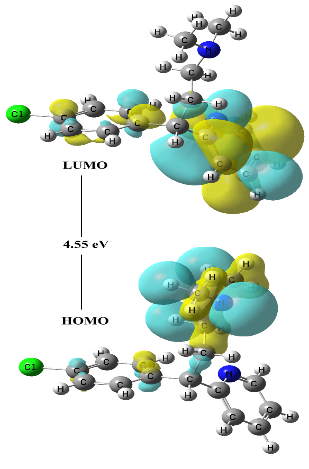


Figure 2. HOMO-LUMO plots of Chlorpheniramine,
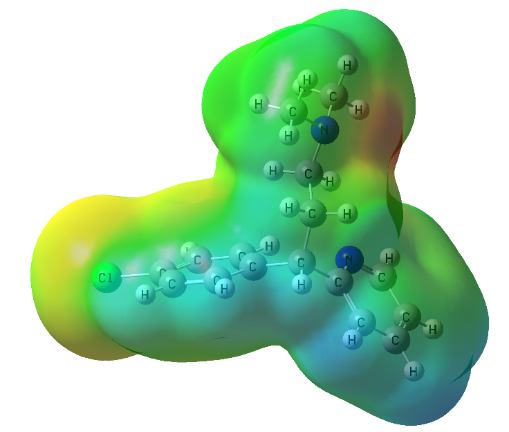


Figure 3. MESP plot of Chlorpheniramine,


3.2. Electronic and thermodynamic parameters

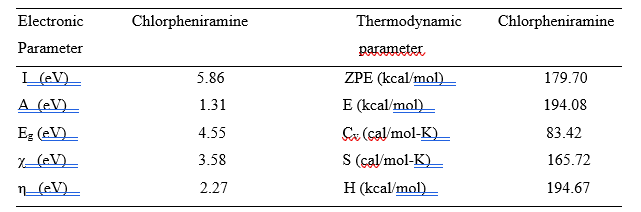
The thermodynamic and electronic parameters of Chlorpheniramine calculated at B3LYP/6-311++G (d, p) level are listed in Table 1.  These calculated parameters are used to describe chemical reactivity of molecules. The calculated electronic parameters include electron affinity (A), ionization potential (I), chemical hardness (η) and absolute electro negativity (χ). Ionization potential and electron affinity are calculated as the negative of energy eigen-values of HOMO and LUMO respectively.  χ and η can be calculated by using finite-difference approximation [33] as below,

χ = ½(I + A) and η = ½(I – A).

 Thermodynamical parameters such as zero point energy (ZPE), thermal energy at room temperature (E), entropy (S), heat capacity (Cv) and enthalpy (H) may be useful in estimating reaction path of the molecules.


Table 1.  Electronic and Thermodynamic parameters calculated at B3LYP/6-311++G(d,p) level,


CONCLUSION

In this study, the geometrical and electronic properties of chlorpheniramine were systematically investigated using density functional theory at the B3LYP/6-311++G(d,p) level of theory. The optimized molecular structure revealed a stable geometry with well-defined bond lengths and bond angles, indicating the structural stability of the molecule. The frontier molecular orbital analysis provided valuable insight into the electronic behaviour of the compound. The distribution of the HOMO and LUMO orbitals and the calculated energy gap suggest moderate chemical stability and potential charge transfer within the molecule. Furthermore, the molecular electrostatic potential (MESP) surface analysis was performed to visualize the charge distribution and identify possible reactive regions. The MESP map indicated that the negative potential regions are mainly localized around electronegative atoms, while the positive potential regions are distributed over hydrogen atoms and less electronegative parts of the molecule. These regions are important for understanding possible electrophilic and nucleophilic interactions. Overall, the combined analysis of optimized geometry, HOMO–LUMO orbitals, and MESP surface provides a detailed understanding of the electronic structure, stability, and reactive sites of chlorpheniramine. The results obtained from this theoretical study may serve as a useful reference for further computational and experimental investigations related to the pharmacological properties and molecular interactions of anti-allergic drugs.

REFERENCES

  1. Linton S, Hossenbaccus L, Ellis AK. Evidence-based use of antihistamines for treatment of allergic conditions. Annals of Allergy, Asthma & Immunology. 2023 Oct 1;131(4):412-20.
  2. Chaudhari R, Gosavi S, Bornare P, Sonawane S, Ahire T. An overview of antihistamines and their properties used for treatment of different diseases. Anti-Inflammatory & Anti-Allergy Agents in Medicinal Chemistryrrent Medicinal Chemistry-Anti-Inflammatory and Anti-Allergy Agents). 2023 Dec 1;22(4):220-9.
  3. Rizvi SA, Ferrer G, Khawaja UA, Sanchez-Gonzalez MA. Chlorpheniramine, an old drug with new potential clinical applications: a comprehensive review of the literature. Current Reviews in Clinical and Experimental Pharmacology Formerly Current Clinical Pharmacology. 2024 Jul 1;19(2):137-45.
  4. Izquierdo I, Casas L, Cabrera S, Fernandez A. How to handle off-label prescriptions of rupatadine, a second-generation antihistamine and PAF antagonist: a review. Drugs in Context. 2024 Jan 18;13:2023-9.
  5. Setzer L. Treatment of Allergic Rhinitis: Diphenhydramine vs. Fexofenadine.
  6. Rizvi SA, Ferrer G, Khawaja UA, Sanchez-Gonzalez MA. Chlorpheniramine, an old drug with new potential clinical applications: a comprehensive review of the literature. Current Reviews in Clinical and Experimental Pharmacology Formerly Current Clinical Pharmacology. 2024 Jul 1;19(2):137-45.
  7. Jawad HM, Husain TA, Qader IN. Study of physical and electrical properties of sandwich compound as drug delivery to transport chlorpheniramine medication using density functional theory. Journal of Physical Chemistry and Functional Materials. 2023 Dec 12;6(2):124-31.
  8. Pathania V, Grover N, Vermani SK, Vermani BK, Sharma S, Kaur H. Study of molecular interactions of the H-1 antihistamine drug chlorpheniramine (CP) in water and in aqueous solutions of urea, glucose, and sodium chloride at different temperatures. Journal of Solution Chemistry. 2024 Mar;53(3):449-70.
  9. Sharma M, Singh J, Sharma S, Singh M. Understanding the Molecular Interactions of Chlorpheniramine Maleate with Imidazolium Based Ionic Liquids in Aqueous System at Different Temperature T=(288.15 K to 318.15 K): Physicochemical, Thermodynamics and Transport Studies. Thermodynamics and Transport Studies.
  10. Kumar A, Srivastava AK, Gangwar S, Misra N, Mondal A, Brahmachari G. Combined experimental (FT-IR, UV–visible spectra, NMR) and theoretical studies on the molecular structure, vibrational spectra, HOMO, LUMO, MESP surfaces, reactivity descriptor and molecular docking of Phomarin. Journal of Molecular Structure. 2015 Sep 15;1096:94-101.
  11. Kumar A, Srivastava AK, Tiwari SN, Misra N, Sharma D. Evolution of anisotropy, first order hyperpolarizability and electronic parameters in p-alkyl-p’-cynobiphenyl series of liquid crystals: odd-even effect revisited. Molecular Crystals and Liquid Crystals. 2019 Mar 4;681(1):23-31.
  12. Kumar A, Dwivedi A, Srivastava AK, Misra N, Narayana B, Samshuddin S, Sarojini BK. Molecular structures, vibrational spectra, electronic properties, and molecular docking of two pyrazoline derivatives containing 1-carboxamide and 1-carbothioamide: a comparative study. Polycyclic Aromatic Compounds. 2017 Aug 8;37(4):267-79.
  13. Srivastava AK, Kumar A, Srivastava H, Pandey S, Kumar N, Brahmachari G, Misra N. Molecular Dynamics and Quantum Chemical Studies on Piperine, a Naturally Occurring Alkaloid. Polycyclic Aromatic Compounds. 2024 Jul 2;44(6):3663-77.
  14. Kumar R, Kumar A, Srivastava AK, Brahmachari G, Tiwari G, Misra N. Structural, spectroscopic analysis of two hexahydroacridine-1, 8 (2H, 5H)-dione derivatives and identification of drug like properties: Experimental and computational study. Materials Today: Proceedings. 2020 Jan 1;29:1050-4.
  15. Kumar R, Kumar A, Srivastava AK, Brahmachari G, Tiwari G, Misra N. ES Chemistry and Sustainability, 2025 Dec., 5, 1943.
  16. Srivastava AK, Dwivedi A, Kumar A, Gangwar SK, Misra N. Conformational analysis, inter-molecular interactions, electronic properties and vibrational spectroscopic studies on cis-4-hydroxy-d-proline. Cogent Chemistry. 2016 Dec 31;2(1):1149927.
  17. Ghose AK, Crippen GM. Use of physicochemical parameters in distance geometry and related three-dimensional quantitative structure-activity relationships: a demonstration using Escherichia coli dihydrofolate reductase inhibitors. Journal of medicinal chemistry. 1985 Mar;28(3):333-46.
  18. Putz MV, Duda-Seiman C, Duda-Seiman D, Putz AM, Alexandrescu I, Mernea M, Avram S. Chemical structure-biological activity models for pharmacophores’ 3D-interactions. International journal of molecular sciences. 2016 Jul 8;17(7):1087.
  19. Hohenberg, P.; Kohn, W. Inhomogeneous Electron Gas. Physical Review 1964136(3B), B864.
  20. A.D. Becke,   Journal of Chemical Physics, (1993), 98, 5648-5652.
  21. C. Lee, W.  Yang,   R.G. Parr,   Physical Review B, (1988), 37, 785-789.
  22. M.J.Frisch, et al. Gaussian 09 Revision B.01, Gaussian Inc.Wallington CT, (2010).
  23. R. Dennington, T.Keith,J.Millam, GaussView Ver. 5.01. Semichem Inc. KS, (2005).
  24. Choudhary V, Bhatt A, Dash D, Sharma N. DFT calculations on molecular structures, HOMO–LUMO study, reactivity descriptors and spectral analyses of newly synthesized diorganotin (IV) 2?chloridophenylacetohydroxamate complexes. Journal of computational chemistry. 2019 Oct 15;40(27):2354-63.
  25. Miar M, Shiroudi A, Pourshamsian K, Oliaey AR, Hatamjafari F. Theoretical investigations on the HOMO–LUMO gap and global reactivity descriptor studies, natural bond orbital, and nucleus-independent chemical shifts analyses of 3-phenylbenzo [d] thiazole-2 (3 H)-imine and its para-substituted derivatives: Solvent and substituent effects. Journal of Chemical Research. 2021 Jan;45(1-2):147-58.
  26. Pilli SR, Banerjee T, Mohanty K. HOMO–LUMO energy interactions between endocrine disrupting chemicals and ionic liquids using the density functional theory: Evaluation and comparison. Journal of Molecular Liquids. 2015 Jul 1;207:112-24.
  27. Prasad O. Investigations on Molecular Structure, Electronic Properties, NLO Properties, HOMO–LUMO Analysis and Comparison of Drug-likeness of Triazolothiadiazole Derivatives by Quantum methods and QSAR Analysis. Reviews in Theoretical Science. 2015;3:1-0.
  28. Haritha M, Suresh CH. Unveiling Drug Discovery Insights Through Molecular Electrostatic Potential Analysis. Wiley Interdisciplinary Reviews: Computational Molecular Science. 2024 Nov;14(6):e1735.
  29. Selvaraman N, Selvam SK, Muthusamy K. The binding mode prediction and similar ligand potency in the active site of vitamin D receptor with QM/MM interaction, MESP, and MD simulation. Chemical biology & drug design. 2016 Aug;88(2):272-80.
  30. Suresh C, Haritha M. Unveiling Drug Discovery Insights through Molecular Electrostatic Potential Analysis.
  31. Gadre SR, Suresh CH, Mohan N. Electrostatic potential topology for probing molecular structure, bonding and reactivity. Molecules. 2021 May 29;26(11):3289.
  32. Jayashree A, Narayana B, Kumar SM, Raghi KR, Sarojini BK, Kumar TM. Synthesis, X-ray crystal structure, Hirshfeld surface analysis, DFT, MESP and molecular docking studies of 2-(4-bromophenyl)-1-(3-fluoro-4-methylphenyl)-4, 5-diphenyl-1H-imidazole. Chemical Data Collections. 2019 Jun 1;21:100237.
  33. R.G. Parr and W. Yang  Density Functional Theory of Atoms and molecules, Oxford University press and Clarendon Press, New York and Oxford (1989).

Reference

  1. Linton S, Hossenbaccus L, Ellis AK. Evidence-based use of antihistamines for treatment of allergic conditions. Annals of Allergy, Asthma & Immunology. 2023 Oct 1;131(4):412-20.
  2. Chaudhari R, Gosavi S, Bornare P, Sonawane S, Ahire T. An overview of antihistamines and their properties used for treatment of different diseases. Anti-Inflammatory & Anti-Allergy Agents in Medicinal Chemistryrrent Medicinal Chemistry-Anti-Inflammatory and Anti-Allergy Agents). 2023 Dec 1;22(4):220-9.
  3. Rizvi SA, Ferrer G, Khawaja UA, Sanchez-Gonzalez MA. Chlorpheniramine, an old drug with new potential clinical applications: a comprehensive review of the literature. Current Reviews in Clinical and Experimental Pharmacology Formerly Current Clinical Pharmacology. 2024 Jul 1;19(2):137-45.
  4. Izquierdo I, Casas L, Cabrera S, Fernandez A. How to handle off-label prescriptions of rupatadine, a second-generation antihistamine and PAF antagonist: a review. Drugs in Context. 2024 Jan 18;13:2023-9.
  5. Setzer L. Treatment of Allergic Rhinitis: Diphenhydramine vs. Fexofenadine.
  6. Rizvi SA, Ferrer G, Khawaja UA, Sanchez-Gonzalez MA. Chlorpheniramine, an old drug with new potential clinical applications: a comprehensive review of the literature. Current Reviews in Clinical and Experimental Pharmacology Formerly Current Clinical Pharmacology. 2024 Jul 1;19(2):137-45.
  7. Jawad HM, Husain TA, Qader IN. Study of physical and electrical properties of sandwich compound as drug delivery to transport chlorpheniramine medication using density functional theory. Journal of Physical Chemistry and Functional Materials. 2023 Dec 12;6(2):124-31.
  8. Pathania V, Grover N, Vermani SK, Vermani BK, Sharma S, Kaur H. Study of molecular interactions of the H-1 antihistamine drug chlorpheniramine (CP) in water and in aqueous solutions of urea, glucose, and sodium chloride at different temperatures. Journal of Solution Chemistry. 2024 Mar;53(3):449-70.
  9. Sharma M, Singh J, Sharma S, Singh M. Understanding the Molecular Interactions of Chlorpheniramine Maleate with Imidazolium Based Ionic Liquids in Aqueous System at Different Temperature T=(288.15 K to 318.15 K): Physicochemical, Thermodynamics and Transport Studies. Thermodynamics and Transport Studies.
  10. Kumar A, Srivastava AK, Gangwar S, Misra N, Mondal A, Brahmachari G. Combined experimental (FT-IR, UV–visible spectra, NMR) and theoretical studies on the molecular structure, vibrational spectra, HOMO, LUMO, MESP surfaces, reactivity descriptor and molecular docking of Phomarin. Journal of Molecular Structure. 2015 Sep 15;1096:94-101.
  11. Kumar A, Srivastava AK, Tiwari SN, Misra N, Sharma D. Evolution of anisotropy, first order hyperpolarizability and electronic parameters in p-alkyl-p’-cynobiphenyl series of liquid crystals: odd-even effect revisited. Molecular Crystals and Liquid Crystals. 2019 Mar 4;681(1):23-31.
  12. Kumar A, Dwivedi A, Srivastava AK, Misra N, Narayana B, Samshuddin S, Sarojini BK. Molecular structures, vibrational spectra, electronic properties, and molecular docking of two pyrazoline derivatives containing 1-carboxamide and 1-carbothioamide: a comparative study. Polycyclic Aromatic Compounds. 2017 Aug 8;37(4):267-79.
  13. Srivastava AK, Kumar A, Srivastava H, Pandey S, Kumar N, Brahmachari G, Misra N. Molecular Dynamics and Quantum Chemical Studies on Piperine, a Naturally Occurring Alkaloid. Polycyclic Aromatic Compounds. 2024 Jul 2;44(6):3663-77.
  14. Kumar R, Kumar A, Srivastava AK, Brahmachari G, Tiwari G, Misra N. Structural, spectroscopic analysis of two hexahydroacridine-1, 8 (2H, 5H)-dione derivatives and identification of drug like properties: Experimental and computational study. Materials Today: Proceedings. 2020 Jan 1;29:1050-4.
  15. Kumar R, Kumar A, Srivastava AK, Brahmachari G, Tiwari G, Misra N. ES Chemistry and Sustainability, 2025 Dec., 5, 1943.
  16. Srivastava AK, Dwivedi A, Kumar A, Gangwar SK, Misra N. Conformational analysis, inter-molecular interactions, electronic properties and vibrational spectroscopic studies on cis-4-hydroxy-d-proline. Cogent Chemistry. 2016 Dec 31;2(1):1149927.
  17. Ghose AK, Crippen GM. Use of physicochemical parameters in distance geometry and related three-dimensional quantitative structure-activity relationships: a demonstration using Escherichia coli dihydrofolate reductase inhibitors. Journal of medicinal chemistry. 1985 Mar;28(3):333-46.
  18. Putz MV, Duda-Seiman C, Duda-Seiman D, Putz AM, Alexandrescu I, Mernea M, Avram S. Chemical structure-biological activity models for pharmacophores’ 3D-interactions. International journal of molecular sciences. 2016 Jul 8;17(7):1087.
  19. Hohenberg, P.; Kohn, W. Inhomogeneous Electron Gas. Physical Review 1964136(3B), B864.
  20. A.D. Becke,   Journal of Chemical Physics, (1993), 98, 5648-5652.
  21. C. Lee, W.  Yang,   R.G. Parr,   Physical Review B, (1988), 37, 785-789.
  22. M.J.Frisch, et al. Gaussian 09 Revision B.01, Gaussian Inc.Wallington CT, (2010).
  23. R. Dennington, T.Keith,J.Millam, GaussView Ver. 5.01. Semichem Inc. KS, (2005).
  24. Choudhary V, Bhatt A, Dash D, Sharma N. DFT calculations on molecular structures, HOMO–LUMO study, reactivity descriptors and spectral analyses of newly synthesized diorganotin (IV) 2?chloridophenylacetohydroxamate complexes. Journal of computational chemistry. 2019 Oct 15;40(27):2354-63.
  25. Miar M, Shiroudi A, Pourshamsian K, Oliaey AR, Hatamjafari F. Theoretical investigations on the HOMO–LUMO gap and global reactivity descriptor studies, natural bond orbital, and nucleus-independent chemical shifts analyses of 3-phenylbenzo [d] thiazole-2 (3 H)-imine and its para-substituted derivatives: Solvent and substituent effects. Journal of Chemical Research. 2021 Jan;45(1-2):147-58.
  26. Pilli SR, Banerjee T, Mohanty K. HOMO–LUMO energy interactions between endocrine disrupting chemicals and ionic liquids using the density functional theory: Evaluation and comparison. Journal of Molecular Liquids. 2015 Jul 1;207:112-24.
  27. Prasad O. Investigations on Molecular Structure, Electronic Properties, NLO Properties, HOMO–LUMO Analysis and Comparison of Drug-likeness of Triazolothiadiazole Derivatives by Quantum methods and QSAR Analysis. Reviews in Theoretical Science. 2015;3:1-0.
  28. Haritha M, Suresh CH. Unveiling Drug Discovery Insights Through Molecular Electrostatic Potential Analysis. Wiley Interdisciplinary Reviews: Computational Molecular Science. 2024 Nov;14(6):e1735.
  29. Selvaraman N, Selvam SK, Muthusamy K. The binding mode prediction and similar ligand potency in the active site of vitamin D receptor with QM/MM interaction, MESP, and MD simulation. Chemical biology & drug design. 2016 Aug;88(2):272-80.
  30. Suresh C, Haritha M. Unveiling Drug Discovery Insights through Molecular Electrostatic Potential Analysis.
  31. Gadre SR, Suresh CH, Mohan N. Electrostatic potential topology for probing molecular structure, bonding and reactivity. Molecules. 2021 May 29;26(11):3289.
  32. Jayashree A, Narayana B, Kumar SM, Raghi KR, Sarojini BK, Kumar TM. Synthesis, X-ray crystal structure, Hirshfeld surface analysis, DFT, MESP and molecular docking studies of 2-(4-bromophenyl)-1-(3-fluoro-4-methylphenyl)-4, 5-diphenyl-1H-imidazole. Chemical Data Collections. 2019 Jun 1;21:100237.
  33. R.G. Parr and W. Yang  Density Functional Theory of Atoms and molecules, Oxford University press and Clarendon Press, New York and Oxford (1989).

Photo
Arun Kumar
Corresponding author

Department of Chemistry, Sitamarhi Institute of Technology, Sitamarhi (Bihar), India

Photo
Ratnesh Kumar
Co-author

Department of Physics, Sitamarhi Institute of Technology, Sitamarhi (Bihar), India

Photo
Ram Naresh Singh
Co-author

Department of Chemistry, New Government Polytechnic, Patna (Bihar), India

Ram Naresh Singh, Arun Kumar, Ratnesh Kumar, A First Principle Study on Geometrical and Electronic Properties of Chlorpheniramine: An Anti-Allergic Drug, Int. J. of Pharm. Sci., 2026, Vol 4, Issue 3, 3203-3209, https://doi.org/10.5281/zenodo.19229030

More related articles
Herbal Body Wash: A Review of Evaluating Their Pot...
Adithi, Shwetha, Krishna R., Yashaswini S. M., Amulya, Anand, ...
A Comprehensive Review on Dapagliflozin and Tadala...
Bariya Siddhraj, Patil Priyanka, Dalwadi Mitali, Limbachiya Harsh...
Perspectives On Cancer Stem Cells: Implications Fo...
Nidhi Srivastava, Mukesh Ramola, Nidhi Tayal, ...
Synthesis Of A,B-Unsaturated Carbonyl Compound And Their Pharmacological Activit...
Wadje Suresh Subhash , Md Rayees Ahmad, Ajay S. Bamne , Nitin P. Ghume, Pooja M. Sontakke, Sabiya K....
Formulation And Evaluation of Ezetimibe Nanoemulsion...
M. Swathi Ramani, M. Sunitha Reddy, K. Anie Vijetha, ...
Related Articles
Prognostic Significance of High-Sensitivity C-Reactive Protein in Acute Myocardi...
Jocili Joseph, Jose Paul, Jomol Varghese, Happy Thomas, ...
Tropic Fever With Multiple Organ Dysfunction : A Case Report...
Drishya L, Akhila Anil, Anjitha Santhosh, Manju Thampi, Shaiju. S. Dharan, ...
Synthetic Advancement Of Carbazoles, Acting As Vibrant Platform In The Field Of ...
Subhajit makar, Gargi Pal, Pratap Chandra Pradha, Hemanta Kumar Khatua, Paresh Roul, ...
Herbal Body Wash: A Review of Evaluating Their Potential in Modern Skin Care Rou...
Adithi, Shwetha, Krishna R., Yashaswini S. M., Amulya, Anand, ...
More related articles
Herbal Body Wash: A Review of Evaluating Their Potential in Modern Skin Care Rou...
Adithi, Shwetha, Krishna R., Yashaswini S. M., Amulya, Anand, ...
A Comprehensive Review on Dapagliflozin and Tadalafil: Role in Erectile Disfunct...
Bariya Siddhraj, Patil Priyanka, Dalwadi Mitali, Limbachiya Harsh, ...
Perspectives On Cancer Stem Cells: Implications For Future Therapies...
Nidhi Srivastava, Mukesh Ramola, Nidhi Tayal, ...
Herbal Body Wash: A Review of Evaluating Their Potential in Modern Skin Care Rou...
Adithi, Shwetha, Krishna R., Yashaswini S. M., Amulya, Anand, ...
A Comprehensive Review on Dapagliflozin and Tadalafil: Role in Erectile Disfunct...
Bariya Siddhraj, Patil Priyanka, Dalwadi Mitali, Limbachiya Harsh, ...
Perspectives On Cancer Stem Cells: Implications For Future Therapies...
Nidhi Srivastava, Mukesh Ramola, Nidhi Tayal, ...