

We use cookies to ensure our website works properly and to personalise your experience. Cookies policy
Rashtrasant Janardhan Swami College Of Pharmacy, kokamthan, Ahmednagar, Maharashtra-414001
Chromatographic separation techniques are essential tools in analytical chemistry, utilized for the isolation, identification, and quantification of complex mixtures. This review provides an overview of various chromatographic methods, including gas chromatography (GC), liquid chromatography (LC), and their advanced variations such as high-performance liquid chromatography (HPLC) and supercritical fluid chromatography (SFC). Each technique’s principles, advantages, and limitations are discussed, along with their applications across diverse fields, including pharmaceuticals, environmental analysis, and food safety. Recent advancements in stationary phase materials and detection technologies are highlighted, showcasing the evolution of chromatographic techniques toward improved efficiency and resolution. The review emphasizes the importance of selecting appropriate methods tailored to specific analytical challenges, underscoring the ongoing innovations that continue to enhance the capabilities of chromatographic separations.
Chromatography is a fundamental analytical technique used to separate, identify, and quantify components in complex mixtures. Since its inception by Mikhail Tswett in 1890, who utilized paper chromatography to isolate plant pigments, the field has significantly advanced, giving rise to a multitude of chromatographic methods tailored for various applications.
The principle of chromatography relies on the differential distribution of compounds between a stationary phase and a mobile phase. As the mixture moves through the stationary phase, components interact differently based on their chemical and physical properties, leading to separation. This versatility allows chromatography to be applied in numerous fields, including pharmaceuticals, environmental science, food safety, and biotechnology. The growing complexity of samples and the demand for high-throughput analysis have driven innovations in chromatographic techniques. Methods such as high-performance liquid chromatography (HPLC) and gas chromatography (GC) have become standards in laboratories due to their sensitivity and accuracy. Furthermore, advancements in stationary phase materials and detection technologies have enhanced the resolution and efficiency of separations. This review aims to provide an overview of various chromatographic techniques, their principles, applications, and recent advancements. By highlighting the importance of these methods in analytical chemistry, we aim to inform researchers and practitioners about the best practices and innovations in chromatographic separation.
Chromatography is a crucial analytical technique employed for the separation, identification, and quantification of components in complex mixtures. Since its development by Mikhail Tswett in 1890, who first used paper chromatography to separate plant pigments, the field has expanded to include a diverse range of methods tailored for specific applications.
At its core, chromatography operates on the principle of differential partitioning between a stationary phase and a mobile phase. As a sample mixture is introduced, its components interact variably with these phases, resulting in their separation based on various factors such as polarity, size, and affinity. This makes chromatography an indispensable tool across multiple disciplines, including pharmaceuticals, environmental monitoring, food safety, and clinical analysis. The demand for precise and rapid analytical methods has spurred advancements in chromatographic techniques. High-performance liquid chromatography (HPLC), gas chromatography (GC), and newer methods like supercritical fluid chromatography (SFC) have emerged as key techniques in laboratories due to their high sensitivity, accuracy, and versatility. Recent innovations in stationary phase technology and detection systems have further improved separation efficiency and resolution.
Type of chromatography:
1) Thin Layer Chromatography: Thin layer chromatography, or TLC is a method for analyzing mixtures by separating the compounds in the mixture. TLC can be used to help determine the number of components in a mixture, the identity of compounds, and the purity of a compound by observing the appearance of a product or the disappearance of a reactant, it can also be used to monitor the progress of a reaction.TLC is a sensitive technique – microgram (0.000001 g) quantities can be analyzed by TLC- and it takes little time for an analysis (about 5-10 minutes)
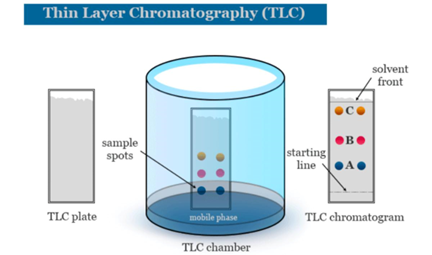
2) High Performance Thin Layer Chromatography: Chromatography is a physical process of separation in which the components to be separated are distributed between 2 immiscible phases-a stationary phase which has a large surface area and mobile phase which is in constant motion through the stationary phase.
3) Paper Chromatography: Paper chromatography is an analytical chemistry technique for separating and identifying color mixtures.In paper chromatography, substances are distributed between stationary phase and a mobile phase. Stationary phase is usually a piece of filter paper and mobile phase is the colors that travels up the stationary phase. Components of the samples will separate readily according to how strongly they absorb on the stationary phase vs. how readily they dissolve in the mobile phase.
Principle: The principal of separation is mainly partition rather then absorption cellulose layers in filter paper contains moisture which acts as stationary phase. Organic solvents or buffers are used as mobile phases, instead of water as stationary phase other organic solvents can be used by suitable modification.

4) Column Chromatography: Column chromatography can be used to separate the components in a mixture.The stationary phase is a solid, or a solid that has been thinly coated in a viscous liquid and packed into a glass column.The sample is applied carefully to the top of the packing and a solvent, which acts as the mobile phase, is dripped slowly onto the column from the reservoir above.A tap at the bottom of the column allows the solvent, which is called the eluent, to leave the bottom of the column at the same rate as it enters it at the other end.
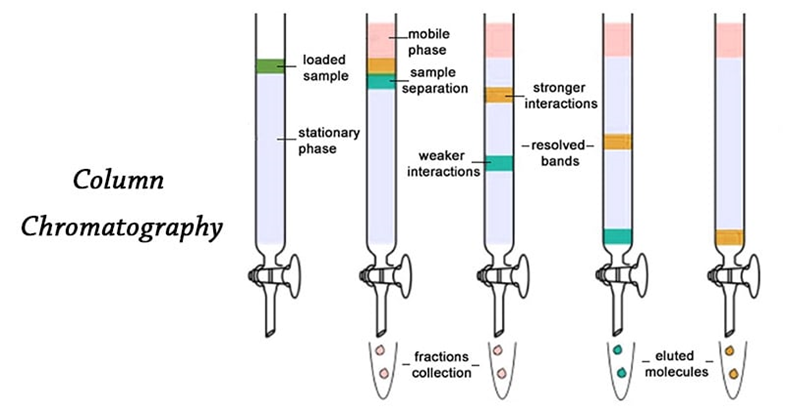
5) Adsorption Chromatography: Adsorption chromatography is one of the oldest chromatographic techniques, utilizing a mobile phase—liquid or gas—that interacts with a stationary solid phase. The separation of solutes occurs due to their differing affinities for the stationary phase; compounds that adsorb more strongly move more slowly, while those that adsorb less move faster. Common forms of this technique include column chromatography, gas-solid chromatography, thin-layer chromatography, and high-performance liquid chromatography (HPLC). Each method has unique applications and advantages, allowing for effective separation and analysis of complex mixtures.
6) Partition Chromatography: In partition chromatography, a thin liquid layer coats a solid support, creating an equilibrium between the solute in the mobile phase and the stationary liquid. This technique separates compounds based on their partitioning behavior between the two phases. Types of partition chromatography include high-performance liquid chromatography (HPLC), paper chromatography, gas-liquid chromatography, thin-layer chromatography (TLC), and partition column chromatography. Each of these methods is suited for different applications and offers varying degrees of resolution and efficiency in separating complex mixtures.
7) Ion Exchange Chromatography : Ion-exchange chromatography leverages the ionic charges of the twenty common amino acids, which serve as the building blocks of proteins. Amino acids possess positively or negatively charged side groups (R groups), influencing the overall charge of the protein. Proteins with a net positive charge are classified as “basic,” while those with a net negative charge are considered “acidic.” This technique allows proteins to bind to a support with the opposite charge, facilitating separation based on their ionic properties. Ion-exchange chromatography is particularly valuable for protein purification, enabling the identification and isolation of different chemical families acidic, basic, and neutralwithin a sample.
8) High Performance Liquid Chromatography : HPLC is a form of liquid chromatography used to separate compounds that are dissolved in solution.HPLC instruments consist of a reservoir of mobile phase, a pump, an injector, a separation column, and a detector.Compounds are separated by injecting a sample mixture onto the column. The different component in the mixture pass through the column at differentiates due to differences in their partition behavior between the mobile phase and the stationary phase.
9) Gas Chromatography: Gas chromatography – “It is a process of separating component(s) from the given crude drug by using a gaseous mobile phase.” It involves a sample being vaporized and injected onto the head of the chromatographic column. The sample is transported through the column by the flow of inert, gaseous mobile phase. The column itself contains a liquid stationary phase which is adsorbed onto the surface of an inert solid.
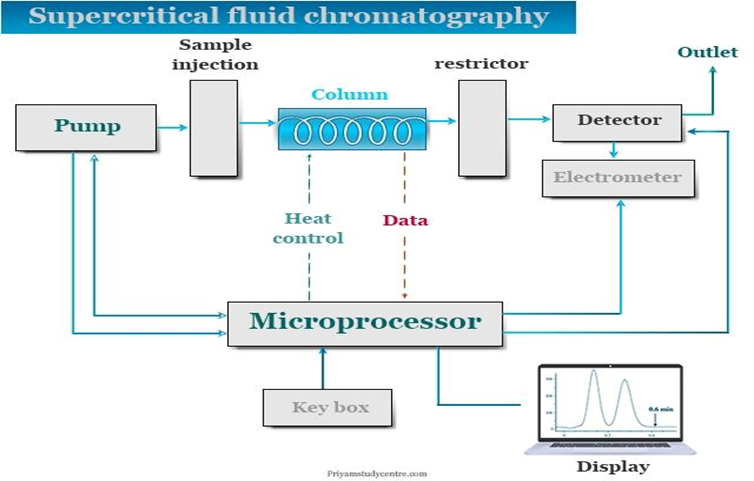
10) Supercritical Fluid Chromatography: Supercritical fluid extraction and Supercritical fluid chromatography are techniques which use supercritical fluids as solvent for both extraction and separation respectively.The properties such as density, viscosity and diffusion constant of the supercritical fluids are intermediate between those of a substance in gaseous and liquid state.This helps in efficient extraction and chromatographic separation compared to other techniques.
REFERENCES



Swati Pachore, Anushka shinde, Sandip laware, A Review On Chromatographic Separation Techniques, Int. J. of Pharm. Sci., 2024, Vol 2, Issue 10, 758-766. https://doi.org/10.5281/zenodo.13935296
 10.5281/zenodo.13935296