

We use cookies to ensure our website works properly and to personalise your experience. Cookies policy
1,2,4,5 Faculty of Pharmacy, Uttar Pradesh University of Medical Sciences, Saifai, Etawah, Uttar Pradesh, India
3 Ch. Sughar Singh Pharmacy College Jaswantnagr, Etawah, Uttar Pradesh, India 206130
6 Department of Pharmaceutical Sciences, Gurukula Kangari Deemed to be University, Haridwar, Uttarakhand
7 Department of Production, Kolash Pharma, EPIP Phase-II, Baddi, Solan, Himachal Pradesh, India 173205
Ciprofloxacin is a member of the fluoroquinolone family, which has biological activity against both gram-positive and gram-negative bacteria. Given the high rate of resistance brought on by other antibiotics, the aforementioned medication is quite important. Numerous studies have been conducted to find ciprofloxacin and its metabolites because of their importance in the drug's biological activity. Liquid chromatography, gas chromatography, capillary electrophoresis, and other separation techniques were used to create, adapt, and implement analytical procedures for the drug analysis. For the Ciprofloxacin assay for quality control, biological fluids, animal tissues, and various sample types, other research used the hyphenation between liquid chromatography and mass spectrometry. In order to estimate ciprofloxacin and its combination of drugs, this review discusses various analytical techniques such as UV spectrophotometry, chromatographic techniques such as High Performance Liquid Chromatography (HPLC), Ultra Performance Liquid Chromatography (UPLC), High Performance Thin Layer Chromatography (HPTLC), and hyphenated techniques such as Liquid Chromatography-Mass Spectroscopy (LC-MS), Ultra Performance Liquid Chromatography-Mass Spectroscopy (UPLC-MS). This review clarifies the ideal conditions for estimating ciprofloxacin.
An antibiotic called ciprofloxacin is used to treat bacterial diseases like urinary tract infections and pneumonia. It belongs to the class of fluoroquinolones [1]. Ciprofloxacin is an empirical formula for 1-cyclopropyl-6-floro-1,4-dihydro-4-oxo-7-(1-piperazinyl)-3 quinoline carboxylic acid. Its molecular weight is 331.35 g/mol [2]. Quinolones have a potent antibacterial effect by binding to two bacterial enzymes, DNA gyrase and Topoisomerase IV. It results in the development of the Quinolone enzyme DNA complex, which then experiences conformational changes before the enzyme breaks the DNA. The drug then prevents DNA replication by preventing the damaged DNA strands from replicating. Ultimately, this destroys the bacteria's DNA and results in cell death[3]. The current study examined dosage forms and developed techniques for figuring out how much ciprofloxacin is present in active medicinal substances.
The fluoroquinolone class includes the broad-spectrum antibiotic ciprofloxacin. The most common infectious disease that the drug is effective against is urinary tract infections (Vance-Bryanetal.,1990). Ciprofloxacin is an effective treatment for both gram-positive and gram-negative bacteria because it inhibits topoisomerase IV. Ciprofloxacin is the least resistant antibiotic compared to most others (cephalosporins, aminoglycosides, and penicillin) (Navarro etal.,2002).Four active metabolites are produced by the medication's partial liver metabolism: des-ethylene ciprofloxacin, oxo-ciprofloxacin, sulfo-ciprofloxacin, and N-acetyl ciprofloxacin. The primary urine metabolite is oxo-Ciprofloxacin, while the fecal metabolite is sulfo-Ciprofloxacin (Vance-Bryan et al., 1990). In the urine, all four metabolites and a significant amount of the drug are removed unchanged. Because ciprofloxacin and its metabolites have substantial biological activity, several studies have employed a range of analytical techniques due to the significance and pressing need for such a drug (Vance-Bryan et al., 1990). For the purposes of quality control testing and process optimization, ciprofloxacin has been examined utilizing a range of techniques in pharmaceutical dosage forms. Other techniques have been developed for the analysis of pharmaceuticals and their metabolites in biological fluids, including serum, plasma, urine, and saliva. However, sample pre-treatment and method improvement are necessary due to the complexity and endogenous components of biological fluids (Esha et al., 2018, Vance-Bryant et al., 1990).
MECHANISMS OF ACTION
Ciprofloxacin is a bactericidal antibiotic in the fluoroquinolone drug class. It stops DNA-gyrase and bacterial DNA topoisomerase from reproducing DNA. The most potent member of the fluoroquinolone class against gram-negative bacilli bacteria, especially those from the Enterobacteriaceae family, which includes Salmonella, Shigella, Escherichia coli, and Neisseria, is ciprofloxacin. Ciprofloxacin is also an effective treatment for some gram-positive bacteria. Ciprofloxacin is the most effective quinolone against Pseudomonas aeruginosa.18 There have been reports of a progressive decline in susceptibility in North America, South America, and Europe, primarily in hospital or nursing care settings with established risk factors. Ciprofloxacin is one of the few drugs that can be taken orally to treat P. aeruginosa [19].
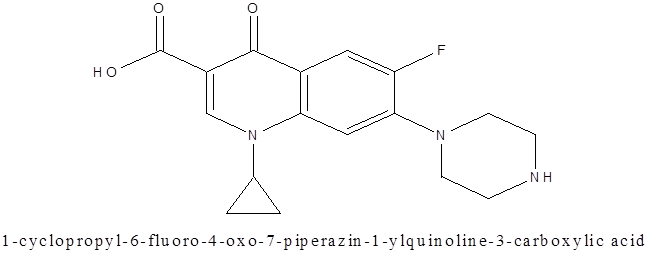
Ciprofloxacin
METHODS FOR ESTIMATIONS
The fluoroquinolone drug ciprofloxacin is frequently used to treat bacterial infections. Because ciprofloxacin has a quinolone chromophore and aromatic rings, it absorbs ultraviolet light strongly, which makes UV spectrophotometry a suitable, simple, and affordable method for its quantitative measurement. The quinolone nucleus of ciprofloxacin absorbs UV light as a result of π → π* and n → π* electronic transitions. According to Beer-Lambert's Law, some UV light is absorbed when it travels through a ciprofloxacin solution, and the absorbance is proportionate to the drug concentration. Ciprofloxacin tablets and modified-release formulations' in-vitro dissolving patterns are monitored using the UV method. Samples taken out at different intervals are subjected to spectrophotometric analysis. Ciprofloxacin tablets and modified-release formulations' in-vitro dissolving patterns are monitored using the UV method.
EXPERIMENTAL:
Using a Shimadzu twin beam spectrophotometer and water as the solvent to detect absorbance, the spectra of ciprofloxacin UV visible 1601 were determined.
The choice of wavelength
Selecting wavelength: A precise solution of 200 ppm ciprofloxacin in water was prepared. In the UV range of 200–400 nm, this solution was scanned. The absorbance was calculated with a wavelength maximum (λmax) of 278 nm.
Sample Preparation: The six distinct brands of ciprofloxacin—Novidat, Axcin, Cyrocin, Cycin Quinoflox, and Ciproxin—were acquired from several pharmacies located in Karachi, Pakistan. Each brand's ciprofloxacin tablets have the same batch number and are labeled as containing 500 mg of the medication. 20 tablets of each brand of ciprofloxacin should be precisely weighed and evenly crushed using a mortar and pestle. Weigh the sample powder equal to 20 mg of ciprofloxacin by estimating the average weight. Then, transfer the powder into a volumetric flask and add water to bring the volume up to 100 ml.
Preparing Dilutions and procedures:
Ciprofloxacin names such as Novidat, Axcin, Cyrocin, Cycin, Quinoflox, and Ciproxin are produced in various dilutions using conventional stock solutions. The 200 ppm standard stock solution was used to make five dilutions of each brand: 100 ppm, 50 ppm, 25 ppm, 12.5 ppm, and 6.25 ppm. Once the standard and sample solutions are ready, use a UV-VIS spectrophotometer at the wavelength of maximum absorbance (278 nm) to measure absorbance in a 1 cm cuvette. Measurements should be made of the standard solution (200 ppm in 100 ml) and several dilutions (100 ppm, 50 ppm, 25 ppm, 12.5 ppm, and 6.25 ppm in 100 ml). Determine each pill's milligram of ciprofloxacin.
Different brands of ciprofloxacin
|
Pharma |
Brand name |
Average WT of tablet g |
WT for 100ppm in 100ml |
Absorbance at 278 nm |
% As assays |
|
Sami |
Novidat |
0.7620 |
0.0152 |
0.125 |
100.00 |
|
Sandoze |
Axcin |
0.7693 |
0.015 |
0.127 |
101.60 |
|
Highnoon |
Cyrocin |
0.8666 |
0.0173 |
0.178 |
142.40 |
|
Ildong |
Cycin |
0.772 |
0.0172 |
0.124 |
99.20 |
|
Bosh |
Quinoflox |
0.7529 |
0.159 |
0.156 |
124.80 |
|
Bayer |
Ciproxin |
0.7643 |
0.0152 |
0.171 |
136.80 |
Absorbance of different brands
|
Concentration |
A |
B |
C |
D |
E |
F |
|
100 |
0.125 |
0.127 |
0.178 |
0.0156 |
0.16 |
0.171 |
|
50 |
0.0625 |
0.066 |
0.092 |
0.075 |
0.08 |
0.088 |
|
25 |
0.033 |
0.033 |
0.045 |
0.035 |
0.04 |
0.045 |
|
12.5 |
0.017 |
0.015 |
0.022 |
0.017 |
0.014 |
0.018 |
|
6.25 |
0.0080 |
0.007 |
0.001 |
0.008 |
0.007 |
0.008 |
Because of the high natural fluorescence of ciprofloxacin, many studies have been conducted. Ciprofloxacin levels in human urine samples were evaluated by Navalon et al. using a solid-phase spectrofluorometric method (Navalón et al., 2000). Tatar demonstrated a quick and accurate spectrofluorometric method for identifying fluoroquinolones, including ciprofloxacin, in pharmaceutical dosage forms (Ulu, 2009). Because of its aromatic quinolone ring structure, ciprofloxacin is a fluoroquinolone antibiotic that naturally glows. It emits fluorescence according to concentration when triggered with an adequate wavelength. This characteristic is applied to highly sensitive quantitative analysis. When ciprofloxacin absorbs UV light, electrons are stimulated from the ground singlet state (S?) to the excited singlet state. Excess energy is released during vibrational rest. Light is released as the excited electron settles down to the ground state. Excitation occurs at a shorter wavelength than emission (the Stokes shift).
METHODS AND MATERIALS
Reagents: All of the solvents were of analytical quality. Acetone, acetonitrile, ethanol, methanol, isopropanol, and chloroform are among the products.Ten drug standard samples were dissolved in methanol as needed to create a 100 µg mL-1 stock standard solution. The stock standard solution was diluted to create working standard solutions.
Apparatus: An IBM computer running FLwinlab Tm application software 4.00.02 and an FP-750 spectrofluorometer (Jasco, Germany) were used to measure fluorescence signals. A 10 mm quartz cell with an excitation and emission monochromator bandwidth of 2.5 nm and a temperature of 25.0±0.5oC was used for the measurements. A UV-Lambda 40 spectrophotometer (Perkin Elmer Instruments, USA) was used to measure the absorbance.A Jasco FT-400/600Plus series spectrometer (Germany) was used to capture the infrared spectrum.
An efficient analytical method for figuring out how much ciprofloxacin is present in biological materials and pharmaceutical formulations is capillary electrophoresis (CE). The method involves applying a high voltage electric field while ionized ciprofloxacin migrates through a fused-silica capillary that is filled with a suitable background electrolyte. To obtain a satisfactory resolution, phosphate or borate buffers with an acidic pH (2.5–4.0) are usually utilized. UV detection is frequently used for measurement at 270–280 nm. Because of its exceptional separation efficiency, quick analytical time, minimal solvent consumption, and reliable accuracy, CE is perfect for routine quality control and review studies.
Mass spectrometry (MS) is one of the most powerful tools in the analytical industry today, with many benefits in terms of sensitivity and selectivity. Ion fragmentation, which enables the interpretation of the resulting fragments, and ionization of almost any substance under examination, when the mass spectrometer has enabled the accurate determination of an atom or molecule's mass. Thus, the structural features of the targeted chemical could be found. The many ionization techniques that have been discovered have enabled the ionization of non-volatile complex compounds, including proteins and polysaccharides, hence increasing the effectiveness of the MS.
The LC-MS technology, which has unquestionably emerged as the preferred chromatography tool, was created by hyphenating the sensitivity of MS with the resolving power of liquid chromatography (LC). Liquid chromatography separates the liquid phase and turns it into gas, whereas the MS ionizes the gas phase to create ions that are sent into the MS detector for additional separation and analysis. LC-MS has surpassed a number of other techniques, such as gas chromatography mass spectrometry (GC-MS), since it is suitable for the analysis of non-volatile, thermally unstable, and large ionic compounds. The LC-MS method was modified in several studies to identify Ciprofloxacin in various matrices and dosage forms; wastewater samples were analyzed using the LC-MS method with fluorescence detection to identify several fluoroquinolones, including Ciprofloxacin at λexc 278 nm and λemi 445 nm (Nakata et al., 2005). Prior to the assay in another LC-MS method, a double step SPE technique was performed to identify the material in question (Caro et al., 2006). After a SPE stage, the structure of the targeted drug in a mixture with Enorfloxacin in chicken tissues was clarified using tandem mass spectrometry (LC-MS/MS), which provided an advantage to the analytical method (Ferrari et al., 2015).
A typical mass spectrometer consists of an ion source, a mass analyzer, a detector, and a computer for data display. While each of these components is important, the process's sensitivity and ionization efficiency are greatly influenced by the ionization technique. It is now feasible to evaluate intact materials directly and without the chromatographic separation step thanks to recent advancements in ionization technologies. This has decreased run times, sample preparation, and the carryover effect of the chromatographic system. Ester Caro et al. used a direct electrospray ionization mass spectrometry (ESI–MS) approach to measure ciprofloxacin after a two-step solid phase extraction (SPE) pretreatment. The matrix effects were significantly reduced by this pretreatment since urine samples contain a number of endogenous compounds. As a result, the technology made it possible to test ciprofloxacin directly with fewer interference, higher sensitivity, and a quicker analysis time than with conventional chromatographic techniques. When fast and accurate quantification is required for pharmacokinetic and bioanalytical studies, the method proved to be efficient, selective, and suitable. Direct ESI-MS is a useful technique for fast and precise ciprofloxacin analysis. When combined with suitable sample pretreatment, such as solid phase extraction, it produces accurate results with minimal matrix effect and rapid analysis durations, making it ideal for clinical and pharmaceutical research.
Nano-electrospray ionization mass spectrometry (nano-ESI-MS) is an advanced and extremely sensitive variation of conventional ESI-MS that operates at extremely low flow rates (in the nanoliter per minute range). This technique has grown in significance for measuring ciprofloxacin due to its better ionization efficiency, lower sample consumption, and enhanced sensitivity. Unlike traditional ESI-MS, which requires higher solvent flow and larger sample amounts, nano-ESI-MS introduces the analyte directly into the mass spectrometer through a fine capillary tip under a high electric field. Ion formation and desolvation are enhanced as a result of the creation of much smaller charged droplets. The primary ion detected for ciprofloxacin is the protonated molecular ion [M + H]? at m/z 332, verifying its identity. As mass spectrometry ionization techniques have advanced, the traditional ESI source has transformed into nano-ESI technology. Although the conventional ESI source has proven to be sensitive and efficient, Nano-ESI technology has a few more notable features. Because tiny sample amounts are needed for analysis, it is highly suitable for limited volume samples, significantly lower flow rates and higher ionization efficiency, more consistent spraying, smaller initial droplet sizes, and consequently less analyte quantity lost. One of the primary benefits of nano-ESI-MS is its ability to assess ciprofloxacin at trace concentration levels, usually in the picogram to nanogram range. As a result, it is particularly useful for bioanalytical applications like pharmacokinetic research, ambient trace analysis, and therapeutic medication monitoring. Additionally, when analyzing complex biological samples like urine or plasma, the lower flow rates reduce matrix effects and ion suppression, which are common issues with standard ESI-MS. Direct nano-ESI-MS is a powerful technique for ciprofloxacin analysis that is both rapid and very sensitive. Because of its ability to deliver rapid, accurate, and low-volume analysis, especially in biological and trace-level investigations, it is a desirable replacement for conventional LC-MS procedures.
Liquid chromatography (LC) is one of the most widely used and reliable analytical techniques for determining ciprofloxacin in pharmaceutical dosage forms, biological fluids, and environmental contaminants. Because of its superior sensitivity, selectivity, and repeatability, LC has become the method of choice in both routine quality control and research labs. In liquid chromatography for ciprofloxacin analysis, reverse-phase columns—particularly C18 silica-based stationary phases—are commonly employed. The separation is carried out using mobile phases consisting of phosphate or acetate buffer mixed with organic solvents such as acetonitrile or methanol. In order to improve peak shape and retention, the mobile phase's pH is usually maintained between 2.5 and 4. Ciprofloxacin shows notable UV absorption at 276–278 nm, making UV or fluorescence detectors the most popular detection techniques. Fluorescence detection, especially in biological materials, significantly enhances sensitivity and selectivity. Furthermore, LC has lately been used in conjunction with mass spectrometry (LC–MS/MS) to offer structural confirmation and trace-level detection. The primary advantages of LC are its excellent resolution, high precision, and compatibility with complex matrices. However, drawbacks include higher solvent consumption, longer analytical times, and higher operational expenses when compared to spectrophotometric procedures. Liquid chromatography remains the gold standard for ciprofloxacin analysis due to its remarkable precision, specificity, and versatility. Its ongoing development ensures its importance in modern pharmaceutical analysis, particularly when paired with mass spectrometry.
One of the most important and often used analytical techniques for measuring ciprofloxacin in pharmaceutical dosage forms, biological fluids, and stability studies is High-Performance Liquid Chromatography (HPLC). Because of its exceptional sensitivity, precision, and specificity, HPLC is considered the gold standard for ciprofloxacin analysis in quality control and research labs. Reverse-phase C18 columns and mobile phases consisting of phosphate buffer (pH 2.5–3.5) combined with organic solvents such as acetonitrile or methanol are commonly used to separate ciprofloxacin. Because of the acidic pH, ciprofloxacin's basic piperazine group is better maintained and has a superior peak shape. UV detectors operating at 276–278 nm are commonly utilized, however more sensitive methods employ mass spectrometric or fluorescence detectors. Ciprofloxacin assay in tablets, capsules, ophthalmic solutions, and injections; estimation in conjunction with other drugs concurrently; analysis that demonstrates stability, enabling ciprofloxacin to be separated from its breakdown products; quality control; impurity profiling; and bioanalytical research in conjunction with MS (LC–MS/MS) all require HPLC.HPLC is suitable for routine quality control because of its primary advantages, which include high resolution, repeatability, and dependability. However, it requires expensive equipment, specialized personnel, and the use of solvents, which may limit its usage in labs with low funding. HPLC is still a crucial instrument for the analysis of ciprofloxacin. Its ongoing importance in the pharmaceutical industry HPLC is still a crucial instrument for the analysis of ciprofloxacin. Its ability to generate accurate, selective, and stability-indicating data ensures its continued importance in pharmaceutical quality control and research applications. Its ability to generate accurate, selective, and stability-indicating data ensures quality control and research applications.
High-Performance Thin Layer Chromatography (HPTLC) is a rapid, economical, and efficient chromatographic technique for estimating ciprofloxacin in pharmaceutical dosage forms and biological materials. It offers a simple replacement for HPLC, especially for regular screening and quality assurance. In HPTLC study of ciprofloxacin, separation is frequently performed on silica gel 60 F254 plates using mobile phases that contain mixtures of buffer systems, ethyl acetate, methanol, ammonia, or chloroform. Ciprofloxacin spots can be detected after formation using UV light (254 or 366 nm) or densitometric scanning, often at 276–278 nm. Among the effective uses of HPTLC techniques are: Ciprofloxacin evaluation in tablets, capsules, and eye solutions
simultaneous estimation in formulas for combinations. studies of analysis and deterioration that show stability. Rapid screening and quality control. The main advantages of HPTLC are its low cost, rapid analysis time, low solvent consumption, and ability to analyze several samples simultaneously. Additionally, chromatograms can be recorded and examined visually. However, HPTLC usually shows less sensitivity and precision than HPLC and LC-MS methods. When quick, affordable, and high-throughput analysis is needed for ciprofloxacin estimate, HPTLC is a useful analytical method. It is still useful for normal formulation screening and pharmaceutical quality control, but it cannot replace HPLC for very sensitive or trace-level analysis.
Liquid chromatography–mass spectrometry (LC–MS), one of the most powerful and advanced analytical techniques, can be used to identify, quantify, and characterize ciprofloxacin in pharmaceutical, biological, and environmental materials. By combining the remarkable sensitivity and selectivity of mass spectrometry with the excellent separation efficiency of liquid chromatography, LC-MS yields incredibly accurate and reliable results. Ciprofloxacin analysis often uses reverse-phase LC with C18 columns; the mobile phases are composed of acidified aqueous buffers and organic solvents like acetonitrile or methanol. Ciprofloxacin is typically ionized using electrospray ionization (ESI) in the mass spectrometer after it has been eluted. The unique protonated molecular ion [M + H]? at m/z 332 is used for identification, while product ions obtained in MS/MS mode give structural confirmation. One of the several uses of LC-MS techniques is the determination of ciprofloxacin trace levels in tissues, urine, and plasma. Pharmacokinetic and bioequivalency investigations, stability-indicating analysis, impurity and degradation product detection, and environmental antibiotic residue monitoring. The key advantages of LC-MS over conventional LC-UV procedures are its excellent sensitivity, high specificity, and potential for structural elucidation. However, its disadvantages include costly equipment, intricate procedures, and the requirement for skilled analysts. LC-MS has become an essential tool for ciprofloxacin analysis because to its unmatched sensitivity and ability to confirm molecular structure. Pharmaceutical quality control, clinical research, and environmental safety investigations continue to use it more and more.
Ciprofloxacin is a popular second-generation fluoroquinolone antibiotic that combats both Gram-positive and Gram-negative bacteria. Skin, gastrointestinal, respiratory, and urinary tract infections are all treated with it. Due to its extensive use, accurate and sensitive analytical methods are required to ensure its therapeutic efficacy, safety, and quality. Traditional methods including UV spectrophotometry, HPLC, and microbiological assays are less sensitive and selective than modern hyphenated procedures, despite their frequent use. With the use of Ultra Performance Liquid Chromatography coupled with Mass Spectrometry (UPLC–MS), ciprofloxacin may now be rapidly, sensitively, and selectively detected in pharmaceutical formulations and biological materials.
Principle for Ciprofloxac in UPLC-MS integrates two methods:
6.1. Separation in UPLC: UPLC uses columns loaded with particles as tiny as ≤1.7 µm under high pressure to achieve rapid separation and great resolution. Ciprofloxacin is separated from excipients, impurities, and degradation products using a suitable mobile phase technique.
6.2 Detection Using Mass Spectrometry: After chromatographic separation, ciprofloxacin enters the mass spectrometer and is ionized using electrospray ionization (ESI), often in positive mode. Ciprofloxacin generates the protonated molecular ion [M+H]? at m/z 332, which is recognized and used for measurement.
7. INSTRUMENTATION
7.1 UPLC System
7.2 Mass Spectrometer
Source of ions: ESI (positive mode) Quadrupole, triple quadrupole, and Q-TOF detector mass analyzer. System of data For the analysis of ciprofloxacin, UPLC-MS is a very reliable and efficient method. It is an essential technique in modern analytical laboratories because it yields fast, accurate, and sensitive results in biological and pharmaceutical matrices. For the analysis of ciprofloxacin, UPLC-MS is a very reliable and efficient method. Because it yields fast, sensitive, and accurate results in biological and pharmaceutical matrices, it is an essential technique in modern analytical laboratories.
The microbiological test depends on ciprofloxacin preventing a susceptible bacterium from growing. When the antibiotic seeps into the culture media, a zone of inhibition is formed. There is a clear correlation between the diameter of the zone and the concentration of ciprofloxacin in the sample. The microbiological test depends on ciprofloxacin preventing a susceptible bacterium from growing. When the antibiotic seeps into the culture media, a zone of inhibition is formed. There is a clear correlation between the diameter of the zone and the concentration of ciprofloxacin in the sample. Test organisms that are very vulnerable to ciprofloxacin include Escherichia coli, Staphylococcus aureus, and Bacillus subtilis. Methods Used: The Cylinder Plate Agar Diffusion Method Sample solutions and standard ciprofloxacin are put to wells or cylinders on agar plates that have been infected with test organisms. After incubation, zones of inhibition are quantified. The reduction in turbidity caused by the inhibition of bacterial growth is assessed using the turbidimetric approach more appropriate for liquid formulations.
Procedure (Agar Diffusion Method)
Microbiological assays are still crucial for the evaluation and quality control of antibiotic formulations, such as ciprofloxacin. Unlike physicochemical approaches that just measure chemical content, microbiological assays assess the drug's biological potency by measuring its ability to inhibit the growth of sensitive bacteria. Because of their unique advantage, they are an essential auxiliary tool in pharmacological analysis. These tests are especially helpful for ensuring consistency from batch to batch, detecting activity loss during storage, and confirming the therapeutic efficiency of antibiotics. Easy to use, reasonably priced, and widely accepted in pharmacopeial standards are techniques such as agar diffusion and turbidimetric procedures. Their ability to faithfully capture the real biological response of microorganisms ensures that the drug will work as expected in clinical conditions. Even though modern chromatographic and spectrometric methods like HPLC and UPLC–MS provide greater sensitivity, accuracy, and speed, microbiological studies are still required to evaluate antibiotic efficacy. Instrumental techniques may overlook potency changes or inactive degradation products that do not significantly alter the chemical structure. In contrast, microbiological testing immediately assesses the antibiotic's functional efficiency, which is crucial for patient safety.
However, microbiological methods are time-consuming, less accurate, and affected by temperature, pH, and the diversity of microbial strains. Despite these disadvantages, continuous improvements in automation, data analysis, and assay standardization are improving test accuracy and reproducibility. In conclusion, microbiological testing is still an essential component of antibiotic quality assurance. They provide a comprehensive evaluation of the chemical makeup and biological activity of ciprofloxacin when paired with state-of-the-art analytical techniques, ensuring the manufacture of pharmaceuticals that are safe, effective, and of the greatest quality.
Summary Table
|
Methods |
Sensitivity |
Selectivity |
Cost |
Application |
|
UV |
Low |
Low |
Low |
Routine QC |
|
HPLC |
Moderate |
High |
Moderate |
Assays and stability |
|
HPTLC |
Moderate |
Moderate |
Low |
Screening |
|
LC-MS |
High |
Very high |
High |
Impurity analysis |
|
UPLC-MS |
Very high |
Very high |
Very high |
Trace and bioanalysis |
|
Microbiological Assays |
Moderate |
Moderate |
Low |
Potency testing |
CONCLUSION
To ensure the quality, safety, and therapeutic efficacy of pharmaceutical dosage forms of ciprofloxacin, precise analysis is necessary. Over time, a variety of analytical techniques have been developed to determine it, including UV-visible spectrophotometry, fluorimetry, HPLC, HPTLC, capillary electrophoresis, microbiological assays, and complex hyphenated techniques like LC-MS and UPLC-MS. Simple spectrophotometric methods are suitable for routine quality control, chromatographic techniques provide greater precision and selectivity, and microbiological testing confirms the drug's biological efficacy. The most advanced approaches for ciprofloxacin analysis are hyphenated methods such as UPLC-MS and LC-MS. They offer superior sensitivity, rapid analysis, high resolution, and the ability to detect pollutants and degradation products at trace levels. These approaches are particularly helpful for stability research, bioanalysis, and pharmacokinetic applications in circumstances when conventional methods might not be effective.
Because of its ease of use, speed, and affordability, UV-visible spectrophotometry is still the most often used technique in routine analysis. However, its use in complicated formulations is limited by its poor selectivity and vulnerability to excipient influence.
The most popular and dependable method for estimating ciprofloxacin is High Performance Liquid Chromatography (HPLC). Because of its excellent specificity, accuracy, and precision, it can be used for impurity profiling, stability investigations, and assays. HPLC techniques are advised for ciprofloxacin analysis by official pharmacopeias like the USP, BP, and IP, underscoring its regulatory significance. Additional benefits of HPTLC and UPLC techniques include less solvent use, quicker analysis times, and large sample throughput.
For trace-level analysis and degradation product identification, advanced hyphenated techniques such as LC–MS/MS have become increasingly popular, especially in research and bioanalytical studies. Despite the fact that these techniques offer higher sensitivity and structural information, their frequent industrial application is limited by their high cost and requirement for expert operators. By assessing the biological potency of ciprofloxacin, which cannot be determined solely by chemical means, microbiological assays continue to perform a supportive function.
Prospective Views: It is anticipated that future advancements in ciprofloxacin analysis will concentrate on automation, miniaturized methods, and green analytical chemistry. Faster, more cost-effective, and environmentally friendly analytical techniques may result from the use of UPLC, microfluidic devices, chemometric-assisted spectroscopic techniques, and electrochemical sensors. Furthermore, combining multivariate data analysis and artificial intelligence with traditional techniques may enhance impurity profiling, stability prediction, and procedure optimization. These developments will meet strict regulatory and environmental criteria while improving analytical efficiency.
REFERENCES







Pankaj Yadav, Divyanshu Verma, Pradeep Kumar, Devesh Kumar, Preeti Yadav, Madhav, Prashant, A Review on Estimation of Ciprofloxacin in Pharmaceuticals Dosage Form, Int. J. of Pharm. Sci., 2026, Vol 4, Issue 2, 1274-1286. https://doi.org/10.5281/zenodo.18537923
 10.5281/zenodo.18537923