

We use cookies to ensure our website works properly and to personalise your experience. Cookies policy
PRES Institute of Pharmacy Loni (KD).
Azadirachta indica, commonly known as neem, is a well-known medicinal plant extensively used in traditional medicine systems like Ayurveda and Unani for its diverse therapeutic properties. Among its many applications, neem has gained significant attention for its effectiveness in treating various skin disorders due to its antibacterial, antifungal, anti-inflammatory, antioxidant, and wound-healing activities. "Neem has shown effectiveness in treating various dermatological issues such as acne, eczema, psoriasis, fungal skin infections, and ulcers." "Numerous laboratory and animal studies have confirmed the antimicrobial and wound-healing potential of neem" while topical formulations such as neem oil, creams, and extracts have shown clinical efficacy in dermatological applications. This review highlights the phytochemistry, mechanisms of action, therapeutic benefits, and safety profile of Azadirachta indica in managing skin diseases, emphasizing its potential as a natural alternative or adjunct in modern dermatological therapy.
"As the body's largest organ, the skin serves as a vital barrier, shielding against environmental damage, microbial invasion, and physical trauma. Skin disorders such as acne, eczema, psoriasis, fungal infections, and wounds are highly prevalent and can significantly impact quality of life. While conventional treatments like corticosteroids, antibiotics, and antifungals are commonly used, they often come with side effects such as skin thinning, resistance, or irritation, leading to growing interest in alternative therapies derived from natural sources. Azadirachta indica, commonly known as neem, is a well-known medicinal plant in traditional systems of medicine such as Ayurveda, Siddha, and Unani. Indigenous to the Indian subcontinent, neem has been revered for centuries for its wide spectrum of therapeutic properties, particularly in the treatment of skin ailments. Almost every part of the neem tree—including its leaves, bark, seeds, oil, and flowers—has been used in herbal remedies for their antimicrobial, anti-inflammatory, antioxidant, and wound-healing activities. Modern pharmacological studies have validated many of these traditional uses, showing that neem exhibits potent effects against various bacterial and fungal pathogens, supports skin regeneration, and reduces oxidative stress and inflammation in damaged skin. Neem-based formulations such as oils, creams, soaps, and extracts are increasingly being incorporated into dermatological products and cosmeceuticals. This review aims to explore the botanical profile, phytochemistry, and scientific evidence supporting the use of Azadirachta indica in managing skin disorders, highlighting its mechanisms of action and therapeutic potential as a natural remedy in dermatology
Scientific Name: Azadirachta indica A. Juss.
Common Name: Neem, Indian Lilac
Family: Meliaceae
Sanskrit Name: Nimba
Hindi Name: Neem
Parts Used: Leaves, bark, seeds, flowers, fruits
"Azadirachta indica is a rapidly growing, evergreen species that may attain a height of 15–20 meters and is characterized by a broad canopy filled with dense leaves.
Trunk: Straight, rough, and dark grayish-brown with fissured bark.
Leaves: Pinnately compound, alternate, with 7–17 leaflets. The leaflets are bright green, lance-shaped, and feature serrated .
Flowers: "The flowers are small, aromatic, and range in color from white to creamy white, growing in clusters within the leaf axils."
Fruit: A smooth, olive-like drupe that is green when unripe and turns yellow upon ripening. Contains a single large seed.
Seeds: Neem seeds are abundant in oil, commonly referred to as neem oil, which is utilized in both therapeutic and cosmetic product formulations.
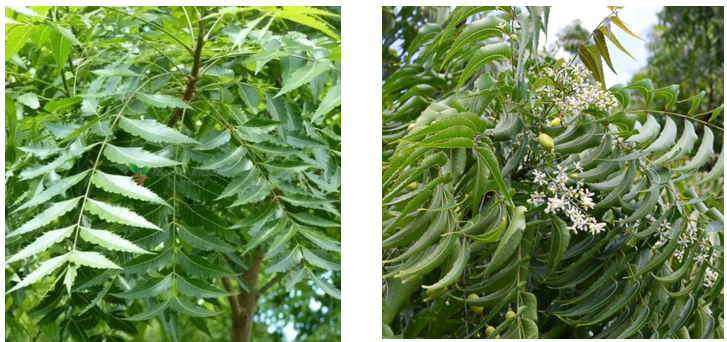
Native to the Indian subcontinent and widely distributed in India, Pakistan, Bangladesh, Sri Lanka, and tropical regions of Africa and Southeast Asia. Neem grows in a wide range of soils and can tolerate drought, high temperatures (up to 50°C), and poor soil fertility. Grown extensively due to its wide-ranging applications in medicine, farming, and industry."
Phytochemical Constituents:-
Neem is rich in a diverse array of phytochemicals such as: Triterpenoids (e.g., nimbin, nimbidin, nimbolide) Limonoids (e.g., azadirachtin) Flavonoids, Quercetin, Fatty acids in neem oil (e.g., oleic, linoleic, palmitic acid)
Azadirachta indica (Neem) has demonstrated a wide range of pharmacological activities that are particularly beneficial in the treatment of various skin disorders. These actions are primarily attributed to its rich phytochemical composition, including limonoids, triterpenoids, flavonoids, and polyphenols. Below are the key pharmacological effects relevant to dermatological applications:
Neem demonstrates strong antibacterial action, effectively targeting numerous pathogens responsible for skin infections." Active against Staphylococcus aureus, Streptococcus pyogenes, and Propionibacterium acnes—major causative agents of acne, boils, and other skin infections. Neem leaf and bark extracts, as well as neem oil, have been shown to inhibit bacterial growth and biofilm formation.
Application: Useful in treating acne, folliculitis, cellulitis, and infected wounds.
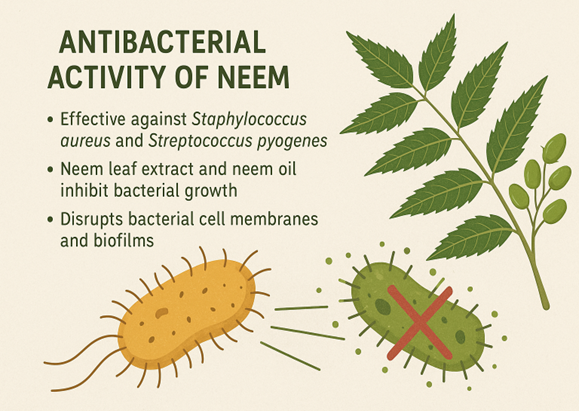
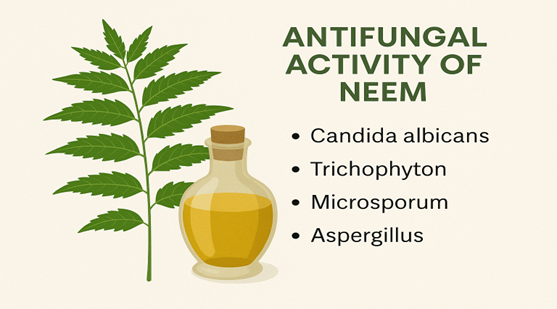
Neem possesses broad-spectrum antifungal properties: Effective against Candida albicans, Trichophyton, Epidermophyton, and Microsporum species. Neem extracts interfere with fungal cell membranes and inhibit fungal proliferation.
Application: Used for fungal infections such as ringworm, athlete’s foot, onychomycosis,and cutaneous candidiasis.
3. Anti-inflammatory Effects
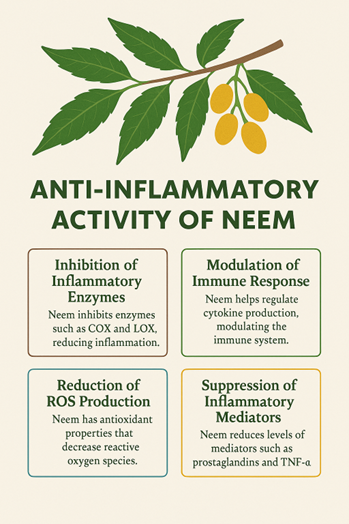
Neem compounds like nimbidin, quercetin, and nimbolide modulate inflammatory pathways: Suppress the production of pro-inflammatory . It suppresses the activity of cyclooxygenase (COX) and lipoxygenase (LOX) enzymes, thereby alleviating inflammation and associated discomfort."
Application: Beneficial in eczema, psoriasis, allergic dermatitis, and inflammatory acne.
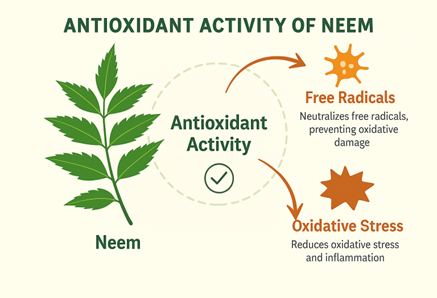
Antioxidant Activity
Neem is rich in antioxidants that neutralize free radicals: Compounds like flavonoids, polyphenols, and vitamin E scavenge reactive oxygen species (ROS). It Protect skin cells from oxidative damage and photoaging.
Application: Prevents premature aging, hyperpigmentation, and supports skin repair.
Neem promotes the natural wound healing process: Enhances collagen synthesis, fibroblast proliferation, and angiogenesis. Accelerates re-epithelialization and contraction of wounds. Helps lower microbial presence in wounds and ulcers.
Application: Effective in managing chronic wounds, diabetic foot ulcers, burns, and minor cuts."
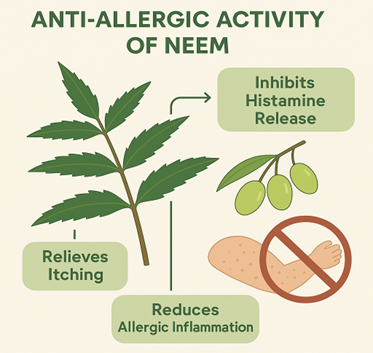
Neem helps alleviate itching and allergic skin reactions: Inhibits histamine release and mast cell degranulation.
"Application: Beneficial in treating eczema, allergic dermatitis, insect stings, and itchy scalp conditions.
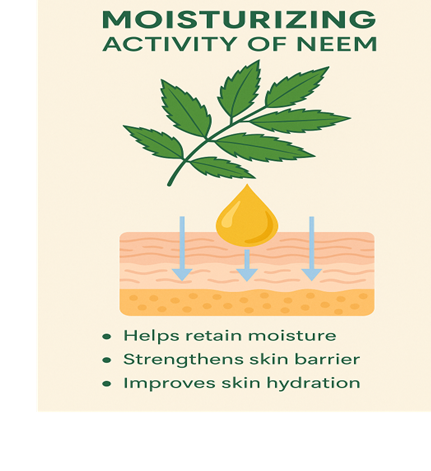
"Neem oil contains essential fatty acids such as oleic and linoleic acid, which support skin hydration and help preserve the integrity of the skin barrier."
Application: Used in dry skin conditions, eczema, and psoriatic plaques.
Azadirachta indica (Neem) stands out as a highly valuable medicinal plant with a long history of use in traditional systems of medicine, particularly for treating a wide range of skin diseases. Its rich phytochemical composition—including limonoids, triterpenoids, flavonoids, and polyphenols—contributes to a broad spectrum of pharmacological actions such as antimicrobial, anti-inflammatory, antioxidant, wound-healing, and moisturizing effects. These properties make n an effective and versatile remedy for dermatological conditions such as acne.
REFERENCES





Komal Dhatrak*, Diksha Lokhande, Prajwal Gosavi, Mechanisms of Drug Resistance in Cancer Therapy, Int. J. of Pharm. Sci., 2025, Vol 3, Issue 12, 264-270 https://doi.org/10.5281/zenodo.17786833
 10.5281/zenodo.17786833