

We use cookies to ensure our website works properly and to personalise your experience. Cookies policy
D Y Patil Agriculture and Technical Campus University, Kolhapur
This report provides a comprehensive analysis of Amoxicillin–Clavulanate in India, focusing on its market trends, regulatory environment, supply chain, branding strategies, and public health implications. Amoxicillin, a widely used ?-lactam antibiotic, combined with Clavulanic acid—a ?-lactamase inhibitor—has become one of the most prescribed antibiotics globally due to its broad-spectrum effectiveness and inclusion in the World Health Organization’s Essential Medicines List. The study examines the global and Indian markets, highlighting that India holds a dominant position in the production and export of Amoxicillin formulations, supported by its strong generic pharmaceutical industry. It also explores the supply chain structure, from API production to packaging and distribution, noting key lessons learned from the COVID-19 pandemic, which exposed vulnerabilities in global pharmaceutical logistics. Further, the report discusses marketing and branding strategies such as the success of GSK’s Augmentin, differentiation through fixed-dose combinations, development of pediatric formulations, and CSR programs aimed at improving access in low-income regions. The regulatory environment—guided by FDA, EMA, and CDSCO standards—is reviewed, emphasizing quality, pharmacovigilance, and price control policies such as India’s DPCO. Economic factors like price competition, tender-based procurement, and insurance reimbursement systems are analyzed, alongside key challenges including antimicrobial resistance (AMR), counterfeit drugs, and rising API costs. The report also identifies opportunities for innovation through new formulations, rural market expansion, and digital health integration. Overall, this study underscores the need for balancing affordability, accessibility, and antibiotic stewardship to ensure the sustainable future of Amoxicillin in both public health and the global pharmaceutical market.
Amoxicillin with clavulanic acid, usually called amoxicillin-clavulanate, is one of the most commonly prescribed antibiotics in India. It is a combination medicine that belongs to the penicillin group of antibiotics and is widely used for treating everyday infections. Because of its effectiveness, the drug is also included in the World Health Organization’s list of essential medicines.
The medicine has two parts. Amoxicillin is the main antibiotic that kills bacteria by breaking down their cell walls. But some bacteria are smart enough to produce special enzymes called β-lactamases, which can block the effect of amoxicillin. To solve this problem, clavulanic acid is added. This second ingredient does not kill bacteria directly but protects amoxicillin from being destroyed by those enzymes. Together, they make a stronger and more reliable treatment.
Doctors in India prescribe amoxicillin-clavulanate for many different infections. It is very common for respiratory infections like pneumonia, sinus infections, bronchitis, and throat infections. It is also used for urinary tract infections (UTIs), dental infections, skin and soft tissue infections, and even bone and joint infections. For children, doctors often use it as a syrup, while adults usually take it in tablet form. In serious cases, it is also given as an injection in hospitals.
In the Indian market, the medicine is available in many forms:
Apart from being a life-saving drug, amoxicillin-clavulanate is also a market leader in the Indian pharmaceutical industry. The best-known brand is Augmentin, manufactured by GlaxoSmithKline (GSK) India. Augmentin has consistently been the highest-selling medicine in the country, with sales of about ?75–80 crore every month.
Many Indian pharma companies also make their own versions (generics) under different names. Some popular ones are Clavam (Sun Pharma), Moxikind-CV (Abbott), Megamox-CV (Cipla), Moxclav (Mankind Pharma), and R-Clav (Dr. Reddy’s). Because of this wide competition, the medicine is easily available in almost every pharmacy across India.
While the medicine is very effective, its heavy use has created some problems. In India, antibiotic resistance is becoming a big public health concern. Many people use antibiotics when they don’t actually need them, like for viral infections such as colds and flu. Sometimes, antibiotics are even bought without a doctor’s prescription. Overuse like this makes bacteria resistant, which means that medicines like amoxicillin-clavulanate may not work as well in the future. To prevent this, the government and doctors are promoting rational use of antibiotics and running awareness programs.
HISTORY:
Global History:
The development of Amoxicillin and its combination with Clavulanic acid marked an important milestone in the evolution of modern antibiotics.
1972 (UK): Amoxicillin, a semisynthetic penicillin, was first introduced by Beecham Research Laboratories. It quickly gained recognition for its broad-spectrum antibacterial activity and improved absorption compared to earlier penicillins.
1976 (UK): Scientists at Beecham discovered Clavulanic acid, a naturally occurring β- lactamase inhibitor derived from Streptomyces clavuligerus. This discovery was crucial because it helped overcome bacterial resistance to penicillin-type antibiotics.
1981 (UK): The fixed-dose combination of Amoxicillin + Clavulanic Acid was launched under the brand name Augmentin by Beecham, which later became part of GlaxoSmithKline (GSK). This formulation was a medical breakthrough, as it restored the effectiveness of penicillins against resistant bacteria and became one of the most prescribed antibiotics worldwide.
In India:
During the 1980s, Augmentin was introduced in the Indian market by Glaxo India (now GSK India). It rapidly gained popularity due to its superior effectiveness compared to plain Amoxicillin, particularly in treating common respiratory and ENT infections.
Over time, Augmentin became one of the most trusted and widely prescribed antibiotics in India. Its success also inspired several Indian pharmaceutical companies to develop affordable generic versions, making Amoxicillin–Clavulanate accessible to a much larger population across the country.
OBJECTIVES:
NEEDS:
MARKET OVERVIEW:
Global amoxicillin drugs market is estimated to be valued at US$ 4.48 billion in 2024 and is projected to expand at a CAGR of 4% to reach US$ 6.64 billion by 2034. Amoxicillin is one of the most prescribed antibiotics, making up 18.26% of prescriptions in 2023, including 49 million in the U.S. Rising respiratory infections like RSV, flu, and COVID-19, especially in children, are driving demand. China (40%) and India (25%) lead production, while U.S. shortages are fueling East Asia’s growth. Advances include amoxicillin–clavulanate and combinations with beta-lactamase inhibitors to fight resistance, though allergy risks and rising antibiotic resistance remain challenges.
In terms of demand, the numbers are striking. According to the U.S. National Institutes of Health (NIH), over 23 million prescriptions for amoxicillin-based treatments are filled in the United States every year, highlighting the significant global reliance on this therapy.
|
Report Attribute |
Detail |
|
Amoxicillin Drug Market Size (2024E) |
US$ 4.48 Billion |
|
Forecasted Market Value (2034F) |
US$ 6.64 Billion |
|
Global Market Growth Rate (2024 to 2034) |
4% CAGR |
|
East Asia Market Value (2034F) |
US$ 1.27 Billion |
|
North America Market Growth Rate (2034F) |
3.9% |
|
Oral Segment Value (2034F) |
US$ 5.29 Billion |
|
Japan Market Value (2034F) |
US$ 298.48 Million |
|
Key Companies Profiled |
GSK, Pfizer, Sandoz, Health Biotech, Guangzhou Baiyunshan Pharmaceutical, Lunan Pharmaceutical Group, China National Pharmaceutical Group Corp, North China Pharmaceutical Group, Bright Future Pharmaceutical Laboratories, United Laboratories Internat, Simcere Pharmaceutical |
In India:
The Indian amoxicillin market was valued at approximately USD 214 million in 2024 and is expected to expand to nearly USD 257 million by 2030, reflecting a steady CAGR of around 3.2%. Growth is driven by the high burden of bacterial infections, increasing healthcare access in both rural and urban regions, and the widespread availability of affordable generics.
Among formulations, oral tablets dominate the market due to their cost-effectiveness, patient compliance, and easier distribution compared to injections or capsules. The demand is further supported by government healthcare initiatives and rising antibiotic consumption across India’s expanding population.
Despite this growth, challenges such as antimicrobial resistance, regulatory scrutiny, and the need for rational antibiotic use remain important considerations shaping the future of the Indian amoxicillin market.
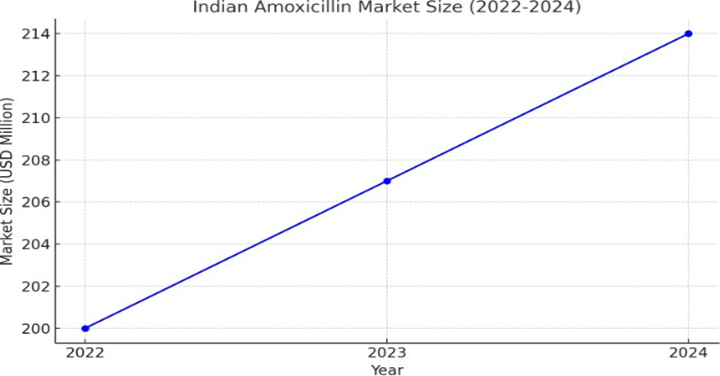
Here’s a clear chart showing the Indian Amoxicillin Market size from 2022 to 2024.
SUPPLY CHAIN AND PRODUCTION:
The manufacturing process of Amoxicillin begins with the synthesis of its Active Pharmaceutical Ingredient (API), which is derived from 6-aminopenicillanic acid (6-APA) — a penicillin derivative. This involves a series of precise chemical reactions to produce the active compound required for therapeutic use.
Major API production hubs are located in India and China, which supply much of the world’s pharmaceutical industry. However, this dependence on a few countries makes the global supply chain vulnerable to geopolitical tensions, trade restrictions, and transportation delays.
After API production, the material is sent to pharmaceutical facilities where it is formulated into various dosage forms, such as tablets, capsules, syrups, and oral suspensions. The process involves careful blending with excipients, granulation, compression, coating, and multiple rounds of quality testing.
For instance, in the United States, companies like USAntibiotics have developed facilities capable of meeting national demand, producing both solid and liquid forms of Amoxicillin. Maintaining strict Good Manufacturing Practices (GMP) is essential to ensure the safety and consistency of the final product.
Once manufactured, Amoxicillin products are packaged, labeled, and distributed under strict regulatory standards. The distribution network includes wholesalers, pharmacies, hospitals, and healthcare providers, ensuring that medicines reach both urban and rural areas.
Large distributors such as McKesson and retail chains like Walmart play important roles in ensuring timely access to essential antibiotics. Efficient logistics are vital to prevent shortages, particularly during public health emergencies.
The availability of Amoxicillin directly affects patient care. During the COVID-19 pandemic, shortages of key medicines led to delays in treatment for various infections. Rural and remote regions were most affected due to slower distribution systems. On the other hand, the rise of telemedicine and online prescriptions improved accessibility in many areas, changing how patients obtained medications.
The pandemic exposed significant weaknesses in the global pharmaceutical supply chain but also provided key lessons for building resilience:
MARKETING & BRANDING STRATEGIES:
Effective marketing and branding are essential in the pharmaceutical industry, especially for widely used drugs like Amoxicillin and its combinations. In a market dominated by generics, companies must focus on differentiation, accessibility, and trust to maintain a strong position.
In emerging markets, branded generics play an important role in balancing affordability and quality. By creating recognizable brand names, pharmaceutical companies can build trust among doctors and patients while competing with unbranded generics. Positioning these products as reliable, safe, and accessible helps companies strengthen their brand image and increase market share in cost-sensitive regions.
Combining two or more drugs into a single formulation—such as Amoxicillin + Clavulanate— offers both medical and commercial benefits. These fixed-dose combinations improve treatment outcomes, reduce antibiotic resistance, and increase patient convenience. From a branding perspective, they also allow companies to differentiate their products and maintain a competitive edge in a saturated market.
Developing child-friendly formulations such as syrups, chewable tablets, and dispersible tablets helps expand the market to pediatric patients. These formulations improve medication adherence and make treatment easier for children. Promoting these variants as safe, effective, and easy to use enables companies to tap into new patient segments and strengthen their overall brand presence.
Corporate Social Responsibility (CSR) and access initiatives aim to make essential medicines more available in low-income and underserved regions. Programs such as medicine donation drives, tiered pricing, and partnerships with public health agencies enhance both public goodwill and global health outcomes. These initiatives not only support social responsibility but also improve brand reputation and long-term trust among stakeholders.
REGULATORY ENVIRONMENT:
The pharmaceutical industry operates under strict regulations to ensure that all medicines are safe, effective, and of consistent quality. Regulatory authorities across different regions set guidelines for drug approval, monitoring, and pricing, which directly influence how companies develop and market their products.
Regulatory agencies such as the U.S. Food and Drug Administration (FDA), the European Medicines Agency (EMA), and India’s Central Drugs Standard Control Organization (CDSCO) have established clear standards for the approval of generic drugs.
Generic formulations must demonstrate bioequivalence to the original (branded) drug — meaning they deliver the same active ingredient at the same rate and extent in the body. Manufacturers must also follow Good Manufacturing Practices (GMP) to ensure product quality, consistency, and safety at every stage of production.
After approval, companies are required to continuously monitor the safety of their products through pharmacovigilance systems. This includes tracking, recording, and reporting any adverse drug reactions (ADRs) or unexpected side effects to the regulatory authorities.
Effective pharmacovigilance protects public health, ensures early detection of potential risks, and strengthens public trust in medicines and the companies that produce them.
Growing concern over antimicrobial resistance (AMR) has led to global and national policies promoting antimicrobial stewardship. These policies encourage the responsible use of antibiotics, restrict over-the-counter sales, and provide guidelines for appropriate prescribing.
Such initiatives directly affect market dynamics and prescribing trends for antibiotics like Amoxicillin, pushing companies to align their strategies with responsible use principles.
In countries like India, price control mechanisms help maintain the affordability of essential medicines. The Drug Price Control Order (DPCO), implemented by the National Pharmaceutical Pricing Authority (NPPA), sets maximum retail prices for various drugs, including antibiotics.
While this ensures that medicines remain accessible to the public, it also limits profit margins for manufacturers. Companies must therefore focus on efficiency, volume sales, and value- based innovation to stay competitive within regulated pricing structures.
CASE STUDIES:
Real-world examples help illustrate how effective branding, manufacturing strategies, and public health initiatives have shaped the success and accessibility of Amoxicillin and its combinations across global markets.
GlaxoSmithKline (GSK) successfully positioned Augmentin—a combination of Amoxicillin and Clavulanic acid—as one of the most trusted antibiotic brands worldwide.
By emphasizing clinical reliability, consistent quality, and innovation in formulation, GSK built strong brand loyalty among doctors and patients. The company focused on scientific marketing, continuous medical education, and awareness about antibiotic resistance to strengthen its reputation. In India, Augmentin remains one of the top-selling prescription medicines, demonstrating how a branded generic can maintain market leadership through trust and quality.
India’s pharmaceutical industry plays a crucial role in the global Amoxicillin supply chain. Indian companies such as Sun Pharma, Cipla, Abbott, and Dr. Reddy’s manufacture large volumes of Amoxicillin and its combinations for both domestic and international markets.
Due to cost-effective production, strong manufacturing infrastructure, and regulatory compliance with global standards (like US FDA and EMA), India has become a key exporter of affordable antibiotics to low- and middle-income countries. This dominance supports global health access while strengthening India’s position as the “pharmacy of the world.”
Global health organizations such as the World Health Organization (WHO) and Gavi, the Vaccine Alliance have implemented programs to improve access to essential antibiotics for childhood infections like pneumonia.
Through collaborations with governments and pharmaceutical companies, these initiatives ensure the availability of Amoxicillin dispersible tablets and pediatric formulations in low- income countries. These programs have significantly reduced child mortality rates by improving access to affordable, high-quality antibiotics, thereby driving steady demand for Amoxicillin globally.
CONCLUSION:
Amoxicillin–Clavulanate remains one of the most important and widely used antibiotics in global healthcare, playing a vital role in the treatment of bacterial infections. Its effectiveness, affordability, and availability have made it a cornerstone of modern medicine, especially in developing countries like India. However, as the market continues to expand, several challenges—including antimicrobial resistance (AMR), price control regulations, and supply chain vulnerabilities—demand strategic attention from both policymakers and the pharmaceutical industry.
India’s dominance in the production and export of Amoxicillin formulations highlights its critical contribution to global antibiotic access. At the same time, the industry must ensure quality assurance, rational drug use, and regulatory compliance to maintain trust and sustainability. The evolution of fixed-dose combinations (FDCs), pediatric formulations, and digital distribution channels presents promising opportunities for market growth and innovation.
The future success of Amoxicillin lies in balancing public health priorities with business sustainability. Strengthening antimicrobial stewardship, investing in local manufacturing, and expanding access through CSR initiatives and digital health integration will be key steps in ensuring that this essential medicine continues to save lives worldwide.
REFERENCES

Sairaj Patil, Mitali Chougule, Shravani Gosavi, Amoxicillin-Clavulanate in India: Market Trends, Competitive Landscape, and Public Health Implications, Int. J. of Pharm. Sci., 2026, Vol 4, Issue 1, 1289-1298. https://doi.org/10.5281/zenodo.18232461
 10.5281/zenodo.18232461