

We use cookies to ensure our website works properly and to personalise your experience. Cookies policy
Holy Queen College of Pharmaceutical Sciences and Research, Puthuruthy, Thrissur-680623, Kerala, India
Ananas comosus is a perennial herbaceous plant which belongs to the Bromeliaceae family, commonly known as Pineapple, Pina, Nanas. This study investigates the phytochemical profile, antioxidant potential, and alpha-amylase inhibitory activity of the crown of Ananas comosus (pineapple). Although the fruit is widely consumed for its nutritional value and bromelain content, the crown is often discarded as agricultural waste. This research aims to evaluate its therapeutic potential using an aqueous alcoholic extract obtained via Soxhlet extraction. Phytochemical screening of the extract revealed the presence of essential bioactive secondary metabolites, including alkaloids, flavonoids, glycosides, and carbohydrates. The antioxidant capacity was assessed using the Ferric Reducing Antioxidant Power (FRAP) assay, with Ascorbic acid serving as the reference standard. The results demonstrated a significant ability of the extract to reduce ferric iron to ferrous iron, confirming its potency as a free-radical scavenger. The anti-diabetic potential was evaluated through an in-vitro alpha-amylase inhibition assay using the Dinitrosalicylic acid (DNS) method. Based on a maltose calibration curve, the extract exhibited significant alpha amylase inhibitory activity, suggesting its effectiveness in slowing carbohydrate digestion and managing postprandial glucose levels. The findings indicate that the Ananas comosus crown is a rich source of bioactive compounds with substantial antioxidant and anti-diabetic properties. These results provide a scientific basis for repurposing pineapple waste into value-added medicinal products.
Herbal medicine, also called botanical medicine or phytomedicine, refers to the use of any plant's seeds, berries, roots, leaves, bark, or flowers for medicinal purposes. Long practiced outside of conventional medicine, herbalism is becoming more mainstream as up-to-date analysis and research show their value in the treatment and prevention of disease. In the last few years there has been an exponential growth in the field of herbal medicine and these drugs are gaining popularity both in developing and developed countries because of their natural origin and less side effects.3
Ananas comosus (L.) Merr, belongs to the Bromeliaceae family, which comprises roughly 50 genera and 200 species. The pineapple, a perennial herbaceous plant, typically reaches heights and widths of 1-2 meters, resembling a spinning top in its shape. Its primary components consist of the stem, leaves, peduncle, multiple fruit, crown, shoots, and roots. The multiple fruit forms through the fusion of individual fruitlets on a single stalk, with numerous flowers arranged helically along the axis. Fresh pineapple also provides minerals such as calcium, chlorine, potassium, phosphorus, and sodium The composition of pineapple varies significantly based on factors like ripening process and cultivar type. A study assessing antioxidant activity using a B-carotene-linoleate acid antioxidant assay at a concentration of 100 ppm found pineapple to be a substantial source of antioxidants. This suggests a high phenolic content in the fruit, highlighting its antioxidant properties. Pineapple is rich in bromelain, an enzyme that aids digestion by breaking down proteins. Bromelain shows promise as an anti-inflammatory, antioxidant, anti-cancer, and heart-protective agent.4
Antioxidants are compounds that inhibit oxidation, a chemical reaction that can produce free radicals. Autoxidation leads to degradation of organic compounds, including living matter.1 Antioxidants are frequently added to industrial products, such as polymers, fuels, and lubricants, to extend their usable lifetimes. Foods are also treated with antioxidants to prevent spoilage, in particular the rancidification of oils and fats. In cells, antioxidants such as glutathione, mycothiol, or bacillithiol, and enzyme systems like superoxide dismutase, inhibit damage from oxidative stress. Dietary antioxidants are vitamins A, C, and E, but the term has also been applied to various compounds that exhibit antioxidant properties in vitro, having little evidence for antioxidant properties in vivo. Dietary supplements marketed as antioxidants have not been shown to maintain health or prevent disease in humans.6
Amylase is a type of enzyme that catalyses the breakdown of starches and other complex carbohydrates into simpler sugars such as maltose and dextrin. It plays a crucial role in the digestive process, particularly in humans, where it initiates the breakdown of carbohydrates in the mouth and continues its action in the small intestine. Amylase is produced primarily in the salivary glands (as salivary amylase or ptyalin) and the pancreas (as pancreatic amylase). Its activity is vital for the effective digestion and absorption of carbohydrates, ensuring the body can derive energy from dietary starches. Amylase is a highly versatile enzyme found not only in humans but also in animals, plants, and microorganisms. It is widely used in industrial applications such as brewing, baking, and in the production of biofuels, where it helps in breaking down starch into fermentable sugars.5
AIM
The aim of the study was to collect the Ananas comosus crown and to perform antioxidant and alpha-amylase inhibitory activity on the aqueous-alcoholic extract of dried Ananas comosus crown.
MATERIALS AND METHODS
Fresh crown of Ananas comosus collected from farm and authenticated by Junior Scientific Officer, State Medicinal Plants Board ,Kerala, Thrissur . The collected crown were dried in shade, crushed to coarse powder and used for further studies. The collected crown washed in running water to remove any organic or foreign particle if present. Dried in shade for 15 days and pulverized in mortar and pestle of the laboratory. The resultant powder was sieved to obtain a uniform particle sized crude drug.
% yield =weight of dry extractweight of plant powder×100

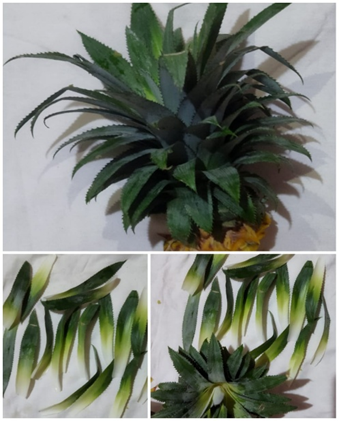
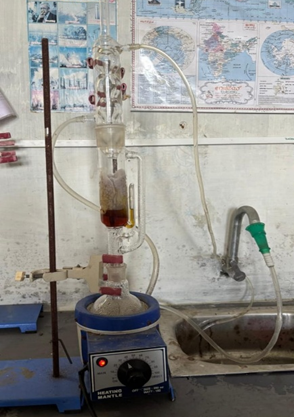
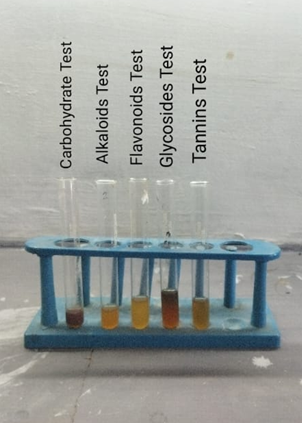
Fig no:01- Ananas comosus Crown Fig no:02- Soxhlet Extraction Fig no:03- Chemical Test
Test for Carbohydrates
Molisch’s Test: Add 2-3 drops of Molisch’s reagent to 2 ml of plant extract and Add few drops of Conc. H2SO4 slowly along the sides of the test tube. Formation of Violet ring at the junction of two phases indicates the presence of the carbohydrates.7
Test for Alkaloids
Mayer’s Test: Add 2-3 drops of Mayer’s reagent to 1 ml of plant extract and shake the test tube. Formation of yellowish white precipitate shows the presence of the alkaloids.8
Test for Flavonoids
Alkaline Reagent Test: To 1ml of plant extract add 3ml of 2% of NaOH, a deep yellow colour appears. Then add few drops of dilute HCl to it. Deep yellow colour fades showing the presence of flavonoids.9
Test for Glycosides
Legal’s Test: The extract was dissolved in pyridine and sodium nitroprusside and add few drops of 20% NaOH solution. Formation of Pink red to red colour indicates the presence of glycosides.10
Test for Tannins
Gelatin Test: Add few 2ml extract to the test tube and add few drops of 1% gelatin solution and mix. Formation of white precipitate indicates the presence of tannins.11
Ferric Reducing Power by FRAP Method
Preparation of Reagents
Method
Here, ascorbic acid was used as a reference standard, the reducing power of the samples were comparable with the reference standard.1
α-amylase inhibition by DNS method
Materials
Starch solution: Took 1 g of potato starch and dissolved in 100 ml of 0.02 M phosphate buffer (pH 7).
DNS reagent: It can be prepared by dissolve at room temperature 1 g of 3, 5- Di Nitro Salicylic Acid in 20 ml of 2N NaOH, add 50 ml of distilled water followed by 30 g of Rochelle Salt make the volume up to 100 ml with distilled water. Protect this solution from CO2 and store at 4°C.
α-amylase enzyme solution: Dissolve 6 mg of α-amylase in 200 ml of 0.2 M phosphate buffer (pH 7) containing 0.006 M NaCl. From this stock solution take 10 ml, dilute to 100 ml with same buffer solution. The final concentration of enzyme in the solution is 30 µg/ml.
Maltose standard solution: Dissolve 50 mg of maltose in 50 ml distilled water and store at 4°C. NaOH (4.5%): Weigh 4.5 g of NaOH, dissolve it in approximately 80 ml of distilled water, and make the volume up to 100 ml with distilled water.
NaOH (2N): Weigh 8 g NaOH, dissolve in approximately 80 ml distilled water, and the final volume up to 100 ml with distilled water.
Phosphate buffer (0.2 M, pH 7): Take 39 ml of 0.2 M. monobasic sodium phosphate solution and mix with 61ml of 0.2M dibasic sodium phosphate solution and dilute to a total volume of 200 ml.
Phosphate buffer (0.02 M. pH 7): Take 10 ml of the above phosphate buffer (0.2 M) and dilute it to 100 ml with distilled water.2
Preparation of Maltose Calibration Curve
Pipette aliquots of 0.1 to 1.0 ml of maltose (100-1000 µg) solution into test tubes and make up the volume to 1ml with suitable addition of distilled water. To each tube add 2 ml of DNS reagent. Cover tubes with marbles. Keep the tubes in water bath for 10 minutes. Cool the tubes and add 10 ml of distilled water to each test tube. The orange red colour formed is measured at 540 nm against a reagent blank.2
Determination of α-Amylase inhibitory activity
Pre-incubate the entire reagents for 15 minutes at 37° C in a water bath. Pipette 0.5 ml of 1% starch solution and add it to 0.25 ml of phosphate buffer (0.2M, pH 7) and 0.25 ml of α-amylase enzyme solution. Similarly, a second set of test tubes (blank) by using phosphate buffer in place of enzyme solution. Prepare a third set of test tubes containing 0.5 ml of starch solution, 2 ml of DNS reagent. 0.25 ml of α-amylase enzyme solution; this set is called the zero-time control. Incubate all the tubes at 37°C for three minutes. At the end of the incubation add 2 ml of DNS reagent to first and second set of tubes to stop the reaction and transfer all the tubes to water bath for 10 minutes. After cooling under cold water, add 10 ml of distilled water, mix thoroughly and take absorbance at 540 nm against the blank.2
Liberated reducing sugars are expressed as maltose equivalent using the calibration curve. One unit of enzyme activity is defined as that amount which liberates 1 ????mol of reducing sugars (calculated as maltose) /min from soluble starch at 37°C, pH 7, and. under the specified experimental condition.2
Preparation of extract and quantification of α-amylase inhibitory activity
Weighed 1 g of the sample and extracted it with 75 ml of distilled water and 75 ml of ethanol for 2 hours at 40°C. Centrifuged the suspension at 5000 rpm and collected the supernatant. Took 0.25 ml of the supernatant and incubated it with 0.25 ml of enzyme solution for 15 minutes at 37°C. Ensured all reagents were also incubated at 37°C for 3 minutes. After incubation, added 2 ml of DNS reagent to the first, second, and sample tubes to stop the reaction. Transferred the tubes to a water bath for 10 minutes. After cooling with cold water, added 10 ml of distilled water and mixed thoroughly. Measured the absorbance at 540 nm, using the blank as a reference.2
The released reducing sugars were expressed as maltose equivalents based on the calibration curve. One unit of enzyme activity was defined as the amount that liberated 1 µmol of reducing sugars per minute from soluble starch at 37°C and pH 7, under the specified experimental conditions.2
% Inhibition of α-Amylase
% Inhibitory activity = (A - C)/(B - C) × 100
RESULTS AND DISCUSSION
Results for Phytochemical Investigation
Table 02: Result of Phytochemical investigation
|
Sr. No |
Chemical Test |
+/- |
|
1 |
Test for Carbohydrate |
+ |
|
2 |
Test for Alkaloids |
+ |
|
3 |
Test for Flavonoids |
+ |
|
4 |
Test for Glycosides |
+ |
|
5 |
Test for Tannins |
- |
Results for Antioxidant Activity
Table 03: Result of FRAP Method
|
Sr. No |
Concentration (????g/ml) |
Absorbance (520nm) |
|
1 |
10 |
0.85 |
|
2 |
20 |
1.06 |
|
3 |
30 |
1.14 |
|
4 |
40 |
1.18 |
|
5 |
50 |
1.28 |
In this experiment, the yellow color changes to pale green color depending on the concentration of antioxidants in the samples, by comparing the reference standard Ascorbic acid (1) with plant extract is found to be greater, So the Antioxidant activity in Ananas comosus is more.
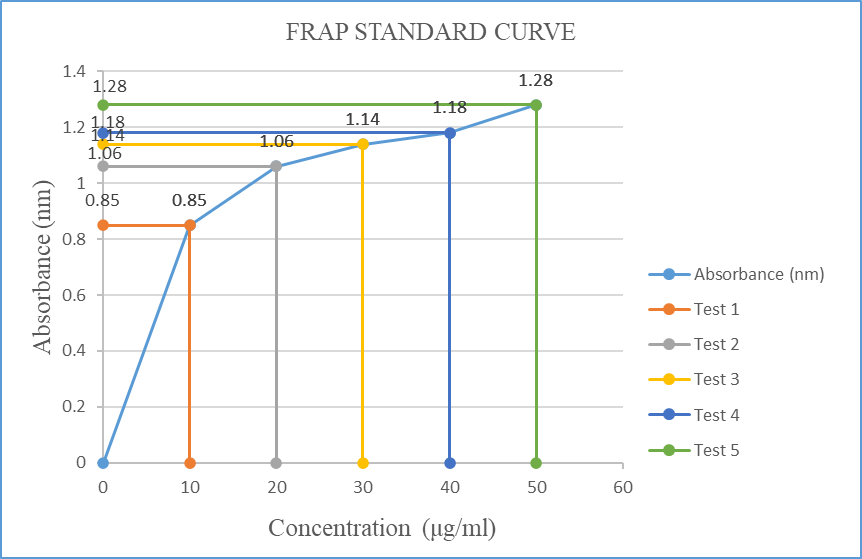
Graph 01: FRAP Standard Curve
Results for a- Amylase Inhibitory Activity
Table 04: Maltose calibration curve values
|
Concentration (μg/ml) |
Absorbance (540nm) |
|
0 |
0 |
|
0.1 |
0.23 |
|
0.2 |
0.26 |
|
0.3 |
0.30 |
|
0.4 |
0.34 |
|
0.5 |
0.40 |
|
0.6 |
0.43 |
|
0.7 |
0.50 |
|
0.8 |
0.55 |
|
0.9 |
0.61 |
|
1.0 |
0.73 |
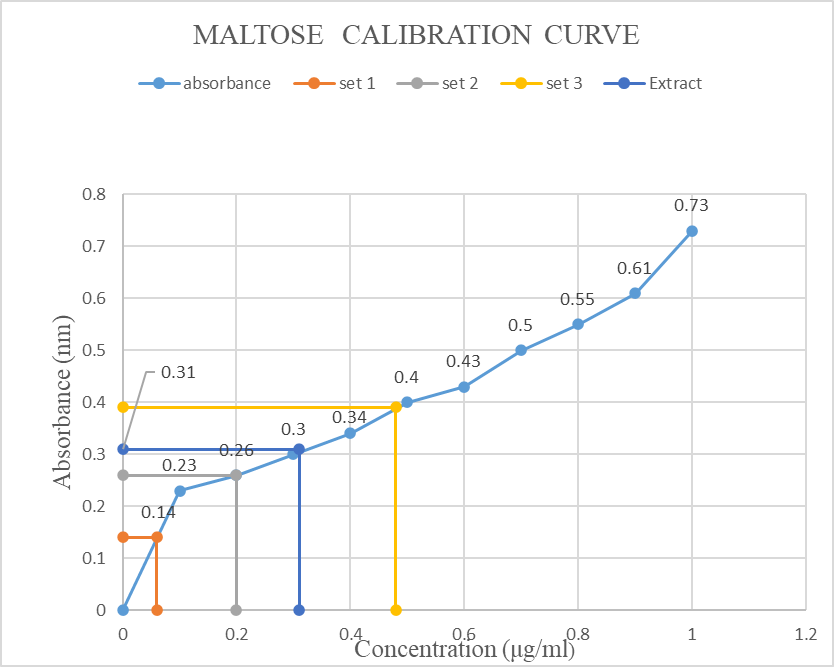
Graph 02: Maltose Calibration Curve
Table 05: Result of α- Amylase inhibitory activity detection
|
Sample |
Absorbance (540nm) |
|
Set 1 (E+S) |
0.14 |
|
Set 2 (blank) |
0.26 |
|
Set 3 (E+S+DNS) |
0.39 |
|
Extract (E+S+DNS) |
0.31 |
Where,
E = Enzyme, S = Starch, DNS = Dinitro Salicylic Acid reagent
% Inhibition of α-Amylase
% Inhibitory activity = (A - C)/(B - C) × 100
% Inhibitory activity = (0.31 – 0.39)/(0.26 – 0.39) × 100 = 61.53%
Antioxidant Activity of Ananas comosus Crown by FRAP Method
The FRAP (Ferric Reducing Antioxidant Power) method evaluates the antioxidant capacity of the Ananas comosus (pineapple) crown by measuring its ability to reduce ferric (Fe3+) to ferrous (Fe2+) ions through electron transfer, with absorbance at 520nm reflecting the sample's potency. Research confirms that pineapple crowns possess significant antioxidant activity driven by bioactive compounds like flavonoids, which utilize hydroxyl groups for radical scavenging, and the enzyme bromelain, which inhibits oxidative reactions. By donating electrons to stabilize harmful free radicals, these extracts mitigate oxidative stress, inflammation, and tissue damage, establishing the pineapple crown as a scientifically validated, valuable natural source for therapeutic and health-promoting applications.
Alpha Amylase Inhibitory Activity of Ananas comosus Crown by DNS Method
The DNS method evaluates the anti-diabetic potential of Ananas comosus (pineapple) crown extracts by measuring their ability to inhibit alpha-amylase, an enzyme responsible for breaking down complex carbohydrates into glucose. Rich in flavonoids and the enzyme bromelain, these extracts block carbohydrate digestion in the gut, effectively slowing sugar absorption and preventing postprandial glucose spikes. By repurposing agricultural waste into a natural inhibitor, the pineapple crown offers a promising therapeutic strategy for managing type 2 diabetes, obesity, and cardiovascular health.
REFERENCES


Mathew George, Lincy Joseph, Aswin K Nair, Ayisha Safna P, Christeena V R, Malavika E S, Vrindha C V, Antioxidant and Alpha-Amylase Inhibitory Activity of Ananas comosus Crown, Int. J. of Pharm. Sci., 2025, Vol 3, Issue 12, 4275-4282. https://doi.org/10.5281/zenodo.18110693
 10.5281/zenodo.18110693